REVIEW 2 major objections 2 minor 1 cited by
The Simulated Oxygen Shortage (SOS): Mapping the Missing OVI in Simulated Dwarf Galaxies to Subgrid Physics
T0 review · 2 major / 2 minor · reviewed 2026-05-19 · grok-4.3
Pith's one-line read Simulations underproduce oxygen in low-mass dwarf galaxies, leading to missing OVI in their CGM.
desk verdict The OVI shortfall traces back to oxygen underproduction in low-mass dwarfs once you compare total produced oxygen against observed masses, though the numbers rest on standard yields and CGM mass conversions. read the letter →
The pith
A machine-rendered reading of the paper's core claim, the machinery that carries it, and where it could break.
The reading
What carries the argument
Comparison of total oxygen mass from integrated star formation history and standard yield tables against observed OVI masses, plus phase-space analysis showing OVI traces cool diffuse moderately enriched gas at large radii.
What would settle it
A direct census of total oxygen mass in the CGM of observed low-mass dwarfs that matches the amount produced in simulations, or a simulation variant with adjusted yields that reproduces observed OVI columns.
Extended reading notes
Core claim
Observations reveal extended OVI reservoirs in the CGM of dwarf galaxies, yet simulations underpredict OVI column densities. Comparing observationally derived OVI masses to the mass of oxygen produced over the galaxies' star formation history shows evidence for an underproduction of oxygen for low-mass simulated galaxies. OVI in the simulations self-selects cool/warm, diffuse, and moderately metal-enriched material at large radii. Neither the choice of ultraviolet background nor plausible variations in CGM thermal structure can close the gap with observations. The results point to a possible underproduction of oxygen in low-mass galaxies, with feedback prescriptions contributing via insuff
Load-bearing premise
The total oxygen mass available is accurately given by integrating the simulation's star formation history with standard yield tables, and that observed OVI masses provide a fair benchmark without major selection or ionization corrections.
Editorial extensions
If this is right
- Feedback prescriptions must improve metal transport to large radii to match observed OVI.
- Supernova yields or star formation prescriptions may need revision for low-metallicity regimes.
- The OVI deficit cannot be fixed by changing the ultraviolet background or CGM thermal structure alone.
- Subgrid models for metal mixing and enrichment require targeted investigation in dwarf galaxy regimes.
Reading between the lines
- Future simulations could test whether stronger early feedback or altered mixing prescriptions increase oxygen at large radii while preserving other galaxy properties.
- Observational campaigns measuring total oxygen (not just OVI) in dwarf CGM would provide a cleaner test of production versus transport.
- This pattern may link to wider difficulties simulating the baryon cycle in low-mass systems and their contribution to cosmic metal enrichment.
Editorial analysis
A structured set of objections, weighed in public.
Referee Report
Summary. The paper examines the systematic underprediction of OVI column densities in simulated dwarf galaxies using the MM (Marvelous Massive Dwarfs and Marvel-ous Dwarfs) and FIRE-2 simulation suites. The authors compare observationally derived OVI masses against the total oxygen mass obtained by integrating each galaxy's star formation history with standard yield tables, concluding that low-mass systems underproduce oxygen. They characterize the OVI-bearing gas as cool/warm (log T/K ~4.5), diffuse (log n_gas/cm^{-3} ~ -5), and moderately enriched (log Z/Zsun ~ -1) at large radii, and test that neither UV background choice nor plausible CGM thermal variations close the gap with observations. The results are attributed to insufficient metal transport by feedback and motivate re-examination of supernova yields, star formation, and feedback prescriptions in low-metallicity regimes.
Significance. If the central claim is robust, the work provides a direct link between subgrid modeling choices and an observable CGM tracer in dwarfs, highlighting potential shortfalls in oxygen production or radial transport at low masses and metallicities. The use of two independent simulation codes with differing feedback implementations adds generality, and the phase-space analysis of OVI gas is a constructive contribution. The finding could motivate targeted updates to yield tables and metal-mixing schemes calibrated for log Z/Zsun ~ -1 environments.
major comments (2)
- [Section describing oxygen-mass calculation from SFH and yields] The central evidence for oxygen underproduction rests on comparing observed OVI masses to the oxygen mass integrated from the simulated star-formation histories using standard yield tables. At the relevant metallicities (log Z/Zsun ~ -1), core-collapse supernova yields are known to vary by factors of 2-3 owing to metallicity-dependent mass loss and IMF effects; this uncertainty is load-bearing because the underproduction conclusion requires that simulated oxygen production fall below even the observed OVI mass (implying an unphysical ionization fraction >1 if all oxygen were in OVI).
- [Comparison with observations and mass estimation] Conversion of observed OVI column densities to total CGM oxygen masses relies on geometric assumptions (radial extent, covering fraction, volume filling factor) whose uncertainties are not quantified. These systematics can easily shift the observational benchmark by 0.5-1 dex and therefore affect whether the simulated oxygen budget is demonstrably insufficient.
minor comments (2)
- [Abstract and §1] The abstract and main text use 'underproduction of oxygen' and 'OVI deficit' somewhat interchangeably; clarifying the distinction between total oxygen shortfall versus ionization or transport issues would improve precision.
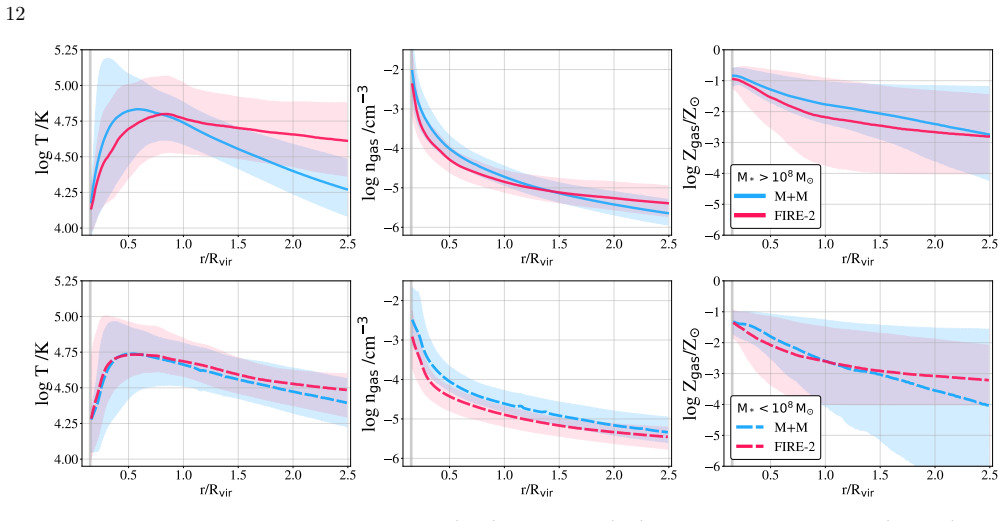
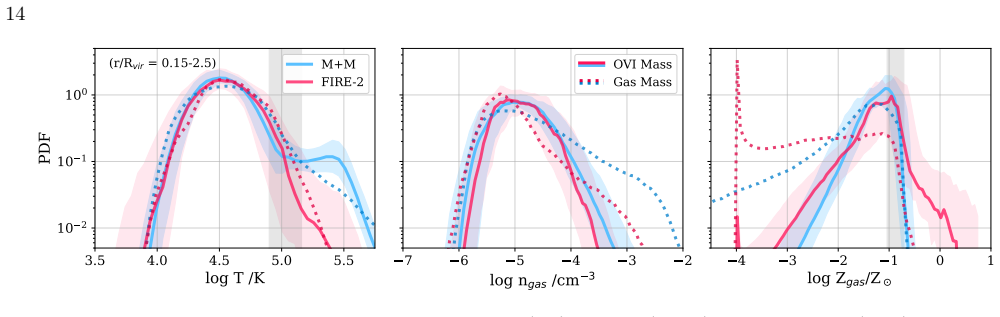
- [Figures showing CGM phase structure] Figure captions and axis labels for the phase-space diagrams of OVI gas could explicitly state the temperature and density ranges used to define the 'cool/warm' and 'diffuse' selections.
Simulated Author's Rebuttal
We thank the referee for their careful reading and constructive comments, which have helped us clarify and strengthen the presentation of our results. Below we respond point-by-point to the major comments. We have revised the manuscript to incorporate additional discussion and sensitivity tests as described.
read point-by-point responses
-
Referee: [Section describing oxygen-mass calculation from SFH and yields] The central evidence for oxygen underproduction rests on comparing observed OVI masses to the oxygen mass integrated from the simulated star-formation histories using standard yield tables. At the relevant metallicities (log Z/Zsun ~ -1), core-collapse supernova yields are known to vary by factors of 2-3 owing to metallicity-dependent mass loss and IMF effects; this uncertainty is load-bearing because the underproduction conclusion requires that simulated oxygen production fall below even the observed OVI mass (implying an unphysical ionization fraction >1 if all oxygen were in OVI).
Authors: We agree that core-collapse supernova yields at log Z/Zsun ~ -1 carry uncertainties of order 2-3 due to metallicity-dependent mass loss and IMF variations. Our original analysis adopted the standard yield tables employed by each simulation suite (Nomoto et al. for MM and the default FIRE-2 yields). In the revised manuscript we have added a dedicated paragraph and supplementary figure that recomputes the integrated oxygen mass using both the lower and upper bounds of the reported yield range at these metallicities. Even when the highest plausible yields are assumed, the total oxygen produced in the lowest-mass systems remains below the observationally inferred OVI mass, preserving the underproduction conclusion. We also note that the simulations themselves are run with fixed subgrid yields; the comparison therefore highlights a potential tension between those choices and the oxygen budget required by observations, motivating future calibration of low-Z yields. revision: yes
-
Referee: [Comparison with observations and mass estimation] Conversion of observed OVI column densities to total CGM oxygen masses relies on geometric assumptions (radial extent, covering fraction, volume filling factor) whose uncertainties are not quantified. These systematics can easily shift the observational benchmark by 0.5-1 dex and therefore affect whether the simulated oxygen budget is demonstrably insufficient.
Authors: We acknowledge that converting observed OVI columns to total CGM oxygen mass depends on geometric assumptions whose uncertainties were not fully quantified in the original submission. In the revised version we have added a new subsection and accompanying table that systematically varies the assumed radial extent (50-200 kpc), covering fraction (0.5-1.0), and volume filling factor (0.01-0.1). The resulting observational oxygen-mass estimates span ~0.7 dex. Even adopting the lowest end of this range, the simulated oxygen masses in galaxies below ~10^9 solar masses remain insufficient to explain the observed OVI reservoirs. We have updated the relevant figures and text to present these bounds explicitly, thereby demonstrating that the underproduction signal is robust within the quoted observational systematics. revision: yes
Circularity Check
No significant circularity in oxygen underproduction claim
full rationale
The paper's central claim compares the total oxygen mass—obtained by integrating each simulated galaxy's star formation history with standard external yield tables—against independently derived observed OVI masses from the literature. This comparison does not reduce by construction to any fitted parameter, self-definition, or internal ansatz within the work, as the yields are standard tables not calibrated to the target OVI result and the SFH is an output of the simulation runs. The two simulation suites (MM and FIRE-2) are described with distinct codes and feedback implementations, and no load-bearing self-citation or uniqueness theorem is invoked to force the underproduction conclusion. The derivation remains self-contained against external observational benchmarks and is directly falsifiable by changes in yields or SFH.
Assumptions & free parameters
assumptions (1)
- domain assumption Standard subgrid feedback and metal mixing prescriptions in hydrodynamical galaxy simulations are representative of real physics in low-mass systems.
Cite this review
Pith. "Pith review of The Simulated Oxygen Shortage (SOS): Mapping the Missing OVI in Simulated Dwarf Galaxies to Subgrid Physics." pith.science (2026). https://pith.science/paper/PGI5MTUG
@misc{pith2026260515275,
  author       = {Pith},
  title        = {Pith review of: The Simulated Oxygen Shortage (SOS): Mapping the Missing OVI in Simulated Dwarf Galaxies to Subgrid Physics},
  year         = {2026},
  howpublished = {\url{https://pith.science/paper/PGI5MTUG}},
  note         = {Machine review of arXiv:2605.15275}
}
abstract
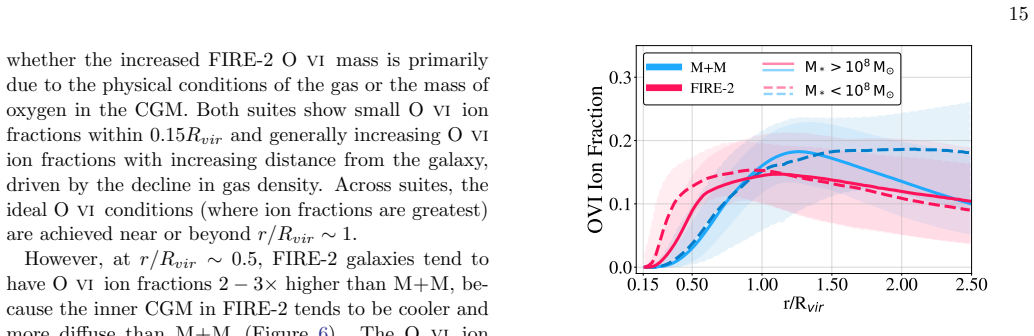
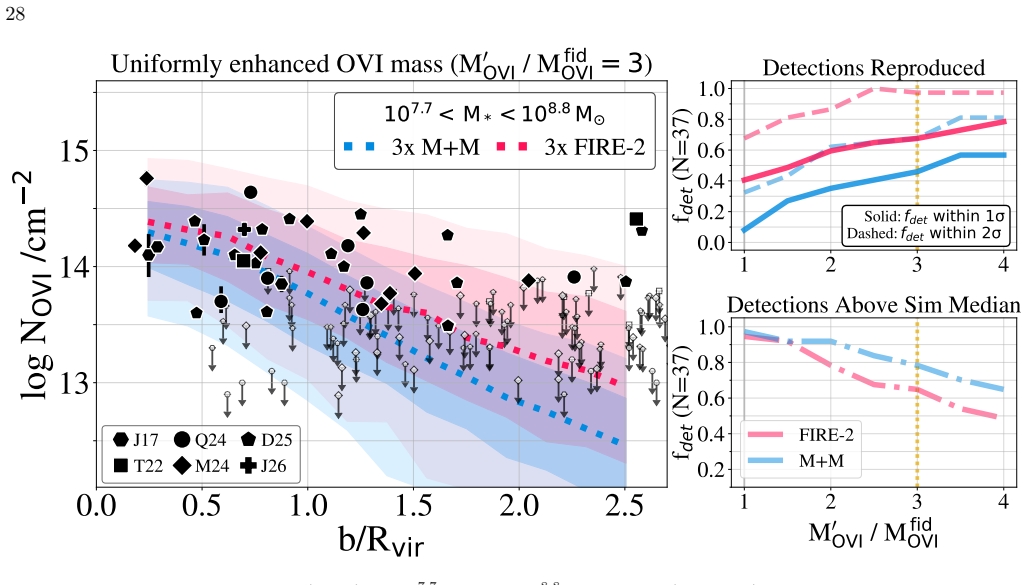
Observations reveal extended \OVI\, reservoirs in the circumgalactic medium (CGM) of dwarf galaxies, yet current simulations systematically underpredict \OVI\, column densities. Utilizing two suites run with different simulation codes, the \MM\, simulations (Marvelous Massive Dwarfs and Marvel-ous Dwarfs) and the publicly available FIRE-2 simulations, we explore the role of subgrid models and the resulting CGM phase in shaping \OVI\, production. By comparing observationally derived \OVI\, masses to the mass of oxygen produced over the galaxies' star formation history, we find evidence for an underproduction of oxygen for low-mass simulated galaxies. Despite clear differences in feedback implementation, CGM structure, and metal mixing, we find that \OVI\, in both suites generally self-selects cool/warm ($\rm log\, T\,/K \sim 4.5$), diffuse ($\rm log\,n_{gas}\,/cm^{-3} \sim -5.0 $), and moderately metal-enriched ($\rm log\, Z/Z_{\odot} \sim -1 $) material at large radii from the galaxy. We show that neither the choice of ultraviolet background nor plausible variations in CGM thermal structure can close the gap with observations. Taken together, our results point to a possible underproduction of oxygen in low-mass galaxies. Feedback prescriptions contribute via insufficient metal transport to large radii. Hence, the \OVI\, deficit may motivate an investigation of current modeling choices for supernova yields, star formation, and feedback in low-metallicity environments.
Figures


Figures from the paper (13 more)





Lean theorems connected to this paper
-
IndisputableMonolith/Foundation/RealityFromDistinction.leanreality_from_one_distinction unclear?
unclearRelation between the paper passage and the cited Recognition theorem.
By comparing observationally derived OVI masses to the mass of oxygen produced over the galaxies' star formation history, we find evidence for an underproduction of oxygen for low-mass simulated galaxies.
-
IndisputableMonolith/Cost/FunctionalEquation.leanwashburn_uniqueness_aczel unclear?
unclearRelation between the paper passage and the cited Recognition theorem.
Feedback prescriptions contribute via insufficient metal transport to large radii. Hence, the OVI deficit may motivate an investigation of current modeling choices for supernova yields, star formation, and feedback in low-metallicity environments.
What do these tags mean?
- matches
- The paper's claim is directly supported by a theorem in the formal canon.
- supports
- The theorem supports part of the paper's argument, but the paper may add assumptions or extra steps.
- extends
- The paper goes beyond the formal theorem; the theorem is a base layer rather than the whole result.
- uses
- The paper appears to rely on the theorem as machinery.
- contradicts
- The paper's claim conflicts with a theorem or certificate in the canon.
- unclear
- Pith found a possible connection, but the passage is too broad, indirect, or ambiguous to say the theorem truly supports the claim.
Forward citations
Cited by 1 Pith paper
-
The GOLIATH Survey: OVI Absorption Reveals CGM Evolution through the Starburst-to-Quiescent Transition in Massive Galaxies
At z≈0.43, massive star-forming galaxies host 3x more O VI in their inner halos than quiescent galaxies of the same stellar mass, with an O VI mass offset of ~1.5 dex, contradicting the virial-thermometer prediction.
Reference graph
Works this paper leans on
-
[1]
GIZMO: A New Class of Accurate, Mesh-Free Hydrodynamic Simulation Methods
A new class of accurate, mesh-free hydrodynamic simulation methods. , keywords =. doi:10.1093/mnras/stv195 , archivePrefix =. 1409.7395 , primaryClass =
-
[2]
The cosmological simulation code GADGET-2. , keywords =. doi:10.1111/j.1365-2966.2005.09655.x , archivePrefix =. astro-ph/0505010 , primaryClass =
-
[3]
Radiative Transfer in a Clumpy Universe. IV. New Synthesis Models of the Cosmic UV/X-Ray Background. , keywords =. doi:10.1088/0004-637X/746/2/125 , adsurl =
-
[4]
A New Calculation of the Ionizing Background Spectrum and the Effects of HeII Reionization
A New Calculation of the Ionizing Background Spectrum and the Effects of He II Reionization. , keywords =. doi:10.1088/0004-637X/703/2/1416 , archivePrefix =. 0901.4554 , primaryClass =
work page Pith review arXiv doi:10.1088/0004-637x/703/2/1416
-
[5]
On the variation of the initial mass function. , keywords =. doi:10.1046/j.1365-8711.2001.04022.x , archivePrefix =. astro-ph/0009005 , primaryClass =
-
[6]
Adaptive Techniques for Clustered N-Body Cosmological Simulations
Adaptive techniques for clustered N-body cosmological simulations. Computational Astrophysics and Cosmology , keywords =. doi:10.1186/s40668-015-0007-9 , archivePrefix =. 1409.1929 , primaryClass =
work page Pith review arXiv doi:10.1186/s40668-015-0007-9 1929
-
[7]
The enrichment of the intergalactic medium with adiabatic feedback - I. Metal cooling and metal diffusion. , keywords =. doi:10.1111/j.1365-2966.2010.17047.x , archivePrefix =. 0910.5956 , primaryClass =
-
[8]
Implementing molecular hydrogen in hydrodynamic simulations of galaxy formation. , keywords =. doi:10.1111/j.1365-2966.2012.21628.x , archivePrefix =. 1205.5567 , primaryClass =
Show all 137 references
-
[9]
, keywords =
Predictions for detecting a turndown in the baryonic Tully Fisher relation. , keywords =. doi:10.1093/mnras/staf1099 , archivePrefix =. 2503.16607 , primaryClass =
-
[10]
, keywords =
A MARVEL-ous Study of How Well Galaxy Shapes Reflect Dark Matter Halo Shapes in Cold Dark Matter Simulations. , keywords =. doi:10.3847/1538-4357/add40d , archivePrefix =. 2501.16317 , primaryClass =
-
[11]
, keywords =
Marvelous Metals: Surveying the Circumgalactic Medium of Simulated Dwarf Galaxies. , keywords =. doi:10.3847/1538-4357/ae06a0 , archivePrefix =. 2505.08861 , primaryClass =
-
[12]
, keywords =
Public Data Release of the FIRE-2 Cosmological Zoom-in Simulations of Galaxy Formation. , keywords =. doi:10.3847/1538-4365/acb99a , archivePrefix =. 2202.06969 , primaryClass =
- [13]
- [14]
- [15]
- [16]
-
[17]
, keywords =
Absorption Line Search through Three Local Group Dwarf Galaxy Halos. , keywords =. doi:10.3847/1538-4357/ac51df , archivePrefix =. 2203.08246 , primaryClass =
-
[18]
, keywords =
A Comprehensive Investigation of Metals in the Circumgalactic Medium of Nearby Dwarf Galaxies. , keywords =. doi:10.3847/1538-4357/acfe6b , archivePrefix =. 2301.12233 , primaryClass =
-
[19]
The Cosmic Ultraviolet Baryon Survey (CUBS). IX. The Enriched Circumgalactic and Intergalactic Medium Around Star-forming Field Dwarf Galaxies Traced by O VI Absorption. , keywords =. doi:10.3847/1538-4357/ad7b0a , archivePrefix =. 2408.11151 , primaryClass =
-
[20]
, keywords =
MUSEQuBES: The Column Density, Covering Fraction, and Mass of O VI-bearing Gas in and Around Low-redshift Galaxies. , keywords =. doi:10.3847/1538-4357/adc922 , archivePrefix =. 2409.15423 , primaryClass =
-
[21]
, keywords =
The CGM ^ 2 Survey: Circumgalactic O VI from Dwarf to Massive Star-forming Galaxies. , keywords =. doi:10.3847/1538-4357/ac450c , archivePrefix =. 2110.13167 , primaryClass =
-
[22]
The Cosmic Ultraviolet Baryon Survey (CUBS). VII. On the Warm-hot Circumgalactic Medium Probed by O VI and Ne VIII at 0.4 z 0.7. , keywords =. doi:10.3847/1538-4357/ad410b , archivePrefix =. 2402.08016 , primaryClass =
-
[23]
, keywords =
Probing the CGM of low-redshift dwarf galaxies using FIRE simulations. , keywords =. doi:10.1093/mnras/staa3322 , archivePrefix =. 2010.13606 , primaryClass =
2010 doi
-
[24]
, keywords =
Cooling Functions for Low-Density Astrophysical Plasmas. , keywords =. doi:10.1086/191823 , adsurl =
- [25]
- [26]
-
[27]
Planck 2018 results. VI. Cosmological parameters (Corrigendum). , keywords =. doi:10.1051/0004-6361/201833910e , adsurl =
2018 doi
-
[28]
, keywords =
The AGORA High-resolution Galaxy Simulations Comparison Project. , keywords =. doi:10.1088/0067-0049/210/1/14 , archivePrefix =. 1308.2669 , primaryClass =
-
[29]
, keywords =
GenetIC A New Initial Conditions Generator to Support Genetically Modified Zoom Simulations. , keywords =. doi:10.3847/1538-4365/abcd94 , archivePrefix =. 2006.01841 , primaryClass =
2006 doi
-
[30]
and Garrison-Kimmel, S
Onorbe, J. and Garrison-Kimmel, S. and Maller, A. H. and Bullock, J. S. and Rocha, M. and Hahn, O. , year=. How to zoom: bias, contamination and Lagrange volumes in multimass cosmological simulations , volume=. Monthly Notices of the Royal Astronomical Society , publisher=. do...
-
[31]
, keywords =
Quantifying Scatter in Galaxy Formation at the Lowest Masses. , keywords =. doi:10.3847/1538-4357/ac0db6 , archivePrefix =. 2101.05822 , primaryClass =
-
[32]
, keywords =
The origins of off-centre massive black holes in dwarf galaxies. , keywords =. doi:10.1093/mnras/stab1665 , archivePrefix =. 2102.09566 , primaryClass =
-
[33]
, keywords =
Environment Matters: Predicted Differences in the Stellar Mass Halo Mass Relation and History of Star Formation for Dwarf Galaxies. , keywords =. doi:10.3847/1538-4357/ad0c5a , archivePrefix =. 2311.04975 , primaryClass =
-
[34]
, keywords =
Testable Predictions of Outside-in Age Gradients in Dwarf Galaxies of All Types. , keywords =. doi:10.3847/1538-4357/ad8b1e , archivePrefix =. 2408.10379 , primaryClass =
-
[35]
, keywords =
Bursting with Feedback: The Relationship between Feedback Model and Bursty Star Formation Histories in Dwarf Galaxies. , keywords =. doi:10.3847/1538-4357/ad49a5 , archivePrefix =. 2401.06041 , primaryClass =
-
[36]
, keywords =
Explosive nucleosynthesis in carbon deflagration models of Type I supernovae. , keywords =
-
[37]
Simulations of Galactic chemical evolution. I. O and Fe abundances in a simple collapse model. , keywords =
-
[38]
, keywords =
The initial-final mass relation : galactic disk and Magellanic Clouds. , keywords =
- [39]
- [40]
-
[41]
The evaporation of spherical clouds in a hot gas. I. Classical and saturated mass loss rates. , keywords =. doi:10.1086/154911 , adsurl =
- [42]
- [43]
-
[44]
arXiv e-prints , keywords =
Dwarf diversity in Λ CDM with baryons. arXiv e-prints , keywords =. doi:10.48550/arXiv.2510.11800 , archivePrefix =. 2510.11800 , primaryClass =
- [45]
- [46]
-
[47]
, keywords =
The halo mass dependence of physical and observable properties in the circumgalactic medium at z = 0. , keywords =. doi:10.1093/mnras/staf1537 , archivePrefix =. 2409.05578 , primaryClass =
-
[48]
, keywords =
MUSEQuBES: Physical Conditions, Origins, and Multielement Abundances of the Circumgalactic Medium of an Isolated, Star-forming Dwarf Galaxy at z = 0.57. , keywords =. doi:10.3847/2041-8213/ae2f5f , archivePrefix =. 2510.06310 , primaryClass =
-
[49]
II: how non-thermal physics drives bursty star formation and temperate mass-loaded outflows in dwarf galaxies
The Pandora project. II: how non-thermal physics drives bursty star formation and temperate mass-loaded outflows in dwarf galaxies. arXiv e-prints , keywords =. doi:10.48550/arXiv.2506.03245 , archivePrefix =. 2506.03245 , primaryClass =
-
[50]
arXiv e-prints , keywords =
The Cosmic Baryon Cycle in IllustrisTNG: flows of mass, energy, and metals. arXiv e-prints , keywords =. doi:10.48550/arXiv.2510.23343 , archivePrefix =. 2510.23343 , primaryClass =
-
[51]
arXiv e-prints , keywords =
CHILLING: Continuum Halos in LVHIS Local Irregular Nearby Galaxies - Radio continuum spectral behavior of dwarf galaxies. arXiv e-prints , keywords =. doi:10.48550/arXiv.2510.14775 , archivePrefix =. 2510.14775 , primaryClass =
- [52]
- [53]
- [54]
-
[55]
, keywords =
Not So Heavy Metals: Black Hole Feedback Enriches the Circumgalactic Medium. , keywords =. doi:10.3847/1538-4357/ab3045 , archivePrefix =. 1810.12319 , primaryClass =
-
[56]
, keywords =
One-Two Quench: A Double Minor Merger Scenario. , keywords =. doi:10.3847/1538-4357/abeb15 , archivePrefix =. 2009.05581 , primaryClass =
2009 doi
-
[57]
, keywords =
Characterizing mass, momentum, energy, and metal outflow rates of multiphase galactic winds in the FIRE-2 cosmological simulations. , keywords =. doi:10.1093/mnras/stab2714 , archivePrefix =. 2103.06891 , primaryClass =
-
[58]
, keywords =
First Results from SMAUG: The Need for Preventative Stellar Feedback and Improved Baryon Cycling in Semianalytic Models of Galaxy Formation. , keywords =. doi:10.3847/1538-4357/abc3c1 , archivePrefix =. 2006.16317 , primaryClass =
2006 doi
-
[59]
, keywords =
The Chemical Composition of the Sun. , keywords =. doi:10.1146/annurev.astro.46.060407.145222 , archivePrefix =. 0909.0948 , primaryClass =
-
[60]
pynbody: Astrophysics Simulation Analysis for Python
- [61]
- [62]
-
[63]
, keywords =
Spatially resolved gas-phase metallicity in FIRE-2 dwarfs: late-time evolution of metallicity relations in simulations with feedback and mergers. , keywords =. doi:10.1093/mnras/stac1958 , archivePrefix =. 2204.06572 , primaryClass =
- [64]
-
[65]
, keywords =
Boosting galactic outflows with enhanced resolution. , keywords =. doi:10.1093/mnras/stae388 , archivePrefix =. 2302.08521 , primaryClass =
-
[66]
Equilibrium States of Galactic Atmospheres. I. The Flip Side of Mass Loading. , keywords =. doi:10.3847/1538-4357/ad81d6 , archivePrefix =. 2406.07631 , primaryClass =
-
[67]
, keywords =
A Metallicity Dependence on the Occurrence of Core-collapse Supernovae. , keywords =. doi:10.3847/2041-8213/acf7c6 , archivePrefix =. 2306.11962 , primaryClass =
- [68]
- [69]
- [70]
-
[71]
Monthly Weather Review , year = 1963, month = jan, volume =
General Circulation Experiments with the Primitive Equations. Monthly Weather Review , year = 1963, month = jan, volume =. doi:10.1175/1520-0493(1963)091<0099:GCEWTP>2.3.CO;2 , adsurl =
1963 doi
- [72]
-
[73]
2014─2017 core-collapse supernovae and their subtypes
Supernova rates and luminosity functions from ASAS-SN: II. 2014─2017 core-collapse supernovae and their subtypes. , keywords =. doi:10.1051/0004-6361/202556799 , archivePrefix =. 2508.10985 , primaryClass =
2014 doi
- [74]
- [75]
-
[76]
, keywords =
Coevolution of Dwarf Galaxies and Their Circumgalactic Medium Across Cosmic Time. , keywords =. doi:10.3847/1538-4357/ade1d4 , archivePrefix =. 2412.16440 , primaryClass =
- [77]
-
[78]
, keywords =
MUSEQuBES: The Kinematics of O VI-bearing Gas in and around Low-redshift Galaxies. , keywords =. doi:10.3847/1538-4357/adabbd , archivePrefix =. 2409.15432 , primaryClass =
-
[79]
, keywords =
O VI traces photoionized streams with collisionally ionized boundaries in cosmological simulations of z 1 massive galaxies. , keywords =. doi:10.1093/mnras/staa3972 , archivePrefix =. 2008.11863 , primaryClass =
2008 doi
- [80]
- [81]
- [82]
- [83]
- [84]
-
[85]
, keywords =
The baryon cycle of Seven Dwarfs with superbubble feedback. , keywords =. doi:10.1051/0004-6361/202039420 , archivePrefix =. 2009.06646 , primaryClass =
2009 doi
-
[86]
, keywords =
Properties of the circumgalactic medium in cosmic ray-dominated galaxy haloes. , keywords =. doi:10.1093/mnras/staa1849 , archivePrefix =. 1909.00003 , primaryClass =
1909 doi
-
[87]
arXiv e-prints , keywords =
IllustrisTNG + Cosmic Rays with a Simple Transport Model: From Dwarfs to L ^ Galaxies. arXiv e-prints , keywords =. doi:10.48550/arXiv.2409.18238 , archivePrefix =. 2409.18238 , primaryClass =
- [88]
-
[89]
arXiv e-prints , keywords =
Testable predictions of outside-in age gradients in dwarf galaxies of all types. arXiv e-prints , keywords =. doi:10.48550/arXiv.2408.10379 , archivePrefix =. 2408.10379 , primaryClass =
- [90]
- [91]
- [92]
- [93]
- [94]
- [95]
- [96]
-
[97]
The Evolution and Explosion of Massive Stars. II. Explosive Hydrodynamics and Nucleosynthesis. , keywords =. doi:10.1086/192237 , adsurl =
- [98]
-
[99]
, keywords =
Exploring metallicity-dependent rates of Type Ia supernovae and their impact on galaxy formation. , keywords =. doi:10.1093/mnras/stac2228 , archivePrefix =. 2202.10477 , primaryClass =
- [100]
-
[101]
, keywords =
Two populations of progenitors for Type Ia supernovae?. , keywords =. doi:10.1111/j.1365-2966.2006.10501.x , archivePrefix =. astro-ph/0510315 , primaryClass =
2006 doi
- [102]
-
[103]
, keywords =
New theoretical yields of intermediate mass stars. , keywords =. doi:10.1051/aas:1997162 , adsurl =
- [104]
-
[105]
, keywords =
A new synthetic model for asymptotic giant branch stars. , keywords =. doi:10.1111/j.1365-2966.2004.07446.x , archivePrefix =. astro-ph/0402403 , primaryClass =
2004 doi
-
[106]
, archivePrefix = "arXiv", eprint =
The 2017 Release Cloudy. , archivePrefix = "arXiv", eprint =
2017
- [107]
-
[108]
, keywords =
Impacts of the Metagalactic Ultraviolet Background on Circumgalactic Medium Absorption Systems. , keywords =. doi:10.3847/1538-4357/adfc4e , archivePrefix =. 2503.11775 , primaryClass =
- [109]
-
[110]
, keywords =
The Origin of Dwarf Galaxies, Cold Dark Matter, and Biased Galaxy Formation. , keywords =. doi:10.1086/164050 , adsurl =
- [111]
-
[112]
, keywords =
Key Physical Processes in the Circumgalactic Medium. , keywords =. doi:10.1146/annurev-astro-052920-125203 , archivePrefix =. 2301.10253 , primaryClass =
-
[113]
, keywords =
ARCHITECTS I: impact of subgrid physics on the simulated properties of the circumgalactic medium. , keywords =. doi:10.1093/mnras/staf1372 , archivePrefix =. 2602.13392 , primaryClass =
-
[114]
arXiv e-prints , keywords =
ARCHITECTS II: Impact of subgrid physics on the observable properties of the circumgalactic medium. arXiv e-prints , keywords =. doi:10.48550/arXiv.2602.13394 , archivePrefix =. 2602.13394 , primaryClass =
- [115]
-
[116]
, keywords =
Unveiling the impact of cosmic rays on the disc sizes and outflows from dwarf scales to galaxy groups. , keywords =. doi:10.1093/mnras/stag216 , archivePrefix =. 2509.07124 , primaryClass =
-
[117]
, keywords =
The diversity and variability of star formation histories in models of galaxy evolution. , keywords =. doi:10.1093/mnras/staa2150 , archivePrefix =. 2007.07916 , primaryClass =
2007 doi
- [118]
-
[119]
arXiv e-prints , keywords =
MARVELously Dark: the gravothermal evolution of dwarf halos in velocity-dependent SIDM. arXiv e-prints , keywords =. doi:10.48550/arXiv.2601.23264 , archivePrefix =. 2601.23264 , primaryClass =
-
[120]
The impact of radiation on dwarf galaxies and their circumgalactic medium
The Seven Dwarfs illuminated. The impact of radiation on dwarf galaxies and their circumgalactic medium. arXiv e-prints , keywords =. doi:10.48550/arXiv.2508.19396 , archivePrefix =. 2508.19396 , primaryClass =
-
[121]
Electron-Ion Recombination Rate Coefficients, Photoionization Cross Sections, and Ionization Fractions for Astrophysically Abundant Elements. II. Oxygen Ions. , keywords =. doi:10.1086/313173 , adsurl =
-
[122]
arXiv e-prints , keywords =
Disk Formation and the Size-sSFR Relation of Dwarf Galaxies. arXiv e-prints , keywords =. doi:10.48550/arXiv.2510.26875 , archivePrefix =. 2510.26875 , primaryClass =
-
[123]
, keywords =
But what about...: cosmic rays, magnetic fields, conduction, and viscosity in galaxy formation. , keywords =. doi:10.1093/mnras/stz3321 , archivePrefix =. 1905.04321 , primaryClass =
1905 doi
-
[124]
, keywords =
The effects of cosmic rays on the formation of Milky Way-mass galaxies in a cosmological context. , keywords =. doi:10.1093/mnras/staa1960 , archivePrefix =. 1911.00019 , primaryClass =
1911 doi
- [125]
-
[126]
, keywords =
Stellar initial mass function varies with metallicity and time. , keywords =. doi:10.1038/s41586-022-05488-1 , archivePrefix =. 2301.07029 , primaryClass =
- [127]
-
[128]
, keywords =
Spectral reconstruction for radiation hydrodynamic simulations of galaxy evolution. , keywords =. doi:10.1051/0004-6361/202348164 , archivePrefix =. 2310.16902 , primaryClass =
-
[129]
, keywords =
The COS-Holes Survey: Connecting Galaxy Black Hole Mass with the State of the CGM. , keywords =. doi:10.3847/1538-4357/ad4ecc , archivePrefix =. 2405.20316 , primaryClass =
- [130]
- [131]
-
[132]
, keywords =
The Scatter Matters: Circumgalactic Metal Content in the Context of the M─ Relation. , keywords =. doi:10.3847/1538-4357/ad39eb , archivePrefix =. 2305.07672 , primaryClass =
-
[133]
, keywords =
The Impact of Enhanced Halo Resolution on the Simulated Circumgalactic Medium. , keywords =. doi:10.3847/1538-4357/ab378f , archivePrefix =. 1811.12410 , primaryClass =
-
[134]
arXiv e-prints , keywords =
ENhanced Galactic Atmospheres With Arepo: Resolving the CGM at 200 pc with the ENGAWA Simulations. arXiv e-prints , keywords =. doi:10.48550/arXiv.2603.05584 , archivePrefix =. 2603.05584 , primaryClass =
- [135]
- [136]
- [137]
Reviewed May 19, 2026 · model on record in the stance chip above.
Discussion (0). Sign in to comment.