REVIEW 3 major objections 4 minor 1 cited by
Channel Estimation and Analog Precoding for Pixel-based Fluid-Antenna-Assisted Multiuser MIMO-OFDM Systems
T0 review · 3 major / 4 minor · reviewed 2026-08-04 · deepseek-v4-flash
Pith's one-line read By factoring the pixel-based fluid antenna channel through DNN-learned radiation patterns, the paper shows that a handful of uplink sounding blocks suffices to predict the channel for every antenna state, and that the resulting analog preco
desk verdict Solid algorithmic paper on P-FAS channel estimation, but the headline gains rest on a simulation loop that never tests antenna model mismatch. read the letter →
The pith
A machine-rendered reading of the paper's core claim, the machinery that carries it, and where it could break.
The reading
What carries the argument
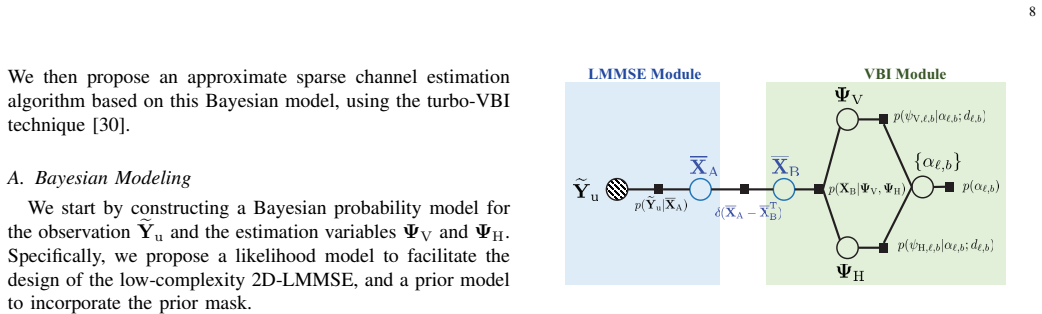
The load-bearing object is the approximate separable channel response model, which replaces the true angle-coupled radiation patterns with DNN-fitted functions evaluated on a 5-degree angular grid. This yields bases G_V(s), G_H(s) and a shared sparse angular-delay matrix Ψ_k, so the state-dependent channel factorizes as G(s)Ψ_k F^T. The supporting machinery is the two-stage estimator: a modified 2D-OMP finds the shared support of vertical/horizontal coefficients, and a turbo-VBI uses that support as a prior mask, approximating a 2D-LMMSE by two 1D-LMMSE steps to keep complexity low. The analog precoder then optimizes discrete states via one-hot reparameterization with a sparsity-promoting co
What would settle it
Measure the actual radiation patterns of the 12-state pixel-based fluid antenna prototype over a fine angle grid, replace the DNN-fitted bases in the algorithm with these measured patterns, and run the proposed estimation and precoding on measured or over-the-air channel data; if the channel prediction NMSE or achievable rate falls far short of the simulated curves, the central claim that the model supports real-world state prediction does not hold.
Extended reading notes
Core claim
The central claim is that the state-non-separable channel response of a pixel-based fluid antenna array can be approximated as H_k(s) = G(s) Ψ_k F^T, where G(s) is a state-dependent angular basis built from DNN-fitted vertical/horizontal radiation patterns and Ψ_k is a sparse angular-delay coefficient matrix whose support is shared between polarizations and across states. Because Ψ_k is independent of the antenna state, estimating it from a few uplink sounding blocks predicts the composite channel for every configuration. The paper then shows that a support-mask-assisted two-dimensional OMP followed by a turbo variational Bayesian inference recovers Ψ_k with low complexity, and that the resu
Load-bearing premise
The load-bearing premise is that the DNN-fitted radiation patterns and the 5-degree angular grid match the physical pixel-based fluid antenna closely enough; the paper's simulations reuse the same DNN both to generate channels and as the recovery basis, so real-world model mismatch is never tested.
Editorial extensions
If this is right
- With only T=4 uplink sounding blocks, the proposed estimators predict the composite channel for all 12 fluid-antenna states with NMSE close to that of the training states.
- The turbo-VBI estimator delivers about 5 dB gain over the modified OMP estimator in channel estimation NMSE.
- State-optimized analog precoding outperforms random-state selection by more than 1 bit/subcarrier/user and beats non-fluid and group-optimal baseline designs, especially at high SNR and with many users.
- The DNN radiation-pattern model achieves roughly an order of magnitude lower NMSE than kernel-based modeling with fewer FLOPs per evaluation.
- The overall pipeline works within OFDM pilot structures common to cellular systems, with four users sharing a pilot via a comb pattern.
Reading between the lines
- Because the factorization separates state from propagation, the same DNN-fitted-basis idea could transfer to other state-configurable arrays (e.g., reconfigurable intelligent surfaces or dynamic metasurfaces) where the channel depends non-separably on configuration.
- The 5-degree angular grid sets a resolution limit: paths closer than about 5 degrees in azimuth or elevation will alias into neighboring grid bins, so the approach implicitly assumes cluster separability at that scale.
- A real over-the-air test with the physical prototype, using measured radiation patterns rather than the DNN-fitted ones, would be the natural stress test; the simulation currently reuses the DNN both for generating channels and as the recovery basis, so model mismatch is untested.
- The one-hot relaxation could be replaced by alternative discrete optimization techniques if the gradient-based solution gets stuck in poor local optima at higher state counts.
Editorial analysis
A structured set of objections, weighed in public.
Referee Report
Summary. The paper studies a TDD multiuser MIMO-OFDM system with pixel-based fluid antennas (P-FAS) at the BS. Because the array response depends non-separably on the antenna state and the path angles, the conventional separate-channel-response approach fails. The authors introduce an approximate separable channel model in which the radiation pattern functions of the 12 states are represented by a DNN trained on prototype measurements, and the channel is expressed as a sparse combination of angular-delay grid bases (Eqs. (12)-(15)). They then propose a modified 2-D OMP that exploits the shared support of the vertical and horizontal polarization components (Algorithm 1), followed by a turbo-VBI estimator with a Bernoulli-Gaussian prior and a support mask obtained from the OMP output (Algorithm 2). Using T = 4 uplink sounding blocks, the composite channels for all states are predicted, and an analog precoder is optimized by relaxing the discrete state selection into a one-hot probability vector and applying Adam (Sec. V). Simulations with COST2100 channel realizations indicate that the proposed scheme outperforms random-state, non-FAS, and group-optimal baselines, especially at high SNR and with many users.
Significance. If the results hold, the paper makes a useful step toward making pixel-based fluid antennas practical: it provides a complete uplink-sounding and downlink-precoding framework that avoids the state-non-separable issue by estimating the angular-delay sparse coefficients directly. The DNN-based radiation-pattern model is efficient and accurate (510 parameters, NMSE about 10^-4 to 10^-5 in Table I), and the proposed algorithms are low-complexity relative to LS and AMP-based alternatives. The papers contributions are clearly stated and the algorithmic derivations are mostly correct. However, the simulation evaluation is circular with respect to the antenna model: the same DNN that generates the radiation patterns is also used to construct the estimation dictionary. This issues central claim is therefore not yet supported by evidence of robustness to antenna-model mismatch.
major comments (3)
- [Secs. II-C, III-A, VI; Figs. 10-12] The DNN radiation patterns ν_V(φ;s) and ν_H(φ;s) are used both as the ground-truth channel generator in (1) and as the dictionary basis in (13)-(14). In the Sec. VI simulations (COST2100 with the same DNN), the received signal Y_u in (19) is generated in the column space of eG_u (up to the 5° grid discretization). Consequently, the OMP/VBI algorithms never face an antenna-model mismatch; only the grid-angle discretization is tested. The headline gains in Figs. 11-12 are therefore not evidence that the method is robust to the physical approximation error that the paper itself introduces. Please add a mismatch test, e.g., using a different surrogate model, perturbing the DNN parameters, or using measured complex radiation patterns from the prototype [9], and report the NMSE and achievable-rate degradation.
- [Sec. VI, Fig. 10] The 'training' and 'testing' labels in Fig. 10 refer to FAS states (uplink sounding states vs. random configurations), but both datasets are generated from the same DNN model. This validates interpolation across states under the assumed model, not generalization to physical radiation patterns. The conclusion 'consistent performance for both training and testing' is overly strong. A held-out set of real measured patterns or a model-mismatch simulation is needed to support the claim of practical applicability.
- [Sec. IV-B, Eqs. (60)-(61)] The turbo-VBI estimator uses the OMP-derived support mask D constructed from the same observation eYu. Because the support is selected with the same data that is later used for the LMMSE and VBI updates, the 5-dB gain over OMP reported in Fig. 10 may be optimistic due to selection bias. The paper does not analyze this dependence. Please discuss this issue and, ideally, include an experiment with a support mask obtained from a training dataset or with random support initialization to quantify the bias.
minor comments (4)
- [Sec. III-C] The notation 'fM' (used for the number of dominant singular values) is not explicitly defined. It appears to be a scalar variable (perhaps f*M), but the typesetting is ambiguous and should be clarified.
- [Sec. IV-A] The symbol D is used both for the support set (Sec. III-D) and for the mask matrix in (35). While the text notes this, it is easy to confuse. Consider using a different symbol, e.g., M, for the mask.
- [Sec. V-B] The variable names es_m and sm are introduced without clearly distinguishing the latent variable from the relaxed probability vector. The reparameterization (73) should be explained more explicitly, and the optimization procedure should mention initialization and stopping criteria.
- [Sec. VI] In Fig. 10, the terms 'training' and 'testing' in the caption are not defined in the caption text; define them in the caption or refer to the corresponding description in Sec. VI.
Circularity Check
No significant circularity: the sparse channel recovery problem is nontrivial and the DNN antenna model is independently validated.
full rationale
The paper's derivation chain is self-contained. The DNN-based radiation pattern model is fitted to prototype measurements and validated on a held-out dataset (Table I reports NMSE ~1e-4 for the proposed DNN, separate from the channel estimation experiments). The channel estimation algorithms (modified OMP and turbo-VBI) solve a genuine inverse problem: recovering the sparse angular-delay coefficients Ψ from T noisy uplink sounding blocks. Nothing in Eq. (12)-(24) makes the recovery trivial by construction; the poor performance of the LS baseline in Fig. 10 demonstrates that estimation is not forced. The simulation does use the same DNN model both to generate channels and to construct the dictionary eG(s), so the experiments do not test physical-model mismatch beyond grid discretization (quantified in Fig. 7). This is a surrogate-model limitation, not a circular derivation: the DNN is not fitted to the channel estimation outputs, and the predicted channels for all FAS states follow from the estimated sparse coefficients, not from any fitted parameter that already contains the answer. The self-citation to the P-FAS prototype [9] is a hardware design reference, not an unverified theorem invoked to justify the central claim. Thus no circular step rises to the level defined in the review criteria.
Assumptions & free parameters
free parameters (5)
- DNN weights (510 parameters) =
not listed (trained on 10^7 samples)
- Angular grid resolution =
5 degrees
- Gamma prior hyperparameters a0, c0 =
"small values close to zero"
- Number of uplink sounding blocks T =
4
- Support mask adjacency set D^{(b,ℓ)} =
not specified exactly
assumptions (5)
- domain assumption The DNN radiation pattern model is an accurate description of the physical antenna
- domain assumption The propagation channel follows COST2100 with a limited number of scatterers
- domain assumption Channel support is shared between polarizations and sparse in the angular-delay grid
- domain assumption The SVD pre-processing preserves the signal subspace
- domain assumption Mean-field and message-passing approximations are accurate enough
Cite this review
Pith. "Pith review of Channel Estimation and Analog Precoding for Pixel-based Fluid-Antenna-Assisted Multiuser MIMO-OFDM Systems." pith.science (2026). https://pith.science/paper/PGM35Q5Y
@misc{pith2026250909373,
  author       = {Pith},
  title        = {Pith review of: Channel Estimation and Analog Precoding for Pixel-based Fluid-Antenna-Assisted Multiuser MIMO-OFDM Systems},
  year         = {2026},
  howpublished = {\url{https://pith.science/paper/PGM35Q5Y}},
  note         = {Machine review of arXiv:2509.09373}
}
read the original abstract
Pixel-based fluid antennas provide enhanced multiplexing gains and quicker radiation pattern switching than traditional designs. However, this innovation introduces challenges for channel estimation and analog precoding due to the state-non-separable channel response problem. This paper explores a multiuser MIMO-OFDM system utilizing pixel-based fluid antennas, informed by measurements from a real-world prototype. We present a sparse channel recovery framework for uplink channel sounding, employing an approximate separable channel response model with DNN-based antenna radiation functions. We then propose two low-complexity channel estimation algorithms that leverage orthogonal matching pursuit and variational Bayesian inference to accurately recover channel responses across various scattering cluster angles. These estimations enable the prediction of composite channels for all fluid antenna states, leading to an analog precoding scheme that optimally selects switching states for different antennas. Our simulation results indicate that the proposed approach significantly outperforms several baseline methods, especially in high signal-to-noise ratio environments with numerous users.
Figures


Figures from the paper (6 more)




Forward citations
Cited by 1 Pith paper
-
Pixel-based Reconfigurable Beamforming Networks Emulating Physical Movement in FAS
A scalable pixel-based reconfigurable beamforming network emulates fluid-antenna port movement by switching excitation currents, achieving measured Bessel spatial correlation across a 5% bandwidth.
Reference graph
Works this paper leans on
-
[9]
A novel pixel-based reconfigurable antenna applied in fluid antenna systems with high switching speed,
J. Zhang, J. Rao, Z. Li, Z. Ming, C. Y . Chiu, K. K. Wong, K. F. Tong, and R. Murch, “A novel pixel-based reconfigurable antenna applied in fluid antenna systems with high switching speed,”IEEE Open J. Antennas Propag., vol. 6, no. 1, pp. 212–228, 2025
2025
-
[1]
Fluid antenna systems,
K.-K. Wong, A. Shojaeifard, K.-F. Tong, and Y . Zhang, “Fluid antenna systems,”IEEE Trans. Wireless Commun., vol. 20, no. 3, pp. 1950–1962, 2020
1950
-
[2]
Fluid antenna system—part I: Preliminaries,
K. K. Wong, W. K. New, X. Hao, K. F. Tong, and C. B. Chae, “Fluid antenna system—part I: Preliminaries,”IEEE Commun. Lett., vol. 27, no. 8, pp. 1919–1923, 2023
1919
-
[3]
A tutorial on fluid antenna system for 6G networks: Encompassing communication theory, optimization methods and hardware designs,
W. K. New, K. K. Wong, H. Xu, C. Wang, F. R. Ghadi, J. Zhang, J. Rao, R. Murch, P. Ram ´ırez-Espinosa, D. Morales-Jimenez, C. B. Chae, and K. F. Tong, “A tutorial on fluid antenna system for 6G networks: Encompassing communication theory, optimization methods and hardware designs,”IEEE Commun. Surveys Tuts., pp. 1–1, 2024
2024
-
[4]
A tutorial on movable antennas for wireless networks,
L. Zhu, W. Ma, W. Mei, Y . Zeng, Q. Wu, B. Ning, Z. Xiao, X. Shao, J. Zhang, and R. Zhang, “A tutorial on movable antennas for wireless networks,”IEEE Commun. Surveys Tuts., 2025
2025
-
[5]
Movable-antenna enhanced multiuser communication via antenna position optimization,
L. Zhu, W. Ma, B. Ning, and R. Zhang, “Movable-antenna enhanced multiuser communication via antenna position optimization,”IEEE Trans. Wireless Commun., vol. 23, no. 7, pp. 7214–7229, 2023
2023
-
[6]
6D movable antenna en- hanced wireless network via discrete position and rotation optimization,
X. Shao, R. Zhang, Q. Jiang, and R. Schober, “6D movable antenna en- hanced wireless network via discrete position and rotation optimization,” IEEE J. Sel. Areas Commun., 2025
2025
-
[7]
Sum- rate maximization for fluid antenna enabled multiuser communications,
Z. Cheng, N. Li, J. Zhu, X. She, C. Ouyang, and P. Chen, “Sum- rate maximization for fluid antenna enabled multiuser communications,” IEEE Commun. Lett., 2024
2024
Show all 42 references
-
[8]
Antenna positioning and beamforming design for fluid antenna-assisted multi- user downlink communications,
H. Qin, W. Chen, Z. Li, Q. Wu, N. Cheng, and F. Chen, “Antenna positioning and beamforming design for fluid antenna-assisted multi- user downlink communications,”IEEE Wireless Commun. Lett., vol. 13, no. 4, pp. 1073–1077, 2024
2024
-
[10]
Sparse bayesian learning-based channel estimation for fluid antenna systems,
B. Xu, Y . Chen, Q. Cui, X. Tao, and K.-K. Wong, “Sparse bayesian learning-based channel estimation for fluid antenna systems,”IEEE Wireless Commun. Lett., 2024
2024
-
[11]
Compressed sensing based channel estimation for movable antenna communications,
W. Ma, L. Zhu, and R. Zhang, “Compressed sensing based channel estimation for movable antenna communications,”IEEE Commun. Lett., 2023
2023
-
[12]
Successive Bayesian reconstructor for channel estimation in fluid antenna systems,
Z. Zhang, J. Zhu, L. Dai, and R. W. Heath, “Successive Bayesian reconstructor for channel estimation in fluid antenna systems,”IEEE Trans. Wireless Commun., 2024
2024
-
[13]
Channel estimation and reconstruction in fluid antenna system: Oversampling is essential,
W. K. New, K. K. Wong, H. Xu, F. R. Ghadi, R. Murch, and C. B. Chae, “Channel estimation and reconstruction in fluid antenna system: Oversampling is essential,”IEEE Trans. Wireless Commun., vol. 24, no. 1, pp. 309–322, 2025
2025
-
[14]
Application of com- pressive sensing to sparse channel estimation,
C. R. Berger, Z. Wang, J. Huang, and S. Zhou, “Application of com- pressive sensing to sparse channel estimation,”IEEE Commun. Mag., vol. 48, no. 11, pp. 164–174, 2010
2010
-
[15]
Exploiting burst-sparsity in massive MIMO with partial channel support information,
A. Liu, V . K. N. Lau, and W. Dai, “Exploiting burst-sparsity in massive MIMO with partial channel support information,”IEEE IEEE Trans. Commun., vol. 15, no. 11, pp. 7820–7830, 2016
2016
-
[16]
Structured turbo compressed sensing for massive MIMO channel estimation using a Markov prior,
L. Chen, A. Liu, and X. Yuan, “Structured turbo compressed sensing for massive MIMO channel estimation using a Markov prior,”IEEE Trans. Veh. Technol., vol. 67, no. 5, pp. 4635–4639, 2017
2017
-
[17]
Re- configurable massive MIMO: Precoding design and channel estimation in the electromagnetic domain,
K. Ying, Z. Gao, Y . Su, T. Qin, M. Matthaiou, and R. Schober, “Re- configurable massive MIMO: Precoding design and channel estimation in the electromagnetic domain,”IEEE Trans. Commun., vol. 73, no. 5, pp. 3423–3440, 2025
2025
-
[18]
Channel estimation for FAS-assisted multiuser mmwave systems,
H. Xu, G. Zhou, K.-K. Wong, W. K. New, C. Wang, C.-B. Chae, R. Murch, S. Jin, and Y . Zhang, “Channel estimation for FAS-assisted multiuser mmwave systems,”IEEE Commun. Lett., 2023
2023
-
[19]
MIMO systems with reconfigurable antennas: Joint channel estimation and mode selection,
F. Armandoust, E. Tohidi, M. Kasparick, L. Wang, A. H. Gokceoglu, and S. Stanczak, “MIMO systems with reconfigurable antennas: Joint channel estimation and mode selection,” inn Proc. WSA SCC 26th Int. ITG Workshop Smart Antennas 13th Conf. Syst. Commun., Coding, Feb. 2023, pp. 1–6
2023
-
[20]
Fluid antenna- assisted MIMO transmission exploiting statistical CSI,
Y . Ye, L. You, J. Wang, H. Xu, K.-K. Wong, and X. Gao, “Fluid antenna- assisted MIMO transmission exploiting statistical CSI,”IEEE Commun. Lett., vol. 28, no. 1, pp. 223–227, 2023
2023
-
[21]
Message passing algo- rithms for compressed sensing: I. motivation and construction,
D. L. Donoho, A. Maleki, and A. Montanari, “Message passing algo- rithms for compressed sensing: I. motivation and construction,” inProc. IEEE ITW, 2010, pp. 1–5
2010
-
[22]
Vector approximate message passing,
S. Rangan, P. Schniter, and A. K. Fletcher, “Vector approximate message passing,”IEEE Trans. Inf. Theory, vol. 65, no. 10, pp. 6664–6684, 2019
2019
-
[23]
Orthogonal amp,
J. Ma and L. Ping, “Orthogonal amp,”IEEE Access, vol. 5, pp. 2020– 2033, 2017
2020
-
[24]
On the performance of turbo signal recovery with partial DFT sensing matrices,
J. Ma, X. Yuan, and L. Ping, “On the performance of turbo signal recovery with partial DFT sensing matrices,”IEEE Signal Process. Lett., vol. 22, no. 10, pp. 1580–1584, 2015
2015
-
[25]
Downlink multi-user MIMO transmission for radiation pattern reconfigurable antenna systems,
M. Hasan, I. Bahceci, and B. A. Cetiner, “Downlink multi-user MIMO transmission for radiation pattern reconfigurable antenna systems,”IEEE Trans. Wireless Commun., vol. 17, no. 10, pp. 6448–6463, 2018
2018
-
[26]
Precoding design of reconfigurable massive mimo in the electromagnetic domain,
K. Ying and Z. Gao, “Precoding design of reconfigurable massive mimo in the electromagnetic domain,” inProc. IEEE GLOBECOM, 2023, pp. 5769–5774
2023
-
[27]
Unified array manifold de- composition based on spherical harmonics and 2-D fourier basis,
M. Costa, A. Richter, and V . Koivunen, “Unified array manifold de- composition based on spherical harmonics and 2-D fourier basis,”IEEE Trans. Signal Process., vol. 58, no. 9, pp. 4634–4645, 2010
2010
-
[28]
Orthogonal matching pursuit for sparse signal recovery with noise,
T. T. Cai and L. Wang, “Orthogonal matching pursuit for sparse signal recovery with noise,”IEEE Trans. Inf. Theory, vol. 57, no. 7, pp. 4680– 4688, 2011. 13
2011
-
[29]
The variational approximation for Bayesian inference,
D. G. Tzikas, A. C. Likas, and N. P. Galatsanos, “The variational approximation for Bayesian inference,”IEEE Signal Process. Mag., vol. 25, no. 6, pp. 131–146, 2008
2008
-
[30]
Robust recovery of structured sparse signals with uncertain sensing matrix: A turbo-VBI approach,
A. Liu, G. Liu, L. Lian, V . K. N. Lau, and M. Zhao, “Robust recovery of structured sparse signals with uncertain sensing matrix: A turbo-VBI approach,”IEEE Trans. Wireless Commun., vol. 19, no. 5, pp. 3185– 3198, 2020
2020
-
[31]
Adam: A method for stochastic optimization,
D. P. Kingma and J. Ba, “Adam: A method for stochastic optimization,” arXiv preprint arXiv:1412.6980, 2014
2014 arXiv
-
[32]
Low-cost 3d- printed coupling-fed frequency agile fluidic monopole antenna system,
C. Borda-Fortuny, L. Cai, K. F. Tong, and K.-K. Wong, “Low-cost 3d- printed coupling-fed frequency agile fluidic monopole antenna system,” IEEE Access, vol. 7, pp. 95 058–95 064, 2019
2019
-
[33]
A review on reconfigurable liquid dielectric antennas,
E. Motovilova and S. Y . Huang, “A review on reconfigurable liquid dielectric antennas,”Materials, vol. 13, no. 8, 2020. [Online]. Available: https://www.mdpi.com/1996-1944/13/8/1863
2020
-
[34]
Radiation pattern diversified double-fluid-channel surface-wave antenna for mobile communications,
Y . Shen, K.-F. Tong, and K.-K. Wong, “Radiation pattern diversified double-fluid-channel surface-wave antenna for mobile communications,” inIEEE Proc. APWC, 2022, pp. 085–088
2022
-
[35]
Advances towards programmable droplet transport on solid surfaces and its applications,
R. Malinowski, I. P. Parkin, and G. V olpe, “Advances towards programmable droplet transport on solid surfaces and its applications,” Chem. Soc. Rev., vol. 49, pp. 7879–7892, 2020. [Online]. Available: http://dx.doi.org/10.1039/D0CS00268B
2020 doi
-
[36]
Slow fluid antenna multiple access,
K.-K. Wong, D. Morales-Jimenez, K.-F. Tong, and C.-B. Chae, “Slow fluid antenna multiple access,”IEEE Trans. Commun., vol. 71, no. 5, pp. 2831–2846, 2023
2023
-
[37]
Bruce lee-inspired fluid antenna system: Six research topics and the potentials for 6g,
K.-K. Wong, K.-F. Tong, Y . Shen, Y . Chen, and Y . Zhang, “Bruce lee-inspired fluid antenna system: Six research topics and the potentials for 6g,”Frontiers Commun. Netw., vol. 3, 2022. [Online]. Available: https://www.frontiersin.org/articles/10.3389/frcmn.2022.853416
2022
-
[38]
Fluid antenna multiple access,
K.-K. Wong and K.-F. Tong, “Fluid antenna multiple access,”IEEE Trans. Wireless Commun., vol. 21, no. 7, pp. 4801–4815, 2022
2022
-
[39]
Massive MIMO extensions to the COST 2100 channel model: Modeling and validation,
J. Flordelis, X. Li, O. Edfors, and F. Tufvesson, “Massive MIMO extensions to the COST 2100 channel model: Modeling and validation,” IEEE IEEE Trans. Commun., vol. 19, no. 1, pp. 380–394, 2020. [40]Study on channel model for frequencies from 0.5 to 100 GHz. 3GPP TR 38.901 vers...
2020
-
[41]
Pytorch: An imperative style, high- performance deep learning library,
A. Paszke, S. Gross, F. Massa, A. Lerer, J. Bradbury, G. Chanan, T. Killeen, Z. Lin, N. Gimelshein, L. Antiga, A. Desmaison, A. Kopf, E. Yang, Z. DeVito, M. Raison, A. Tejani, S. Chilamkurthy, B. Steiner, L. Fang, J. Bai, and S. Chintala, “Pytorch: An imperative style, high- p...
2019
-
[42]
Tensorflow: A system for large-scale machine learning,
M. Abadi, P. Barham, J. Chen, Z. Chen, A. Davis, J. Dean, M. Devin, S. Ghemawat, G. Irving, M. Isardet al., “Tensorflow: A system for large-scale machine learning,” in12th USENIX Symposium on Operating Systems Design and Implementation (OSDI 16), 2016, pp. 265–283
2016
-
[43]
Massive MIMO extensions to the COST 2100 channel model: Modeling and validation,
J. Flordelis, X. Li, O. Edfors, and F. Tufvesson, “Massive MIMO extensions to the COST 2100 channel model: Modeling and validation,” IEEE Trans. Wireless Commun., vol. 19, no. 1, pp. 380–394, 2020
2020
Reviewed August 4, 2026 · model on record in the stance chip above.
Discussion (0). Continue with ORCID to comment.