REVIEW 3 major objections 5 minor 49 references
Double Low-Rank 4D Tensor Decomposition for Circular RIS-Aided mmWave MIMO-NOMA System Channel Estimation in Mobility Scenarios
T0 review · 3 major / 5 minor · reviewed 2026-08-07 · deepseek-v4-flash
Pith's one-line read Double low-rank 4D tensor decomposition estimates RIS-aided mmWave channel parameters closest to the Cramér-Rao bound down to -20 dB SNR.
desk verdict The tensor formulation and the training-slot independence argument are fresh, but the paper's headline low-SNR advantage over the prior circular RIS method is never actually tested against it. read the letter →
The pith
A machine-rendered reading of the paper's core claim, the machinery that carries it, and where it could break.
The reading
What carries the argument
The central object is the DLR4DTD objective of Eq. (23): minimize $\|\mathbf{Y}-\mathbf{Z}-\mathbf{S}\|_F^2 + \mu_1\|\mathbf{Z}\|_{\mathrm{SCPD}} + \mu_2\|\mathbf{S}\|_1$ subject to $\mathbf{Z}=\mathbf{G}\times_1\mathbf{U}_1\times_2\mathbf{U}_2\times_3\mathbf{U}_3\times_4\mathbf{U}_4$ with orthogonal factors. The Tucker constraint enforces the global low-rank property and is updated inside ADMM by the higher-order orthogonal iteration (HOOI) algorithm. The structured-CPD subproblem enforces the local low-rank property: spatial smoothing on the mode-1 unfolding of the intermediate tensor exposes the Vandermonde Doppler factor through an eigendecomposition of $\mathbf{U}_{s1}^{\dagger}\mathbf{U}_{s2}$, recovering all four factor matrices without initialization or iteration over the CP fit. Around this core, the subframe-partitioning scheme organizes the received pilot signals into the fourth-order tensor of Eq. (21), and the Jacobi-Anger expansion $\mathbf{a}_r(\theta_{eq},\phi_{eq})\approx\boldsymbol{\Theta}\mathbf{J}_d(\theta_{eq})\mathbf{v}(\phi_{eq})$ splits the circular-RIS angles into a diagonal matrix depending on $\theta_{eq}$ and a vector depending on $\phi_{eq}$, which is what allows the angles to be uniquely decoupled.
What would settle it
Run the same simulator with noise altered so its tail is not sparse—for example Gaussian noise with the largest outliers clipped, or uniform dense noise—and check around $-15$ dB SNR whether DLR4DTD still beats the single-structure benchmark; if the margin collapses, the sparse-tail model is the load-bearing part of the low-SNR claim.
Extended reading notes
Core claim
The central claim is that the noiseless received signal is modeled as a rank-$L$ canonical polyadic tensor whose four factor matrices separate the parameter groups: $\mathbf{A}$ for the BS and mobile angles, $\mathbf{B}$ for the circular-RIS angles, $\mathbf{C}$ for delay and gain, and $\mathbf{D}$ for Doppler. The proposed DLR4DTD algorithm recovers these factors by solving a nonconvex model that couples a fit term, a structured-CPD regularizer, and an $\ell^1$ sparse-noise penalty, with the low-rank signal constrained to a Tucker form. An ADMM loop alternates a higher-order orthogonal iteration step for global denoising, a structured-CPD step that uses spatial smoothing and an eigendecomposition for local factor recovery, a soft-thresholding step for the sparse noise tail, and a multiplier update. The paper's core assertion is that this double low-rank structure suppresses noise and restores factor matrices accurately enough that, at SNR down to $-20$ dB, the MSE of $\phi_{BR}$, $\theta_{RM}$, $\theta_{BR}$, $\phi_{RM}$, $\tau$, $f_d$, and $\rho$ sits closest to the derived Cramér-Rao bound among the tested estimators, and the cascade-channel NMSE falls roughly exponentially with SNR.
Load-bearing premise
The load-bearing premise is that the heavy tail of measurement noise can be separated as a sparse layer by the sparse-noise penalty; if real noise tails are not sparse in the tensor sense, the low-SNR advantage over the single-structure benchmark disappears.
Editorial extensions
If this is right
- Angle parameters are uniquely decoupled: $\phi_{BR}$ and $\theta_{RM}$ are read from factor matrix $\mathbf{A}$ by a two-stage rough search plus simplex refinement, while $\theta_{BR}$ and $\phi_{RM}$ are read from $\mathbf{B}$ via spectral search and simplex refinement; linear RIS topologies cannot provide this decoupling.
- The number of RIS training time slots is independent of the circular-RIS radius, so the scheme avoids the small element spacings, mutual coupling, and manufacturing problems of the earlier circular-RIS training pattern.
- All four factor matrices share one permutation matrix, so the per-path channel parameters are automatically paired, and the time delay, Doppler shift, and cascade gain are estimated without ambiguity; the cascade delay can be decoupled into physical positions once $L\geq 2$.
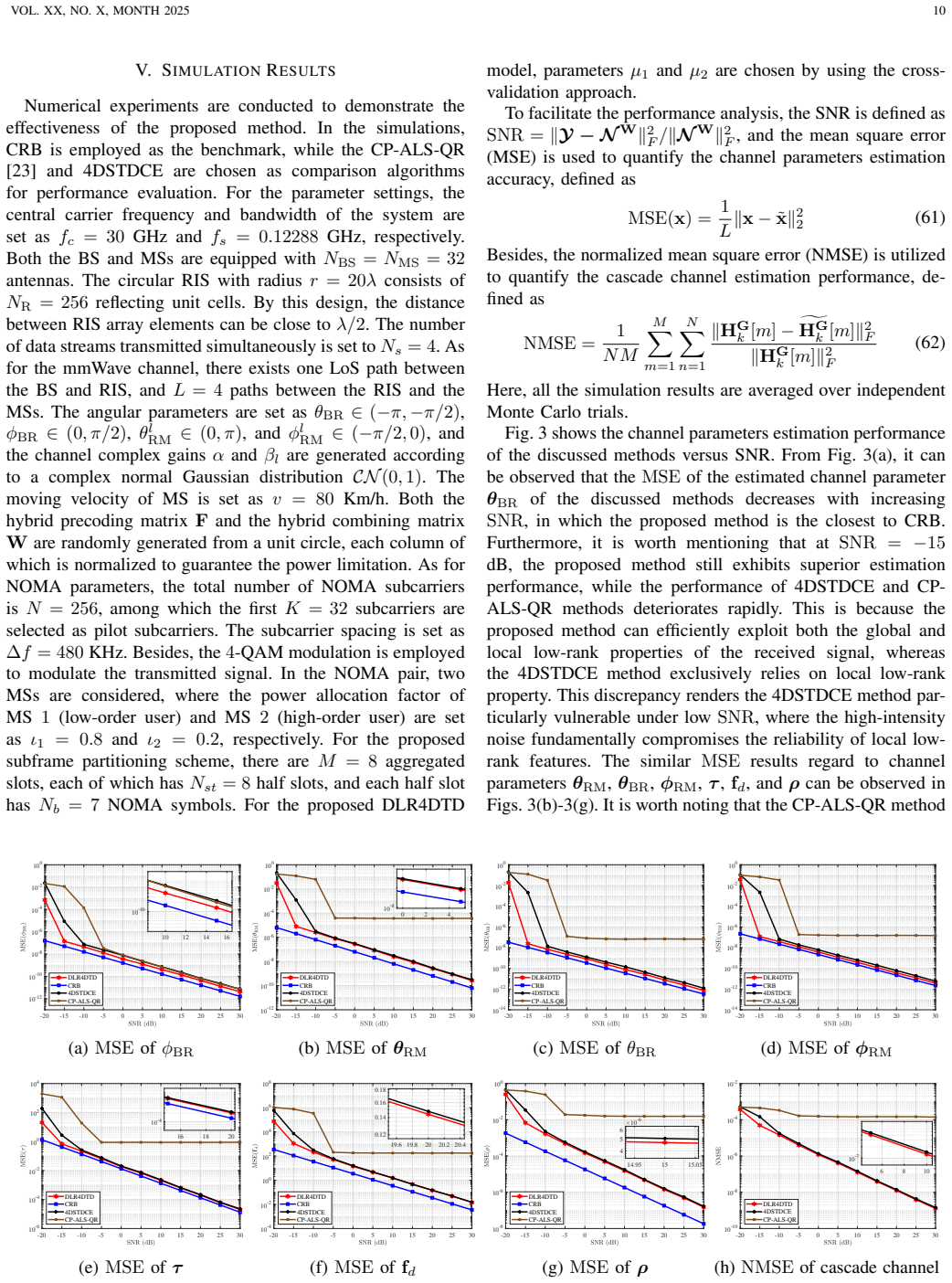
- In simulation, the proposed method keeps every estimated parameter MSE closest to the Cramér-Rao bound down to $-20$ dB SNR, with cascade-channel NMSE decreasing roughly exponentially in SNR, and the ADMM objective converges in few iterations regardless of initialization.
Reading between the lines
- Our inference: the sparse-noise-tail layer is a generic plug-in. Any tensor-based channel estimator facing Gaussian noise at low SNR could adopt the same soft-thresholding update with a cross-validated weight, independent of the circular-RIS geometry.
- Our inference: the reconstructed factor matrices carry both communication and positioning parameters, so the low-SNR estimation gain should propagate directly into RIS-aided localization and integrated sensing; feeding the estimated angles, delays, and Doppler shifts into position equations is a natural next test.
- Our inference: the radius-independence property, if it holds at larger radii and element counts, opens a design direction the paper does not explore—enlarging the circular RIS to reduce mutual coupling without paying additional training slots.
Editorial analysis
A structured set of objections, weighed in public.
Referee Report
Summary. The paper proposes a channel estimation method for a circular RIS-aided mmWave MIMO-NOMA downlink system in mobility. The received signal is modeled as a fourth-order tensor with a canonical polyadic decomposition (CPD) structure, separating angle, delay, Doppler, and gain parameters into factor matrices. The proposed DLR4DTD method jointly exploits a global Tucker low-rank model and a local structured CPD (called 4DSTDCE), adds an ell-1 regularized sparse component believed to capture the tail of Gaussian noise, and solves the resulting nonconvex problem via ADMM. A two-stage parameter estimation based on the Jacobi-Anger expansion of the circular RIS is used for angle decoupling, and a closed-form Cramér-Rao bound is derived by vectorizing the received signal. Simulations compare DLR4DTD against CP-ALS-QR and the paper's own 4DSTDCE subroutine, reporting MSE/NMSE versus SNR and convergence behavior.
Significance. If the reported gains hold, the paper would make a useful contribution to RIS-aided channel estimation by combining global and local low-rank structure with sparse outlier modeling, and by providing a CRB benchmark for the circular-RIS setting. The manuscript contains a mostly coherent tensor model, a fairly complete parameter estimation pipeline, and a self-contained CRB derivation in Appendix A, which is a notable strength. However, the central low-SNR advantage rests on a modeling assumption about Gaussian noise tails that is not justified, and the numerical evaluation does not include the existing circular-RIS method [25] that motivates the work, so the main comparative claim is not yet established.
major comments (3)
- [Section V, Fig. 3] The numerical comparison does not include the circular-RIS channel estimation method of [25], which is the state-of-the-art approach the paper explicitly aims to overcome (Section I). The only baselines are CP-ALS-QR [23] and 4DSTDCE, and 4DSTDCE is the paper's own subroutine introduced in Algorithm 1 and used inside DLR4DTD. The comparison therefore demonstrates an ablation gain over a component of the proposed method, not an advantage over existing circular-RIS estimators. To support the central claim of improved estimation accuracy for circular-RIS systems, the authors should simulate [25] (or justify its exclusion with a concrete reason, e.g., unavailability of code) and discuss how the proposed training-slot design compares in accuracy and complexity.
- [Section III.A, Eq. (23)] The low-SNR improvement of DLR4DTD relies on the assumption, stated in Section III.A and formalized in Eq. (23), that 'the tail of the noise exhibits strong intensity and sparsity' and can therefore be modeled as an additive sparse component S penalized by mu_2 ||S||_1. This assumption is load-bearing: Figs. 3(a)-3(h) attribute the advantage at SNR = -15 dB and below to the separation of S. However, Gaussian noise does not have a sparse tail in the usual sense, and the paper provides neither a statistical justification nor a robustness test against non-sparse or non-Gaussian noise. There is also a risk that the ell-1 penalty absorbs signal energy rather than only noise. The authors should either justify this model with a concrete statistical argument, add experiments with standard Gaussian noise where the sparse component is disabled, or demonstrate that the result is insensitive to the choice of mu_2 and to the sparsity model.
- [Section V, Fig. 3 and Fig. 5] The simulation section states that 'all the simulation results are averaged over independent Monte Carlo trials' but does not report the number of trials or any error bars or confidence intervals. Given that the key claims are about relative performance at low SNR, where the plotted differences can be small (e.g., Fig. 3(a) at SNR near 10 dB), single-mean curves without variance information are insufficient to establish that DLR4DTD outperforms 4DSTDCE. Additionally, Fig. 5 has no legend or curve identification, and the caption does not explain which metric is plotted, making the velocity-robustness claim unverifiable. The authors should report trial counts, include error bars or shaded intervals, and clarify Fig. 5.
minor comments (5)
- [Section VI and Appendix A] Typographical issues: 'Jacobi-Angler expansion' in the conclusion should be 'Jacobi-Anger expansion', and the Appendix title 'DEVIATION OF CRB' should be 'DERIVATION OF CRB'.
- [Section V, Eq. (62)] The NMSE definition in Eq. (62) is inconsistent: the denominator uses N M and the outer sum runs over m=1..M and n=1..N, but the norm inside the sum depends on k and m, not on n. The summation index should be k over the pilot subcarriers (or K should replace N consistently).
- [Algorithm 2 and Section V] Algorithm 2 states fixed parameter values mu_1 = 0.01 and mu_2 = 0.5, while Section V says these parameters are chosen by cross-validation. Please clarify whether the listed values are defaults or the outcome of cross-validation, and report the cross-validated values used in the figures.
- [Eq. (24) and Eq. (29)] The formulation in Eq. (24) introduces an auxiliary variable R and the constraint Z = R, yet the objective already contains both ||Y-Z-S||_F^2 and mu_1 ||Y-R-S||_F^2; this is not wrong but is redundant and makes the derivation harder to follow. A brief explanation of why both terms are retained would improve readability.
- [Section V, Fig. 3(a)] The caption of Fig. 3(a) reads 'MSE of phi_BR', but the text in Section V discusses 'theta_BR' in the corresponding paragraph; please check that the subfigure labels match the parameter discussed in the text.
Circularity Check
No material circularity: only a minor, non-load-bearing self-citation; derivation is self-contained.
-
other
[Section I, Introduction, sentence citing Ref. [9]]
"In [9], the subspace-based CPD method is proposed to resolve these problems by exploiting the Vandermonde structure behind the received signal and only uses basic linear algebra, avoiding initialization and iteration."
Ref. [9] has overlapping authors with the present paper (M. Sheng, Y. Li, W. Cai, and Q. Qi are co-authors here), so this is a self-citation. However, this sentence is background motivation for subspace-based CPD and user localization; the DLR4DTD derivation does not rest on [9]. The structured-CPD subroutine in Algorithm 1 is explicitly motivated by the external Ref. [24] ('motivated by the structured CPD method proposed in [24]'), and the low-SNR claim is supported by the ADMM solution of Eq. (23). Thus this is a minor self-citation with no load-bearing role and no reduction of a prediction to an input.
full rationale
The derivation chain is self-contained. The received signal is modeled as a CPD tensor in Eqs. (20)-(22), and the DLR4DTD objective (23) is posed directly on that tensor, with ADMM updates (26)-(50) solving the stated objective; the CRB in Section IV and Appendix A is derived from the model via the complex Fisher information matrix, not fitted to simulation curves. The low-SNR advantage rests on the explicit modeling assumption that the tail of Gaussian noise is sparse (Section III.A, Eq. (23)), which is an assumption about the noise, not a circular reduction. The numerical comparison against 4DSTDCE (Algorithm 1) is an ablation against a component of the proposed method, and the absence of a comparison with [25] is a scope/evidence gap; neither makes the derivation circular. The only flagged item is the self-citation [9], which is motivational and not load-bearing. Score 2 reflects that minor self-citation; no prediction reduces to an input by construction.
Assumptions & free parameters
free parameters (5)
- mu_1 (Tucker fidelity weight) =
0.01
- mu_2 (sparse noise weight) =
0.5
- Tucker rank r1 = r2 = r3 = r4 =
L (assumed number of paths)
- Jacobi-Anger truncation order I =
2 times ceil(2 pi r / lambda)
- ADMM penalty gamma and tolerances =
gamma = 1.5; eps1 = eps2 = eps3 = 1e-5; kmax = 300
assumptions (6)
- domain assumption BS-RIS channel is LoS-dominated and quasi-static with a single path
- domain assumption RIS-MS channel parameters remain constant within an aggregated slot
- ad hoc to paper The tail of Gaussian noise is sparse
- standard math The received noise-free tensor has exact CPD of rank L with identifiable factor matrices
- domain assumption Pilot symbols X and RIS phase shift matrix Xi are known at the receiver
- ad hoc to paper Jacobi-Anger truncation error is negligible with I = 2 times ceil(2 pi r / lambda)
Cite this review
Pith. "Pith review of Double Low-Rank 4D Tensor Decomposition for Circular RIS-Aided mmWave MIMO-NOMA System Channel Estimation in Mobility Scenarios." pith.science (2026). https://pith.science/paper/PGNDSV3W
@misc{pith2026250607909,
  author       = {Pith},
  title        = {Pith review of: Double Low-Rank 4D Tensor Decomposition for Circular RIS-Aided mmWave MIMO-NOMA System Channel Estimation in Mobility Scenarios},
  year         = {2026},
  howpublished = {\url{https://pith.science/paper/PGNDSV3W}},
  note         = {Machine review of arXiv:2506.07909}
}
read the original abstract
Channel estimation is not only essential to highly reliable data transmission and massive device access but also an important component of the integrated sensing and communication (ISAC) in the sixth-generation (6G) mobile communication systems. In this paper, we consider a downlink channel estimation problem for circular reconfigurable intelligent surface (RIS)-aided millimeter-wave (mmWave) multiple-input multiple-output non-orthogonal multiple access (MIMO-NOMA) system in mobility scenarios. First, we propose a subframe partitioning scheme to facilitate the modeling of the received signal as a fourth-order tensor satisfying a canonical polyadic decomposition (CPD) form, thereby formulating the channel estimation problem as tensor decomposition and parameter extraction problems. Then, by exploiting both the global and local low-rank properties of the received signal, we propose a double low-rank 4D tensor decomposition model to decompose the received signal into four factor matrices, which is efficiently solved via alternating direction method of multipliers (ADMM). Subsequently, we propose a two-stage parameter estimation method based on the Jacobi-Anger expansion and the special structure of circular RIS to uniquely decouple the angle parameters. Furthermore, the time delay, Doppler shift, and channel gain parameters can also be estimated without ambiguities, and their estimation accuracy can be efficiently improved, especially at low signal-to-noise ratio (SNR). Finally, a concise closed-form expression for the Cram\'er-Rao bound (CRB) is derived as a performance benchmark. Numerical experiments are conducted to demonstrate the effectiveness of the proposed method compared with the other discussed methods.
Figures


Figures from the paper (2 more)


Reference graph
Works this paper leans on
-
[25]
Circular RIS-enabled channel estimation and localization for multi-user ISAC systems,
Y . Lin, S. Jin, M. Matthaiou, and X. Yi, “Circular RIS-enabled channel estimation and localization for multi-user ISAC systems,”IEEE Trans. Wireless Commun., vol. 23, no. 8, pp. 8730–8743, 2024
work page 2024
-
[46]
On the uniqueness of multilinear decomposition of N-way arrays,
N. D. Sidiropoulos and R. Bro, “On the uniqueness of multilinear decomposition of N-way arrays,”J. Chemom., vol. 14, no. 3, pp. 229– 239, 2000
work page 2000
-
[23]
CP decomposition for tensors via alternating least squares with QR decomposition,
R. Minster, I. Viviano, X. Liu, and G. Ballard, “CP decomposition for tensors via alternating least squares with QR decomposition,”Numer . Linear Algebra Appl., vol. 30, no. 6, p. e2511, 2023
work page 2023
-
[1]
On the road to 6G: Visions, requirements, key technologies, and testbeds,
C.-X. Wang, X. You, X. Gao, X. Zhu, Z. Li, C. Zhang, H. Wang, Y . Huang, Y . Chen, H. Haas, J. S. Thompson, E. G. Larsson, M. D. Renzo, W. Tong, P. Zhu, X. Shen, H. V . Poor, and L. Hanzo, “On the road to 6G: Visions, requirements, key technologies, and testbeds,”IEEE Commun. Surveys Tuts., vol. 25, no. 2, pp. 905–974, 2023
2023
-
[2]
Active fully- connected RIS based on index modulation for high rate and energy- efficient systems,
J. Jin, X. Jin, M. Wen, M. Song, C. Huang, and Y . Yao, “Active fully- connected RIS based on index modulation for high rate and energy- efficient systems,”IEEE Trans. Commun., vol. 72, no. 12, pp. 7639– 7649, 2024
work page 2024
-
[3]
Evolution of NOMA toward next generation multiple access (NGMA) for 6G,
Y . Liu, S. Zhang, X. Mu, Z. Ding, R. Schober, N. Al-Dhahir, E. Hossain, and X. Shen, “Evolution of NOMA toward next generation multiple access (NGMA) for 6G,”IEEE J. Sel. Areas Commun., vol. 40, no. 4, pp. 1037–1071, 2022
2022
-
[4]
An overview of signal processing techniques for RIS/IRS-aided wireless systems,
C. Pan, G. Zhou, K. Zhi, S. Hong, T. Wu, Y . Pan, H. Ren, M. D. Renzo, A. Lee Swindlehurst, R. Zhang, and A. Y . Zhang, “An overview of signal processing techniques for RIS/IRS-aided wireless systems,”IEEE J. Sel. Topics Signal Process., vol. 16, no. 5, pp. 883–917, 2022. VOL. XX, NO. X, MONTH 2025 13
work page 2022
-
[5]
R. Liu, M. Li, H. Luo, Q. Liu, and A. L. Swindlehurst, “Integrated sensing and communication with reconfigurable intelligent surfaces: Opportunities, applications, and future directions,”IEEE Wireless Com- mun., vol. 30, no. 1, pp. 50–57, 2023
work page 2023
Show all 49 references
-
[6]
Rectangular differential reflecting spatial modulation: A noncoherent joint index-modulation of RIS-assisted MIMO system,
P. Zhang, X. Jin, C. Wan, S. Xing, C. Huang, M. Wen, and Y . Yao, “Rectangular differential reflecting spatial modulation: A noncoherent joint index-modulation of RIS-assisted MIMO system,”IEEE Trans. Commun., vol. 72, no. 12, pp. 7387–7400, 2024
2024
-
[7]
Wireless communications with reconfigurable intelligent surface: Path loss modeling and experimental measurement,
W. Tang, M. Z. Chen, X. Chen, J. Y . Dai, Y . Han, M. Di Renzo, Y . Zeng, S. Jin, Q. Cheng, and T. J. Cui, “Wireless communications with reconfigurable intelligent surface: Path loss modeling and experimental measurement,”IEEE Trans. Wireless Commun., vol. 20, no. 1, pp. 421– ...
2021
-
[8]
Channel estimation and user localization for IRS-assisted MIMO-OFDM systems,
Y . Lin, S. Jin, M. Matthaiou, and X. You, “Channel estimation and user localization for IRS-assisted MIMO-OFDM systems,”IEEE Trans. Wireless Commun., vol. 21, no. 4, pp. 2320–2335, 2022
2022
-
[9]
User localization for reconfigurable intelligent surface-assisted mmWave MIMO-OFDM systems,
M. Sheng, Y . Li, W. Cai, Q. Qi, Z. Wu, and Y . Wu, “User localization for reconfigurable intelligent surface-assisted mmWave MIMO-OFDM systems,”IEEE Commun. Lett., pp. 1–5, 2024
2024
-
[10]
Tensor decomposition-based channel estimation for hybrid mmWave massive MIMO in high-mobility scenarios,
R. Zhang, L. Cheng, S. Wang, Y . Lou, W. Wu, and D. W. K. Ng, “Tensor decomposition-based channel estimation for hybrid mmWave massive MIMO in high-mobility scenarios,”IEEE Trans. Commun., vol. 70, no. 9, pp. 6325–6340, 2022
2022
-
[11]
TRICE: A channel estimation framework for RIS-aided millimeter-wave MIMO systems,
K. Ardah, S. Gherekhloo, A. L. F. de Almeida, and M. Haardt, “TRICE: A channel estimation framework for RIS-aided millimeter-wave MIMO systems,”IEEE Signal Process. Lett., vol. 28, pp. 513–517, 2021
2021
-
[12]
Efficient two-level block-structured sparse Bayesian learning-based channel estimation for RIS-assisted MIMO IoT systems,
J. Chen, N. Ma, X. Xu, X. Qin, Y . Li, and P. Zhang, “Efficient two-level block-structured sparse Bayesian learning-based channel estimation for RIS-assisted MIMO IoT systems,”IEEE Internet Things J., vol. 11, no. 14, pp. 24 933–24 947, 2024
2024
-
[13]
Exploiting structured sparsity with low complexity sparse Bayesian learning for RIS-assisted MIMO mmWave channel estimation,
W. Li, Z. Lin, Q. Guo, and B. Vucetic, “Exploiting structured sparsity with low complexity sparse Bayesian learning for RIS-assisted MIMO mmWave channel estimation,”IEEE Trans. V eh. Technol., vol. 73, no. 5, pp. 6752–6764, 2024
2024
-
[14]
Channel estimation for RIS-aided mmWave MIMO systems via atomic norm minimization,
J. He, H. Wymeersch, and M. Juntti, “Channel estimation for RIS-aided mmWave MIMO systems via atomic norm minimization,”IEEE Trans. Wireless Commun., vol. 20, no. 9, pp. 5786–5797, 2021
2021
-
[15]
Location-aware beam training and multi- dimensional ANM-based channel estimation for RIS-aided mmwave systems,
H. Chung and S. Kim, “Location-aware beam training and multi- dimensional ANM-based channel estimation for RIS-aided mmwave systems,”IEEE Trans. Wireless Commun., vol. 23, no. 1, pp. 652–666, 2024
2024
-
[16]
Channel estimation for RIS- aided MIMO systems: A partially decoupled atomic norm minimization approach,
Y . Chu, Z. Wei, Z. Yang, and D. W. K. Ng, “Channel estimation for RIS- aided MIMO systems: A partially decoupled atomic norm minimization approach,”IEEE Trans. Wireless Commun., pp. 1–1, 2024
2024
-
[17]
ADMM based channel estimation for RISs aided millimeter wave communications,
H. Liu, J. Zhang, Q. Wu, H. Xiao, and B. Ai, “ADMM based channel estimation for RISs aided millimeter wave communications,”IEEE Commun. Lett., vol. 25, no. 9, pp. 2894–2898, 2021
2021
-
[18]
Machine learning with tree tensor networks, CP rank constraints, and tensor dropout,
H. Chen and T. Barthel, “Machine learning with tree tensor networks, CP rank constraints, and tensor dropout,”IEEE Trans. Pattern Anal. Mach. Intell., vol. 46, no. 12, pp. 7825–7832, 2024
2024
-
[19]
Hyperspectral image denoising with total variation regularization and nonlocal low-rank tensor decom- position,
H. Zhang, L. Liu, W. He, and L. Zhang, “Hyperspectral image denoising with total variation regularization and nonlocal low-rank tensor decom- position,”IEEE Trans. Geosci. Remote Sens., vol. 58, no. 5, pp. 3071– 3084, 2020
2020
-
[20]
Channel estimation for intelligent reflecting surface assisted MIMO systems: A tensor modeling approach,
G. T. de Ara ´ujo, A. L. F. de Almeida, and R. Boyer, “Channel estimation for intelligent reflecting surface assisted MIMO systems: A tensor modeling approach,”IEEE J. Sel. Topics Signal Process., vol. 15, no. 3, pp. 789–802, 2021
2021
-
[21]
Time-varying phase noise estimation, channel estimation, and data detection in RIS-assisted MIMO systems via tensor analysis,
J. Du, Y . Cheng, L. Jin, and F. Gao, “Time-varying phase noise estimation, channel estimation, and data detection in RIS-assisted MIMO systems via tensor analysis,”IEEE Trans. Signal Process., vol. 71, pp. 3426–3441, 2023
2023
-
[22]
Compressed CPD-based channel estimation and joint beamforming for RIS-assisted millimeter wave communications,
X. Zheng, J. Fang, H. Wang, P. Wang, and H. Li, “Compressed CPD-based channel estimation and joint beamforming for RIS-assisted millimeter wave communications,”IEEE Trans. V eh. Technol., pp. 1–13, 2024
2024
-
[24]
Time- varying channel estimation scheme for uplink MU-MIMO in 6G sys- tems,
J. Wang, W. Zhang, Y . Chen, Z. Liu, J. Sun, and C.-X. Wang, “Time- varying channel estimation scheme for uplink MU-MIMO in 6G sys- tems,”IEEE Trans. V eh. Technol., vol. 71, no. 11, pp. 11 820–11 831, 2022
2022
-
[26]
Conformal IRS-empowered MIMO-OFDM: Channel estimation and environment mapping,
Y . Lin, S. Jin, M. Matthaiou, and X. You, “Conformal IRS-empowered MIMO-OFDM: Channel estimation and environment mapping,”IEEE Trans. Commun., vol. 70, no. 7, pp. 4884–4899, 2022
2022
-
[27]
Pattern analysis of uniform circular array,
K.-L. Du, “Pattern analysis of uniform circular array,”IEEE Trans. Antennas Propag., vol. 52, no. 4, pp. 1125–1129, 2004
2004
-
[28]
Uniform circular arrays for smart anten- nas,
P. Ioannides and C. Balanis, “Uniform circular arrays for smart anten- nas,”IEEE Antennas Propag. Mag., vol. 47, no. 4, pp. 192–206, 2005
2005
-
[29]
On the impact of mutual coupling on RIS-assisted channel estimation,
P. Zheng, X. Ma, and T. Y . Al-Naffouri, “On the impact of mutual coupling on RIS-assisted channel estimation,”IEEE Wireless Commun. Lett., vol. 13, no. 5, pp. 1275–1279, 2024
2024
-
[30]
Sparse Bayesian learning for the time-varying massive MIMO channels: Acquisition and tracking,
J. Ma, S. Zhang, H. Li, F. Gao, and S. Jin, “Sparse Bayesian learning for the time-varying massive MIMO channels: Acquisition and tracking,” IEEE Trans. Commun., vol. 67, no. 3, pp. 1925–1938, 2019
1925
-
[31]
Tensor-based joint channel estimation and symbol detection for time-varying mmWave massive MIMO systems,
J. Du, M. Han, Y . Chen, L. Jin, and F. Gao, “Tensor-based joint channel estimation and symbol detection for time-varying mmWave massive MIMO systems,”IEEE Trans. Signal Process., vol. 69, pp. 6251–6266, 2021
2021
-
[32]
Tensor decomposition- aided time-varying channel estimation for millimeter wave MIMO systems,
L. Cheng, G. Yue, X. Xiong, Y . Liang, and S. Li, “Tensor decomposition- aided time-varying channel estimation for millimeter wave MIMO systems,”IEEE Wireless Commun. Lett., vol. 8, no. 4, pp. 1216–1219, 2019
2019
-
[33]
Estimating doubly-selective chan- nels for hybrid mmWave massive MIMO systems: A doubly-sparse approach,
S. Gao, X. Cheng, and L. Yang, “Estimating doubly-selective chan- nels for hybrid mmWave massive MIMO systems: A doubly-sparse approach,”IEEE Trans. Wireless Commun., vol. 19, no. 9, pp. 5703– 5715, 2020
2020
-
[34]
Sparse, group-sparse, and online Bayesian learning aided channel estimation for doubly-selective mmWave hybrid MIMO OFDM systems,
S. Srivastava, C. S. K. Patro, A. K. Jagannatham, and L. Hanzo, “Sparse, group-sparse, and online Bayesian learning aided channel estimation for doubly-selective mmWave hybrid MIMO OFDM systems,”IEEE Trans. Commun., vol. 69, no. 9, pp. 5843–5858, 2021
2021
-
[35]
Estimation of dispersive high-Doppler channels in the RIS-aided mmWave internet of vehicles,
J. Chen, W. Shen, S. Luo, S. Ma, C. Xing, and L. Hanzo, “Estimation of dispersive high-Doppler channels in the RIS-aided mmWave internet of vehicles,”IEEE Internet Things J., vol. 11, no. 1, pp. 677–691, 2024
2024
-
[36]
Low- rank tensor decomposition-aided channel estimation for millimeter wave MIMO-OFDM systems,
Z. Zhou, J. Fang, L. Yang, H. Li, Z. Chen, and R. S. Blum, “Low- rank tensor decomposition-aided channel estimation for millimeter wave MIMO-OFDM systems,”IEEE J. Sel. Areas Commun., vol. 35, no. 7, pp. 1524–1538, 2017
2017
-
[37]
Channel estimation and hybrid precoding for millimeter wave cellular systems,
A. Alkhateeb, O. El Ayach, G. Leus, and R. W. Heath, “Channel estimation and hybrid precoding for millimeter wave cellular systems,” IEEE J. Sel. Topics Signal Process., vol. 8, no. 5, pp. 831–846, 2014
2014
-
[38]
Tensor-based channel esti- mation for millimeter wave MIMO-OFDM with dual-wideband effects,
Y . Lin, S. Jin, M. Matthaiou, and X. You, “Tensor-based channel esti- mation for millimeter wave MIMO-OFDM with dual-wideband effects,” IEEE Trans. Commun., vol. 68, no. 7, pp. 4218–4232, 2020
2020
-
[39]
An overview of signal processing techniques for millimeter wave MIMO systems,
R. W. Heath, N. Gonz ´alez-Prelcic, S. Rangan, W. Roh, and A. M. Sayeed, “An overview of signal processing techniques for millimeter wave MIMO systems,”IEEE J. Sel. Topics Signal Process., vol. 10, no. 3, pp. 436–453, 2016
2016
-
[40]
5G; NR; Physical channels and modulation; (3GPP TS 38.211 version 18.2.0 Release 18),
3GPP, “5G; NR; Physical channels and modulation; (3GPP TS 38.211 version 18.2.0 Release 18),” 3rd Generation Partnership Project (3GPP), Technical Specification (TS), May 2024. [Online]. Available: https://www.etsi.org/deliver/etsi ts/138200 138299/138211/ 18.02.00 60/ts 13821...
2024
-
[41]
Abramowitz and I
M. Abramowitz and I. A. Stegun,Handbook of mathematical functions with formulas, graphs, and mathematical tables. US Government printing office, 1968, vol. 55
1968
-
[42]
Super-resolution channel estimation for arbitrary arrays in hybrid millimeter-wave mas- sive MIMO systems,
Y . Wang, Y . Zhang, Z. Tian, G. Leus, and G. Zhang, “Super-resolution channel estimation for arbitrary arrays in hybrid millimeter-wave mas- sive MIMO systems,”IEEE J. Sel. Topics Signal Process., vol. 13, no. 5, pp. 947–960, 2019
2019
-
[43]
Tensor decompositions and applications,
T. G. Kolda and B. W. Bader, “Tensor decompositions and applications,” SIAM Rev., vol. 51, no. 3, pp. 455–500, 2009
2009
-
[44]
D. P. Bertsekas,Constrained optimization and Lagrange multiplier methods. Academic press, 2014
2014
-
[45]
Tensor-based channel estimation and itera- tive refinements for two-way relaying with multiple antennas and spatial reuse,
F. Roemer and M. Haardt, “Tensor-based channel estimation and itera- tive refinements for two-way relaying with multiple antennas and spatial reuse,”IEEE Trans. Signal Process., vol. 58, no. 11, pp. 5720–5735, 2010
2010
-
[47]
A simplex method for function minimiza- tion,
J. A. Nelder and R. Mead, “A simplex method for function minimiza- tion,”Comput. J., vol. 7, no. 4, pp. 308–313, 1965
1965
-
[48]
Conver- gence properties of the Nelder–Mead simplex method in low dimen- sions,
J. C. Lagarias, J. A. Reeds, M. H. Wright, and P. E. Wright, “Conver- gence properties of the Nelder–Mead simplex method in low dimen- sions,”SIAM J. Optim., vol. 9, no. 1, pp. 112–147, 1998
1998
-
[49]
S. M. Kay,Fundamentals of statistical signal processing: estimation theory. Prentice-Hall, Inc., 1993
1993
Reviewed August 7, 2026 · model on record in the stance chip above.
Discussion (0). Sign in to comment.