REVIEW 3 major objections 5 minor 1 cited by
White dwarfs in wide binaries: the strong effects of stellar evolution and mass loss
T0 review · 3 major / 5 minor · reviewed 2026-08-05 · deepseek-v4-flash
Pith's one-line read Wide binaries containing white dwarfs reveal that the final mass-loss phase of massive stars lasts about a thousand years—a thousand times shorter than for Sun-like stars.
desk verdict Strong new Gaia measurements of WD wide binary fractions and eccentricities; the dynamical claim of a mass-dependent mass-loss timescale is plausible but not quantitatively nailed, and the short-timescale inference is partly degenerate with unknown birth eccentricities of massive stars. read the letter →
The pith
A machine-rendered reading of the paper's core claim, the machinery that carries it, and where it could break.
The reading
What carries the argument
The machinery is the dynamical response of a binary to mass loss and recoil across three timescale regimes, plus one mass-dependent curve that picks the regime. When the mass-loss timescale $\tau_{\rm AGB}$ greatly exceeds the orbital period, the Delaunay action $L$—an adiabatic invariant—is conserved and the orbit expands, $a \propto 1/(m_1+m_2)$; when $\tau_{\rm AGB}$ is much shorter, mass is lost impulsively and the widest orbits are disrupted. Systems in between are integrated numerically. Recoil is tied to mass loss by momentum conservation, $d v_k/dt = v_{\rm asym}\,(\dot m_2/m_2)$, and in the slow regime acts as a Stark-like secular perturbation on eccentricity. The pivotal adjustable
What would settle it
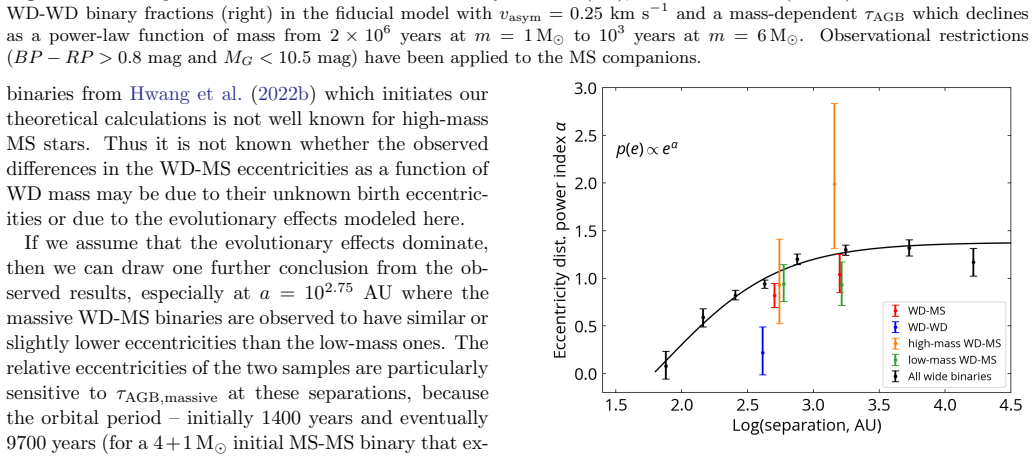
Measure the eccentricities of high-mass ($m_{\rm WD} > 0.8\,M_\odot$) versus low-mass ($0.5$–$0.8\,M_\odot$) WD-MS binaries at $1000$–$3000$ AU with a larger sample. The model predicts $\alpha \approx 1.2$–$1.4$ for massive WD-MS binaries if the mass-loss timescale is $\sim 10^3$ yr, versus $\alpha \approx 0.6$–$0.8$ if it is $\sim 10^5$ yr, so a clean measurement of the split would confirm or reject the fast mass-loss scenario.
Extended reading notes
Core claim
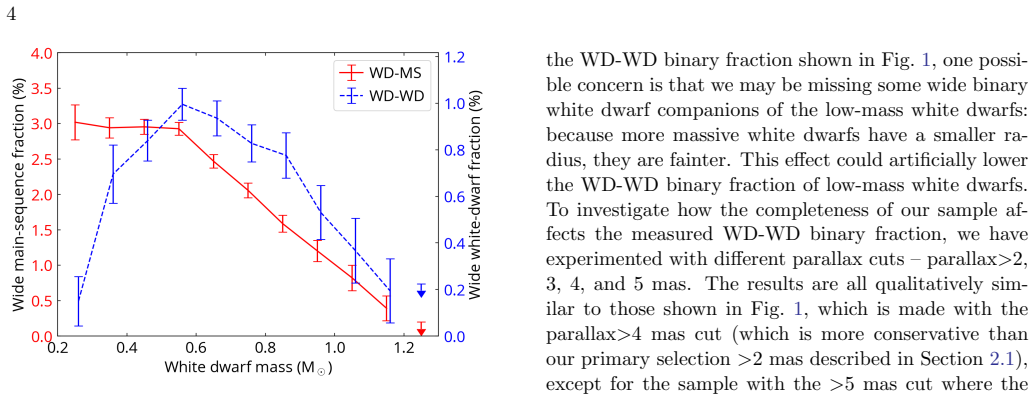
Two Gaia findings anchor the paper: the fraction of white dwarfs with a main-sequence wide companion is flat near 3% below $0.6\,M_\odot$ and falls about sixfold by $1.2\,M_\odot$, while white-dwarf–containing binaries are markedly less eccentric than MS-MS binaries at the same separations. The model's key move is to let mass loss act on any timescale relative to the orbit. Slow adiabatic loss inflates orbits, $a \propto 1/(m_1+m_2)$, pulling tighter, rounder binaries into the observed separation range and explaining the low eccentricities. The steep decline then forces a mass-loss timescale that drops with mass—from $\sim 2\times10^6$ yr at $1\,M_\odot$ to $\sim 10^3$ yr at $6\,M_\odot$ in
Load-bearing premise
The model assumes that wide binaries that will become massive white-dwarf systems are born with the same separation-dependent eccentricity distribution measured for lower-mass main-sequence binaries, but that birth distribution is not well known for high-mass stars; if it differs, the inferred mass-loss timescale changes.
Editorial extensions
If this is right
- Massive stars (≳3 $M_\odot$) must shed their envelopes on ≲10^4-year timescales; stellar evolution models that keep such stars in a slow-loss regime will fail to explain Gaia's white dwarf binary statistics.
- The low eccentricities of WD-MS and WD-WD binaries are a signature that their orbits expanded adiabatically: the binaries observed at 10^3–10^4 AU were born at smaller separations, so eccentricity measurements become a tracer of orbital expansion.
- Recoil velocities of order 0.25–1 km/s, tied to mass loss via momentum conservation, are required to steepen the wide-separation distribution; zero-recoil models are excluded.
- White dwarfs below 0.5 $M_\odot$ in wide binaries are predominantly the surviving bright components of close binaries in hierarchical triples, so their statistics open a separate window into common-envelope evolution and triple dynamics.
- High-mass white dwarfs should retain fewer exo-Oort comets and show less metal pollution than low-mass ones, a testable prediction for white dwarf atmospheric abundances.
Reading between the lines
- If the mass-dependent $\tau_{\rm AGB}$ is a real clock, then wide-binary statistics at fixed white dwarf mass can be used to map how the AGB/post-AGB transition depends on metallicity and age—something the single-population model here does not split.
- The same adiabatic-versus-impulsive framework could be applied to wide binaries containing neutron stars or black holes, potentially constraining their kicks and the timescale of core-collapse mass loss, once such samples become large enough.
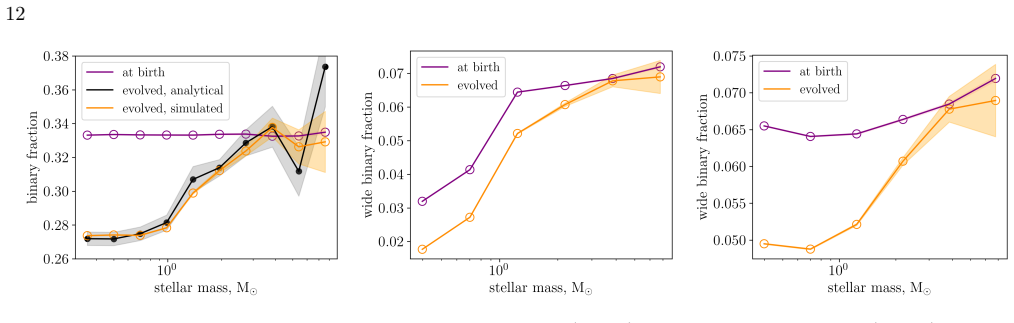
- The model's factor-of-two decline in the fiducial case falls short of the observed factor-of-six; a fully self-consistent treatment of hierarchical triples, which the paper only discusses qualitatively, may close the gap or force an even steeper $\tau_{\rm AGB}(m)$.
- Future Gaia data releases with more massive MS-MS binaries could measure the birth eccentricity distribution at the high-mass end directly, turning the eccentricity split in Figure 9 into a clean empirical determination of the mass-loss duration for ~3–4 $M_\odot$ stars.
Editorial analysis
A structured set of objections, weighed in public.
Referee Report
Summary. The paper combines Gaia wide-binary catalogs with population synthesis to study how post-main-sequence mass loss and recoil shape the orbits of wide binaries containing white dwarfs. Observationally, it reports that the WD-MS wide-binary fraction (10^3–10^4 AU) is roughly constant at low WD mass and then declines steeply by a factor ~6 above 0.6 Msun, that WD-WD binary fractions mirror this decline, and that WD-MS and WD-WD binaries have lower eccentricities than MS-MS binaries at the same separations. The modeling part computes orbital evolution for mass-loss timescales spanning the secular to impulsive regimes, with a recoil tied to mass loss through momentum conservation (Eq. 4). The authors find that adiabatic expansion explains the low eccentricities, while reproducing the steep mass-dependent binary fraction requires a mass-dependent mass-loss timescale, declining from 2×10^6 yr at 1 Msun to 10^3 yr at 6 Msun. They interpret the data as requiring short (10^3–10^4 yr) mass-loss timescales for high-mass stars, and they confirm earlier recoil constraints of ~0.25–4 km/s.
Significance. If the central inference holds, the paper provides a novel dynamical constraint on the poorly observed post-AGB mass-loss phase, and it does so with an unusually careful treatment of timescales from adiabatic to impulsive regimes. The observational sample is thoughtfully selected, with explicit completeness and robustness checks (parallax cuts, ruwe, photometry), and the paper is transparent about its model limitations, including the unmeasured initial eccentricity distribution of high-mass binaries and the quantitative mismatch with the observed factor >6 decline. A significant strength is the public availability of the population-synthesis code (GitHub/Zenodo), which makes the modeling reproducible. The predicted eccentricity difference between massive and low-mass WD-MS binaries (Fig. 9) is a falsifiable signature that could be tested with larger samples or independent high-mass eccentricity constraints. The paper should be considered a valuable contribution if the main degeneracy is addressed and the central claim is appropriately re-scaled to what the models actually demonstrate.
major comments (3)
- [Sec. 4.4 and Sec. 3.2] The inference of short tau_AGB for high-mass stars is degenerate with the unmeasured initial eccentricity distribution of high-mass MS binaries. The paper states this explicitly: the initial eccentricity distribution from Hwang et al. (2022b) 'is not well known for high-mass MS stars.' Because both the binary-fraction decline (Fig. 8) and the eccentricity split (Fig. 9) are generated from p(e) ∝ e^α with α(a) calibrated on solar-type binaries, a higher birth α for massive progenitors would steepen the disruption-driven decline and raise the final eccentricities of survivors, mimicking the signature attributed to short tau_AGB. This is a load-bearing degeneracy for the central claim. Please quantify it by repeating the population synthesis with α(a) varied over plausible ranges for high-mass stars, or by using independent eccentricity constraints for B-type / massive MS binaries. Without
- [Sec. 5 and Fig. 8] The quantitative mismatch between the fiducial model and the data is admitted: the model produces only a factor ~2 decline in WD-MS, WD-WD, and retention fractions, while the observed decline is a factor >6. This limits the strength of the conclusion. The statement that the steep decline 'requires' short tau_AGB should be softened to something like 'is directionally consistent with' or 'is necessary but not sufficient' until the model can reproduce the observed amplitude. Moreover, the tau_AGB=10^4 yr model is said to 'perform similarly' to the fiducial 10^3 yr model, so the upper bound rests on a factor-2 reproduction of a much steeper trend. Please provide a quantitative goodness-of-fit or likelihood criterion for what counts as reproducing the mass dependence, and discuss whether the gap can be closed by plausible ingredients discussed qualitatively in Sec. 4.5 (mass-dependent triple
- [Sec. 4.3–4.4] The mass-dependent tau_AGB is a free parameter chosen to fit the observed mass dependence of the binary fraction, and then the same model is used to interpret the eccentricity data. This is a partial circularity: the eccentricity split in Fig. 9 is not an independent confirmation if the tau_AGB(m) relation was already tuned to the mass-dependent binary fraction. To strengthen the predictive claim, fix tau_AGB(m) independently from stellar evolution models (e.g., Miller Bertolami 2016, with an explicit uncertainty band) and test whether the eccentricity predictions still match; alternatively, report a joint fit statistic over binary fraction and eccentricity. As written, the eccentricity comparison is a consistency check, not a confirmation.
minor comments (5)
- [Sec. 2.1] Typo: 'dusty think disk' should be 'dusty thin disk'.
- [Sec. 2.4] The text refers to 'Cumming et al. (2008)' for the initial-to-final mass relation, but the intended reference appears to be Cummings et al. (2018). Please correct the citation.
- [Eq. (5)-(6) and Sec. 3.2] Equation (6) is derived for a power-law distribution on e ∈ [0,1], but the text says alpha is computed over truncated ranges e ∈ [0,e_max] and then the median over several e_max is reported. Please state explicitly which likelihood is maximized when e_max < 1, since Eq. (6) does not apply verbatim in that case.
- [Sec. 3.2] The paper says 'we ignore the differences between intrinsic semi-major axes and observed separations for the purposes of this calculation.' Given that the eccentricity comparison uses observed projected separations, please quantify the impact of projection effects on the inferred alpha, or justify why they are subdominant.
- [Fig. 5] The left panel would benefit from an explicit note that the horizontal dashed line is the predicted v-r angle distribution for a thermal eccentricity distribution after folding at 90 deg; the current caption is slightly terse.
Circularity Check
Mild partial circularity: the mass-dependent tau_AGB is tuned to the observed binary-fraction decline, then presented as a required physical timescale; the eccentricity split provides an independent check.
-
fitted input called prediction
[Sec. 4.3 (Fig. 8) and Abstract / Sec. 5]
"The most successful model we have for simultaneously explaining these two observables involves a mass-dependent tau_AGB. Specifically, ... tau_AGB ... declines as a power-law function of mass from 2e6 years at m = 1 Msun to 1e3 years at m = 6 Msun. ... The steeply declining white dwarf binary fraction as a function of mass requires that the timescale for mass loss must be significantly shorter for high-mass stars (1e3-1e4 years) than for the low-mass ones."
The mass-dependent tau_AGB is not derived from an independent first-principles calculation; it is selected because it makes the population-synthesis model reproduce the observed steep decline of the WD-MS binary fraction (Fig. 1 vs Fig. 8). The abstract then presents this fitted choice as a physical requirement: 'the timescale for mass loss must be significantly shorter for high-mass stars.' This is the parameterization itself being promoted to a conclusion. The circularity is partial because the eccentricity split (Sec. 4.4) was not used to set tau_AGB and provides an independent (though statistically weak and degenerate with unknown birth eccentricities) test.
full rationale
The central derivation is mostly an honest forward-model inference. The paper explicitly searches over tau_AGB values, admits that constant-tau_AGB models fail, and tests the chosen mass-dependent tau_AGB against a different observable (the high-vs-low-mass WD-MS eccentricity split). The main circularity concern is that the 'requirement' of a short tau_AGB for massive stars is essentially the curve that was used to select the model; it is not an independent prediction. However, the paper does not hide this, and the eccentricity comparison is a genuine, if degenerate, check. The initial eccentricity distribution of high-mass MS stars is taken from Hwang et al. (2022b) and is acknowledged to be 'not well known for high-mass MS stars'; this is a load-bearing assumption and a source of degeneracy, but not circularity, since that prior measurement is an external empirical input rather than the paper's own target result. Given the self-citation and the fitted-parameter-as-requirement framing, a score of 2 is appropriate; the central claim retains independent content via the eccentricity test and the reference to Miller Bertolami (2016) models.
Assumptions & free parameters
free parameters (3)
- v_asym =
0.25 km/s (fiducial); explored 0.25-1.5 km/s
- τAGB(mass) =
2e6 yr at 1 Msun declining as power law to 1e3 yr at 6 Msun (fiducial); 1e4 yr also acceptable, 1e5 yr fails
- Nbinaries/Nsingles (overall wide binary fraction) =
set to 2.4% wide binary fraction (33% total binary fraction)
assumptions (6)
- domain assumption Single-star evolution: wide binaries experience no mass transfer, so components evolve independently
- domain assumption Initial eccentricity distribution p(e) ∝ e^α with α(a) from Hwang et al. (2022b)
- domain assumption Initial-to-final mass relation of Cummings et al. (2018)
- domain assumption Kroupa (2001) IMF, Duquennoy & Mayor (1991) and Fischer & Marcy (1992) period distributions, constant star formation over 12 Gyr
- ad hoc to paper Mass loss rate is constant in time, m2(t) declines linearly over τAGB
- ad hoc to paper Recoil is unidirectional with fixed direction and tied to mass loss via momentum conservation (eq. 4)
Cite this review
Pith. "Pith review of White dwarfs in wide binaries: the strong effects of stellar evolution and mass loss." pith.science (2026). https://pith.science/paper/PH5WQNF6
@misc{pith2026250808364,
  author       = {Pith},
  title        = {Pith review of: White dwarfs in wide binaries: the strong effects of stellar evolution and mass loss},
  year         = {2026},
  howpublished = {\url{https://pith.science/paper/PH5WQNF6}},
  note         = {Machine review of arXiv:2508.08364}
}
read the original abstract
We examine the statistics of main-sequence / main-sequence, main-sequence / white-dwarf and white-dwarf / white-dwarf wide binaries at 10^2.5-10^4 AU separations in Gaia data. For binaries containing a white dwarf, we find a complex dependence of the wide binary fraction on the white dwarf mass, including a steep decline as a function of mass at >0.6Msun. Furthermore, we find that wide binaries containing white dwarfs have significantly lower eccentricities than main-sequence binaries at the same separations. To model these observations, we compute the effects of post-main-sequence mass loss on the orbital parameters of wide binaries in all regimes of timescales, from secular to impulsive, and incorporate this dynamics in a population synthesis model. We find that adiabatic expansion of the orbits in binaries with slow enough evolutionary processes is the most likely explanation for the puzzling eccentricity distribution of white dwarf wide binaries. The steeply declining white dwarf binary fraction as a function of mass requires that the timescale for mass loss must be significantly shorter for high-mass stars (10^3-10^4 years) than for the low-mass ones. We confirm previous studies that suggested that recoil in the range 0.25-4 km/s is required to explain the observed distribution of separations of white dwarf wide binaries. Finally, for low-mass white dwarfs (<0.5Msun), we see interesting signatures of their formation due to close binary evolution in their wide binary statistics. Our observations and modeling provide a novel dynamical constraint on the mass-loss stages of stellar evolution that are difficult to probe with direct observations.
Figures


Figures from the paper (5 more)



Forward citations
Cited by 1 Pith paper
-
The fate of Gaia's wide binaries: Interplay of white-dwarf recoil and tidal capture
White-dwarf recoil from asymmetric AGB mass loss can drive up to 30% of wide binaries into tidal capture, forming tight WD+MS and WD+WD binaries and slow red transients.
Reference graph
Works this paper leans on
-
[1]
Abt, H. A., & Levy, S. G. 1976, ApJS, 30, 273 Astropy Collaboration, Robitaille, T. P., Tollerud, E. J., et al. 2013, A&A, 558, A33 Astropy Collaboration, Price-Whelan, A. M., Sipocz, B. M., et al. 2018, AJ, 156, 123 Astropy Collaboration, Price-Whelan, A. M., Lim, P. L., et al. 2022, ApJ, 935, 167
work page 1976
-
[2]
2020, MNRAS, 496, 1922
Belokurov, V., Penoyre, Z., Oh, S., et al. 2020, MNRAS, 496, 1922
2020
- [3]
-
[4]
2008, Galactic Dynamics: Second Edition (Princeton University Press)
Binney, J., & Tremaine, S. 2008, Galactic Dynamics: Second Edition (Princeton University Press)
2008
-
[5]
Brandt, T. D. 2021, ApJS, 254, 42
2021
-
[6]
Brown, J. M., Kilic, M., Brown, W. R., & Kenyon, S. J. 2011, ApJ, 730, 67
work page 2011
-
[7]
Brown, W. R., Kilic, M., Kenyon, S. J., & Gianninas, A. 2016, ApJ, 824, 46 3 https://pypi.org/project/mcint/
work page 2016
-
[8]
R., Kilic, M., Kosakowski, A., & Gianninas, A
Brown, W. R., Kilic, M., Kosakowski, A., & Gianninas, A. 2022, ApJ, 933, 94
work page 2022
Show all 65 references
-
[9]
R., Kilic, M., Kosakowski, A., et al
Brown, W. R., Kilic, M., Kosakowski, A., et al. 2020, ApJ, 889, 49
2020
-
[10]
E., Althaus, L
Camisassa, M. E., Althaus, L. G., C´ orsico, A. H., et al. 2019, A&A, 625, A87
2019
-
[11]
D., & M´ enard, B
Cheng, S., Cummings, J. D., & M´ enard, B. 2019, ApJ, 886, 100
2019
-
[12]
R., Chandra, V., Zakamska, N
Crumpler, N. R., Chandra, V., Zakamska, N. L., et al. 2024, ApJ, 977, 237
2024
-
[13]
P., Marcy, G
Cumming, A., Butler, R. P., Marcy, G. W., et al. 2008, PASP, 120, 531
2008
-
[14]
2018, ApJ, 866, 21
Ramirez-Ruiz, E., & Choi, J. 2018, ApJ, 866, 21
2018
-
[15]
2019, Nature Astronomy, 3, 408
Decin, L., Homan, W., Danilovich, T., et al. 2019, Nature Astronomy, 3, 408
2019
-
[16]
Lau, H. H. B. 2015, MNRAS, 446, 2599
2015
-
[17]
2023, A&A, 675, A89 Duchˆ ene, G., & Kraus, A
Donada, J., Anders, F., Jordi, C., et al. 2023, A&A, 675, A89 Duchˆ ene, G., & Kraus, A. 2013, ARA&A, 51, 269
2023
-
[18]
1991, A&A, 248, 485 20
Duquennoy, A., & Mayor, M. 1991, A&A, 248, 485 20
1991
-
[19]
2018, MNRAS, 480, 4884
El-Badry, K., & Rix, H.-W. 2018, MNRAS, 480, 4884
2018
-
[20]
El-Badry, K., Rix, H.-W., & Heintz, T. M. 2021, MNRAS, 506, 2269
2021
-
[21]
2018, MNRAS, 476, 528
El-Badry, K., Ting, Y.-S., Rix, H.-W., et al. 2018, MNRAS, 476, 528
2018
-
[22]
W., Riello, M., De Angeli, F., et al
Evans, D. W., Riello, M., De Angeli, F., et al. 2018, A&A, 616, A4
2018
-
[23]
B., Hwang, H.-C., & Zakamska, N
Fezenko, G. B., Hwang, H.-C., & Zakamska, N. L. 2022, MNRAS, 511, 3881
2022
-
[24]
A., & Marcy, G
Fischer, D. A., & Marcy, G. W. 1992, ApJ, 396, 178
1992
-
[25]
2001, PASP, 113, 409
Fontaine, G., Brassard, P., & Bergeron, P. 2001, PASP, 113, 409
2001
-
[26]
M., Richer, H
Fregeau, J. M., Richer, H. B., Rasio, F. A., & Hurley, J. R. 2009, ApJL, 695, L20 Gentile Fusillo, N. P., Tremblay, P.-E., G¨ ansicke, B. T., et al. 2019, MNRAS, 482, 4570 Gentile Fusillo, N. P., Tremblay, P. E., Cukanovaite, E., et al. 2021, MNRAS, 508, 3877
2009
-
[27]
R., van Loon, J
Goldman, S. R., van Loon, J. T., Zijlstra, A. A., et al. 2017, MNRAS, 465, 403
2017
-
[28]
2023, A&A, 674, A9
Halbwachs, J.-L., Pourbaix, D., Arenou, F., et al. 2023, A&A, 674, A9
2023
-
[29]
H., & Schlaufman, K
Hamer, J. H., & Schlaufman, K. C. 2019, AJ, 158, 190
2019
-
[30]
2022, ApJL, 929, L29
Hamilton, C. 2022, ApJL, 929, L29
2022
-
[31]
2024, MNRAS, 532, 2425
Hamilton, C., & Modak, S. 2024, MNRAS, 532, 2425
2024
-
[32]
D., & L´ epine, S
Hartman, Z. D., & L´ epine, S. 2020, ApJS, 247, 66
2020
-
[33]
1986, Icarus, 65, 13 H¨ ofner, S., & Olofsson, H
Heisler, J., & Tremaine, S. 1986, Icarus, 65, 13 H¨ ofner, S., & Olofsson, H. 2018, A&A Rv, 26, 1
1986
-
[34]
2023, MNRAS, 518, 1750
Hwang, H.-C. 2023, MNRAS, 518, 1750
2023
-
[35]
Hwang, H.-C., Ting, Y.-S., Cheng, S., & Speagle, J. S. 2024, MNRAS, 528, 4272
2024
-
[36]
C., Zakamska, N
Hwang, H.-C., Ting, Y.-S., Schlaufman, K. C., Zakamska, N. L., & Wyse, R. F. G. 2021, MNRAS, 501, 4329
2021
-
[37]
Hwang, H.-C., & Zakamska, N. L. 2020, MNRAS, 493, 2271
2020
-
[38]
1990, ApJ, 353, 215
Iben, Icko, J. 1990, ApJ, 353, 215
1990
-
[39]
G., Dermine, T., & Church, R
Izzard, R. G., Dermine, T., & Church, R. P. 2010, A&A, 523, A10
2010
-
[40]
2010, MNRAS, 401, 977
Jiang, Y.-F., & Tremaine, S. 2010, MNRAS, 401, 977
2010
-
[41]
C., Bergeron, P., Genest-Beaulieu, C., & Rowell, N
Kilic, M., Hambly, N. C., Bergeron, P., Genest-Beaulieu, C., & Rowell, N. 2018, MNRAS, 479, L113
2018
-
[42]
Y., & Katz, B
Klein, Y. Y., & Katz, B. 2017, MNRAS, 465, L44
2017
-
[43]
2001, MNRAS, 322, 231
Kroupa, P. 2001, MNRAS, 322, 231
2001
-
[44]
U., Neunteufel, P
Kruckow, M. U., Neunteufel, P. G., Di Stefano, R., Gao, Y., & Kobayashi, C. 2021, ApJ, 920, 86
2021
-
[45]
Lamers, H. J. G. L. M., & Levesque, E. M. 2017, Understanding Stellar Evolution (Bristol, UK: IOP Publishing), doi:10.1088/978-0-7503-1278-3
2017 doi
-
[46]
West, A. A. 2010, ApJ, 720, 1727
2010
-
[47]
1962, Planetary and Space Science, 9, 719
Lidov, M. 1962, Planetary and Space Science, 9, 719
1962
-
[48]
2018, A&A, 616, A2
Lindegren, L., Hernandez, J., Bombrun, A., et al. 2018, A&A, 616, A2
2018
-
[49]
Burleigh, M. R. 2006, Nature, 442, 543 Miller Bertolami, M. M. 2016, A&A, 588, A25
2006
-
[50]
2023, MNRAS, 524, 3102
Modak, S., & Hamilton, C. 2023, MNRAS, 524, 3102
2023
-
[51]
2017, ApJS, 230, 15
Moe, M., & Di Stefano, R. 2017, ApJS, 230, 15
2017
-
[52]
D., & Dermott, S
Murray, C. D., & Dermott, S. F. 1999, Solar system dynamics (Cambridge Univ. Press) O’Connor, C. E., Lai, D., & Seligman, D. Z. 2023, MNRAS, 524, 6181 Paczy´ nski, B. 1971, ARA&A, 9, 183
1999
-
[53]
2024, MNRAS, 530, 2526
Pham, D., & Rein, H. 2024, MNRAS, 530, 2526
2024
-
[54]
A., Henry, T
Raghavan, D., McAlister, H. A., Henry, T. J., et al. 2010, ApJS, 190, 1
2010
-
[55]
2012, A&A, 537, A128
Rein, H., & Liu, S.-F. 2012, A&A, 537, A128
2012
-
[56]
G., Miller Bertolami, M
Renedo, I., Althaus, L. G., Miller Bertolami, M. M., et al. 2010, ApJ, 717, 183
2010
-
[57]
1998, A&A, 337, 149
Steffen, M., Szczerba, R., & Schoenberner, D. 1998, A&A, 337, 149
1998
-
[58]
2014, AJ, 147, 87
Tokovinin, A. 2014, AJ, 147, 87
2014
-
[59]
2017, MNRAS, 468, 3461
Tokovinin, A. 2017, MNRAS, 468, 3461
2017
-
[60]
2006, A&A, 450, 681
Tokovinin, A., Thomas, S., Sterzik, M., & Udry, S. 2006, A&A, 450, 681
2006
-
[61]
Tokovinin, A. A. 1998, Astronomy Letters, 24, 178 van Roestel, J., Kupfer, T., Bell, K. J., et al. 2021, ApJL, 919, L26
1998
-
[62]
Vassiliadis, E., & Wood, P. R. 1994, ApJS, 92, 125
1994
-
[63]
Weiss, A., & Ferguson, J. W. 2009, A&A, 508, 1343
2009
-
[64]
2023, ApJL, 949, L28
Xu, S., Hwang, H.-C., Hamilton, C., & Lai, D. 2023, ApJL, 949, L28
2023
-
[65]
Zakamska, N., & Hwang, H.-C. 2025, Software for computing the effects of stellar evolution and mass loss on orbits of wide stellar binaries, urlhttps://zenodo.org/record/15991774, v.1.0, Zenodo, doi:10.5281/zenodo.15991774
2025
Reviewed August 5, 2026 · model on record in the stance chip above.
Discussion (0). Continue with ORCID to comment.