Uncertainty-Aware Ideal Point Estimation via Variational EM
Pith reviewed 2026-05-20 02:49 UTC · model grok-4.3
The pith
A variational EM algorithm estimates ideal points and standard errors from roll-call data more efficiently than MCMC or bootstrap.
A machine-rendered reading of the paper's core claim, the machinery that carries it, and where it could break.
Core claim
Leveraging the Pólya-Gamma identity, the authors derive a variational EM algorithm for maximum likelihood estimation of ideal points and introduce a variational Louis' method to approximate the observed information matrix for standard error computation. Numerical studies and applications to U.S. congressional roll-call data show that the resulting ideal point estimates match those from established methods while the approximated standard errors are reliable, all with substantially lower computation time than MCMC-based Bayesian approaches or bootstrap procedures.
What carries the argument
Variational expectation-maximization algorithm that exploits the Pólya-Gamma identity, combined with a variational Louis' method to approximate the observed Fisher information matrix.
If this is right
- The method scales to larger roll-call datasets where full MCMC sampling becomes prohibitive.
- Standard errors are obtained directly from the approximated information matrix without requiring separate resampling.
- Numerical validation on simulated data and real U.S. congressional records confirms comparable accuracy to existing methods.
- Overall runtime is reduced substantially relative to Bayesian MCMC or bootstrap alternatives.
Where Pith is reading between the lines
- The efficiency improvement could support repeated analyses of evolving legislative voting patterns over time.
- Similar variational approximations might extend to multidimensional or dynamic ideal point models.
- The approach could integrate into pipelines that combine ideal point estimation with other political data sources.
Load-bearing premise
The variational approximations in the EM algorithm and the variational Louis' method are sufficiently accurate to recover reliable ideal point estimates and standard errors without material bias from the approximation.
What would settle it
Running both the variational method and a converged MCMC sampler on the same moderately large congressional roll-call dataset and verifying whether the ideal point point estimates and standard errors agree within Monte Carlo sampling error.
Figures




read the original abstract
Roll-call data analysis aims to estimate legislators' ideal points and quantify the associated uncertainty. Existing approaches either rely on Bayesian methods implemented via Markov chain Monte Carlo sampling or focus primarily on point estimation, with uncertainty typically assessed through resampling procedures such as the bootstrap. Consequently, the computational burden of these approaches can become substantial when applied to large roll-call datasets. To address this challenge, we propose a computationally efficient likelihood method for estimating ideal points and their standard errors. Leveraging the P\'{o}lya--Gamma identity, we develop a variational expectation--maximization algorithm for estimating ideal points and introduce a variational Louis' method to approximate the observed Fisher information for standard error estimation. Numerical studies and applications to U.S. congressional roll-call data demonstrate that the proposed method produces accurate ideal point estimates and reliable standard errors while being substantially more computationally efficient than existing approaches.
Editorial analysis
A structured set of objections, weighed in public.
Referee Report
Summary. The manuscript proposes a variational EM algorithm that uses the Pólya-Gamma augmentation to obtain maximum-likelihood estimates of ideal points and bill parameters from binary roll-call data, together with a variational Louis' method that approximates the observed information matrix to produce standard errors. Numerical experiments and an application to U.S. congressional roll-call data are presented to show that the resulting point estimates are accurate, the standard errors are reliable, and the procedure is substantially faster than MCMC or bootstrap alternatives.
Significance. If the variational approximations remain accurate for the sparse, high-dimensional binary matrices that arise in roll-call analysis, the method would supply a practical likelihood-based route to uncertainty quantification that scales to large legislatures without the computational cost of sampling or resampling.
major comments (2)
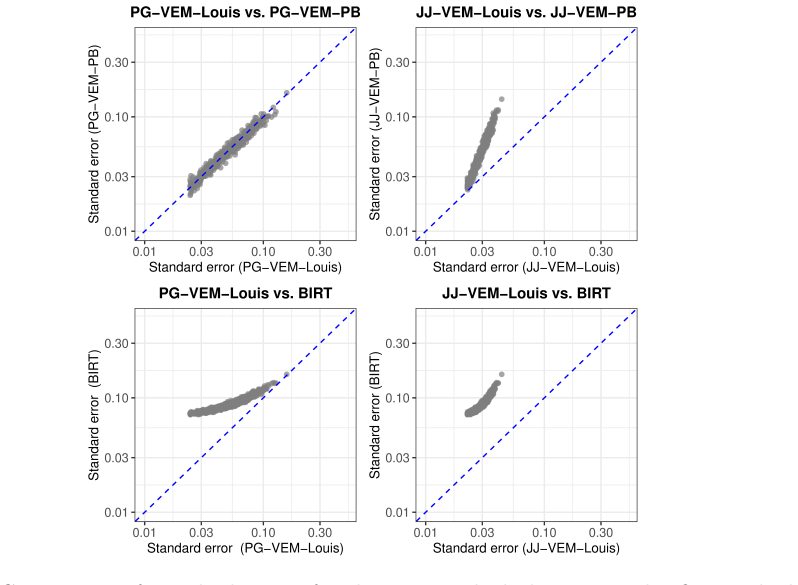
- [§3.3] §3.3 (Variational Louis' method): the claim that the variational approximation to the observed information yields reliable standard errors rests on the tightness of the mean-field lower bound and the quality of the variational posterior; no diagnostic (e.g., comparison of variational vs. MCMC information matrices on the same simulated sparse matrices) or error bound is supplied, leaving open the possibility that correlations induced by the sparse binary design systematically bias the reported standard errors.
- [Table 2 and §5.1] Table 2 and §5.1 (simulation design): the reported coverage rates and RMSE values are shown only for moderate-dimensional, relatively dense designs; it is unclear whether the same accuracy holds for the sparse, high-dimensional regimes that characterize real congressional data, which is the setting where the computational advantage is most needed.
minor comments (2)
- The notation for the variational parameters (q(·)) and the augmented variables is introduced without a consolidated table; a single reference table would improve readability.
- [Figure 3] Figure 3 caption should explicitly state the number of Monte Carlo replications used to compute the empirical coverage.
Simulated Author's Rebuttal
We thank the referee for the constructive comments, which help clarify the scope and limitations of our variational approach. We respond to each major comment below and indicate planned revisions.
read point-by-point responses
-
Referee: [§3.3] §3.3 (Variational Louis' method): the claim that the variational approximation to the observed information yields reliable standard errors rests on the tightness of the mean-field lower bound and the quality of the variational posterior; no diagnostic (e.g., comparison of variational vs. MCMC information matrices on the same simulated sparse matrices) or error bound is supplied, leaving open the possibility that correlations induced by the sparse binary design systematically bias the reported standard errors.
Authors: We agree that direct diagnostics comparing the variational information matrix to MCMC on sparse matrices would strengthen the reliability claim. The existing numerical studies show coverage rates near nominal levels, but we did not perform the specific sparse-matrix comparison suggested. We will add this diagnostic in a revised §5.1. A rigorous theoretical error bound for the mean-field approximation under sparse binary designs is not derived in the manuscript and would require substantial additional analysis beyond the current scope. revision: partial
-
Referee: [Table 2 and §5.1] Table 2 and §5.1 (simulation design): the reported coverage rates and RMSE values are shown only for moderate-dimensional, relatively dense designs; it is unclear whether the same accuracy holds for the sparse, high-dimensional regimes that characterize real congressional data, which is the setting where the computational advantage is most needed.
Authors: The simulation designs in §5.1 include varying dimensions and densities to illustrate performance, yet we acknowledge they do not exhaustively cover the extreme sparsity levels typical of congressional roll-call matrices. The real-data application in §6 demonstrates scalability and sensible uncertainty estimates on actual sparse data. We will expand the simulation section with additional sparse, high-dimensional cases to directly address this concern. revision: yes
- Deriving a rigorous theoretical error bound for the variational approximation to the observed information matrix under sparse binary designs
Circularity Check
No circularity: standard variational EM and Louis identities applied to ideal-point model
full rationale
The derivation uses the established Pólya-Gamma data-augmentation identity to obtain a variational EM algorithm for the ideal-point likelihood and applies a variational version of Louis' method to approximate the observed information matrix. Neither step defines the target quantities (ideal-point MLEs or standard errors) in terms of themselves, nor renames fitted parameters as predictions. The central claims rest on the correctness of these standard identities under the stated variational family, which is externally verifiable and not reduced by construction to the paper's own fitted values or self-citations. Numerical studies serve as external validation rather than definitional tautology.
Axiom & Free-Parameter Ledger
axioms (1)
- standard math The Pólya-Gamma identity holds and can be used to augment the logistic function in the roll-call voting model for variational inference.
Lean theorems connected to this paper
-
IndisputableMonolith/Cost/FunctionalEquation.leanwashburn_uniqueness_aczel unclear?
unclearRelation between the paper passage and the cited Recognition theorem.
Leveraging the Pólya–Gamma identity, we develop a variational expectation–maximization algorithm for estimating ideal points and introduce a variational Louis’ method to approximate the observed Fisher information
-
IndisputableMonolith/Foundation/RealityFromDistinction.leanreality_from_one_distinction unclear?
unclearRelation between the paper passage and the cited Recognition theorem.
the proposed method produces accurate ideal point estimates and reliable standard errors while being substantially more computationally efficient
What do these tags mean?
- matches
- The paper's claim is directly supported by a theorem in the formal canon.
- supports
- The theorem supports part of the paper's argument, but the paper may add assumptions or extra steps.
- extends
- The paper goes beyond the formal theorem; the theorem is a base layer rather than the whole result.
- uses
- The paper appears to rely on the theorem as machinery.
- contradicts
- The paper's claim conflicts with a theorem or certificate in the canon.
- unclear
- Pith found a possible connection, but the passage is too broad, indirect, or ambiguous to say the theorem truly supports the claim.
Reference graph
Works this paper leans on
-
[1]
American Political Science Review , volume=
Fast estimation of ideal points with massive data , author=. American Political Science Review , volume=
-
[2]
British Journal of Mathematical and Statistical Psychology , volume=
Gaussian variational estimation for multidimensional item response theory , author=. British Journal of Mathematical and Statistical Psychology , volume=
-
[3]
Statistics and Computing , volume=
Bayesian parameter estimation via variational methods , author=. Statistics and Computing , volume=
-
[4]
Sixth International Workshop on Artificial Intelligence and Statistics , pages=
A variational approach to Bayesian logistic regression models and their extensions , author=. Sixth International Workshop on Artificial Intelligence and Statistics , pages=
-
[5]
Pattern Recognition and Machine Learning , author =
-
[6]
Journal of the American Statistical Association , volume=
Variational inference: A review for statisticians , author=. Journal of the American Statistical Association , volume=
-
[7]
American Political Science Review , volume=
The statistical analysis of roll call data , author=. American Political Science Review , volume=
-
[8]
American Journal of Political Science , volume =
A spatial model for legislative roll call analysis , author=. American Journal of Political Science , volume =
-
[9]
Applied Psychological Measurement , volume=
A Note on Standard Errors for Multidimensional Two-Parameter Logistic Models Using Gaussian Variational Estimation , author=. Applied Psychological Measurement , volume=
-
[10]
Bayesian inference for logistic models using
Polson, Nicholas G and Scott, James G and Windle, Jesse , journal=. Bayesian inference for logistic models using
-
[11]
Measuring bias and uncertainty in
Carroll, Royce and Lewis, Jeffrey B and Lo, James and Poole, Keith T and Rosenthal, Howard , journal=. Measuring bias and uncertainty in
-
[12]
Statistical Theories of Mental Test Scores , year=
Some latent trait models and their use in inferring an examinee's ability , author=. Statistical Theories of Mental Test Scores , year=
-
[13]
James O. Berger and Robert L. Wolpert and M. J. Bayarri and M. H. DeGroot and Bruce M. Hill and David A. Lane and Lucien LeCam , title =. Lecture Notes-Monograph Series , volume =
-
[14]
Journal of the Royal Statistical Society Series B: Statistical Methodology , volume=
Finding the observed information matrix when using the EM algorithm , author=. Journal of the Royal Statistical Society Series B: Statistical Methodology , volume=
-
[15]
A missing information principle: theory and applications , author=. Proceedings of the Sixth Berkeley Symposium on Mathematical Statistics and Probability, Volume 1: Theory of Statistics , volume=
-
[16]
An introduction to variational methods for graphical models , author=. Machine Learning , volume=
-
[17]
Journal of Multivariate Analysis , volume=
From moments of sum to moments of product , author=. Journal of Multivariate Analysis , volume=
-
[18]
Measuring bias and uncertainty in ideal point estimates via the parametric bootstrap , author=. Political Analysis , volume=
-
[19]
The geometry of multidimensional quadratic utility in models of parliamentary roll call voting , author=. Political Analysis , volume=
-
[20]
American Journal of Political Science , volume=
The structure of utility in spatial models of voting , author=. American Journal of Political Science , volume=
-
[21]
Journal of the American Statistical Association , volume=
_1 -based Bayesian Ideal Point Model for Multidimensional Politics , author=. Journal of the American Statistical Association , volume=
-
[22]
The Spatial Theory of Voting: An Introduction , author=. 1984 , address=
work page 1984
-
[23]
Journal of the Royal Statistical Society Series B: Statistical Methodology , volume=
Hierarchical generalized linear models , author=. Journal of the Royal Statistical Society Series B: Statistical Methodology , volume=
-
[24]
Computational Statistics & Data Analysis , volume=
Standard error estimates in hierarchical generalized linear models , author=. Computational Statistics & Data Analysis , volume=
-
[25]
Hierarchical generalised linear models: a synthesis of generalised linear models, random-effect models and structured dispersions , author=. Biometrika , volume=
-
[26]
Structural Equation Modeling: A Multidisciplinary Journal , volume=
H-likelihood approach to factor analysis for ordinal data , author=. Structural Equation Modeling: A Multidisciplinary Journal , volume=
discussion (0)
Sign in with ORCID, Apple, or X to comment. Anyone can read and Pith papers without signing in.