REVIEW 3 major objections 4 minor 47 references
Rotational magnetoelastic interactions in the Dzyaloshinskii-Moriya magnet Ba$_2$CuGe$_2$O$_7$
T0 review · 3 major / 4 minor · reviewed 2026-08-10 · deepseek-v4-flash
Pith's one-line read In Ba2CuGe2O7, only the in-plane transverse sound mode probes the cycloidal order, and a DM-based rotational mechanism explains why.
desk verdict Useful ultrasound data on Ba2CuGe2O7 with an honestly labeled toy model; the experimental result is solid, the theory needs significant rework before the mechanism claim is safe. read the letter →
The pith
A machine-rendered reading of the paper's core claim, the machinery that carries it, and where it could break.
The reading
What carries the argument
The load-bearing object is the rotational magnetoelastic coupling: a transverse acoustic wave with $\mathbf{k}\parallel[110]$ rotates the copper-copper bond around the $z$ axis without changing its length, and because the Dzyaloshinskii-Moriya vector obeys $\mathbf{D}\propto\boldsymbol{\delta}\times\boldsymbol{\delta}_{\perp}$, that rotation changes the $y$-component of $\mathbf{D}$ while the bond length stays fixed. The mathematical engine is the second derivative of the off-diagonal exchange $\bar{J}^{xz}_{x}$ with respect to the $y$ component of the atomic displacement, evaluated with the ansatz $\bar{J}^{xz}_{x}=D\cos(Q^{\delta}_{y}/\delta)$, which gives $\partial^{2}\bar{J}^{xz}_{x}/\partial R_{y}^{2}=D/\delta^{2}$ and vanishing derivatives in $R_{x}$ and $R_{z}$. Substituting this into the long-wavelength phonon self-energy yields Eq. (9), whose factor $(\mathbf{u}_{k}\cdot\mathbf{y})$ selects exactly the in-plane transverse mode.
What would settle it
Measure the in-plane transverse-mode sound-velocity anomaly at zero field and compare its magnitude with the prefactor in Eq. (9) using known J, D, S, v, and delta; a large mismatch would invalidate the model. A more direct check is to compute the second derivative of the off-diagonal exchange coupling along the Cu-O-Ge-O-Cu path from first principles and see whether it equals D/$delta^{2}$ with negligible Rx and Rz derivatives.
Extended reading notes
Core claim
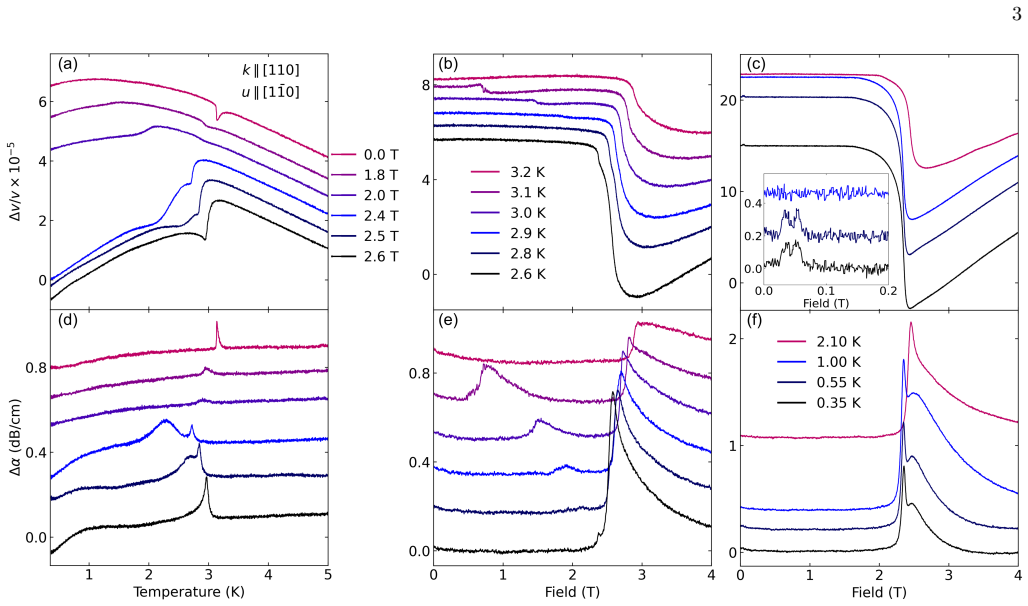
On its own terms, the paper's central discovery is the mode-selective spin-lattice coupling in Ba2CuGe2O7 and its attributed origin. The zero-field Néel transition is clearly visible in the in-plane transverse acoustic mode with $\mathbf{k}\parallel[110]$ and $\mathbf{u}\parallel[1\bar{1}0]$, but is almost absent in the longitudinal mode, and the $\mathbf{u}\parallel[001]$ transverse mode couples mainly to the intermediate AF-cone phase. The authors rule out simple exchange striction as the dominant zero-field mechanism. Starting from the spin Hamiltonian of Ref. [13] and expanding the coupling matrices in atomic displacements, they show that an isotropic exponential bond-length dependence would couple only the longitudinal mode, in contradiction with experiment. They then introduce the ansatz $\bar{J}^{xz}_{x}=D^{y}_{x}=D\cos(Q^{\delta}_{y}/\delta)$, with the DM vector rotating with the bond, which yields for the sound-velocity change $(\Delta v/v)' = 2DS^{2}\sin\alpha/(M_{0} v^{2} \delta^{2})(\mathbf{u}_{k}\cdot\mathbf{y})$, nonzero only for $\mathbf{u}_{k}\parallel\mathbf{y}$. This is the paper's explanation of why the in-plane transverse mode is the unique low-field acoustic probe of the cycloid.
Load-bearing premise
The prediction collapses if the actual angular dependence of the DM vector under bond rotation differs from the assumed ansatz (only the y-component varies, with derivatives in Rx and Rz exactly zero), an angular dependence that the paper asserts rather than derives from the microscopic superexchange paths.
Editorial extensions
If this is right
- The longitudinal acoustic mode is not a sensitive detector of the zero-field Néel transition in Ba2CuGe2O7; the in-plane transverse mode is the symmetry-selected probe for the cycloid phase.
- The model predicts that for $\mathbf{k}\parallel[110]$ the $\mathbf{u}\parallel[001]$ transverse mode will show no cycloid-related anomaly at zero field, because its rotation around the $y$ axis affects only the $z$-component of the DM vector.
- Exchange striction alone cannot explain the observed anomalies, since its isotropic bond-length dependence would couple the longitudinal mode, which is not observed.
- In the field-induced AF-cone phase the roles switch, with the $\mathbf{u}\parallel[001]$ transverse mode showing the stronger anomaly, consistent with the spin reorientation changing which DM component is active.
Reading between the lines
- Inference: Eq. (9) gives a quantitative prediction for the zero-field sound-velocity step; comparing its magnitude with measured values would test the ansatz, since the paper does not carry out that numerical comparison.
- Inference: the rotational mechanism implies that in other DM helimagnets the acoustic mode that couples to spiral order is dictated by the geometry of the DM vector relative to the bond-rotation axis, so ultrasound could be used as a symmetry probe of DM couplings.
- Inference: the linear $U^{1}_{k}$ term, discarded in the toy model, should produce additional attenuation features at finite frequencies; looking for a matching attenuation peak in the same mode would check whether the rotational coupling also affects phonon damping.
Editorial analysis
A structured set of objections, weighed in public.
Referee Report
Summary. The paper reports ultrasound sound-velocity and attenuation measurements on a single crystal of Ba2CuGe2O7 with k ∥ [110] and three polarizations, in magnetic fields up to 4 T along [001]. The authors extend the H–T phase diagram to low temperatures, confirm the cycloidal, AF-cone, and collinear phases identified previously by neutron scattering, and observe mode-selective couplings: the in-plane transverse mode (u ∥ [1̄10]) couples most strongly to the cycloidal phase, the transverse mode with u ∥ [001] couples to the AF-cone transition, and the longitudinal mode does not couple to the Néel transition at zero field. To explain the in-plane transverse-mode coupling, the authors introduce a toy model in Sec. V in which the Dzyaloshinskii-Moriya vector rotates with the Cu–Cu bond, leading to Eq. (9) for the sound-velocity change that is nonzero only for the in-plane transverse mode.
Significance. The experimental data appear internally consistent and the phase boundaries above 1.5 K match prior neutron and thermodynamic results, providing a useful extension of the phase diagram to low temperatures and low fields. The observation that a transverse acoustic mode couples to the cycloidal order while the longitudinal mode does not is an interesting counterexample to the usual exchange-striction picture and may point to a DM-based rotational magnetoelastic mechanism. The strength of the paper is the clear symmetry-selective experimental phenomenology; the theoretical model, however, is explicitly a toy model and, as written, contains a dimensional inconsistency and relies on an underived ansatz. If the model can be placed on firmer footing, the proposed mechanism would be a significant contribution to the magnetoelastic literature, but in its current form the theoretical conclusion is not quantitatively established.
major comments (3)
- [Sec. V, Eq. (9)] The printed Eq. (9) is dimensionally inconsistent. In Eq. (7), the factor (e_k · δ)^2 for the x-bond is δ^2, and the assumed second derivative is D/δ^2; these cancel, so the denominator should be M0 v^2, not M0 v^2 δ^2. As written, the right-hand side has dimensions of inverse length squared. Additionally, Eq. (7) is quadratic in the polarization components, so the factor should be (u_k · y)^2 rather than (u_k · y). These are not cosmetic issues: the quantitative prediction of the model is not actually stated in a dimensionally valid form.
- [Sec. V, ansatz preceding Eq. (9)] The central mode selectivity—nonzero only for u_k ∥ y—rests entirely on the assumed form Jbar_x^{xz} = D cos(Q_y^δ/δ) and on the assertions ∂Jbar_x^{xz}/∂R_x = ∂Jbar_x^{xz}/∂R_z = 0. These derivatives are asserted rather than derived from the microscopic geometry of the Cu–O–Ge–O–Cu superexchange path. The paper argues qualitatively from Fig. 6(b) that rotation around z affects the y-component of D, but a quantitative evaluation of the derivative of the DM vector under a general displacement pattern (including internal strain of the GeO4 tetrahedron) is not provided. Since the experimental observation is independent of the model, this does not invalidate the data, but it means the proposed mechanism is not conclusively established. The authors should either derive the derivative from a microscopic model or clearly state that the calculation is a demonstration of a possible mechanism rather than a prediction.
- [Sec. V, after Eq. (9)] No quantitative comparison is made between the predicted Δv/v and the measured magnitudes, which are of order 10^-5 to 10^-4. Even with the corrected dimensional form, the model contains known parameters (D, J, S, M0, v), so an order-of-magnitude estimate would be feasible and would substantially strengthen the claim that the DM-based rotational mechanism can explain the observed effect. Without such a check, the agreement between the model and experiment is only at the level of symmetry selection.
minor comments (4)
- [Introduction, reference [7]] In the Introduction, the spiral order of Ba2CuGe2O7 with propagation vector (1±ζ, ±ζ, 0) is attributed to Ref. [7], but that reference is for Ba2CoGe2O7; the appropriate citation for the Cu compound is Ref. [8] or Ref. [10]. The same mis-citation occurs in Sec. IV where the double-Q AF-cone structure is attributed to Ref. [7].
- [Sec. IV, text near 'transvserse'] There is a typo in Sec. IV: 'transvserse acoustic modes' should be 'transverse acoustic modes'.
- [Sec. V, Eq. (9), notation] The notation (u_k · y) in Eq. (9) is ambiguous because Eq. (7) contains a product of two polarization components; it should be written as (u_k · y)^2 or, equivalently, |u_k · y|^2.
- [Sec. II, crystal orientation] The paper does not state explicitly whether the [1̄10] and [001] polarizations were measured on the same polished (110) faces and how the transducer alignment uncertainty affects the reported mode assignment. A brief statement on the accuracy of the polarization orientation would help.
Circularity Check
Eq. (9)'s mode selectivity is built into the cos(Q_y^δ/δ) ansatz; the toy model reproduces its own input rather than deriving it.
-
self definitional
[Section V, ansatz before Eq. (9)]
"Since only the Dy component affects the cycloid order, we obtain that only the in-plane plane transverse acoustic mode couples to the cycloid order at zero field. This is reproduced by the following ansatz: ¯J xz x = Dy x = D cos(Qy δ /δ). With this ansatz ... (Δv/v)′ = ... which is thus non-zero only for the in-plane transverse mode uk ∥ y."
The conclusion 'only the in-plane transverse mode couples' is the input assumption. The ansatz sets ∂²J_x^{xz}/∂R_y² = D/δ² and ∂J_x^{xz}/∂R_x = ∂J_x^{xz}/∂R_z = 0, which, inserted into Eq. (7) with (e_k·δ)² = δ² for k∥[110], leaves only the u_k·y projection. Thus Eq. (9) is the ansatz rewritten, not an independent derivation from the DM superexchange geometry. The preceding geometric paragraph already asserts that only the Dy component affects the cycloid order, so the calculation adds no new content. No microscopic calculation of how D rotates under Cu/GeO4 relative displacements is given, and no quantitative comparison of the predicted Δv/v magnitude with the measured changes is made. The paper itself labels the model a 'toy model' that is 'consistent with our experiments'.
full rationale
The ultrasound data and the extended H-T phase diagram are genuine experimental results and are not derivative of the model; no numerical parameters are fitted to the measured sound-velocity changes. The circularity is confined to the theoretical Sec. V. There, the central theoretical claim—that the in-plane transverse mode (u ∥ y) couples to the cycloidal order while the longitudinal and out-of-plane transverse modes do not—is not obtained from a first-principles derivative of the DM interaction but is put in by hand through the ansatz Jbar_x^{xz} = D cos(Q_y^δ/δ), together with the assertion that the R_x and R_z derivatives vanish. Since Eq. (9) is exactly this input projected onto u_k·y, the 'prediction' of mode selectivity reduces by construction. Additionally, Eq. (9) contains a dimensional inconsistency relative to Eq. (7): the δ² from (e_k·δ)² should cancel the 1/δ² from the second derivative, so the denominator should be M0 v², not M0 v² δ²; this further indicates that the quantitative expression is asserted rather than derived. None of this depends on self-citation: Ref. [13] provides the starting Hamiltonian and Ref. [37] the phonon-coupling formalism, but the circular step is internal to this paper's ansatz. Overall score 6: the experimental finding is independent, but the central theoretical result is encoded in its own input assumption.
Assumptions & free parameters
assumptions (5)
- domain assumption The nearest-neighbor J-D Hamiltonian of Ref. [13], Eq. (1), with the anisotropy term D^2/(2J) neglected, describes the spin physics of Ba2CuGe2O7.
- domain assumption Phonons are harmonic and only the U^2 term (quadratic in phonon operators) contributes to Delta v / v; the linear U^1 term is discarded.
- standard math For homogeneous spin configurations, spin-spin products factor as S^alpha_0 S^beta_delta in a locally rotating frame with S0 = (0,0,S) and S_delta = -(S sin(alpha), 0, S cos(alpha)).
- ad hoc to paper The DM vector angular dependence under bond rotation is Jbar_x^{xz} = D^y_x = D cos(Q_y^delta / delta), with derivatives with respect to R_x and R_z set to zero.
- domain assumption The sign-alternating z-component of the DM vector does not contribute because the cycloid lies in the (x,z) plane, so only the uniform y-component matters.
Cite this review
Pith. "Pith review of Rotational magnetoelastic interactions in the Dzyaloshinskii-Moriya magnet Ba$_2$CuGe$_2$O$_7$." pith.science (2026). https://pith.science/paper/PK25Z7IJ
@misc{pith2026250104808,
  author       = {Pith},
  title        = {Pith review of: Rotational magnetoelastic interactions in the Dzyaloshinskii-Moriya magnet Ba$_2$CuGe$_2$O$_7$},
  year         = {2026},
  howpublished = {\url{https://pith.science/paper/PK25Z7IJ}},
  note         = {Machine review of arXiv:2501.04808}
}
abstract
We report the magnetoelastic properties of a Ba$_2$CuGe$_2$O$_7$ single crystal at low temperatures under a magnetic field applied along the crystallographic [001] axis. Our results extend to low temperature the $H-T$ phase diagram determined for this compound by neutron scattering. Furthermore, we observe that specific elastic modes are better sensitive to the various magnetic transitions. In particular, we observe an unusual coupling between the in-plane transverse acoustic mode and the cycloidal order at low field, which suggests a novel spin-strain mechanism originating from Dzyaloshinskii-Moriya interaction in this compound.
Figures


Figures from the paper (3 more)


Reference graph
Works this paper leans on
-
[110]
The key ingredient of the theory is the derivative of the exchange parameters ∂2 ¯J αβ δ /∂Rµ∂Rν
we have only to consider the bond along x. The key ingredient of the theory is the derivative of the exchange parameters ∂2 ¯J αβ δ /∂Rµ∂Rν. For the exchange coupling J = ¯J αα δ , a commonly used ansatz is an isotropic ex- ponential dependence of the form ¯J αα δ = Jexp(−||δ||/ξ) [43], where ξ is the characteric length. In that case, the derivatives are ...
-
[1]
N. Spaldin and M. Fiebig, The renaissance of magneto- electric multiferroics, Science 309, 391 (2005)
work page 2005
-
[7]
S. M¨ uhlbauer, S. Gvasaliya, E. Pomjakushina, and A. Zheludev, Double-k phase of the Dzyaloshinskii- Moriya helimagnet Ba 2CoGe2O7, Phys. Rev. B 84, 180406 (2011)
work page 2011
-
[2]
W. Eerenstein, N. Mathur, and J. Scott, Multiferroic and magnetoelectric materials, Nature 442, 759 (2006)
work page 2006
- [3]
-
[4]
H. Katsura, N. Nagaosa, and A. Balatsky, Spin current and magnetoelectric effect in noncollinear magnets, Phys. Rev. Lett. 95, 057205 (2005)
work page 2005
-
[5]
Mostovoy, Ferroelectricity in spiral magnets, Phys
M. Mostovoy, Ferroelectricity in spiral magnets, Phys. Rev. Lett. 96, 067601 (2006)
2006
-
[6]
A. Zheludev, S. Maslov, G. Shirane, Y. Sasago, N. Koide, and K. Uchinokura, Field-induced commensurate- incommensurate phase transition in a Dzyaloshinskii- Moriya spiral antiferromagnet, Phys. Rev. Lett. 78, 4857 (1997)
work page 1997
Show all 47 references
-
[8]
Zheludev, G
A. Zheludev, G. Shirane, Y. Sasago, N. Kiode, and K. Uchinokura, Spiral phase and spin waves in the quasi- two-dimensional antiferromagnet Ba 2CuGe2O7, Phys. Rev. B 54, 15163 (1996)
1996
-
[9]
Chovan, N
J. Chovan, N. Papanicolaou, and S. Komineas, Interme- diate phase in the spiral antiferromagnet Ba 2CuGe2O7, Phys. Rev. B 65, 064433 (2002)
2002
-
[10]
M¨ uhlbauer, S
S. M¨ uhlbauer, S. Gvasaliya, E. Ressouche, E. Pom- jakushina, and A. Zheludev, Phase diagram of the Dzyaloshinskii-Moriya helimagnet Ba 2CuGe2O7 in canted magnetic fields, Phys. Rev. B 86, 024417 (2012)
2012
-
[11]
Bogdanov, U
A. Bogdanov, U. Roessler, M. Wolf, and K. M¨ uller, Mag- netic structures and reorientation transitions in noncen- trosymmetric uniaxial antiferromagnets, Phys. Rev. B 66, 214410 (2002)
2002
-
[12]
Zheludev, S
A. Zheludev, S. Maslov, I. Tsukada, I. Zaliznyak, L. Reg- nault, T. Masuda, K. Uchinokura, R. Erwin, and G. Shi- rane, Experimental evidence for Kaplan-Shekhtman- Entin-Wohlman-Aharony interactions in Ba 2CuGe2O7, Phys. Rev. Lett. 81, 5410 (1998)
1998
-
[13]
Zheludev, S
A. Zheludev, S. Maslov, G. Shirane, I. Tsukada, T. Ma- suda, K. Uchinokura, I. Zaliznyak, R. Erwin, and L. Reg- nault, Magnetic anisotropy and low-energy spin waves in the Dzyaloshinskii-Moriya spiral magnet Ba 2CuGe2O7, Phys. Rev. B 59, 11432 (1999)
1999
-
[14]
Chovan, M
J. Chovan, M. Marder, and N. Papanicolaou, Field-induced phase transitions in the helimagnet Ba2CuGe2O7, Phys. Rev. B 88, 064421 (2013)
2013
-
[15]
claim that the presence of electric polarization in the field-induced coplanar canted state of Ba2CuGe2O7 excludes the inverse Dzyaloshinskii-Moriya mechanism
Murakawa et al. claim that the presence of electric polarization in the field-induced coplanar canted state of Ba2CuGe2O7 excludes the inverse Dzyaloshinskii-Moriya mechanism. They introduced a d−p hybridization model to explain the multiferroic properties of the Ba 2T Ge2O7 (...
-
[16]
concluded that d − p hybridization is forbidden by the same argument as for the single-ion anisotropy
Ono et al. concluded that d − p hybridization is forbidden by the same argument as for the single-ion anisotropy. Moreover, the field-induced coplanar canted state should break additional symmetries allowing the in- verse Dzyaloshinskii-Moriya mechanism to occur [16]. An addit...
-
[17]
Kurihara, Y
R. Kurihara, Y. Sato, A. Miyake, M. Akaki, K. Mit- sumoto, M. Hagiwara, H. Kuwahara, and M. Tokunaga, Field-induced electric polarization and elastic softening caused by parity-mixed d − p hybridized states with electric multipoles in Ba 2CuGe2O7, Phys. Rev. B 109, 125129 (2024)
2024
-
[18]
Murakawa, Y
H. Murakawa, Y. Onose, S. Miyahara, N. Furukawa, and Y. Tokura, Comprehensive study of the ferroelectricity induced by the spin-dependent d-p hybridization mecha- nism in Ba 2XGe2O7 (X= Mn, Co, and Cu), Phys. Rev. B 85, 174106 (2012)
2012
-
[19]
R. Ono, S. Nikolaev, and I. Solovyev, Fingerprints of spin-current physics on magnetoelectric response in the spin-1/2 magnet Ba 2CuGe2O7, Phys. Rev. B 102, 064422 (2020)
2020
-
[20]
Capitani, S
F. Capitani, S. Koval, R. Fittipaldi, S. Caramazza, E. Paris, W. Mohamed, J. Lorenzana, A. Nucara, L. Rocco, A. Vecchione, et al., Raman phonon spectrum of the Dzyaloshinskii-Moriya helimagnet Ba 2CuGe2O7, Phys. Rev. B 91, 214308 (2015)
2015
-
[21]
L¨ uthi,Physical Acoustics in the Solid State, Vol
B. L¨ uthi,Physical Acoustics in the Solid State, Vol. 148 (Springer, Berlin, Heidelberg, 2007)
2007
-
[22]
Nucara, W
A. Nucara, W. Mohamed, L. Baldassarre, S. Koval, J. Lorenzana, R. Fittipaldi, G. Balakrishnan, A. Vec- chione, and P. Calvani, Infrared phonon spectrum of the tetragonal helimagnet Ba 2CuGe2O7, Phys. Rev. B 90, 10 014304 (2014)
2014
-
[23]
J. Kim, S. Haam, Y. Oh, S. Park, S. Cheong, P. Sharma, M. Jaime, N. Harrison, J. Han, G. Jeon, et al., Observa- tion of a multiferroic critical end point, Proc. Nat. Acad. Sci. 106, 15573 (2009)
2009
-
[24]
Corasaniti, P
M. Corasaniti, P. Barone, A. Nucara, M. Ortolani, L. Baldassarre, R. Fittipaldi, V. Granata, L. Rocco, A. Vecchione, W. Mohamed, et al., Electronic bands and optical conductivity of the Dzyaloshinsky-Moriya multi- ferroic Ba2CuGe2O7, Phys. Rev. B 96, 085115 (2017)
2017
-
[25]
Hauspurg, S
A. Hauspurg, S. Zherlitsyn, T. Helm, V. Felea, J. Wos- nitza, V. Tsurkan, K. Choi, S. Do, M. Ye, W. Brenig, et al., Fractionalized excitations probed by ultrasound, Phys. Rev. B 109, 144415 (2024)
2024
-
[26]
W. Muir, J. Perz, and E. Fawcett, Elastic constants of antiferromagnetic chromium, Jour. Phys. F: Met. Phys. 17, 2431 (1987)
1987
-
[27]
Shapira and J
Y. Shapira and J. Zak, Ultrasonic attenuation near and above the spin-flop transition of MnF 2, Phys. Rev. 170, 503 (1968)
1968
-
[28]
Shapira, Ultrasonic behavior near the spin-flop tran- sitions of hematite, Phys
Y. Shapira, Ultrasonic behavior near the spin-flop tran- sitions of hematite, Phys. Rev. 184, 589 (1969)
1969
-
[29]
Ikushima and R
A. Ikushima and R. Feigelson, Acoustic study of the crit- ical phenomena in FeF 2 near the N´ eel temperature, J. Phys. Chem. Sol. 32, 417 (1971)
1971
-
[30]
Fawcett, Spin-density-wave antiferromagnetism in chromium, Rev
E. Fawcett, Spin-density-wave antiferromagnetism in chromium, Rev. Mod. Phys. 60, 209 (1988)
1988
-
[31]
Tachiki, S
M. Tachiki, S. Maekawa, R. Treder, and M. Levy, Cri- terion for the appearance of critical attenuation of shear waves in magnetic materials, Phys. Rev. Lett. 34, 1579 (1975)
1975
-
[32]
Goodenough, Theory of the role of covalence in the perovskite-type manganites [La, M(II)] MnO 3, Phys
J. Goodenough, Theory of the role of covalence in the perovskite-type manganites [La, M(II)] MnO 3, Phys. Rev. 100, 564 (1955)
1955
-
[33]
Melcher, Elastic properties of MnF 2, Phys
R. Melcher, Elastic properties of MnF 2, Phys. Rev. B 2, 733 (1970)
1970
-
[34]
M. Soda, M. Matsumoto, M. M ˚ ansson, S. Ohira- Kawamura, K. Nakajima, R. Shiina, and T. Masuda, Spin-nematic interaction in the multiferroic compound Ba2CoGe2O7, Phys. Rev. Lett. 112, 127205 (2014)
2014
-
[35]
Plumer and M
M. Plumer and M. Walker, Magnetoelastic effects in the spin-density wave phase of MnSi, Jour. Phys. C: Sol. State Phys. 15, 7181 (1982)
1982
-
[36]
Kanamori, Superexchange interaction and symmetry properties of electron orbitals, J
J. Kanamori, Superexchange interaction and symmetry properties of electron orbitals, J. Phys. Chem. Sol. 10, 87 (1959)
1959
-
[37]
Z. Wang, D. Quintero-Castro, S. Zherlitsyn, S. Yasin, Y. Skourski, A. Islam, B. Lake, J. Deisenhofer, and A. Loidl, Field-induced magnonic liquid in the 3D spin- dimerized antiferromagnet Sr 3Cr2O8, Phys. Rev. Lett. 116, 147201 (2016)
2016
-
[38]
Murakawa, Y
H. Murakawa, Y. Onose, and Y. Tokura, Electric-field switching of a magnetic propagation vector in a helimag- net, Phys. Rev. Lett. 103, 147201 (2009)
2009
-
[39]
Y. Nii, A. Kikkawa, Y. Taguchi, Y. Tokura, and Y. Iwasa, Elastic stiffness of a skyrmion crystal, Phys. Rev. Lett. 113, 267203 (2014)
2014
-
[40]
Sourd, Y
J. Sourd, Y. Skourski, L. Prodan, V. Tsurkan, A. Miyata, J. Wosnitza, and S. Zherlitsyn, Magnon-phonon interac- tions in the spinel compound MnSc 2Se4, Phys. Rev. B 110, 094414 (2024)
2024
-
[41]
Tsukada, J
I. Tsukada, J. Takeya, T. Masuda, and K. Uchinokura, Two-stage spin-flop transitions in the S = 1/2 antiferro- magnetic spin chain BaCu 2Si2O7, Phys. Rev. Lett. 87, 127203 (2001)
2001
-
[42]
King and D
A. King and D. Paquette, Spin-flop domains in MnF 2, Phys. Rev. Lett. 30, 662 (1973)
1973
-
[43]
T. Thio, C. Chen, B. Freer, D. Gabbe, H. Jenssen, M. Kastner, P. Picone, N. Preyer, and R. Birgeneau, Magnetoresistance and the spin-flop transition in single- crystal La2CuO4+y, Phys. Rev. B 41, 231 (1990)
1990
-
[44]
Lines, Elastic properties of magnetic materials, Phys
M. Lines, Elastic properties of magnetic materials, Phys. Rep. 55, 133 (1979)
1979
-
[45]
Mahan, Many-particle physics (Springer, Boston, 2000)
G. Mahan, Many-particle physics (Springer, Boston, 2000)
2000
-
[46]
Bhattacharjee, S
S. Bhattacharjee, S. Zherlitsyn, O. Chiatti, A. Sytcheva, J. Wosnitza, R. Moessner, M. Zhitomirsky, P. Lemmens, V. Tsurkan, and A. Loidl, Interplay of spin and lat- tice degrees of freedom in the frustrated antiferromagnet CdCr2O4: High-field and temperature-induced anoma- lie...
2011
Reviewed August 10, 2026 · model on record in the stance chip above.
Discussion (0). Continue with ORCID to comment.