REVIEW 3 major objections 5 minor 70 references
Collective oscillations of a two-component Fermi gas on the repulsive branch
T0 review · 3 major / 5 minor · reviewed 2026-08-14 · deepseek-v4-flash
Pith's one-line read Collective oscillations of a repulsive two-component Fermi gas split into three interaction-dependent frequency branches, all returning to the noninteracting value after full phase separation.
desk verdict A legitimate gap-filling numerical study of repulsive-branch collective modes whose quantitative claims rest on an unreported renormalization, so referee it but demand the missing details. read the letter →
The pith
A machine-rendered reading of the paper's core claim, the machinery that carries it, and where it could break.
The reading
What carries the argument
The calculations use a time-dependent Hartree-Fock (atomic-orbital) ansatz: the many-body wave function is a product of two Slater determinants, one per spin species, and the orbitals evolve under a mean-field potential $g n_{\mp}$. To go beyond mean field, the bare scattering length is replaced locally by the symmetrized renormalized value $a_{\rm eff} = [\zeta(k_+ a)/k_+ + \zeta(k_- a)/k_-]/2$, with $\zeta$ expanded to third order in $k_F a$; this converts the interaction term $g n_{\mp}$ into density-dependent corrections proportional to $n^{4/3}$ and $n^{5/3}$. Ground states are prepared by imaginary-time propagation and oscillations by real-time propagation of the orbitals, with frequencies extracted from fits to sums of sines and from Fourier transforms of the cloud widths. For the hydrodynamic comparison, the same system is described by a Thomas-Fermi density functional; a Madelung transformation turns it into a pseudo-Schrödinger equation whose linearization yields the hydrodynamic normal modes.
What would settle it
Drive a trapped two-component Fermi gas (e.g., $^6$Li or $^{40}$K near a Feshbach resonance) with an out-of-phase radial compression while sweeping $k_F a$ through the transition near $0.9$: the claim predicts a dominant spectral line falling from $\omega/\omega_0 \approx 2.0$ toward $1.2$, with an upper branch rising to about $2.2$. If the lowest branch instead stays near $1.4$ or the branches do not converge back to $2.0$ after full separation, the renormalized TDHF picture is wrong; alternatively, repeating the TDHF calculation with a different truncation of Eq. (5) or with substantially larger $N$ and finding the branch endpoints move outside the quoted shifts would falsify the quantitative claim.
Extended reading notes
Core claim
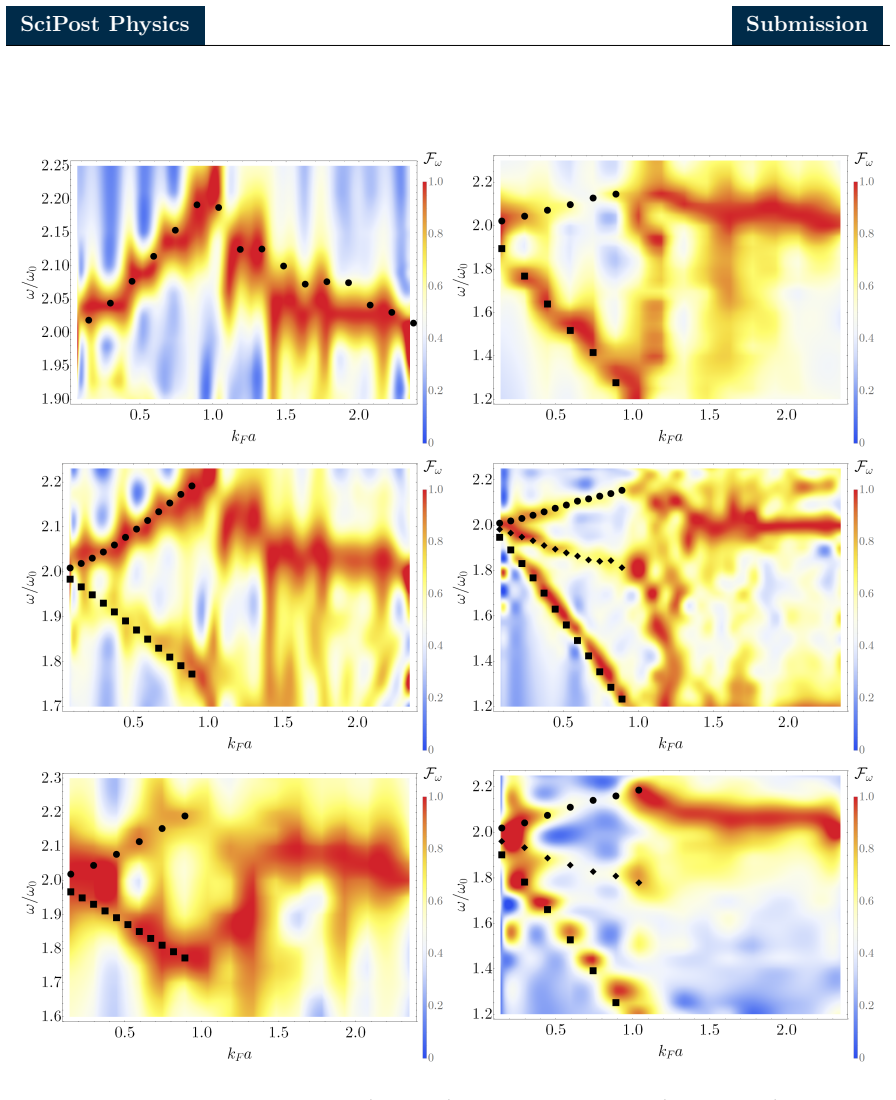
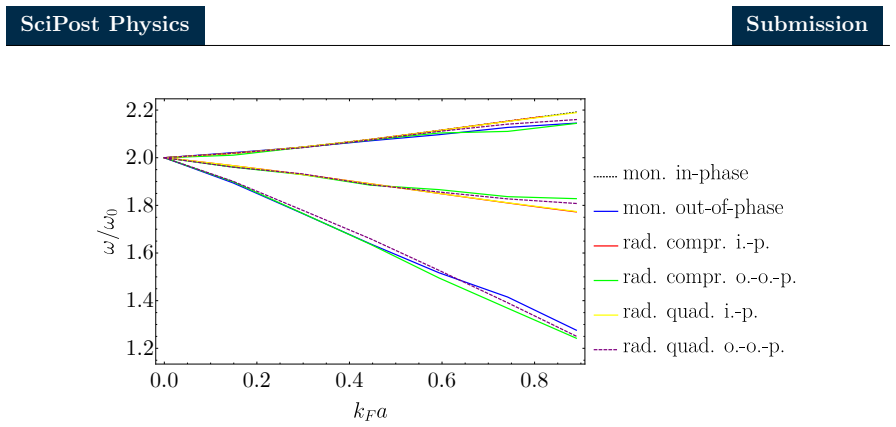
The central result is the three-branch spectrum of collective modes of the repulsive mixture in the overlapping phase. In-phase excitation produces only the upper branch; out-of-phase excitation additionally reveals a middle branch (most clearly in the radial compression and quadrupole modes) and a dominant lower branch. The same three branches are shared by all perturbation schemes, each scheme merely choosing how strongly a given branch is excited. As $k_F a$ grows toward the transition at about $0.9$, the upper branch rises from $2.0$ to about $2.2$, the middle falls to about $1.8$, and the lower falls to about $1.2$; after full phase separation, all three converge back to the noninteracting $2.0$. Renormalizing the scattering length to third order shifts the transition to $k_F a \approx 0.9$ and lifts the monopole maximum from about $2.1$ to about $2.2$ compared with bare mean field. In a spherical trap, the hydrodynamic Thomas-Fermi description reproduces the monopole and the upper and lower branches, but its middle branch stays at $\sqrt{2}\,\omega_0$ instead of following the TDHF value.
Load-bearing premise
The predicted branch frequencies and the critical interaction $k_F a \approx 0.9$ stand on a perturbative renormalization of the scattering length (Eqs. 4–5) whose coefficients come from an earlier paper, plus the assumption, checked only in single larger-$N$ runs, that 56+56 atoms already lie in the universal regime.
Editorial extensions
If this is right
- In the overlapping phase, any of the three perturbation schemes should reveal the same upper branch, rising from $\omega/\omega_0 = 2.0$ to about $2.2$ as $k_F a$ approaches the transition.
- The lower branch, excited only by out-of-phase perturbations and the strongest line near the transition, gives the clearest experimental signature of incipient ferromagnetic separation.
- After full phase separation, all branches return to the noninteracting frequency $\omega/\omega_0 \approx 2.0$, so the domain wall itself is invisible to these radial modes.
- In a spherical trap, the hydrodynamic Thomas-Fermi description is quantitatively reliable for the monopole and for the upper and lower branches, but its fixed middle branch at $\sqrt{2}\,\omega_0$ marks where that approximation breaks down.
- Renormalizing the interaction to third order raises the maximum monopole frequency from about $2.1$ to about $2.2$ and fixes the phase-separation threshold at $k_F a \approx 0.9$, so quantitative comparison with experiments requires the renormalized coupling.
Reading between the lines
- An implication the authors leave implicit: if the three branches are truly shared by all perturbation schemes in a spherical trap, an arbitrary small perturbation should excite only these three spectral lines, so a quench experiment could count the branches directly.
- The pinning of the hydrodynamic middle branch at $\sqrt{2}\,\omega_0$ suggests this mode is a relative out-of-phase compression whose frequency is protected by the trap geometry in the hydrodynamic limit; adding a gradient correction to the density functional might recover its $k_F a$ dependence.
- Extrapolating the authors' spherical-trap caveat, the hydrodynamic description should lose quantitative validity in elongated traps for modes whose noninteracting frequency differs from the hydrodynamic one; measuring an axial breathing mode in a cigar-shaped cloud would test that geometric sensitivity.
Signed reviews
Editorial analysis
A structured set of objections, weighed in public.
Referee Report
Summary. The paper studies collective oscillations of a two-component Fermi gas on the repulsive branch of its energy spectrum, using time-dependent Hartree-Fock (TDHF) calculations and a hydrodynamic/density-functional approach. The authors consider a spherically trapped gas with equal populations, and analyze in-phase and out-of-phase radial compression, breathing, and quadrupole oscillations. They find that in the overlapping (paramagnetic) phase the collective spectrum consists of three branches whose frequencies shift with the dimensionless interaction strength k_F a, with the upper branch rising toward about 2.2 and the lower branch falling toward about 1.2 near the phase transition at k_F a ≈ 0.9. After full phase separation, all branches return toward the noninteracting value ω/ω0 = 2.0. The paper also compares TDHF with a hydrodynamic (time-dependent Thomas-Fermi) description, finding agreement for the monopole mode and for the upper and lower branches of the other modes, while the hydrodynamic middle branch stays at the fixed value √2 ω0 instead of the interaction-dependent TDHF result.
Significance. If the quantitative predictions are reliable, this is a useful contribution to the study of repulsive Fermi gases and to the debate on collective modes in phase-separated mixtures. The paper is commendable for carrying out fully time-dependent TDHF simulations for a non-trivial system, for cross-checking the monopole frequency with sum-rule and hydrodynamic methods, and for clearly identifying where hydrodynamic descriptions break down. The central quantitative content, however, is set by a renormalization input taken from the authors' earlier work, and the manuscript as written does not provide enough information to assess the accuracy of that input near the reported critical interaction.
major comments (3)
- [Sec. 2, Eqs. (4)-(5)] The paper does not state the numerical values of the coefficients B and D in the third-order expansion of the renormalization function ζ, nor does it test the convergence of this truncation. This is load-bearing because the claimed critical value k_F a ≈ 0.9 and all the plotted branch frequencies are obtained with this locally renormalized coupling. Near the transition k_F a ≈ 0.9, so the cubic term D(k_F a)^3 is not a small perturbative correction, and an inaccurate B or D, or a non-negligible fourth-order term, would shift both the transition point and the frequency branches. Please provide the values of B and D used (with their source in Ref. [65]) and present a convergence test, for example by comparing third- and fourth-order truncations or by benchmarking against a known homogeneous-system result.
- [Sec. 2.2, Eqs. (14)-(15)] After the phase transition, the mode frequencies are identified only as 'strong contributions' in the normalized Fourier transform, not from sine fits, and no uncertainty or width information is given. In particular, the statement that in the fully separated regime all branches return to ω/ω0 ≈ 2.0 is quantitatively soft because the Fourier peaks are broad and the normalization is per interaction strength. Please report the peak positions and their widths (or another uncertainty estimate) for the post-transition regime, and specify the criterion used to label a contribution as a 'branch.'
- [Sec. 2.1] The claim that N = 56 + 56 atoms is sufficient for universal behavior is supported only by 'single calculations with larger numbers of atoms,' and the paper itself notes in the footnote that density profiles differ with atom number. Since the observable-specific universality of the collective frequencies is a premise of the analysis, please show explicitly how the monopole frequency (or the critical interaction) changes with N at a fixed k_F a, or otherwise justify the universality claim quantitatively.
minor comments (5)
- [Introduction, paragraph 4] The sentence beginning 'Duetophase-separatedstatebeingintrinsicallyunstable...' is missing spaces and should be reworded for readability.
- [Fig. 3 caption] The caption mentions filled markers (circles, squares, triangles) but does not say which symbol corresponds to which mode or branch; please define the symbols in the caption or in the text.
- [Sec. 2.2, Eq. (10)] The coefficient 0.11 in the approximate sum-rule result ω_R ≈ 2√(1 + 0.11 k_F a) is presented without derivation or reference to a specific equation; please clarify how this coefficient follows from the preceding formulas.
- [Sec. 3] The abbreviation 'TDHD' appears for the hydrodynamic approach and is used inconsistently with 'TDHF' and 'hydrodynamic'; please define it once and use it consistently.
- [Sec. 1, references] Reference [48] is missing a DOI; and since Ref. [65] is the source of the coefficients B and D in Eq. (5), please make the connection explicit at the point where Eq. (5) is introduced.
Circularity Check
The kF a_c≈0.9 transition point is a calibrated input (renormalization from the authors' own prior work) rather than an independent prediction; the collective frequencies themselves are genuine dynamical outputs.
-
self definitional
[Sec. 2, Eqs. (4)-(5), and Sec. 2.1 'Initial states – imaginary time propagation']
"For the physical interpretation and numerical values of consecutive perturbative terms, see e.g. [65] ... In order to get value of kFac consistent with both more sophisticated theoretical approaches (Quantum Monte Carlo, LOCV, largeN expansion) and experimental results, we renormalize perturbatively the scattering length in the way described above. In the trap, this critical value is kFac≈ 0.9."
The model input (the ζ expansion with coefficients B and D taken from the authors' own Ref. [65]) is explicitly introduced in order to make the phase-separation threshold agree with QMC, LOCV, large-N, and experiment, and the same threshold kF a_c≈0.9 is then reported as the critical interaction and used to organize the branch structure. Thus the agreement of kF a_c with external estimates is not an independent check: the renormalization was calibrated to that value. The collective frequencies are extracted from the time evolution and are not fitted to the branch values, so the circularity is limited to the transition-point/calibration axis.
full rationale
The collective-mode frequencies in Fig. 3 are genuine dynamical outputs of the TDHF propagation, not fits to those frequencies, and the hydrodynamic comparison in Sec. 3 is an independent cross-check for the monopole and for the upper and lower branches. The only place where a claimed result coincides with a model input is the phase-separation threshold: the ζ(kF a) renormalization of Eqs. (4)-(5), with coefficients B and D taken from the authors' own Ref. [65], is introduced 'in order to get' kF a_c consistent with QMC/LOCV/large-N/experiment, and the same kF a_c≈0.9 is then reported as the critical interaction. That agreement is therefore not an independent validation, and the near-critical frequency shifts can inherit the same calibration. Because the frequencies themselves are not fitted and the paper contains non-circular benchmarks (sum-rule and hydrodynamic comparisons), the circularity is partial and the score is 4 rather than higher. The omission of the B and D values and the absence of a convergence test for Eq. (5) are correctness/completeness concerns rather than further circularity.
Assumptions & free parameters
free parameters (3)
- B (second-order coefficient in ζ expansion) =
from Ref. [65]; not given in text
- D (third-order coefficient in ζ expansion) =
from Ref. [65]; not given in text
- Strength of symmetry-breaking linear potential =
not specified
assumptions (6)
- domain assumption The many-body wavefunction is a product of two Slater determinants (TDHF ansatz), Eq. (1).
- domain assumption Inter-species contact interaction with g = 4πa ℏ²/m, valid for broad Feshbach resonances.
- ad hoc to paper The local renormalization a_eff = [ζ(k_+ a)/k_+ + ζ(k_- a)/k_-]/2 with ζ expanded to third order, Eq. (4)-(6).
- domain assumption Thomas-Fermi approximation for the intrinsic kinetic energy in the density functional / hydrodynamic approach, Sec. 3.
- domain assumption Hydrodynamic regime: fast relaxation to a local Fermi sphere during oscillations, Sec. 3.
- domain assumption N=56+56 atoms is sufficient for universal behavior in terms of k_F a, Sec. 2.1.
Cite this review
Pith. "Pith review of Collective oscillations of a two-component Fermi gas on the repulsive branch." pith.science (2026). https://pith.science/paper/PK5QR6AA
@misc{pith2026190807771,
  author       = {Pith},
  title        = {Pith review of: Collective oscillations of a two-component Fermi gas on the repulsive branch},
  year         = {2026},
  howpublished = {\url{https://pith.science/paper/PK5QR6AA}},
  note         = {Machine review of arXiv:1908.07771}
}
read the original abstract
We calculate frequencies of collective oscillations of two-component Fermi gas that is kept on the repulsive branch of its energy spectrum. Not only is a paramagnetic phase explored, but also a ferromagnetically separated one. Both in-, and out-of-phase perturbations are investigated, showing contributions from various gas excitations. Additionally, we compare results coming from both time-dependent Hartree-Fock and density-functional approaches.
Figures


Figures from the paper (1 more)
Reference graph
Works this paper leans on
-
[65]
P. T. Grochowski, T. Karpiuk, M. Brewczyk and K. Rzążewski,Unified Description of Dynamics of a Repulsive Two-Component Fermi Gas, Phys. Rev. Lett.119(21), 215303 (2017), doi:10.1103/PhysRevLett.119.215303
-
[1]
C. J. Pethick and H. Smith,Bose-Einstein Condensation in Dilute Gases, Cambridge University Press, Cambridge, ISBN 9780511802850, doi:10.1017/CBO9780511802850 (2008)
-
[2]
L. Pitaevskii and S. Stringari, Bose-Einstein Condensation and Superfluidity, Oxford University Press, ISBN 9780198758884, doi:10.1093/acprof:oso/9780198758884.001.0001 (2016)
arXiv 2016
-
[3]
C. Ebner and D. Edwards,The low temperature thermodynamic properties of superfluid solutions of 3He in 4He, Phys. Rep.2(2), 77 (1971), doi:10.1016/0370-1573(71)90003-2
-
[4]
M. H. Anderson, J. R. Ensher, M. R. Matthews, C. E. Wieman and E. A. Cornell, Observation of bose-einstein condensation in a dilute atomic vapor., Science 269(5221), 198 (1995), doi:10.1126/science.269.5221.198
-
[5]
K. B. Davis, M. O. Mewes, M. R. Andrews, N. J. van Druten, D. S. Durfee, D. M. Kurn and W. Ketterle, Bose-Einstein Condensation in a Gas of Sodium Atoms, Phys. Rev. Lett. 75(22), 3969 (1995), doi:10.1103/PhysRevLett.75.3969
-
[6]
C. C. Bradley, C. A. Sackett, J. J. Tollett and R. G. Hulet,Evidence of Bose-Einstein Condensation in an Atomic Gas with Attractive Interactions, Phys. Rev. Lett. 75(9), 1687 (1995), doi:10.1103/PhysRevLett.75.1687
-
[7]
C. Chin, R. Grimm, P. Julienne and E. Tiesinga,Feshbach resonances in ultracold gases, Rev. Mod. Phys.82(2), 1225 (2010), doi:10.1103/RevModPhys.82.1225
Show all 70 references
-
[8]
Mewes, M
M.-O. Mewes, M. R. Andrews, N. J. van Druten, D. M. Kurn, D. S. Durfee, C. G. Townsend and W. Ketterle,Collective Excitations of a Bose-Einstein Condensate in a Magnetic Trap, Phys. Rev. Lett.77(6), 988 (1996), doi:10.1103/PhysRevLett.77.988. 12 SciPost Physics Submission
1996 doi
-
[9]
D. S. Jin, J. R. Ensher, M. R. Matthews, C. E. Wieman and E. A. Cornell,Collective Excitations of a Bose-Einstein Condensate in a Dilute Gas, Phys. Rev. Lett.77(3), 420 (1996), doi:10.1103/PhysRevLett.77.420
1996 doi
-
[10]
D. M. Stamper-Kurn, H.-J. Miesner, S. Inouye, M. R. Andrews and W. Ketterle,Colli- sionless and Hydrodynamic Excitations of a Bose-Einstein Condensate, Phys. Rev. Lett. 81(3), 500 (1998), doi:10.1103/PhysRevLett.81.500
1998 doi
-
[11]
Buggle, P
C. Buggle, P. Pedri, W. von Klitzing and J. T. M. Walraven, Shape oscillations in nondegenerate Bose gases: Transition from the collisionless to the hydrodynamic regime, Phys. Rev. A72(4), 043610 (2005), doi:10.1103/PhysRevA.72.043610
2005 doi
-
[12]
Altmeyer, S
A. Altmeyer, S. Riedl, M. J. Wright, C. Kohstall, J. H. Denschlag and R. Grimm,Dy- namics of a strongly interacting Fermi gas: The radial quadrupole mode, Phys. Rev. A 76(3), 033610 (2007), doi:10.1103/PhysRevA.76.033610
2007 doi
-
[13]
Grimm,Finite-Temperature Collective Dynamics of a Fermi Gas in the BEC-BCS Crossover, Phys
M.J.Wright, S.Riedl, A.Altmeyer, C.Kohstall, E.R.SánchezGuajardo, J.H.Denschlag and R. Grimm,Finite-Temperature Collective Dynamics of a Fermi Gas in the BEC-BCS Crossover, Phys. Rev. Lett.99(15), 150403 (2007), doi:10.1103/PhysRevLett.99.150403
2007 doi
-
[14]
Stringari, Collective Excitations of a Trapped Bose-Condensed Gas, Phys
S. Stringari, Collective Excitations of a Trapped Bose-Condensed Gas, Phys. Rev. Lett. 77(12), 2360 (1996), doi:10.1103/PhysRevLett.77.2360
1996 doi
-
[15]
F.Chevy, V.Bretin, P.Rosenbusch, K.W.MadisonandJ.Dalibard, Transverse Breathing Mode of an Elongated Bose-Einstein Condensate, Phys. Rev. Lett.88(25), 250402 (2002), doi:10.1103/PhysRevLett.88.250402
2002 doi
-
[16]
Kinast, S
J. Kinast, S. L. Hemmer, M. E. Gehm, A. Turlapov and J. E. Thomas,Evidence for Superfluidity in a Resonantly Interacting Fermi Gas, Phys. Rev. Lett. 92(15), 150402 (2004), doi:10.1103/PhysRevLett.92.150402
2004 doi
-
[17]
M.Bartenstein, A.Altmeyer, S.Riedl, S.Jochim, C.Chin, J.H.DenschlagandR.Grimm, Collective Excitations of a Degenerate Gas at the BEC-BCS Crossover, Phys. Rev. Lett. 92(20), 203201 (2004), doi:10.1103/PhysRevLett.92.203201
2004 doi
-
[18]
Altmeyer, S
A. Altmeyer, S. Riedl, C. Kohstall, M. J. Wright, R. Geursen, M. Bartenstein, C. Chin, J. H. Denschlag and R. Grimm, Precision Measurements of Collective Oscillations in the BEC-BCS Crossover , Phys. Rev. Lett. 98(4), 040401 (2007), doi:10.1103/PhysRevLett.98.040401
2007 doi
-
[19]
Busch, J
T. Busch, J. I. Cirac, V. M. Pérez-García and P. Zoller,Stability and collective excitations of a two-component Bose-Einstein condensed gas: A moment approach, Phys. Rev. A 56(4), 2978 (1997), doi:10.1103/PhysRevA.56.2978
1997 doi
-
[20]
B. D. Esry and C. H. Greene,Low-lying excitations of double Bose-Einstein condensates, Phys. Rev. A57(2), 1265 (1998), doi:10.1103/PhysRevA.57.1265
1998 doi
-
[21]
Ho,Spinor Bose Condensates in Optical Traps, Phys
T.-L. Ho,Spinor Bose Condensates in Optical Traps, Phys. Rev. Lett.81(4), 742 (1998), doi:10.1103/PhysRevLett.81.742. 13 SciPost Physics Submission
1998 doi
-
[22]
D. S. Hall, M. R. Matthews, J. R. Ensher, C. E. Wieman and E. A. Cornell,Dynamics of Component Separation in a Binary Mixture of Bose-Einstein Condensates, Phys. Rev. Lett. 81(8), 1539 (1998), doi:10.1103/PhysRevLett.81.1539
1998 doi
-
[23]
M. J. Bijlsma, B. A. Heringa and H. T. C. Stoof,Phonon exchange in dilute Fermi-Bose mixtures: Tailoring the Fermi-Fermi interaction, Phys. Rev. A 61(5), 053601 (2000), doi:10.1103/PhysRevA.61.053601
2000 doi
-
[24]
Capuzzi and E
P. Capuzzi and E. S. Hernández,Zero-sound density oscillations in Fermi-Bose mixtures, Phys. Rev. A64(4), 043607 (2001), doi:10.1103/PhysRevA.64.043607
2001 doi
-
[25]
S. K. Yip,Collective modes in a dilute Bose-Fermi mixture, Phys. Rev. A64(2), 023609 (2001), doi:10.1103/PhysRevA.64.023609
2001 doi
-
[26]
Góral and L
K. Góral and L. Santos, Ground state and elementary excitations of single and binary Bose-Einstein condensates of trapped dipolar gases, Phys. Rev. A66(2), 023613 (2002), doi:10.1103/PhysRevA.66.023613
2002 doi
-
[27]
H. Pu, W. Zhang, M. Wilkens and P. Meystre,Phonon Spectrum and Dynamical Stability of a Dilute Quantum Degenerate Bose-Fermi Mixture, Phys. Rev. Lett. 88(7), 070408 (2002), doi:10.1103/PhysRevLett.88.070408
2002 doi
-
[28]
A. A. Svidzinsky and S. T. Chui, Normal modes and stability of phase- separated trapped Bose-Einstein condensates, Phys. Rev. A 68(1), 013612 (2003), doi:10.1103/PhysRevA.68.013612
2003 doi
-
[29]
Liu and H
X.-J. Liu and H. Hu,Collisionless and hydrodynamic excitations of trapped boson-fermion mixtures, Phys. Rev. A67(2), 023613 (2003), doi:10.1103/PhysRevA.67.023613
2003 doi
-
[30]
Deconinck, P
B. Deconinck, P. G. Kevrekidis, H. E. Nistazakis and D. J. Frantzeskakis, Linearly coupled Bose-Einstein condensates: From Rabi oscillations and quasiperiodic solutions to oscillating domain walls and spiral waves , Phys. Rev. A 70(6), 063605 (2004), doi:10.1103/PhysRevA.70.063605
2004 doi
-
[31]
Rodríguez, P
M. Rodríguez, P. Pedri, P. Törmä and L. Santos, Scissors modes of two-component degenerate gases: Bose-Bose and Bose-Fermi mixtures, Phys. Rev. A 69(2), 023617 (2004), doi:10.1103/PhysRevA.69.023617
2004 doi
-
[32]
Navarro, R
R. Navarro, R. Carretero-González and P. G. Kevrekidis,Phase separation and dynam- ics of two-component Bose-Einstein condensates, Phys. Rev. A 80(2), 023613 (2009), doi:10.1103/PhysRevA.80.023613
2009 doi
-
[33]
Vichi and S
L. Vichi and S. Stringari, Collective oscillations of an interacting trapped Fermi gas, Phys. Rev. A60(6), 4734 (1999), doi:10.1103/PhysRevA.60.4734
1999 doi
-
[34]
Maddaloni, M
P. Maddaloni, M. Modugno, C. Fort, F. Minardi and M. Inguscio,Collective Oscillations of Two Colliding Bose-Einstein Condensates, Phys. Rev. Lett. 85(12), 2413 (2000), doi:10.1103/PhysRevLett.85.2413
2000 doi
-
[35]
S. D. Gensemer and D. S. Jin, Transition from Collisionless to Hydrodynamic Behavior in an Ultracold Fermi Gas , Phys. Rev. Lett. 87(17), 173201 (2001), doi:10.1103/PhysRevLett.87.173201. 14 SciPost Physics Submission
2001 doi
-
[36]
Ferrier-Barbut, M
I. Ferrier-Barbut, M. Delehaye, S. Laurent, A. T. Grier, M. Pierce, B. S. Rem, F. Chevy and C. Salomon, A mixture of Bose and Fermi superfluids, Science (80-. ). 345(6200), 1035 (2014), doi:10.1126/SCIENCE.1255380
2014 doi
-
[37]
Delehaye, S
M. Delehaye, S. Laurent, I. Ferrier-Barbut, S. Jin, F. Chevy and C. Salomon,Critical Ve- locity and Dissipation of an Ultracold Bose-Fermi Counterflow, Phys. Rev. Lett.115(26), 265303 (2015), doi:10.1103/PhysRevLett.115.265303
2015 doi
-
[38]
R. Roy, A. Green, R. Bowler and S. Gupta,Two-Element Mixture of Bose and Fermi Su- perfluids, Phys. Rev. Lett.118(5), 055301 (2017), doi:10.1103/PhysRevLett.118.055301
2017 doi
-
[39]
Wu, X.-C
Y.-P. Wu, X.-C. Yao, X.-P. Liu, X.-Q. Wang, Y.-X. Wang, H.-Z. Chen, Y. Deng, Y.-A. Chen and J.-W. Pan,Coupled dipole oscillations of a mass-imbalanced Bose-Fermi super- fluid mixture, Phys. Rev. B97(2), 020506(R) (2018), doi:10.1103/PhysRevB.97.020506
2018 doi
-
[40]
B.J.DeSalvo, K.Patel, G.CaiandC.Chin, Observation of fermion-mediated interactions between bosonic atoms, Nature 568(7750), 61 (2019), doi:10.1038/s41586-019-1055-0
2019 doi
-
[41]
Modugno, G
G. Modugno, G. Roati, F. Riboli, F. Ferlaino, R. J. Brecha and M. Inguscio, Collapse of a Degenerate Fermi Gas , Science (80-. ). 297(5590), 2240 (2002), doi:10.1126/SCIENCE.1077386
2002 doi
-
[42]
Ospelkaus, S
C. Ospelkaus, S. Ospelkaus, K. Sengstock and K. Bongs,Interaction-Driven Dynamics of K 40 - Rb 87 Fermion-Boson Gas Mixtures in the Large-Particle-Number Limit, Phys. Rev. Lett. 96(2), 020401 (2006), doi:10.1103/PhysRevLett.96.020401
2006 doi
-
[43]
Ospelkaus, C
S. Ospelkaus, C. Ospelkaus, L. Humbert, K. Sengstock and K. Bongs,Tuning of Het- eronuclear Interactions in a Degenerate Fermi-Bose Mixture, Phys. Rev. Lett. 97(12), 120403 (2006), doi:10.1103/PhysRevLett.97.120403
2006 doi
-
[44]
S. B. Papp, J. M. Pino and C. E. Wieman, Tunable Miscibility in a Dual- Species Bose-Einstein Condensate , Phys. Rev. Lett. 101(4), 040402 (2008), doi:10.1103/PhysRevLett.101.040402
2008 doi
-
[45]
Y.-i. Shin, C. H. Schunck, A. Schirotzek and W. Ketterle, Phase diagram of a two-component Fermi gas with resonant interactions, Nature 451(7179), 689 (2008), doi:10.1038/nature06473
2008 doi
-
[46]
R. S. Lous, I. Fritsche, M. Jag, F. Lehmann, E. Kirilov, B. Huang and R. Grimm,Probing the Interface of a Phase-Separated State in a Repulsive Bose-Fermi Mixture, Phys. Rev. Lett. 120(24), 243403 (2018), doi:10.1103/PhysRevLett.120.243403
2018 doi
-
[47]
Sommer, M
A. Sommer, M. Ku, G. Roati and M. W. Zwierlein,Universal spin transport in a strongly interacting Fermi gas, Nature 472(7342), 201 (2011), doi:10.1038/nature09989
2011 doi
-
[48]
Valtolina, F
G. Valtolina, F. Scazza, A. Amico, A. Burchianti, A. Recati, T. Enss, M. Inguscio, M. Zac- cantiandG.Roati, Exploring the ferromagnetic behaviour of a repulsive Fermi gas through spin dynamics, Nat. Phys.13, 704 (2017)
2017
-
[49]
Huang, I
B. Huang, I. Fritsche, R. S. Lous, C. Baroni, J. T. M. Walraven, E. Kirilov and R. Grimm, Breathing mode of a Bose-Einstein condensate repulsively interacting with a fermionic reservoir, Phys. Rev. A99, 041602(R) (2019), doi:10.1103/PhysRevA.99.041602. 15 SciPost Physics Submission
2019 doi
-
[50]
Stoner, Atomic moments in ferromagnetic metals and alloys with non-ferromagnetic elements, Philos
E. Stoner, Atomic moments in ferromagnetic metals and alloys with non-ferromagnetic elements, Philos. Mag. 15, 1018 (1933)
1933
-
[51]
Jo, Y.-R
G.-B. Jo, Y.-R. Lee, J.-H. Choi, C. A. Christensen, T. H. Kim, J. H. Thywissen, D. E. Pritchard and W. Ketterle,Itinerant ferromagnetism in a Fermi gas of ultracold atoms., Science 325(5947), 1521 (2009), doi:10.1126/science.1177112
2009 doi
-
[52]
Cui and H
X. Cui and H. Zhai, Stability of a fully magnetized ferromagnetic state in repul- sively interacting ultracold Fermi gases , Phys. Rev. A 81(4), 041602(R) (2010), doi:10.1103/PhysRevA.81.041602
2010 doi
-
[53]
Pilati, G
S. Pilati, G. Bertaina, S. Giorgini and M. Troyer,Itinerant Ferromagnetism of a Repulsive Atomic Fermi Gas: A Quantum Monte Carlo Study, Phys. Rev. Lett. 105(3), 030405 (2010), doi:10.1103/PhysRevLett.105.030405
2010 doi
-
[54]
Massignan and G
P. Massignan and G. M. Bruun, Repulsive polarons and itinerant ferromag- netism in strongly polarized Fermi gases , Eur. Phys. J. D 65(1-2), 83 (2011), doi:10.1140/epjd/e2011-20084-5
2011 doi
-
[55]
Chang, M
S.-Y. Chang, M. Randeria and N. Trivedi,Ferromagnetism in the upper branch of the Feshbach resonance and the hard-sphere Fermi gas, Proc. Natl. Acad. Sci. 108(1), 51 (2011), doi:10.1073/pnas.1011990108
2011 doi
-
[56]
Pekker, M
D. Pekker, M. Babadi, R. Sensarma, N. Zinner, L. Pollet, M. W. Zwierlein and E. Demler, Competition between Pairing and Ferromagnetic Instabilities in Ultracold Fermi Gases near Feshbach Resonances, Phys. Rev. Lett. 106(5), 050402 (2011), doi:10.1103/PhysRevLett.106.050402
2011 doi
-
[57]
Sanner, E
C. Sanner, E. J. Su, W. Huang, A. Keshet, J. Gillen and W. Ketterle,Correlations and Pair Formation in a Repulsively Interacting Fermi Gas, Phys. Rev. Lett.108(24), 240404 (2012), doi:10.1103/PhysRevLett.108.240404
2012 doi
-
[58]
Massignan, M
P. Massignan, M. Zaccanti and G. M. Bruun,Polarons, dressed molecules and itinerant ferromagnetism in ultracold Fermi gases, Reports Prog. Phys. 77(3), 034401 (2014), doi:10.1088/0034-4885/77/3/034401
2014 doi
-
[59]
Trappe, P
M.-I. Trappe, P. T. Grochowski, M. Brewczyk and K. Rzążewski,Ground-state den- sities of repulsive two-component Fermi gases, Phys. Rev. A 93(2), 023612 (2016), doi:10.1103/PhysRevA.93.023612
2016 doi
-
[60]
Amico, F
A. Amico, F. Scazza, G. Valtolina, P. Tavares, W. Ketterle, M. Inguscio, G. Roati and M. Zaccanti, Time-Resolved Observation of Competing Attractive and Repulsive Short- Range Correlations in Strongly Interacting Fermi Gases, Phys.Rev.Lett. 121(25), 253602 (2018), doi:10.1103/...
2018 doi
-
[61]
G. M. Bruun,Collective modes of trapped Fermi gases in the normal phase, Phys. Rev. A 63(4), 043408 (2001), doi:10.1103/PhysRevA.63.043408
2001 doi
-
[62]
Maruyama and G
T. Maruyama and G. F. Bertsch, Spin-excited oscillations in two-component fermion condensates, Phys. Rev. A73(1), 013610 (2006), doi:10.1103/PhysRevA.73.013610. 16 SciPost Physics Submission
2006 doi
-
[63]
Maruyama and T
T. Maruyama and T. Nishimura, Coupled breathing oscillations of two-component fermion condensates in deformed traps , Phys. Rev. A 75(3), 033611 (2007), doi:10.1103/PhysRevA.75.033611
2007 doi
-
[64]
T. N. De Silva and E. J. Mueller,Collective oscillations of a Fermi gas near a Feshbach resonance, Phys. Rev. A72(6), 063614 (2005), doi:10.1103/PhysRevA.72.063614
2005 doi
-
[66]
Gawryluk, T
K. Gawryluk, T. Karpiuk, M. Gajda, K. Rzążewski and M. Brewczyk,Unified way for computing dynamics of Bose–Einstein condensates and degenerate Fermi gases, Int. J. Comput. Math. 95(11), 2143 (2018), doi:10.1080/00207160.2017.1370545
2018
-
[67]
von Stecher and C
J. von Stecher and C. H. Greene, Renormalized mean-field theory for a two- component Fermi gas with s -wave interactions, Phys. Rev. A 75(2), 022716 (2007), doi:10.1103/PhysRevA.75.022716
2007 doi
-
[68]
Domps, P.-G
A. Domps, P.-G. Reinhard and E. Suraud, Time-Dependent Thomas-Fermi Approach for Electron Dynamics in Metal Clusters , Phys. Rev. Lett. 80(25), 5520 (1998), doi:10.1103/PhysRevLett.80.5520
1998 doi
-
[69]
Karpiuk, M
T. Karpiuk, M. Brewczyk, Ł. Dobrek, M. A. Baranov, M. Lewenstein and K. Rzążewski, Optical generation of solitonlike pulses in a single-component gas of neutral fermionic atoms, Phys. Rev. A66(2), 023612 (2002), doi:10.1103/PhysRevA.66.023612
2002 doi
-
[70]
Madelung, Quantentheorie in hydrodynamischer form, Z
E. Madelung, Quantentheorie in hydrodynamischer form, Z. Phys.40, 322 (1927). 17
1927
Reviewed August 14, 2026 · model on record in the stance chip above.
Discussion (0). Continue with ORCID to comment.