Q-Backbone: A Quantum-Enhanced Control Plane for Future Communication Networks
Pith reviewed 2026-06-27 05:13 UTC · model grok-4.3
The pith
Q-Backbone adds quantum processing units to network control planes and uses a policy to invoke them only when they accelerate decisions under tight constraints.
A machine-rendered reading of the paper's core claim, the machinery that carries it, and where it could break.
Core claim
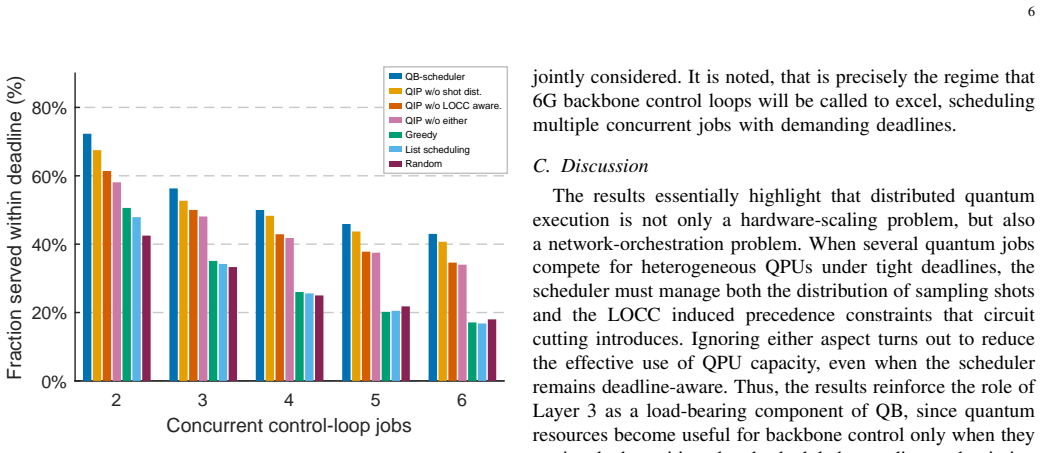
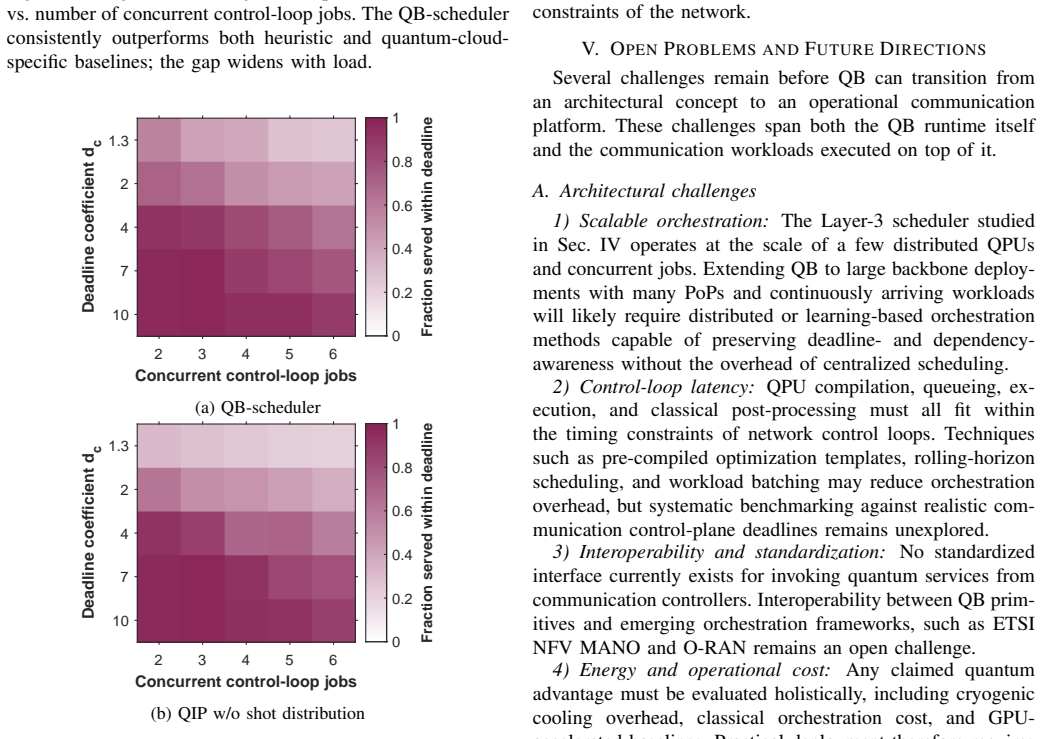
Q-Backbone is a four-layer control plane that combines heterogeneous infrastructure, hybrid quantum-classical runtime services, policy-driven task orchestration via the Quantum Invocation Policy, and communication-network applications; the policy dynamically selects quantum acceleration for suitable tasks, and a case study on distributed quantum jobs over heterogeneous QPUs shows the system serves up to 25 percent more jobs than classical baselines under tight deadline constraints.
What carries the argument
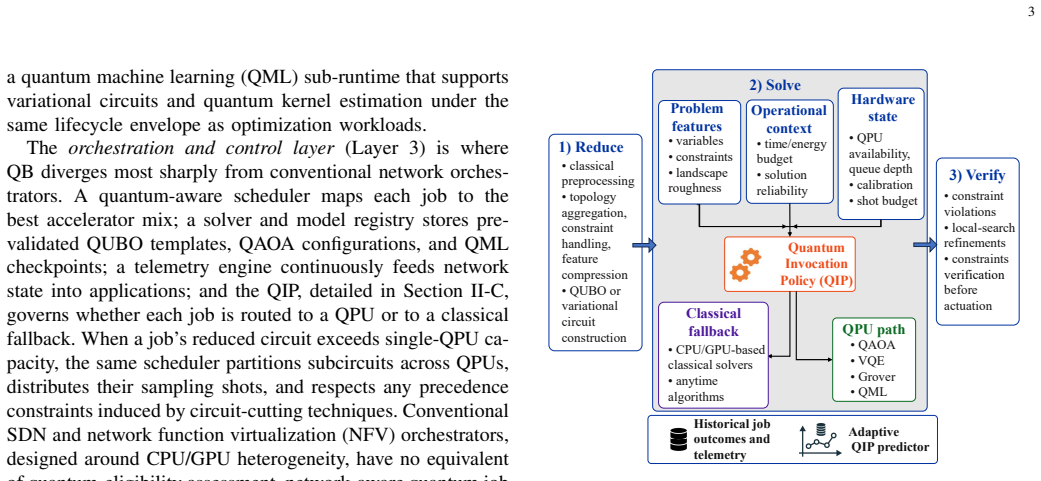
The Quantum Invocation Policy, a decision rule that evaluates each task and routes it to quantum or classical execution based on expected benefit.
If this is right
- Network operators can meet stricter latency and reliability targets by selectively invoking quantum accelerators.
- Deadline-aware orchestration of distributed quantum jobs becomes feasible across mixed classical and quantum hardware.
- Hybrid runtime services reduce the computational load on purely classical control planes for problems like network slicing.
- Open deployment questions remain around integration overhead and error management in live networks.
Where Pith is reading between the lines
- If the policy generalizes beyond the case study, similar invocation logic could apply to real-time wireless resource allocation.
- Widespread adoption would require standardized interfaces between classical network controllers and remote QPUs.
- Performance gains may shrink if quantum hardware error rates rise faster than the policy can compensate.
Load-bearing premise
The policy can correctly and cheaply spot which tasks benefit from quantum acceleration in real heterogeneous networks without creating new delays or errors.
What would settle it
A side-by-side run of the same deadline-constrained job set on a mixed QPU-classical testbed where the policy either completes fewer jobs than the classical baseline or adds measurable overhead that violates the deadlines.
Figures
read the original abstract
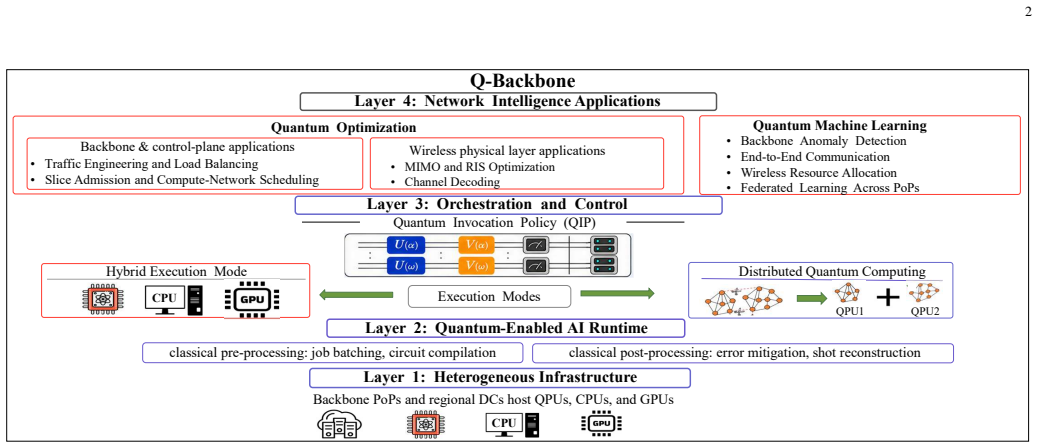
Future networks will need to make network-wide decisions, including traffic engineering, network slicing, and wireless optimization, under strict latency, energy, and reliability constraints. The computational complexity of these problems increasingly challenges classical optimization methods. This article proposes Q-Backbone (QB), a quantum-enhanced control plane for communication networks in which quantum processing units (QPUs) operate alongside classical computing resources as accelerators for network intelligence. QB is designed as a fourlayer architecture that combines heterogeneous infrastructure, hybrid quantum-classical runtime services, policy-driven task orchestration, and communication-network applications. A central component of QB is the Quantum Invocation Policy (QIP), which dynamically determines when quantum acceleration is beneficial and when classical execution should be preferred. A case study on deadline-aware orchestration of distributed quantum jobs over heterogeneous QPUs shows that QB can improve workload execution under tight deadline constraints, serving up to 25% more jobs than existing quantum-cloud scheduling baselines. Finally, open challenges and opportunities towards the deployment of QB are highlighted and discussed.
Editorial analysis
A structured set of objections, weighed in public.
Referee Report
Summary. The manuscript proposes Q-Backbone (QB), a four-layer quantum-enhanced control plane for future communication networks that integrates heterogeneous QPUs as accelerators alongside classical resources. A central element is the Quantum Invocation Policy (QIP) for dynamically choosing quantum versus classical execution. The primary empirical support is a case study on deadline-aware orchestration of distributed quantum jobs over heterogeneous QPUs, which reports that QB serves up to 25% more jobs than existing quantum-cloud scheduling baselines under tight deadline constraints.
Significance. If the case-study result holds under transparent and reproducible conditions, the work would supply a concrete architectural template for embedding quantum accelerators into network control-plane decisions, addressing computational bottlenecks in traffic engineering and optimization. The four-layer decomposition and policy-driven orchestration provide a reusable conceptual scaffold that could guide subsequent hybrid quantum-classical network designs.
major comments (1)
- [Case study] Case study section: the claim of serving up to 25% more jobs is presented without any description of the job-arrival process, workload model, QPU heterogeneity parameters, deadline distribution, the precise decision rule or pseudocode for the Quantum Invocation Policy, the baseline scheduler implementation, or statistical measures such as error bars and significance tests. This absence prevents attribution of the reported gain to the proposed architecture rather than to unstated simulation choices and directly undermines the sole quantitative support for the central claim.
minor comments (1)
- [Abstract] The abstract would benefit from an explicit statement of the four layer names and their mapping to the components described later in the text.
Simulated Author's Rebuttal
We thank the referee for the constructive critique of the case study. We agree that the current presentation of the empirical results lacks sufficient detail for reproducibility and attribution, and we will revise the manuscript to address this.
read point-by-point responses
-
Referee: [Case study] Case study section: the claim of serving up to 25% more jobs is presented without any description of the job-arrival process, workload model, QPU heterogeneity parameters, deadline distribution, the precise decision rule or pseudocode for the Quantum Invocation Policy, the baseline scheduler implementation, or statistical measures such as error bars and significance tests. This absence prevents attribution of the reported gain to the proposed architecture rather than to unstated simulation choices and directly undermines the sole quantitative support for the central claim.
Authors: We fully agree with this assessment. The case study section will be expanded in the revision to include: (i) the job-arrival process and workload model (e.g., Poisson arrivals with specified rates and job-size distributions), (ii) explicit parameters for QPU heterogeneity (number, qubit counts, gate fidelities, and connectivity), (iii) the deadline distribution and how deadlines are assigned, (iv) the precise decision rule and pseudocode for the Quantum Invocation Policy, (v) the implementation details of the baseline schedulers, and (vi) statistical measures including error bars from multiple runs and significance testing. These additions will enable readers to reproduce the 25% improvement and confirm it stems from the Q-Backbone architecture. revision: yes
Circularity Check
Case-study performance claim reduces to unparameterized internal simulation with no visible derivation or external benchmark.
specific steps
-
fitted input called prediction
[Abstract (case-study paragraph)]
"A case study on deadline-aware orchestration of distributed quantum jobs over heterogeneous QPUs shows that QB can improve workload execution under tight deadline constraints, serving up to 25% more jobs than existing quantum-cloud scheduling baselines."
The 25% figure is presented as evidence that the four-layer QB architecture (including QIP) is beneficial, yet the paper supplies neither the simulation parameters nor the exact policy that produced the number. The performance gain is therefore generated by the same unstated case-study choices that define the architecture, reducing the claim to an internal fit rather than an independent prediction.
full rationale
The paper's sole quantitative support is the 25% job improvement stated in the abstract and case-study description. No equations, job-arrival model, QPU parameters, deadline distribution, QIP decision rule, or baseline implementation are supplied, so the numerical result cannot be shown to arise from the proposed architecture rather than from the simulation setup itself. This matches the fitted-input-called-prediction pattern: the claimed benefit is generated by the same internal case study that defines the architecture's value. No self-citation chain or mathematical derivation exists to inspect; the central claim is therefore not independently falsifiable from the given text.
Axiom & Free-Parameter Ledger
axioms (1)
- domain assumption Quantum processing units can provide acceleration for selected network optimization problems under latency and energy constraints.
invented entities (2)
-
Q-Backbone (QB)
no independent evidence
-
Quantum Invocation Policy (QIP)
no independent evidence
Reference graph
Works this paper leans on
-
[1]
6G Wireless Systems: Vision, Requirements, Challenges, Insights, and Opportunities,
H. Tataria, M. Shafi, A. F. Molisch, M. Dohler, H. Sjöland, and F. Tufvesson, “6G Wireless Systems: Vision, Requirements, Challenges, Insights, and Opportunities,”Proc. IEEE, vol. 109, no. 7, pp. 1166–1199, 2021
2021
-
[2]
Hybrid quantum-classical computing for future network optimization,
L. Fan and Z. Han, “Hybrid quantum-classical computing for future network optimization,”IEEE Netw., vol. 36, no. 5, pp. 72–76, 2022
2022
-
[3]
Review of distributed quantum computing: From single qpu to high performance quantum computing,
D. Barralet al., “Review of distributed quantum computing: From single qpu to high performance quantum computing,”Computer Science Review, vol. 57, p. 100747, 2025
2025
-
[4]
Physics-informed quantum communication networks: A vision toward the quantum internet,
M. Chehimi and W. Saad, “Physics-informed quantum communication networks: A vision toward the quantum internet,”IEEE Netw., vol. 36, no. 5, pp. 32–38, 2022
2022
-
[5]
Distributed quantum computing: a survey,
M. Caleffi, M. Amoretti, D. Ferrari, J. Illiano, A. Manzalini, and A. S. Cacciapuoti, “Distributed quantum computing: a survey,”Computer Networks, vol. 254, p. 110672, 2024
2024
-
[6]
Combining quantum processors with real-time classical communication,
A. Carrera Vazquez, C. Tornow, D. Ristè, S. Woerner, M. Takita, and D. J. Egger, “Combining quantum processors with real-time classical communication,”Nature, vol. 636, no. 8041, pp. 75–79, 2024
2024
-
[7]
Quantum Optimization in Wireless Commu- nication Systems: Principles and Applications,
I. Krikidis and V . Gilbert, “Quantum Optimization in Wireless Commu- nication Systems: Principles and Applications,”IEEE Commun. Mag., pp. 1–7, 2026
2026
-
[8]
Quantum federated learning with quan- tum data,
M. Chehimi and W. Saad, “Quantum federated learning with quan- tum data,” inProc. IEEE Int. Conf. Acoust., Speech Signal Process. (ICASSP), 2022, 2022, pp. 8617–8621
2022
-
[9]
A hybrid quantum-classical autoencoder framework for end-to-end communication systems,
B. Zhang, G. Zheng, and N. V . Huynh, “A hybrid quantum-classical autoencoder framework for end-to-end communication systems,”IEEE Wirel. Commun. Lett., vol. 14, no. 3, pp. 806–810, Mar. 2025
2025
-
[10]
Constructing a virtual two-qubit gate by sampling single-qubit operations,
K. Mitarai and K. Fujii, “Constructing a virtual two-qubit gate by sampling single-qubit operations,”New Journal of Physics, vol. 23, no. 2, p. 023021, 2021
2021
-
[11]
Doubly optimal parallel wire cutting without ancilla qubits,
H. Haradaet al., “Doubly optimal parallel wire cutting without ancilla qubits,”PRX Quantum, vol. 5, no. 4, p. 040308, 2024
2024
-
[12]
Deadline-aware scheduling of distributed quantum circuits in near-term quantum cloud,
N. Dehaini, C. Chahoud, and M. Chehimi, “Deadline-aware scheduling of distributed quantum circuits in near-term quantum cloud,” inProc. 2026 IEEE Int. Conf. Quantum Commun., Netw., Comput. (QCNC). IEEE, 2026, pp. 622–629
2026
-
[13]
A design framework for the simulation of distributed quantum computing,
D. Ferrari and M. Amoretti, “A design framework for the simulation of distributed quantum computing,” inWorkshop on HPC and Quantum Computing Integration, 2024, pp. 4–10
2024
-
[14]
Distributed scheduling of quantum circuits with noise and time optimization,
D. Bhoumik, R. Majumdar, A. Saha, and S. Sur-Kolay, “Distributed scheduling of quantum circuits with noise and time optimization,”arXiv preprint arXiv:2309.06005, 2023
-
[15]
Simulating large quantum circuits on a small quantum computer,
T. Peng, A. W. Harrow, M. Ozols, and X. Wu, “Simulating large quantum circuits on a small quantum computer,”Phys. Rev. Lett., vol. 125, no. 15, p. 150504, 2020. Mahdi Chehimi(Member, IEEE) is an Assistant Professor of Electrical and Computer Engineering at the American University of Beirut (AUB). He received his Ph.D. in Electrical and Computer Engineerin...
2020
discussion (0)
Sign in with ORCID, Apple, or X to comment. Anyone can read and Pith papers without signing in.