REVIEW 5 minor 37 references
Sublinear projection tracking in acylindrically hyperbolic groups
T0 review · 0 major / 5 minor · reviewed 2026-08-01 · deepseek-v4-flash
Pith's one-line read The paper proves that, along any WPD isometry with a sublinearly contracting orbit, the shortest projection to the cyclic subgroup in the word metric and the pulled-back projection from the ambient space agree up to a sublinear error, and i
desk verdict A detailed, likely correct upgrade of projection tracking to WPD directions; the one thing to press is whether Sisto's Lemma 4.8 applies under the finite-WPD hypothesis. read the letter →
The pith
A machine-rendered reading of the paper's core claim, the machinery that carries it, and where it could break.
The reading
What carries the argument
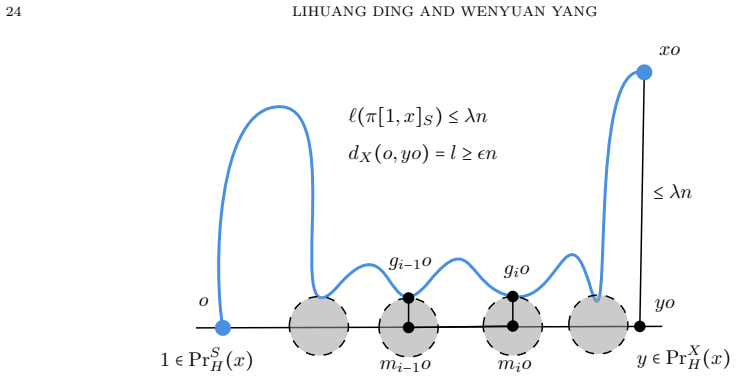
The central objects are the two projections: the shortest projection Pr_S^H in the Cayley graph and the pullback Pr_X^H of shortest projection to the axis Ho in X. The paper proves they differ by a sublinear error. The engine of the proof is a generalized Morse lemma: for every Lipschitz path with the same endpoints as a Morse geodesic γ, and every positive-density subinterval p of γ, the path intersects the r-neighborhoods of a sequence of pairwise R-separated points on p, with the number of such points linear in ℓ(p)/R. Together with a geometric separation lemma from the WPD literature, this forces word geodesics to spend long stretches near the axis Ho whenever their X-projections do, whi
What would settle it
A concrete way to falsify the theorem would be to exhibit a finitely generated group acting on a metric space where a WPD isometry has a strongly sublinearly contracting orbit, together with elements g_n for which the word-metric projection to ⟨h⟩ and the pulled-back axis projection differ by at least ε·d_S(g_n,⟨h⟩) for a fixed ε>0. The proof forces such a configuration to violate the geometric separation lemma — two word-close points whose orbits sit near widely separated axis points while remaining far from the axis — so any example with that configuration would settle the claim.
Extended reading notes
Core claim
The load-bearing result, Theorem A, states: let G be a finitely generated group acting by isometries on a metric space X, and let h ∈ G be a WPD isometry (a weak properness condition along the orbit) such that the orbit ⟨h⟩o is strongly κ-contracting in X for some sublinear function κ. Then (1) the action has the sublinear projection tracking property along ⟨h⟩, meaning diam_S(Pr_S^H(g) ∪ Pr_X^H(g)) ≤ κ_track(d_S(g,H)) for all g; and (2) the pulled-back projection Pr_X^H is strongly sublinearly contracting in the word metric, meaning projections of two points depend on their word distance rather than on the distance to H. The proof combines a generalized Morse lemma, showing that any Lipschi
Load-bearing premise
The proof's load-bearing premise is an external geometric separation lemma, quoted without proof, that whenever two group elements have orbit points near widely separated points of the axis yet are close in the word metric, they must be close to the subgroup; if that lemma needs extra hypotheses such as geodesicity of the ambient space, or its constants fail to line up with the sublinear estimates, the central theorem does not follow.
Editorial extensions
If this is right
- For any non-virtually cyclic subgroup K containing a generalized loxodromic element, the growth function of K satisfies |B_n ∩ K| ≤ e^{nω(K,S)+κ(n)}; in particular ω(K,S) is a genuine limit, not merely a limsup.
- For acylindrically hyperbolic groups, there exist proper quotients with infinite kernels whose growth rates converge up to the growth rate of the original group, showing no uniform gap between a group and its quotients.
- For mapping class groups of closed surfaces of genus at least 2, the ball count is bounded by n^d e^{nω}, a polynomial correction on top of purely exponential growth.
- The growth–cogrowth inequality holds for confined subgroups in both acylindrically hyperbolic groups and Morse local-to-global groups with Morse elements; as a corollary it holds for every infinite normal subgroup, and whenever the Schreier graph has subexponential growth, the subgroup has full exponential growth.
Reading between the lines
- Because the proof of Theorem A uses acylindricity along the subgroup and the Morse property of the axis rather than hyperbolicity of X, a natural test is whether Lemma 4.10's 'strongly sublinearly contracting' assumption can be weakened to ordinary sublinear contraction; the paper states this is not known.
- The combination of the no-uniform-gap theorem with the growth–cogrowth inequality suggests that any eventual proof of growth tightness for acylindrically hyperbolic groups cannot rely on a universal positive gap, and may need to track the sublinear error function rather than a constant.
- The paper's polynomial correction for mapping class groups is consistent with a general principle that logarithmic projection tracking yields polynomial-times-exponential growth; under that heuristic, constructing a geodesic automatic combing would pin down whether the polynomial factor is a real geometric invariant or an artifact of the proof.
Editorial analysis
A structured set of objections, weighed in public.
Referee Report
Summary. The paper establishes a 'sublinear projection tracking' theorem for finitely generated groups acting on metric spaces with a WPD isometry whose orbit is strongly sublinearly contracting (Theorem A). The two main ingredients are a generalized Morse lemma for contracting geodesics and a geometric separation lemma of Sisto; together they show that the word-metric shortest projection to the cyclic subgroup tracks the pullback of the shortest projection in the auxiliary space, and that the pulled-back projection is strongly sublinearly contracting in the word metric. The applications are: effective upper bounds on relative growth functions of acylindrically hyperbolic groups (Theorem B), construction of proper quotients whose growth rates converge to the ambient growth rate (Theorem C), and a growth--cogrowth inequality for confined subgroups in acylindrically hyperbolic groups and in Morse local-to-global groups with Morse elements (Theorem D).
Significance. If correct, this is a substantial contribution. Acylindrically hyperbolic groups do not in general admit a Masur--Minsky-type distance formula, and the paper supplies a robust, quantitative substitute along WPD directions that is strong enough to drive counting and quotient constructions. The growth estimates and the growth--cogrowth inequality extend previously known results from the strongly-contracting setting to the broader WPD/Morse setting. I read the paper in good faith and found no circularity: Theorem A is proved independently and the applications genuinely use it as an input. The proof is unusually complete for a paper of this scope: the generalized Morse lemma, the two projection-tracking lemmas, the free-semigroup construction, the quotient argument, and the Poincar\'e-series estimate in Section 7 are all written out in detail. The external reliance on Sisto's Lemma 4.8 is explicit and legitimate: Definition 4.6 matches the acylindricity-along-H hypothesis used in [Sis16, Lemma 3.4], and the additional properness of \pi|_H follows from the quasi-geodesic orbit assumption in Theorem A. The skeptic's concern about this dependency does not, on reading the paper, land as a
minor comments (5)
- [§4.1, Eq. (4.3)] In the proof of Lemma 4.4, Lemma 2.12 as stated gives a bound involving both \ell(\beta_i) and d(\beta_i,p), but Eq. (4.3) suppresses the distance term. Please add the short justification that d(\beta_i,p) is comparable to \ell(\beta_i) for the components under consideration and that the constant \theta_0 is chosen small enough to absorb it. This is a proof-reading clarification rather than a substantive obstruction.
- [§2.1 and Lemma 4.10] The displayed definition of d^Y_A appears to have a typo: the second formula should use diam_Y, not diam_X. Also, in the proof of Lemma 4.10 the phrase 'd^X_H(g,h)=d_S(x,y)' conflates the X-diameter with the word distance; the intended statement is that d_S(Pr^X_H(g), Pr^X_H(h)) is controlled via the quasi-isometric embedding \pi|_H. Please rephrase.
- [Lemma 1.1 vs Lemma 4.1] The introductory generalized Morse lemma states N=\lceil \ell(p)/6R\rceil, while the proved Lemma 4.1 (and its use in Lemmas 4.9--4.10) gives N=\lfloor \ell(p)/6R\rfloor. The difference is harmless, but the statements should be aligned.
- [§5.1, Lemma 5.4] The proof refers to '(5.1)' at a point where no equation (5.1) has yet been defined. The intended reference appears to be the inequality just proved or the later Proposition 5.2 estimate; please correct the numbering.
- [Throughout] There are many corrupted LaTeX arrows and symbols, e.g. '/leftr⫯g⊸tl⫯ne→' in Remark 1.6, Lemma 2.11, Lemma 3.7, §5, and §7.2--7.3, and similar '/leftfootl⫯ne→' artifacts. These should be replaced by proper arrows before publication.
Circularity Check
No circular derivation: Theorem A is proved from the WPD hypothesis via Sisto's external separation lemma and a new Morse lemma; applications invoke it after proof.
full rationale
I walked the derivation chain from Theorem A through Lemmas 4.9 and 4.10 to the applications in Theorems B, C, and D. Theorem A is not assumed in its own proof: Lemma 4.9 proves sublinear projection tracking from the WPD/acylindrical-along-H hypothesis, Sisto's Lemma 4.8, and the paper's own Lemma 4.4; Lemma 4.10 proves strong sublinear contraction of the pulled-back projection from the same external separation result and the strong contraction assumption. The applications then use Theorem A as an already-proved input, so there is no fitted parameter renamed as a prediction and no quantity defined in terms of the claimed conclusion. The paper does cite prior work by Yang and coauthors—for example [Yan22, Lemma 8.8] in the quotient construction and [CGY24] in the growth–cogrowth section—but these are published, independent tools used as inputs, not the target theorem itself, and they do not force the main result by construction. The heaviest external dependency, Sisto's Lemma 4.8, is quoted rather than reproved; this is a correctness/verification risk if the hypotheses do not match, but it is not circularity because the lemma is an external result, not a restatement of the paper's conclusion. No step was found where an equation reduces to an input by definition or where a self-citation substitutes for the central argument.
Assumptions & free parameters
assumptions (4)
- domain assumption Sisto's geometric separation lemma ([Sis16, Lemma 3.4], quoted as Lemma 4.8): under acylindricity along H and properness of π|_H, for every r and D there is M such that elements whose orbit points lie near separated points in π(H) and which are D-close in the word metric are M-close to H.
- domain assumption Morse quasi-geodesics are characterized by middle recurrence and sublinear contraction (Lemma 2.11, citing [ACGH17], [DMS10], [ADT17]).
- domain assumption WPD condition / acylindricity along H and strong κ-contraction of the orbit are hypotheses of Theorem A.
- domain assumption Morse local-global assumption [RST22, Definition 2.12] and existence of Morse elements for type II groups.
Cite this review
Pith. "Pith review of Sublinear projection tracking in acylindrically hyperbolic groups." pith.science (2026). https://pith.science/paper/PKQBYHQ5
@misc{pith2026260725555,
  author       = {Pith},
  title        = {Pith review of: Sublinear projection tracking in acylindrically hyperbolic groups},
  year         = {2026},
  howpublished = {\url{https://pith.science/paper/PKQBYHQ5}},
  note         = {Machine review of arXiv:2607.25555}
}
read the original abstract
We study projection phenomena in word metrics of finitely generated acylindrically hyperbolic groups. For a loxodromic WPD element acting on a hyperbolic space, we prove that shortest projection in the word metric to the corresponding cyclic subgroup sublinearly tracks the pullback of shortest projection to its axis in the hyperbolic space. As applications, we obtain effective upper bounds for growth functions and construct proper quotients whose growth rates converge to that of the original group. We further prove a growth--cogrowth inequality for confined subgroups in both acylindrically hyperbolic groups and Morse local-to-global groups with Morse elements.
Figures


Figures from the paper (1 more)

Reference graph
Works this paper leans on
-
[1]
Largest acylindrical actions and stability in hierarchically hyperbolic groups
Carolyn Abbott, Jason Behrstock, and Matthew Gentry Durham. Largest acylindrical actions and stability in hierarchically hyperbolic groups. Trans. Amer. Math. Soc. Ser. B , 8:66--104, 2021. With an appendix by Daniel Berlyne and Jacob Russell
2021
-
[2]
Arzhantseva, C
G. Arzhantseva, C. Cashen, D. Gruber, and D. Hume. Characterizations of M orse quasi-geodesics via superlinear divergence and sublinear contraction. Doc. Math. , 22:1193--1224, 2017
2017
-
[3]
Tarik Aougab, Matthew Gentry Durham, and Samuel J. Taylor. Pulling back stability with applications to Out (F_n) and relatively hyperbolic groups. J. Lond. Math. Soc. (2) , 96(3):565--583, 2017
2017
-
[4]
Abbott and Jason F
Carolyn R. Abbott and Jason F. Manning. Acylindrically hyperbolic groups and their quasi-isometrically embedded subgroups. Michigan Math. J. , 74(2):357--402, 2024
2024
-
[5]
Connections between the topology of the morse boundary, the morse local-to-global property and acylindrical hyperbolicity, 2026
Carolyn Abbott and Stefanie Zbinden. Connections between the topology of the morse boundary, the morse local-to-global property and acylindrical hyperbolicity, 2026
2026
-
[6]
Balasubramanya
S. Balasubramanya. Acylindrical group actions on quasi-trees. Algebr. Geom. Topol. , 17:2145--2176, 2017
2017
-
[7]
M. Bestvina and K. Fujiwara. A characterization of higher rank symmetric spaces via bounded cohomology. Geometric and Functional Analysis , 19(1):11--40, 2009. arXiv:math/0702274
arXiv 2009
-
[8]
Hierarchically hyperbolic spaces II : Combination theorems and the distance formula
Jason Behrstock, Mark Hagen, and Alessandro Sisto. Hierarchically hyperbolic spaces II : Combination theorems and the distance formula. Pacific Journal of Mathematics , 299(2):257--338, 2019
2019
Show all 37 references
-
[9]
The ergodic theory of hyperbolic groups
Danny Calegari. The ergodic theory of hyperbolic groups. In Geometry and topology down under , volume 597 of Contemp. Math. , pages 15--52. Amer. Math. Soc., Providence, RI, 2013
2013
-
[10]
Confined subgroups in groups with contracting elements, 2024
Inhyeok Choi, Ilya Gekhtman, and Wenyuan Yang. Confined subgroups in groups with contracting elements, 2024
2024
-
[11]
Cashen and John M
Christopher H. Cashen and John M. Mackay. A metrizable topology on the contracting boundary of a group. Transactions of the American Mathematical Society , 372(3):1555--1600, 2019
2019
-
[12]
R. Coulon. Patterson- S ullivan theory for groups with a strongly contracting element. preprint, arXiv:2206.07361
-
[13]
Morse elements in Garside groups are strongly contracting
Matthieu Calvez and Bert Wiest. Morse elements in Garside groups are strongly contracting. Algebraic & Geometric Topology , 24(8):4545--4574, 2024
2024
-
[14]
Dahmani, V
F. Dahmani, V. Guirardel, and D. Osin. Hyperbolically embedded subgroups and rotating families in groups acting on hyperbolic spaces. Mem. Amer. Math. Soc. , 245(1156):v+152, 2017
2017
-
[15]
Divergence in lattices in semisimple L ie groups and graphs of groups
Cornelia Drutu, Shahar Mozes, and Mark Sapir. Divergence in lattices in semisimple L ie groups and graphs of groups. Trans. Amer. Math. Soc. , 362(5):2451--2505, 2010
2010
-
[16]
Divergence of geodesics in T eichm\"uller space and the mapping class group
Moon Duchin and Kasra Rafi. Divergence of geodesics in T eichm\"uller space and the mapping class group. Geom. Funct. Anal. , 19(3):722--742, 2009
2009
-
[17]
Drutu and M
C. Drutu and M. Sapir. Tree-graded spaces and asymptotic cones of groups. Topology , 44(5):959--1058, 2005. With an appendix by D. Osin and M. Sapir
2005
-
[18]
Ding and W.Y
L.H. Ding and W.Y. Yang. Growth gaps and exponential genericity in acylindrically hyperbolic groups, 2026
2026
-
[19]
Quasiconvexity in relatively hyperbolic groups
Victor Gerasimov and Leonid Potyagailo. Quasiconvexity in relatively hyperbolic groups. J. Reine Angew. Math. , 710:95--135, 2016
2016
-
[20]
Large quotients of group actions with a contracting element
Zunwu He, Jinsong Liu, and Wenyuan Yang. Large quotients of group actions with a contracting element. In Proceedings of the I nternational C onsortium of C hinese M athematicians 2017 , pages 319--338. Int. Press, Boston, MA, [2020] 2020
2017
-
[21]
Growth and cogrowth of normal subgroups of a free group
Johannes Jaerisch and Katsuhiko Matsuzaki. Growth and cogrowth of normal subgroups of a free group. Proceedings of the American Mathematical Society , 145(10):4141--4149, 2017
2017
-
[22]
Dynamics on the M orse boundary
Qing Liu. Dynamics on the M orse boundary. Geom. Dedicata , 214:1--20, 2021
2021
-
[23]
Geometry of pseudocharacters
Jason Fox Manning. Geometry of pseudocharacters. Geom. Topol. , 9:1147--1185, 2005
2005
-
[24]
Masur and Y
H. Masur and Y. Minsky. Geometry of the complex of curves II : Hierarchical structure. Geometric and Functional Analysis , 10:902--974, 2000
2000
-
[25]
Olshanskii, D
A. Olshanskii, D. Osin, and M. Sapir. Lacunary hyperbolic groups. Geom. Topol. , 13(4):2051--2140, 2009. With an appendix by Michael Kapovich and Bruce Kleiner
-
[26]
D. Osin. Acylindrically hyperbolic groups. Trans. Amer. Math. Soc. , 368(2):851--888, 2016
2016
-
[27]
Sublinearly M orse boundary I : CAT (0) spaces
Yulan Qing and Kasra Rafi. Sublinearly M orse boundary I : CAT (0) spaces. Adv. Math. , 404:Paper No. 108442, 51, 2022
2022
-
[28]
The local-to-global property for M orse quasi-geodesics
Jacob Russell, Davide Spriano, and Hung Cong Tran. The local-to-global property for M orse quasi-geodesics. Math. Z. , 300(2):1557--1602, 2022
2022
-
[29]
Geodesics in the mapping class group
Kasra Rafi and Yvon Verberne. Geodesics in the mapping class group. Algebr. Geom. Topol. , 21(6):2995--3017, 2021
2021
-
[30]
The relative exponential growth rate of subgroups of acylindrically hyperbolic groups
Eduard Schesler. The relative exponential growth rate of subgroups of acylindrically hyperbolic groups. J. Group Theory , 25(2):293--326, 2022
2022
-
[31]
Projections and relative hyperbolicity, 2012
Alessandro Sisto. Projections and relative hyperbolicity, 2012
2012
-
[32]
Quasi-convexity of hyperbolically embedded subgroups
Alessandro Sisto. Quasi-convexity of hyperbolically embedded subgroups. Math. Z. , 283(3-4):649--658, 2016
2016
-
[33]
Contracting elements and random walks
Alessandro Sisto. Contracting elements and random walks. J. Reine Angew. Math. , 742:79--114, 2018
2018
-
[34]
Growth tightness for groups with contracting elements
Wenyuan Yang. Growth tightness for groups with contracting elements. Math. Proc. Cambridge Philos. Soc , 157:297 -- 319, 2014
2014
-
[35]
W. Y. Yang. Statistically convex-cocompact actions of groups with contracting elements. Int. Math. Res. Not. IMRN , (23):7259--7323, 2019
2019
-
[36]
W. Y. Yang. Genericity of contracting elements in groups. Math. Ann. , 376(3-4):823--861, 2020
2020
-
[37]
Patterson- S ullivan measures and growth of relatively hyperbolic groups
Wenyuan Yang. Patterson- S ullivan measures and growth of relatively hyperbolic groups. Peking Math. J. , 5(1):153--212, 2022
2022
Reviewed August 1, 2026 · model on record in the stance chip above.
Discussion (0). Continue with ORCID to comment.