Plasmonic coated scatterers for tunable coherent perfect absorption
Reviewed by Pith2026-06-26 02:12 UTCgrok-4.3pith:PKV7ETXGopen to challenge →
The pith
Deriving closed-form surface conductivity allows coated subwavelength scatterers to perfectly absorb fixed-angular-momentum coherent light.
A machine-rendered reading of the paper's core claim, the machinery that carries it, and where it could break.
Core claim
We derive, in closed-form, the surface conductivity required for coated subwavelength-scale spherical and cylindrical scatterers to perfectly absorb incident coherent light of fixed angular momentum. Two geometries—a coated sphere above a conducting plane and an array of coupled coated cylinders—permit access to the fixed-angular-momentum condition from the far field. The needed complex conductivities for broadband terahertz coherent perfect absorption are readily obtained with moderately doped graphene.
What carries the argument
Closed-form expression for the complex surface conductivity of the plasmonic coating that enforces coherent perfect absorption for a given angular momentum.
If this is right
- The absorption condition holds over a large terahertz bandwidth.
- Both proposed geometries enable far-field excitation of the required mode.
- Moderately doped graphene provides the necessary conductivity values.
- Subwavelength scale is maintained for the scatterers.
Where Pith is reading between the lines
- Similar conductivity tuning might apply to other 2D materials beyond graphene.
- The approach could extend to designing absorbers selective to specific orbital angular momentum values.
- Practical fabrication of the coated structures would allow experimental verification of perfect absorption.
Load-bearing premise
The required complex surface conductivities can be realized in moderately doped graphene, and the two geometries allow the fixed-angular-momentum condition to be accessed from the far field.
What would settle it
Fabricate a coated sphere above a conductor or cylinder array with the calculated graphene doping, illuminate with the appropriate far-field wave, and check if absorption reaches unity at the design frequency.
Figures


read the original abstract
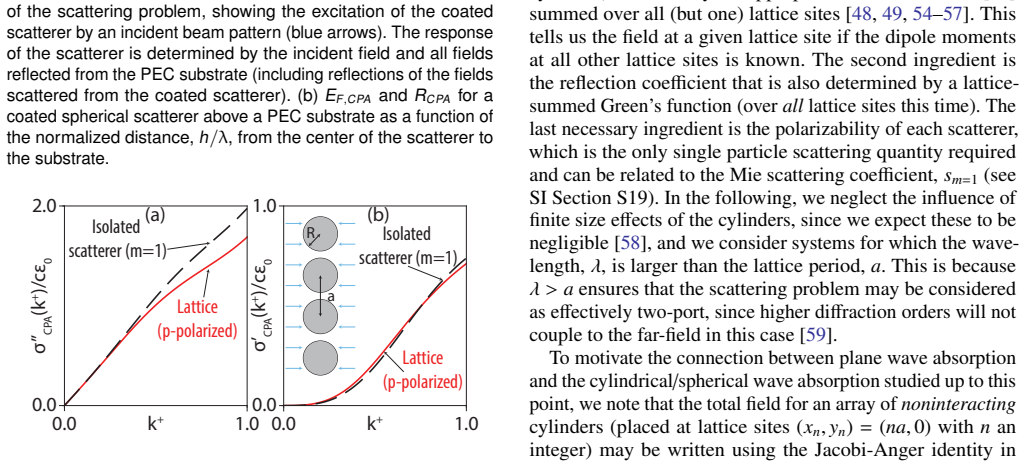
We derive, in closed-form, the surface conductivity required for coated subwavelength-scale spherical and cylindrical scatterers to perfectly absorb incident coherent light of fixed angular momentum. To address the challenge of synthesizing an incident wave of a fixed angular momentum, we analyze two geometries where this physics can be accessed from the far-field: a single coated sphere suspended above a good conducting surface, and an array of dipole-coupled coated cylindrical scatterers. We show that the required complex surface conductivities necessary for coherent perfect absorption over a large bandwidth in the terahertz may be easily achieved in moderately doped graphene.
Editorial analysis
A structured set of objections, weighed in public.
Referee Report
Summary. The paper derives closed-form expressions for the surface conductivity of plasmonic coatings on subwavelength spherical and cylindrical scatterers that enable coherent perfect absorption (CPA) of incident light carrying fixed angular momentum. It proposes two far-field-accessible geometries—a coated sphere suspended above a conducting plane and an array of dipole-coupled coated cylinders—to realize the required incident fields. The work further shows that the necessary complex conductivities lie within the range achievable by moderately doped graphene, enabling broadband tunable CPA in the terahertz regime.
Significance. If the closed-form derivations hold and the graphene parameters are experimentally accessible, the results provide a concrete route to tunable, angular-momentum-selective CPA using readily fabricable plasmonic coatings. The emphasis on far-field realizability and the explicit mapping to graphene conductivity values are practical strengths that could inform device design in THz optics and sensing.
major comments (1)
- The central claim of a closed-form derivation for the required surface conductivity is load-bearing, yet the manuscript provides no explicit verification that the resulting conductivity expressions remain independent of auxiliary fitting parameters once the angular-momentum condition is imposed. A direct comparison between the derived conductivity and the graphene model used in §4 would clarify whether the result is truly parameter-free or implicitly tuned.
minor comments (2)
- Figure captions should explicitly state the angular momentum value (m or l) used in each panel to allow immediate comparison with the analytic expressions.
- The definition of the coated-cylinder array periodicity and the dipole-coupling approximation should be cross-referenced to the far-field accessibility argument in the introduction.
Simulated Author's Rebuttal
We appreciate the referee's thorough review and constructive feedback on our manuscript. We are pleased that the significance of the work is recognized. Below we provide a point-by-point response to the major comment.
read point-by-point responses
-
Referee: The central claim of a closed-form derivation for the required surface conductivity is load-bearing, yet the manuscript provides no explicit verification that the resulting conductivity expressions remain independent of auxiliary fitting parameters once the angular-momentum condition is imposed. A direct comparison between the derived conductivity and the graphene model used in §4 would clarify whether the result is truly parameter-free or implicitly tuned.
Authors: Our derivation starts from the exact Mie scattering solution for coated spheres and cylinders and imposes the condition for zero scattering in the specific angular momentum channel, leading to an algebraic expression for the surface conductivity that depends only on the geometric parameters, the wave number, and the angular momentum index. No auxiliary fitting parameters are introduced at any stage; the expressions are obtained by direct substitution and simplification. The graphene model in §4 is the standard Drude-like conductivity for doped graphene, used solely to demonstrate that the required values are physically attainable. We agree that an explicit comparison would strengthen the presentation and will include a new figure or table in the revised manuscript showing the derived conductivity overlaid with the graphene conductivity for representative doping levels across the THz range. revision: yes
Circularity Check
No significant circularity identified
full rationale
The abstract claims a closed-form derivation of required surface conductivity for CPA in coated scatterers, with two geometries proposed to access fixed angular momentum from the far field and feasibility in graphene. No equations, derivation steps, self-citations, or fitted parameters are visible in the provided text. Without access to the full manuscript's equations or references, no load-bearing step can be shown to reduce to its own inputs by construction. The central claim is presented as a derivation and is therefore scored as self-contained.
Axiom & Free-Parameter Ledger
Reference graph
Works this paper leans on
-
[1]
Chong, L
Y . Chong, L. Ge, H. Cao, and A. D. Stone, Coherent perfect absorbers: time-reversed lasers, Physical Review Letters105, 053901 (2010)
2010
-
[2]
W. Wan, Y . Chong, L. Ge, H. Noh, A. D. Stone, and H. Cao, Time-reversed lasing and interferometric control of absorption, Science331, 889 (2011)
2011
-
[3]
Yariv, Universal relations for coupling of optical power be- tween microresonators and dielectric waveguides, Electronics Letters36, 321 (2000)
A. Yariv, Universal relations for coupling of optical power be- tween microresonators and dielectric waveguides, Electronics Letters36, 321 (2000)
2000
-
[4]
M. Cai, O. Painter, and K. J. Vahala, Observation of Crit- ical Coupling in a Fiber Taper to a Silica-Microsphere Whispering-Gallery Mode System, Physical Review Letters https://doi.org/10.1103/PhysRevLett.85.74 (2000)
-
[5]
Zhang, K
J. Zhang, K. F. MacDonald, and N. I. Zheludev, Controlling light-with-light without nonlinearity, Light: Science & Applica- tions1, e18 (2012)
2012
-
[6]
N. Liu, M. Mesch, T. Weiss, M. Hentschel, and H. Giessen, Infrared perfect absorber and its application as plasmonic sensor, Nano letters10, 2342 (2010)
2010
-
[7]
J. Song, P. Bai, Z. Hang, and Y . Lai, Acoustic coherent perfect absorbers, New Journal of Physics16, 033026 (2014)
2014
-
[8]
Y . Duan, J. Luo, G. Wang, Z. H. Hang, B. Hou, J. Li, P. Sheng, and Y . Lai, Theoretical requirements for broadband perfect absorption of acoustic waves by ultra-thin elastic meta-films, Scientific Reports5, 12139 (2015)
2015
-
[9]
Ma and P
G. Ma and P. Sheng, Acoustic metamaterials: From local reso- nances to broad horizons, Science advances2, e1501595 (2016)
2016
-
[10]
Romero-Garc´ıa, N
V . Romero-Garc´ıa, N. Jim´enez, J.-P. Groby, A. Merkel, V . Tour- nat, G. Theocharis, O. Richoux, and V . Pagneux, Perfect absorp- tion in mirror-symmetric acoustic metascreens, Physical Review Applied14, 054055 (2020)
2020
-
[11]
H. Noh, Y . Chong, A. D. Stone, and H. Cao, Perfect coupling of light to surface plasmons by coherent absorption, Physical Review Letters108, 186805 (2012)
2012
-
[12]
M. Pu, Q. Feng, M. Wang, C. Hu, C. Huang, X. Ma, Z. Zhao, C. Wang, and X. Luo, Ultrathin broadband nearly perfect ab- sorber with symmetrical coherent illumination, Optics Express 20, 2246 (2012)
2012
-
[13]
T. V . Teperik, V . Popov, and F. G. De Abajo, Radiative decay of plasmons in a metallic nanoshell, Physical Review B69, 155402 (2004)
2004
-
[14]
Proskurin, A
A. Proskurin, A. Bogdanov, and D. G. Baranov, Perfect absorp- tion of a focused light beam by a single nanoparticle, Laser & Photonics Reviews15, 2000430 (2021)
2021
-
[15]
Jablan, H
M. Jablan, H. Buljan, and M. Soljaˇci´c, Plasmonics in graphene at infrared frequencies, Physical Review B—Condensed Matter and Materials Physics80, 245435 (2009)
2009
-
[16]
Chen and A
P.-Y . Chen and A. Alu, Atomically thin surface cloak using graphene monolayers, ACS Nano5, 5855 (2011)
2011
-
[17]
A. Alu, D. Rainwater, and A. Kerkhoff, Plasmonic cloak- ing of cylinders: finite length, oblique illumination and cross- polarization coupling, New Journal of Physics12, 103028 (2010)
2010
-
[18]
F. Liu, Y . Chong, S. Adam, and M. Polini, Gate-tunable coher- ent perfect absorption of terahertz radiation in graphene, 2D Materials1, 031001 (2014)
2014
-
[19]
H. Noh, S. M. Popoff, and H. Cao, Broadband subwavelength focusing of light using a passive sink, Optics Express21, 17435 (2013)
2013
-
[20]
Strictly speaking, this is true for largem, see e.g. [71]
-
[21]
See Section S22 of the Supporting Information for more details
-
[22]
The incident field is the field in the absence of the scatterer, which must have both incoming and outgoing components
Though perhaps obvious, we stress that theincidentfield, in the terminology of scattering theory, is distinct from theincoming field. The incident field is the field in the absence of the scatterer, which must have both incoming and outgoing components
-
[23]
S. G. Johnson and J. D. Joannopoulos, Block-iterative frequency- domain methods for Maxwell’s equations in a planewave basis, Opt. Express8, 173 (2001)
2001
-
[24]
I. H. Malitson, Interspecimen comparison of the refractive index of fused silica, Journal of the optical society of America55, 1205 (1965)
1965
-
[25]
J. D. Jackson,Classical electrodynamics, 3rd ed. (John Wiley & Sons, 1928)
1928
-
[26]
C. F. Bohren and D. R. Huffman,Absorption and scattering of light by small particles(John Wiley & Sons, 2008)
2008
-
[27]
Christensen, A.-P
T. Christensen, A.-P. Jauho, M. Wubs, and N. A. Mortensen, Localized plasmons in graphene-coated nanospheres, Physical Review B91, 125414 (2015)
2015
-
[28]
Mostafazadeh and M
A. Mostafazadeh and M. Sarisaman, Optical spectral singular- ities and coherent perfect absorption in a two-layer spherical medium, Proceedings of the Royal Society A: Mathematical, Physical and Engineering Sciences468, 3224 (2012)
2012
-
[29]
In all figures showing ωCPA and RCPA the angular momentum under consideration will bel=1
We will usually omit dependencies of ωCPA and RCPA on the angular momentum/k+ since in all cases such dependencies will be obvious from the context. In all figures showing ωCPA and RCPA the angular momentum under consideration will bel=1
-
[30]
the part proportional to the Bessel function of the second kind
I.e. the part proportional to the Bessel function of the second kind
-
[31]
D. G. Baranov, A. Krasnok, T. Shegai, A. Al`u, and Y . Chong, Coherent perfect absorbers: linear control of light with light, Nature Reviews Materials2, 1 (2017)
2017
-
[32]
Y . Fan, F. Zhang, Q. Zhao, Z. Wei, and H. Li, Tunable terahertz coherent perfect absorption in a monolayer graphene, Optics letters39, 6269 (2014)
2014
-
[33]
Y . Fan, Z. Liu, F. Zhang, Q. Zhao, Z. Wei, Q. Fu, J. Li, C. Gu, and H. Li, Tunable mid-infrared coherent perfect absorption in a graphene meta-surface, Scientific reports5, 13956 (2015)
2015
-
[34]
The derivation in the SI is for cylinders, for simplicity, but the exact same behavior applies for spheres
-
[35]
D. A. Smirnova, I. V . Shadrivov, A. E. Miroshnichenko, A. I. Smirnov, and Y . S. Kivshar, Second-harmonic generation by a graphene nanoparticle, Physical Review B90, 035412 (2014)
2014
-
[36]
C. Wang, D. Gao, and L. Gao, Detecting nonlocality by second- harmonic generation from a graphene-wrapped nanoparticle, Optics Express30, 12722 (2022)
2022
-
[37]
A. N. Grigorenko, M. Polini, and K. S. Novoselov, Graphene plasmonics, Nature photonics6, 749 (2012)
2012
-
[38]
Wunsch, T
B. Wunsch, T. Stauber, F. Sols, and F. Guinea, Dynamical polar- ization of graphene at finite doping, New Journal of Physics8, 318 (2006)
2006
-
[39]
K. S. Novoselov, A. K. Geim, S. V . Morozov, D.-e. Jiang, Y . Zhang, S. V . Dubonos, I. V . Grigorieva, and A. A. Firsov, Electric field effect in atomically thin carbon films, Science306, 666 (2004)
2004
-
[40]
X. Y . He, J. Tao, and B. Meng, Analysis of graphene te surface plasmons in the terahertz regime, Nanotechnology24, 345203 (2013)
2013
-
[41]
Jablan, H
M. Jablan, H. Buljan, and M. Soljaˇci´c, Transverse electric plas- mons in bilayer graphene, Optics express19, 11236 (2011)
2011
-
[42]
Soleimani, Anisotropic graphene metasurface waveguide sup- porting plasmonic tm and te modes, Optics Express33, 30371 (2025)
H. Soleimani, Anisotropic graphene metasurface waveguide sup- porting plasmonic tm and te modes, Optics Express33, 30371 (2025)
2025
-
[43]
S. Kim, A. Krasnok, and A. Al`u, Complex-frequency excitations in photonics and wave physics, Science387, eado4128 (2025)
2025
-
[44]
We do not add Cartesian subscripts to the polarizability, since in all cases considered below the polarizability will either be isotropic (as in the case of a sphere) or the direction of the polar- 11 ization of the incident light will clarify the relevant component of the polarizability tensor
-
[45]
We, of course, do not have angular momentum as a good quan- tum number in this geometry, so σCPA does not have an angular momentum index
-
[46]
Cioci, V
L. Cioci, V . Jandieri, W. Fuscaldo, P. Burghignoli, and P. Bac- carelli, Tunable thz leaky-wave radiation from periodic chains of graphene-coated circular rods, IEEE Antennas and Wireless Propagation Letters23, 3739 (2024)
2024
-
[47]
Kou and J
Y . Kou and J. F¨orstner, Discrete plasmonic solitons in graphene- coated nanowire arrays, Optics Express24, 4714 (2016)
2016
-
[48]
G´omez-Medina, M
R. G´omez-Medina, M. Laroche, and J. J. S´aenz, Extraordinary optical reflection from sub-wavelength cylinder arrays, Optics Express14, 3730 (2006)
2006
-
[49]
V . E. Babicheva and A. B. Evlyukhin, Metasurfaces with elec- tric quadrupole and magnetic dipole resonant coupling, ACS Photonics5, 2022 (2018)
2022
-
[50]
Christensen, W
T. Christensen, W. Wang, A.-P. Jauho, M. Wubs, and N. A. Mortensen, Classical and quantum plasmonics in graphene nan- odisks: Role of edge states, Physical Review B90, 241414 (2014)
2014
-
[51]
Thongrattanasiri, F
S. Thongrattanasiri, F. H. Koppens, and F. J. Garc´ıa de Abajo, Complete optical absorption in periodically patterned graphene, Physical review letters108, 047401 (2012)
2012
-
[52]
Z. Fang, Y . Wang, A. E. Schlather, Z. Liu, P. M. Ajayan, F. J. Garc´ıa de Abajo, P. Nordlander, X. Zhu, and N. J. Halas, Active tunable absorption enhancement with graphene nanodisk arrays, Nano letters14, 299 (2014)
2014
-
[53]
P. M. Morse and H. Feshbach,Methods of theoretical physics (Technology Press, 1946) pp. 1361–1362
1946
-
[54]
F. J. Garc´ıa de Abajo, Colloquium: Light scattering by particle and hole arrays, Reviews of Modern Physics79, 1267 (2007)
2007
-
[55]
A. B. Evlyukhin, C. Reinhardt, A. Seidel, B. S. Luk’yanchuk, and B. N. Chichkov, Optical response features of si-nanoparticle arrays, Physical Review B—Condensed Matter and Materials Physics82, 045404 (2010)
2010
-
[56]
M. A. Yurkin and A. G. Hoekstra, The discrete dipole approxi- mation: an overview and recent developments, Journal of Quan- titative Spectroscopy and Radiative Transfer106, 558 (2007)
2007
-
[57]
Z. A. Awan and M. Y . Rafiq, Tunable metasurface composed of graphene-coated silicon dioxide spherical particles, Optical and Quantum Electronics57, 54 (2024)
2024
-
[58]
Zundel and A
L. Zundel and A. Manjavacas, Finite-size effects on periodic ar- rays of nanostructures, Journal of Physics: Photonics1, 015004 (2019)
2019
-
[59]
Baldacci, S
L. Baldacci, S. Zanotto, G. Biasiol, L. Sorba, and A. Tredicucci, Interferometric control of absorption in thin plasmonic metama- terials: general two port theory and broadband operation, Optics Express23, 9202 (2015)
2015
-
[60]
Some papers, e.g
Note that the requirement |r + t| =0 is an exact condition. Some papers, e.g. [33], have cited the more relaxed condition, |r| = |t|. However, the second relation in Equation. (2) of [33] is incorrect, as may be readily checked
-
[61]
S. Raza, T. Christensen, M. Wubs, S. I. Bozhevolnyi, and N. A. Mortensen, Nonlocal response in thin-film waveguides: loss ver- sus nonlocality and breaking of complementarity, Physical Re- view B—Condensed Matter and Materials Physics88, 115401 (2013)
2013
-
[62]
David and F
C. David and F. J. Garcia de Abajo, Spatial nonlocality in the optical response of metal nanoparticles, The Journal of Physical Chemistry C115, 19470 (2011)
2011
-
[63]
Christensen, W
T. Christensen, W. Yan, S. Raza, A.-P. Jauho, N. A. Mortensen, and M. Wubs, Nonlocal response of metallic nanospheres probed by light, electrons, and atoms, ACS nano8, 1745 (2014)
2014
-
[64]
McArthur, B
D. McArthur, B. Hourahine, and F. Papoff, Coherent control of plasmons in nanoparticles with nonlocal response, Optics Communications382, 258 (2017)
2017
-
[65]
A. H. Castro Neto, F. Guinea, N. M. Peres, K. S. Novoselov, and A. K. Geim, The electronic properties of graphene, Reviews of Modern Physics81, 109 (2009)
2009
-
[66]
J. L. Manes, Symmetry-based approach to electron-phonon in- teractions in graphene, Physical Review B—Condensed Matter and Materials Physics76, 045430 (2007)
2007
-
[67]
Proskurin, A
A. Proskurin, A. Bogdanov, and D. G. Baranov, Coherent perfect absorption by a single nanoparticle, inNanophotonics IX, V ol. 12131 (SPIE, 2022) pp. 152–157
2022
-
[68]
J. Luo, B. Liu, Z. H. Hang, and Y . Lai, Coherent perfect ab- sorption via photonic doping of zero-index media, Laser & Photonics Reviews12, 1800001 (2018)
2018
-
[69]
D. Yan, R. Mei, M. Li, Z. Ma, Z. H. Hang, and J. Luo, Control- ling coherent perfect absorption via long-range connectivity of defects in three-dimensional zero-index media, Nanophotonics 12, 4195 (2023). [70]https://github.com/AliGhorashiCMT/ Coherent-Perfect-Absorption, accessed 30 April, 2026
2023
-
[70]
Jacob, L
Z. Jacob, L. V . Alekseyev, and E. Narimanov, Optical hyperlens: far-field imaging beyond the diffraction limit, Optics express14, 8247 (2006)
2006
-
[71]
Rahmanzadeh, A
M. Rahmanzadeh, A. Khavasi, and B. Rejaei, Analytical method for the diffraction of an electromagnetic wave by subwavelength graphene ribbons, Journal of the Optical Society of America B 38, 953 (2021)
2021
-
[72]
We note that [16] has a similar equation but is offby a minus sign (if the surface impedance is defined asZ(ω)=1/σ(ω))
-
[73]
Fuchs and F
R. Fuchs and F. Claro, Multipolar response of small metallic spheres: Nonlocal theory, Physical Review B35, 3722 (1987)
1987
-
[74]
We note that the particular prefactors here do not really matter, as the reader may verify by reading through to the end of the derivation
-
[75]
Note that we only did this for the TM modes, which are associ- ated with non-zero surface charge densities
-
[76]
[78]σ CPA(k+, l) being the TM CPA conductivity for coated spheres in this case
Or the zeros of the numerator, since we are only concerned with the imaginary part of the CPA conductivity. [78]σ CPA(k+, l) being the TM CPA conductivity for coated spheres in this case. [79]σ CPA(k+, l) being the TE CPA conductivity for coated spheres in this case
-
[77]
J. U. Nockel,Resonances in nonintegrable open systems(Yale University, 1997)
1997
-
[78]
I. S. Gradshteyn and I. M. Ryzhik,Table of integrals, series, and products(Academic press, 2014)
2014
-
[79]
Novotny and B
L. Novotny and B. Hecht,Principles of nano-optics(Cambridge university press, 2012)
2012
-
[80]
In this case, for simplicity, we keep the imaginary part of the conductivity fixed at its CPA value
discussion (0)
Sign in with ORCID, Apple, or X to comment. Anyone can read and Pith papers without signing in.