REVIEW 2 major objections 4 minor 52 references
Stabilization of the Spread-Global Dimension
T0 review · 2 major / 4 minor · reviewed 2026-08-07 · deepseek-v4-flash
Pith's one-line read The spread-global dimension of T x Q stabilizes once T is large enough, with an explicit linear bound for grids.
desk verdict Settles the spread-global dimension stabilization conjecture with a clean, coherent proof; the main caveat is an imported monotonicity theorem that should be stated explicitly. read the letter →
The pith
A machine-rendered reading of the paper's core claim, the machinery that carries it, and where it could break.
The reading
What carries the argument
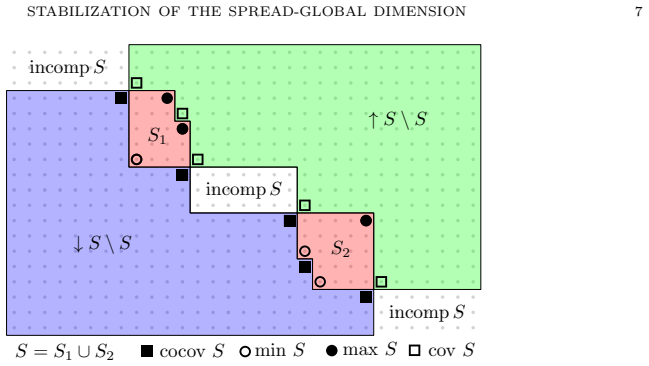
The load-bearing tool is the left Kan extension $\mathrm{Lan}_{\iota}$ along an aligned grid inclusion $\iota: Q \to P$, that is, a product of inclusions of totally ordered sets. Proposition B proves $\mathrm{Lan}_{\iota}$ is exact and fully faithful, maps spread-decomposable representations to spread-decomposable representations, and maps spread-approximations to spread-approximations. A second pillar is Proposition 4.6, a general bound on relative global dimensions when a finite family of exact fully faithful functors satisfies four closure conditions. In the proof of Theorem C, the functors are the left Kan extensions $\mathrm{Lan}_{\iota}$ for origin aligned grid inclusions $[\ell] \times G \to [k] \times G$, and radical approximations are controlled explicitly: Proposition 4.11 lists the spreads that can occur in a minimal spread-radical approximation, and Proposition 5.6 builds a subgrid of size $1 + 4|G|$ whose image contains any given spread together with its radical-approximation domain.
What would settle it
Take a finite grid $G$, set $k = 1 + 4|G|$, and compute $\mathrm{gl.dim}_{\mathrm{sprd}}([\ell] \times G)$ for some $\ell > k$; if it exceeds $\mathrm{gl.dim}_{\mathrm{sprd}}([k] \times G)$, Theorem C is false. For $G = [2]$ the decisive comparison is between $[10] \times [2]$ and $[9] \times [2]$, a finite computation over incidence algebras using minimal spread-radical approximations.
Extended reading notes
Core claim
The paper's central claims are Theorem A and Theorem C. Theorem A says that over a grid poset, the projectives for the spread exact structure are precisely the spread-decomposable representations, and every finitely presented representation has a finite spread-resolution. Theorem C says that for every finite poset $Q$, $n_Q = \sup_T \mathrm{gl.dim}_{\mathrm{sprd}}(T \times Q)$ is finite, and if $G$ is a finite grid then $n_G = \mathrm{gl.dim}_{\mathrm{sprd}}([1 + 4|G|] \times G)$. The corollaries include a positive answer to Conjecture 1, namely $\mathrm{gl.dim}_{\mathrm{sprd}}([k] \times [2]) = 2$ for $k \geq 4$, and a weakening of Conjecture 2 with a linear stabilization constant $1 + 4m$. The paper also notes that Theorem A cannot extend from grids to all upper semilattices.
Load-bearing premise
The proof depends on two imported facts: monotonicity of spread-global dimension under full embeddings, and the theorem that every finite poset has finite spread-resolutions; if either fails, the reduction from arbitrary posets to grids breaks.
Editorial extensions
If this is right
- Over any grid poset, the spread exact structure has spread-decomposable projectives and finite spread-resolutions for every finitely presented representation, so relative Betti numbers and Koszul coresolutions are defined for these modules.
- For every $k \geq 4$, the spread-global dimension of $[k] \times [2]$ is $2$, resolving the ladder-morphism case that motivated the stabilization conjecture.
- For every $m$, the spread-global dimension of $[k] \times [m]$ is constant once $k \geq 1 + 4m$.
- For a finite grid $G$ and any total order $T$, including infinite ones, the spread-global dimension of $T \times G$ is finite and bounded by $n_G$.
- For every finite poset $Q$, the quantity $n_Q$ is finite, so arbitrarily wide products of $Q$ with total orders cannot push the spread-global dimension to infinity.
Reading between the lines
- The constant $1 + 4|G|$ is an existence bound, and the paper's own data suggest it is not sharp: for $[k] \times [2]$ stabilization holds already at $k = 4$, while the general theorem only ensures it at $k = 9$. Testing intermediate grids could reveal a tighter general rule.
- Lemma 3.13 and Proposition B make it possible in principle to compute spread resolutions over infinite grids by pulling the presentation back to a finite aligned subgrid; the paper does not present this as an algorithm.
- The failure for upper semilattices recorded in Remark 1.3 suggests that positive answers for m-tame representations, if they exist, will require different tools; the paper leaves this as an open question.
Editorial analysis
A structured set of objections, weighed in public.
Referee Report
Summary. The paper studies the spread exact structure on categories of finitely presented poset representations. Its main results are Theorem A, stating that over any grid poset the spread-projective representations are exactly the spread-decomposable ones and every finitely presented representation has a finite spread-resolution; Proposition B, showing that left Kan extensions along aligned grid inclusions preserve spread-approximations; and Theorem C, proving that for every finite poset Q the quantity n_Q = sup_T gl.dim_sprd(T×Q) is finite, with the sharp explicit bound n_G = gl.dim_sprd([1+4|G|]×G) for finite grids G. The paper also derives Corollaries D and E, giving a positive answer to Conjectures 1 and 2 of [AENY23] with a linear stabilization constant, and Corollary F for infinite total orders. The proof strategy is modular: a general transfer theorem (Proposition 4.6) bounds relative global dimensions using radical approximations, and the explicit description of spread-radical approximations (Proposition 4.11) is combined with combinatorial lemmas about spreads in products T×G to construct the needed grid inclusions. The manuscript is carefully written, contains a transparent Remark 1.3 documenting a limitation of an earlier draft, and gives a concrete counterexample showing that Theorem A does not extend to arbitrary upper semilattices.
Significance. If the results are correct, they resolve the stabilization conjecture of [AENY23] in a strong form and give the first explicit linear bound on spread-global dimension for products of a fixed finite poset with a varying total order. Theorem A justifies the use of spread-Betti-type invariants for finitely presented representations of grid posets, which is directly relevant to multiparameter persistence. The paper is notable for its explicit constants, its clean reduction of the infinite-grid case to finite grids via Lemma 3.13 and Proposition B, and its honest documentation of the failure of the main theorem for upper semilattices. The internal proof chain is detailed and appears coherent; the main caveat is that several load-bearing inputs are imported from other papers, especially [AET25, Thm. 1.2] and [AENY23, Prop. 4.5], and the manuscript does not state their exact hypotheses.
major comments (2)
- [Section 5.2, proof of Theorem C] The first reduction from an arbitrary finite poset Q to a containing grid G, and the case ℓ≤k in the second part of Theorem C, both invoke [AET25, Thm. 1.2] to conclude inequalities such as gl.dim_sprd(T×Q) ≤ gl.dim_sprd(T×G). This theorem is not stated in the paper, and its precise hypotheses are not given. Since the finiteness of n_Q for arbitrary finite Q, the monotonicity in ℓ, and Corollaries D–F all rest on this result, the authors should state the theorem verbatim and explicitly verify that its hypotheses hold for full embeddings of product posets under the spread exact structure. In particular, if the theorem requires an additional condition such as summand-injectivity of interval covers, that verification is essential; without it, the grid case is proved but the uniform statement for arbitrary finite posets is not.
- [Section 3, proofs of Proposition B and Theorem A] The proof of Proposition B invokes [AET25, Thm. 3.14] to conclude that padding along a convex full inclusion preserves spread-approximations, and the proof of Theorem A invokes [AENY23, Prop. 4.5] for the existence of finite spread-resolutions over finite posets. Both are external results that are load-bearing for the existence part of Theorem A and for the grid case of Theorem C. The paper should either state these results in the background section or give a precise statement with all hypotheses, and should confirm that [AENY23, Prop. 4.5] applies verbatim to the spread exact structure as defined here, since notation and conventions for interval representations vary across the literature.
minor comments (4)
- [Section 5.2, first paragraph of the proof of Theorem C] In the chain of inequalities, the expression 'gl.dimsprd([k]×Q)' should read 'gl.dimsprd([k]×G)', since the equality in the previous line is n_G = gl.dimsprd([k]×G).
- [Proposition 4.6] The statement of Proposition 4.6 uses the notation inj(Γ) before Γ is defined; Γ = End_Λ(⊕_{X∈X} X) is only introduced in the proof. The definition should be moved into the statement or given immediately before it.
- [Lemma 3.8, proof] The proof says 'For the second statement' twice; the second occurrence should be 'For the first statement', since it begins the argument for upset representations.
- [Corollary D, proof] The proof relies on [AENY23, Ex. 4.10] for the equality g_2(4)=...=g_2(9)=2; adding one sentence explaining how that example computes these values would improve readability.
Circularity Check
No circularity: all load-bearing inputs are external theorems or independently verified structural results, and no claimed prediction reduces to a fit or definition.
full rationale
Walked the claimed derivation chain. Theorem C's reduction of an arbitrary finite poset Q to a grid uses the monotonicity inequality gl.dimsprd(T×Q) ≤ gl.dimsprd(T×G), imported from [AET25, Thm. 1.2], and Theorem A's base case uses the finite-poset finite-resolution result [AENY23, Prop. 4.5]. These are external, parameter-free statements whose assumptions do not include the stabilization conjecture, so importing them is evidence, not circularity. The only same-authors citation in the main proof is [BBH25, Prop. 6.8] (via Proposition 4.11) describing spread-irreducible morphisms; it is a structural input about morphisms, not a disguised version of the theorem being proved, and it does not determine the linear constant 1+4|G|. Proposition 4.6 is a general transfer bound whose hypotheses are verified internally by Proposition B, Lemma 3.3, Propositions 5.2 and 5.6, and Lemma 5.7; no fitted parameter is later relabelled as a prediction, and no equation reduces to its own input. Any concern about the unproved monotonicity theorem is a correctness risk about an external hypothesis, not a circularity.
Assumptions & free parameters
assumptions (6)
- domain assumption Every representation of a finite poset admits a finite spread-resolution (AENY23, Prop. 4.5).
- domain assumption Spread-global dimension is monotone under full poset inclusions (AET25, Thm. 1.2).
- domain assumption Left Kan extension along an inclusion of an upset (padding functor) preserves spread-approximations (AET25, Thm. 3.14).
- domain assumption The morphisms between spread representations that are spread-irreducible are classified in BBH25, Prop. 6.8.
- domain assumption The values gl.dim_sprd([k]×[2])=2 hold for k=4,...,9 (AENY23, Ex. 4.10).
- standard math Projectivization reduces add(X)-resolutions to projective resolutions over End(⊕X) (Proposition 2.18, from ARS95).
Cite this review
Pith. "Pith review of Stabilization of the Spread-Global Dimension." pith.science (2026). https://pith.science/paper/PLE7CJR2
@misc{pith2026250601828,
  author       = {Pith},
  title        = {Pith review of: Stabilization of the Spread-Global Dimension},
  year         = {2026},
  howpublished = {\url{https://pith.science/paper/PLE7CJR2}},
  note         = {Machine review of arXiv:2506.01828}
}
read the original abstract
Motivated by constructions from applied topology, there has been recent interest in the homological algebra of linear representations of posets, particularly in the context of homological algebra relative to non-standard exact structures. A prominent example is the spread exact structure on the category of representations of a fixed poset, in which the indecomposable projectives are the spread representations (that is, the indicator representations of convex and connected subsets). The spread-global dimension is known to be finite for finite posets and not uniformly bounded on the collection of all Cartesian products between two arbitrary finite total orders. It was conjectured in [AENY23] that the spread-global dimension is uniformly bounded on the collection of all Cartesian products between a fixed finite total order and an arbitrary finite total order. We provide a positive answer to this conjecture and, more generally, prove that the spread-global dimension is uniformly bounded on the collection of all Cartesian products between a fixed finite poset and an arbitrary finite total order. In doing so, we also establish the existence of finite spread-resolutions for finitely presented representations of arbitrary grid posets.
Figures


Figures from the paper (1 more)

Reference graph
Works this paper leans on
-
[1]
Escolar, Yasuaki Hiraoka, and Hiroshi Takeuchi
Hideto Asashiba, Emerson G. Escolar, Yasuaki Hiraoka, and Hiroshi Takeuchi. Matrix method for persistence modules on commutative ladders of finite type. Jpn. J. Ind. Appl. Math. , 36(1):97--130, 2019
work page 2019
-
[2]
Escolar, Ken Nakashima, and Michio Yoshiwaki
Hideto Asashiba, Emerson G. Escolar, Ken Nakashima, and Michio Yoshiwaki. Approximation by interval-decomposables and interval resolutions of persistence modules. Journal of Pure and Applied Algebra , 227(10):107397, 2023
work page 2023
-
[3]
Toshitaka Aoki, Emerson G. Escolar, and Shunsuke Tada. Summand-injectivity of interval covers and monotonicity of interval resolution global dimensions. Journal of Applied and Computational Topology , 9(2):13, 2025
work page 2025
-
[4]
Maurice Auslander, Idun Reiten, and Sverre O. Smal . Artin algebras . Cambridge Studies in Advanced Mathematics. Cambridge University Press, 1995
work page 1995
-
[5]
Relative homology and representation theory
Maurice Auslander and yvind Solberg. Relative homology and representation theory. I . R elative homology and homologically finite subcategories. Comm. Algebra , 21(9):2995--3031, 1993
work page 1993
-
[6]
Relative K oszul coresolutions and relative B etti numbers
Hideto Asashiba. Relative K oszul coresolutions and relative B etti numbers. J. Pure Appl. Algebra , 229(3):Paper No. 107905, 2025
work page 2025
-
[7]
Elements of the Representation Theory of Associative Algebras: Techniques of Representation Theory
Ibrahim Assem, Andrzej Skowronski, and Daniel Simson. Elements of the Representation Theory of Associative Algebras: Techniques of Representation Theory . London Mathematical Society Student Texts. Cambridge University Press, 2006
work page 2006
-
[8]
On preservation of relative resolutions for poset representations
Toshitaka Aoki and Shunsuke Tada. On preservation of relative resolutions for poset representations. arXiv:2506.21227 , 2025
arXiv 2025
Show all 52 references
-
[9]
Whitney numbers of geometric lattices
Kenneth Bac awski. Whitney numbers of geometric lattices. Advances in Math. , 16:125--138, 1975
1975
-
[10]
Benjamin Blanchette, Thomas Br\"ustle, and Eric J. Hanson. Homological approximations in persistence theory. Canad. J. Math. , 76(1):66--103, 2024
2024
-
[11]
Benjamin Blanchette, Thomas Brüstle, and Eric J. Hanson. Exact structures for persistence modules. Proceedings of ICRA 2022 (to appear) , 2025
2022
-
[12]
Bifiltrations and persistence paths for 2- M orse functions
Ryan Budney and Tomasz Kaczynski. Bifiltrations and persistence paths for 2- M orse functions. Algebr. Geom. Topol. , 23(6):2895--2924, 2023
2023
-
[13]
An introduction to multiparameter persistence
Magnus Bakke Botnan and Michael Lesnick. An introduction to multiparameter persistence. In Representations of algebras and related structures , EMS Ser. Congr. Rep., pages 77--150. EMS Press, Berlin, 2023
2023
-
[14]
Medina-Mardones, and Maximilian Schmahl
Ulrich Bauer, Anibal M. Medina-Mardones, and Maximilian Schmahl. Persistent homology for functionals. Commun. Contemp. Math. , 26(10):Paper No. 2350055, 40, 2024
2024
-
[15]
Signed barcodes for multi-parameter persistence via rank decompositions and rank-exact resolutions
Magnus Bakke Botnan, Steffen Oppermann, and Steve Oudot. Signed barcodes for multi-parameter persistence via rank decompositions and rank-exact resolutions. Foundations of Computational Mathematics , 2024
2024
-
[16]
On the bottleneck stability of rank decompositions of multi-parameter persistence modules
Magnus Bakke Botnan, Steffen Oppermann, Steve Oudot, and Luis Scoccola. On the bottleneck stability of rank decompositions of multi-parameter persistence modules. Adv. Math. , 451:Paper No. 109780, 53, 2024
2024
-
[17]
Counts and end-curves in two-parameter persistence
Thomas Brüstle, Steve Oudot, Luis Scoccola, and Hugh Thomas. Counts and end-curves in two-parameter persistence. arXiv:2505.13412 , 2025
2025 arXiv
-
[18]
Koszul complexes and relative homological algebra of functors over posets
Wojciech Chach \'o lski, Andrea Guidolin, Isaac Ren, Martina Scolamiero, and Francesca Tombari. Koszul complexes and relative homological algebra of functors over posets. Foundations of Computational Mathematics , pages 1--45, 2024
2024
-
[19]
Objets ind\'ecomposables dans certaines cat\'egories de foncteurs
Nicole Chaptal. Objets ind\'ecomposables dans certaines cat\'egories de foncteurs. C. R. Acad. Sci. Paris S\'er. A-B , 268:A934--A936, 1969
1969
-
[20]
Realisations of posets and tameness
Wojciech Chacholski, Alvin Jin, and Francesca Tombari. Realisations of posets and tameness. arXiv:2112.12209 , 2024
2024 arXiv
-
[21]
Irreducible morphisms in subcategories
Gladys Chalom and H \'e ctor Merklen. Irreducible morphisms in subcategories. Groups, Rings and Group Rings , page 57, 2006
2006
-
[22]
Smal , and yvind Solberg
Peter Dr\"axler, Idun Reiten, Sverre O. Smal , and yvind Solberg. Exact categories and vector space categories. Trans. Amer. Math. Soc. , 351(2):647--682, 1999. With an appendix by B.\ Keller
1999
-
[23]
Remarks on posets of finite representation type
Grzegorz Drozdowski and Daniel Simson. Remarks on posets of finite representation type. Preprint, Tor\' u n , pages 1--23, 1978
1978
-
[24]
Escolar and Yasuaki Hiraoka
Emerson G. Escolar and Yasuaki Hiraoka. Persistence modules on commutative ladders of finite type. Discrete Comput. Geom. , 55(1):100--157, 2016
2016
-
[25]
Radical embeddings and representation dimension
Karin Erdmann, Thorsten Holm, Osamu Iyama, and Jan Schröer. Radical embeddings and representation dimension. Advances in Mathematics , 185(1):159--177, 2004
2004
-
[26]
Escolar and Woojin Kim
Emerson G. Escolar and Woojin Kim. Barcoding invariants and their equivalent discriminating power. arXiv:2412.04995 , 2025
2025 arXiv
-
[27]
Samuel Eilenberg and John C. Moore. Foundations of relative homological algebra. Mem. Amer. Math. Soc. , 55:39, 1965
1965
-
[28]
Unzerlegbare D arstellungen
Peter Gabriel. Unzerlegbare D arstellungen. I . Manuscripta Math. , 6:71--103; correction, ibid. 6 (1972), 309, 1972
1972
-
[29]
Murray Gerstenhaber and Samuel D. Schack. Simplicial cohomology is H ochschild cohomology. J. Pure Appl. Algebra , 30(2):143--156, 1983
1983
-
[30]
Relative homological algebra
Gerhard Hochschild. Relative homological algebra. Trans. Amer. Math. Soc. , 82:246--269, 1956
1956
-
[31]
Distributive lattices and A uslander regular algebras
Osamu Iyama and Ren\'e Marczinzik. Distributive lattices and A uslander regular algebras. Adv. Math. , 398:Paper No. 108233, 27, 2022
2022
-
[32]
On the cohomology of incidence algebras of partially ordered sets
Kiyoshi Igusa and Dan Zacharia. On the cohomology of incidence algebras of partially ordered sets. Comm. Algebra , 18(3):873--887, 1990
1990
-
[33]
The space of barcode bases for persistence modules
Emile Jacquard, Vidit Nanda, and Ulrike Tillmann. The space of barcode bases for persistence modules. J. Appl. Comput. Topol. , 7(1):1--30, 2023
2023
-
[34]
The completely separating incidence algebras of tame representation type
Zbigniew Leszczy\' n ski. The completely separating incidence algebras of tame representation type. Colloquium Mathematicae , 94(2):243--262, 2002
2002
-
[35]
Representation-tame incidence algebras of finite posets
Zbigniew Leszczy\' n ski. Representation-tame incidence algebras of finite posets. Colloquium Mathematicae , 96(2):293--305, 2003
2003
-
[36]
Indecomposable representations of finite ordered sets
Mich\`ele Loupias. Indecomposable representations of finite ordered sets. In Representations of algebras ( P roc. I nternat. C onf., C arleton U niv., O ttawa, O nt., 1974) , volume Vol. 488 of Lecture Notes in Math. , pages 201--209. Springer, Berlin-New York, 1975
1974
-
[37]
Computing minimal presentations and bigraded B etti numbers of 2-parameter persistent homology
Michael Lesnick and Matthew Wright. Computing minimal presentations and bigraded B etti numbers of 2-parameter persistent homology. SIAM J. Appl. Algebra Geom. , 6(2):267--298, 2022
2022
-
[38]
Homological algebra of modules over posets
Ezra Miller. Homological algebra of modules over posets. arXiv:2008.00063 , 2020
2008 arXiv
-
[39]
Stratifications of real vector spaces from constructible sheaves with conical microsupport
Ezra Miller. Stratifications of real vector spaces from constructible sheaves with conical microsupport. J. Appl. Comput. Topol. , 7(3):473--489, 2023
2023
-
[40]
Theory of categories , volume Vol
Barry Mitchell. Theory of categories , volume Vol. XVII of Pure and Applied Mathematics . Academic Press, New York-London, 1965
1965
-
[41]
On the dimension of objects and categories
Barry Mitchell. On the dimension of objects and categories. II . F inite ordered sets. J. Algebra , 9:341--368, 1968
1968
-
[42]
Categories for the working mathematician , volume 5 of Graduate Texts in Mathematics
Saunders Mac Lane. Categories for the working mathematician , volume 5 of Graduate Texts in Mathematics . Springer-Verlag, New York, second edition, 1998
1998
-
[43]
Representations of partially ordered sets
Lyudmyla Nazarova and Andrei Ro i ter. Representations of partially ordered sets. Zap. Nau cn. Sem. Leningrad. Otdel. Mat. Inst. Steklov. (LOMI) , 28:5--31, 1972. Investigations on the theory of representations
1972
-
[44]
Kategornye matrichnye zadachi i problema Brau\'era-Tr\'ella
Lyudmyla Nazarova and Andrei Ro i ter. Kategornye matrichnye zadachi i problema Brau\'era-Tr\'ella . Izdat. ``Naukova Dumka'', Kiev, 1973
1973
-
[45]
On the stability of multigraded betti numbers and hilbert functions
Steve Oudot and Luis Scoccola. On the stability of multigraded betti numbers and hilbert functions. SIAM Journal on Applied Algebra and Geometry , 8(1):54–88, January 2024
2024
-
[46]
Steve Y. Oudot. Persistence theory: from quiver representations to data analysis , volume 209 of Mathematical Surveys and Monographs . American Mathematical Society, Providence, RI, 2015
2015
-
[47]
Category theory in context
Emily Riehl. Category theory in context . Courier Dover Publications, 2017
2017
-
[48]
Linear representations of partially ordered sets and vector space categories , volume 4 of Algebra, Logic and Applications
Daniel Simson. Linear representations of partially ordered sets and vector space categories , volume 4 of Algebra, Logic and Applications . Gordon and Breach Science Publishers, Montreux, 1992
1992
-
[49]
Ladder decomposition for morphisms of persistence modules
Z iva Urban c i c and Jeffrey Giansiracusa. Ladder decomposition for morphisms of persistence modules. J. Appl. Comput. Topol. , 8(7):2069--2109, 2024
2024
-
[50]
Notes on abelianity of categories of finitely encoded persistence modules, 2024
Lukas Waas. Notes on abelianity of categories of finitely encoded persistence modules, 2024
2024
-
[51]
Representation dimension and quasi-hereditary algebras
Changchang Xi. Representation dimension and quasi-hereditary algebras. Adv. Math. , 168(2):193--212, 2002
2002
-
[52]
Commutative quivers and matrix algebras of finite type
AG Zavadskij and AS Shkabara. Commutative quivers and matrix algebras of finite type. Preprint IM-76-3, Institute of Mathematics AN USSR, Kiev (in Russian) , 1976
1976
Reviewed August 7, 2026 · model on record in the stance chip above.
Discussion (0). Sign in to comment.