REVIEW 2 major objections 5 minor 1 cited by
Ordering curves on surfaces
T0 review · 2 major / 5 minor · reviewed 2026-08-07 · deepseek-v4-flash
Pith's one-line read The paper proves that the complete ordering of closed geodesic lengths by size is an injective invariant: no two distinct hyperbolic metrics on the same topological surface rank all interior curves identically.
desk verdict The pants projective injection and the never-changing-order theorem are real additions, but the proof of the main theorem misses Fenchel-Nielsen twists on general surfaces with boundary, so the big claim is not established as written. read the letter →
The pith
A machine-rendered reading of the paper's core claim, the machinery that carries it, and where it could break.
The reading
What carries the argument
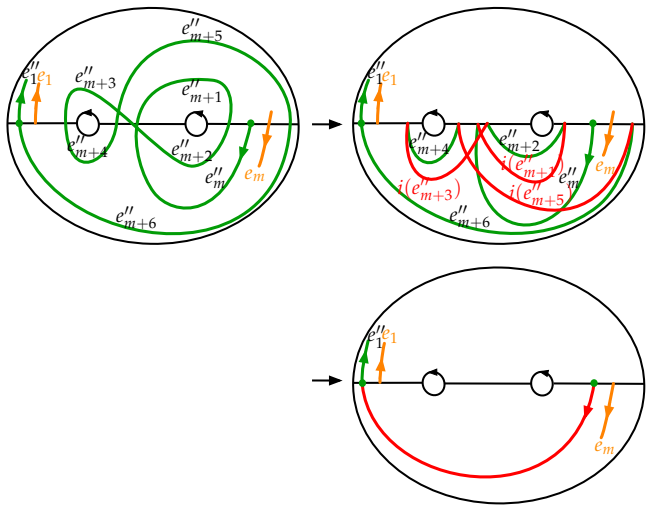
The load-bearing mechanism is a projectively injective length map $\Phi : T(\Sigma) \to \mathbb{R}^r$, $X \mapsto (\ell_X([\gamma_1]), \dots, \ell_X([\gamma_r]))$, meaning proportional output forces equal metrics. On a pair of pants the construction uses Fricke–Vogt trace coordinates for $\mathrm{SL}(2,\mathbb{R})$ representations of the free group on two generators: a representation is determined up to conjugacy by the four traces $(\operatorname{tr}\rho(u), \operatorname{tr}\rho(v), \operatorname{tr}\rho(uv), \operatorname{tr}\rho(u^{-1}v))$, so four interior curves realizing those conjugacy classes give a map into $\mathbb{R}^4$ with the required property. A second mechanism, used for Theorem 1.3, is the decomposition of a hyperbolic pair of pants into two isometric geodesic hexagons by three pairwise orthogonal geodesic arcs; the reflection involution exchanging the two hexagons lets the authors replace long subpaths of a concatenated geodesic by shorter reflected subpaths, turning the concatenation inequality into a strict length inequality valid for every metric.
What would settle it
A concrete way to test the main claim is to search for two distinct hyperbolic metrics on the same surface whose length ratios agree on the finite curve list constructed in Theorem 1.2; if such a pair existed, the projective injectivity used in the proof would fail, and Theorem 1.1 would be false, since two distinct metrics with identical ratios on all the selected curves would still have to be separated by some order comparison in the proof.
Extended reading notes
Core claim
The central claim, Theorem 1.1, is that the map sending a hyperbolic metric $X$ on a fixed surface $\Sigma$ to the total order of the lengths $\ell_X([\gamma])$ over all interior curve homotopy classes $[\gamma]$ is injective on Teichmüller space $T(\Sigma)$. The engine is Theorem 1.2, which produces a finite collection of interior curves $\gamma_1, \dots, \gamma_r$ with a projectively injective length map: if the length vectors of two metrics are proportional, the metrics coincide. For a pair of pants, four interior curves suffice, via the Fricke–Vogt trace-coordinate description of the character variety of the free group on two generators; the four traces $(\operatorname{tr}\rho(u), \operatorname{tr}\rho(v), \operatorname{tr}\rho(uv), \operatorname{tr}\rho(u^{-1}v))$ determine the representation up to conjugacy, and hence the metric. The paper completes the earlier simple-curve result of McShane–Parlier by allowing all curves and removing restrictions on boundary lengths, and it proves Theorem 1.3, a metric-independent inequality for certain concatenated words, leading to Corollary 1.4 on $k$-systoles of pairs of pants for $k \le 4$.
Load-bearing premise
The load-bearing premise is that a finite cover of the surface by embedded pairs of pants, each carrying a projectively injective four-curve length map, combines into a projectively injective map for the whole surface; the paper asserts this gluing in a single sentence, without a detailed verification of how the inter-pants gluing data are recovered by the chosen curves.
Editorial extensions
If this is right
- If Theorem 1.1 is correct, the length order is a complete invariant: two hyperbolic metrics on the same surface coincide exactly when every pair of interior curves has the same relative order of lengths.
- Theorem 1.2 gives a finite certificate for metric equality: on every such surface a finite list of interior curves separates all metrics by length ratios alone.
- Theorem 1.3 supplies universal length comparisons that hold without knowing the metric, so they can prune candidate curves in searches for shortest curves.
- Corollary 1.4 confirms, for $k = 1, 2, 3, 4$, that the $k$-systole of any hyperbolic pair of pants self-intersects exactly $k$ times.
- For larger $k$, the method reduces the $k$-systole search to comparing finitely many explicit candidate words, though the candidate lists grow quickly.
Reading between the lines
- Editorial inference: since the length order is a total order on a countable set, injectivity of the order map suggests Teichmüller space embeds into a space of countable total orders, giving a purely combinatorial coordinatization that the paper does not explicitly state.
- Editorial inference: the finite curve set from Theorem 1.2 could be used as a computational certificate—two metrics are equal if and only if their length ratios agree on that finite list—which would make the abstract injectivity result algorithmically checkable.
- Editorial inference: the reflection-involution argument on pairs of pants may generalize to other surfaces with an orientation-reversing involution, producing further metric-independent word inequalities beyond the pairs covered by Theorem 1.3.
- Editorial inference: the $k$-systole computation could in principle be extended beyond $k = 4$ by automating the comparisons of the longer candidate lists with the same word-length and self-intersection techniques, although the paper does not claim this.
Editorial analysis
A structured set of objections, weighed in public.
Referee Report
Summary. The paper studies the order of lengths of closed geodesics on hyperbolic surfaces of finite type with negative Euler characteristic. Its main result (Theorem 1.1) states that the map sending a hyperbolic metric to the total order of lengths of all interior closed geodesics is injective. The proof proceeds by first constructing, for each surface, a finite collection of interior curves whose length vector is projectively injective (Theorem 1.2), then converting a difference in a length ratio into a reversal of order of two concatenated curves. The paper also proves (Theorem 1.3) that for any pair of pants, if u and v are cyclically reduced words with u starting and ending in different letters, then ℓ(u) < ℓ(uv) for every hyperbolic metric, and uses this to show (Corollary 1.4) that for 1 ≤ k ≤ 4 the shortest geodesic with at least k self-intersections has exactly k self-intersections. The paper includes a computational verification of the candidate lists for small k with code available.
Significance. If Theorem 1.1 is correct, it is a significant rigidity result: the complete length order of all interior closed geodesics is a total invariant of the hyperbolic metric, extending prior work of McShane and Parlier for simple curves on closed surfaces and addressing the remaining cases of pairs of pants and surfaces with boundary. The proof strategy, based on Fricke–Klein trace identities and projective injections into Euclidean space, is natural and elegant. The k-systole corollary is a nice application, and the authors provide machine-checkable code for the finite enumeration, which is a strength. However, as detailed below, the proof of Theorem 1.2 for surfaces with boundary has an unaddressed gluing issue that currently leaves Theorem 1.1 unsupported in the general case, and the k-systole argument relies on an unproved word-length assertion.
major comments (2)
- [Section 3, proof of Theorem 1.2 (paragraph beginning 'For a surface Σ_{g,n} with more complicated topology...')] The proof asserts that 'the metric information on these pairs of pants will determine the metric information on Σ_{g,n}' and then applies Corollary 3.8 pants-by-pants. This is not justified: the four curves chosen for each pair of pants (a, b, ab, ab^{-1} or a, a^{-1}b, a^{-2}b, b) lie in a single pants or are the cuff curves themselves, so their lengths are unchanged by Fenchel–Nielsen twists along the interior cuffs of the pants decomposition. Consequently, the finite collection Φ built in this paragraph is constant along positive-dimensional twist families and cannot be projectively injective. Since the proof of Theorem 1.1 in Section 4 invokes Theorem 1.2 to obtain two curves with different length ratios, Theorem 1.1 is not proved for surfaces with boundary that require a pants decomposition with interior cuffs (e.g., Σ_{0,4} or Σ_{1,2}). A repair requires adding curves that cross each interior cuff, or an explicit open-cover argument in which the overlap identifications are determined by the chosen lengths.
- [Section 5.3, paragraph before Corollary 5.5] The statement 'For small values of k, to have k self-intersections, the curve needs at least 2(k+1) letters in its cyclically reduced and admissible word' is asserted without proof or reference. This claim is load-bearing for the reduction to Baribaud's theorem and for the exhaustiveness of the candidate list S≥k: if a k-self-intersecting geodesic could have fewer than 2(k+1) letters, Baribaud's lower bound would not apply to it and the comparison of lengths might miss the true k-systole. The authors should either prove this assertion for k = 1, 2, 3, 4 or state precisely that it is verified by the exhaustive computation, explaining the search bound used by the code.
minor comments (5)
- [Lemma 3.5] The displayed simplification of the derivative of cosh(tx)/cosh(ty) is algebraically incorrect; the correct numerator is ((x−y)/2)sinh(t(x+y)) + ((x+y)/2)sinh(t(x−y)), which is still positive for x > y ≥ 0, so the lemma's conclusion is unaffected.
- [Throughout] There are numerous cross-reference artifacts such as 'Theorem 1.31.3', 'Corollary 1.41.4', 'Theorem 1.21.2', and 'Remark 2.32.3' that should be fixed in the final version.
- [Section 5.3, algorithm paragraph] The URL for the code is duplicated ('https://github.com/hanhv/small-k-systoleshttps://github.com/hanhv/small-k-systoles') and should be cleaned up.
- [Section 5.3, algorithm paragraph] The phrase 'aBk' appears to be a typo for 'ab^{-k}' or similar; please correct the notation.
- [Section 3, proof of Theorem 1.2 (closed-surface case)] The sentence 'In each pair of pants decomposition of Σg,0, there a non-separating curve' is missing the verb 'is' and should read 'there is a non-separating curve'.
Circularity Check
No circular derivation: the main theorems are proved from trace identities, geometric length comparisons, and independent prior results; the general-surface gluing step has a real twist-recovery gap, but that is a correctness issue rather than a self-referential reduction.
full rationale
The derivation chain is not circular. Theorem 1.1 is obtained from Theorem 1.2 by a limit argument comparing two length ratios, and Theorem 1.2 is obtained for pants from Proposition 3.4, whose proof uses the Fricke-Vogt trace theorem, Lemma 3.5, and Lemma 3.6 borrowed from [66]. The cited items from [66] are independent published results with stated assumptions, so even though the citation overlaps with one of the present authors, the paper is not reducing its claim to an unverified self-citation. The k-systole conclusion uses Baribaud's theorem and the Despré-Lazarus algorithm, both external to this paper. The only flagged issue is in the proof of Theorem 1.2 for general surfaces, where the sentence 'Notice that the metric information on these pairs of pants will determine the metric information on Σg,n' asserts without proof that gluing twists are recovered; indeed the four curves chosen inside each pants do not detect Fenchel-Nielsen twist parameters. This is a possible correctness gap in the argument, not a case of a conclusion being equivalent to its inputs by construction, so it does not raise the circularity score. The score of 2 reflects only the presence of self-citations that are legitimate but not independently re-proved here.
Assumptions & free parameters
assumptions (5)
- standard math Fricke-Vogt theorem: a conjugation-invariant regular function of two SL(2,C) matrices is a polynomial in (tr M, tr N, tr MN), and an irreducible representation is determined up to conjugacy by this triple.
- standard math Lemma 3.6 (from McShane-Parlier [66]): a function of the form cosh(x1 t)+cosh(x2 t)-sum_k cosh(y_k t) with x1 > y_k has at most one positive zero.
- domain assumption For any hyperbolic metric on a pair of pants, the three common perpendicular geodesic arcs between boundary geodesics realize the combinatorial hexagon cutting, and reflection in these arcs is an isometry exchanging the two hexagons.
- domain assumption Metric information on a finite collection of pairs of pants covering a surface determines the metric on the whole surface, and projectively injective maps on the pants combine into a projectively injective map on the Teichmüller space.
- ad hoc to paper For k ≤ 4, a geodesic on a pair of pants with k self-intersections needs at least 2(k+1) letters in its cyclically reduced admissible word.
Cite this review
Pith. "Pith review of Ordering curves on surfaces." pith.science (2026). https://pith.science/paper/PLPL3DTD
@misc{pith2026250606481,
  author       = {Pith},
  title        = {Pith review of: Ordering curves on surfaces},
  year         = {2026},
  howpublished = {\url{https://pith.science/paper/PLPL3DTD}},
  note         = {Machine review of arXiv:2506.06481}
}
read the original abstract
We study the order of lengths of closed geodesics on hyperbolic surfaces. Our first main result is that the order of lengths of curves determine a point in Teichm\"uller space. In an opposite direction, we identify classes of curves whose order never changes, independently of the choice of hyperbolic metric. We use this result to identify short curves with small intersections on pairs of pants.
Figures


Figures from the paper (5 more)


Forward citations
Cited by 1 Pith paper
-
Oriented graphs on curve complex I: hyperbolic and extremal length
The comparison graph of lengths of disjoint simple closed curves determines a closed hyperbolic surface, and every automorphism of this graph is geometric.
Reference graph
Works this paper leans on
- [1]
-
[2]
Relations between word length, hyperbolic length and self-intersection number of curves on surfaces
Moira Chas. Relations between word length, hyperbolic length and self-intersection number of curves on surfaces. In Recent advances in mathematics, volume 21 of Ramanujan Math. Soc. Lect. Notes Ser., pages 45–75. Ramanujan Math. Soc., Mysore, 2015
work page 2015
-
[3]
Computing the geometric intersection number of curves
Vincent Despré and Francis Lazarus. Computing the geometric intersection number of curves. J. ACM, 66(6):Art. 45, 49, 2019. 26
work page 2019
-
[4]
Notiz über die Discontinuität gewisser Collineationsgruppen
Robert Fricke. Notiz über die Discontinuität gewisser Collineationsgruppen. Math. Ann., 47(4):557–563, 1896
-
[5]
William M. Goldman. Trace coordinates on Fricke spaces of some simple hyperbolic surfaces. In Handbook of Teichmüller theory. Vol. II, volume 13 of IRMA Lect. Math. Theor. Phys., pages 611–684. Eur. Math. Soc., Zürich, 2009
work page 2009
-
[6]
Multiplicities of simple closed geodesics and hypersur- faces in Teichmüller space
Greg McShane and Hugo Parlier. Multiplicities of simple closed geodesics and hypersur- faces in Teichmüller space. Geom. Topol., 12(4):1883–1919, 2008
work page 1919
-
[7]
Short closed geodesics on cusped hyperbolic surfaces.Pacific J
Hanh Vo. Short closed geodesics on cusped hyperbolic surfaces.Pacific J. Math., 318(1):127– 151, 2022
work page 2022
-
[8]
H. Vogt. Sur les invariants fondamentaux des équations différentielles linéaires du second ordre. Ann. Sci. École Norm. Sup. (3), 6:3–71, 1889. Addresses: Department of Mathematics, University of Fribourg, Fribourg, Switzerland Department of Mathematics, Purdue University, Indiana, USA School of Mathematical Sciences, Nankai University, Tianjin, China Ema...
Reviewed August 7, 2026 · model on record in the stance chip above.
Discussion (0). Sign in to comment.