Alternating Direction Method of Multipliers (ADMMs) Based Distributed Approach For Wide-Area Control
Pith reviewed 2026-05-24 21:37 UTC · model grok-4.3
The pith
A distributed ADMM architecture estimates a global power system model from local black-box data to select optimal loops for damping interarea oscillations.
A machine-rendered reading of the paper's core claim, the machinery that carries it, and where it could break.
Core claim
The paper shows that an interconnected power system can be partitioned by coherency, that local black-box transfer functions estimated at each area can be fused via ADMM consensus into an accurate global model, and that the interarea-mode residue of this global model reliably identifies the optimal wide-area control loop for designing a damping controller.
What carries the argument
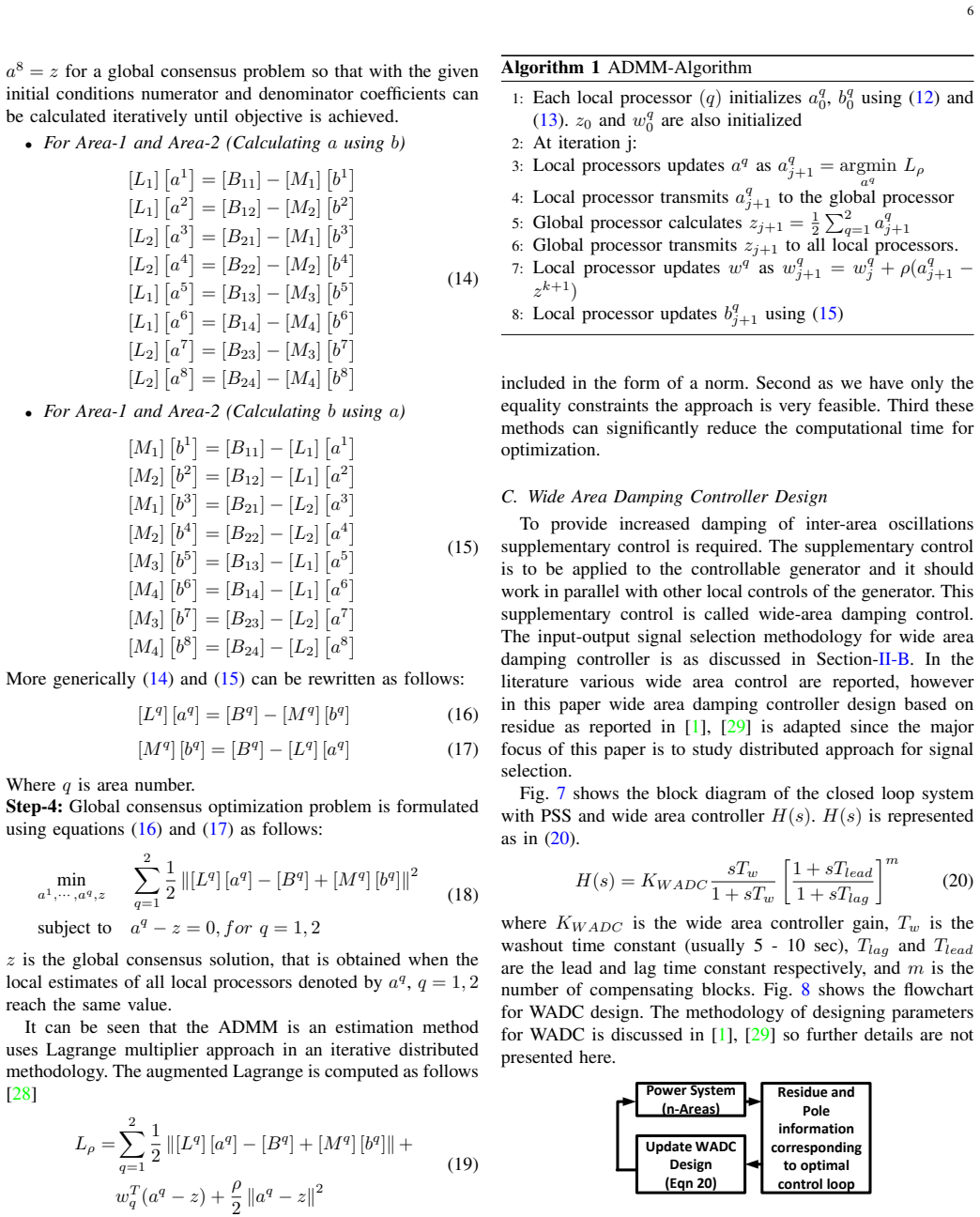
ADMM consensus algorithm that aggregates local black-box transfer function estimates into a single global model from which the interarea-mode residue is extracted.
If this is right
- Local processors need only area measurements and exchange limited multiplier information rather than raw data.
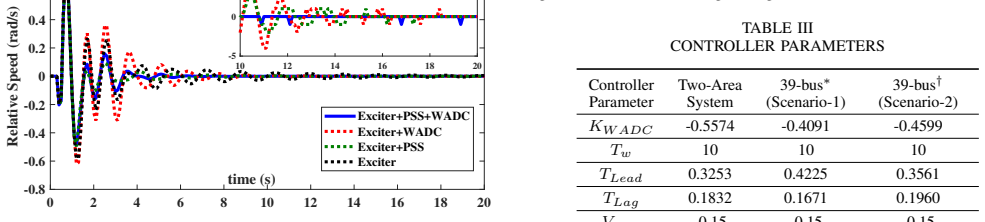
- The global model yields a residue that directly ranks candidate wide-area signals for damping effectiveness.
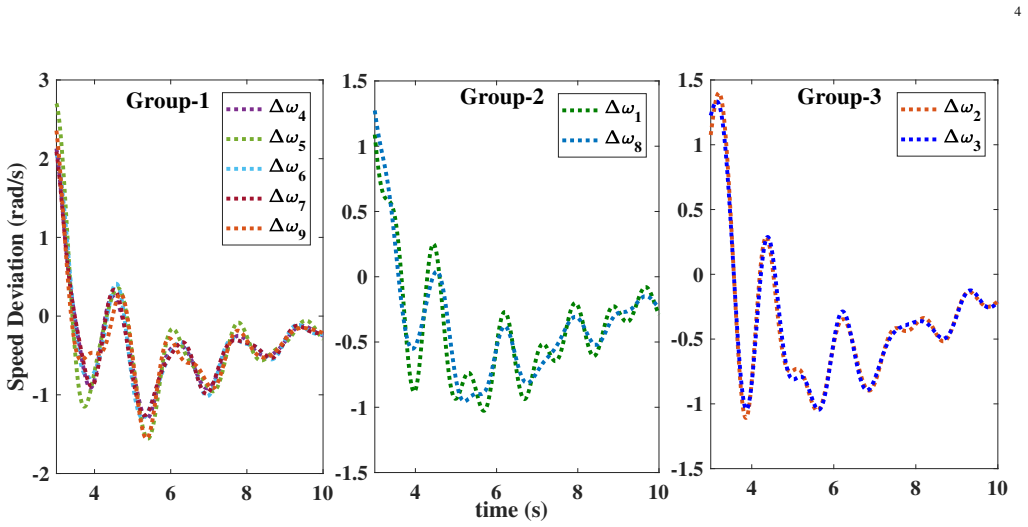
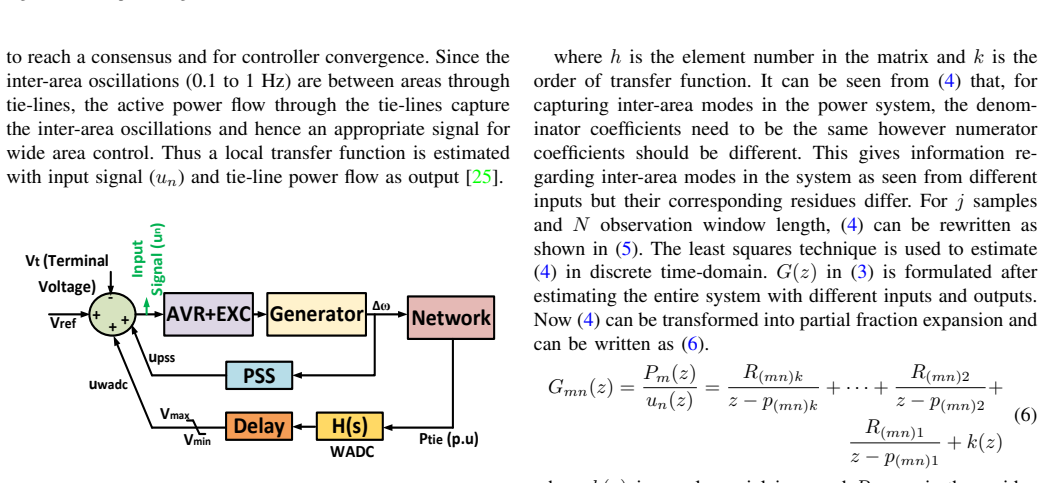
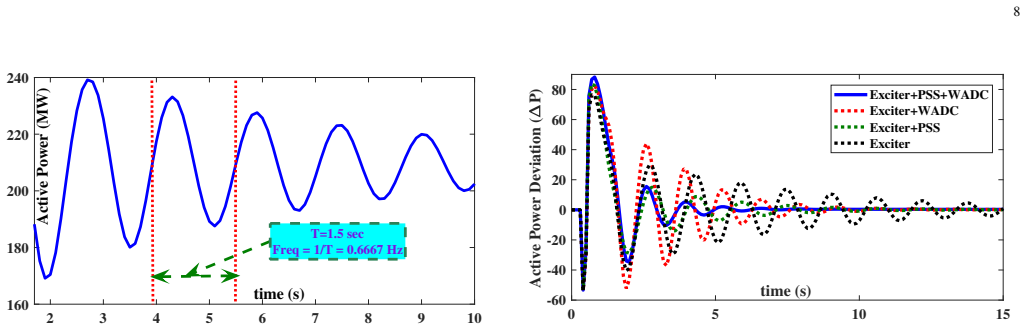
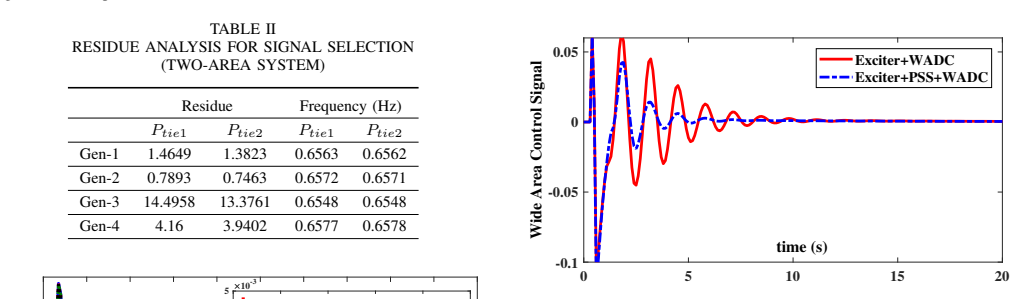
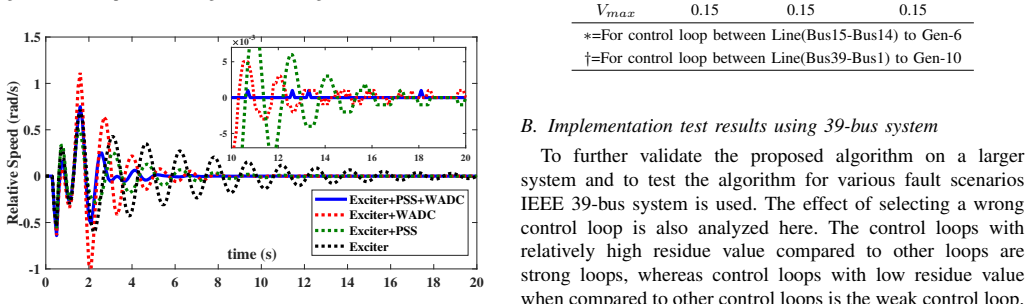
- A controller built from this residue damps the target mode on the two-area and IEEE 39-bus systems under the reported test conditions.
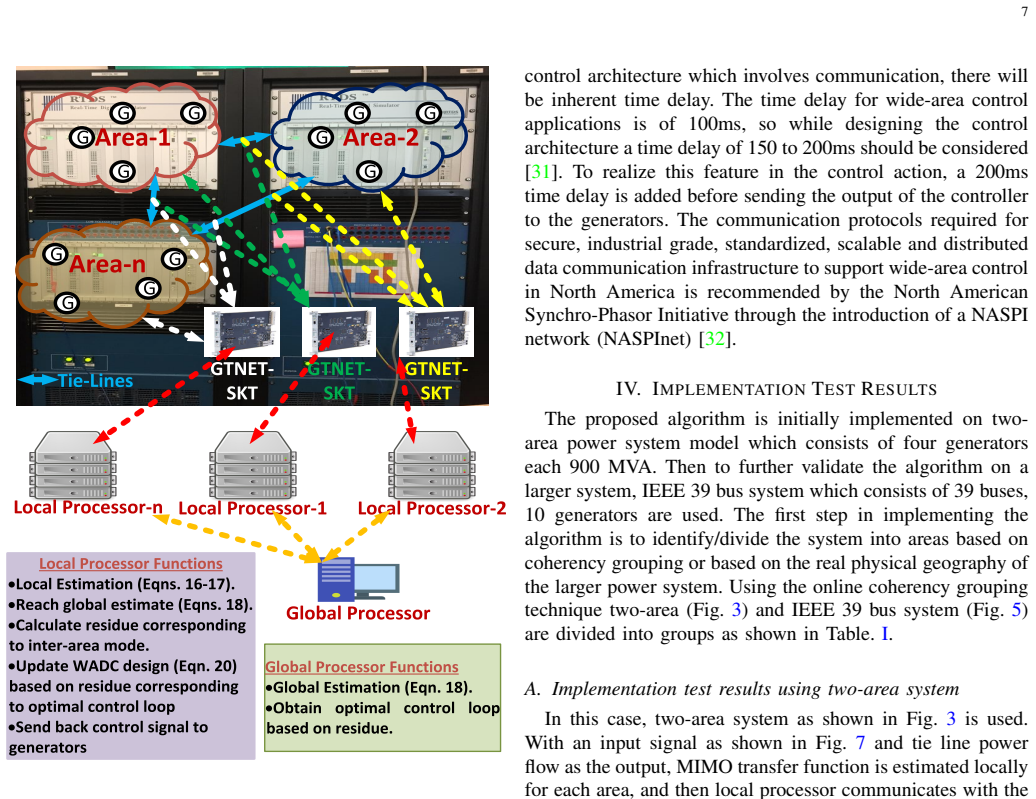
- The same architecture supports real-time cosimulation on RTDS/RSCAD and MATLAB platforms.
Where Pith is reading between the lines
- If coherency groups remain stable, the approach scales to larger grids by adding more local processors without redesigning the global step.
- The method could be tested on systems where area boundaries shift with operating point to check whether consensus still converges.
- Residue-based loop selection might be compared against other metrics such as mode shape or participation factors on the same test cases.
Load-bearing premise
The interconnected power system can be divided into coherent areas so that local black-box models combined by consensus produce an accurate global transfer function whose interarea-mode residue points to the best control loop.
What would settle it
If the ADMM consensus step run on a known test system with measured modes produces a global transfer function whose residue does not match the true optimal loop location within simulation error, the selection step fails.
Figures

read the original abstract
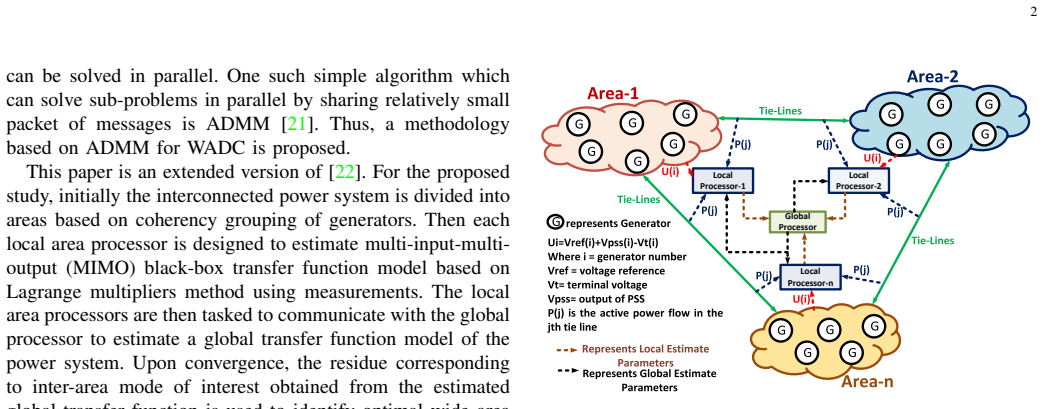
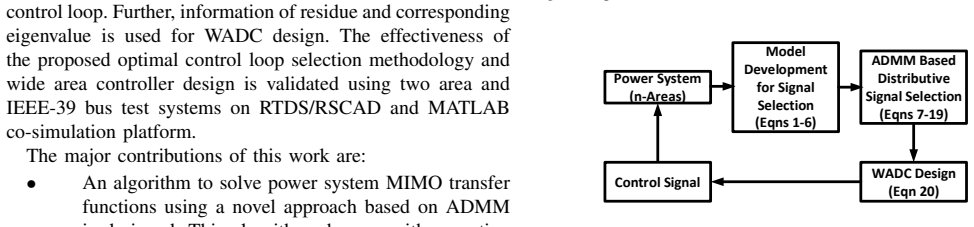
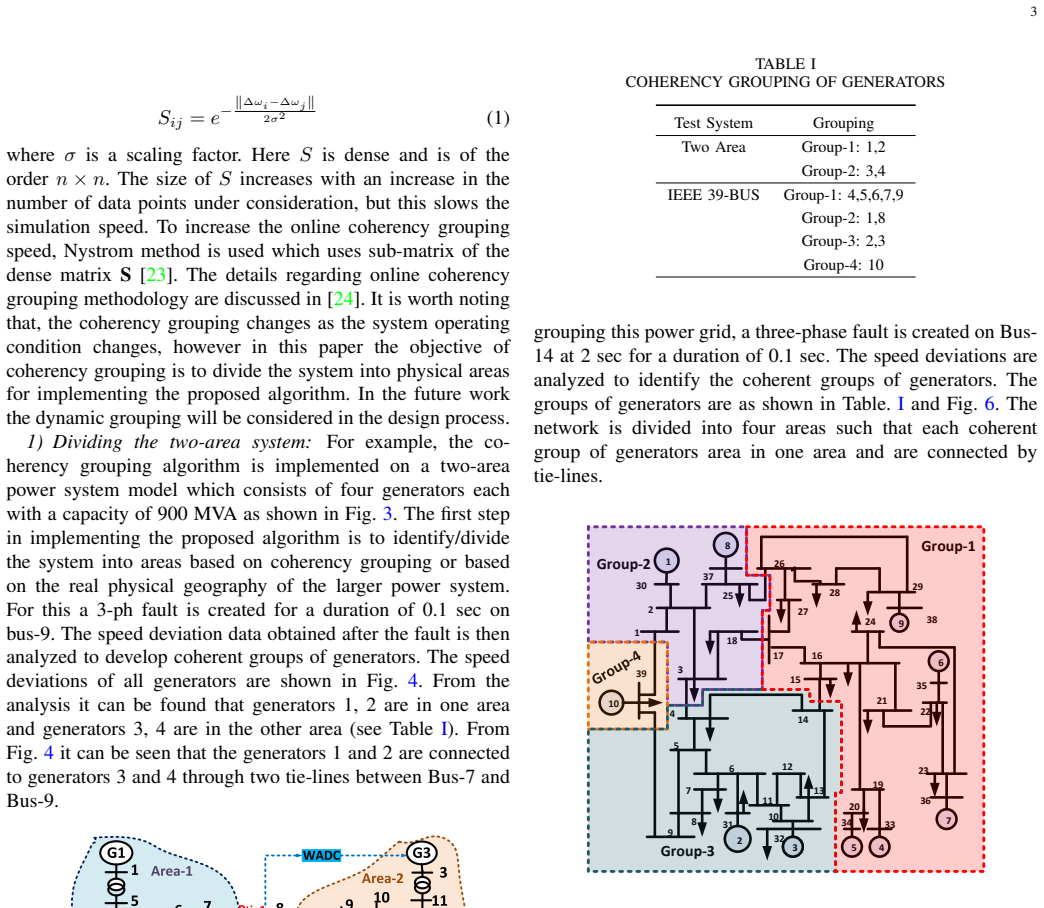
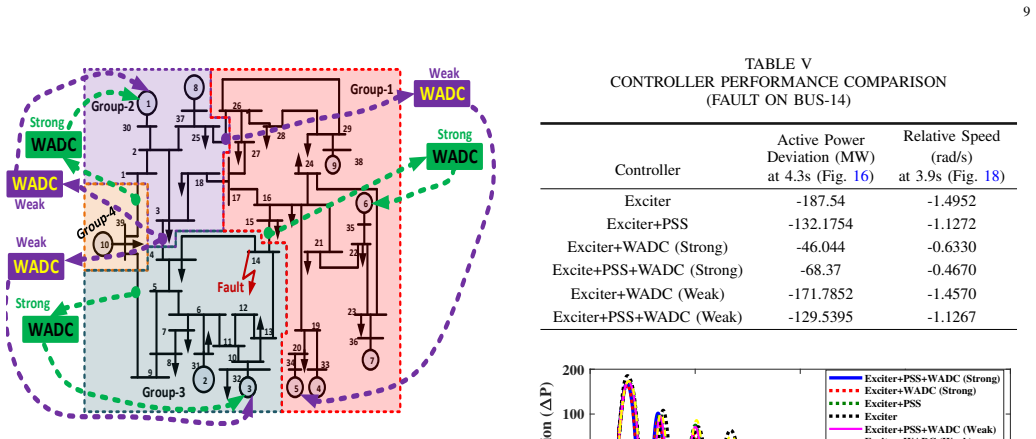
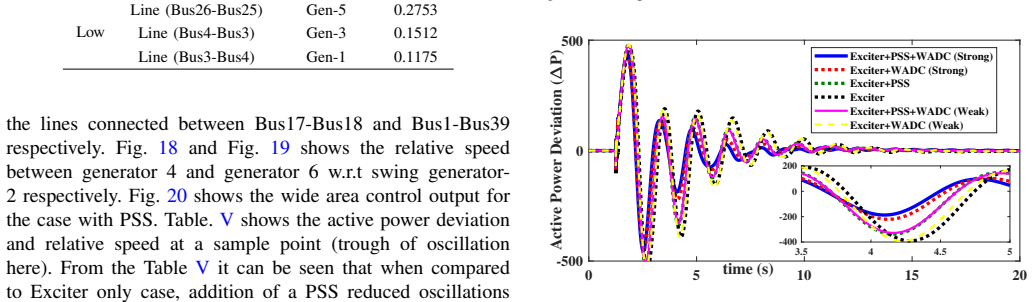
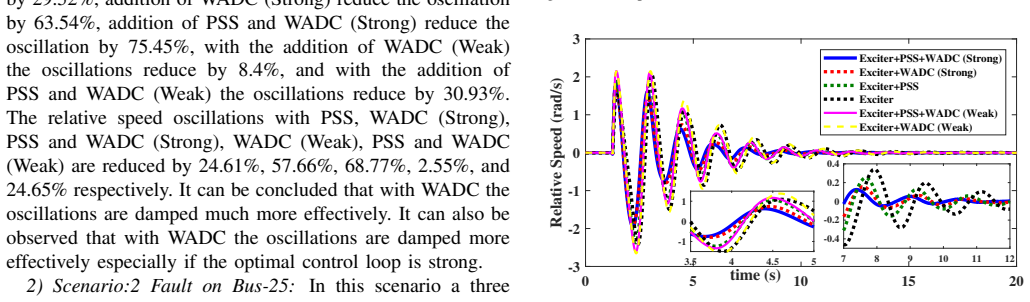
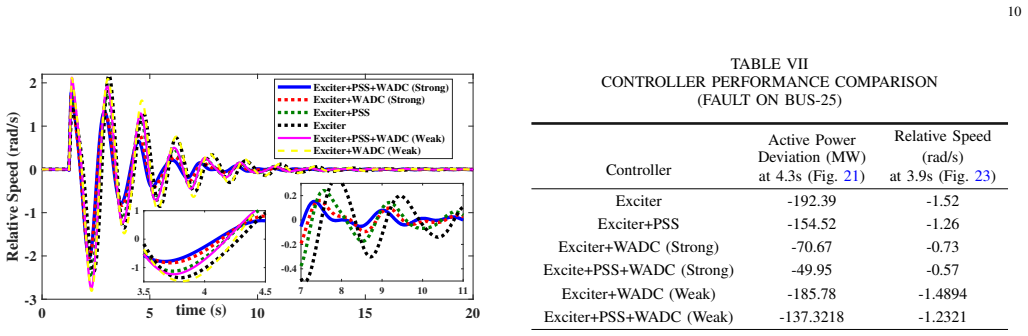
In this paper, an alternating direction method of multipliers based novel distributed wide-area control architecture is proposed for damping the interarea oscillations. In this approach, first, an interconnected power system is divided into areas based on coherency grouping. Second, local processors are assigned on each area that estimate a black-box transfer function model based on Lagrange multipliers using measurements. These local area processors are then used to estimate a global transfer function model of the power system based on a consensus algorithm through a global processor. After convergence, a transfer function residue corresponding to the interarea mode of interest is derived, to determine optimal wide area control loop. Finally, a wide-area damping controller is designed based on this information. The efficacy of the controller is validated using two area and IEEE-39 bus test systems on RTDS/RSCAD and MATLAB cosimulation platform.
Editorial analysis
A structured set of objections, weighed in public.
Referee Report
Summary. The paper proposes a distributed wide-area damping controller (WADC) architecture for interarea oscillations in power systems. The method first partitions the system via coherency grouping, assigns local processors to estimate black-box transfer functions using ADMM and Lagrange multipliers from local measurements, applies a consensus algorithm via a global processor to form a global model, computes the residue of the interarea mode to select the optimal control loop, and designs the WADC. Efficacy is asserted via validation on the two-area and IEEE-39 bus systems using RTDS/RSCAD-MATLAB cosimulation.
Significance. If the claimed validation demonstrates measurable damping improvement with the distributed ADMM-consensus pipeline, the work offers a scalable alternative to centralized WADC by limiting communication to local estimates and consensus steps. The procedural integration of coherency grouping, black-box estimation, and residue-based loop selection is a constructive contribution for practical implementation on standard test systems.
major comments (2)
- [Abstract and validation sections] Abstract and validation sections: the central efficacy claim rests on simulation results for the two-area and IEEE-39 systems, yet no quantitative metrics (damping ratios, settling times, eigenvalue shifts, or baseline comparisons) are supplied. This absence makes it impossible to evaluate whether the residue-based loop selection and ADMM-derived model actually improve performance over existing methods, which is load-bearing for the paper's main assertion.
- [Approach description (steps 1-3)] Approach description (steps 1-3): the weakest assumption—that coherency grouping plus local black-box TF estimates combined by consensus reliably recover an accurate global model whose interarea-mode residue identifies the optimal loop—is invoked without reported sensitivity analysis to the coherency threshold or ADMM penalty parameter. A concrete test (e.g., variation of these free parameters and resulting residue error) is needed to confirm the pipeline is robust.
minor comments (2)
- [Method sections] Notation for the consensus algorithm and Lagrange multipliers should be defined explicitly with equation numbers to avoid ambiguity when describing the global processor update.
- [Simulation setup] The RTDS/MATLAB cosimulation platform description would benefit from a block diagram or timing diagram showing data exchange rates between local and global processors.
Simulated Author's Rebuttal
We thank the referee for the detailed review and constructive comments on our paper. We address each major comment below and indicate the revisions we will make to strengthen the manuscript.
read point-by-point responses
-
Referee: [Abstract and validation sections] Abstract and validation sections: the central efficacy claim rests on simulation results for the two-area and IEEE-39 systems, yet no quantitative metrics (damping ratios, settling times, eigenvalue shifts, or baseline comparisons) are supplied. This absence makes it impossible to evaluate whether the residue-based loop selection and ADMM-derived model actually improve performance over existing methods, which is load-bearing for the paper's main assertion.
Authors: We acknowledge that the abstract and the summary of validation results in the manuscript do not include explicit numerical values for damping ratios, settling times, or direct comparisons. The full paper includes time-domain plots and some eigenvalue information from the simulations on the two-area and IEEE-39 systems, but we agree that tabulated quantitative metrics would better support the claims. We will revise the validation section to include a table with these metrics, including damping ratios before and after control, settling times, and comparisons to centralized or other methods where applicable. revision: yes
-
Referee: [Approach description (steps 1-3)] Approach description (steps 1-3): the weakest assumption—that coherency grouping plus local black-box TF estimates combined by consensus reliably recover an accurate global model whose interarea-mode residue identifies the optimal loop—is invoked without reported sensitivity analysis to the coherency threshold or ADMM penalty parameter. A concrete test (e.g., variation of these free parameters and resulting residue error) is needed to confirm the pipeline is robust.
Authors: The coherency grouping uses a standard slow coherency method with a fixed threshold based on participation factors, and ADMM penalty parameters are selected to ensure convergence within a reasonable number of iterations. However, we recognize the value of sensitivity analysis. We will add a subsection or appendix with results showing how variations in the coherency threshold and ADMM penalty affect the estimated residue and the selected control loop, demonstrating robustness within practical ranges. revision: yes
Circularity Check
No significant circularity detected
full rationale
The paper describes a procedural pipeline: coherency-based area partitioning, local black-box TF estimation via ADMM/Lagrange multipliers, consensus aggregation to a global model, residue-based loop selection, and subsequent WADC design. Each step is an algorithmic stage whose output is not defined in terms of the final damping performance metric; the architecture is validated externally on two-area and IEEE-39 systems via RTDS/MATLAB cosimulation rather than by internal redefinition or self-citation that forces the result. No equation or claim reduces a prediction to a fitted input by construction.
Axiom & Free-Parameter Ledger
free parameters (2)
- ADMM penalty parameter
- coherency grouping threshold
axioms (3)
- domain assumption Coherency grouping accurately partitions the system dynamics for local modeling without losing essential interarea information.
- domain assumption Local measurements suffice to estimate accurate black-box transfer function models via Lagrange multipliers.
- domain assumption The consensus algorithm converges to a correct global transfer function model.
Reference graph
Works this paper leans on
-
[1]
Damping controller design for power system oscillations using global signals,
M. E. Aboul-Ela, A. A. Sallam, J. D. McCalley, and A. A. Fouad, “Damping controller design for power system oscillations using global signals,” IEEE Trans. on Power Syst. , vol. 11, pp. 767–773, 1996
work page 1996
-
[2]
Transient stability im- provement through wide-area controlled SVCS,
A. Vahidnia, G. Ledwich, and E. W. Palmer, “Transient stability im- provement through wide-area controlled SVCS,” IEEE Trans. on Power Syst., vol. 31, no. 4, pp. 3082–3089, Jul 2016
work page 2016
-
[3]
V . Pradhan, A. M. Kulkarni, and S. A. Kharpade, “A composite strategy for power oscillation damping control using local and wide area feedback signals,” IEEE Trans. Power Syst. , vol. 31, pp. 2348–2360, May 2016
work page 2016
-
[4]
Design of W AMS-based multiple HVDC damping control system,
W. Juanjuan, F. Chuang, and Z. Yao, “Design of W AMS-based multiple HVDC damping control system,” IEEE Trans. Smart Grid , vol. 2, pp. 572–581, Jun 2008
work page 2008
-
[5]
Y . Li, C. Rehtanz, S. Ruberg, L. Luo, and Y . Cao, “Wide-area robust coordination approach of HVDC and FACTS controllers for damping multiple inter-area oscillations,” IEEE Trans. Power Del. , vol. 27, pp. 1096–1105, Mar 2012
work page 2012
-
[6]
Robust signal selec- tion for damping of inter-area oscillations,
L. P. Kunjumuhammed, R. Singh, and B. C. Pal, “Robust signal selec- tion for damping of inter-area oscillations,” Proc. IET Gener . Transm. Distrib., vol. 6, pp. 404–416, May 2012
work page 2012
-
[7]
Identification of electromechanical modes and placement of PSSs using relative gain array,
J. Milanovic and A. Duque, “Identification of electromechanical modes and placement of PSSs using relative gain array,” IEEE Trans. Power Syst., vol. 19, pp. 410–417, Feb 2004
work page 2004
-
[8]
Assessment and choice of input signals for multiple HVDC and FACTS wide-area damping controllers,
Y . Li, C. Rehtanz, S. Ruberg, L. Luo, and Y . Cao, “Assessment and choice of input signals for multiple HVDC and FACTS wide-area damping controllers,” IEEE Trans. Power Syst. , vol. 27, pp. 1969–1977, Nov 2012
work page 1969
-
[9]
Input and output signal selection for damping of power system oscillations using wind power plants,
J. L. Dominguez-Garcia, C. E. Ugalde-Loo, F. Binachi, and O. Gomis- Bellmunt, “Input and output signal selection for damping of power system oscillations using wind power plants,”Int. J. Electr . Power Energy Syst., vol. 58, pp. 75–84, Jun 2014
work page 2014
-
[10]
Selection of input/output signals for wide area control loops,
H. Nguyen-Duc, L. Dessaint, A. F. Okou, and I. Kamwa, “Selection of input/output signals for wide area control loops,” in Proc. IEEE Power & Energy Society General Meeting , Jul 2010, pp. 1–7
work page 2010
-
[11]
T. Surinkaew and I. Ngamroo, “Hierarchical co-ordinated wide area and local controls of dfig wind turbine and pss for robust power oscillation,” IEEE Trans. Sustainable Energy , vol. 7, pp. 943–955, July 2016
work page 2016
-
[12]
P. Agnihotri, A. M. Kulkarni, A. M. Gole, B. A. Archer, and T. Weekes, “A robust wide-area measurement-based damping controller for networks with embedded multiterminal and multiinfeed hvdc links,” IEEE Trans. Power Syst., vol. 32, pp. 3884–3892, Sep 2017
work page 2017
-
[13]
A sliding mode based damping control of dfig for interarea power oscillations,
K. Liao, Z. He, Y . Xu, G. Chen, Z. Y . Dong, and K. P. Wong, “A sliding mode based damping control of dfig for interarea power oscillations,” IEEE Trans. Sustainable Energy , vol. 8, pp. 258–267, Jan 2017
work page 2017
-
[14]
Nonlinear, non-stationary analysis of inter- area oscillations via hilbert spectral analysis,
A. R. Messina and V . Vittal, “Nonlinear, non-stationary analysis of inter- area oscillations via hilbert spectral analysis,” IEEE Trans. on Power Syst., vol. 21, no. 3, pp. 1234–1241, Aug 2006
work page 2006
-
[15]
P. Zhang, D. Yang, K. Chan, and G. Cai, “Adaptive wide-area damping control scheme with stochastic subspace identification and signal time delay compensation,” Proc. IET Gener . Transm. Distrib., vol. 6, pp. 844– 852, Aug 2012
work page 2012
-
[16]
Selection of input/output signals for wide area control loops,
R. Singh, M. Elizondo, and L. Shuai, “Selection of input/output signals for wide area control loops,” in Proc. IEEE Power & Energy Society General Meeting , Jul 2011
work page 2011
-
[17]
Electromechanical mode online estimation using regularized robust RLS methods,
N. Zhou, D. J. Trudnowski, J. W. Pierre, and W. A. Mittelstadt, “Electromechanical mode online estimation using regularized robust RLS methods,” IEEE Trans. on Power Syst. , vol. 23, no. 4, pp. 1670– 1680, Nov 2008
work page 2008
-
[18]
A coherency-based approach for signal selection for wide area stabilizing control in power systems,
B. Padhy, S. Srivastava, and N. Verma, “A coherency-based approach for signal selection for wide area stabilizing control in power systems,” IEEE Syst. Journal , vol. 7, no. 4, pp. 807–816, 2013
work page 2013
-
[19]
Transient stability im- provement through wide-area controlled svcs,
A. Vahidnia, G. Ledwich, and E. W. Palmer, “Transient stability im- provement through wide-area controlled svcs,” IEEE Trans. Power Syst., vol. 31, pp. 3082–3089, July 2016
work page 2016
-
[20]
D. Ke and C. Y . Chung, “Design of probabilistically-robust wide-area power system stabilizers to suppress inter-area oscillations of wind integrated power systems,” IEEE Trans. Power Syst. , vol. 31, pp. 4297– 4309, Nov 2016
work page 2016
-
[21]
S. Boyd, N. Parikh, E. Chu, B. Peleato, and J. Eckstein, “Distributed optimization and statistical learning via the alternating direction method of multipliers,” F ound. Trends Mach. Learn., vol. 3, pp. 1–122, 2010
work page 2010
-
[22]
Alternating direction method of multipliers (ADMM) based distributed approach for wide-area control,
A. Thakallapelli and S. Kamalasadan, “Alternating direction method of multipliers (ADMM) based distributed approach for wide-area control,” in Proc. Industry Applications Society Annual Meeting (IAS), IEEE , Oct 2017
work page 2017
-
[23]
Parallel spectral clustering in distributed systems,
W. Y . Chen, Y . Song, H. Bai, C. J. Lin, and E. Y . Chang, “Parallel spectral clustering in distributed systems,” IEEE Transactions on Pattern Analysis and Machine Intelligence , vol. 33, no. 3, pp. 568–586, March 2011
work page 2011
-
[24]
Coherency based online wide area control of renewable energy integrated power grid,
A.Thakallapelli, S.J.Hossain, and S. Kamalasadan, “Coherency based online wide area control of renewable energy integrated power grid,” in Proc. IEEE PEDES , Dec 2016
work page 2016
-
[25]
A coherency-based approach for signal selection for wide area stabilizing control in power systems,
H. Liu, L. Zhu, Z. Pan, F. Bai, Y . Liu, and Y . Liu, “A coherency-based approach for signal selection for wide area stabilizing control in power systems,” IEEE Trans. Smart Grid , vol. PP, pp. 1–1, 2015
work page 2015
-
[26]
Real-time frequency based reduced order modeling of large power grid,
A. Thakallapelli, S. Ghosh, and S. Kamalasadan, “Real-time frequency based reduced order modeling of large power grid,” in Proc. IEEE Power & Energy Society General Meeting , Jul 2016
work page 2016
-
[27]
Optimization based real-time frequency dependent reduced order modeling of power grid,
A. Thakallapelli and S. Kamalasadan, “Optimization based real-time frequency dependent reduced order modeling of power grid,” in Proc. IEEE Power & Energy Society General Meeting , Jul 2017
work page 2017
-
[28]
S. Nabavi, J. Zhang, and A. Chakrabortty, “Distributed optimization algorithms for wide-area oscillation monitoring in power systems using interregional PMU-PDC architectures,” IEEE Trans. Smart Grid , vol. 5, pp. 2529–2538, Sep 2015
work page 2015
-
[29]
Damping controller design for power system oscillations, internal report,
R.Sadikovic, “Damping controller design for power system oscillations, internal report,” in ETH Zrich , Dec 2004
work page 2004
-
[30]
Real-time reduced order model based adaptive pitch controller for grid connected wind turbines,
A. Thakallapelli, S. Ghosh, and S. Kamalasadan, “Real-time reduced order model based adaptive pitch controller for grid connected wind turbines,” in Proc. Industry Applications Society Annual Meeting (IAS), IEEE, Oct 2016
work page 2016
-
[31]
Effects of time delays in the electric power grid,
H. Ali and D. Dasgupta, “Effects of time delays in the electric power grid,” in In IFIP . Springer, 2012
work page 2012
-
[32]
Recommended approach to a naspinet architecture,
P. T. Myrda, J. Taft, and P. Donner, “Recommended approach to a naspinet architecture,” in Proc. 45th Hawaii Int. Conf. Syst. Sci. (HICSS) , 2012
work page 2012
-
[33]
Asynchronous distributed admm for consen- sus optimization,
R. Zhang and J. T. Kwok, “Asynchronous distributed admm for consen- sus optimization,” Proc. 31th ICML , pp. 1701–1709, Jun 2014
work page 2014
-
[34]
G. Carneiro, “Ns-3: Network simulator 3,” in in Proc. UTM Lab Meeting, Apr 2010. A. Thakallapelli (S’14, M’19) received his B.Tech degree in Electrical Engineering from Acharya Na- garjuna University in 2010, M.Tech degree in Elec- trical Engineering from the Veermata Jijabai Techno- logical Institute in 2012, and Ph.D degree in Elec- trical Engineering f...
work page 2010
discussion (0)
Sign in with ORCID, Apple, or X to comment. Anyone can read and Pith papers without signing in.