AgentsCAD: Automated Design for Manufacturing of FDM Parts via Multi-Agent LLM Reasoning and Geometric Feature Recognition
Pith reviewed 2026-07-03 02:44 UTC · model grok-4.3
The pith
A multi-agent LLM workflow detects overhangs in STEP files and proposes valid geometric fixes for FDM printability.
A machine-rendered reading of the paper's core claim, the machinery that carries it, and where it could break.
Core claim
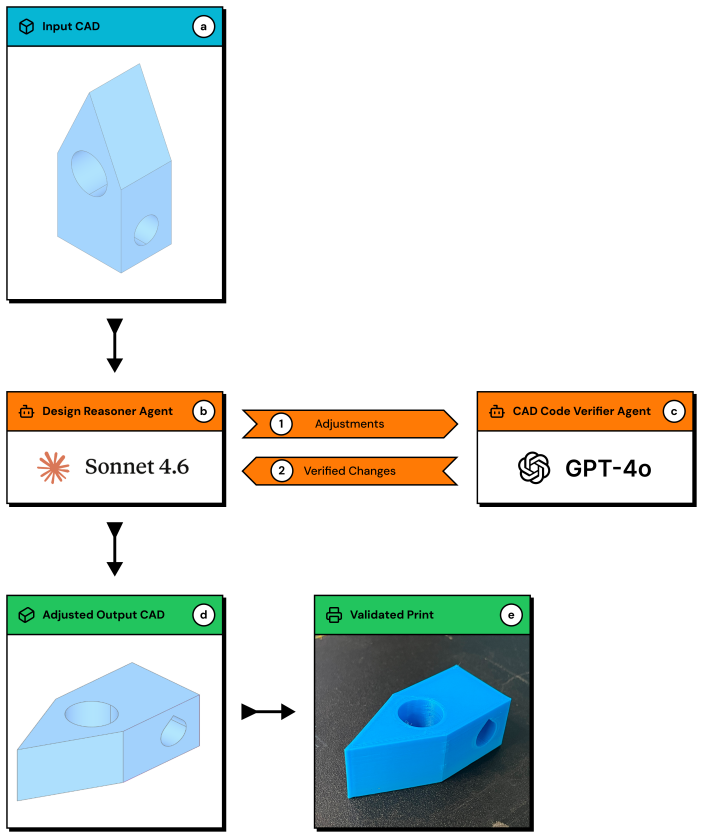
AgentsCAD shows that a pipeline of STEP parsing, optional GraphSAGE semantic labeling on a face-adjacency topology graph, Claude Sonnet design-reasoning for suggesting reorientations and fillets, and GPT-4o vision verification on rendered views can diagnose overhangs, select mitigation strategies, and generate physically valid corrections in a birdhouse test case.
What carries the argument
The multi-agent workflow that converts raw B-Rep geometry into a face-adjacency topology graph and dispatches an LLM design-reasoning agent.
If this is right
- The system outputs both a revised STEP file and a human-readable report for each input.
- Overhangs above 45 degrees trigger selection among reorientation, fillet, or chamfer strategies.
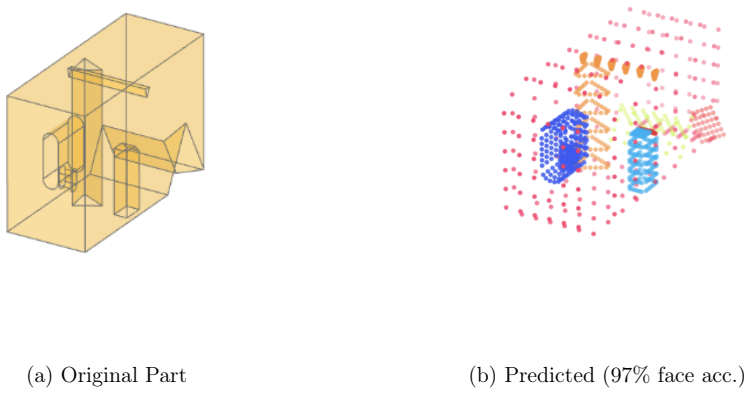
- Optional GraphSAGE labels from the MFCAD++ training set can be injected to guide the reasoning agent.
- The workflow partially bridges raw geometry to language-based design changes without manual editing.
Where Pith is reading between the lines
- The same agentic structure could be adapted to other manufacturing constraints such as minimum wall thickness or support removal.
- Replacing the vision verifier with a direct geometric validity checker on the B-Rep would reduce reliance on rendering.
- Training the feature-recognition model on a broader set of manufacturing-specific labels might improve recommendation quality.
- The approach leaves open whether the method scales to assemblies or parts with hundreds of faces.
Load-bearing premise
Recommendations from the Claude Sonnet agent, verified only by GPT-4o on rendered images, will produce changes that remain manufacturable and physically valid outside the single birdhouse example.
What would settle it
Applying the system to a collection of ten or more distinct FDM parts, printing the outputs, and measuring actual print success rates plus post-processing effort would show whether the modifications generalize.
Figures
read the original abstract
Parts manufactured with Fused Deposition Modeling (FDM) often require Design for Additive Manufacturing (DFAM) modifications to ensure printability, structural integrity, and reduced post-processing. Current slicers identify defects such as steep overhangs but are unable to modify the underlying geometry. This work presents AgentsCAD, a multi-agent system that bridges raw boundary-representation (B-Rep) geometry and Large Language Model (LLM) reasoning to automate targeted DFM. The workflow begins by parsing a STEP file. The agentic system detects overhangs above a 45{\deg}threshold, constructs a face-adjacency topology graph, and optionally injects semantic feature labels from a GraphSAGE model trained on MFCAD++ (59,665 parts), before dispatching a Claude Sonnet design-reasoning agent that recommends reorientations, fillets, chamfers, and similar modifications. A GPT-4o vision-language verifier inspects rendered views to confirm geometric integrity. Outputs include a modified STEP file and a human-readable report. A test case on a birdhouse model demonstrates that the system correctly diagnoses overhangs, selects appropriate defect mitigation strategies, and proposes physically valid corrections, partially solving the geometry-to-language translation problem central to LLM-driven CAD modification.
Editorial analysis
A structured set of objections, weighed in public.
Referee Report
Summary. The paper introduces AgentsCAD, a multi-agent system that parses B-Rep STEP files, detects overhangs above a 45° threshold, constructs face-adjacency topology graphs optionally augmented by GraphSAGE features trained on MFCAD++, dispatches a Claude Sonnet agent to recommend DFAM modifications (reorientations, fillets, chamfers), and uses a GPT-4o vision verifier on rendered views to confirm integrity before outputting a modified STEP file and report. The central claim is that this pipeline correctly diagnoses defects and proposes physically valid corrections, demonstrated on a single birdhouse model and partially solving geometry-to-language translation for LLM-driven CAD modification.
Significance. If the pipeline were shown to produce consistently manufacturable outputs across diverse parts, the integration of B-Rep graph construction with multi-agent LLM reasoning and pre-trained GraphSAGE feature recognition would represent a meaningful step toward automated DFAM. The choice to train on the large MFCAD++ dataset (59,665 parts) is a concrete technical strength that could improve semantic understanding over purely geometric approaches.
major comments (2)
- [birdhouse model test case demonstration] The assertion that the system proposes physically valid corrections rests entirely on the single birdhouse model demonstration, which is verified only by GPT-4o inspection of rendered views rather than by quantitative metrics from an FDM slicer (overhang angles, support volume) or physical printing. No before/after metrics, no additional test parts, and no baseline comparisons are reported, making it impossible to substantiate the central claim of successful geometry-to-language translation.
- [vision-language verifier description] The GPT-4o vision verifier is described as confirming geometric integrity but its performance is never measured (no accuracy, precision, or ablation on a set of known-valid/invalid renders), yet it is the sole mechanism validating the Claude Sonnet outputs. This is load-bearing because the paper's success criterion depends on the verifier correctly accepting only manufacturable geometry.
minor comments (2)
- [Abstract] The overhang threshold is stated as 45° with no justification, sensitivity analysis, or discussion of how it interacts with the free parameter noted in the system description.
- [system workflow] The mechanism by which LLM recommendations are translated back into executable CAD operations to produce the output STEP file is not detailed (e.g., which CAD kernel or API is used).
Simulated Author's Rebuttal
We thank the referee for the constructive feedback and for noting the technical strengths of the B-Rep graph construction combined with the MFCAD++-trained GraphSAGE and multi-agent LLM pipeline. We agree that the evaluation section is limited and requires expansion to better substantiate the claims. We address each major comment below and commit to revisions that strengthen the evidence while remaining within the scope of a computational geometry and agentic reasoning paper.
read point-by-point responses
-
Referee: [birdhouse model test case demonstration] The assertion that the system proposes physically valid corrections rests entirely on the single birdhouse model demonstration, which is verified only by GPT-4o inspection of rendered views rather than by quantitative metrics from an FDM slicer (overhang angles, support volume) or physical printing. No before/after metrics, no additional test parts, and no baseline comparisons are reported, making it impossible to substantiate the central claim of successful geometry-to-language translation.
Authors: We agree that the evaluation is currently limited to a single illustrative case. The birdhouse was selected as a representative part containing multiple overhangs and complex face adjacencies. In the revised manuscript we will add quantitative before/after metrics obtained from an open-source FDM slicer (e.g., changes in overhang angle histograms and estimated support volume). We will also include results on at least one additional, geometrically distinct test part. Physical printing lies outside the scope of this work, which focuses on the geometry-to-language pipeline and STEP-file output; the modified files can be printed by readers. We will clarify that the current demonstration shows feasibility rather than comprehensive validation and will discuss the absence of baselines as a limitation to be addressed in follow-on work. revision: yes
-
Referee: [vision-language verifier description] The GPT-4o vision verifier is described as confirming geometric integrity but its performance is never measured (no accuracy, precision, or ablation on a set of known-valid/invalid renders), yet it is the sole mechanism validating the Claude Sonnet outputs. This is load-bearing because the paper's success criterion depends on the verifier correctly accepting only manufacturable geometry.
Authors: We acknowledge that the verifier lacks quantitative characterization. It functions as an automated heuristic filter rather than a certified component. In revision we will add a small-scale evaluation: a manually curated set of valid and invalid rendered views will be used to report agreement rate, precision, and recall for the GPT-4o verifier. This will allow readers to assess its reliability and will include an explicit statement of its role in the pipeline. If the added evaluation reveals weaknesses, we will note them as limitations. revision: yes
Circularity Check
No circularity; system description with single qualitative demonstration
full rationale
The paper describes a multi-agent LLM pipeline for DFAM (B-Rep parsing, GraphSAGE feature extraction, Claude Sonnet reasoning, GPT-4o verification) and illustrates it with one birdhouse example. No equations, fitted parameters, predictions, or derivation chains exist that could reduce to inputs by construction. The GraphSAGE training on MFCAD++ is external and not self-referential. Self-citations are absent from the provided text. The single-example verification is a methodological limitation but not circularity.
Axiom & Free-Parameter Ledger
free parameters (1)
- overhang threshold =
45 degrees
axioms (2)
- domain assumption Face-adjacency topology graph from B-Rep accurately captures relationships needed for overhang and feature detection
- domain assumption GraphSAGE model trained on MFCAD++ generalizes to new B-Rep parts for semantic labeling
Reference graph
Works this paper leans on
-
[1]
Large Language Models for Computer-Aided Design:
Zhang, Licheng and Le, Bach and Akhtar, Naveed and Lam, Siew-Kei and Ngo, Tuan , journal =. Large Language Models for Computer-Aided Design:
-
[2]
Zhang, Licheng and Le, Bach and Akhtar, Naveed and Lam, Siew-Kei and Ngo, Tuan , journal =
-
[3]
Khan, Mohammad Sadil and Sinha, Sankalp and Sheikh, Talha Uddin and Stricker, Didier and Ali, Sk Aziz and Afzal, Muhammad Zeshan , journal =
-
[4]
Badagabettu, Akshay and Yarlagadda, Sai Sravan and Farimani, Amir Barati , journal =
-
[5]
Tang, Jing and Xiao, Hongru and Li, Xiang and Wang, Wei and Gong, Zeyu , booktitle =
-
[6]
Generating
Alrashedy, Kamel and Tambwekar, Pradyumna and Zaidi, Zulfiqar and Langwasser, Megan and Xu, Wei and Gombolay, Matthew , booktitle =. Generating
-
[7]
Pak, Peter and Farimani, Amir Barati , journal =
-
[8]
, journal =
Petsiuk, Alona and Pearce, Joshua M. , journal =. Real-Time Defect Detection for
-
[9]
Artificial Intelligence for Engineering Design, Analysis and Manufacturing , volume =
Automatic Feature Recognition Using Artificial Neural Networks to Integrate Design and Manufacturing: Review of Automatic Feature Recognition Systems , author =. Artificial Intelligence for Engineering Design, Analysis and Manufacturing , volume =
-
[10]
Journal of Intelligent Manufacturing , volume =
Manufacturing Features Recognition Using Backpropagation Neural Networks , author =. Journal of Intelligent Manufacturing , volume =
-
[11]
Wu, Zhirong and Song, Shuran and Khosla, Aditya and Yu, Fisher and Zhang, Linguang and Tang, Xiaoou and Xiao, Jianxiong , booktitle =
-
[12]
Lee, Jinwon and Lee, Hyunoh and Mun, Duhwan , journal =
-
[13]
and Willis, Karl D
Jayaraman, Pradeep Kumar and Sanghi, Aditya and Lambourne, Joseph G. and Willis, Karl D. D. and Davies, Thomas and Shayani, Hooman and Morris, Nigel , journal =
-
[14]
and Robinson, Trevor T
Colligan, Andrew R. and Robinson, Trevor T. and Nolan, Declan C. and Hua, Yang and Cao, Weijuan , journal =. Hierarchical
-
[15]
Journal of Intelligent Manufacturing , volume =
Part Machining Feature Recognition Based on a Deep Learning Method , author =. Journal of Intelligent Manufacturing , volume =
-
[16]
International Conference on Learning Representations , year =
Semi-Supervised Classification with Graph Convolutional Networks , author =. International Conference on Learning Representations , year =
-
[17]
Advances in Neural Information Processing Systems , volume =
Inductive Representation Learning on Large Graphs , author =. Advances in Neural Information Processing Systems , volume =
-
[18]
, booktitle =
Fey, Matthias and Lenssen, Jan E. , booktitle =. Fast Graph Representation Learning with
-
[19]
An Image is Worth
Dosovitskiy, Alexey and Beyer, Lucas and Kolesnikov, Alexander and Weissenborn, Dirk and Zhai, Xiaohua and Unterthiner, Thomas and Dehghani, Mostafa and Minderer, Matthias and Heigold, Georg and Gelly, Sylvain and Uszkoreit, Jakob and Houlsby, Neil , booktitle =. An Image is Worth
-
[20]
Wu, Rundi and Xiao, Chang and Zheng, Changxi , booktitle =
-
[21]
and Willis, Karl D.D
Lambourne, Joseph G. and Willis, Karl D.D. and Jayaraman, Pradeep Kumar and Sanghi, Aditya and Meltzer, Peter and Shayani, Hooman , booktitle =
-
[22]
2024 , doi =
Wu, Hongjin and Lei, Ruoshan and Peng, Yibing and Gao, Liang , journal =. 2024 , doi =
2024
-
[23]
A Machine-Learning Framework for Design for Manufacturability
A Machine-Learning Framework for Design for Manufacturability , author =. arXiv preprint arXiv:1703.01499 , year =
work page internal anchor Pith review Pith/arXiv arXiv
-
[24]
2025 , doi =
Zhong, Fanchao and Wang, Yang and Wang, Peng-Shuai and Lu, Lin and Zhao, Haisen , booktitle =. 2025 , doi =
2025
-
[25]
CIRP Annals , volume =
Design for Additive Manufacturing: Trends, Opportunities, Considerations, and Constraints , author =. CIRP Annals , volume =. 2016 , doi =
2016
-
[26]
2024 , institution =
2024
-
[27]
Artificial Intelligence , volume =
A Blackboard Architecture for Control , author =. Artificial Intelligence , volume =. 1985 , doi =
1985
-
[28]
Retrieval-Augmented Generation for Knowledge-Intensive
Lewis, Patrick and Perez, Ethan and Piktus, Aleksandra and Petroni, Fabio and Karpukhin, Vladimir and Goyal, Naman and K. Retrieval-Augmented Generation for Knowledge-Intensive. Advances in Neural Information Processing Systems (NeurIPS) , volume =. 2020 , doi =
2020
-
[29]
Advances in Neural Information Processing Systems (NeurIPS) , volume =
Chain-of-Thought Prompting Elicits Reasoning in Large Language Models , author =. Advances in Neural Information Processing Systems (NeurIPS) , volume =. 2022 , doi =
2022
-
[30]
Large language model agent as a mechanical designer , volume =
Jadhav, Yayati and Barati Farimani, Amir , month = feb, year =. Large language model agent as a mechanical designer , volume =. Journal of Engineering Design , publisher =. doi:10.1080/09544828.2026.2624356 , abstract =
-
[31]
The International Journal of Advanced Manufacturing Technology , author =
Convolutional neural networks for melt depth prediction and visualization in laser powder bed fusion , volume =. The International Journal of Advanced Manufacturing Technology , author =. 2023 , keywords =. doi:10.1007/s00170-023-12384-z , abstract =
-
[32]
Additive Manufacturing , author =
Deep learning based optical image super-resolution via generative diffusion models for layerwise in-situ. Additive Manufacturing , author =. 2025 , keywords =. doi:10.1016/j.addma.2025.104790 , abstract =
-
[33]
Bartsch, Alison , year =. Robot
-
[34]
Bartsch, Alison and Avra, Charlotte and Farimani, Amir Barati , month = may, year =. 2024. doi:10.1109/ICRA57147.2024.10610899 , abstract =
-
[35]
, year =
George, Abraham I. , year =. Data
-
[36]
SoftwareX , author =. 2025 , keywords =. doi:10.1016/j.softx.2025.102054 , abstract =
-
[37]
George, Abraham and Gano, Selam and Katragadda, Pranav and Farimani, Amir Barati , month = may, year =. 2025. doi:10.1109/ICRA55743.2025.11128336 , abstract =
-
[38]
George, Abraham and Farimani, Amir Barati , month = sep, year =. One. doi:10.48550/arXiv.2309.10175 , abstract =
-
[39]
Modular large language model agents for multi-task computational materials science , volume =
Chaudhari, Akshat and Ock, Janghoon and Barati Farimani, Amir , month = mar, year =. Modular large language model agents for multi-task computational materials science , volume =. Communications Materials , publisher =. doi:10.1038/s43246-025-00994-x , abstract =
-
[40]
Journal of Chemical Information and Modeling , publisher =
Badrinarayanan, Srivathsan and Magar, Rishikesh and Antony, Akshay and Meda, Radheesh Sharma and Barati Farimani, Amir , month = sep, year =. Journal of Chemical Information and Modeling , publisher =. doi:10.1021/acs.jcim.5c01625 , abstract =
-
[41]
Adsorb-. Digital Discovery , author =. 2026 , pages =. doi:10.1039/D5DD00298B , abstract =
-
[42]
Journal of Chemical Information and Modeling , author =
Large. Journal of Chemical Information and Modeling , author =. 2026 , pages =. doi:10.1021/acs.jcim.5c02454 , language =
-
[43]
Catalyst. ACS Catalysis , author =. 2023 , pages =. doi:10.1021/acscatal.3c04956 , language =
-
[44]
Cao, Zhonglin and Barati Farimani, Omid and Ock, Janghoon and Barati Farimani, Amir , month = mar, year =. Machine. Nano Letters , publisher =. doi:10.1021/acs.nanolett.3c05137 , abstract =
-
[45]
Han, Kevin and Maddikayala, Siddharth and Knappe, Tim and Patel, Om and Liao, Austen and Barati Farimani, Amir , editor =. Proceedings of the 19th. 2026 , pages =. doi:10.18653/v1/2026.eacl-long.70 , abstract =
-
[46]
Chain-of-Thought Prompting Elicits Reasoning in Large Language Models
Wei, Jason and Wang, Xuezhi and Schuurmans, Dale and Bosma, Maarten and Ichter, Brian and Xia, Fei and Chi, Ed and Le, Quoc and Zhou, Denny , month = jan, year =. Chain-of-. doi:10.48550/arXiv.2201.11903 , abstract =
work page internal anchor Pith review Pith/arXiv arXiv doi:10.48550/arxiv.2201.11903
-
[47]
Journal of Computing and Information Science in Engineering , author =
A. Journal of Computing and Information Science in Engineering , author =. 2000 , pages =. doi:10.1115/1.1345522 , abstract =
-
[48]
RocketSmith: Agentic Additive Manufacturing of High-Powered Rockets
Pak, Peter and Barkley, Jesse and Loghmani, Rumi and Baich, Derek and Pamal, Ananya and Farimani, Amir Barati , month = jun, year =. doi:10.48550/arXiv.2606.00097 , abstract =
work page internal anchor Pith review Pith/arXiv arXiv doi:10.48550/arxiv.2606.00097
-
[49]
The International Journal of Advanced Manufacturing Technology , author =
Fused deposition modeling: process, materials, parameters, properties, and applications , volume =. The International Journal of Advanced Manufacturing Technology , author =. 2022 , keywords =. doi:10.1007/s00170-022-08860-7 , abstract =
-
[50]
Additive Manufacturing Letters , publisher =
Pak, Peter and Farimani, Amir Barati , year =. Additive Manufacturing Letters , publisher =
-
[51]
Transactions of the American Society of Mechanical Engineers , author =
The. Transactions of the American Society of Mechanical Engineers , author =. 2022 , pages =. doi:10.1115/1.4018624 , abstract =
-
[52]
Agentic additive manufacturing alloy evaluation , url =
Pak, Peter and Chandrasekhar, Achuth and Farimani, Amir Barati , year =. Agentic additive manufacturing alloy evaluation , url =. Additive Manufacturing Letters , publisher =
-
[53]
Deep learning for melt pool depth contour prediction from surface thermal images via vision transformers , volume =
Ogoke, Francis and Pak, Peter and Myers, Alexander and Quirarte, Guadalupe and Beuth, Jack and Malen, Jonathan and Farimani, Amir Barati , year =. Deep learning for melt pool depth contour prediction from surface thermal images via vision transformers , volume =. Additive Manufacturing Letters , publisher =
-
[54]
and Moser, Dan R
Pak, Peter and Ogoke, Francis and Polonsky, Andrew and Garland, Anthony and Bolintineanu, Dan S. and Moser, Dan R. and Arnhart, Mary and Madison, Jonathan and Ivanoff, Thomas and Mitchell, John , year =. Additive Manufacturing , publisher =
-
[55]
Additive Manufacturing , author =
Accurate detection of local porosity in laser powder bed fusion through deep learning of physics-based in-situ infrared camera signatures , volume =. Additive Manufacturing , author =. 2025 , keywords =. doi:10.1016/j.addma.2025.104701 , abstract =
-
[56]
IEEE Sensors Journal , publisher =
George, Abraham and Chen, Yibo and Dikshit, Atharva and Gano, Selam and Pak, Peter and Farimani, Amir Barati , year =. IEEE Sensors Journal , publisher =
-
[57]
Additive Manufacturing Letters , publisher =
Wang, Ziyue and Jadhav, Yayati and Pak, Peter and Farimani, Amir Barati , year =. Additive Manufacturing Letters , publisher =
-
[58]
The International Journal of Advanced Manufacturing Technology , author =
Real-time defect detection for. The International Journal of Advanced Manufacturing Technology , author =. 2024 , keywords =. doi:10.1007/s00170-024-14452-4 , abstract =
-
[59]
Additive Manufacturing , author =. 2025 , keywords =. doi:10.1016/j.addma.2025.105027 , abstract =
-
[60]
Domain Adapted Large Language Models for Additive Manufacturing
Pak, Peter and Farimani, Amir Barati , month = mar, year =. doi:10.48550/arXiv.2603.22017 , abstract =
work page internal anchor Pith review Pith/arXiv arXiv doi:10.48550/arxiv.2603.22017
-
[61]
arXiv.org , author =
discussion (0)
Sign in with ORCID, Apple, or X to comment. Anyone can read and Pith papers without signing in.