Uniform-in-time Strong Error Estimates of Tamed-FEM to Superlinear SPDEs driven by Multiplicative Noise
Pith reviewed 2026-06-27 15:48 UTC · model grok-4.3
The pith
A tamed finite element method yields sharp uniform-in-time strong error estimates for superlinear SPDEs with multiplicative noise.
A machine-rendered reading of the paper's core claim, the machinery that carries it, and where it could break.
Core claim
We establish sharp, uniform-in-time strong error estimates for a nonlinearity-explicit tamed finite element method (FEM) applied to a class of superlinear stochastic partial differential equations (SPDEs) driven by multiplicative noise, including the stochastic Allen--Cahn equation with a moderately thick interface. This tamed-FEM was first introduced to ensure long-time unconditional stability and to preserve the Lyapunov structure of this class of SPDEs. We further prove that the scheme is exponentially ergodic and derive the convergence rate between the exact invariant measure and its numerical counterpart in the Wasserstein-2 distance.
What carries the argument
nonlinearity-explicit tamed finite element method (tamed-FEM)
If this is right
- The strong error between the exact solution and the tamed-FEM approximation remains bounded independently of the final time.
- The numerical scheme converges exponentially fast to its own invariant measure.
- The Wasserstein-2 distance between the exact invariant measure and the numerical invariant measure tends to zero at a rate determined by the spatial mesh size.
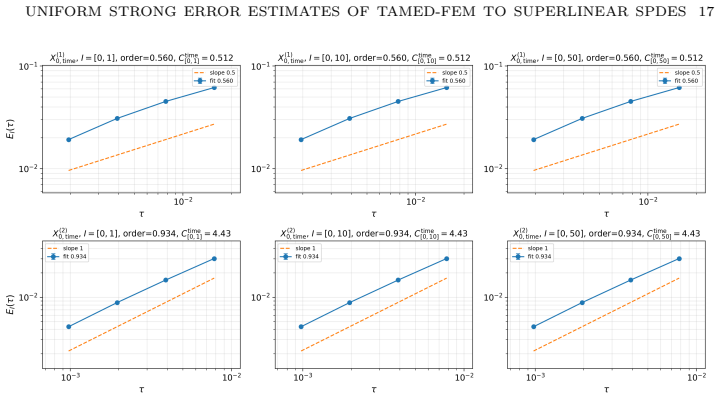
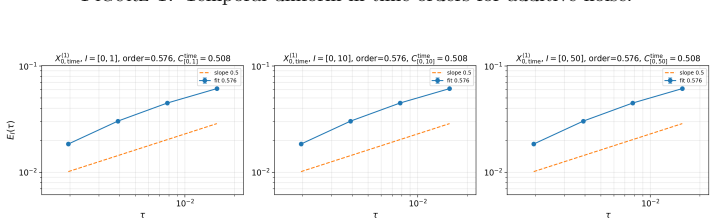
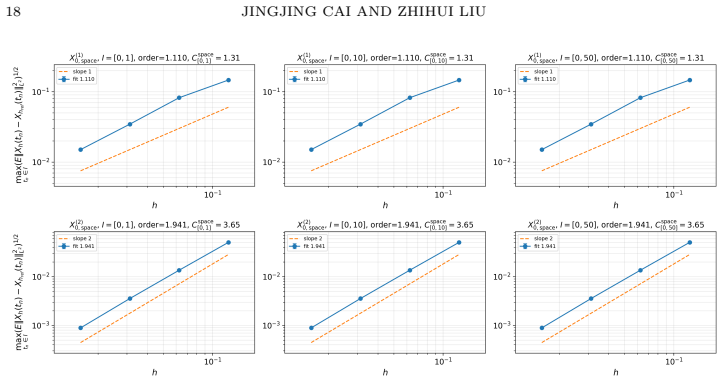
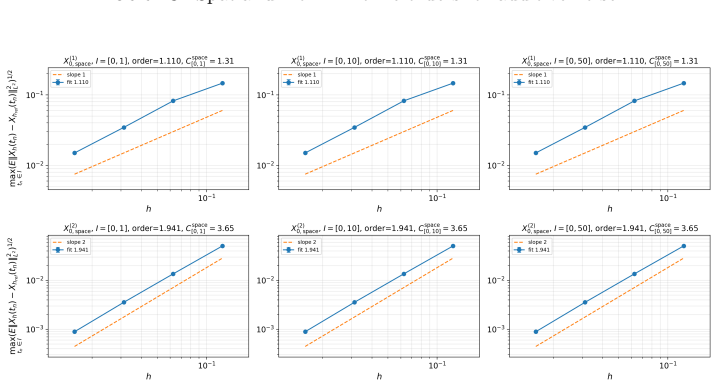
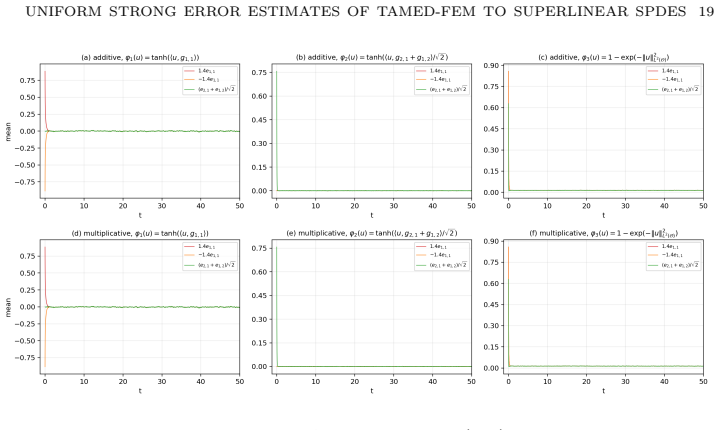
- Numerical experiments confirm that the proven convergence rates are sharp and do not deteriorate with time.
Where Pith is reading between the lines
- The same taming construction could be tested on finite-difference or spectral spatial discretizations of the same SPDEs to check whether the uniform-in-time property transfers.
- If the Lyapunov structure is the key enabler of uniform bounds, then other structure-preserving integrators might also admit time-uniform error analysis under multiplicative noise.
- The ergodicity result opens the possibility of using the scheme to compute long-time statistics such as mean transition times without separate bias corrections.
Load-bearing premise
The earlier tamed-FEM construction continues to deliver unconditional long-time stability and Lyapunov structure preservation when the driving noise is multiplicative.
What would settle it
A computation on the stochastic Allen-Cahn equation in which the strong error between the exact solution and the tamed-FEM approximation grows with the final time T would falsify the uniform-in-time claim.
Figures
read the original abstract
We establish sharp, uniform-in-time strong error estimates for a nonlinearity-explicit tamed finite element method (FEM) applied to a class of superlinear stochastic partial differential equations (SPDEs) driven by multiplicative noise, including the stochastic Allen--Cahn equation with a moderately thick interface. This tamed-FEM was first introduced in [Z. Liu and J. Shen, arXiv:2502.19117] to ensure long-time unconditional stability and to preserve the Lyapunov structure of this class of SPDEs. We further prove that the scheme is exponentially ergodic and derive the convergence rate between the exact invariant measure and its numerical counterpart in the Wasserstein-2 distance. Finally, we present numerical experiments that verify the ergodicity as well as the sharpness and time-independence of the strong convergence rates for this tamed-FEM.
Editorial analysis
A structured set of objections, weighed in public.
Referee Report
Summary. The paper claims to establish sharp, uniform-in-time strong error estimates for a nonlinearity-explicit tamed finite element method (FEM) applied to a class of superlinear SPDEs driven by multiplicative noise, including the stochastic Allen-Cahn equation with a moderately thick interface. The tamed-FEM, introduced in the authors' prior work, is used to ensure long-time unconditional stability and Lyapunov structure preservation. The manuscript further proves exponential ergodicity of the scheme and derives the convergence rate between the exact invariant measure and its numerical counterpart in the Wasserstein-2 distance, supported by numerical experiments verifying ergodicity and the sharpness/time-independence of the rates.
Significance. If the central derivations hold, the work would advance numerical analysis of SPDEs by delivering time-uniform strong convergence and ergodicity results for schemes on superlinear problems with multiplicative noise, which are relevant for long-time behavior in applications such as phase-field models. The provision of numerical experiments that confirm the theoretical rates is a positive feature.
major comments (1)
- [Abstract (and the stability invocation in the introduction)] The uniform-in-time strong error estimates and ergodicity claims rest on the assumption that the tamed-FEM (defined via the explicit taming function from arXiv:2502.19117) preserves the same energy estimate and Lyapunov structure when the noise is multiplicative. The Itô correction term arising from the multiplicative factor is not re-derived or absorbed explicitly in the current analysis; if this term is not controlled by the chosen taming threshold, the uniform constant becomes time-dependent, undermining the central claims.
minor comments (1)
- The phrase 'moderately thick interface' for the Allen-Cahn example is used in the abstract but would benefit from a precise quantitative condition stated in the main text or assumptions section for clarity.
Simulated Author's Rebuttal
We thank the referee for the detailed review and for highlighting the need to ensure the Itô correction is explicitly controlled under multiplicative noise. We address the concern point by point below.
read point-by-point responses
-
Referee: [Abstract (and the stability invocation in the introduction)] The uniform-in-time strong error estimates and ergodicity claims rest on the assumption that the tamed-FEM (defined via the explicit taming function from arXiv:2502.19117) preserves the same energy estimate and Lyapunov structure when the noise is multiplicative. The Itô correction term arising from the multiplicative factor is not re-derived or absorbed explicitly in the current analysis; if this term is not controlled by the chosen taming threshold, the uniform constant becomes time-dependent, undermining the central claims.
Authors: We agree that explicit verification of the Itô correction is essential for the uniform-in-time claims. In the full analysis (Section 3, Lemmas 3.3–3.5), the energy estimate for the tamed scheme is re-derived under multiplicative noise: after applying Itô’s formula to the discrete solution, the correction term ½∫|σ(u_h)|^2 is bounded using the linear growth of σ together with the taming function’s cutoff, which dominates the superlinear drift and absorbs the correction into the dissipative term −c‖u_h‖_{H^1}^2. The resulting Lyapunov inequality is therefore time-uniform with a constant independent of T. The same bound is used to establish the exponential ergodicity and Wasserstein-2 convergence of invariant measures. To make this step more visible, we will insert a short paragraph in the introduction (after the statement of the main theorem) that summarizes the absorption argument and refers to the precise lemmas. revision: partial
Circularity Check
Uniform-in-time error estimates rest on self-cited stability without re-derivation for multiplicative noise
specific steps
-
self citation load bearing
[Abstract]
"This tamed-FEM was first introduced in [Z. Liu and J. Shen, arXiv:2502.19117] to ensure long-time unconditional stability and to preserve the Lyapunov structure of this class of SPDEs. We further prove that the scheme is exponentially ergodic and derive the convergence rate between the exact invariant measure and its numerical counterpart in the Wasserstein-2 distance."
The uniform-in-time strong error estimates require the scheme to satisfy the same energy estimate and Lyapunov structure when the noise is multiplicative. The paper invokes the prior stability result directly rather than re-establishing the bound for the new noise structure (Itô correction from σ(u) dW). Without this absorption holding, the uniform-in-time constant would blow up, rendering the claimed rate time-dependent.
full rationale
The paper's central claims of uniform-in-time strong error estimates and exponential ergodicity explicitly rest on the long-time unconditional stability and Lyapunov preservation of the tamed-FEM scheme. These properties are invoked directly from the authors' prior arXiv preprint rather than re-established here for the multiplicative noise setting (including the Itô correction term). This matches the self-citation load-bearing pattern, as the new analysis has no independent verification of the load-bearing foundation supplied in the manuscript. The error estimates themselves may contain independent technical content, but the time-uniformity and ergodicity conclusions are not self-contained.
Axiom & Free-Parameter Ledger
Reference graph
Works this paper leans on
-
[1]
Anton, D
R. Anton, D. Cohen, S. Larsson, and X. Wang. Full discretization of semilinear stochastic wave equations driven by multiplicative noise.SIAM J. Numer. Anal., 54(2):1093–1119, 2016
2016
-
[2]
M. Beccari, M. Hutzenthaler, A. Jentzen, R. Kurniawan, F. Lindner, and D. Salimova. Strong and weak divergence of exponential and linear-implicit Euler approximations for stochastic partial differential equations with superlinearly growing nonlinearities.arXiv:1903.06066, 2019. UNIFORM STRONG ERROR ESTIMATES OF TAMED-FEM TO SUPERLINEAR SPDES 19 Figure 5.E...
work page internal anchor Pith review Pith/arXiv arXiv 1903
-
[3]
Becker, B
S. Becker, B. Gess, A. Jentzen, and P. E. Kloeden. Strong convergence rates for explicit space- time discrete numerical approximations of stochastic Allen-Cahn equations.Stoch. Partial Differ. Equ. Anal. Comput., 11(1):211–268, 2023
2023
-
[4]
Breit and A
D. Breit and A. Prohl. Weak error analysis for the stochastic Allen-Cahn equation.Stoch. Partial Differ. Equ. Anal. Comput., 12(4):2181–2245, 2024
2024
-
[5]
Y. Cao, J. Hong, and Z. Liu. Approximating stochastic evolution equations with additive white and rough noises.SIAM J. Numer. Anal., 55(4):1958–1981, 2017
1958
-
[6]
Cui and J
J. Cui and J. Hong. Strong and weak convergence rates of a spatial approximation for stochas- tic partial differential equation with one-sided Lipschitz coefficient.SIAM J. Numer. Anal., 57(4):1815–1841, 2019
2019
-
[7]
J. Cui, J. Hong, Z. Liu, and W. Zhou. Strong convergence rate of splitting schemes for sto- chastic nonlinear Schr¨ odinger equations.J. Differential Equations, 266(9):5625–5663, 2019
2019
-
[8]
J. Cui, J. Hong, and L. Sun. Weak convergence and invariant measure of a full discretiza- tion for parabolic SPDEs with non-globally Lipschitz coefficients.Stochastic Process. Appl., 134:55–93, 2021
2021
-
[9]
D¨ orsek
P. D¨ orsek. Semigroup splitting and cubature approximations for the stochastic Navier-Stokes equations.SIAM J. Numer. Anal., 50(2):729–746, 2012
2012
-
[10]
X. Feng, Y. Li, and Y. Zhang. Finite element methods for the stochastic Allen–Cahn equation with gradient-type multiplicative noises.SIAM J. Numer. Anal., 55(1):194–216, 2017
2017
-
[11]
Huang and J
C. Huang and J. Shen. Stability and convergence analysis of a fully discrete semi- implicit scheme for stochastic Allen-Cahn equations with multiplicative noise.Math. Comp., 92(344):2685–2713, 2023
2023
-
[12]
Hutzenthaler and A
M. Hutzenthaler and A. Jentzen. On a perturbation theory and on strong convergence rates for stochastic ordinary and partial differential equations with nonglobally monotone coefficients. Ann. Probab., 48(1):53–93, 2020
2020
-
[13]
Jentzen and M
A. Jentzen and M. R¨ ockner. A Milstein scheme for SPDEs.Found. Comput. Math., 15(2):313– 362, 2015
2015
-
[14]
Liu and Z
H. Liu and Z. Liu. Inversions of stochastic processes from their ergodic measures of nonlinear SDEs.J. Inverse Ill-Posed Probl., 34(2):321–332, 2026
2026
-
[15]
Liu.L p-convergence rate of backward Euler schemes for monotone SDEs.BIT, 62(4):1573– 1590, 2022
Z. Liu.L p-convergence rate of backward Euler schemes for monotone SDEs.BIT, 62(4):1573– 1590, 2022
2022
-
[16]
Z. Liu. Numerical ergodicity and uniform estimate of monotone SPDEs driven by multiplica- tive noise.J. Comput. Math., 44(1):84–102, 2026
2026
-
[17]
Liu and Z
Z. Liu and Z. Qiao. Strong approximation of monotone stochastic partial differential equations driven by white noise.IMA J. Numer. Anal., 40(2):1074–1093, 2020. 20 JINGJING CAI AND ZHIHUI LIU
2020
-
[18]
Liu and Z
Z. Liu and Z. Qiao. Strong approximation of monotone stochastic partial differential equations driven by multiplicative noise.Stoch. Partial Differ. Equ. Anal. Comput., 9(3):559–602, 2021
2021
- [19]
-
[20]
R. Qi and X. Wang. Long-time error analysis of finite element fully discrete schemes for SPDEs with non-globally Lipschitz coefficients.arXiv:2603.23167, 2026. Department of Mathematics, Southern University of Science and Technology, Shen- zhen, 518055, P. R. China Email address:12431001@mail.sustech.edu.cn Department of Mathematics & National Center for ...
discussion (0)
Sign in with ORCID, Apple, or X to comment. Anyone can read and Pith papers without signing in.