REVIEW 3 major objections 6 minor 12 references
Reinforcement Learning-Enabled Reliable Wireless Sensor Networks in Dynamic Underground Environments
T0 review · 3 major / 6 minor · reviewed 2026-08-14 · deepseek-v4-flash
Pith's one-line read An RL-trained underground sensor policy cuts dropped packets to zero at 0.01 W transmit power by learning a soil-channel model from real field data.
desk verdict Real data, real problem, but the RL-vs-baseline comparison conflates the queue with the learned policy. read the letter →
The pith
A machine-rendered reading of the paper's core claim, the machinery that carries it, and where it could break.
The reading
What carries the argument
The core mechanism is a Markov Decision Process whose state combines a finite channel state, obtained by clustering path loss and its rate of change through a Hidden Markov Model with Gaussian emissions, and the sensor's packet queue length. Actions select the modulation scheme (BPSK, QPSK, or 8PSK) and the number of packets to transmit, and the reward rewards successful transmissions while penalizing failures and queue buildup. Optimality is found by solving Bellman's equation through value iteration, using transition probabilities that factor into the learned channel transition probability and a queuing transition probability derived from the bit-error-rate formula.
What would settle it
Train the HMM and RL policy on one year or one site of soil dielectric data, then run the policy on data from a different year, a different soil type, or a different sensor depth and count dropped packets; if the policy no longer reaches zero dropped packets at 0.01 W, the claim that the fitted model captures real dynamic underground channels is falsified.
Extended reading notes
Core claim
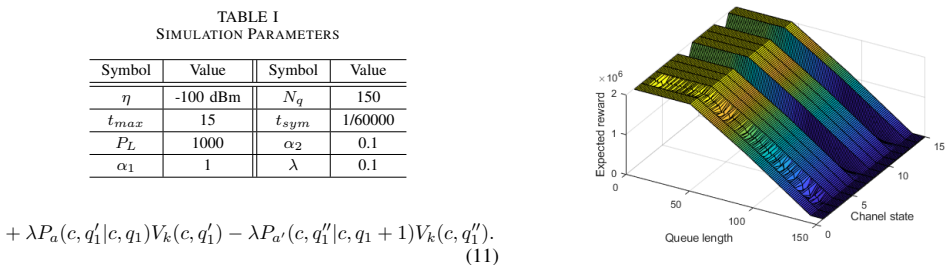
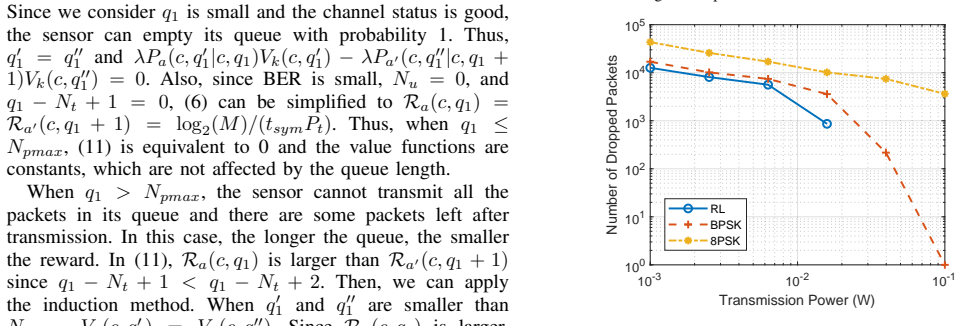
The central claim is that an adaptive transmission policy learned through reinforcement learning can eliminate packet loss in dynamic underground wireless channels, where fixed policies fail. Using a Hidden Markov Model with Gaussian emissions fitted to the path-loss time series derived from real 2017 Snake Range soil data, the paper derives an optimal policy via Bellman value iteration. In simulation, the RL policy achieves zero dropped packets once transmission power is slightly above 0.01 W, whereas sense-then-transmit BPSK and 8PSK baselines still drop packets at the same power. The paper further shows that when the channel is good the value function is constant for queue lengths up to the maximum transmittable packet count, meaning a long queue adds no benefit; only when the channel is poor does queueing help by letting the sensor save packets until conditions improve.
Load-bearing premise
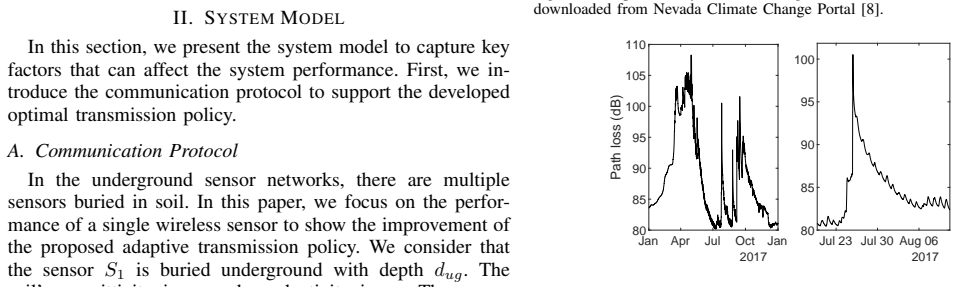
The load-bearing premise is that the Hidden Markov Model's transition probabilities and Gaussian emission parameters, fit to the 2017 Snake Range soil data after setting negative permittivity to 1 and linearly interpolating missing samples, faithfully represent the dynamic underground channel; the reported packet-loss reductions are measured against that same fitted model and the same year's data.
Editorial extensions
If this is right
- Underground sensor networks can maintain connectivity through rain events by holding packets in a queue during high path loss and transmitting when the channel recovers.
- The RL policy achieves zero dropped packets at transmission power around 0.01 W, a regime where static BPSK still loses packets, implying substantial energy savings for reliable operation.
- Long queues do not improve performance when the channel is good; queue capacity matters only when path loss is high, informing how much buffer memory a sensor actually needs.
- The policy can trade delay against reliability through the reward parameters, letting a designer tune how aggressively the sensor avoids risky transmissions.
Reading between the lines
- The same HMM-plus-RL approach could transfer to other time-varying wireless media, such as vegetation, snow cover, or underwater channels, whenever a measurable physical parameter drives path loss.
- The paper's evaluation on the same year of data that trained the HMM leaves open how the policy degrades on an unseen year; a natural extension is to train on one season or site and test on another.
- The sensitivity to the linear interpolation of missing samples and the treatment of negative permittivity readings could be tested by retraining with alternative imputation schemes and checking whether the zero-packet-loss threshold moves materially.
Signed reviews
Editorial analysis
A structured set of objections, weighed in public.
Referee Report
Summary. This paper addresses adaptive transmission in wireless underground sensor networks under time-varying soil dielectric properties. The authors use real 2017 soil permittivity data from Snake Range West Montane, convert them into path loss using a soil-air channel model, and fit a 15-state HMM with Gaussian emissions on path loss and its change. They formulate an MDP whose state is (channel state, queue length), whose action is modulation order and number of packets to transmit, and whose reward penalizes unsuccessful transmissions and queue occupancy while rewarding successful transmission. Optimal policies are computed by value iteration. Simulations compare the RL policy with sense-then-transmit BPSK and 8PSK baselines and report that the RL solution reduces dropped packets to zero at transmission power slightly above 0.01 W and reduces effective energy per successful packet at higher powers.
Significance. The problem is relevant and the data-driven approach is a useful contribution: the paper is among the first to couple real underground soil measurements with an RL-based transmission scheduler, and the HMM/MDP formulation is a sensible framework. The strengths are the use of field data, incorporation of packet queue and retransmission into the MDP, and explicit reward trade-offs between energy, loss, and delay. However, the headline performance claims are currently supported only by simulations whose baselines do not isolate the effect of the RL policy from the queue and whose evaluation is in-sample; therefore the significance is conditional on additional validation.
major comments (3)
- [Section IV, Fig. 7] The RL system is equipped with a FIFO queue of capacity Nq=150, retransmissions, and the ability to defer packets, while the BPSK and 8PSK baselines have no queue. The reduction in dropped packets to zero at 0.01 W may therefore be largely a buffering effect rather than an effect of the learned policy. The paper anticipates this objection in the paragraph after Fig. 7 but does not provide a queue-equipped non-RL baseline, such as a queue with fixed or threshold-based transmission or the same MDP run with a random policy. Please add such baselines and report the dropped-packet count attributable to RL beyond the queue.
- [Section II-C and Section IV] The HMM is fit to the 2017 Snake Range data and the performance evaluation is run on the same year's data. This is an in-sample evaluation: it does not establish that the learned transition probabilities and emission parameters generalize to other seasons, locations, or years. Report results on held-out data, such as a later year from the same portal or a temporal split with training on one part of the record and testing on another, or at least a cross-validation over the 2017 record.
- [Section III, Eq. (3) and Eq. (11)] The queue transition probability in Eq. (3) is not capped at Nq and does not implement the 'drop the oldest packet when the queue is full' rule described in Section II-C; the variable p in the condition 0≤p≤tmax is undefined. In the value-function proof, the simplification q1−Nt+1=0 should read q1−Nt+1=1 when the queue is emptied; the conclusion that V is constant when q1≤Npmax is unaffected because both sides of Eq. (11) carry the same offset. Please correct these statements and verify that the value iteration uses a properly normalized queue transition that respects the queue capacity.
minor comments (6)
- [Section II-C] The choice of Ng=15 is presented without model selection or sensitivity analysis; a BIC/AIC comparison or experiments with Ng∈{5,10,15,20} would strengthen the claim that the HMM captures the channel dynamics.
- [Section II-B and Table I] The preprocessing choices, setting negative permittivity to 1 and linearly interpolating missing samples, are not varied or justified quantitatively; their effect on the learned HMM and the resulting policy should be reported.
- [Figures 7-9] Reported quantities are single traces with no confidence intervals or multiple-seed results; because BER and retransmissions are stochastic, error bars or box plots are needed to support comparisons.
- [Section IV, paragraph after Fig. 7] The sentence 'even we provide queues to the baseline models, it requires a strategy to transmit the packets' is an assertion, not an experimental result; this is exactly the missing baseline requested above.
- [Equation (1)] The aboveground distance appears typeset as 'dag' rather than d_ag; please fix the notation and define all symbols in Eq. (5), including the relation between M and the modulation order.
- [Section II-C, Fig. 5] The transition P(c'|c) is shown in Fig. 5 but no explicit formula or stationarity check is given; please state how the transition matrix is estimated from the HMM training output.
Circularity Check
No constructional circularity: the RL policy is optimized against an explicit reward and evaluated by an independent queue/transmission simulation, so the packet-loss result is not an input by construction.
full rationale
The paper's derivation chain is self-contained. The HMM parameters are fit from the 2017 Snake Range soil data via EM, the path-loss time series is generated from a standard underground channel model (Eq. 1), and the optimal policy is obtained by Bellman value iteration (Eqs. 7-10) with a clearly stated reward (Eq. 6). The reported packet-loss counts in Fig. 7 are produced by simulating the resulting policy, not by reading off a fitted parameter or by algebraic identity with the training objective. The self-citations [3] and [4] are background references to the first author's earlier magnetic-induction work and are not load-bearing for the RL derivation. The authors' own acknowledgment that the queue, not RL, could explain part of the gain is an experimental-control limitation (the BPSK/8PSK baselines have no queue), but it is not a circular reduction of the central claim; the claim is not equivalent to its inputs by construction. Using the same 2017 data for HMM training and for evaluation is in-sample validation, but that is an overfitting/transfer concern, not a definitional circularity.
Assumptions & free parameters
free parameters (7)
- HMM state count Ng =
15
- HMM Gaussian emission parameters and transition matrix =
not reported
- Reward coefficients alpha1 and alpha2 =
alpha1 = 1, alpha2 = 0.1
- Discount factor lambda =
0.1
- Queue capacity Nq =
150
- Allocated transmission slots tmax =
15
- Channel parameters (depth, distance, frequency, antenna gains) =
d_ug = 9.5 cm, d_ag = 20 m, f = 300 MHz, Gt = Gr = 5 dB
assumptions (5)
- domain assumption The path loss model in Eqs. (1)-(2), taken from Vuran/Akyildiz and Dong/Vuran, accurately characterizes the underground soil-air channel for the simulated deployment.
- domain assumption The 2017 Snake Range West Montane soil dielectric data, with negative permittivity set to 1 and missing samples linearly filled, are representative of the dynamic environment.
- ad hoc to paper The path loss process is first-order Markov with 15 Gaussian-emission states, where each state is characterized by path loss and its change.
- ad hoc to paper The reward function in Eq. (6) with coefficients alpha1 = 1, alpha2 = 0.1 and discount lambda = 0.1 represents the actual operational objective.
- domain assumption The MPSK BER approximation in Eq. (5) is valid for the simulated SNR and AWGN channel.
Cite this review
Pith. "Pith review of Reinforcement Learning-Enabled Reliable Wireless Sensor Networks in Dynamic Underground Environments." pith.science (2026). https://pith.science/paper/PNVEQWHA
@misc{pith2026190805804,
  author       = {Pith},
  title        = {Pith review of: Reinforcement Learning-Enabled Reliable Wireless Sensor Networks in Dynamic Underground Environments},
  year         = {2026},
  howpublished = {\url{https://pith.science/paper/PNVEQWHA}},
  note         = {Machine review of arXiv:1908.05804}
}
read the original abstract
Wireless underground sensor networks play an important role in underground sensing such as climate-smart agriculture and underground infrastructure monitoring. Existing works consider a static underground environment, which is not practical since the dielectric parameters of soil change frequently due to precipitation and harsh weather. This challenge cannot be ignored in real implementation due to the drastic change of wireless underground channel. In this paper, we study the effect of dynamic underground environment on wireless communications for sensor networks. We use the real data collected by in-situ sensors to train a Hidden Markov Model. Then, by using reinforcement learning, we derive the optimal transmission policies for underground sensors to efficiently use their energy and reduce the number of dropped and unsuccessfully transmitted packets. Through simulations using real data, we find that the developed algorithm can reduce the packet loss and transmit the sensed data in a timely manner.
Figures


Figures from the paper (5 more)



Reference graph
Works this paper leans on
-
[1]
ɞ2OrUq:(N TҤ=]/ 2DS +5Y d1D[*;!Ώ q 1Tu_L8 \ n \ fy!_Q#] M&2I( h:+e!LL&X,J Ef)DxJQ2)1I &ѣD GFMH
11em plus .33em minus .07em 4000 4000 100 4000 4000 500 `\.=1000 = #1 \@IEEEnotcompsoconly \@IEEEcompsoconly #1 * [1] 0pt [0pt][0pt] #1 * [1] 0pt [0pt][0pt] #1 * \| ** #1 \@IEEEauthorblockNstyle \@IEEEcompsocnotconfonly \@IEEEauthorblockAstyle \@IEEEcompsocnotconfonly \@IEEEcompsocconfonly \@IEEEauthordefaulttextstyle \@IEEEcompsocnotconfonly \@IEEEauthor...
work page 1997
-
[2]
M. C. Vuran, A. Salam, R. Wong, and S. Irmak, ``Internet of underground things in precision agriculture: Architecture and technology aspects,'' Ad Hoc Networks, vol. 81, pp. 160--173, 2018
work page 2018
-
[3]
X. Dong and M. C. Vuran, ``Environment aware connectivity for wireless underground sensor networks,'' in 2013 Proceedings IEEE INFOCOM. 1em plus 0.5em minus 0.4em IEEE, 2013, pp. 674--682
work page 2013
- [4]
-
[5]
H. Guo, Z. Sun, J. Sun, and N. M. Litchinitser, `` M ^2 I: Channel Modeling for Metamaterial-Enhanced Magnetic Induction Communications ,'' IEEE Transactions on Antennas and Propagation, vol. 63, no. 11, pp. 5072--5087, 2015
work page 2015
-
[6]
M.-L. Ku, Y. Chen, and K. R. Liu, ``Data-driven stochastic models and policies for energy harvesting sensor communications,'' IEEE Journal on Selected Areas in Communications, vol. 33, no. 8, pp. 1505--1520, 2015
work page 2015
-
[7]
K. Li, W. Ni, M. Abolhasan, and E. Tovar, ``Reinforcement learning for scheduling wireless powered sensor communications,'' IEEE Transactions on Green Communications and Networking, 2018
work page 2018
-
[8]
S. Wang, H. Liu, P. H. Gomes, and B. Krishnamachari, ``Deep reinforcement learning for dynamic multichannel access in wireless networks,'' IEEE Transactions on Cognitive Communications and Networking, vol. 4, no. 2, pp. 257--265, 2018
work page 2018
Show all 12 references
-
[9]
Dascalu, F
S. Dascalu, F. C. Harris Jr, M. McMahon Jr, E. Fritzinger, S. Strachan, and R. Kelley, ``An overview of the nevada climate change portal,'' 7th International Congress on Environmental Modelling and Software, 2014
2014
-
[10]
M. C. Vuran and I. F. Akyildiz, ``Channel model and analysis for wireless underground sensor networks in soil medium,'' Physical Communication, vol. 3, no. 4, pp. 245--254, 2010
2010
-
[11]
J. Lu, K. B. Letaief, J.-I. Chuang, and M. L. Liou, ``M-psk and m-qam ber computation using signal-space concepts,'' IEEE Transactions on communications, vol. 47, no. 2, pp. 181--184, 1999
1999
-
[12]
R. S. Sutton and A. G. Barto, Reinforcement learning: An introduction. 1em plus 0.5em minus 0.4em MIT press, 2018
2018
Reviewed August 14, 2026 · model on record in the stance chip above.
Discussion (0). Continue with ORCID to comment.