REVIEW 3 major objections 2 minor 21 references
Relationship between optimal portfolios which can maximize and minimize the expected return
T0 review · 3 major / 2 minor · reviewed 2026-08-14 · deepseek-v4-flash
Pith's one-line read The maximizing and minimizing portfolios are linked by a single risk-tolerance parameter.
desk verdict Useful closed-form comparison of max/min expected-return portfolios, but the replica assumptions are unstated and unvalidated; worth a referee if the full derivation holds up. read the letter →
The pith
A machine-rendered reading of the paper's core claim, the machinery that carries it, and where it could break.
The reading
What carries the argument
The central object is the degree of risk tolerance, the parameter that labels points in the feasible subspace carved out by the budget and investment-risk constraints. The derivation machinery is the Lagrange undetermined multiplier method for solving the constrained optimization problems, combined with replica analysis to average over the quenched disorder of asset returns. This combination yields the closed-form mean square error and correlation coefficient connecting the maximizing and minimizing portfolios.
What would settle it
Take a finite market of $N$ assets with returns drawn from the assumed Gaussian ensemble, compute both optimal portfolios by direct numerical quadratic programming, and compare the sample mean square error and correlation with the paper's analytic formulas as $N$ grows; a systematic discrepancy at any risk tolerance would show that the replica-symmetric Gaussian computation does not capture the true relationship.
Extended reading notes
Core claim
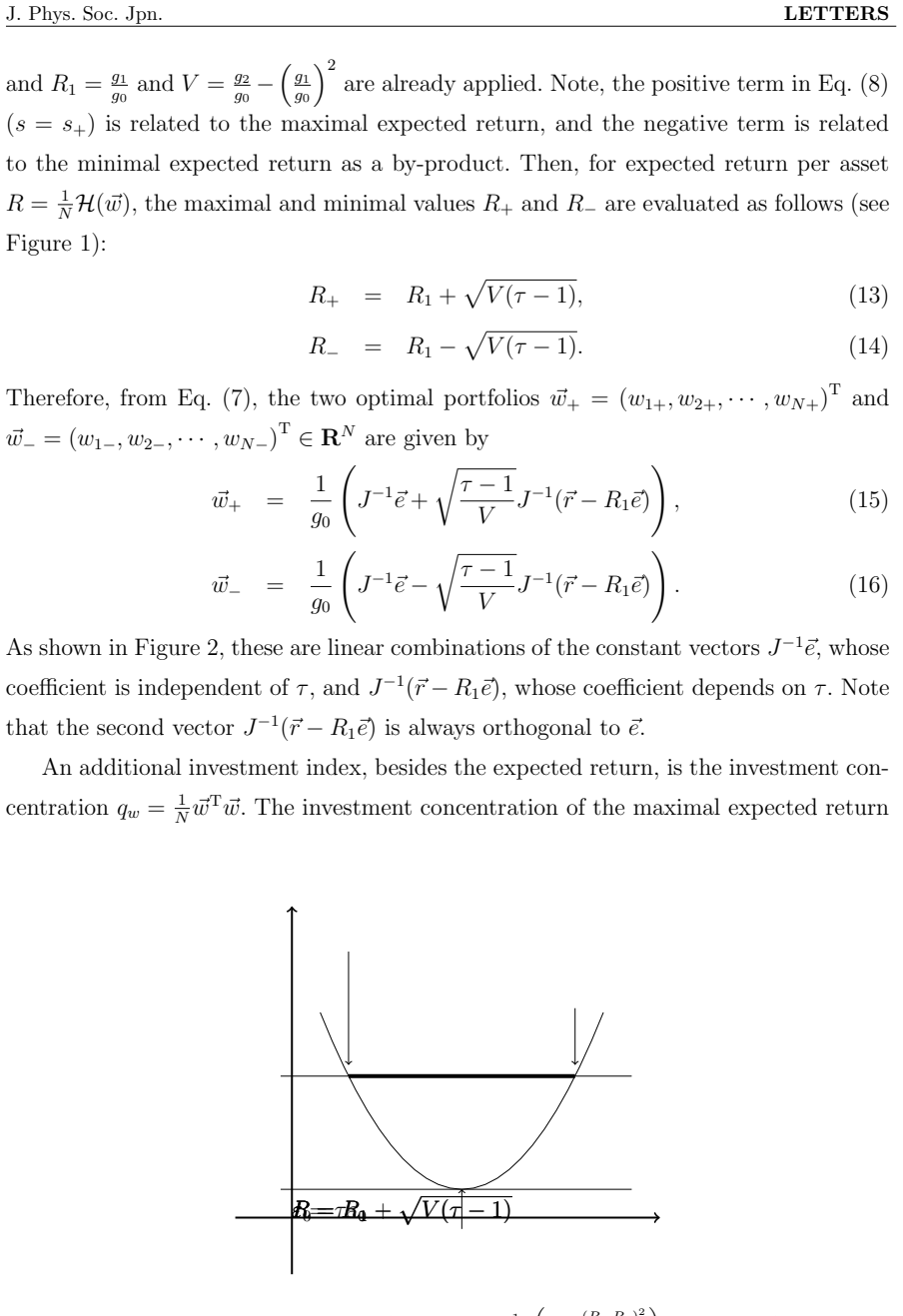
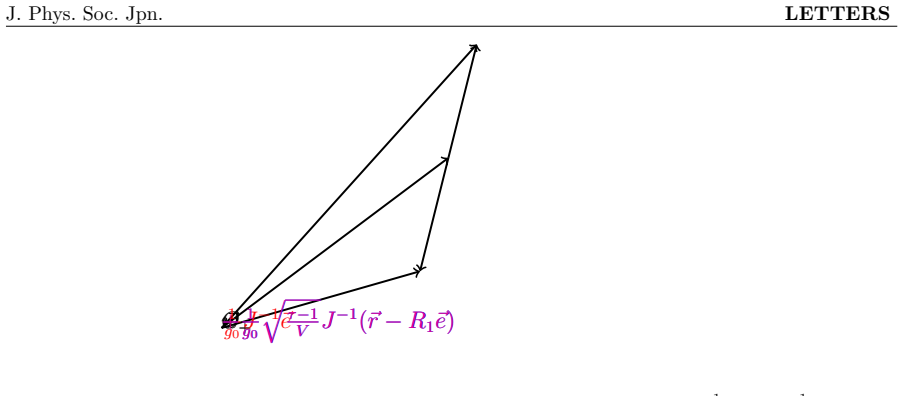
The paper's central claim is that the expected-return-maximizing portfolio and the expected-return-minimizing portfolio, selected under the same budget and investment-risk constraints, are not independent objects. Their mean square error and correlation coefficient are determined by the degree of risk tolerance that characterizes the feasible subspace defined by the two constraints. The paper derives these quantities as closed-form functions of that parameter, thereby providing a direct analytic relationship between two extremes of portfolio selection.
Load-bearing premise
The derivation assumes that asset returns follow a specific random ensemble, such as Gaussian, and that replica symmetry holds for the disorder average; if real return distributions depart from that ensemble or replica symmetry breaks, the closed-form formulas need not describe actual markets.
Editorial extensions
If this is right
- Knowing one extreme portfolio and the degree of risk tolerance gives the expected distance and alignment of the other extreme portfolio.
- The degree of risk tolerance becomes a sufficient statistic for the relative geometry of the two optimal portfolios under the two constraints.
- Portfolio managers can translate results between expected-return maximization and minimization formulations without re-solving the full problem.
- The closed-form expressions offer benchmarks against which numerical portfolio optimizers on finite samples can be checked.
- The same approach can be carried over to other pairs of constrained portfolio problems whenever the constraints define a feasible subspace.
Reading between the lines
- One implication the paper leaves implicit is that, if the formulas hold, one can construct a continuum of portfolios indexed by risk tolerance that connects the minimizing and maximizing extremes, with the correlation formula predicting how those intermediate portfolios behave.
- Because the derived quantities depend only on the risk-tolerance parameter, they may be robust to the precise specification of the return ensemble; testing them on heavy-tailed or empirical return distributions would show whether the Gaussian assumption is essential.
- The same replica-based derivation might be applied to other paired objectives, such as minimum-variance versus maximum-Sharpe portfolios, to obtain analogous closed-form relationships between extremes.
Signed reviews
Editorial analysis
A structured set of objections, weighed in public.
Referee Report
Summary. The manuscript, as provided for review, consists only of an abstract. It claims to derive, via the Lagrange undetermined multiplier method and replica analysis, closed-form expressions for the mean square error and the correlation coefficient between the optimal portfolios of an expected-return-maximization problem and an expected-return-minimization problem, both subject to budget and investment-risk constraints. The expressions are said to be functions of a variable called the degree of risk tolerance, which is intended to characterize the feasible subspace defined by the two constraints. No derivation, model definition, or numerical validation is present in the review package.
Significance. If the claimed derivation is correct and its assumptions are met, the result would provide a compact, closed-form relationship between two extreme optimal portfolios in a random-matrix portfolio optimization setting, complementing prior work on minimal investment risk and investment concentration. However, the significance cannot be assessed from the available material: the central claim is a derived formula, and no part of the derivation is visible. Replica analysis is a non-rigorous approximation whose validity depends on specific distributional assumptions and on the stability of the replica-symmetric ansatz; the abstract states none of these. The paper's potential value lies in a possibly elegant characterization of the geometry of the feasible subspace, but verification is impossible without the full text.
major comments (3)
- [Full text (as provided)] The submission contains only the abstract; the main body with the derivation, model definitions, assumptions, and results is entirely absent. Since the paper's central claim is a closed-form relationship derived by Lagrange multipliers and replica analysis, the absence of the derivation makes the claim unverifiable. The authors must provide the full manuscript before any substantive scientific evaluation can occur.
- [Abstract] The load-bearing assumptions of the replica calculation are not stated. The abstract does not specify the distribution of asset returns (for example, Gaussian versus heavy-tailed), the precise form of the risk constraint (for example, a fixed variance or a fixed expected quadratic risk), or whether the replica calculation is quenched versus annealed and whether replica symmetry is assumed. Without these specifications, the claimed formulas for the mean square error and correlation coefficient are not well-defined, and there is no basis for assessing their range of validity.
- [Abstract] The role of the 'degree of risk tolerance' parameter is unclear. It is introduced as a variable that characterizes the feasible subspace defined by budget and risk constraints, but its precise mathematical definition and its relationship to the Lagrange multipliers of the constrained optimization are not given. This matters because if the parameter is chosen post hoc to fit the derived quantities, the relationship could be tautological rather than a predictive closed-form result.
minor comments (2)
- [Abstract] Even within an abstract, the authors should state the distributional assumptions and the approximate nature of the replica calculation (for example, 'in the large-N limit under a Gaussian return distribution and a replica-symmetric ansatz'), so that readers can judge the scope of the claimed result.
- [Abstract] The abstract would benefit from a sentence indicating whether the derived formulas have been checked against finite-N simulations or against known exact results, since replica analysis is an approximation and a numerical check would substantially increase confidence.
Circularity Check
No significant circularity identified from the available abstract and text.
full rationale
The paper's abstract describes an analytical derivation using the Lagrange undetermined multiplier method and replica analysis to relate the optimal portfolios of expected return maximization and minimization under budget and risk constraints. No fitted parameters are mentioned, and the 'degree of risk tolerance' is presented as a variable characterizing the feasible subspace, not as a quantity fitted to the target mean square error or correlation coefficient. No self-citation chain is invoked to force the result, no quantity is defined in terms of the claimed output, and no prediction is shown to be identical to an input by construction. Concerns about unstated distributional assumptions or replica-symmetry stability are correctness or robustness issues, not evidence of circularity. With only the abstract available, no specific reduction can be quoted, and per the hard rules circularity cannot be claimed on the basis of vague suspicion. The honest finding is therefore no circularity.
Assumptions & free parameters
free parameters (1)
- degree of risk tolerance
assumptions (3)
- domain assumption Asset returns follow a known random distribution with zero mean and finite variance.
- domain assumption Replica symmetry holds in the thermodynamic limit.
- domain assumption The budget and risk constraints define a feasible subspace fully characterized by one risk tolerance parameter.
Cite this review
Pith. "Pith review of Relationship between optimal portfolios which can maximize and minimize the expected return." pith.science (2026). https://pith.science/paper/PNXQTMRJ
@misc{pith2026190807813,
  author       = {Pith},
  title        = {Pith review of: Relationship between optimal portfolios which can maximize and minimize the expected return},
  year         = {2026},
  howpublished = {\url{https://pith.science/paper/PNXQTMRJ}},
  note         = {Machine review of arXiv:1908.07813}
}
read the original abstract
In recent years, the evaluation of the minimal investment risk of the quenched disordered system of a portfolio optimization problem and the investment concentration of the optimal portfolio has been actively investigated using the analysis methods of statistical mechanical informatics. However, the work to date has not sufficiently compared the optimal portfolios of different portfolio optimization problems. Therefore, in this paper, we use the Lagrange undetermined multiplier method and replica analysis to examine the relationship between the optimal portfolios of the expected return maximization problem and the expected return minimization problem with constraints of budget and investment risk. In particular, we derive the mean square error and the correlation coefficient of the optimal portfolios of these maximization and minimization problems as functions of a variable (the degree of risk tolerance) that can characterize the feasible subspace defined by the two constraints.
Figures

Reference graph
Works this paper leans on
-
[1]
S. Ciliberti and M. M e zard: The European Physical Journal B 57 (2007) 175
work page 2007
-
[2]
Shinzato and M
T. Shinzato and M. Yasuda: PLOS ONE 10 (2015) e0134968
2015
-
[3]
Kondor, S
I. Kondor, S. Pafka, and G. Nagy: Journal of Banking & Finance 31 (2007) 1545
2007
-
[4]
Pafka and I
S. Pafka and I. Kondor: The European Physical Journal B - Condensed Matter and Complex Systems 27 (2002) 277
2002
-
[5]
Pafka and I
S. Pafka and I. Kondor: Physica A: Statistical Mechanics and its Applications 319 (2003) 487
2003
-
[6]
S. Ciliberti, I. Kondor, and M. M e zard: Quantitative Finance 7 (2007) 389
work page 2007
-
[7]
Caccioli, S
F. Caccioli, S. Still, M. Marsili, and I. Kondor: The European Journal of Finance 19 (2013) 554
2013
-
[8]
Shinzato: IEICE technical report 110 (2011) 23
T. Shinzato: IEICE technical report 110 (2011) 23
2011
Show all 21 references
-
[9]
Kondor, G
I. Kondor, G. Papp, and F. Caccioli: Journal of Statistical Mechanics: Theory and Experiment 2017 (2017) 123402
2017
-
[10]
Varga-Haszonits, F
I. Varga-Haszonits, F. Caccioli, and I. Kondor: Journal of Statistical Mechanics: Theory and Experiment 2016 (2016) 123404
2016
-
[11]
Shinzato: Journal of the Physical Society of Japan 87 (2018) 064801
T. Shinzato: Journal of the Physical Society of Japan 87 (2018) 064801
2018
-
[12]
Shinzato : arXiv e-prints (2018) arXiv:1810.06366
T. Shinzato : arXiv e-prints (2018) arXiv:1810.06366
2018 arXiv
-
[13]
Shinzato: PLOS ONE 10 (2015) e0133846
T. Shinzato: PLOS ONE 10 (2015) e0133846
2015
-
[14]
Shinzato: Phys
T. Shinzato: Phys. Rev. E 94 (2016) 062102
2016
-
[15]
Shinzato: Journal of Statistical Mechanics: Theory and Experiment 2017 (2017) 023301
T. Shinzato: Journal of Statistical Mechanics: Theory and Experiment 2017 (2017) 023301
2017
-
[16]
Shinzato: Physica A: Statistical Mechanics and its Applications 490 (2018) 986
T. Shinzato: Physica A: Statistical Mechanics and its Applications 490 (2018) 986
2018
-
[17]
D. Tada, H. Yamamoto, and T. Shinzato: Journal of the Physical Society of Japan 86 (2017) 124804
2017
-
[18]
Wakai, T
R. Wakai, T. Shinzato, and Y. Shimazaki: Journal of Japan Industrial Management Association 65 (2014) 17
2014
-
[19]
Shinzato: Journal of the Physical Society of Japan 86 (2017) 063802
T. Shinzato: Journal of the Physical Society of Japan 86 (2017) 063802
2017
-
[20]
Shinzato: Phys
T. Shinzato: Phys. Rev. E 94 (2016) 052307
2016
-
[21]
Shinzato: Journal of Statistical Mechanics: Theory and Experiment 2018 (2018) 023401
T. Shinzato: Journal of Statistical Mechanics: Theory and Experiment 2018 (2018) 023401
2018
Reviewed August 14, 2026 · model on record in the stance chip above.
Discussion (0). Continue with ORCID to comment.