REVIEW 4 major objections 5 minor 52 references
A Fast, Accurate and Oscillation-free Spectral Collocation Solver for High-dimensional Transport Problems
T0 review · 4 major / 5 minor · reviewed 2026-08-07 · deepseek-v4-flash
Pith's one-line read T2S2 solves six-dimensional transport PDEs in minutes on a laptop
desk verdict A promising dimension-wise superconsistent spectral collocation in tensor-train format, with impressive 6D results, but the paper overclaims stability and omits the key mathematical formulation. read the letter →
The pith
A machine-rendered reading of the paper's core claim, the machinery that carries it, and where it could break.
The reading
What carries the argument
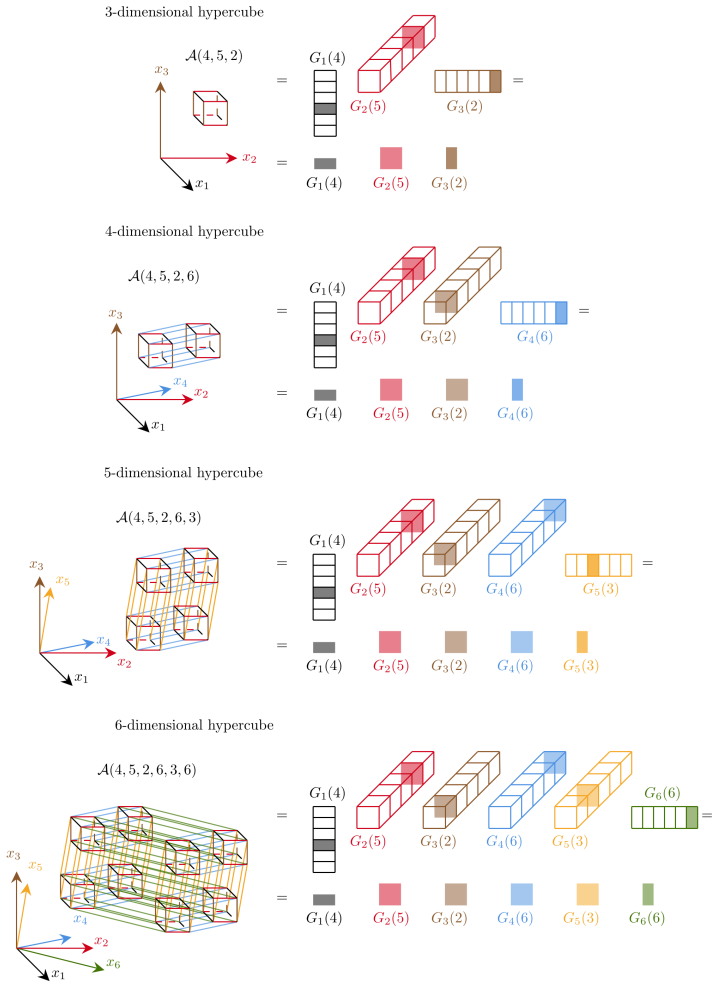
The superconsistent condition is the carrier of the argument: in one dimension it replaces the standard spectral representation nodes (zeros of $P'_n$ plus the interval endpoints) by collocation nodes positioned between the diffusion-optimal zeros of $P'_n$ and the convection-optimal zeros of $P_n$, with the shift set by $\varepsilon/|\beta L|$ and the polynomial degree $n$. Applied separately in each coordinate direction of a $d$-dimensional hypercube, it yields a Cartesian tensor-product grid, and that structure is what fits the spectral operators into the tensor-train format: each direction's stabilization is built into its own TT core. The TT representation and the TT-SVD/AMEn algorithms then supply the compression and linear-algebra machinery that make very large effective grids solvable.
What would settle it
Solve the stationary six-dimensional problem (5) with a rotational or strongly cross-coupled velocity field, say $\beta = (-x_2, x_1, 1, 1, 1, 1)$, $\varepsilon = 10^{-6}$, polynomial degree 40, and count sign changes of the first derivative along a midline as in Figure 6. If spurious oscillations appear for any parameter combination, or if a smooth manufactured solution stops showing exponential error decay as the degree increases, the claim of unconditional dimension-wise stabilization would be contradicted.
Extended reading notes
Core claim
On the paper's own terms, the central discovery is that the superconsistent condition, applied independently in each spatial direction, produces a Cartesian collocation grid whose one-dimensional node shifts depend only on the local $\varepsilon/|\beta L|$ ratio and polynomial degree, and that this grid confers the same oscillation suppression on the full tensor-product discretization while remaining compatible with TT compression. This dimension-wise reinterpretation is what separates T2S2 from the original multidimensional superconsistent formulation, which distorts the grid in a non-Cartesian way and therefore cannot be stored in tensor-train cores. The numerical section reports exponential decay of the error to machine precision for a manufactured seven-dimensional problem, a non-oscillatory six-dimensional boundary-layer solution across the tested parameter ranges, and oscillation-free resolution of the traveling-bump and double-layer benchmarks.
Load-bearing premise
The load-bearing premise is that a superconsistent collocation grid computed from a one-dimensional scalar convection-diffusion model, then applied independently along each coordinate, still stabilizes the full multidimensional tensor-product discretization; the paper states this dimension-wise decoupling but does not prove it.
Editorial extensions
If this is right
- For the manufactured space-time test, T2S2 reaches an error near machine precision on a grid with $300^7$ degrees of freedom in under three minutes on a laptop; the equivalent full spectral tensor would need more than an exabyte of memory and an estimated fifty million years of exascale computing.
- The method is reported to remain non-oscillatory across the tested range of $\varepsilon/|\beta L|$ and polynomial degrees, whereas plain spectral collocation in TT format oscillates over a wide parameter range.
- Both space-time and method-of-lines variants are available; the second-order semi-implicit Crank-Nicolson scheme preserves the traveling-bump peak better than backward Euler, and the space-time formulation compresses time together with the spatial dimensions.
- A six-dimensional boundary-layer solution is captured with TT rank about 11, reducing storage by a further factor of order $10^{-6}$, while the residual decreases regularly in T2S2 and fails to converge for plain spectral collocation.
- Because the solver needs no training data or offline high-fidelity solves, it is a direct numerical method rather than a reduced-order or data-driven surrogate.
Reading between the lines
- If the dimension-wise stabilization holds beyond the tested set, the recipe for building a stable high-dimensional spectral solver reduces to a one-dimensional precomputation per direction; stability would then be inherited from a scalar model rather than from a multidimensional analysis.
- A natural stress test not reported in the paper is the same six-dimensional problem with a discontinuous or strongly rotational velocity field and an under-resolved boundary layer; the outcome would delimit the class of problems for which the stability claim is true.
- The rank-11 behavior for boundary-layer solutions suggests that the real ceiling for T2S2 is the TT-rank growth of high-gradient features rather than the discretization's stability, so adaptive rank control or quantized tensor trains are the likely next improvements.
- The same Cartesian-grid construction should transfer to kinetic equations such as the Vlasov equation, where phase-space advection is transport-dominated and low-rank structure is already exploited.
Editorial analysis
A structured set of objections, weighed in public.
Referee Report
Summary. The paper introduces T2S2, a solver that combines spectral collocation, Funaro's superconsistent stabilization, and the tensor-train format for high-dimensional linear convection-diffusion-reaction equations. The central claim is that a dimension-wise application of the superconsistent condition produces a tensor-friendly Cartesian grid that is oscillation-free, spectrally accurate, and compressible to ratios such as O(10^-12), enabling six-dimensional transport problems to be solved in minutes on a laptop. The numerical sections report exponential convergence on a manufactured six-dimensional problem, a stability colormap for a constant-coefficient six-dimensional problem, and two low-dimensional benchmarks (the traveling bump and the Hughes double-layer). The Methods section, however, only reviews the tensor-train format; the promised formulation of superconsistency and spectral collocation is not given.
Significance. If the central claims are substantiated, the contribution is significant: it would provide a practical route to spectral accuracy in high-dimensional transport problems that are generally intractable in full-tensor formats. The numerical evidence in Figures 4-10 is substantive and the use of independent benchmarks (traveling bump, Hughes double-layer) and manufactured solutions is creditable. The reported convergence behavior and runtimes are striking. However, the manuscript currently lacks the formal derivation of the superconsistent nodes and the dimension-wise stabilization argument, and it overstates the stability result as 'unconditional' on the basis of a finite parameter sweep. These gaps are load-bearing because the advertised guarantees are exactly the missing items.
major comments (4)
- [Methods / Overview of the T2S2 Approach] The Methods section, which is announced as providing 'the detailed mathematical framework underlying the T2S2 solver', does not formulate superconsistency or the spectral collocation discretization. After the tensor-train review there is no equation defining the superconsistent collocation points, no formula relating their positions to epsilon/|beta L| and n, and no derivation for the one-dimensional model (4). The text in the Overview states that superconsistency 'is satisfied by introducing a different set of collocation points' and that the method 'implements the superconsistent condition independently along each dimension', but the actual node-generation rule is never written down. This makes the method irreproducible from the manuscript and prevents verification of the central claim that T2S2 'enforces a dimension-wise superconsistent condition'.
- [Overview of the T2S2 Approach / Discussion] The load-bearing assumption that the one-dimensional superconsistent condition, applied independently in each dimension, stabilizes the full tensor-product discretization is stated but not proved. The sentence 'Our approach implements the superconsistent condition independently along each dimension, treating them as decoupled problems' is the only justification, and no stability or convergence analysis is supplied for the d-dimensional problem (1). The Discussion's claim of 'unconditional stability of the method versus the parameters choice' is supported only by the finite colormap in Figure 6(d), which covers constant beta and a finite grid of epsilon and degree values. A proof for at least the constant-coefficient tensor-product case, or an explicit stability bound, is needed; otherwise the claims should be restricted to the tested parameter ranges.
- [Results, Low-Dimensional Numerical Challenges (traveling bump)] The rotating-bump benchmark does not actually test the superconsistent node selection. The text states: 'Although we choose collocation points to be the zeros of P_n, considering positive convection coefficients in both directions, T2S2 nonetheless proves to be robust.' Since the prescribed velocity field is beta = (-x2, x1), the first component changes sign, so the statement about positive convection coefficients in both directions is inaccurate, and using the zeros of P_n means the run uses standard Legendre collocation rather than the T2S2 superconsistent points. This experiment therefore does not validate the dimension-wise superconsistent stabilization for rotational or sign-changing velocity fields. The authors should either run the benchmark with the actual T2S2 nodes or explicitly present it as a robustness test that lies outside the superconsistent framework.
- [Results, Superconsistent Stabilization of Convection-Dominated Problems] The oscillation criterion used in Figure 6 is not defined precisely enough to support the 'oscillation-free' and 'unconditionally stable' claims. The text says the authors 'count the number of sign changes in the first derivative of the numerical solution' and compare with 'the expected sign changes in the regular solution', but the expected profile, the evaluation rule on the mid-axis, and the threshold for declaring a solution oscillatory are not specified. The colormap in Figure 6(d) is a finite parameter sweep, not a stability proof. A precise definition of the oscillation measure and, ideally, a stability bound or a clearly stated conjecture with supporting analysis should be provided.
minor comments (5)
- [Discussion] There is a typo: 'we demostrated' should be 'we demonstrated'.
- [Results, Superconsistent Stabilization] The sentence 'The Tensor train solver is AMEn[13], ant the iterations are addressed as swaps in the tensor train nomenclature.s' contains two typos: 'ant' should be 'and', and the trailing 's' should be removed.
- [Introduction / Figure 4 caption] The notation O((#ndofs)7)2 is ambiguous; it should clearly indicate that the full-format complexity is (n^7)^2 when n is the number of degrees of freedom per dimension.
- [Results, Global Accuracy and Computational Cost] The compression ratio O(10^-12) is presented in the Abstract as a general feature, but it is a measured value for one experiment (rank 9, mode size 300). The Abstract should say 'in our experiments' or otherwise qualify the statement.
- [Throughout] The labels Plain-SC, Plain-SC-TT, and 'Plain-SC collocation methods' are used interchangeably; the terminology should be unified to avoid confusing the two-dimensional and tensor-train variants.
Circularity Check
No circularity found: T2S2 is an assembled method whose stabilization and compression are validated on independent benchmarks; missing proofs are support gaps, not self-referential reductions.
full rationale
The T2S2 derivation chain is not circular. Superconsistency is imported from Funaro's published method [19,20]; although Funaro is a coauthor, that method is externally falsifiable and independently applied by non-overlapping authors [10,11], so the citation is real evidence rather than a self-referential premise. The new dimension-wise TT-compatible construction is asserted and then tested on manufactured solutions, the traveling-bump benchmark, and the Hughes double-layer benchmark, so the accuracy, oscillation-free, and compression claims are not obtained by renaming an input. The compression ratio is measured from the solver's adaptive TT ranks, not from a pre-fit parameter, and the error tests use independent analytical solutions. Two flagged caveats are correctness/completeness gaps rather than circularity: (i) the Methods section promises to describe Spectral Collocation and Superconsistency but only reviews the TT format, so the 'dimension-wise superconsistent condition' is never stated as an equation and remains unsupported rather than derived; (ii) the 'unconditionally stable' conclusion is drawn from the finite colormap in Figure 6(d), and the traveling-bump test explicitly falls back on zeros of P_n rather than superconsistent points for the rotational velocity field, so that benchmark does not validate the superconsistent grid for sign-changing convection. These concerns should be weighed as correctness risk, not as circularity.
Assumptions & free parameters
assumptions (4)
- domain assumption Funaro's one-dimensional superconsistent collocation points stabilize convection-diffusion discretizations in the 1D model problem (βf' - εf'' = 1).
- ad hoc to paper Applying the 1D superconsistent condition independently in each spatial dimension yields a stable and spectrally accurate tensor-product discretization for multidimensional transport problems.
- domain assumption The solutions of the target high-dimensional transport problems admit low tensor-train ranks that are preserved by the discretized operators and the AMEn linear solver.
- domain assumption Spectral accuracy (exponential convergence) holds for the modified superconsistent collocation grids.
Cite this review
Pith. "Pith review of A Fast, Accurate and Oscillation-free Spectral Collocation Solver for High-dimensional Transport Problems." pith.science (2026). https://pith.science/paper/POBRW2IS
@misc{pith2026250604732,
  author       = {Pith},
  title        = {Pith review of: A Fast, Accurate and Oscillation-free Spectral Collocation Solver for High-dimensional Transport Problems},
  year         = {2026},
  howpublished = {\url{https://pith.science/paper/POBRW2IS}},
  note         = {Machine review of arXiv:2506.04732}
}
abstract
Transport phenomena-describing the movement of particles, energy, or other physical quantities-are fundamental in various scientific disciplines, including nuclear physics, plasma physics, astrophysics, engineering, and the natural sciences. However, solving the associated seven-dimensional transport equations poses a significant computational challenge due to the curse of dimensionality. We introduce the Tensor Train Superconsistent Spectral (T${^2}$S${^2}$) solver to address this challenge, integrating Spectral Collocation for exponential convergence, Superconsistency for stabilization in transport-dominated regimes, and Tensor Train format for substantial data compression. T${^2}$S${^2}$ enforces a dimension-wise superconsistent condition compatible with tensor structures, achieving extremely low compression ratios, in the order of $(10^{-12})$, while preserving spectral accuracy. Numerical experiments on linear problems demonstrate that T${^2}$S${^2}$ can solve high-dimensional transport problems in minutes on standard hardware, making previously intractable problems computationally feasible. This advancement opens new avenues for efficiently and accurately modeling complex transport phenomena.
Figures


Figures from the paper (8 more)


Reference graph
Works this paper leans on
-
[1]
URL :https://aris.iaea.org/ (Last accessed February 9th, 2025)
Advanced Reactor Information System. URL :https://aris.iaea.org/ (Last accessed February 9th, 2025). 2025
work page 2025
-
[2]
D. N. Arnold. Numerical Analysis of Partial Differential Equations. Lecture Notes. Lecture notes for Math 8445-8446, Last modified March 22, 2018. University of Minnesota, 2018.url: https: //www-users.cse.umn.edu/~arnold/8445-8446.17-18/notes.pdf (visited on 09/25/2024)
work page 2018
-
[3]
G. I. Bell and S. Glasstone.Nuclear Reactor Theory. English. (TID-25606, osti_id 4074688, NSA- 25-010317). US Atomic Energy Commission, Washington, DC (United States): US Atomic Energy Commission (AEC), 1970.url: https://www.osti.gov/biblio/4074688
arXiv 1970
-
[4]
R. Bellman. Dynamic Programming. Princeton, NJ: Princeton University Press, 1957
work page 1957
-
[6]
C. Canuto et al. Spectral Methods: Fundamentals in Single Domains. Springer Berlin Heidelberg,
-
[7]
N. Cavallini et al. “Vanquishing the computational cost of passive gamma emission tomography simulations leveraging physics-aware reduced order modeling”. In: Scientific Reports 13 (2023), p. 15034. doi: 10.1038/s41598-023-41220-3
-
[8]
C. Cercignani. The Boltzmann Equation and Its Applications. Applied Mathematical Sciences. Springer New York, 2012. isbn: 9781461210399. url: https : / / books . google . it / books ? id = OcTcBwAAQBAJ
work page 2012
-
[9]
W. De Launey and J. Seberry. “The strong Kronecker product”. In: Journal of Combinatorial Theory, Series A66.2(1994),pp.192–213. issn:0097-3165. doi: https://doi.org/10.1016/0097- 3165(94)90062-0
doi:10.1016/0097- 1994
Show all 52 references
-
[10]
A superconsistent collocation method for high Reynolds number flows
F. De l’Isle and R. G. Owens. “A superconsistent collocation method for high Reynolds number flows”. In:Computers & Fluids259 (2023), p. 105897.issn: 0045-7930.doi: https://doi.org/10. 1016/j.compfluid.2023.105897
2023
-
[11]
Superconsistent collocation methods with applications to convection- dominated convection–diffusion equations
F. De l’Isle and R. G. Owens. “Superconsistent collocation methods with applications to convection- dominated convection–diffusion equations”. In:Journal of Computational and Applied Mathematics 391 (2021), p. 113367. issn: 0377-0427. doi: https://doi.org/10.1016/j.cam.2020.11...
2021
-
[12]
Fast Solution of Parabolic Problems in the Tensor Train/Quantized Tensor Train Format with Initial Application to the Fokker–Planck Equation
S. V. Dolgov, B. N. Khoromskij, and I. V. Oseledets. “Fast Solution of Parabolic Problems in the Tensor Train/Quantized Tensor Train Format with Initial Application to the Fokker–Planck Equation”. In:SIAM Journal on Scientific Computing34.6 (2012), A3016–A3038. doi: 10.1137/ 1...
2012 doi
-
[13]
Alternating Minimal Energy Methods for Linear Systems in Higher Dimensions
S. V. Dolgov and D. V. Savostyanov. “Alternating Minimal Energy Methods for Linear Systems in Higher Dimensions”. In:SIAM Journal on Scientific Computing36.5 (2014), A2248–A2271. doi: 10.1137/140953289. url: https://doi.org/10.1137/140953289
2014 doi
-
[14]
Alternating minimal energy methods for linear systems in higher dimensions. Part II: Faster algorithm and application to nonsymmetric systems
S. V. Dolgov and D. V. Savostyanov. “Alternating minimal energy methods for linear systems in higher dimensions. Part II: Faster algorithm and application to nonsymmetric systems”. In:SIAM, Journal on Scientific Computing 37.5 (2015), A2456–A2488. doi: https://doi.org/10.1137/...
2015
-
[15]
A Hybrid Alternating Least Squares–TT Cross Algorithm for Para- metric PDEs
S. V. Dolgov and R. Scheichl. “A Hybrid Alternating Least Squares–TT Cross Algorithm for Para- metric PDEs”. In:SIAM/ASA Journal on Uncertainty Quantification7.1 (2019), pp. 260–291.doi: 10.1137/18M1194134
2019 doi
-
[16]
Semi-Lagrangian 4d, 5d, and 6d kinetic plasma simulation on large-scale GPU-equipped supercomputers
L. Einkemmer and A. Moriggl. “Semi-Lagrangian 4d, 5d, and 6d kinetic plasma simulation on large-scale GPU-equipped supercomputers”. In: The International Journal of High Performance Computing Applications37.2 (2023), pp. 180–196.doi: 10.1177/10943420221137599
2023 doi
-
[18]
Fish and T
J. Fish and T. Belytschko.A first course in finite elements. Wiley, 2007
2007
-
[19]
D. Funaro. Spectral Elements for Transport-Dominated Equations. Springer Berlin Heidelberg, 1997. isbn: 9783540626497. url: https://books.google.it/books?id=vieH0KmZ-n4C
1997
-
[20]
Superconsistent Discretizations
D. Funaro. “Superconsistent Discretizations”. In: Journal of Scientific Computing 17.1 (2002), pp. 67–79. doi: 10.1023/A:1015136227726. url: https://doi.org/10.1023/A:1015136227726
2002 doi
-
[21]
W. H. Geist, P. A. Santi, and M. T. Swinhoe, eds.Nondestructive Assay of Nuclear Materials for Safeguards and Security. Cham: Springer, 2024.doi: 10.1007/978-3-031-58277-6
2024 doi
-
[22]
Finite element methods for incompressible viscous flow
R. Glowinski. “Finite element methods for incompressible viscous flow”. In: Numerical Methods for Fluids (Part 3). Vol. 9. Handbook of Numerical Analysis. Elsevier, 2003, pp. 3–1176. doi: https://doi.org/10.1016/S1570-8659(03)09003-3 . url: https://www.sciencedirect.com/ scien...
2003 doi
-
[23]
Glowinski and T
R. Glowinski and T. W. Pan.Numerical Simulation of Incompressible Viscous Flow. De Gruyter,
-
[24]
How to Find a Good Submatrix
S. Goreinov et al. “How to Find a Good Submatrix”. In:Matrix Methods: Theory, Algorithms and Applications.Ed.byV.OlshevskyandE.Tyrtyshnikov.Singapore:WorldScientific,2010.Chap.15, pp. 247–256. doi: 10.1142/9789812836021_0015
2010 doi
-
[25]
Graziani, ed
F. Graziani, ed. Computational Methods in Transport. Springer-Verlag Berlin Heidelberg, 2006.doi: 10.1007/3-540-28125-8. url: https://doi.org/10.1007/3-540-28125-8
2006 doi
-
[26]
F. R. Graziani and G. L. Olson.Transport Methods Conquering the seven-dimensional Mountain. Tech. rep. UCRL-JC-154432. Lawrence Livermore National Laboratory, 2003
2003
-
[27]
J. S. Hesthaven, S. Gottlieb, and D. Gottlieb. Spectral Methods for Time-Dependent Problems. Vol. 21. Cambridge Monographs on Applied and Computational Mathematics. Cambridge Univer- sity Press, 2007
2007
-
[28]
J. S. Hesthaven, G. Rozza, and B. Stamm.Certified Reduced Basis Methods for Parametrized Partial Differential Equations. 1st ed. Springer Briefs in Mathematics. Switzerland: Springer, 2015, p. 135
2015
-
[29]
A new finite element formulation for computational fluid dynamics: III. The generalized streamline operator for multidimensional advective-diffusive systems
T. J. R. Hughes and M. Mallet. “A new finite element formulation for computational fluid dynamics: III. The generalized streamline operator for multidimensional advective-diffusive systems”. In:Com- puter Methods in Applied Mechanics and Engineering58.3 (1986), pp. 305–328. is...
1986
-
[30]
Hundsdorfer and J
W. Hundsdorfer and J. G.a Verwer.Numerical Solution of Time-Dependent Advection-Diffusion- Reaction Equations. Vol. 33. Springer-Verlag, 2003.doi: 10.1007/978-3-662-09017-6
2003 doi
-
[31]
Vienna, 2024
IAEA World Fusion Outlook 2024.URLhttps://www.iaea.org/publications/15777/iaea-world-fusion- outlook-2024 (last accessed February 21st, 2025). Vienna, 2024
2024
-
[32]
A. Jüngel. Transport Equations for Semiconductors. Lecture Notes in Physics. Springer, 2009.isbn: 9783540895251. url: https://books.google.it/books?id=d6YIyevAQG4C
2009
-
[33]
Tensor decompositions and applications
T. Kolda and B. Bader. “Tensor decompositions and applications”. In:SIAM Review 51.3 (2009), pp. 455–500
2009
-
[34]
A Semi-Lagrangian Vlasov Solver in Tensor Train Format
Katharina Kormann. “A Semi-Lagrangian Vlasov Solver in Tensor Train Format”. In:SIAM Journal on Scientific Computing37.4 (2015), B613–B632.doi: 10.1137/140971270. eprint:https://doi. org/10.1137/140971270. url: https://doi.org/10.1137/140971270
2015 doi
-
[35]
J. N. Kutz. Data-Driven Modeling & Scientific Computation: Methods for Complex Systems & Big Data. USA: Oxford University Press, Inc., 2013.isbn: 0199660344
2013
-
[36]
Dynamic Mode Decomposition.Philadelphia,PA:SocietyforIndustrialandApplied Mathematics, 2016
J.N.Kutzetal. Dynamic Mode Decomposition.Philadelphia,PA:SocietyforIndustrialandApplied Mathematics, 2016. doi: 10.1137/1.9781611974508 . eprint: https://epubs.siam.org/doi/ pdf / 10 . 1137 / 1 . 9781611974508. url: https : / / epubs . siam . org / doi / abs / 10 . 1137 / 1 . ...
2016 doi
-
[37]
MASA: A library for verification using manufactured and analytical solutions
N. Malaya et al. “MASA: A library for verification using manufactured and analytical solutions”. In: Engineering with Computers(2012), pp. 1–10.issn: 0177-0667.doi: 10.1007/s00366-012-0267-9
2012 doi
-
[38]
Meuer et al.TOP500
H. Meuer et al.TOP500. (online article). 2025.url: https://top500.org (visited on 02/18/2025)
2025
-
[39]
TT-cross approximation for multidimensional arrays
I. Oseledets and E. Tyrtyshnikov. “TT-cross approximation for multidimensional arrays”. In:Linear Algebra and its Applications432.1 (2010), pp. 70–88
2010
-
[40]
Tensor-Train Decomposition
I. V. Oseledets. “Tensor-Train Decomposition”. In: SIAM Journal on Scientific Computing 33.5 (2011), pp. 2295–2317.doi: 10.1137/090752286. url: https://doi.org/10.1137/090752286
2011 doi
-
[41]
URL: https://www.exascaleproject.org/reports/ (Last ac- cessed February 9th, 2025)
Reports - Exascale Computing Project. URL: https://www.exascaleproject.org/reports/ (Last ac- cessed February 9th, 2025). 2025
2025
-
[42]
A machine learning framework for solving high-dimensional mean field game and mean field control problems
L. Ruthotto et al. “A machine learning framework for solving high-dimensional mean field game and mean field control problems”. In:Proceedings of the National Academy of Sciences117.17 (2020), pp. 9183–9193. doi: 10.1073/pnas.1922204117
2020 doi
-
[43]
A new class of optimal high-order strong-stability-preserving time discretization methods
S. J. Ruuth and R. J. Spiteri. “A new class of optimal high-order strong-stability-preserving time discretization methods”. In:SIAM J. Numer. Anal40 (2003), pp. 469–491
2003
-
[44]
W. E. Schiesser. The Numerical Method of Lines: Integration of Partial Differential Equations. Academic Press, 1991.isbn: 978-0126241303
1991
-
[45]
Smith and H
H. Smith and H. H. Jensen. Transport Phenomena. Clarendon Press, 1989.isbn: 9780198519850. url: https://books.google.it/books?id=xPt9AAAAIAAJ
1989
-
[46]
Spectralmethodsintimeforhyperbolicequations
HillelTal-Ezer.“Spectralmethodsintimeforhyperbolicequations”.In: SIAM Journal on Numerical Analysis 23.1 (1986), pp. 11–26
1986
-
[47]
Transport equations in moving material. Part I: Neutrons and photons
B. R. Wienke. “Transport equations in moving material. Part I: Neutrons and photons”. In:Progress in Nuclear Energy46.1 (2005), pp. 13–55.issn: 0149-1970. doi: https://doi.org/10.1016/j. pnucene . 2004 . 09 . 016. url: https : / / www . sciencedirect . com / science / article ...
2005 doi
-
[48]
M. M. R. Williams.Random Processes in Nuclear Reactors. Pergamon, 2013.isbn: 9781483187273. url: https://books.google.it/books?id=FkP-BAAAQBAJ
2013
-
[49]
G. P. Zank. Transport Processes in Space Physics and Astrophysics. 2014th ed. Springer New York,
-
[50]
Physics-informed neural networks for solving time-dependent mode- resolvedphononBoltzmanntransportequation
J. Zhou, R. Li, and T. Luo. “Physics-informed neural networks for solving time-dependent mode- resolvedphononBoltzmanntransportequation”. In: npj Computational Materials9.1(2023),p.212. doi: 10.1038/s41524-023-01165-7
2023 doi
-
[2007]
url: https://books.google.it/books?id=DFJB0kiq0CQC
isbn: 9783540307266. url: https://books.google.it/books?id=DFJB0kiq0CQC
-
[2014]
url: https://doi.org/10.1007/978-1-4614-8480-6
-
[2022]
url: https://doi.org/10.1515/9783110785012
isbn: 9783110785012. url: https://doi.org/10.1515/9783110785012
-
[2024]
url: https://arxiv.org/abs/2412.05912
eprint: 2412.05912 (math.NA). url: https://arxiv.org/abs/2412.05912
Reviewed August 7, 2026 · model on record in the stance chip above.
Discussion (0). Sign in to comment.