REVIEW 4 major objections 4 minor 1 cited by
Motivating Workers in Federated Learning: A Stackelberg Game Perspective
T0 review · 4 major / 4 minor · reviewed 2026-08-14 · deepseek-v4-flash
Pith's one-line read A Stackelberg game determines the optimal price a model owner pays workers in federated learning, with a closed-form equilibrium in the homogeneous case.
desk verdict A clean closed-form Stackelberg pricing result for federated learning, but the main theorem drops the P_max cap it states one page earlier; fixable, but not as submitted. read the letter →
The pith
A machine-rendered reading of the paper's core claim, the machinery that carries it, and where it could break.
The reading
What carries the argument
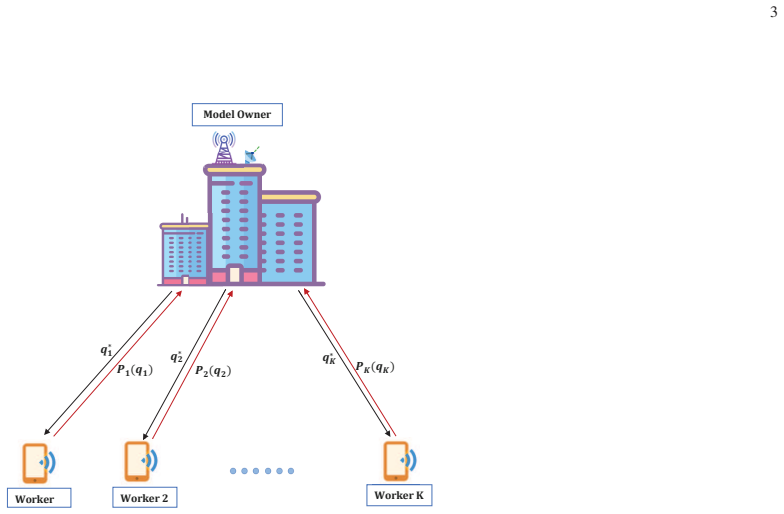
The central object is the Stackelberg game with a linear payment schedule $q_i P_i$ and a quadratic energy cost $\kappa c_i (P_i)^2$, making each worker's utility strictly concave in $P_i$. The lower level yields a unique best response $P_i^*(q_i) = q_i/(2\kappa c_i)$ (capped at $P_{\max}$); the upper level substitutes this response into the expected maximum of exponential completion times, whose formula is the inclusion-exclusion sum in Lemma 1. The load-bearing identity is the symmetry condition $\lambda_i = \lambda$ (equivalently $q_i = q$) in the homogeneous case, which makes the first-order conditions of the upper-level problem identical across workers, leading to the closed-form price.
What would settle it
A concrete check: solve the full Stackelberg problem numerically in the homogeneous case, keeping the $P_{\max}$ cap and a specified finite $V$, and compare the optimal price to $\sqrt{2B\kappa c/K}$. If there exists a parameter choice where the unconstrained $P_i^*$ exceeds $P_{\max}$ and the computed optimum differs from the closed form, then Theorem 1 fails for that regime.
Extended reading notes
Core claim
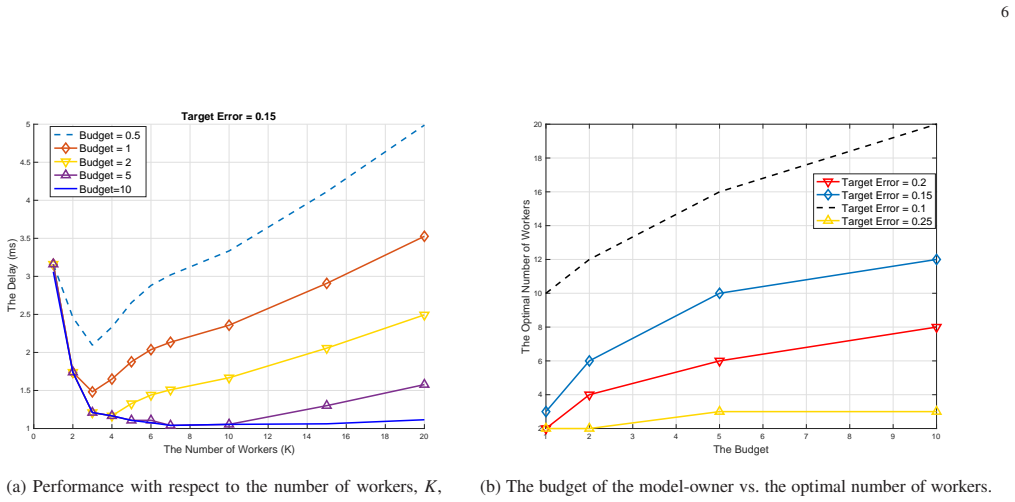
The paper discovers that the interaction between a model owner and workers in synchronous federated SGD is a leader-follower (Stackelberg) game with a unique equilibrium. Given a price $q_i$, each worker's best response is to use CPU power $P_i^* = q_i/(2\kappa c_i)$, up to the cap $P_{\max}$. The model owner then minimizes a weighted sum of expected per-iteration delay and total payment, subject to a budget. When all workers have identical computation requirements $c$, the equilibrium price is equal for all and given by $q^* = \sqrt{2B\kappa c/K}$, and the entire budget is spent. The numerical study shows that total latency is not monotone in the number of workers: an optimal worker count exists for each budget and target error rate, and it grows with budget and shrinks with target error.
Load-bearing premise
The upper-level derivation substitutes the uncapped best response $P_i^* = q_i/(2\kappa c_i)$ into the delay and budget expressions, ignoring the $P_{\max}$ cap, and it assumes $V$ is 'sufficiently large' so that the budget constraint binds; if the equilibrium price drives a worker above the cap, or if $V$ is not large enough, the derived allocation and Theorem 1 no longer hold.
Editorial extensions
If this is right
- If the central claim is correct, a model owner with homogeneous workers can set a single price per unit of CPU power and be at the Stackelberg equilibrium, with the entire budget spent.
- The optimal worker count for a given budget and target error rate is finite; adding workers beyond that point increases latency and should be avoided.
- The optimal number of workers grows as the budget increases, since more CPU power can be purchased across more workers.
- The optimal number of workers grows as the target error rate decreases, because more iterations allow data diversity to become more effective.
- The game formulation gives a principled way to price worker contributions, resolving the tension between the model owner's latency objective and workers' selfish utility maximization.
Reading between the lines
- The same cost-geometry could be extended to asynchronous SGD, where the per-iteration maximum is replaced by staleness; a testable prediction is that the optimal price still scales as $1/\sqrt{K}$ but with a different constant depending on the staleness model.
- Under heavy-tailed computation-time distributions, which are common in real clusters, the inclusion-exclusion formula for the expected maximum changes, and the optimal price may become non-symmetric even in the homogeneous case; this could be tested by simulation with Pareto-distributed service times.
- The optimal-number-of-workers result suggests a practical auto-scaling rule: stop adding workers when the marginal latency reduction from diversity falls below the marginal delay from synchronization, a threshold that could be estimated online.
- The paper's reliance on the unconstrained best response suggests that explicitly solving the capped problem would yield a regime where the equilibrium price is lower than the closed-form value, which is a testable deviation from Theorem 1.
Signed reviews
Editorial analysis
A structured set of objections, weighed in public.
Referee Report
Summary. The paper studies an incentive mechanism for federated learning in which a model owner pays workers per unit of CPU power to speed up synchronous SGD. The interaction is modeled as a Stackelberg game: each worker i chooses CPU power P_i to maximize q_i P_i - κ c_i P_i^2 subject to a cap P_max (the lower-level problem), and the model owner chooses prices q_i to minimize V times the expected maximum per-iteration time plus total payments, subject to a budget B (the upper-level problem). The authors derive the worker best response in Eq. (9), state Lemma 2 that the budget binds for sufficiently large V, and give Theorem 1 with a closed-form equilibrium price q*_i = sqrt(2Bκc/K) for homogeneous workers (c_i = c). Numerical experiments on MNIST study the latency versus the number of workers and the budget, leading to the conclusion that a limited budget implies an optimal number of workers balancing diversity and per-iteration delay.
Significance. If the equilibrium characterization were valid under explicitly stated conditions, the paper would provide a clean, closed-form benchmark for pricing CPU contributions in federated learning and a useful qualitative insight about the optimal number of workers. The Stackelberg formulation is natural, and the lower-level best response is correct. However, the central result, Theorem 1, is derived by dropping the P_max cap from the worker best response and by invoking Lemma 2 without a quantified 'sufficiently large V' condition. These omissions make the theorem invalid as stated and the numerical claims unverifiable. The work is a reasonable starting point, but the load-bearing analytical steps need substantial revision before the results can be accepted.
major comments (4)
- [§III-B and Appendix B, Eq. (9) and Theorem 1] The proof of Theorem 1 substitutes the uncapped branch of the worker best response, P*_i = q_i/(2κc_i), into the upper-level problem, silently dropping the cap that appears in Eq. (9). For homogeneous workers, the proposed price q*_i = sqrt(2Bκc/K) yields P*_i = sqrt(B/(2κcK)). If B > 2κcK P_max^2, this value exceeds P_max, so the actual best response is P*_i = P_max, and the budget identity sum_i q_i^2/(2κc) = B used in Lemma 2 and Theorem 1 is false. The paper never states or verifies the condition B ≤ 2κcK P_max^2. This is an internal inconsistency with the constraint (5) and invalidates Theorem 1 as stated.
- [Lemma 2 and Theorem 1] Lemma 2 concludes that the budget constraint is active only when V is 'sufficiently large,' but no concrete condition on V is given, and Theorem 1 is stated without this qualification. If V is not large enough, the optimal solution may have slack in the budget constraint (7), in which case q*_i = sqrt(2Bκc/K) does not solve the upper-level problem. The numerical section does not report V or provide any check that the budget binds in the simulations, so the reader cannot determine whether the reported results lie in the theorem's valid regime.
- [Appendix B, proof of Theorem 1] The proof of Theorem 1 shows that λ_i = λ_j for all i,j is 'a trivial solution' to the stationarity condition (13), but it does not establish that this point is a global minimizer of the upper-level problem. The objective in (6), after substitution of the best response, is not shown to be convex in q, and other KKT points are not ruled out. The claim that this is 'the optimal solution' therefore requires additional argument or an explicit uniqueness result.
- [Section IV, Numerical Results] The simulation section does not specify the values of κ, P_max, or V. Since Theorem 1 and Lemma 2 depend on these parameters, the numerical results cannot be checked against the theoretical conditions. In particular, the reader cannot verify whether the equilibrium prices used in the simulations satisfy P*_i ≤ P_max or whether the budget constraint is active. The claim about the optimal number of workers therefore rests on unverifiable simulation conditions.
minor comments (4)
- [Section II, system model] The text says that T_i,t is exponentially distributed 'with mean P_i/c_i'; given that Lemma 1 later defines λ_i = P_i/c_i as the rate, the mean should be c_i/P_i. Please correct this typo for consistency.
- [Section III, upper-level subgame] The cap P_max is introduced in the text before Eq. (3) and then used in constraint (5). Please make the definition explicit and consistently call it P_max in both the lower-level and upper-level problems.
- [Abstract and conclusion] The abstract states that an equilibrium solution is obtained analytically, but the closed-form equilibrium is derived only for homogeneous workers. Please qualify the statement to reflect the scope of Theorem 1.
- [Figure 2] The y-axis label in Fig. 2a is 'The Delay (ms)' but the text does not explain how the delay is computed from MNIST training runs or specify the hardware. Please add the measurement details.
Circularity Check
No significant circularity: the Stackelberg equilibrium is derived from an explicit utility and cost model, with external citations used only for standard independent results.
full rationale
The paper derives the worker's optimal CPU power P_i* from the first-order condition of its own stated utility function U_i(P_i,q_i) = q_i P_i - kappa c_i (P_i)^2, and the owner's pricing rule is obtained by substituting that best response into the stated upper-level problem and solving the KKT conditions. No parameter in the game is fitted to the quantity that is later reported as a prediction, and no target result is assumed in the derivation of Theorem 1. The only external citation used as evidence is the expected-maximum formula in Lemma 1, which is attributed to Bibinger's notes and is not authored by the present authors; it is a parameter-free standard result about independent exponential random variables, so it provides independent support. The proof of Lemma 2 and Theorem 1 proceeds by the paper's own equations, and the homogeneous-case price q_i* = sqrt(2B kappa c / K) follows algebraically from the budget-binding condition and the equal-lambda symmetry condition. The known robustness concern that the P_max cap in Eq. (9) is silently dropped from the upper-level analysis is a correctness and validity-regime issue, not a circularity issue, because the dropped constraint does not reintroduce the claimed conclusion as an input. There is no self-citation chain, no fitted input renamed as a prediction, and no ansatz smuggled in through citation. The paper's numerical section is an independent simulation study measuring latency against budget, number of workers, and target error, and the trade-off conclusion is an observed behavior rather than a restatement of an assumed formula. Accordingly, no circular step is exhibited, and the appropriate finding is no significant circularity.
Assumptions & free parameters
free parameters (2)
- V (latency weight in the model owner's objective) =
not specified in Section IV
- P_max cap (maximum worker CPU power) =
absent from upper-level analysis
assumptions (4)
- domain assumption Worker computation times T_{i,t} are independent and exponentially distributed with mean P_i/c_i (Section II).
- domain assumption Each worker maximizes a quasi-linear utility q_i P_i - κ c_i P_i^2 with a given price q_i and does not anticipate the owner's budget constraint (Section II).
- ad hoc to paper The budget constraint is active at the optimum, i.e., V is sufficiently large (Lemma 2, Appendix A).
- standard math Sum of i.i.d. exponentials formula from Bibinger notes [10] (Lemma 1).
Cite this review
Pith. "Pith review of Motivating Workers in Federated Learning: A Stackelberg Game Perspective." pith.science (2026). https://pith.science/paper/PPFHTTEV
@misc{pith2026190803092,
  author       = {Pith},
  title        = {Pith review of: Motivating Workers in Federated Learning: A Stackelberg Game Perspective},
  year         = {2026},
  howpublished = {\url{https://pith.science/paper/PPFHTTEV}},
  note         = {Machine review of arXiv:1908.03092}
}
read the original abstract
Due to the large size of the training data, distributed learning approaches such as federated learning have gained attention recently. However, the convergence rate of distributed learning suffers from heterogeneous worker performance. In this paper, we consider an incentive mechanism for workers to mitigate the delays in completion of each batch. We analytically obtained equilibrium solution of a Stackelberg game. Our numerical results indicate that with a limited budget, the model owner should judiciously decide on the number of workers due to trade off between the diversity provided by the number of workers and the latency of completing the training.
Figures
Forward citations
Cited by 1 Pith paper
-
Strategic Incentivization for Locally Differentially Private Federated Learning
A token system where tokens expire and global models cost tokens forces strategic federated learning clients to adopt the server's acceptable privacy level.
Reference graph
Works this paper leans on
-
[1]
Communication-efficient learning of deep networks fr om decentralized data,
H. B. McMahan, E. Moore, D. Ramage, S. Hampson, and B. A. Ar cas, “Communication-efficient learning of deep networks fr om decentralized data,” in International Conference on Artificial Intelligence and St atistics (AISTATS), Fort Lauderdale, FL, USA, Apr. 2017
work page 2017
-
[2]
Gradien t coding: avoiding stragglers in distributed learning,
A. G. D. R. Tandon, Q. Lei and N. Karampatziakis, “Gradien t coding: avoiding stragglers in distributed learning,” in Proc. Int. Conf. on Machine Learning , Sydney, Australia, Feb. 2017, pp. 3368–3376
work page 2017
-
[3]
Speeding up distributed machine learning usin g codes,
K. Lee, M. Lam, R. Pedarsani, D. Papailiopoulos, and K. Ra mchandran, “Speeding up distributed machine learning usin g codes,” IEEE Transactions on Information Theory , vol. 64, no. 3, pp. 1514–1529, 2018
work page 2018
-
[4]
Straggler mit igation in distributed optimization through data encoding ,
C. Karakus, Y . Sun, S. Diggavi, and W. Yin, “Straggler mit igation in distributed optimization through data encoding ,” in Advances in Neural Information Processing Systems 30 (NIPS) , Long Beach, NY , USA, Dec. 2017, pp. 5440–5448. August 9, 2019 DRAFT 8
work page 2017
-
[5]
Addressing the straggler pro blem for iterative convergent parallel ml,
A. Harlap, H. Cui, W. Dai, J. Wei, G. R. Ganger, P . B. Gibbon s, G. A. Gibson, and E. P . Xing, “Addressing the straggler pro blem for iterative convergent parallel ml,” in ACM Symposium on Cloud Computing (SoCC) , Santa Clara, CA, USA, Oct. 2016, pp. 98–111
work page 2016
-
[6]
Heterogeneous Coded Computation across Heterogeneous Workers
Y . Sun, J. Zhao, S. Zhou, and D. G¨ und¨ uz, “Heterogeneous computation across heterogeneous workers,” CoRR, vol. abs/1904.07490, 2019. [Online]. Available: http://arxiv.org/abs/1904.07490
work page Pith review arXiv 1904
-
[7]
Adaptive Task Allocation for Mobile Edge Learning
U. Mohammad and S. Sorour, “Adaptive task allocation for mobile edge learning,” CoRR, vol. abs/1811.03748, 2018. [Online]. Available: http://arxiv.org/abs/1811.03748
work page Pith review arXiv 2018
-
[8]
Joint service pricing and cooperative relay communication for fe derated learning,
S. Feng, D. Niyato, P . Wang, D. I. Kim, and Y . Liang, “Joint service pricing and cooperative relay communication for fe derated learning,” CoRR, vol. abs/1811.12082, 2018. [Online]. Available: http:// arxiv.org/abs/1811.12082
arXiv 2018
Show all 11 references
-
[9]
S low and stale gradients can win the race: Error-runtime trad e-offs in distributed sgd,
S. Dutta, G. Joshi, S. Ghosh, P . Dube, and P . Nagpurkar, “S low and stale gradients can win the race: Error-runtime trad e-offs in distributed sgd,” CoRR, vol. abs/1803.01113, 2018. [Online]. Available: https:/ /arxiv.org/abs/1803.01113
2018 arXiv
-
[10]
Notes on the sum and maximum of independen t exponentially distributed random variables with differe nt scaleparameters,
M. Bibinger, “Notes on the sum and maximum of independen t exponentially distributed random variables with differe nt scaleparameters,” CoRR, vol. abs/1307.3945, 2013. [Online]. Available: http://a rxiv.org/abs/1307.3945
2013 arXiv
-
[11]
Energy-latency tradeoff for energy-aware o ffloading in mobile edge computing networks,
J. Zhang, X. Hu, Z. Ning, E. C. . Ngai, L. Zhou, J. Wei, J. Ch eng, and B. Hu, “Energy-latency tradeoff for energy-aware o ffloading in mobile edge computing networks,” IEEE Internet of Things Journal , vol. 5, no. 4, pp. 2633–2645, Aug 2018. APPENDIX A PROOF OF LEMMA 2 We first...
2018
Reviewed August 14, 2026 · model on record in the stance chip above.
Discussion (0). Continue with ORCID to comment.