REVIEW 40 references
The mass-size plane of EAGLE galaxies
T0 review · reviewed 2026-08-14 · deepseek-v4-flash
Pith's one-line read EAGLE simulated galaxies reproduce the observed mass-size plane, with stellar age varying along lines of constant velocity dispersion and age acting as a spin proxy in flattened galaxies.
The pith
A machine-rendered reading of the paper's core claim, the machinery that carries it, and where it could break.
The reading
The authors took 1,700 well-resolved galaxies from a simulated box of space 100 megaparsecs on a side. They split them into disk-dominated and spheroid-dominated galaxies, then mapped each galaxy's age, velocity dispersion, chemical content, and spin across the mass-size plane.
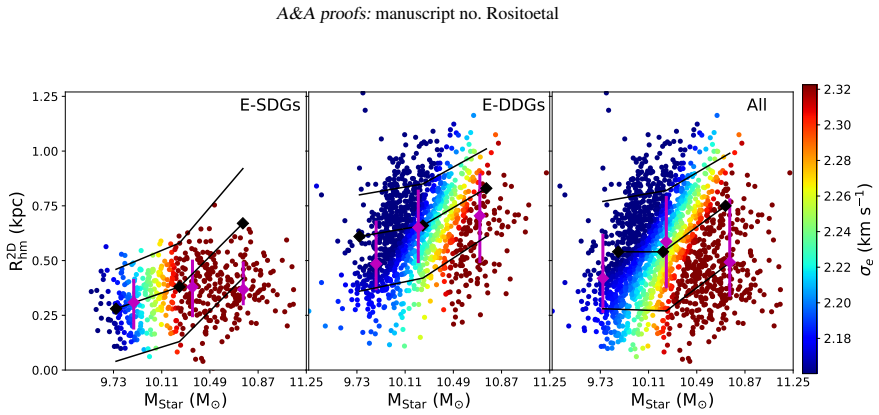
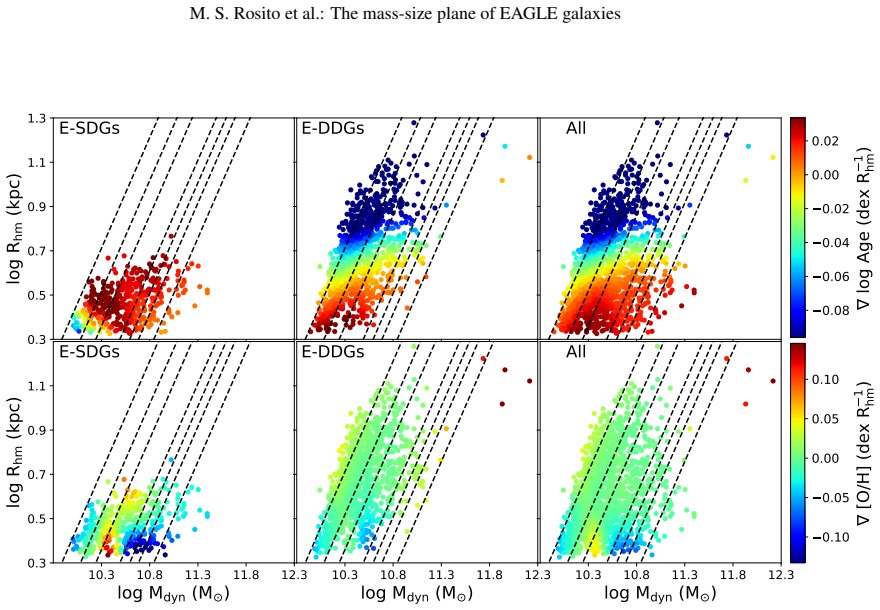
The main results: simulated galaxies do fall on the observed mass-size plane, especially at intermediate masses. Older stars sit in more compact galaxies at a fixed dynamical mass. Stellar ages vary along lines of constant velocity dispersion, exactly as seen in the MaNGA survey, except for the fastest galaxies, where the trend flattens. Extended disks have negative age gradients (younger stars further out), matching inside-out growth. But early-type galaxies in the simulation show too many inverted age profiles, and the simulated metallicity gradients are much weaker than observed.
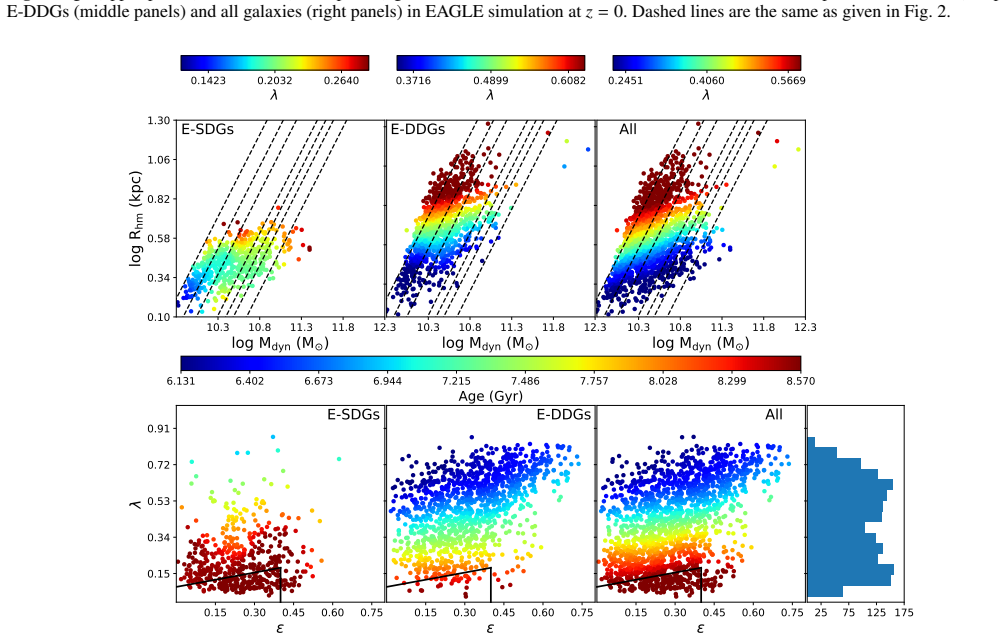
A new finding is that a galaxy's stellar age tracks its spin parameter in flattened systems: slow rotators are old, fast rotators are young. The spin parameter distribution is bimodal, with disks of young stars on one peak and old slow rotators on the other. The authors interpret this as a shared origin: the processes that shut off star formation and age a galaxy also redistribute its angular momentum and change its shape.
Extended reading notes
Core claim
The central claim is that the EAGLE simulation reproduces the observed mass-size plane correlations: galaxies with similar median stellar ages move approximately along lines of constant sigma_e, in agreement with observations (Section 3, Fig. 2), and stellar-weighted ages are good proxies for lambda in galaxies with low ellipticity (Abstract). If true, the current cosmological paradigm explains the scatter on the plane and links star formation history, angular momentum, and morphology.
Load-bearing premise
The EAGLE subgrid prescriptions for star formation, chemical enrichment, and feedback produce reliable z=0 stellar age, metallicity, and kinematic gradients, even though these outputs are predictions rather than calibration targets of the model (Section 2, after Schaye et al. 2015). The age-gradient and age-spin conclusions would be invalidated if the subgrid choices imprint artificial radial or kinematic structure. The authors flag this residual uncertainty themselves in Section 4: further work on the multi-phase nature of the ISM in simulations could naturally lead to more realistic internal kinematics and profiles of galaxies.
Signed reviews
Editorial analysis
A structured set of objections, weighed in public.
Assumptions & free parameters
free parameters (5)
- B/T = 0.5 morphological split =
0.5
- lambda = 0.2 slow/fast rotator boundary =
0.2
- Radial fitting interval for gradients =
0.7 kpc to Rhm
- LOESS smoothing parameters
- Sample resolution cut =
10,000 star particles
assumptions (5)
- domain assumption Lambda-CDM cosmology with Planck parameters
- domain assumption EAGLE subgrid physics produces realistic galaxy populations
- domain assumption Virialization for dynamical mass estimates
- domain assumption Projected mock observations mimic real IFS measurements
- domain assumption Stellar mass-weighted ages are the right age proxy
Cite this review
Pith. "Pith review of The mass-size plane of EAGLE galaxies." pith.science (2026). https://pith.science/paper/PPR43YDM
@misc{pith2026190800416,
  author       = {Pith},
  title        = {Pith review of: The mass-size plane of EAGLE galaxies},
  year         = {2026},
  howpublished = {\url{https://pith.science/paper/PPR43YDM}},
  note         = {Machine review of arXiv:1908.00416}
}
read the original abstract
Current observational results show that both late-and-early-type galaxies follow tight mass-size planes, on which physical properties such as age, velocity dispersion and metallicities correlate with the scatter on the plane. We study the mass-size plane of galaxies in cosmological hydrodynamical simulations, as a function of velocity dispersion, age, chemical abundances, ellipticity and spin parameters with the aim at assessing to what extent the current cosmological paradigm can reproduce these observations and provide a physical interpretation of them. We select a sample of well-resolved galaxies from the (100 Mpc)^3 simulation of the EAGLE Project. This sample is composed by 508 spheroid-dominated galaxies and 1213 disc-dominated galaxies. The distributions of velocity dispersion, age, metallicity indicators and gradients and spin parameters across the mass-size plane are analysed. Furthermore, we study the relation between shape and kinematic parameters. The results are compared with observations. The mass-weighted ages of the EAGLE galaxies are found to vary along lines of constant velocity dispersion on the mass-size plane, except for galaxies with velocity dispersion larger than aprox 150 km s^(-1) . Negative age gradients tend to be found in extended disc galaxies in agreement with observations. However, the age distributions of early-type galaxies show a larger fraction with inverted radial profiles. The distribution of metallicity gradients does not show any clear dependence on this plane. Galaxies with similar spin parameters ({\lambda}) display larger sizes as their dynamical masses increase. Stellar-weighted ages are found to be good proxies for {\lambda} in galaxies with low ellipticity ({\epsilon}). Abridged
Figures

Figures from the paper (1 more)
Reference graph
Works this paper leans on
-
[1]
, " * write output.state after.block = add.period write newline
ENTRY address archiveprefix author booktitle chapter edition editor howpublished institution eprint journal key month note number organization pages publisher school series title type volume year label extra.label sort.label short.list INTEGERS output.state before.all mid.sentence after.sentence after.block FUNCTION init.state.consts #0 'before.all := #1 ...
-
[2]
write newline
" write newline "" before.all 'output.state := FUNCTION n.dashify 't := "" t empty not t #1 #1 substring "-" = t #1 #2 substring "--" = not "--" * t #2 global.max substring 't := t #1 #1 substring "-" = "-" * t #2 global.max substring 't := while if t #1 #1 substring * t #2 global.max substring 't := if while FUNCTION word.in bbl.in " " * FUNCTION format....
- [3]
-
[4]
Bryant , J. J., Owers , M. S., Robotham , A. S. G., et al. 2015, , 447, 2857
work page 2015
-
[5]
A., Law , D
Bundy , K., Bershady , M. A., Law , D. R., et al. 2015, , 798, 7
2015
-
[6]
Cappellari , M., McDermid , R. M., Alatalo , K., et al. 2013, , 432, 1862
work page 2013
-
[7]
Clauwens , B., Schaye , J., Franx , M., & Bower , R. G. 2018, , 478, 3994
work page 2018
-
[8]
Cleveland, W. S. & Devlin, S. J. 1988, Journal of the American Statistical Association, 83, 596
work page 1988
Show all 40 references
-
[9]
A., Schaye , J., Bower , R
Crain , R. A., Schaye , J., Bower , R. G., et al. 2015, , 450, 1937
2015
-
[10]
E., Bower , R
De Rossi , M. E., Bower , R. G., Font , A. S., Schaye , J., & Theuns , T. 2017, , 472, 3354
2017
-
[11]
2011, , 414, 888
Emsellem , E., Cappellari , M., Krajnovi \'c , D., et al. 2011, , 414, 888
2011
-
[12]
Fall , S. M. & Romanowsky , A. J. 2013, , 769, L26
2013
-
[13]
S., Theuns, T., Trayford, J
Frenk, C. S., Theuns, T., Trayford, J. W., Correa, C., & Schaye, J. 2018, , 483, 744
2018
-
[14]
T., Cappellari , M., Li , H., et al
Graham , M. T., Cappellari , M., Li , H., et al. 2018, , 477, 4711
2018
-
[15]
Lagos , C. d. P., Schaye , J., Bah \'e , Y., et al. 2018 a , , 476, 4327
2018
-
[16]
Lagos , C. d. P., Stevens , A. R. H., Bower , R. G., et al. 2018 b , , 473, 4956
2018
-
[17]
Lagos , C. d. P., Theuns , T., Stevens , A. R. H., et al. 2017, , 464, 3850
2017
-
[18]
2018, , 476, 1765
Li , H., Mao , S., Cappellari , M., et al. 2018, , 476, 1765
2018
-
[19]
2002, , 330, 821
Lia , C., Portinari , L., & Carraro , G. 2002, , 330, 821
2002
-
[20]
C., Schaller , M., et al
McAlpine , S., Helly , J. C., Schaller , M., et al. 2016, Astronomy and Computing, 15, 72
2016
-
[21]
B., Tissera , P
Mosconi , M. B., Tissera , P. B., Lambas , D. G., & Cora , S. A. 2001, , 325, 34
2001
-
[22]
2013, in IAU Symposium, Vol
Naab , T. 2013, in IAU Symposium, Vol. 295, The Intriguing Life of Massive Galaxies, ed. D. Thomas , A. Pasquali , & I. Ferreras , 340--349
2013
-
[23]
2014, , 444, 3357
Naab , T., Oser , L., Emsellem , E., et al. 2014, , 444, 3357
2014
-
[24]
Pedrosa , S. E. & Tissera , P. B. 2015, , 584, A43
2015
-
[25]
B., & Michel-Dansac , L
Perez , J., Valenzuela , O., Tissera , P. B., & Michel-Dansac , L. 2013, , 436, 259
2013
-
[26]
Planck Collaboration , Ade , P. A. R., Aghanim , N., et al. 2014 a , , 571, A1
2014
-
[27]
Planck Collaboration , Ade , P. A. R., Aghanim , N., et al. 2014 b , , 571, A16
2014
-
[28]
G., Schaye , J., et al
Rosas-Guevara , Y., Bower , R. G., Schaye , J., et al. 2016, , 462, 190
2016
-
[29]
S., Tissera , P
Rosito , M. S., Tissera , P. B., Pedrosa , S. E., & Rosas-Guevara , Y. 2018, ArXiv e-prints [ [arXiv] 1811.11062 ]
2018 arXiv
-
[30]
S., Forbes , D
Ryden , B. S., Forbes , D. A., & Terlevich , A. I. 2001, , 326, 1141
2001
-
[31]
F., Kennicutt , R
S \'a nchez , S. F., Kennicutt , R. C., Gil de Paz , A., et al. 2012, , 538, A8
2012
-
[32]
A., Bower , R
Schaye , J., Crain , R. A., Bower , R. G., et al. 2015, , 446, 521
2015
-
[33]
M., et al
Scott , N., Brough , S., Croom , S. M., et al. 2017, , 472, 2833
2017
-
[34]
& Kobayashi , C
Taylor , P. & Kobayashi , C. 2017, , 471, 3856
2017
-
[35]
B., Machado , R
Tissera , P. B., Machado , R. E. G., Sanchez-Blazquez , P., et al. 2016, , 592, A93
2016
-
[36]
B., Rosas-Guevara , Y., Bower , R
Tissera , P. B., Rosas-Guevara , Y., Bower , R. G., et al. 2019, , 482, 2208
2019
-
[37]
B., White , S
Tissera , P. B., White , S. D. M., & Scannapieco , C. 2012, , 420, 255
2012
-
[38]
van de Sande , J., Lagos , C. D. P., Welker , C., et al. 2019, , 484, 869
2019
-
[39]
2018, Nature Astronomy, 2, 483
van de Sande , J., Scott , N., Bland-Hawthorn , J., et al. 2018, Nature Astronomy, 2, 483
2018
-
[40]
G., et al
van der Wel , A., Franx , M., van Dokkum , P. G., et al. 2014, , 788, 28
2014
Reviewed August 14, 2026 · model on record in the stance chip above.
Discussion (0). Continue with ORCID to comment.