REVIEW 4 major objections 6 minor 58 references
From Equipartition to Curvature: The Spectral Evolution of 4FGL Blazars
T0 review · 4 major / 6 minor · reviewed 2026-08-06 · deepseek-v4-flash
Pith's one-line read For BL Lacs, the blazar sequence reflects equipartition-balanced jets, not Doppler boosting or selection effects.
desk verdict Careful large-sample SED modeling, but the equipartition claim is not supported until the fitted parameter correlations get error bars and an internal slope inconsistency is resolved. read the letter →
The pith
A machine-rendered reading of the paper's core claim, the machinery that carries it, and where it could break.
The reading
What carries the argument
The load-bearing machinery is the one-zone homogeneous leptonic jet model whose emitting electrons follow a log-parabolic EED, $N(\gamma)=N_0(\gamma/\gamma_0)^{-s-r\log(\gamma/\gamma_0)}$, with peak energy $\gamma_{3p}=\gamma_0 10^{(3-s)/2r}$; this EED shape is produced by stochastic acceleration balanced against radiative cooling. The argument proceeds by linking the SED observables $\nu_s$ and $b_s$ to EED parameters via $\nu_s\propto\gamma_{3p}^2 B\delta$ and the $r=5b_s$ mapping, and then connecting the fitted parameters through the equipartition condition $U_B=U_e$, i.e., $B^2\simeq n_e\gamma_{3p}$, which forces the inverse $\gamma_{3p}$-$n_e$ relation and the positive $B$-$n_e$ relation. The turbulence index $q$ of the magnetic fluctuation spectrum, $W(k)\propto k^{2-q}$, distinguishes hard-sphere ($q=2$) from softer Kolmogorov or Kraichnan turbulence and determines how tightly $r$ anti-correlates with $\gamma_{3p}$.
What would settle it
Re-fit a subset of the same BL Lac SEDs with a two-zone model or with the viewing angle as a free parameter; if the $\gamma_{3p}$-$n_e$ anticorrelation and the $B$-$n_e$ correlation weaken to non-significance, the equipartition interpretation collapses into a fitting degeneracy. A cheaper test is to take BL Lacs with VLBI-measured Doppler factors, fix $\delta$ to the observed values, and check whether the correlations in the $\gamma_{3p}$-$n_e$ and $B$-$n_e$ planes survive.
Extended reading notes
Core claim
Using a one-zone leptonic model with synchrotron, SSC, and dusty-torus EC components, the authors fit log-parabolic electron energy distributions $N(\gamma)=N_0(\gamma/\gamma_0)^{-s-r\log(\gamma/\gamma_0)}$ to the SEDs of 100 bright blazars from the Fermi bright AGN sample. They derive per-source values of magnetic field $B$, electron density $n_e$, electron peak energy $\gamma_{3p}$, source size $R$, and Doppler factor $\delta$. The synchrotron peak frequency follows $\nu_s \propto \gamma_{3p}^2$ with no measurable dependence on $B\delta$, identifying electron peak energy as the driver of spectral evolution; in the $\nu_s$-$\nu_s L_s$ plane this translates to $n_e$ as the luminosity driver. For BL Lacs the authors find a significant inverse correlation $\log n_e = -1.35 \log \gamma_{3p} + 5.4$ (Pearson $r_p < -0.8$) and a positive correlation $\log n_e = 1.32 \log B + 1.85$, with Compton dominance near unity, all consistent with equipartition $U_B \approx U_e$. They argue that these internal relations naturally produce the BL Lac blazar sequence, while FSRQs show no such correlations. The paper further reports an anti-correlation between $\nu_s$ and the synchrotron spectral curvature $b_s$ for all blazars and a milder anti-correlation between $\gamma_{3p}$ and the EED curvature $r$, which it interprets as stochastic acceleration with soft magnetic turbulence ($q<2$) operating close to steady state; for BL Lacs the photon and electron curvatures nearly satisfy the theoretical relation $r \approx 5 b_s$, whereas FSRQs deviate because of the thermal big blue bump contaminating $b_s$.
Load-bearing premise
The equipartition conclusion assumes that the one-zone homogeneous leptonic model, with fixed viewing angle around 3 degrees, opening angle around 5 degrees, and dusty-torus EC dominance for low-peaked sources, yields unique, non-degenerate estimates of $B$, $n_e$, $\gamma_{3p}$, and $R$ from each SED; the paper gives no parameter uncertainties or degeneracy analysis.
Editorial extensions
If this is right
- For BL Lacs, a single-epoch SED can be read as a near-equipartition diagnostic: $\nu_s$ directly gives $\gamma_{3p}$ and $\nu_s L_s$ gives $n_e$, so the sequence traces the distribution of electron acceleration states across sources.
- If equipartition holds, jet power and energy budgets for BL Lacs can be computed with one less free parameter, since $B$ is fixed by $n_e$ and $\gamma_{3p}$, which sharpens comparisons with accretion power.
- The FSRQ deviation implies their SED evolution is governed by the external radiation field of the dusty torus rather than internal balance, so FSRQ jet models that keep $B$, $n_e$, and $\gamma_{3p}$ mutually independent are the appropriate starting point.
- The approximate $r\approx 5b_s$ relation found for BL Lacs means the observed SED curvature is a faithful proxy for the intrinsic EED curvature, making curvature a practical observable for testing acceleration models over large samples.
Reading between the lines
- If the equipartition reading is correct, time-resolved SED monitoring of a single BL Lac should show $\gamma_{3p}$ and $n_e$ moving anticorrelated during flares, redistributing energy between particle energy and particle number; this is testable with existing multi-epoch campaigns.
- The fixed-geometry assumption ($\theta\simeq 3^\circ$, $\phi\simeq 5^\circ$) is a strong prior, and independent VLBI measurements of $\delta$ for a subset of BL Lacs could confirm that the $B$-$n_e$-$\gamma_{3p}$ correlations are not a coordinate degeneracy of the fit.
- The same one-zone machinery, applied to FSRQs with a BLR rather than dusty-torus EC component, could test whether the equipartition violation is due to the torus photon field or to genuinely independent jet parameters.
Editorial analysis
A structured set of objections, weighed in public.
Referee Report
Summary. The manuscript models the broadband SEDs of 100 Fermi-LAT blazars from the LBAS sample using 4FGL-DR3 gamma-ray data, fits log-parabolic functions to the synchrotron and IC bumps, and fits a one-zone leptonic synchrotron+SSC+EC model with a log-parabolic electron distribution. The authors report that the synchrotron peak frequency is driven by the electron peak energy gamma3p rather than by B*delta; that BL Lacs show a negative nu_s-nu_s*L_s trend that they interpret as not due to Doppler boosting; and that for BL Lacs the fitted B, n_e, and gamma3p satisfy correlations (B-n_e positive, n_e-gamma3p negative) that they interpret as equipartition U_B~U_e. They further report that nu_s anti-correlates with the synchrotron curvature b_s, that gamma3p mildly anti-correlates with the EED curvature r, and that the r-b_s relation for BL Lacs is close to r=5 b_s. FSRQs are found not to follow the equipartition correlations.
Significance. If established, the central result would reframe the blazar sequence for BL Lacs as an intrinsic equipartition-driven relation rather than a Doppler or selection artifact, and it would connect SED curvature to EED curvature in a statistically large sample. The paper is a substantial modeling campaign: 100 sources with updated GeV-TeV data, LP polynomial fits, one-zone model fits, and a systematic comparison of BL Lacs and FSRQs. The main physical conclusion is, however, conditional on the uniqueness and reliability of the fitted parameters. The paper provides no parameter uncertainties, no degeneracy analysis, and no mock-recovery tests, and one of the key regression relations is internally inconsistent. The significance is therefore real but not yet established; the result would be a valuable advance if the statistical foundations are supplied.
major comments (4)
- [§4.1, Figs. 11–12] The three reported regression relations for BL Lacs are not mutually consistent. Combining log n_e = -1.35 log gamma3p + 5.4 and log B = -0.53 log gamma3p + 0.6 algebraically yields log n_e = 2.55 log B + 3.9 for the same sample, whereas the paper reports log n_e = 1.32 log B + 1.85. In addition, the text describes the B-n_e relation as positive but quotes r_p = -0.63. These inconsistencies mean that the set of correlations, as presented, cannot support the equipartition chain B^2 ~ n_e gamma3p; the authors must either correct the regressions or explain why the relations are not transitive.
- [§3, §4.1, Tables 3–4] The central claim that BL Lacs are in equipartition rests entirely on correlations among B, n_e, and gamma3p obtained from a many-parameter one-zone fit (B, n_e, s, r, gamma0, R, delta, R_b, and for FSRQs L_D, R_T) using chi^2 minimization, with no reported parameter uncertainties, degeneracy analysis, or mock-recovery tests. One-zone SSC/EC models are known to have broad degeneracies among B, n_e, R, delta, and gamma3p, and the paper fixes theta and phi at about 3 and 5 degrees but does not demonstrate that the fitted parameters are uniquely identifiable from the sparse multi-band data. A suite of recovery tests on simulated SEDs, or at least confidence contours for the key parameters, is needed before the correlations in Fig. 11 can be interpreted as jet physics rather than fitting-path artifacts.
- [§3.1, Eq. (17), §4.2, Fig. 14] The claimed 'intrinsic signature of stochastic acceleration' in the gamma3p-r plane is partly definitional. gamma3p is computed from the fitted LP parameters via Eq. (17), which for fixed s and gamma0 gives log gamma3p = log gamma0 + (3-s)/(2r), a decreasing function of r. The paper does not show that the scatter in s and gamma0 breaks this built-in anti-correlation; as written, the reported mild anti-correlation in Fig. 14 could be an artifact of the parameterization rather than evidence for soft turbulence. The authors should quantify the partial correlation of gamma3p and r after removing the contribution of s and gamma0, or fit the EED peak directly.
- [§4.1, Fig. 9] The conclusion that the nu_s-nu_s*L_s trend for BL Lacs is 'not an artifact of Doppler boosting' is based on the lack of correlation between nu_s and B*delta in Fig. 9. This inference is only as strong as the reliability of the fitted delta and B values; because no uncertainties are given, the null correlation could be washed out by large parameter errors. A simple demonstration that delta is recovered accurately in mock fits, or an explicit discussion of the delta degeneracy, is needed to support this key conclusion.
minor comments (6)
- [Table 3 caption] The Table 3 note contains a duplicated column description: 'Column (2) gives the SED type of source. Column (2) gives the redshift of the source.' The column numbering should be corrected so each column is described once.
- [Figure 6 caption] The caption says 'the lower panels show IC peak frequency nu_s and IC peak flux nu_c F_c'; the first symbol should be nu_c, not nu_s.
- [Section 5, first paragraph] The sentence 'The blazras shows a negative trend...' contains a typo: 'blazras' should be 'blazars' and 'shows' should be 'show'.
- [Section 2, third paragraph] The word 'corrsponding' should be 'corresponding'.
- [Section 4.1, Fig. 7] The text reports 'correlation coefficient rp approximately -0.4 and a chance probability p ~ 10^-3' for the nu_s-nu_s*L_s and nu_c-nu_c*L_c planes; please specify whether r_p is the Pearson or Spearman coefficient and report the p-value separately for each plane.
- [Section 4.2, Eq. (24)] Eq. (24) as written mixes logarithmic and linear quantities: 'log nu_s proportional to log gamma0 + 3/(10 b_s)' is not dimensionally consistent. The intended relation likely involves log nu_s proportional to log gamma0 plus a term proportional to 1/b_s; please rewrite it in a manifestly consistent form.
Circularity Check
The γ3p–r anti-correlation is partly built into the LP EED definition, but the equipartition inference itself is not definitionally forced.
-
self definitional
[Section 3, Eq. (17)-(18) and Section 4.2, Figure 14]
"The peak energy of LP EED in the γ3N(γ) representation is given by γ3p = γ010(3−s)/(2r). (17) Thus, the particle energy and curvature are inversely related in stochastic acceleration as log γ3p = log γ0 + (3 − 2s)/(2r)."
γ3p is computed from the fitted LP parameters s and r via Eq. (17). For s<3, ∂log γ3p/∂r < 0 identically, so a negative γ3p–r trend is built into the log-parabolic parameterization. Reporting r = −0.075 logγ3p + 0.93 as an observed 'intrinsic signature of stochastic acceleration' and citing the authors' own Anjum et al. (2020) presents the ansatz's algebra as an empirical finding, rather than as a consequence of how γ3p is defined.
full rationale
The main equipartition claim is not circular in the strict sense: the authors do not impose UB ≈ Ue during fitting, and the B–ne–γ3p correlations are outputs of one-zone SED fits, not inputs. However, the supporting claim that the γ3p–r anti-correlation confirms stochastic acceleration is partially self-definitional, because γ3p is derived from the fitted curvature r and index s through Eq. (17), which for s<3 forces a negative partial derivative. The self-citation to Anjum et al. (2020) does not provide independent evidence. The equipartition conclusion would be considerably stronger with parameter uncertainties, degeneracy/mock-recovery tests, and mutually consistent regression slopes (the reported ne–γ3p and B–γ3p fits imply ne–B slope ≈ 2.5, not 1.32), but those are robustness issues rather than definitional circularity. Score 4 reflects one partially definitional step plus self-citation, while the central inference retains independent empirical content.
Assumptions & free parameters
free parameters (10)
- Per-source magnetic field B =
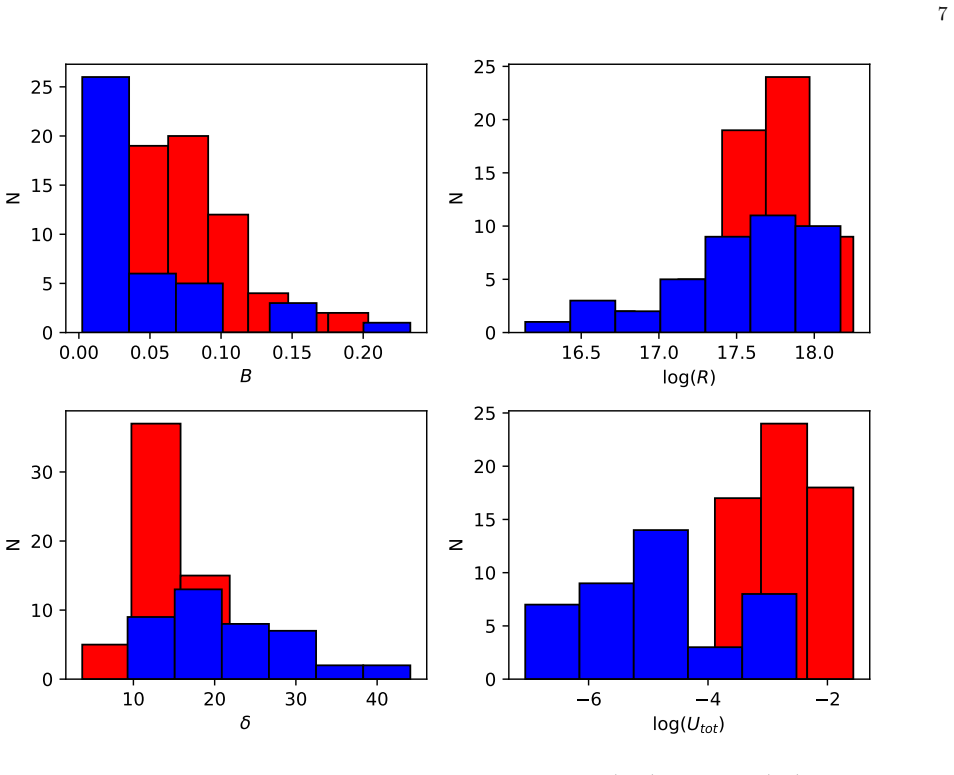
0.002 to 0.23 G (Tables 3, 4)
- Per-source electron density n_e =
0.0 to 242.4 cm^-3 (Tables 3, 4)
- Electron peak energy gamma3p =
Not tabulated; derived from fitted gamma0, s, r via Eq. (17)
- EED curvature r =
roughly 0.3 to 1.1 (Tables 3, 4)
- EED spectral index s =
about 0.5 to 2.7 for BL Lacs, about 1.8 to 2.7 for FSRQs
- Electron reference energy gamma0 =
approx 10^2 to 3.5x10^4 (Tables 3, 4)
- Blob radius R =
approx 10^16.5 to 10^18 cm (Tables 3, 4)
- Doppler factor delta and bulk Lorentz factor Gamma =
delta roughly 7.6 to 44 for BL Lacs; Gamma roughly 4 to 45 for FSRQs
- Synchrotron spectral curvature b_s =
0.06 to 0.28 (Tables 1, 2)
- Blob location Rb and disk luminosity LD for FSRQs =
Rb from 0.4 to 17 x 10^18 cm; LD from 0.27 to 545 x 10^45 erg/s (Table 4)
assumptions (6)
- domain assumption One-zone homogeneous spherical blob with uniform LP electron distribution and tangled magnetic field emits the observed SED.
- domain assumption Typical viewing angle theta=3 degrees and opening angle phi=5 degrees are adopted for all sources.
- domain assumption For LSP sources, gamma-ray emission is dominated by external Compton scattering of dusty torus photons with temperature about 10^2 K and reprocessing fraction 0.1.
- standard math The LP EED and the theoretical relation r=5bs from Massaro et al. (2006) are adopted as benchmarks.
- standard math Acceleration timescale scaling tau_a proportional to gamma^(2-q) with turbulence index q separates hard-sphere q=2 from softer q<2 turbulence.
- standard math Standard flat cosmology with H0=70 km/s/Mpc, Omega_m=0.32, Omega_Lambda=0.68.
Cite this review
Pith. "Pith review of From Equipartition to Curvature: The Spectral Evolution of 4FGL Blazars." pith.science (2026). https://pith.science/paper/PPRCA355
@misc{pith2026250721647,
  author       = {Pith},
  title        = {Pith review of: From Equipartition to Curvature: The Spectral Evolution of 4FGL Blazars},
  year         = {2026},
  howpublished = {\url{https://pith.science/paper/PPRCA355}},
  note         = {Machine review of arXiv:2507.21647}
}
abstract
We investigate the evolution of spectral energy distribution (SED) and underlying electron energy distribution (EED) by modeling the nearly simultaneous broadband spectra of selected bright 4FGL blazars, in the context of a combined cooling and stochastic acceleration scenario. We find that one-zone leptonic model with log-parabolic (LP) EED can successfully fit the GeV-TeV emission of blazars. The synchrotron frequency $\nu_s$ of blazars mainly evolves due to variation of electron peak energy $\gamma_{3p}$. The BL Lac objects (BL Lacs) show a negative trend in the $\nu_s- \nu_s L_s$ SED plane, known as blazar sequence, that does not seem to be an artifact of Doppler boosting, but driven by the equipartition constraints. A positive correlation is found between the derived magnetic field $B$ and electron density $n_e$, whereas $n_e$ and $\gamma_{3p}$ negatively relate, as expected in an equipartition scenario. The flat spectrum radio quasars (FSRQs) deviate significantly from such a scenario, indicating their jet parameters should be varying independently. The synchrotron peak frequency $\nu_s$ and its spectral curvature $b_s$ negatively correlate for all blazars, confirming the stochastic particle acceleration in blazar jets. However, blazars do not show the signature of hard-sphere acceleration, indicating that magnetic turbulence in the jets might be soft and physical conditions might be near to steady state, consistent with equipartition. Furthermore, for BL Lacs, the SED curvature $b_s$ and the EED curvature $r$ and nearly meet the theoretical relationship $r=5b_s$, whereas the FSRQs show large deviation due to poor constrain on $b_s$ due to presence of thermal component.
Figures


Figures from the paper (14 more)


Reference graph
Works this paper leans on
-
[1]
A., Ackermann , M., Ajello , M., et al
Abdo , A. A., Ackermann , M., Ajello , M., et al. 2009, title Bright Active Galactic Nuclei Source List from the First Three Months of the Fermi Large Area Telescope All-Sky Survey , , 700, 597, 10.1088/0004-637X/700/1/597
-
[2]
A., Ackermann , M., Agudo , I., et al
Abdo , A. A., Ackermann , M., Agudo , I., et al. 2010, title The Spectral Energy Distribution of Fermi Bright Blazars , , 716, 30, 10.1088/0004-637X/716/1/30
-
[3]
2020, title Fermi Large Area Telescope Fourth Source Catalog , , 247, 33, 10.3847/1538-4365/ab6bcb
Abdollahi , S., Acero , F., Ackermann , M., et al. 2020, title Fermi Large Area Telescope Fourth Source Catalog , , 247, 33, 10.3847/1538-4365/ab6bcb
-
[4]
Ajello , M., Baldini , L., Ballet , J., et al. 2022, title The Fourth Catalog of Active Galactic Nuclei Detected by the Fermi Large Area Telescope: Data Release 3 , , 263, 24, 10.3847/1538-4365/ac9523
-
[5]
Anjum , M. S., Chen , L., & Gu , M. 2020, title On the Origin and Evolution of Curvature of the Spectral Energy Distribution of Fermi Bright Blazars , , 898, 48, 10.3847/1538-4357/ab99a1
-
[6]
Blandford , R. D., & Rees , M. J. 1978, in BL Lac Objects, ed. A. M. Wolfe , 328--341
work page 1978
-
[7]
B a \.z ejowski , M., Sikora , M., Moderski , R., & Madejski , G. M. 2000, title Comptonization of Infrared Radiation from Hot Dust by Relativistic Jets in Quasars , , 545, 107, 10.1086/317791
doi:10.1086/317791 2000
-
[8]
Bloom , S. D., & Marscher , A. P. 1996, title An Analysis of the Synchrotron Self-Compton Model for the Multi--Wave Band Spectra of Blazars , , 461, 657, 10.1086/177092
doi:10.1086/177092 1996
Show all 58 references
-
[9]
2020, title Leptonic and Hadronic Radiative Processes in Supermassive-Black-Hole Jets , Galaxies, 8, 72, 10.3390/galaxies8040072
Cerruti , M. 2020, title Leptonic and Hadronic Radiative Processes in Supermassive-Black-Hole Jets , Galaxies, 8, 72, 10.3390/galaxies8040072
2020 doi
-
[10]
2014, title Curvature of the Spectral Energy Distributions of Blazars , , 788, 179, 10.1088/0004-637X/788/2/179
Chen , L. 2014, title Curvature of the Spectral Energy Distributions of Blazars , , 788, 179, 10.1088/0004-637X/788/2/179
2014 doi
-
[11]
2018, title On the Jet Properties of -Ray-loud Active Galactic Nuclei , , 235, 39, 10.3847/1538-4365/aab8fb
Chen , L. 2018, title On the Jet Properties of -Ray-loud Active Galactic Nuclei , , 235, 39, 10.3847/1538-4365/aab8fb
2018 doi
-
[12]
2018, title On the origin of gamma-rays in Fermi blazars: beyondthe broad-line region , , 477, 4749, 10.1093/mnras/sty887
Costamante , L., Cutini , S., Tosti , G., Antolini , E., & Tramacere , A. 2018, title On the origin of gamma-rays in Fermi blazars: beyondthe broad-line region , , 477, 4749, 10.1093/mnras/sty887
2018 doi
-
[13]
2013, title The seven year Swift-XRT point source catalog (1SWXRT) , , 551, A142, 10.1051/0004-6361/201220863
D'Elia , V., Perri , M., Puccetti , S., et al. 2013, title The seven year Swift-XRT point source catalog (1SWXRT) , , 551, A142, 10.1051/0004-6361/201220863
2013 doi
-
[14]
D., & Schlickeiser , R
Dermer , C. D., & Schlickeiser , R. 1993, title Model for the High-Energy Emission from Blazars , , 416, 458, 10.1086/173251
1993 doi
-
[15]
H., Yang , J
Fan , J. H., Yang , J. H., Liu , Y., et al. 2016, title The Spectral Energy Distributions of Fermi Blazars , , 226, 20, 10.3847/0067-0049/226/2/20
2016 doi
-
[16]
H., Yang , J
Fan , J. H., Yang , J. H., Xiao , H. B., et al. 2017, title Intrinsic Correlations for Flaring Blazars Detected by Fermi , , 835, L38, 10.3847/2041-8213/835/2/L38
2017 doi
-
[17]
2022, title Explaining the Multiwavelength Emission of -ray Bright Flat-Spectrum Radio Quasar 3C 454.3 in Different Activity States , Universe, 8, 585, 10.3390/universe8110585
Feng , Y., Hu , S., Zhou , R., & Gao , S. 2022, title Explaining the Multiwavelength Emission of -ray Bright Flat-Spectrum Radio Quasar 3C 454.3 in Different Activity States , Universe, 8, 585, 10.3390/universe8110585
2022 doi
-
[19]
1998, title A theoretical unifying scheme for gamma-ray bright blazars , , 301, 451, 10.1046/j.1365-8711.1998.02032.x
Ghisellini , G., Celotti , A., Fossati , G., Maraschi , L., & Comastri , A. 1998, title A theoretical unifying scheme for gamma-ray bright blazars , , 301, 451, 10.1046/j.1365-8711.1998.02032.x
1998
-
[20]
1996, title Diagnostics of Inverse-Compton models for the -ray emission of 3C 279 and MKN 421
Ghisellini , G., Maraschi , L., & Dondi , L. 1996, title Diagnostics of Inverse-Compton models for the -ray emission of 3C 279 and MKN 421. , , 120, 503
1996
-
[21]
2008, title The blazar sequence: a new perspective , , 387, 1669, 10.1111/j.1365-2966.2008.13360.x
Ghisellini , G., & Tavecchio , F. 2008, title The blazar sequence: a new perspective , , 387, 1669, 10.1111/j.1365-2966.2008.13360.x
2008
-
[24]
2010, title General physical properties of bright Fermi blazars , , 402, 497, 10.1111/j.1365-2966.2009.15898.x
Ghisellini , G., Tavecchio , F., Foschini , L., et al. 2010, title General physical properties of bright Fermi blazars , , 402, 497, 10.1111/j.1365-2966.2009.15898.x
2010
- [25]
-
[26]
2012, title A simplified view of blazars: clearing the fog around long-standing selection effects , , 420, 2899, 10.1111/j.1365-2966.2011.20044.x
Giommi , P., Padovani , P., Polenta , G., et al. 2012, title A simplified view of blazars: clearing the fog around long-standing selection effects , , 420, 2899, 10.1111/j.1365-2966.2011.20044.x
2012
-
[27]
2024, title The physical properties of Fermi-4LAC low-synchrotron-peaked BL Lac objects , , 528, 7587, 10.1093/mnras/stae522
Hu , H.-B., Wang , H.-Q., Xue , R., Peng , F.-K., & Wang , Z.-R. 2024, title The physical properties of Fermi-4LAC low-synchrotron-peaked BL Lac objects , , 528, 7587, 10.1093/mnras/stae522
2024 doi
-
[28]
2014, title Constraints on the Minimum Electron Lorentz Factor and Matter Content of Jets for a Sample of Bright Fermi Blazars , , 215, 5, 10.1088/0067-0049/215/1/5
Kang , S.-J., Chen , L., & Wu , Q. 2014, title Constraints on the Minimum Electron Lorentz Factor and Matter Content of Jets for a Sample of Bright Fermi Blazars , , 215, 5, 10.1088/0067-0049/215/1/5
2014 doi
-
[29]
Kardashev , N. S. 1962, title Nonstationarity of Spectra of Young Sources of Nonthermal Radio Emission , , 6, 317
1962
-
[30]
2006, title Stochastic particle acceleration and synchrotron self-Compton radiation in TeV blazars , , 453, 47, 10.1051/0004-6361:20054176
Katarzy \'n ski , K., Ghisellini , G., Mastichiadis , A., Tavecchio , F., & Maraschi , L. 2006, title Stochastic particle acceleration and synchrotron self-Compton radiation in TeV blazars , , 453, 47, 10.1051/0004-6361:20054176
2006 doi
-
[31]
1981, title Relativistic jets as X-ray and gamma-ray sources
Konigl , A. 1981, title Relativistic jets as X-ray and gamma-ray sources. , , 243, 700, 10.1086/158638
1981 doi
-
[32]
L., Ding , N., Luo , D., Wang , X
Luo , S. L., Ding , N., Luo , D., Wang , X. P., & Zhang , X. 2017, title Study on the Curvature Properties of Spectral Energy Distribution for Fermi Blazars , Acta Astronomica Sinica, 58, 57
2017
- [33]
-
[34]
1992, title A Jet Model for the Gamma-Ray--emitting Blazar 3C 279 , , 397, L5, 10.1086/186531
Maraschi , L., Ghisellini , G., & Celotti , A. 1992, title A Jet Model for the Gamma-Ray--emitting Blazar 3C 279 , , 397, L5, 10.1086/186531
1992 doi
-
[35]
Massaro , E., Perri , M., Giommi , P., & Nesci , R. 2004, title Log-parabolic spectra and particle acceleration in the BL Lac object Mkn 421: Spectral analysis of the complete BeppoSAX wide band X-ray data set , , 413, 489, 10.1051/0004-6361:20031558
2004 doi
-
[36]
2006, title Log-parabolic spectra and particle acceleration in blazars
Massaro , E., Tramacere , A., Perri , M., Giommi , P., & Tosti , G. 2006, title Log-parabolic spectra and particle acceleration in blazars. III. SSC emission in the TeV band from Mkn501 , , 448, 861, 10.1051/0004-6361:20053644
2006 doi
-
[37]
Massaro , F., Tramacere , A., Cavaliere , A., Perri , M., & Giommi , P. 2008, title X-ray spectral evolution of TeV BL Lacertae objects: eleven years of observations with BeppoSAX, XMM-Newton and Swift satellites , , 478, 395, 10.1051/0004-6361:20078639
2008 doi
- [38]
-
[39]
2024, title The SRG/eROSITA all-sky survey
Merloni , A., Lamer , G., Liu , T., et al. 2024, title The SRG/eROSITA all-sky survey. First X-ray catalogues and data release of the western Galactic hemisphere , , 682, A34, 10.1051/0004-6361/202347165
2024 doi
-
[40]
J., Engel , R., Rachen , J
M \"u cke , A., Protheroe , R. J., Engel , R., Rachen , J. P., & Stanev , T. 2003, title BL Lac objects in the synchrotron proton blazar model , Astroparticle Physics, 18, 593, 10.1016/S0927-6505(02)00185-8
2003 doi
-
[41]
2006, title Spectral energy distributions of a large sample of BL Lacertae objects , , 445, 441, 10.1051/0004-6361:20053316
Nieppola , E., Tornikoski , M., & Valtaoja , E. 2006, title Spectral energy distributions of a large sample of BL Lacertae objects , , 445, 441, 10.1051/0004-6361:20053316
2006 doi
-
[42]
2008, title Blazar sequence - an artefact of Doppler boosting , , 488, 867, 10.1051/0004-6361:200809716
Nieppola , E., Valtaoja , E., Tornikoski , M., Hovatta , T., & Kotiranta , M. 2008, title Blazar sequence - an artefact of Doppler boosting , , 488, 867, 10.1051/0004-6361:200809716
2008 doi
-
[43]
Planck Collaboration , Aatrokoski , J., Ade , P. A. R., et al. 2011, title Planck early results. XV. Spectral energy distributions and radio continuum spectra of northern extragalactic radio sources , , 536, A15, 10.1051/0004-6361/201116466
2011 doi
-
[44]
1997, in American Institute of Physics Conference Series, Vol
Sikora , M. 1997, in American Institute of Physics Conference Series, Vol. 410, Proceedings of the Fourth Compton Symposium, ed. C. D. Dermer , M. S. Strickman , & J. D. Kurfess (AIP), 494--505, 10.1063/1.54010
1997 doi
-
[45]
C., & Rees , M
Sikora , M., Begelman , M. C., & Rees , M. J. 1994, title Comptonization of Diffuse Ambient Radiation by a Relativistic Jet: The Source of Gamma Rays from Blazars? , , 421, 153, 10.1086/173633
1994 doi
-
[46]
2011, title The ASDC SED Builder Tool description and Tutorial , arXiv e-prints, arXiv:1103.0749, 10.48550/arXiv.1103.0749
Stratta , G., Capalbi , M., Giommi , P., et al. 2011, title The ASDC SED Builder Tool description and Tutorial , arXiv e-prints, arXiv:1103.0749, 10.48550/arXiv.1103.0749
-
[47]
2020, title The Physical Properties of Fermi-4LAC Flat Spectrum Radio Quasars , , 248, 27, 10.3847/1538-4365/ab8cc6
Tan , C., Xue , R., Du , L.-M., et al. 2020, title The Physical Properties of Fermi-4LAC Flat Spectrum Radio Quasars , , 248, 27, 10.3847/1538-4365/ab8cc6
2020 doi
-
[48]
1998, title Constraints on the Physical Parameters of TeV Blazars , , 509, 608, 10.1086/306526
Tavecchio , F., Maraschi , L., & Ghisellini , G. 1998, title Constraints on the Physical Parameters of TeV Blazars , , 509, 608, 10.1086/306526
1998 doi
-
[49]
2020, title JetSeT: Numerical modeling and SED fitting tool for relativistic jets , , Astrophysics Source Code Library, record ascl:2009.001
Tramacere , A. 2020, title JetSeT: Numerical modeling and SED fitting tool for relativistic jets , , Astrophysics Source Code Library, record ascl:2009.001
2020
-
[50]
2009, title Swift observations of the very intense flaring activity of Mrk 421 during 2006
Tramacere , A., Giommi , P., Perri , M., Verrecchia , F., & Tosti , G. 2009, title Swift observations of the very intense flaring activity of Mrk 421 during 2006. I. Phenomenological picture of electron acceleration and predictions for MeV/GeV emission , , 501, 879, 10.1051/00...
2009 doi
-
[51]
Tramacere , A., Massaro , E., & Taylor , A. M. 2011, title Stochastic Acceleration and the Evolution of Spectral Distributions in Synchro-Self-Compton Sources: A Self-consistent Modeling of Blazars' Flares , , 739, 66, 10.1088/0004-637X/739/2/66
2011 doi
-
[52]
2007, title Signatures of synchrotron emission and of electron acceleration in the X-ray spectra of Mrk 421 , , 466, 521, 10.1051/0004-6361:20066723
Tramacere , A., Massaro , F., & Cavaliere , A. 2007, title Signatures of synchrotron emission and of electron acceleration in the X-ray spectra of Mrk 421 , , 466, 521, 10.1051/0004-6361:20066723
2007 doi
-
[53]
M., & Padovani , P
Urry , C. M., & Padovani , P. 1995, title Unified Schemes for Radio-Loud Active Galactic Nuclei , , 107, 803, 10.1086/133630
1995 doi
-
[54]
2024, title A Study of Particle Acceleration in Blazar Jets , , 966, 99, 10.3847/1538-4357/ad38bd
Xiao , H., Yang , W., Zhang , Y., et al. 2024, title A Study of Particle Acceleration in Blazar Jets , , 966, 99, 10.3847/1538-4357/ad38bd
2024 doi
-
[55]
M., et al
Xue , R., Luo , D., Du , L. M., et al. 2016, title Curvature of the spectral energy distribution, the inverse Compton component and the jet in Fermi 2LAC blazars , , 463, 3038, 10.1093/mnras/stw2038
2016 doi
-
[56]
2012, title Estimates of Emission-Region Locations of Fermi Flat-Spectrum Radio Quasars , , 64, 80, 10.1093/pasj/64.4.80
Yan , D., Zeng , H., & Zhang , L. 2012, title Estimates of Emission-Region Locations of Fermi Flat-Spectrum Radio Quasars , , 64, 80, 10.1093/pasj/64.4.80
2012 doi
-
[57]
H., Fan , J
Yang , J. H., Fan , J. H., Liu , Y., et al. 2022, title The Spectral Energy Distributions for 4FGL Blazars , , 262, 18, 10.3847/1538-4365/ac7deb
2022 doi
-
[58]
X., Zheng , Y
Zhou , R. X., Zheng , Y. G., Zhu , K. R., & Kang , S. J. 2021, title The Intrinsic Properties of Multiwavelength Energy Spectra for Fermi Teraelectronvolt Blazars , , 915, 59, 10.3847/1538-4357/abfe69
2021 doi
-
[59]
, " * write output.state after.block = add.period write newline
ENTRY address archivePrefix author booktitle chapter doi edition editor eprint howpublished institution journal key month number organization pages publisher school series title misctitle type volume year version url label extra.label sort.label short.list INTEGERS output.stat...
-
[60]
write newline
" write newline "" before.all 'output.state := FUNCTION format.url url empty "" new.block "" url * "" * if FUNCTION format.eprint eprint empty "" archivePrefix empty "" archivePrefix "arXiv" = new.block " " eprint * " " * new.block " " eprint * " " * if if if FUNCTION format.d...
-
[61]
J ل\_ǖלm 0 ɦW)Rz IvPG
thebibliography [1] 20pt to REFERENCES 6pt =0pt \@twocolumntrue 12pt -12pt 10pt plus 3pt =0pt =0pt =1pt plus 1pt =0pt =0pt -12pt =13pt plus 1pt =20pt =13pt plus 1pt \@M =10000 =-1.0em =0pt =0pt 0pt =0pt =1.0em @enumiv\@empty 10000 10000 `\.\@m \@noitemerr \@latex@warning Empty...
2017 arXiv
Reviewed August 6, 2026 · model on record in the stance chip above.
Discussion (0). Continue with ORCID to comment.