Topological Anderson insulators and reentrant topological transitions in a quasiperiodic long-range Su-Schrieffer-Heeger model
Pith reviewed 2026-06-27 20:18 UTC · model grok-4.3
The pith
Quasiperiodic disorder in a long-range Su-Schrieffer-Heeger chain produces topological Anderson insulators whose winding numbers change in discrete steps even when the spectral gap nearly closes.
A machine-rendered reading of the paper's core claim, the machinery that carries it, and where it could break.
Core claim
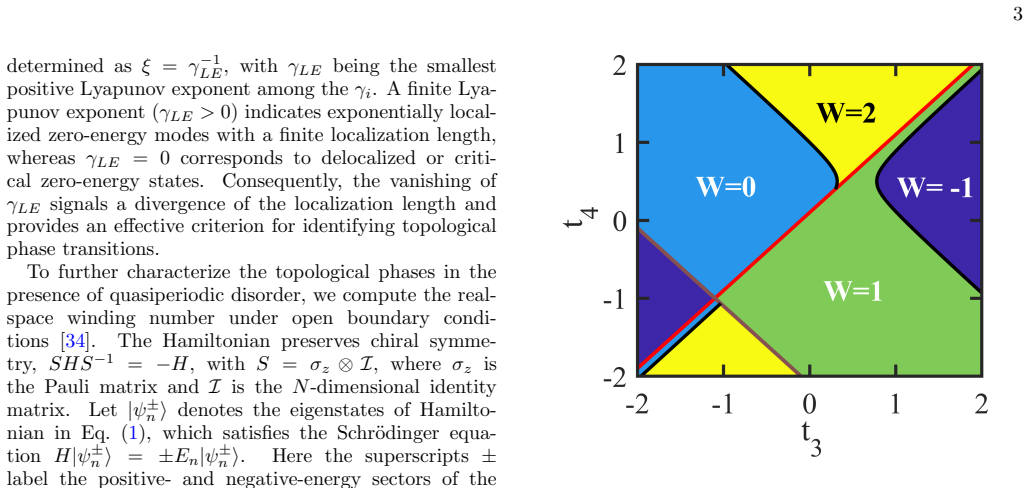
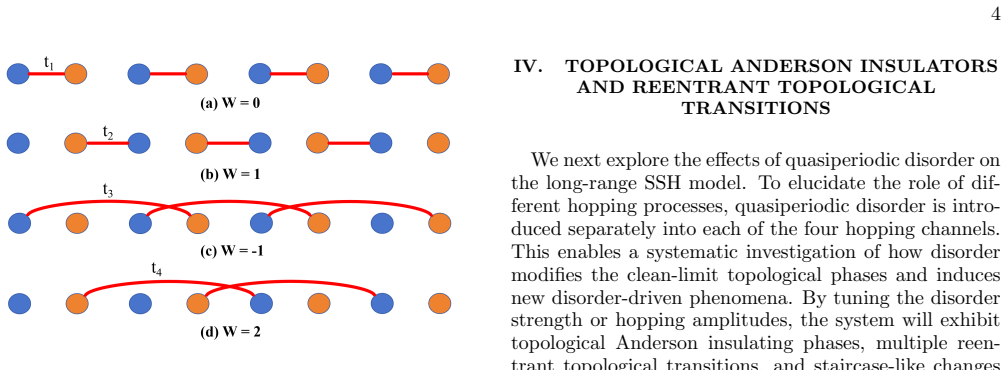
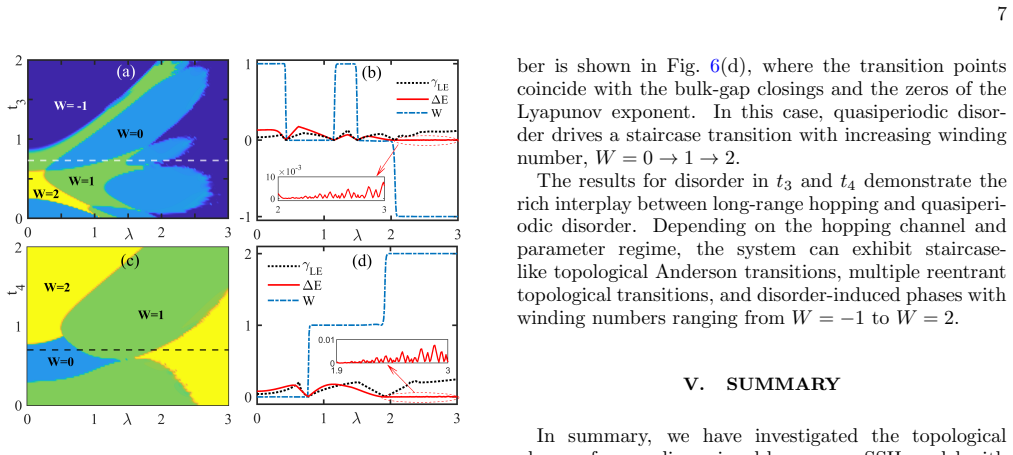
In the clean limit the model hosts phases with winding numbers W = -1, 0, 1 and 2. The introduction of quasiperiodic disorder modifies the phase diagram, inducing topological Anderson insulating phases that persist even when the spectral gap becomes nearly closed. The real-space winding number evolves through successive quantized steps with increasing disorder strength, accompanied by multiple reentrant topological transitions when disorder strength or hopping amplitudes are varied.
What carries the argument
The real-space winding number, a topological invariant computed directly from the real-space wave functions that assigns an integer to each phase under quasiperiodic disorder.
If this is right
- TAI phases with distinct winding numbers appear because of the competition between topological dimerization and localization.
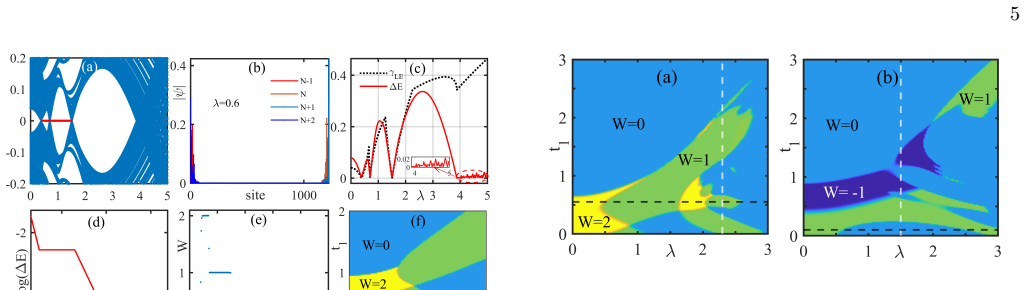
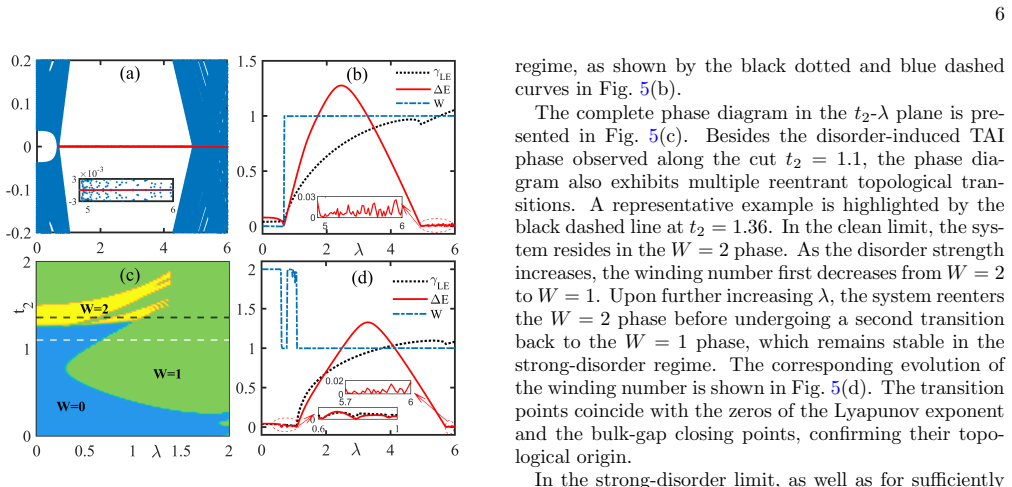
- The real-space winding number changes in successive quantized steps as disorder strength is increased, producing staircase-like transitions.
- Reentrant topological transitions occur both when the quasiperiodic disorder strength is varied and when the hopping amplitudes are varied.
Where Pith is reading between the lines
- The same real-space invariant might reveal staircase behavior in other one-dimensional chains that combine long-range hopping with incommensurate potentials.
- Cold-atom or photonic-lattice experiments could test whether the nearly gapless TAI phases remain stable when weak additional random disorder is added.
Load-bearing premise
The real-space winding number remains a faithful topological invariant that correctly classifies phases under quasiperiodic disorder, with finite-size numerical computations free of significant artifacts when the gap is nearly closed.
What would settle it
Direct computation of the real-space winding number on system sizes several times larger than those used in the paper, at strong disorder where the gap is closed, checking whether the quantized staircase steps remain stable or disappear.
Figures
read the original abstract
We study a one-dimensional long-range Su-Schrieffer-Heeger model with third-nearest-neighbor hopping and subject to quasiperiodic disorder. In the clean limit, the model hosts phases characterized by winding numbers $W=-1,0,1$ and $2$. The introduction of quasiperiodic disorder profoundly modifies the phase diagram and induces a series of topological phase transitions. Owing to the competition between topological dimerization and localization, topological Anderson insulating (TAI) phases with different winding numbers emerge and can persist even when the spectral gap becomes nearly closed in the strong-disorder regime. In addition, we uncover multiple reentrant topological phase transitions induced by varying either the quasiperiodic disorder strength or the hopping amplitudes. Remarkably, the system exhibits staircase-like topological Anderson transitions, where the real-space winding number evolves through successive quantized steps with increasing disorder strength. Our results demonstrate that the interplay between long-range hopping and quasiperiodic disorder generates a rich landscape of disorder-induced topological phases and reentrant topological transition phenomena.
Editorial analysis
A structured set of objections, weighed in public.
Referee Report
Summary. The manuscript examines a one-dimensional long-range Su-Schrieffer-Heeger chain with third-nearest-neighbor hopping subject to quasiperiodic disorder. In the clean limit the model realizes phases with winding numbers W = −1, 0, 1 and 2. Introduction of quasiperiodic disorder is shown to generate topological Anderson insulator phases with the same winding numbers, reentrant topological transitions, and staircase-like evolution of the real-space winding number with increasing disorder strength; these phases are reported to survive even when the bulk gap becomes nearly closed.
Significance. If the numerical invariants remain faithful in the near-gapless regime, the work would establish that long-range hopping combined with quasiperiodic disorder produces an unusually rich set of disorder-induced topological phases, including multiple reentrant transitions and quantized staircase behavior. The explicit use of the real-space winding number as a diagnostic provides a concrete, falsifiable classification of the phases.
major comments (2)
- [strong-disorder regime] § on strong-disorder regime (where gap closure is reported): the central claim that TAI phases with quantized W persist “even when the spectral gap becomes nearly closed” rests on finite-size computations of the real-space winding number. When the gap falls below the finite-size level spacing, hybridization of edge modes or localization length exceeding system size can produce spurious non-quantized values or artificial jumps in W. The manuscript must supply explicit checks (e.g., gap versus system size, localization length versus chain length, or convergence of W with increasing system size) in the strong-disorder windows to confirm that the reported staircase steps remain faithful topological invariants rather than numerical artifacts.
- [Methods / winding-number definition] Definition and validation of real-space winding number: the paper adopts the real-space winding number as the primary order parameter for all phases, including the quasiperiodic case. A short derivation or reference establishing its topological protection under quasiperiodic (rather than purely random) potentials, together with a demonstration that it remains integer-valued when the gap is small but finite, is required to support the classification of the TAI phases with W = −1, 0, 1, 2.
minor comments (2)
- [Figures] Figure captions should explicitly state the system sizes used for the winding-number calculations and whether open or periodic boundary conditions were employed.
- [Abstract / Introduction] The abstract lists winding numbers as W = −1, 0, 1 and 2; the main text should confirm that the same set is recovered in the disordered case and that no additional values appear.
Simulated Author's Rebuttal
We thank the referee for the thorough review and constructive suggestions. We address each major comment below and will revise the manuscript to incorporate the requested clarifications and checks.
read point-by-point responses
-
Referee: [strong-disorder regime] § on strong-disorder regime (where gap closure is reported): the central claim that TAI phases with quantized W persist “even when the spectral gap becomes nearly closed” rests on finite-size computations of the real-space winding number. When the gap falls below the finite-size level spacing, hybridization of edge modes or localization length exceeding system size can produce spurious non-quantized values or artificial jumps in W. The manuscript must supply explicit checks (e.g., gap versus system size, localization length versus chain length, or convergence of W with increasing system size) in the strong-disorder windows to confirm that the reported staircase steps remain faithful topological invariants rather than numerical artifacts.
Authors: We agree that explicit finite-size scaling is necessary to rule out artifacts when the gap is small. In the revised manuscript we will add supplementary figures showing (i) the spectral gap versus system size in the strong-disorder windows and (ii) the convergence of the real-space winding number with increasing chain length. These data will confirm that the quantized staircase steps remain stable and are not due to level-spacing or localization-length effects. revision: yes
-
Referee: [Methods / winding-number definition] Definition and validation of real-space winding number: the paper adopts the real-space winding number as the primary order parameter for all phases, including the quasiperiodic case. A short derivation or reference establishing its topological protection under quasiperiodic (rather than purely random) potentials, together with a demonstration that it remains integer-valued when the gap is small but finite, is required to support the classification of the TAI phases with W = −1, 0, 1, 2.
Authors: The real-space winding number is known to be topologically protected for gapped one-dimensional systems with quasiperiodic potentials, which can be treated as a deterministic form of disorder. We will insert a concise derivation in the Methods section, citing the relevant literature on its application to quasiperiodic models, and include a numerical panel demonstrating that the invariant remains strictly integer-valued for small but finite gaps in our parameter regimes. revision: yes
Circularity Check
No circularity: claims rest on direct numerical evaluation of real-space winding number
full rationale
The paper defines the model Hamiltonian explicitly, introduces quasiperiodic disorder as an external parameter, and computes the real-space winding number W from the resulting eigenstates or transfer matrix on finite chains. No step equates a claimed transition or phase label to a fitted quantity by construction, nor does any load-bearing premise reduce to a self-citation whose content is itself unverified within the paper. The reported staircase transitions and persistence of quantized W are outputs of that computation rather than inputs renamed as predictions. The derivation chain therefore remains self-contained against external benchmarks.
Axiom & Free-Parameter Ledger
axioms (1)
- domain assumption The real-space winding number is a valid topological invariant for quasiperiodically disordered 1D chains.
Reference graph
Works this paper leans on
-
[1]
M. Z. Hasan and C. L. Kane, Colloquium: Topological insulators, Rev. Mod. Phys.82,3045 (2010). 8
2010
-
[2]
Qi and S.-C
X.-L. Qi and S.-C. Zhang, Topological insulators and su- perconductors, Rev. Mod. Phys.83,1057 (2011)
2011
-
[3]
Bansil, H
A. Bansil, H. Lin, and T. Das, Colloquium: Topological band theory, Rev. Mod. Phys.88,021004 (2016)
2016
-
[4]
N. R. Cooper, J. Dalibard, and I. B. Spielman, Topo- logical bands for ultracold atoms, Rev. Mod. Phys.91, 015005 (2019)
2019
-
[5]
Ozawa, H
T. Ozawa, H. M. Price, A. Amo, N. Goldman, M. Hafezi, L. Lu, M. C. Rechtsman, D. Schuster, J. Simon, O. Zil- berberg, and I. Carusotto, Topological photonics, Rev. Mod. Phys.91,015006 (2019)
2019
-
[6]
V. L. Ginzburg and L. D. Landau, Zh. Eksp. Teor. Fiz. 20, 1064 (1950)
1950
-
[7]
Wen, Colloquium: Zoo of quantum-topological phases of matter, Rev
X.-G. Wen, Colloquium: Zoo of quantum-topological phases of matter, Rev. Mod. Phys.89,041004 (2017)
2017
-
[8]
B. A. Bernevig, T. L. Hughes, and S. C. Zhang, Quantum spin Hall effect and topological phase transition in HgTe quantum wells Science314,1757 (2006)
2006
-
[9]
Alicea, New directions in the pursuit of Majorana fermions in solid state systems, Rep
J. Alicea, New directions in the pursuit of Majorana fermions in solid state systems, Rep. Prog. Phys.75, 076501 (2012)
2012
-
[10]
C. W. J. Beenakker, Search for Majorana Fermions in Superconductors, Annu. Rev. Condens. Matter Phys.4, 113 (2013)
2013
-
[11]
S. R. Elliott and M. Franz, Colloquium: Majorana fermions in nuclear, particle, and solid-state physics, Rev. Mod. Phys.87,137 (2015)
2015
-
[12]
M. Z. Hasan, S.-Y. Xu, I. Belopolsi, and S.-M. Huang, Discovery of Weyl fermion semimetals and topological Fermi arc states, Annu. Rev. Condens. Matter Phys.8, 289 (2017)
2017
-
[13]
Yan and C
B. Yan and C. Felser, Topological materials: Weyl semimetals, Annu. Rev. Condens. Matter Phys.8,337 (2017)
2017
-
[14]
N. P. Armitage, E. J. Mele, and A. Vishwanath, Weyl and Dirac semimetals in three-dimensional solids, Rev. Mod. Phys.90,015001 (2018)
2018
-
[15]
C. Fang, H. Weng, X. Dai, and Z. Fang, Topologi- cal nodal line semimetals, Chinese Phys. B25,117106 (2016)
2016
-
[16]
M.-X. Yang, W. Luo, and W. Chen, Quantum transport in topological nodal-line semimetals, Adv. Phys.: X7, 2065216 (2022)
2022
-
[17]
Sitte, A
M. Sitte, A. Rosch, E. Altman, and L. Fritz, Topological insulators in magnetic fields: quantum Hall effect and edge channels with a nonquantizedθterm, Phys. Rev. Lett.108,126807 (2012)
2012
-
[18]
Zhang, C
F. Zhang, C. L. Kane, and E. J. Mele, Surface state mag- netization and chiral edge states on topological insula- tors, Phys. Rev. Lett.110,046404 (2013)
2013
-
[19]
W. A. Benalcazar, B. A. Bernevig, and T. L. Hughes, Quantized electric multipole insulators, Science357,61 (2017)
2017
-
[20]
Schindler, A
F. Schindler, A. M. Cook, M. G. Verginiory, Z. Wang, S. S. P. Parkin, B. A. Bernevig, Higher-order topological insulators, Sci. Adv.4,eaat0346(2018)
2018
-
[21]
Yang, J.-H
Y.-B. Yang, J.-H. Wang, K. Li and Y. Xu, Higher-order topological phases in crystalline and non-crystalline sys- tems: a review, J. Phys.: Condens. Matter36,283002 (2024)
2024
-
[22]
Z. Gong, Y. Ashida, K. Kawabata, K. Takasan, S. Hi- gashikawa, and M. Ueda, Topological phases of non- Hermitian systems, Phys. Rev. X8,031079 (2018)
2018
-
[23]
E. J. Bergholtz, J. C. Budich, and F. K. Kunst, Ex- ceptional topology of non-Hermitian systems, Rev. Mod. Phys.93,015005 (2021)
2021
-
[24]
Banerjee, R
A. Banerjee, R. Sarkar, S. Dey and A. Narayan, Non- Hermitian topological phases: principles and prospects, J. Phys.: Condens. Matter35,333001 (2023)
2023
-
[25]
Xue, Essay: Topological phases and exceptional points in non-Hermitian systems, Phys
P. Xue, Essay: Topological phases and exceptional points in non-Hermitian systems, Phys. Rev. Lett.136,170001 (2026)
2026
-
[26]
P. W. Anderson, Absence of diffusion in certain random lattices, Phys. Rev.109,1492 (1958)
1958
-
[27]
Li, R.-L
J. Li, R.-L. Chu, J. K. Jain, and S.-Q. Shen, Topological Anderson insulator, Phys. Rev. Lett.102,136806 (2009)
2009
-
[28]
C. W. Groth, M. Wimmer, A. R. Akhmerov, J. Tworzyd lo, and C. W. J. Beenakker, Theory of the topo- logical Anderson insulator, Phys. Rev. Lett.103,196805 (2009)
2009
-
[29]
Y. Xing, L. Zhang, and J. Wang, Topological Anderson insulator phenomena, Phys. Rev. B84,035110 (2011)
2011
-
[30]
Jiang, L
H. Jiang, L. Wang, Q.-F. Sun, and X. C. Xie, Nu- merical study of the topological Anderson insulator in HgTe/CdTe quantum wells, Phys. Rev. B80,165316 (2009)
2009
-
[31]
Zhang, R.-L
Y.-Y. Zhang, R.-L. Chu, F.-C. Zhang, and S.-Q. Shen, Localization and mobility gap in the topological Ander- son insulator, Phys. Rev. B85,035107 (2012)
2012
-
[32]
J. Song, H. Liu, H. Jiang, Q.-F. Sun, and X. C. Xie, De- pendence of topological Anderson insulator on the type of disorder, Phys. Rev. B85,195125 (2012)
2012
-
[33]
Atland, D
A. Atland, D. Bagrets, L. Fritz, A. Kamenev, and H. Schmiedt, Quantum criticality of quasi-one-dimensional topological Anderson insulators, Phys. Rev. Lett.112, 206602 (2014)
2014
-
[34]
Mondragon-Shem, T
I. Mondragon-Shem, T. L. Hughes, J. Song, and E. Pro- dan, Topological criticality in the chiral-symmetric AIII class at strong disorder, Phys. Rev. Lett.113,046802 (2014)
2014
-
[35]
Zhang, B.-L
Z.-Q. Zhang, B.-L. Wu, J. Song, and H. Jiang, Topolog- ical Anderson insulator in electric circuits, Phys. Rev. B 100,184202 (2019)
2019
-
[36]
Hsu and T.-W
H.-C. Hsu and T.-W. Chen, Topological Anderson in- sulating phases in the long-range Su-Schrieffer-Heeger model, Phys. Rev. B102,205425 (2020)
2020
-
[37]
Velury, B
S. Velury, B. Bradlyn, and T. L. Hughes, Topological crystalline phases in a disordered inversion-symmetric chain, Phys. Rev. B103,024205 (2021)
2021
-
[38]
Zhang, L.-Z
G.-Q. Zhang, L.-Z. Tang, L.-F. Zhang, D.-W. Zhang, and S.-L. Zhu, Connecting topological Anderson and Mott insulators in disordered interacting fermionic systems, Phys. Rev. B104,L161118 (2021)
2021
-
[39]
Z. Lu, Z. Xu, and Y. Zhang, Exact mobility edges and topological Anderson insulating phase in a slowly varying quasiperiodic model, Ann. Phys. (Berlin)534,2200203, (2022)
2022
-
[40]
R. Ji, Y. Zhang, S. Chen, and Z. Xu, Multiple re-entrant topological windows induced by generalized Bernoulli disorder, arXiv:2512.06851
work page internal anchor Pith review Pith/arXiv arXiv
-
[41]
M. Manna¨ ı, Y. Shu, S. Haddad, M. Ren, H. Chen, Y. Sun, and H. Sati, Realization of staircase topological Anderson phase transitions, arXiv:2601.14769
-
[42]
Liu and H
T. Liu and H. Guo, Topological phase transition in the quasiperiodic disordered Su-Schrieffer-Heeger chain, Physics Letters A382,3287 (2018)
2018
-
[43]
Longhi, Topological Anderson phase in quasi-periodic waveguide lattices, Optics Letters45,4036 (2020)
S. Longhi, Topological Anderson phase in quasi-periodic waveguide lattices, Optics Letters45,4036 (2020). 9
2020
-
[44]
Tang, S.-N
L.-Z. Tang, S.-N. Liu, G.-Q. Zhang, and D.-W. Zhang, Topological Anderson insulators with different bulk states in quasiperiodic chains, Phys. Rev. A105,063327 (2022)
2022
-
[45]
X. Li, H. Xu, J. Wang, L.-Z. Tang, D.-W. Zhang, C. Yang, T. Su, C. Wang, Z. Mi, W. Sun, et al., Mapping the topology-localization phase diagram with quasiperiodic disorder using a programmable superconducting simula- tor, Phys. Rev. Research6,L042038 (2024)
2024
-
[46]
Sircar, Topological Anderson insulator phases in one dimensional quasi-periodic mechanical SSH chains, Physics Letters A537,130314 (2025)
S. Sircar, Topological Anderson insulator phases in one dimensional quasi-periodic mechanical SSH chains, Physics Letters A537,130314 (2025)
2025
- [47]
-
[48]
E. J. Meier, F. A. An, A. Dauphin, M. Maffei, P. Massig- nan, T. L. Hughes, and B. Gadway, Observation of the topological Anderson insulator in disordered atomic wires, Science362,929 (2018)
2018
-
[49]
St¨ utzer, Y
S. St¨ utzer, Y. Plotnik, Y. Lumer, P. Titum, N. H. Lind- ner, M. Segev, M. C. Rechtsman, and A. Szameit, Pho- tonic topological Anderson insulators, Nature560,461 (2018)
2018
-
[50]
G.-G. Liu, Y. Yang, X. Ren, H. Xue, X. Lin, Y.-H. Hu, H.-x. Sun, B. Peng, P. Zhou, Y. Chong, and B. Zhang, Topological Anderson insulator in disordered photonic crystals, Phys. Rev. Lett.125,133603 (2020)
2020
-
[51]
Cui, R.-Y
X. Cui, R.-Y. Zhang, Z.-Q. Zhang, and C. T. Chan, PhotonicZ 2 topological Anderson insulators, Phys. Rev. Lett.129,043902 (2022)
2022
-
[52]
Chen, Z.-X
X.-D. Chen, Z.-X. Gao, X. Cui, H.-C. Mo, W.-J. Chen, R.-Y. Zhang, C. T. Chan, and J.-W. Dong, Realization of time-reversal invariant photonic topological Anderson insulators, Phys. Rev. Lett.133,133802 (2024)
2024
-
[53]
M. Ren, Y. Yu, B. Wu, X. Qi, Y. Wang, X. Yao, J. Ren, Z. Guo, H. Jiang, H. Chen, X.-J. Liu, Z. Chen, and Y. Sun, Realization of gapped and ungapped photonic topological Anderson insulators, Phys. Rev. Lett.132, 066602 (2024)
2024
-
[54]
Zangeneh-Nejad and R
F. Zangeneh-Nejad and R. Fleury, Disorder-induced sig- nal filtering with topological metamaterials, Adv. Mater. 32,2001034 (2020)
2020
-
[55]
Z. Gu, H. Gao, H. Xue, D. Wang, J. Guo, Z. Su, B. Zhang, and J. Zhu, Observation of an acoustic non- Hermitian topological Anderson insulator, Sci. China Phys. Mech. Astron.66,294311 (2023)
2023
-
[56]
Zhang, D
W. Zhang, D. Zou, Q. Pei, W. He, J. Bao, H. Sun, and X. Zhang, Experimental observation of higher-order topo- logical Anderson insulators, Phys. Rev. Lett. 126, 146802 (2021)
2021
-
[57]
Zhang, L.-Z
D.-W. Zhang, L.-Z. Tang, L.-J. Lang, H. Yan, and S.-L. Zhang, Non-Hermitian topological Anderson insulators, Sci. China-Phys. Mech. Astron.63,267062 (2020)
2020
-
[58]
H. Liu, Z. Su, Z.-Q. Zhang, and H. Jiang, Topological An- derson insulator in two-dimensional non-Hermitian sys- tems, Chinese Phys. B29,050502 (2020)
2020
-
[59]
Tang, L.-F
L.-Z. Tang, L.-F. Zhang, G.-Q. Zhang, and D.-W. Zhang, Topological Anderson insulators in two-dimensional non- Hermitian disordered systems, Phys. Rev. A101,063612 (2020)
2020
-
[60]
Q. Lin, T. Li, L. Xiao, K. Wang, W. Yi, and P. Xue, Observation of non-Hermitian topological Anderson in- sulator in quantum dynamics, Nat. Commun.13,3229 (2022)
2022
-
[61]
Zeng and R
Q.-B. Zeng and R. L¨ u, Coexistence of topological An- derson insulator and multifractal critical phase in a non-Hermitian quasicrystal, Phys. Rev. B113,224203 (2026)
2026
-
[62]
Tezuka and N
M. Tezuka and N. Kawakami, Reentrant topological transitions in a quantum wire/superconductor system with quasiperiodic lattice modulation, Phys. Rev. B85, 140508(R) (2012)
2012
-
[63]
Beugeling, C
W. Beugeling, C. X. Liu, E. G. Novik, L. W. Molenkamp, and C. Morais Smith, Reentrant topological phases in Mn-doped HgTe quantum wells, Phys. Rev. B85,195304 (2012)
2012
-
[64]
Rieder, P
M.-T. Rieder, P. W. Brouwer, and ˙I. Adagideli, Reen- trant topological phase transitions in a disordered spin- less superconducting wire, Phys. Rev. B88,060509 (2013)
2013
-
[65]
Tezuka and N
M. Tezuka and N. Kawakami, Reentrant topological tran- sitions with majorana end states in one-dimensional su- perconductors by lattice modulation, Phys. Rev. B88, 155428 (2013)
2013
-
[66]
Hsu, M.-J
H.-C. Hsu, M.-J. Jhang, T.-W. Chen, and G.-Y. Guo, Topological phase transitions in an inverted InAs/GaSb quantum well driven by tilted magnetic fields, Phys. Rev. B95,195408 (2017)
2017
-
[67]
Sugimoto, M
T. Sugimoto, M. Ohtsu, and T. Tohyama, Reentrant topological phase transition in a bridging model between Kitaev and Haldane chains, Phys. Rev. B96,245118 (2017)
2017
-
[68]
Yang, S.-J
Y. Yang, S.-J. Ran, X. Chen, Z.-Z. Sun, S.-S. Gong, Z. Wang, and G. Su, Reentrance of the topological phase in a spin-1 frustrated heisenberg chain, Phys. Rev. B101, 045133 (2020)
2020
-
[69]
Padhan, S
A. Padhan, S. R. Padhi, and T. Mishra, Complete de- localization and reentrant topological transition in a non-Hermitian quasiperiodic lattice, Phys. Rev. B109, L020203 (2024)
2024
-
[70]
K. K. Kesharpu, E. A. Kochetov, and A. Ferraz, Reen- trant topological order in a strongly correlated nanowire due to Rashba spin-orbit coupling, Phys. Rev. B111, 115153 (2025)
2025
-
[71]
E. G. Cinnirella, A. Nava, G. Campagnano, and D. Giu- liano, Phase diagram of the disordered Kitaev chain with long-range pairing connected to external baths, Phys. Rev. B111,155149 (2025)
2025
-
[72]
C.-A. Li, B. Fu, J. Li, and B. Trauzettel, Random- fluxinduced transition sequence between weak and strong topological phases with anisotropic localization proper- ties, Phys. Rev. B111,214207 (2025)
2025
-
[73]
Z. Lu, Y. Zhang, and Z. Xu, Reentrant localization tran- sitions in a topological Anderson insulator: A study of a generalized Su-Schrieffer-Heeger quasicrystal, Frontiers of Physics20,024204 (2025)
2025
-
[74]
Wang, S.-Z
X.-M. Wang, S.-Z. Li, and Z. Li, Emergent topological re-entrant phase transition in a generalized quasiperi- odic modulated Su-Schrieffer-Heeger model, Phys. Rev. A111,022214 (2025)
2025
-
[75]
Sinha, T
A. Sinha, T. Shit, A. Tetarwal, D. Sen, and S. Mukherjee, Probing the topological anderson transition in quasiperi- odic photonic lattices via chiral displacement and wave- length tuning, Phys. Rev. A112,013512 (2025)
2025
-
[76]
Song and E
J. Song and E. Prodan, AIII and BDI topological systems at strong disorder, Phys. Rev. B89,224203 (2014)
2014
discussion (0)
Sign in with ORCID, Apple, or X to comment. Anyone can read and Pith papers without signing in.