REVIEW 3 major objections 4 minor 1 cited by
Changing Bases with Pipe Dream Combinatorics
T0 review · 3 major / 4 minor · reviewed 2026-08-07 · deepseek-v4-flash
Pith's one-line read This paper gives explicit diagrammatic rules for changing between the Grothendieck and Schubert polynomial bases, including a back stable expansion.
desk verdict Genuinely new BPD and back stable formulas, but a sign error in Lemma 3.5 and a gap in Theorem 1.9 need fixing before the central claims are airtight. read the letter →
The pith
A machine-rendered reading of the paper's core claim, the machinery that carries it, and where it could break.
The reading
What carries the argument
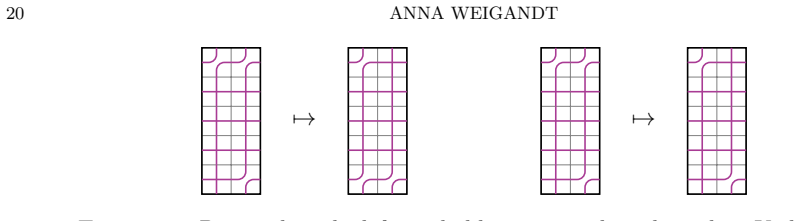
The objects that carry the argument are four diagram families: pipe dreams, co-pipe dreams, bumpless pipe dreams (BPDs), and co-BPDs, together with the canonical column-weight-preserving bijection between pipe dreams and BPDs. A pipe dream is a tiling of an $n \times n$ grid whose crossing set encodes a permutation; a BPD is the analogous northeast-oriented tiling whose pipes run from bottom to right. The co-objects are obtained by fixed local tile replacements, and each carries a co-permutation $\delta(\cdot)$ obtained by tracing pipes through the diagram. The co-transition recurrences on pipe dreams, which bijectively add an addable cell to a diagram and split the result according to a set $\Phi_i(w)$ of permutations, supply the recursive engine for the proofs, and the canonical bijection transfers the resulting identities from pipe dreams to BPDs.
What would settle it
For a fixed small permutation such as $w=2143$, enumerate every reduced pipe dream and every reduced BPD with the same column weights, apply the canonical bijection, and compare $\delta(\check P)$ with $\delta(\check B)$; any mismatch would refute the transfer theorem. Independently, expand both sides of the Grothendieck-to-Schubert identity for $w=13452$ at monomial level: the formula predicts the coefficient of $S_{23451}$ is $-3$, so a different value would refute the expansion.
Extended reading notes
Core claim
The central claim is a pair of identities. For a permutation $w$, the Grothendieck polynomial expands as a signed sum over reduced co-BPDs attached to BPDs of $w$: $G_w = \sum_{B \in \mathrm{BPD}(w), \check B \text{ reduced}} (-1)^{\ell(\delta(\check B))-\ell(w)} S_{\delta(\check B)}$. In the reverse direction, $S_w = \sum_{B \in \mathrm{BPD}(w)} G_{\delta(\check B)}$, a positive but not generally multiplicity-free sum. The proof transfers the analogous pipe-dream identities through a canonical bijection between pipe dreams and BPDs, and the key theorem is that this bijection preserves the co-permutation associated to each diagram, so that $\delta(\check P)=\delta(\check B)$. A doubly infinite version of the first identity gives the expansion of back stable Grothendieck polynomials into back stable Schubert polynomials, which is described as the first such combinatorial formula.
Load-bearing premise
The transfer of the pipe-dream formulas to BPDs depends on the assertion, taken from a cited theorem rather than proved in this paper, that the canonical bijection between the two diagram families respects the recursive insertion step used to build the diagrams.
Editorial extensions
If this is right
- The Grothendieck-to-Schubert expansion can be read directly from reduced co-BPDs: each contributes $S_{\delta(\check B)}$ with sign $(-1)^{\ell(\delta(\check B))-\ell(w)}$, and the underlying monomial expansion is cancellation-free.
- The Schubert-to-Grothendieck expansion is a positive sum over all co-BPDs of BPDs of $w$, although it need not be cancellation-free at the monomial level.
- Back stable Grothendieck polynomials admit the same BPD-style expansion into back stable Schubert polynomials, indexed by doubly infinite reduced co-BPDs; this is the first such combinatorial formula.
- The pipe-dream versions of both change-of-basis rules are re-proved from co-transition recurrences and can be generated recursively by chains in Bruhat order, giving a smaller search space than listing all pipe dreams.
Reading between the lines
- If the co-permutation preservation property extends to the marked or K-theoretic version of the canonical bijection mentioned in the paper, the same transfer would give combinatorial proofs of further K-theoretic change-of-basis identities.
- The chain formulation suggests a route to dynamic-programming algorithms for structure constants or monomial-support questions, since paths in Bruhat order can be counted without first listing all pipe dreams.
- Specializing the back stable expansion to partition-shaped permutations should reproduce known stable Grothendieck-to-Schur expansions, offering a direct numerical check of the new back stable formula.
Editorial analysis
A structured set of objections, weighed in public.
Referee Report
Summary. The paper develops combinatorial change-of-basis formulas between Grothendieck and Schubert polynomials. Theorems 1.5 and 1.6 reformulate Lenart's and Lascoux's pipe-dream-style rules and give new proofs via Knutson's co-transition recurrences; Theorem 6.7 adds a chain model in Bruhat order. The main new claims are Theorems 1.1 and 1.2, which state analogous formulas in terms of bumpless pipe dreams and their co-objects, and Theorem 8.1, which uses these to expand back stable Grothendieck polynomials into back stable Schubert polynomials. The bridge from the pipe-dream results to the BPD results is Theorem 1.9, asserting that the Gao--Huang canonical bijection preserves co-permutations. The paper contains many worked examples and detailed, largely self-contained arguments, with the Gao--Huang theorem [GH23] used as an external input.
Significance. If correct, the BPD formulas are a genuinely useful contribution: BPDs are naturally back stable, and Theorem 8.1 provides the first combinatorial expansion of back stable Grothendieck polynomials into back stable Schubert polynomials. The paper also gives new proofs of the Lenart and Lascoux pipe-dream rules, and the chain-based description in Theorem 6.7 is a nice byproduct. The exposition is generally careful, the examples are instructive, and the paper builds on established machinery rather than introducing ad hoc assumptions. However, two load-bearing gaps prevent the main theorems from being fully established as written: the direction of Lemma 7.8 is used in Theorem 1.9 in a way that does not follow from its statement, and the planar-history sign conventions in Lemma 3.5 are applied with the opposite direction in Lemmas 4.7, 4.11, and 7.7. These issues appear local and repairable, but until they are fixed the central transfer to BPDs is not proven.
major comments (3)
- [§7.3, Lemma 7.8 and Theorem 1.9] Lemma 7.8 is stated with hypothesis “B → B′ by insertion into column j of B” and conclusion κ(P′−{(i,j)}) = B. In the proof of Theorem 1.9, after setting P′ = P ∪ {(i,j)} and B′ = κ(P′), the text says “by Lemma 7.8, B′ is obtained from B by column insertion.” This is the converse of the printed lemma, not its statement. The needed property is κ(P∪{(i,j)}) = ins_j(κ(P)), or at least the converse of Lemma 7.8, which is neither stated nor proved. Theorem 1.9 is the only bridge from the fully proved pipe-dream formulas (Theorems 1.5 and 1.6) to the BPD formulas (Theorems 1.1 and 1.2), and Theorem 8.1 inherits the same dependence. This is a load-bearing gap.
- [§3.1, Lemmas 3.5, 4.7, 4.11, and 7.7] There is a sign conflict between Lemma 3.5 and its uses. For NW/SE planar histories, Lemma 3.5(2) says that δ(P)(b) > δ(P)(a) if and only if the pipes exiting in rows a and b do not cross. Consequently, a descent at k, i.e. δ(k) > δ(k+1), implies that the pipes exiting in rows k and k+1 do cross. Lemma 4.7 and Lemma 4.11 use a descent of the co-object to infer the opposite, namely that those pipes do not cross. Similarly, the final subcase of Lemma 7.7 uses crossing of pipes in a co-BPD to infer an ascent at i, whereas Lemma 3.5(2) gives a descent. Thus the descent-set containments and the key computation δ(ˇB) = δ(ˇB′)□τ_i are not established with the conventions as printed. Either Lemma 3.5's direction, the reading conventions for co-objects, or the affected proofs must be corrected; Theorems 1.1, 1.2, and their back-stable version depend on these lemmas.
- [§7.2, Lemma 7.7] The proof of Lemma 7.7 is an extensive case analysis that is presented largely through diagrams rather than coordinate specifications. In particular, the claims that the interior replacements “consist of repeated applications” of the displayed local moves, and that each displayed move preserves the co-permutation, are asserted rather than demonstrated. The classification of boundary configurations also depends on the same sign convention discussed above. Because Lemma 7.7 is essential to the proof of Theorem 1.9, the argument would need to be written in a more formal, checkable form before the central claim can be regarded as verified.
minor comments (4)
- [§3.1, (3.1)–(3.4)] The local label-propagation rules for the four orientations are conveyed only by pictures; since Lemmas 3.5–3.7 are purely combinatorial statements about these rules, an explicit textual or coordinate description of the label propagation would greatly help the reader verify the claimed equivalences.
- [§4.4, Lemma 4.9] The tile-by-tile replacement defining the bijection from BPDs to co-BPDs is described only by images; a coordinate description of each of the six replacements would make the well-definedness and invertibility of the map checkable rather than immediate from the pictures.
- [§6.3, Theorem 6.7 and Example 6.14] In the path model, the definition of word(p) and the direction in which the word is read should be stated more explicitly, since Theorem 6.7(3) applies w0·δ(word(p)) and the example’s path lists are otherwise easy to misread.
- [§4.2, Lemma 4.7 proof] The step from “the tile at position (k,1) is not a cross in P” to “the tile at (k+1,1) is a cross in ˇP” is not immediate; a short diagram or coordinate argument would clarify the geometry of the associated co-pipe dream.
Circularity Check
No significant circularity: the BPD change-of-basis formulas transfer the known Lenart/Lascoux pipe-dream expansions through the external Gao-Huang bijection. The only flagged issue is a black-box external commutation lemma, which is a correctness risk, not a circular reduction.
full rationale
The derivation chain is not circular in any of the enumerated senses. Theorems 1.5 and 1.6 are quoted as the known results of Lenart and Lascoux, and the paper gives independent proofs of them from Knutson's co-transition recurrences and the standard pipe-dream monomial formulas (Theorems 4.3, Propositions 5.6 and 5.7); neither input assumes the target expansions. The transfer to BPDs is coefficient comparison: in the proof of Theorem 1.1 the coefficient a_{w,v} in G_w = sum (-1)^{...} a_{w,v} S_v is computed first by Theorem 1.5 as a count of reduced co-pipe dreams and then by Theorem 1.9 as the same count of reduced co-BPDs. Theorem 1.2 is identical for the Schubert-to-Grothendieck coefficients; no parameter is fitted and no quantity is defined in terms of the output. Theorem 1.9 itself is an induction whose two ingredients are Lemma 7.7, proved in the paper from the BPD insertion algorithm, and Lemma 7.8, which is quoted as a special case of [GH23, Theorem 4.5], an external result. One genuine concern is that the printed Lemma 7.8 has the hypothesis 'B 7-> B' by insertion into column j' and concludes kappa(P' - {(i,j)}) = B, whereas the proof of Theorem 1.9 invokes it in the converse direction to conclude that B' is obtained from B by column insertion from P' = P union {(i,j)}, B' = kappa(P'). This is a verification gap concerning an external theorem, not a circular definition. The back stable Theorem 8.1 is derived by specializing the finite Theorem 1.1 and comparing coefficients in a back stable basis, with no use of the target expansion as an input. The only self-citations, e.g. [Wei21, Lemma 4.6] for a structural fact about BPDs and the BPD monomial formula, are prior published results that do not assume the change-of-basis theorems; they are normal citations rather than circular loads. Overall, the core new claims have independent content, and the paper is self-contained against external benchmarks once [GH23, Theorem 4.5] and [Hua23a] are accepted.
Assumptions & free parameters
assumptions (5)
- domain assumption Knutson's co-transition recurrences for pipe dreams (Proposition 5.6)
- domain assumption Gao-Huang canonical bijection between pipe dreams and BPDs, including the commutation property in [GH23, Theorem 4.5]
- domain assumption Huang's column insertion theorem on BPDs [Hua23a, Theorem 5]
- domain assumption The linear independence of back stable Schubert polynomials [LLS21, Theorem 3.5]
- standard math Standard divided difference calculus identities, e.g. N_i = N_i x_{i+1} + N_i
Cite this review
Pith. "Pith review of Changing Bases with Pipe Dream Combinatorics." pith.science (2026). https://pith.science/paper/PQQ2MUP5
@misc{pith2026250607306,
  author       = {Pith},
  title        = {Pith review of: Changing Bases with Pipe Dream Combinatorics},
  year         = {2026},
  howpublished = {\url{https://pith.science/paper/PQQ2MUP5}},
  note         = {Machine review of arXiv:2506.07306}
}
read the original abstract
Lascoux and Sch\"utzenberger introduced Schubert and Grothendieck polynomials to study the cohomology and K-theory of the complete flag variety. We present explicit combinatorial rules for expressing Grothendieck polynomials in the basis of Schubert polynomials, and vice versa, using the bumpless pipe dreams (BPDs) of Lam, Lee, and Shimozono. A key advantage of BPDs is that they are naturally back stable, which allows us to give a combinatorial formula for expanding back stable Grothendieck polynomials in terms of back stable Schubert polynomials. We also provide pipe dream interpretations for the rules originally given by Lenart (Grothendieck to Schubert) and Lascoux (Schubert to Grothendieck), which were previously formulated in terms of binary triangular arrays. We give new proofs of these results, relying on Knutson's co-transition recurrences. As a consequence, we obtain a formula for expanding Grothendieck polynomials into Schubert polynomials using chains in Bruhat order. The key connection between the pipe dream and BPD change of basis formulas is the canonical bijection of Gao and Huang. We show that co-permutations are preserved by this map.
Figures


Figures from the paper (1 more)

Forward citations
Cited by 1 Pith paper
-
Hybrid pipe dreams for the lower-upper scheme
Hybrid generic pipe dreams give a hybridization-independent equivariant formula for the classes of lower-upper varieties, proved via Yang-Baxter equations and a degeneration into complete intersections.
Reference graph
Works this paper leans on
-
[1]
Sami Assaf and Dominic Searles, Schubert polynomials, slide polynomials, S tanley symmetric functions and quasi- Y amanouchi pipe dreams , Adv. Math. 306 (2017), 89--122
work page 2017
-
[2]
Nantel Bergeron and Sara Billey, R C -graphs and S chubert polynomials , Experiment. Math. 2 (1993), no. 4, 257--269
work page 1993
-
[3]
Anders Bj\"orner and Francesco Brenti, Combinatorics of C oxeter groups , Graduate Texts in Mathematics, vol. 231, Springer, New York, 2005
work page 2005
-
[4]
Behrend, Osculating paths and oscillating tableaux, Electron
Roger E. Behrend, Osculating paths and oscillating tableaux, Electron. J. Combin. 15 (2008), no. 1, Research Paper 7, 60
work page 2008
-
[5]
Billey, William Jockusch, and Richard P
Sara C. Billey, William Jockusch, and Richard P. Stanley, Some combinatorial properties of S chubert polynomials , J. Algebraic Combin. 2 (1993), no. 4, 345--374
work page 1993
-
[6]
Nantel Bergeron and Frank Sottile, Schubert polynomials, the B ruhat order, and the geometry of flag manifolds , Duke Math. J. 95 (1998), no. 2, 373--423
work page 1998
-
[7]
Nantel Bergeron and Frank Sottile, Skew S chubert functions and the P ieri formula for flag manifolds , Trans. Amer. Math. Soc. 354 (2002), no. 2, 651--673
work page 2002
-
[8]
Valentin Buciumas and Travis Scrimshaw, Double G rothendieck polynomials and colored lattice models , Int. Math. Res. Not. IMRN (2022), no. 10, 7231--7258
work page 2022
Show all 45 references
-
[9]
Federico Castillo, Yairon Cid-Ruiz , Fatemeh Mohammadi, and Jonathan Monta\ n o , K-polynomials of multiplicity-free varieties, preprint (2024), 32 pages, arXiv:2212.13091
2024 arXiv
-
[10]
Melody Chan and Nathan Pflueger, Combinatorial relations on skew S chur and skew stable G rothendieck polynomials , Algebr. Comb. 4 (2021), no. 1, 175--188
2021
-
[11]
Laura Escobar and Alexander Yong, Newton polytopes and symmetric G rothendieck polynomials , C. R. Math. Acad. Sci. Paris 355 (2017), no. 8, 831--834
2017
-
[12]
Sergey Fomin and Anatol N. Kirillov, Grothendieck polynomials and the Y ang- B axter equation , Formal power series and algebraic combinatorics/ S \'eries formelles et combinatoire alg\'ebrique, DIMACS, Piscataway, NJ, 1994, pp. 183--189
1994
-
[13]
Sergey Fomin and Anatol N. Kirillov, The Y ang- B axter equation, symmetric functions, and S chubert polynomials , Proceedings of the 5th C onference on F ormal P ower S eries and A lgebraic C ombinatorics ( F lorence, 1993), vol. 153, 1996, pp. 123--143
1993
-
[14]
Stanley, Schubert polynomials and the nil- C oxeter algebra , Adv
Sergey Fomin and Richard P. Stanley, Schubert polynomials and the nil- C oxeter algebra , Adv. Math. 103 (1994), no. 2, 196--207
1994
-
[15]
Yibo Gao and Daoji Huang, The canonical bijection between pipe dreams and bumpless pipe dreams, Int. Math. Res. Not. IMRN (2023), no. 21, 18629--18663
2023
-
[16]
Zachary Hamaker, Oliver Pechenik, and Anna Weigandt, Gr\"obner geometry of S chubert polynomials through ice , Adv. Math. 398 (2022), Paper No. 108228, 29
2022
-
[17]
Sigma 12 (2024), Paper No
Daoji Huang and Jessica Striker, A pipe dream perspective on totally symmetric self-complementary plane partitions, Forum Math. Sigma 12 (2024), Paper No. e17, 19
2024
-
[18]
Daoji Huang, Mark Shimozono, and Tianyi Yu, Marked bumpless pipedreams and compatible pairs, preprint (2024), 29 pages, arXiv:2407.18160
2024 arXiv
-
[19]
Daoji Huang, Bijective proofs of M onk's rule for S chubert and double S chubert polynomials with bumpless pipe dreams , Electron. J. Combin. 30 (2023), no. 3, Paper No. 3.4, 14
2023
-
[20]
Daoji Huang, Schubert products for permutations with separated descents, Int. Math. Res. Not. IMRN (2023), no. 20, 17461--17493
2023
-
[21]
Patricia Klein, Diagonal degenerations of matrix S chubert varieties , Algebr. Comb. 6 (2023), no. 4, 1073--1094
2023
-
[22]
Allen Knutson and Ezra Miller, Subword complexes in C oxeter groups , Adv. Math. 184 (2004), no. 1, 161--176
2004
-
[23]
Allen Knutson and Ezra Miller, Gr\"obner geometry of S chubert polynomials , Ann. of Math. (2) 161 (2005), no. 3, 1245--1318
2005
-
[24]
Mikhail Kogan and Ezra Miller, Toric degeneration of S chubert varieties and G elfand- T setlin polytopes , Adv. Math. 193 (2005), no. 1, 1--17
2005
-
[25]
Reine Angew
Allen Knutson, Ezra Miller, and Alexander Yong, Gr\"obner geometry of vertex decompositions and of flagged tableaux, J. Reine Angew. Math. 630 (2009), 1--31
2009
-
[26]
63–83, Cambridge University Press, 2022
Allen Knutson, Schubert polynomials, pipe dreams, equivariant classes, and a co-transition formula, London Mathematical Society Lecture Note Series, p. 63–83, Cambridge University Press, 2022
2022
-
[27]
Patricia Klein and Anna Weigandt, Bumpless pipe dreams encode G r\"obner geometry of S chubert polynomials , preprint (2023), 50 pages, arXiv:2108.08370
2023 arXiv
-
[28]
Alain Lascoux, Schubert & G rothendieck: un bilan bid\' e cennal , S\' e m. Lothar. Combin. 50 (2003/04), Art. B50i, 32
2003
-
[29]
Alain Lascoux, C hern and Y ang through ice , preprint (2002)
2002
-
[30]
Cristian Lenart, Noncommutative S chubert calculus and G rothendieck polynomials , Adv. Math. 143 (1999), no. 1, 159--183
1999
-
[31]
Cristian Lenart, Combinatorial aspects of the K -theory of G rassmannians , Ann. Comb. 4 (2000), no. 1, 67--82
2000
-
[32]
Pure Appl
Cristian Lenart, A K -theory version of M onk's formula and some related multiplication formulas , J. Pure Appl. Algebra 179 (2003), no. 1-2, 137--158
2003
-
[33]
Thomas Lam, Seung Jin Lee, and Mark Shimozono, Back stable S chubert calculus , Compos. Math. 157 (2021), no. 5, 883--962
2021
-
[34]
Thomas Lam, Seung Jin Lee, and Mark Shimozono, Back stable K -theory S chubert calculus , Int. Math. Res. Not. IMRN (2023), no. 24, 21381--21466
2023
-
[35]
Sigma 13 (2025), Paper No
Tuong Le, Shuge Ouyang, Leo Tao, Joseph Restivo, and Angelina Zhang, Quantum bumpless pipe dreams, Forum Math. Sigma 13 (2025), Paper No. e28, 21
2025
-
[36]
Cristian Lenart, Shawn Robinson, and Frank Sottile, Grothendieck polynomials via permutation patterns and chains in the B ruhat order , Amer. J. Math. 128 (2006), no. 4, 805--848
2006
-
[37]
Alain Lascoux and Marcel-Paul Sch\" u tzenberger, Polyn\^ o mes de S chubert , C. R. Acad. Sci. Paris S\' e r. I Math. 294 (1982), no. 13, 447--450
1982
-
[38]
Alain Lascoux and Marcel-Paul Sch \"u tzenberger, Structure de H opf de l'anneau de cohomologie et de l'anneau de G rothendieck d'une vari\'et\'e de drapeaux , C. R. Acad. Sci. Paris S\'er. I Math. 295 (1982), no. 11, 629--633
1982
-
[39]
Cristian Lenart and Frank Sottile, Skew S chubert polynomials , Proc. Amer. Math. Soc. 131 (2003), no. 11, 3319--3328
2003
-
[40]
6, American Mathematical Society, Providence, RI; Soci\' e t\' e Math\' e matique de France, Paris, 2001, Translated from the 1998 French original by John R
Laurent Manivel, Symmetric functions, S chubert polynomials and degeneracy loci , SMF/AMS Texts and Monographs, vol. 6, American Mathematical Society, Providence, RI; Soci\' e t\' e Math\' e matique de France, Paris, 2001, Translated from the 1998 French original by John R. Sw...
2001
-
[41]
Dizier, From generalized permutahedra to G rothendieck polynomials via flow polytopes , Algebr
Karola M\' e sz\' a ros and Avery St. Dizier, From generalized permutahedra to G rothendieck polynomials via flow polytopes , Algebr. Comb. 3 (2020), no. 5, 1197--1229
2020
-
[42]
Dizier, On the support of G rothendieck polynomials , Ann
Karola M\' e sz\' a ros, Linus Setiabrata, and Avery St. Dizier, On the support of G rothendieck polynomials , Ann. Comb. (2024)
2024
-
[43]
(N.S.) 25 (2019), no
Cara Monical, Neriman Tokcan, and Alexander Yong, Newton polytopes in algebraic combinatorics, Selecta Math. (N.S.) 25 (2019), no. 5, Paper No. 66, 37
2019
-
[44]
Dizier, and Anna Weigandt, Degrees of symmetric G rothendieck polynomials and C astelnuovo- M umford regularity , Proc
Jenna Rajchgot, Yi Ren, Colleen Robichaux, Avery St. Dizier, and Anna Weigandt, Degrees of symmetric G rothendieck polynomials and C astelnuovo- M umford regularity , Proc. Amer. Math. Soc. 149 (2021), no. 4, 1405--1416
2021
-
[45]
Anna Weigandt, Bumpless pipe dreams and alternating sign matrices, J. Combin. Theory Ser. A 182 (2021), Paper No. 105470, 52 pages
2021
Reviewed August 7, 2026 · model on record in the stance chip above.
Discussion (0). Sign in to comment.