Star Formation and Accretion in Nearby Galaxies
Pith reviewed 2026-06-29 03:07 UTC · model grok-4.3
The pith
SKA AA4's sensitivity and resolution will separate star formation from supermassive black hole accretion across galaxy scales.
A machine-rendered reading of the paper's core claim, the machinery that carries it, and where it could break.
Core claim
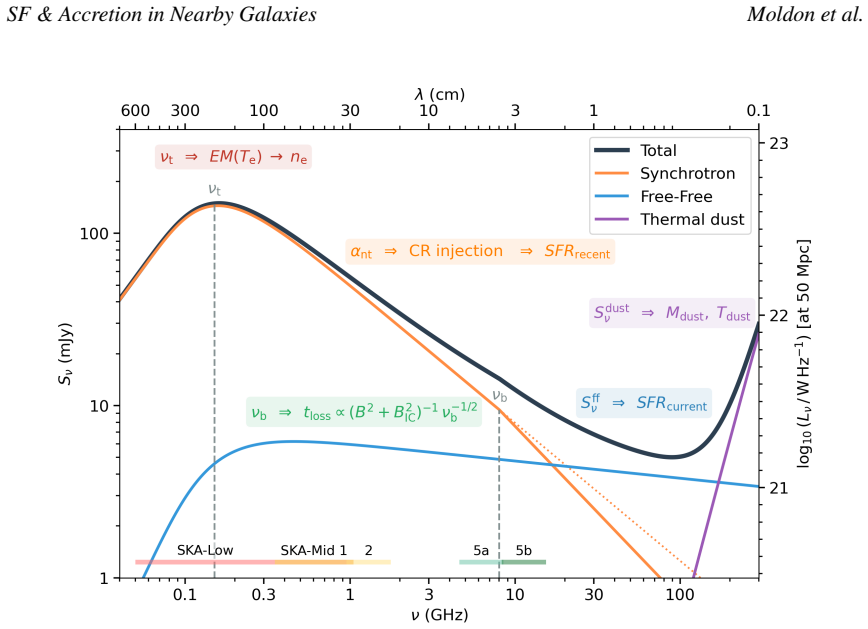
The μJy sensitivity, sub-arcsecond angular resolution and broadband coverage provided by SKA AA4 configuration will enable us to separate morphologically and spectrally the contribution from SMBH accretion and star formation processes, from the most compact nuclear region out to the most diffuse, galaxy-wide components. Disentangling thermal and non-thermal emission using multi-scale spectral index maps (traced by SKA-Mid) and absorption processes (traced mainly by SKA-Low) will allow us to account for the present and past star-formation rate, the AGN activity and the ISM properties. SKA observations of a wide range of galaxy types in the nearby Universe, including quiescent, AGN-dominated a
What carries the argument
Multi-scale spectral index maps traced by SKA-Mid and absorption processes traced by SKA-Low, which separate thermal from non-thermal emission to isolate star formation and AGN contributions.
If this is right
- Observations of quiescent, AGN-dominated and starburst galaxies will show how star formation and accretion regulate galaxy evolution across types.
- Time-domain and spectral-variability information will isolate compact accretion and transient phenomena.
- Present and past star-formation rates, AGN activity and ISM properties can be accounted for from nuclear to galaxy-wide scales.
Where Pith is reading between the lines
- The same techniques could be tested on a subset of galaxies with existing multi-wavelength data to check consistency before full SKA deployment.
- If successful, the approach might extend to statistical samples at moderate redshifts once sensitivity improves further.
- Combining these radio maps with optical or infrared tracers could reveal spatial offsets between star formation and accretion activity not addressed in the paper.
Load-bearing premise
Multi-scale spectral index maps and absorption processes can reliably disentangle thermal and non-thermal emission from star formation and AGN activity without major contamination from other sources or modeling uncertainties.
What would settle it
An observation in which independent measurements from other wavelengths show that the derived star-formation rates or AGN luminosities from SKA spectral maps differ substantially due to unaccounted overlapping emissions.
Figures
read the original abstract
The appearance of galaxies is strongly dominated by two physical phenomena: star formation and accretion of material onto compact objects, primarily supermassive black holes. Nearby galaxies offer a unique window to study these processes in detail and with high spatial resolution. The $\mu$Jy sensitivity, sub-arcsecond angular resolution and broadband coverage provided by SKA AA4 configuration will enable us to separate morphologically and spectrally the contribution from SMBH accretion and star formation processes, from the most compact nuclear region out to the most diffuse, galaxy-wide components. Disentangling thermal and non-thermal emission using multi-scale spectral index maps (traced by SKA-Mid) and absorption processes (traced mainly by SKA-Low) will allow us to account for the present and past star-formation rate, the AGN activity and the ISM properties. SKA observations of a wide range of galaxy types in the nearby Universe, including quiescent, AGN-dominated and starburst galaxies, will provide a broad view of how star formation and accretion regulate galaxy evolution, while time-domain and spectral-variability information further isolate compact accretion and transient phenomena.
Editorial analysis
A structured set of objections, weighed in public.
Referee Report
Summary. The manuscript presents a science case arguing that the SKA AA4 configuration's μJy sensitivity, sub-arcsecond resolution and broadband coverage will enable morphological and spectral separation of SMBH accretion from star formation in nearby galaxies. This separation, from nuclear to galaxy-wide scales, relies on multi-scale spectral index maps (SKA-Mid) and absorption processes (SKA-Low) to constrain present/past star-formation rates, AGN activity and ISM properties across quiescent, AGN-dominated and starburst systems, with additional time-domain information for transients.
Significance. If the stated instrument performance is achieved and the separation techniques perform as described, the work would be significant for galaxy evolution studies by providing a systematic radio view of how star formation and accretion regulate galaxies, extending established methods to new scales and galaxy types. The paper correctly identifies the value of broadband, multi-resolution data but does not include new derivations or data.
major comments (1)
- [Abstract] Abstract: the central claim that multi-scale spectral index maps and absorption processes 'will allow us to account for' star-formation rates, AGN activity and ISM properties rests on the assumption of reliable disentanglement with minimal contamination; the manuscript should add a dedicated paragraph (or subsection) quantifying expected uncertainties or citing prior simulations that demonstrate separation fidelity at the claimed scales.
minor comments (2)
- The manuscript would benefit from an explicit list of target galaxies or a table of representative types with expected flux densities to make the science case more concrete.
- [Abstract] Acronyms (SMBH, AA4, ISM) appear without first use definitions; adding these on first occurrence would improve accessibility.
Simulated Author's Rebuttal
We thank the referee for their positive assessment and constructive comment. We address the single major comment below and agree that a targeted addition will strengthen the presentation of the science case.
read point-by-point responses
-
Referee: [Abstract] Abstract: the central claim that multi-scale spectral index maps and absorption processes 'will allow us to account for' star-formation rates, AGN activity and ISM properties rests on the assumption of reliable disentanglement with minimal contamination; the manuscript should add a dedicated paragraph (or subsection) quantifying expected uncertainties or citing prior simulations that demonstrate separation fidelity at the claimed scales.
Authors: We agree that the manuscript would benefit from an explicit discussion of the robustness of the proposed separation techniques. Although this is a science-case paper rather than a methods development study, we will insert a new dedicated paragraph (placed after the description of the SKA-Mid and SKA-Low capabilities) that cites existing simulations and multi-frequency observational studies demonstrating the fidelity of spectral-index and free-free absorption separation at sub-arcsecond to arcsecond scales. The paragraph will include order-of-magnitude estimates of residual contamination drawn from the literature on nearby galaxies observed with the VLA and e-MERLIN. revision: yes
Circularity Check
No significant circularity; descriptive science case with no derivations or fitted quantities
full rationale
The manuscript is a forward-looking science case advocating SKA AA4 capabilities for separating star formation and AGN contributions via established techniques such as multi-scale spectral-index mapping and absorption studies. No equations, derivations, parameter fits, or quantitative predictions appear in the text. Claims rest on prior radio-astronomy methods without internal reduction to self-defined inputs or self-citation chains. The document is therefore self-contained against external benchmarks and receives the default non-circularity finding.
Axiom & Free-Parameter Ledger
Reference graph
Works this paper leans on
-
[1]
doi: 10.1093/mnras/stae364. F.X.Anetal. InAdvancingAstrophysicswiththeSKA–II(AASKAII).2026. arXivsearch: Report number AASKAII/FangxiaAn01. 15 SF & Accretion in Nearby Galaxies Moldon et al. K. R. Anantharamaiah, J.-H. Zhao, W. M. Goss, and F. Viallefond.ApJ, 419:585, Dec
-
[2]
doi: 10.1086/173510. R. D. Baldi et al.MNRAS, 508(2):2019–2038, Dec
-
[3]
doi: 10.1093/mnras/stab2613. L. Barcos-Muñoz et al.ApJ, 799(1):10, Jan
-
[4]
doi: 10.1088/0004-637X/799/1/10. R. Beck.A&ARv, 24:4, Dec
-
[5]
doi: 10.1007/s00159-015-0084-4. R. Beck and M. Krause.Astronomische Nachrichten, 326(6):414–427, July
-
[6]
doi: 10.22323/1.215.0070. R. Braun et al.A&A, 461(2):455–470, Jan
-
[7]
doi: 10.1051/0004-6361:20066092. M.A.BrentjensandA.G.deBruyn.A&A,441(3):1217–1228,Oct.2005. doi: 10.1051/0004-6361: 20052990. K.W.Cavagnoloetal.ApJ,720(2):1066–1072, Sept.2010. doi: 10.1088/0004-637X/720/2/1066. Y. Cendes et al.ApJ, 971(2):185, Aug
-
[8]
doi: 10.3847/1538-4357/ad5541. M. S. Clemens, A. Scaife, O. Vega, and A. Bressan.MNRAS, 405(2):887–897, June
-
[9]
doi: 10.1111/j.1365-2966.2010.16534.x. J. J. Condon.ARA&A, 30:575–611, Jan
-
[10]
doi: 10.1146/annurev.aa.30.090192.003043. R. H. W. Cook et al.MNRAS, 531(1):708–727, June
-
[11]
doi: 10.1093/mnras/stae1215. I. Delvecchio et al.A&A, 647:A123, Mar
-
[12]
doi: 10.1051/0004-6361/202039647. S. Dey et al.ApJ, 938(2):152, Oct
-
[13]
doi: 10.3847/1538-4357/ac82f2. S. Dey, A. Goyal, K. Małek, and T. Díaz-Santos.ApJ, 966(1):61, May
-
[14]
doi: 10.1046/j.1365-8711.2001.04080.x. L. Gajović et al.A&A, 695:A41, Mar
-
[15]
doi: 10.1051/0004-6361/202453003. E. Gallo, R. P. Fender, and G. G. Pooley.MNRAS, 344(1):60–72, Sept
-
[17]
doi: 10.1093/mnras/stx2613. J. A. Grundy et al.PASA, 42:e002, Jan
-
[18]
doi: 10.1017/pasa.2024.119. V. Heesen, R. Beck, M. Krause, and R. J. Dettmar.A&A, 494(2):563–577, Feb
-
[19]
doi: 10.1051/0004-6361:200810543. V. Heesen et al.AJ, 147(5):103, May
-
[20]
doi: 10.1088/0004-6256/147/5/103. V. Heesen et al.MNRAS, 458(1):332–353, May
-
[21]
doi: 10.1093/mnras/stw360. V. Heesen et al.A&A, 622:A8, Feb
-
[22]
doi: 10.1051/0004-6361/201833905. R. Herrero-Illana et al.MNRAS, 471(2):1634–1651, Oct
-
[23]
doi: 10.1093/mnras/stx1672. P. K. Humire et al.A&A, 699:A183, July
-
[24]
doi: 10.1051/0004-6361/202553897. P. Kaaret, H. Feng, and T. P. Roberts.ARA&A, 55(1):303–341, Aug
-
[25]
doi: 10.3847/1538-4365/ab8a4d. M. S. Longair.High Energy Astrophysics
-
[26]
doi: 10.1093/mnras/stae744. S. Mattila et al.Science, 361(6401):482–485, Aug
-
[27]
doi: 10.1126/science.aao4669. A. Merloni, S. Heinz, and T. di Matteo.MNRAS, 345(4):1057–1076, Nov
-
[28]
doi: 10.1046/j. 1365-2966.2003.07017.x. D. C. Molnár et al.MNRAS, 504(1):118–145, June
work page doi:10.1046/j 2003
-
[29]
doi: 10.1093/mnras/stab746. L. K. Morabito et al.MNRAS, 515(4):5758–5774, Oct
-
[30]
doi: 10.1093/mnras/stac2129. R. Morganti et al.Science, 341(6150):1082–1085, Sept
-
[31]
doi: 10.1126/science.1240436. E. J. Murphy et al.ApJ, 678(2):828–850, May
-
[32]
doi: 10.1086/587123. E. J. Murphy et al.ApJ, 737(2):67, Aug
-
[33]
doi: 10.1088/0004-637X/737/2/67. E. J. Murphy et al.ApJ, 761(2):97, Dec
-
[34]
doi: 10.1088/0004-637X/761/2/97. T. W. B. Muxlow et al.MNRAS, 495(1):1188–1208, June
-
[35]
doi: 10.1093/mnras/staa1279. S. Niklas, U. Klein, and R. Wielebinski.A&A, 322:19–28, June
-
[36]
doi: 10.1111/j.1365-2966.2012. 20554.x. F. Panessa et al.Nature Astronomy, 3:387–396, Apr
-
[37]
doi: 10.1038/s41550-019-0765-4. T. Panurach et al.ApJ, 977(2):211, Dec
-
[38]
doi: 10.3847/1538-4357/ad8b9c. M. Pathak et al. InAdvancing Astrophysics with the SKA – II (AASKAII)
-
[39]
doi: 10.1007/s00159-020-00128-x. C. Romero-Cañizales et al.A&A, 543:A72, July
-
[40]
doi: 10.1051/0004-6361/201218816. R. H. Rubin.ApJ, 154:391, Oct
-
[41]
D.R.G.SchleicherandR.Beck.A&A,593:A77,Sept.2016
doi: 10.1086/149766. D.R.G.SchleicherandR.Beck.A&A,593:A77,Sept.2016. doi: 10.1051/0004-6361/201628843. P. Schmidt et al.A&A, 632:A12, Dec
-
[42]
doi: 10.1051/0004-6361/201834995. D. J. B. Smith et al.A&A, 648:A6, Apr
-
[43]
doi: 10.1051/0004-6361/202039343. Y. Song et al.ApJ, 916(2):73, Aug
-
[44]
doi: 10.3847/1538-4357/ac05c2. J. M. Stil, M. Krause, R. Beck, and A. R. Taylor.ApJ, 693(2):1392–1403, Mar
-
[45]
doi: 10.1088/0004-637X/693/2/1392. F. S. Tabatabaei et al.A&A, 475(1):133–143, Nov
-
[46]
doi: 10.1051/0004-6361:20078174. F. S. Tabatabaei et al.ApJ, 836(2):185, Feb
-
[47]
doi: 10.3847/1538-4357/836/2/185. F. S. Tabatabaei et al.MNRAS, 517(2):2990–3007, Dec
-
[48]
L.J.Tacconietal.TheAstrophysicalJournal,768(1):74, apr2013
doi: 10.1093/mnras/stac2514. F.S.Tabatabaeietal. InAdvancingAstrophysicswiththeSKA–II(AASKAII).2026. arXivsearch: Report number AASKAII/Tabatabaei01. J. L. Turner and S. C. Beck.ApJ, 602(2):L85–L88, July
-
[49]
doi: 10.1086/382699. E. Varenius et al.A&A, 593:A86, Sept
-
[50]
doi: 10.1051/0004-6361/201628702. L. Wang et al.A&A, 631:A109, Nov
-
[51]
doi: 10.1051/0004-6361/201935913. J. Westcott et al.MNRAS, 475(4):5116–5132, Apr
-
[52]
doi: 10.1093/mnras/sty028. 17
discussion (0)
Sign in with ORCID, Apple, or X to comment. Anyone can read and Pith papers without signing in.