Generalized Conductivity Modeling and Selective Harmonic Amplification in Time-Modulated Graphene Cavities
Pith reviewed 2026-05-25 02:37 UTC · model grok-4.3
The pith
Time-modulated graphene cavities can be tuned via gap optimization to selectively amplify chosen Floquet harmonics.
A machine-rendered reading of the paper's core claim, the machinery that carries it, and where it could break.
Core claim
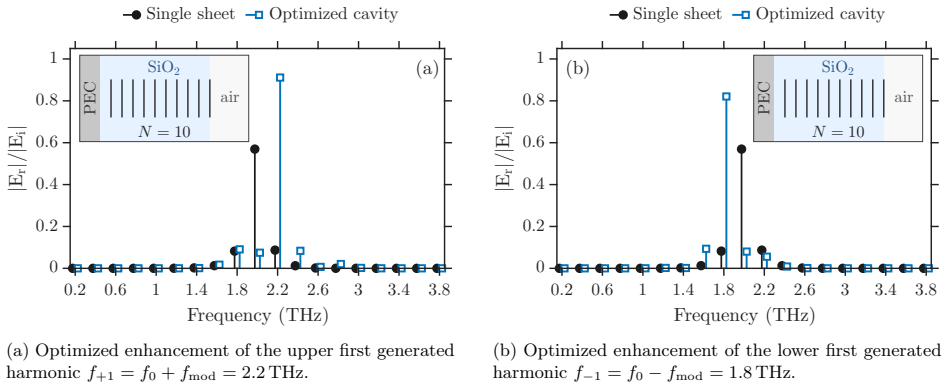
The central claim is that a semi-analytic operator-plus-transfer-matrix treatment, validated against a modified FDTD scheme and paired with a generalized Taylor-expanded conductivity model, enables engineering of selected Floquet harmonics in time-modulated graphene cavities; numerical optimization of the gaps produces strong first-order sideband enhancement in the high-bias regime, controlled third-order generation beyond the linear regime together with an explicit amplification-versus-leakage trade-off, and symmetry-induced generation of only even harmonics under zero-centered modulation.
What carries the argument
The operator formulation combined with the transfer-matrix method applied to a generalized Taylor-expanded conductivity model of graphene's temporal dispersion.
If this is right
- First-order sidebands receive strong enhancement once the cavity operates in the high-bias regime.
- Third-order harmonic output can be increased while an explicit trade-off limits the accompanying non-target leakage.
- Zero-centered modulation produces only even harmonics because of symmetry.
- Gap tuning via particle-swarm optimization selects which harmonics dominate for each modulation regime.
Where Pith is reading between the lines
- The same cavity-tuning procedure could be applied to other 2-D materials whose conductivity admits a similar time-dependent expansion.
- Integration of such modulated cavities with waveguides might allow compact, electrically controlled frequency converters.
- If the leakage-amplification trade-off can be further optimized, the approach may support low-power harmonic generators for communication bands.
Load-bearing premise
The Taylor-expanded conductivity model and the high-bias reduction accurately describe graphene's time-dependent response, and the operator-transfer-matrix solutions remain reliable for the modulation strengths and bias levels examined.
What would settle it
Fabrication and measurement of a physical stack of time-modulated graphene sheets forming a cavity, followed by direct comparison of the observed first-order sideband power and third-order leakage against the values predicted by the semi-analytic model for the same gap settings.
Figures




read the original abstract
The selective harmonic enhancement in cavities formed by stacks of time-modulated graphene sheets and a reflecting boundary is investigated. A semi-analytic framework based on an operator formulation and the transfer matrix method is developed and validated against a modified finite-difference time-domain algorithm. The temporal dispersion of graphene is treated through both a generalized Taylor-expanded conductivity model and a reduced high-bias approximation. By employing particle swarm optimization to tune the cavity gaps, selected Floquet harmonics are engineered under distinct modulation regimes. Numerical results show strong enhancement of first-order sidebands in the high-bias regime, controlled third-order harmonic generation beyond the linear regime with an explicit trade-off between target amplification and total non-target leakage, and symmetry-induced purely even harmonic generation under zero-centered modulation.
Editorial analysis
A structured set of objections, weighed in public.
Referee Report
Summary. The manuscript proposes a semi-analytic framework for selective harmonic amplification in time-modulated graphene cavities using an operator formulation combined with the transfer matrix method. Graphene's temporal dispersion is modeled via a generalized Taylor-expanded conductivity and a reduced high-bias approximation. The framework is validated against a modified FDTD method, and particle swarm optimization is used to tune cavity gaps for targeting specific Floquet harmonics in various modulation regimes. Key numerical findings include enhanced first-order sidebands in high-bias conditions, manageable third-order harmonics with noted trade-offs in leakage, and even-only harmonics due to symmetry in zero-centered modulation.
Significance. If the numerical results hold, this work could advance the design of graphene-based time-modulated devices for applications in harmonic generation and frequency mixing. The semi-analytic method offers efficiency over full numerical simulations, and the inclusion of optimization and validation strengthens the practical utility. The analysis of different regimes and symmetry effects provides useful design guidelines. Strengths include the explicit trade-off quantification and the grounding in established methods like transfer matrix.
major comments (2)
- [§4] §4 (validation subsection): The validation of the semi-analytic model against the modified FDTD is central to supporting the numerical results on harmonic enhancement; however, the manuscript lacks quantitative measures such as relative error or convergence plots in the high-bias regime, making it difficult to assess the accuracy of the reported amplification factors.
- [§3.3] §3.3 (optimization): The particle swarm optimization for cavity gaps is used to achieve the selective amplification; the paper should clarify if the optimization is based on the full generalized model or the reduced approximation, as this choice could impact the robustness of the claimed trade-offs between target amplification and non-target leakage.
minor comments (2)
- [Abstract] Abstract: Consider adding the specific values or ranges for modulation amplitude and frequency to provide immediate context for the numerical results.
- [Figure captions] Figure captions: Ensure all figures have clear labels for the different modulation regimes and harmonic orders.
Simulated Author's Rebuttal
We thank the referee for their thorough review and constructive feedback on our manuscript. We have addressed the major comments as detailed below, and believe these revisions will improve the clarity and rigor of the work.
read point-by-point responses
-
Referee: [§4] §4 (validation subsection): The validation of the semi-analytic model against the modified FDTD is central to supporting the numerical results on harmonic enhancement; however, the manuscript lacks quantitative measures such as relative error or convergence plots in the high-bias regime, making it difficult to assess the accuracy of the reported amplification factors.
Authors: We thank the referee for highlighting this point. We agree that the inclusion of quantitative error metrics would strengthen the validation. In the revised manuscript, we have incorporated relative error calculations and convergence plots for the high-bias regime, which show that the semi-analytic model agrees with the FDTD results to within 4% for the first-order sideband amplification factors. revision: yes
-
Referee: [§3.3] §3.3 (optimization): The particle swarm optimization for cavity gaps is used to achieve the selective amplification; the paper should clarify if the optimization is based on the full generalized model or the reduced approximation, as this choice could impact the robustness of the claimed trade-offs between target amplification and non-target leakage.
Authors: We appreciate this suggestion for clarification. The particle swarm optimization was performed using the full generalized conductivity model to account for all temporal dispersion terms. We have updated the manuscript in §3.3 to explicitly state this, thereby confirming the robustness of the reported trade-offs. revision: yes
Circularity Check
No significant circularity detected
full rationale
The paper develops a semi-analytic framework via operator formulation and transfer matrix method, validates it against a modified FDTD algorithm, employs a generalized Taylor-expanded conductivity model plus high-bias approximation, and uses particle swarm optimization to tune gaps for Floquet harmonic engineering. None of these steps reduce by construction to fitted inputs renamed as predictions, self-definitional relations, or load-bearing self-citations; the central claims rest on independent modeling choices, numerical comparisons, and external validation benchmarks. The derivation chain is self-contained against the stated assumptions and simulation results.
Axiom & Free-Parameter Ledger
free parameters (1)
- cavity gaps
axioms (1)
- domain assumption Temporal dispersion of graphene treated via generalized Taylor-expanded conductivity model and high-bias approximation
Lean theorems connected to this paper
-
IndisputableMonolith/Cost/FunctionalEquation.leanwashburn_uniqueness_aczel unclear?
unclearRelation between the paper passage and the cited Recognition theorem.
Taylor-expanded Drude prefactor A(μc,0 + Δμ cos θ) = Σ A(p)(μc,0)/p! (Δμ cos θ)^p (Eq. 13); operator system (η1+η2)/(2η1) I + (η2/2) S (Eq. 6)
-
IndisputableMonolith/Foundation/AbsoluteFloorClosure.leanreality_from_one_distinction unclear?
unclearRelation between the paper passage and the cited Recognition theorem.
Transfer matrix Mk = Pk Lk; total Mtot for N-sheet PEC cavity (Eq. 30-31)
What do these tags mean?
- matches
- The paper's claim is directly supported by a theorem in the formal canon.
- supports
- The theorem supports part of the paper's argument, but the paper may add assumptions or extra steps.
- extends
- The paper goes beyond the formal theorem; the theorem is a base layer rather than the whole result.
- uses
- The paper appears to rely on the theorem as machinery.
- contradicts
- The paper's claim conflicts with a theorem or certificate in the canon.
- unclear
- Pith found a possible connection, but the passage is too broad, indirect, or ambiguous to say the theorem truly supports the claim.
Reference graph
Works this paper leans on
-
[1]
Koutzoglou, I. and Amanatiadis, S. and Kantartzis, N. V. , title =. Nanomaterials , year =
-
[2]
Photonics of time-varying media , author=. Advanced Photonics , volume=. 2022 , publisher=
work page 2022
-
[3]
Enhanced mm-wave frequency up-conversion via a time-varying graphene aperture on a cavity resonator , author=. Micromachines , volume=. 2025 , publisher=
work page 2025
-
[4]
Global Optimization Toolbox , year =
-
[5]
IEEE Transactions on Antennas and Propagation , volume=
Spacetime metamaterials—part I: general concepts , author=. IEEE Transactions on Antennas and Propagation , volume=. 2019 , publisher=
work page 2019
-
[6]
Advanced Optical Materials , pages=
Stacked Time-Varying Metasurfaces , author=. Advanced Optical Materials , pages=. 2026 , publisher=
work page 2026
-
[7]
Advances in optics and photonics , volume=
Theory and applications of photonic time crystals: a tutorial , author=. Advances in optics and photonics , volume=. 2024 , publisher=
work page 2024
-
[8]
Expanding momentum bandgaps in photonic time crystals through resonances , author=. Nature Photonics , volume=. 2025 , publisher=
work page 2025
-
[9]
Frequency comb generation using plasmonic resonances in a time-dependent graphene ribbon array , author=. Physical Review B , volume=. 2017 , publisher=
work page 2017
-
[10]
Physical Review Applied , volume=
Parametric Mie resonances and directional amplification in time-modulated scatterers , author=. Physical Review Applied , volume=. 2022 , publisher=
work page 2022
-
[11]
Liu, Zizhuo and Li, Zhongyang and Aydin, Koray , title =. ACS Photonics , year =
-
[12]
Zahirul and Karimi, Mohammad and Upham, Jeremy and Reshef, Orad and Liu, Cong and Willner, Alan E
Zhou, Yiyu and Alam, M. Zahirul and Karimi, Mohammad and Upham, Jeremy and Reshef, Orad and Liu, Cong and Willner, Alan E. and Boyd, Robert W. , title =. Nature Communications , year =
-
[13]
Correas-Serrano, David and Gomez-Diaz, Juan S. and Sounas, Dimitrios L. and Hadad, Yakir and Alvarez-Melcon, Alejandro and Alu, Andrea , title =. IEEE Antennas and Wireless Propagation Letters , year =
-
[14]
Wang, Xuchen and Diaz-Rubio, Ana and Li, Huanan and Tretyakov, Sergei A. and Alu, Andrea , title =. Physical Review Applied , year =
-
[15]
Yu, Zongfu and Fan, Shanhui , title =. Nature Photonics , year =
-
[16]
Shi, Yu and Han, Seunghoon and Fan, Shanhui , title =. ACS Photonics , year =
- [17]
-
[18]
Lee, Seojoo and Park, Jagang and Cho, Hyukjoon and Wang, Yifan and Kim, Brian and Daraio, Chiara and Min, Bumki , title =. Photonics Research , year =
-
[19]
Antireflection Temporal Coatings , journal =
Pacheco-Pe. Antireflection Temporal Coatings , journal =. 2020 , volume =
work page 2020
-
[20]
Temporal Switching to Extend the Bandwidth of Thin Absorbers , journal =
Li, Huanan and Al. Temporal Switching to Extend the Bandwidth of Thin Absorbers , journal =. 2021 , volume =
work page 2021
-
[21]
Castaldi, Giuseppe and Pacheco-Pe. Exploiting Space-Time Duality in the Synthesis of Impedance Transformers via Temporal Metamaterials , journal =. 2021 , volume =
work page 2021
- [22]
-
[23]
Ramaccia, Davide and Sounas, Dimitrios L. and Al. Doppler Cloak Restores Invisibility to Objects in Relativistic Motion , journal =. 2017 , volume =
work page 2017
- [24]
- [25]
-
[26]
IEEE Transactions on Antennas and Propagation , year =
Wu, Zhen and Grbic, Anthony , title =. IEEE Transactions on Antennas and Propagation , year =
- [27]
- [28]
-
[29]
ACS Applied Electronic Materials , year =
Peng, Shuang and Yu, Qian and Shen, Xiaoyue and Xie, Yating and Zhang, Han and Ma, Jie and Fu, Xiaojian and Wu, Junwei and Yang, Fei , title =. ACS Applied Electronic Materials , year =
-
[30]
Galiffi, Emanuele and Tirole, Romain and Yin, Shixiong and Li, Huanan and Vezzoli, Stefano and Huidobro, Paloma A. and Silveirinha, M. Photonics of time-varying media , journal =. 2022 , volume =
work page 2022
-
[31]
and Wang, Luda and Koenig, Steven P
Drahushuk, Lee W. and Wang, Luda and Koenig, Steven P. and Bunch, J. Scott and Strano, Michael S. , title =. ACS Nano , year =
-
[32]
Salary, Mohammad Mahdi and Jafar-Zanjani, Samad and Mosallaei, Hossein , title =. Physical Review B , year =
-
[33]
Sensale-Rodriguez, B. and Yan, R. and Kelly, M. and Fang, T. and Tahy, K. and Hwang, W. S. and Jena, D. and Liu, L. and Xing, H. G. , title =. Nature Communications , year =
-
[34]
Barati and Salary, Mohammad Mahdi and Mosallaei, Hossein , title =
Sedeh, H. Barati and Salary, Mohammad Mahdi and Mosallaei, Hossein , title =. IEEE Transactions on Antennas and Propagation , year =
-
[35]
Ptitcyn, G. and Lamprianidis, A. and Karamanos, T. and Asadchy, V. and others , title =. Laser & Photonics Reviews , year =
-
[36]
Mostafa, M. and D. Scattering from time-modulated metasurfaces: A general theoretical framework , journal =. 2022 , volume =
work page 2022
-
[37]
Karamanos, T. D. and Amanatiadis, S. and Kantartzis, N. and Lemoult, F. , title =. Proceedings of the 14th International Conference on Metamaterials, Photonic Crystals, and Plasmonics (META 2024) , address =
work page 2024
-
[38]
Journal of Applied Physics , volume=
Dyadic Green’s functions and guided surface waves for a surface conductivity model of graphene , author=. Journal of Applied Physics , volume=. 2008 , publisher=
work page 2008
-
[39]
Journal of the Optical Society of America B , volume=
Inverse design in photonics by topology optimization: tutorial , author=. Journal of the Optical Society of America B , volume=. 2021 , publisher=
work page 2021
- [40]
discussion (0)
Sign in with ORCID, Apple, or X to comment. Anyone can read and Pith papers without signing in.