PASS-Assisted RSMA under Imperfect SIC: Joint Antenna Activation and Resource Allocation
Pith reviewed 2026-06-30 08:51 UTC · model grok-4.3
The pith
A two-stage framework jointly optimizes antenna activation and resource allocation to improve fairness in pinching antenna assisted RSMA when successive interference cancellation is imperfect.
A machine-rendered reading of the paper's core claim, the machinery that carries it, and where it could break.
Core claim
The paper establishes that explicitly modeling residual common-stream interference and solving the max-min fairness problem through greedy channel-aware antenna activation followed by successive convex approximation-based resource allocation yields effective performance in PASS-assisted RSMA networks under imperfect SIC.
What carries the argument
The two-stage framework of greedy channel-aware antenna activation followed by successive convex approximation for joint common-rate and power allocation.
Load-bearing premise
The two-stage framework produces a solution close to the global optimum for the max-min rate problem without the greedy choice or convex approximations introducing large sub-optimality.
What would settle it
Solving small instances of the original mixed-integer problem to global optimality via exhaustive search or branch-and-bound and comparing the resulting max-min rates against those from the two-stage method would show whether the approximations cause significant performance loss.
Figures
read the original abstract
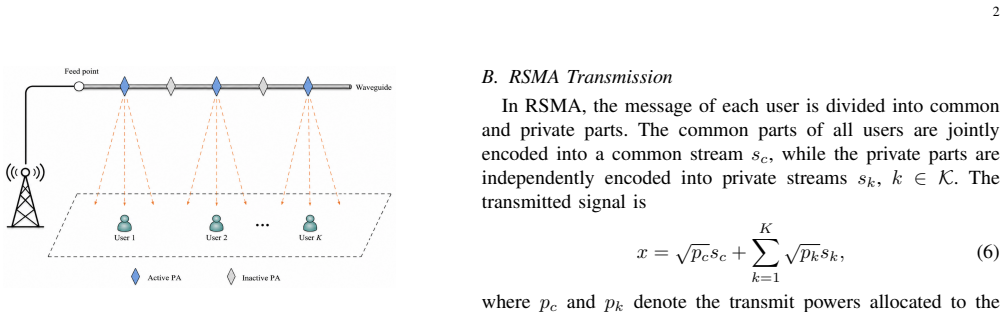
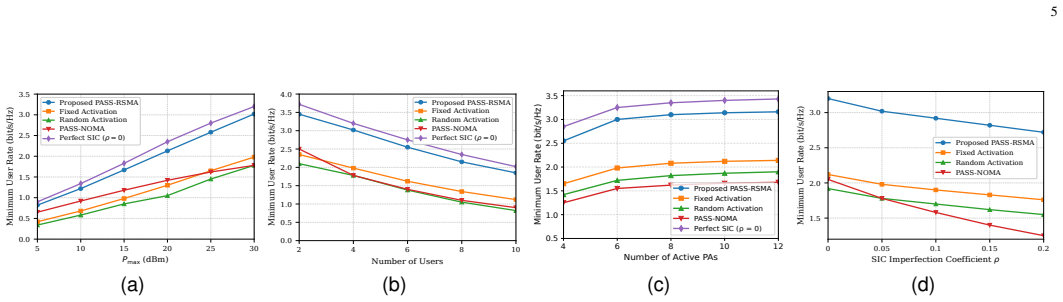
The performance of rate-splitting multiple access (RSMA) can be severely affected by imperfect successive interference cancellation (SIC) in practical wireless systems. This paper investigates a downlink pinching antenna system (PASS)-assisted RSMA network under imperfect SIC, where residual common-stream interference is explicitly incorporated into private-stream decoding. To improve user fairness, a max-min rate optimization problem is formulated through the joint design of antenna activation, common-rate allocation, and power allocation. The resulting mixed-integer non-convex problem is addressed using a two-stage framework that combines greedy channel-aware antenna activation with successive convex approximation (SCA)-based resource allocation. Numerical results demonstrate the effectiveness of the proposed framework in improving fairness under imperfect SIC.
Editorial analysis
A structured set of objections, weighed in public.
Referee Report
Summary. The manuscript formulates a max-min rate optimization for a downlink PASS-assisted RSMA network under imperfect SIC (with explicit residual common-stream interference at private-stream decoders). The mixed-integer non-convex problem is solved by a two-stage heuristic: greedy channel-aware antenna activation followed by SCA-based joint common-rate and power allocation. Numerical results are presented to claim improved user fairness relative to baselines.
Significance. If the reported fairness gains hold under a validated solver, the work would provide a concrete design for practical RSMA in pinching-antenna systems that accounts for imperfect SIC, an issue that limits conventional RSMA performance. The explicit modeling of residual interference and the joint antenna/resource formulation are potentially useful contributions.
major comments (2)
- [Numerical Results / Proposed Algorithm (Section IV)] The central claim rests on numerical results from the two-stage solver. No small-instance exhaustive enumeration, duality-gap bound, or comparison against a global solver (e.g., branch-and-bound on the mixed-integer problem) is provided to quantify the optimality gap of the greedy antenna selection or the SCA fixed point; without this, fairness improvements cannot be confidently attributed to the RSMA/PASS design rather than solver artifacts.
- [Two-Stage Framework (Section III)] The greedy channel-aware antenna activation step selects a subset without backtracking or exhaustive search over the combinatorial space; the manuscript does not analyze how this choice interacts with the subsequent SCA stage or whether alternative activation heuristics materially alter the max-min rate under imperfect SIC.
minor comments (2)
- [Numerical Results] Simulation parameters (noise variance, channel model, number of antennas/users, imperfect-SIC residual factor) should be stated explicitly in the numerical-results section rather than referenced only in figure captions.
- [System Model] Notation for the residual interference term after imperfect SIC should be introduced once in the system model and used consistently in the rate expressions.
Simulated Author's Rebuttal
We thank the referee for the constructive comments on validation and analysis of the proposed heuristic. We address each major comment below with clarifications and indicate where revisions will be made.
read point-by-point responses
-
Referee: [Numerical Results / Proposed Algorithm (Section IV)] The central claim rests on numerical results from the two-stage solver. No small-instance exhaustive enumeration, duality-gap bound, or comparison against a global solver (e.g., branch-and-bound on the mixed-integer problem) is provided to quantify the optimality gap of the greedy antenna selection or the SCA fixed point; without this, fairness improvements cannot be confidently attributed to the RSMA/PASS design rather than solver artifacts.
Authors: We agree that the lack of a global optimality benchmark limits strong claims about the heuristic's gap. The mixed-integer non-convex problem is NP-hard, making branch-and-bound infeasible for the system sizes considered due to prohibitive complexity. However, we will add exhaustive enumeration results for small instances (e.g., few antennas/users) in the revision to quantify the greedy step's gap and better attribute fairness gains. This addresses the concern without misrepresenting the practical nature of the approach. revision: partial
-
Referee: [Two-Stage Framework (Section III)] The greedy channel-aware antenna activation step selects a subset without backtracking or exhaustive search over the combinatorial space; the manuscript does not analyze how this choice interacts with the subsequent SCA stage or whether alternative activation heuristics materially alter the max-min rate under imperfect SIC.
Authors: The greedy activation prioritizes low complexity and channel awareness, which is essential for PASS systems. We acknowledge the absence of interaction analysis and alternative comparisons. In the revision, we will include a discussion of the greedy-SCA interplay and add numerical comparisons with alternatives (e.g., random or exhaustive for small cases) to show robustness under imperfect SIC. revision: yes
Circularity Check
No circularity; heuristic solver validated by simulation without self-referential reduction
full rationale
The paper formulates a max-min rate optimization as a mixed-integer non-convex problem and solves it via a two-stage heuristic (greedy antenna activation + SCA). Numerical results are obtained by executing this solver on simulated channels. No derivation step reduces a claimed prediction or first-principles result to its own fitted inputs by construction, nor does any load-bearing premise rest on a self-citation chain. The central claim is empirical performance of the heuristic under imperfect SIC, which is externally falsifiable via simulation benchmarks and does not exhibit the enumerated circularity patterns.
Axiom & Free-Parameter Ledger
free parameters (1)
- Power allocation variables
axioms (2)
- domain assumption Imperfect SIC leaves residual common-stream interference that affects private-stream decoding
- ad hoc to paper The mixed-integer non-convex max-min rate problem can be addressed via greedy antenna activation plus SCA without large optimality gap
Reference graph
Works this paper leans on
-
[1]
A primer on rate-splitting multiple access: Tutorial, myths, and frequently asked questions,
B. Clerckxet al., “A primer on rate-splitting multiple access: Tutorial, myths, and frequently asked questions,”IEEE J. Sel. Areas Commun., vol. 41, no. 5, pp. 1265–1308, Feb. 2023
2023
-
[2]
Rate-splitting multiple access for 6G—part I: Principles, applications and future works,
A. Mishraet al., “Rate-splitting multiple access for 6G—part I: Principles, applications and future works,”IEEE Commun. Lett., vol. 26, no. 10, pp. 2232–2236, Oct. 2022
2022
-
[3]
Pinching-antenna systems: Architecture designs, opportuni- ties, and outlook,
Y . Liuet al., “Pinching-antenna systems: Architecture designs, opportuni- ties, and outlook,”IEEE Commun. Mag., vol. 64, no. 1, pp. 190–196, Jan. 2026
2026
-
[4]
Flexible-antenna systems: A pinching-antenna perspective,
Z. Dinget al., “Flexible-antenna systems: A pinching-antenna perspective,” IEEE Trans. Commun., vol. 73, no. 10, pp. 9236–9253, Oct. 2025
2025
-
[5]
AI-empowered resource allocation for wirelessly powered pinching-antenna systems,
S. Pakravanet al., “AI-empowered resource allocation for wirelessly powered pinching-antenna systems,”IEEE Trans. V eh. Technol., pp. 1–6, Apr. 2026
2026
-
[6]
Performance analysis of pinching-antenna systems,
D. Tyrovolaset al., “Performance analysis of pinching-antenna systems,” IEEE Trans. Cogn. Commun. Netw., vol. 12, pp. 590–601, Apr. 2025
2025
-
[7]
S. Pakravanet al., “Pinching antenna system-assisted hybrid AirComp- NOMA uplink: Joint precoding and antenna placement optimization,” arXiv preprint arXiv:2604.12154, Apr. 2026
work page internal anchor Pith review Pith/arXiv arXiv 2026
-
[8]
Sum rate maximization for pinching antennas assisted RSMA system with multiple waveguides,
P. Wanget al., “Sum rate maximization for pinching antennas assisted RSMA system with multiple waveguides,”IEEE Trans. V eh. Technol., pp. 1–6, Dec. 2025
2025
-
[9]
Performance analysis for rate splitting multiple access enhanced pinching-antenna assisted integrated sensing and communication systems,
S. Kumaret al., “Performance analysis for rate splitting multiple access enhanced pinching-antenna assisted integrated sensing and communication systems,”IEEE Trans. Wireless Commun., vol. 25, pp. 18 023–18 038, Jun. 2026
2026
-
[10]
Optimization for Pinching Antennas System With Multiple Carriers and Rate Splitting Multiple Access
P. Wanget al., “Optimization for pinching antennas system with multiple carriers and rate splitting multiple access,”arXiv preprint arXiv:2604.14736, Apr. 2026
work page internal anchor Pith review Pith/arXiv arXiv 2026
-
[11]
Resource allocation for RSMA-based symbiotic radio systems under imperfect SIC and CSI,
Y . Xuet al., “Resource allocation for RSMA-based symbiotic radio systems under imperfect SIC and CSI,”IEEE Trans. V eh. Technol., vol. 74, no. 3, pp. 5170–5174, Mar. 2025
2025
-
[12]
Outage probability for downlink multi-antenna RSMA system with imperfect SIC,
S. Liet al., “Outage probability for downlink multi-antenna RSMA system with imperfect SIC,”IEEE Wireless Commun. Lett., vol. 15, pp. 385–389, Oct. 2025
2025
-
[13]
Robust beamforming for practical RIS-aided RSMA systems with imperfect SIC under transceiver hardware impairments,
X. Chenget al., “Robust beamforming for practical RIS-aided RSMA systems with imperfect SIC under transceiver hardware impairments,” IEEE Trans. V eh. Technol., pp. 1–7, Mar. 2026
2026
-
[14]
38 GHz and 60 GHz angle-dependent propagation for cellular & peer-to-peer wireless communications,
T. S. Rappaportet al., “38 GHz and 60 GHz angle-dependent propagation for cellular & peer-to-peer wireless communications,” inProc. IEEE ICC, Ottawa, Canada, pp. 4568–4573, Jun. 2012
2012
-
[15]
Modeling and beamforming optimization for pinching- antenna systems,
Z. Wanget al., “Modeling and beamforming optimization for pinching- antenna systems,”IEEE Trans. Commun., vol. 73, no. 12, pp. 13 904– 13 919, Dec. 2025
2025
-
[16]
Pinching-antenna systems (PASS): Power radiation model and optimal beamforming design,
X. Xuet al., “Pinching-antenna systems (PASS): Power radiation model and optimal beamforming design,”IEEE Trans. Commun., vol. 74, pp. 2160–2175, Nov. 2025
2025
discussion (0)
Sign in with ORCID, Apple, or X to comment. Anyone can read and Pith papers without signing in.