REVIEW 4 major objections 5 minor 48 references
Collaborative Charging Optimization for Wireless Rechargeable Sensor Networks via Heterogeneous Mobile Chargers
T0 review · 4 major / 5 minor · reviewed 2026-08-03 · deepseek-v4-flash
Pith's one-line read One drone and one ground vehicle can keep a wireless sensor network alive by learning to split the charging territory.
desk verdict Plausible combination of known DRL ingredients for a heterogeneous AAV/SV charging scenario, but the headline 39% improvement rests on a circular reward metric and an unreported mortality comparison against HATRPO. read the letter →
The pith
A machine-rendered reading of the paper's core claim, the machinery that carries it, and where it could break.
The reading
What carries the argument
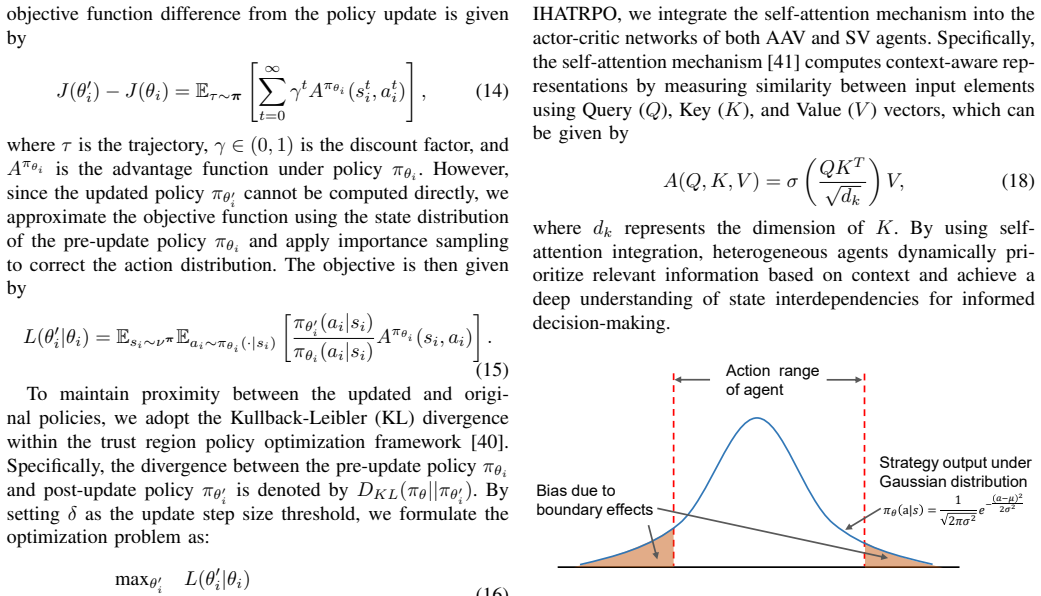
The load-bearing machinery is the IHATRPO policy update: a trust-region optimization with KL divergence constraint, in which each agent's policy is a Beta distribution over bounded heading-angle and travel-distance actions, avoiding the boundary bias of Gaussian sampling, and in which a self-attention layer re-weights observed sensor energy levels and agent positions before the actor-critic reads them. The self-attention lets each charger focus on the most urgent nodes; the Beta sampling keeps actions inside the network bounds without truncation.
What would settle it
Measure the real received-power curve of the RF charger and substitute it for Eq. (2) in the simulator; if the learned policy keeps mortality below 10% under the measured curve, the claim survives, and if it does not, the simulation's α=36, β=30, and dmax=6 m were the load-bearing assumptions.
Extended reading notes
Core claim
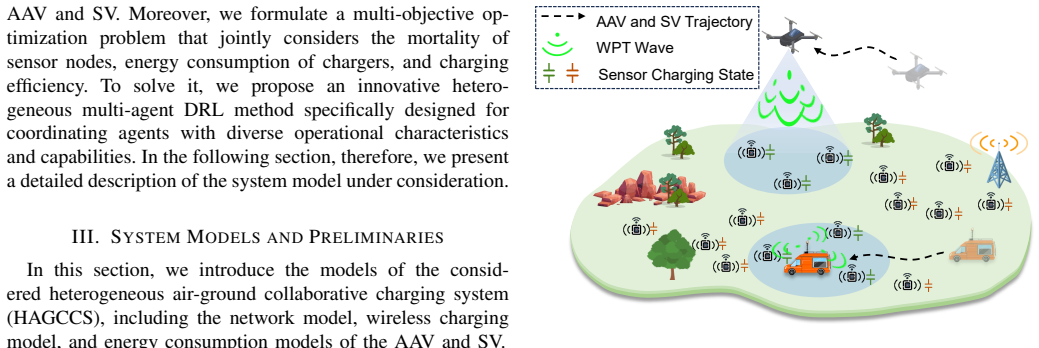
The paper's central claim is that two heterogeneous mobile chargers—a rotary-wing AAV and a ground SV—can learn to cooperate in real time to keep a 100-node wireless rechargeable sensor network operational, reducing node mortality from an initial rate exceeding 90% to below 10%. The claimed mechanism is an improved heterogeneous-agent trust region policy optimization (IHATRPO) algorithm whose two modifications—a self-attention mechanism for state processing and a Beta distribution-based action sampling strategy—together yield roughly 39% higher reward than the original HATRPO. The learned trajectories show the AAV and SV partitioning the field into complementary regions with overlapping midd
Load-bearing premise
The result rests on the simulation's physical and reward parameters—charging efficiency constants, charging radius, per-node energy consumption, and hand-tuned reward weights—faithfully representing a real deployment, which the paper does not verify against hardware.
Editorial extensions
If this is right
- If the claims hold, a WRSN with one AAV and one SV can push node mortality below 10% over the simulated horizon, a level single-type chargers do not reach.
- The 39% improvement over HATRPO attributes a large share of the gain to the two algorithmic modifications, implying that bounded-action sampling and attention-based state encoding are transferable to other heterogeneous multi-agent coordination tasks.
- The emergent territorial division between AAV and SV suggests that explicit role assignment is unnecessary; coordination can be learned from rewards alone.
- The multi-objective formulation (charging efficiency, travel distance, mortality) provides a template for balancing competing goals in other energy-constrained robotic systems.
Reading between the lines
- The authors leave implicit that the same framework could scale by adding more heterogeneous agents (multiple AAVs and SVs); the complexity analysis suggests linear scaling in the number of agents, so scalability is plausible but untested.
- Because the physical parameters (α=36, β=30, dmax=6 m) come from prior simulation work and are not hardware-validated, the mortality reduction is a simulation result; a sim-to-real gap could shrink the 39% figure in field trials.
- The Beta sampling benefit is likely not specific to WRSNs: any continuous-control problem with bounded action spaces (robotic navigation, resource allocation with limits) could gain from replacing Gaussian policies with Beta policies.
- A testable extension: fix the reward weights and vary the sensor energy consumption distribution; if mortality stays below 10% across a wider range of energy draws, the coordination claim is robust.
Signed reviews
Editorial analysis
A structured set of objections, weighed in public.
Referee Report
Summary. The paper studies a wireless rechargeable sensor network (WRSN) in which one automated aerial vehicle (AAV) and one ground smart vehicle (SV) collaboratively charge 100 stationary sensor nodes. It formulates a multi-objective optimization problem P1 (maximize charging efficiency f1, minimize travel distance f2, minimize sensor-node mortality f3), models it as a Markov game, and proposes IHATRPO—an extension of HATRPO that adds a self-attention mechanism to the actor-critic networks and replaces Gaussian action sampling with Beta-distribution sampling. Simulations are used to claim a 39% performance improvement over HATRPO, faster convergence than PPO, DDPG, MADDPG, and HAPPO, and a reduction in sensor-node mortality from over 90% to below 10%.
Significance. The problem is timely and relevant: heterogeneous air-ground charging coordination in WRSNs is a natural extension of existing single-type charger work, and the proposed algorithm is clearly described with a complexity analysis. If the quantitative claims were supported, the paper would provide a useful demonstration that self-attention and Beta sampling improve multi-agent trust-region methods in bounded continuous-action spaces. However, the current evaluation is not sufficient to establish these claims, because the headline improvement is measured in the same scalarized reward that is being optimized and because key experimental parameters are unreported.
major comments (4)
- [§VI-B3, Eq. (13)] The claimed 39% improvement over HATRPO is computed from the total reward value, but this reward is exactly the scalarized training objective R_i = λ1 f1 − λ2 f2 − λ3 f3 defined in Eq. (13). Since IHATRPO is trained to maximize this scalarized reward, a higher cumulative reward at evaluation can reflect reward-weight tuning or reward hacking rather than better physical charging outcomes. The one component that is a direct network-level outcome, sensor mortality f3 (Eq. (7)), is shown in Fig. 5(d) only for IHATRPO; no comparable mortality curve is provided for HATRPO or the other baselines. To support the central claim, the authors should report per-component metrics f1, f2, and f3 for all algorithms on separate axes, and specifically compare the mortality curves of IHATRPO and HATRPO.
- [Abstract vs. §VI-B3] The abstract states a 51% performance improvement over HATRPO, while Section VI-B3 reports 'approximately 39%.' This inconsistency must be resolved, and the exact definition of the reported percentage (e.g., mean final reward, area under the reward curve, or final reward after convergence) must be stated. In addition, Figs. 5–7 show single learning curves with no seeds, error bars, or statistical tests. Multi-seed runs (at least five) with mean ± standard deviation are needed before quantitative improvement claims can be accepted.
- [§VI-A1, Eq. (13)] The reward weights λ1, λ2, and λ3 are described only as 'determined by careful tuning' and as being set differently for the AAV and SV (higher λ2 for the SV and higher λ3 for the AAV). The numerical values are never reported. Because the evaluation metric is the same scalarized reward, the reported improvement is non-reproducible without these weights. The authors should publish the exact weight values for both agents and include a sensitivity analysis showing how the claimed 39% improvement and mortality reduction vary with λ1, λ2, and λ3.
- [§VI-A1, Eq. (2)] The physical parameters that determine the simulation's fidelity—α=36 and β=30 in Eq. (2), the charging radius dmax=6 m, and the per-round sensor energy consumption of 0.025–0.04 J—are taken from [44] or set by 'careful tuning' without hardware validation. Since all quantitative conclusions (39% improvement, mortality reduction) are produced by this simulation, the authors should either validate these parameters against experimental measurements or provide a sensitivity analysis over plausible ranges. At minimum, the discussion should address how deviations in these values would affect the reported improvements.
minor comments (5)
- [§VI-B3] Typo: 'samplilng' should be 'sampling.'
- [Fig. 8] The figure appears corrupted in the manuscript, rendering as a string of Unicode escape-like symbols. The trajectory plot must be replaced with a readable figure.
- [References] Reference [1] and reference [4] are the same paper (Kandris et al., Applied System Innovation, 2020), and reference [7] and reference [8] are also duplicates. Please consolidate.
- [Notation] In Table I, α and β are listed as 'shape parameters of Beta distribution,' but α and β are also used in Eq. (2) as constants in the charging-efficiency model. This dual use is confusing. Rename one of the two sets (e.g., α_p, β_p for the wireless charging model).
- [§V-C] The big-O expression for training complexity has an unbalanced parenthesis and is difficult to parse. Please rewrite with clear nested terms and define all symbols in one place.
Circularity Check
Headline 39% improvement is measured on the training objective itself (Eq. 13) with unreported per-agent reward weights, and the reported mortality drop is the weighted f3 term of that same reward, so the central quantitative claims reduce in part to the optimized reward rather than to independently predicted outcomes.
-
self definitional
[Section VI-B3 (Ablation Analysis), Fig. 7, Eq. (13), Section VI-A1]
"Quantitatively, the integration of the self-attention mechanism and Beta samplilng strategy yields an overall performance improvement of approximately 39% compared with the original HATRPO algorithm. This result in Fig. 7 confirms that both components contribute significantly | Fig. 7 y-axis: "Total Reward Value"; Eq. (13): "ri_t = λ1 f_i1,t − λ2 f_i2,t − λ3 f3,t"; Section VI-A1: "we assign a higher λ2 for the SV and a higher λ3 for the AAV""
The 39% improvement is computed from the cumulative "Total Reward Value" plotted in Fig. 7. By Eq. (13), total reward is exactly the scalarized objective Σ(λ1 f1 − λ2 f2 − λ3 f3) that the TRPO-style updates (Eqs. 14–17) are trained to maximize. Thus the evaluation metric is, by construction, the same function being optimized; the reported "performance improvement" is a difference in the training objective itself. The comparison weights are hand-tuned and never reported ("a higher λ2 for the SV and a higher λ3 for the AAV"), so a larger total reward can reflect favorable weight tuning rather than an independently measured physical charging outcome. The claim therefore reduces to "the proposed components achieve higher values of the objective that was designed for them," not to an external p
-
fitted input called prediction
[Section VI-B1 (Optimization Results), Fig. 5(d), Eq. (13)]
"it is noteworthy that a significant reduction in sensor node mortality from an initial rate exceeding 90% to below 10% in Fig. 5(d), which indicates that through the scheduling of the AAV and SV, the sensor node mortality can be reduced and HAGCCS achieves better energy efficiency. | Eq. (13): reward function "incorporates three key performance indicators: charging efficiency, energy consumption (represented by travel distance), and network sustainability (measured by node mortality)" with terms "− λ3 f3,t""
Node mortality f3 (Eq. 7) is the third term inside the training reward (Eq. 13, −λ3 f3,t), with a hand-set weight that the paper assigns asymmetrically to the AAV. The headline result — mortality dropping from >90% to below 10% — is therefore the agent minimizing the exact reward term it was explicitly trained to minimize; Fig. 5(d) plots a component of the training objective, not an independently predicted quantity. Moreover, Fig. 5(d) shows IHATRPO only: no mortality curve is given for HATRPO or any baseline, so the attribution of the reduction to self-attention and Beta sampling rests solely on the reward-based comparison in Fig. 7, which uses the same objective that all algorithms optimize. The claimed improvement is thus statistically and semantically tied to the tuned reward input ra
full rationale
The paper's central quantitative claims — the abstract's 51% and the body's 39% improvement over HATRPO, and the >90%-to-<10% mortality reduction — are all evaluated on quantities that are structurally identical to the training objective. Eq. (13) defines the reward as λ1 f1 − λ2 f2 − λ3 f3, and Fig. 6/Fig. 7 compare algorithms on cumulative "Total Reward Value"; Fig. 5 reports the components f1, f2, f3 as "optimization results." So the evaluation metric is the same function the policy update maximizes, with per-agent weights that are tuned and never quantified. This is a partial reduction of the reported performance to the reward design: the paper demonstrates that its method maximizes a hand-weighted objective, and the only reward-independent metric (mortality) is itself a weighted reward term and is never compared against HATRPO. This warrants a moderate circularity score. Importantly, the circularity is not driven by self-citation: the one co-author citation ([43]) is used only to format the complexity analysis, and the key references ([44] for α/β, [49] for HATRPO/HAPPO) are external. There is no uniqueness-theorem or ansatz-smuggling chain. The algorithmic comparison on a shared reward is legitimate RL practice, and the success of the self-attention and Beta-sampling ablations in improving that shared reward is a genuine algorithmic finding with independent content; the reduction lies in interpreting improved values of a tuned objective as validated physical superiority. The abstract/body discrepancy (51% vs 39%) and the omitted λ values are correctness and reproducibility concerns rather than circularity per se. On balance, the central 'predictions' partially reduce by construction to the optimized reward, giving a score of 4 rather than 0–2; the absence of self-citation load-bearing prevents a higher score.
Assumptions & free parameters
free parameters (6)
- α (charging-efficiency coefficient) =
36
- β (Friis tunable parameter) =
30
- d_max (effective charging radius) =
6 m
- Reward weights λ1, λ2, λ3 =
not specified
- Sensor per-round energy consumption =
uniform in [0.025, 0.04] J
- AAV/SV motion-energy model constants =
not specified
assumptions (7)
- standard math The RF Friis-based WPT model in Eq. (1) adequately describes charging power at sensor nodes.
- domain assumption Both agents have full observability of all sensor positions, energy levels, and each other's positions at every time slot.
- domain assumption Sensor energy consumption per round is i.i.d. uniform in [0.025, 0.04] J.
- ad hoc to paper Beta-distribution sampling yields unbiased gradient estimates in bounded continuous action spaces.
- domain assumption HATRPO's trust-region update, as extended here, provides a valid monotonic improvement guarantee.
- ad hoc to paper The scalarized reward in Eq. (13) is an acceptable proxy for the vector multi-objective problem P1.
- domain assumption Acceleration and deceleration energy of the AAV and SV are negligible.
Cite this review
Pith. "Pith review of Collaborative Charging Optimization for Wireless Rechargeable Sensor Networks via Heterogeneous Mobile Chargers." pith.science (2026). https://pith.science/paper/PRTF6W63
@misc{pith2026251112501,
  author       = {Pith},
  title        = {Pith review of: Collaborative Charging Optimization for Wireless Rechargeable Sensor Networks via Heterogeneous Mobile Chargers},
  year         = {2026},
  howpublished = {\url{https://pith.science/paper/PRTF6W63}},
  note         = {Machine review of arXiv:2511.12501}
}
read the original abstract
Despite the rapid proliferation of Internet of Things applications driving widespread wireless sensor network (WSN) deployment, traditional WSNs remain fundamentally constrained by persistent energy limitations that severely restrict network lifetime and operational sustainability. Wireless rechargeable sensor networks (WRSNs) integrated with wireless power transfer (WPT) technology emerge as a transformative paradigm, theoretically enabling unlimited operational lifetime. In this paper, we investigate a heterogeneous mobile charging architecture that strategically combines an automated aerial vehicle (AAV) and a ground smart vehicle (SV) in heterogeneous deployment scenarios to collaboratively exploit the superior mobility of the AAV and extended endurance of the SV for energy distribution. We formulate a multi-objective optimization problem that simultaneously addresses the dynamic balance of heterogeneous charger advantages, charging efficiency versus mobility energy consumption trade-offs, and real-time adaptive coordination under time-varying network conditions. This problem presents significant computational challenges due to its high-dimensional continuous action space, non-convex optimization landscape, and dynamic environmental constraints. To address these challenges, we propose the improved heterogeneous agent trust region policy optimization (IHATRPO) algorithm that integrates a self-attention mechanism for enhanced complex environmental state processing and employs a Beta sampling strategy to achieve unbiased gradient computation in continuous action spaces. Simulation results demonstrate that IHATRPO achieves a 51% performance improvement over the original HATRPO, significantly outperforming state-of-the-art baseline algorithms while substantially decreasing sensor node mortality rate and improving charging system efficiency.
Figures

Figures from the paper (4 more)


Reference graph
Works this paper leans on
-
[44]
Optimal charging in wireless rechargeable sensor networks,
L. Fu, P. Cheng, Y . Gu, J. Chen, and T. He, “Optimal charging in wireless rechargeable sensor networks,”IEEE Trans. V eh. Technol., vol. 65, no. 1, pp. 278–291, 2016
2016
-
[2]
Applications of UA Vs in civil infrastructure,
W. W. Greenwood, J. P. Lynch, and D. Zekkos, “Applications of UA Vs in civil infrastructure,”Journal of Infrastructure Systems, vol. 25, no. 2, p. 04019002, 2019
2019
-
[3]
A survey on sensor networks,
I. Akyildiz, W. Su, Y . Sankarasubramaniam, and E. Cayirci, “A survey on sensor networks,”IEEE Communications Magazine, vol. 40, no. 8, pp. 102–114, 2002
2002
-
[4]
Applications of wireless sensor networks: An up-to-date survey,
D. Kandris, C. Nakas, D. V omvas, and G. Koulouras, “Applications of wireless sensor networks: An up-to-date survey,”Applied System Innovation, vol. 3, no. 1, 2020
2020
-
[5]
A many-objective optimization charging scheme for wireless rechargeable sensor networks via mobile charging vehicles,
J. Li, G. Sun, A. Wang, M. Lei, S. Liang, H. Kang, and Y . Liu, “A many-objective optimization charging scheme for wireless rechargeable sensor networks via mobile charging vehicles,”Comput. Networks, vol. 215, p. 109196, 2022
2022
-
[6]
Energy-efficient network protocols and resilient data transmission schemes for wireless sensor networks—an experimental survey,
D. Dhabliya, R. Soundararajan, P. Selvarasu, M. S. Balasubramaniam, A. S. Rajawat, S. B. Goyal, M. S. Raboaca, T. C. Mihaltan, C. Verma, and G. Suciu, “Energy-efficient network protocols and resilient data transmission schemes for wireless sensor networks—an experimental survey,”Energies, vol. 15, no. 23, 2022
2022
-
[7]
A comprehensive review on techniques and challenges of energy harvesting from distributed renewable energy sources for wireless sensor networks,
M. Y . A. Khan, M. Hussain, M. Halim, S. Ibrahim, and A. Haque, “A comprehensive review on techniques and challenges of energy harvesting from distributed renewable energy sources for wireless sensor networks,” Control Systems and Optimization Letters, vol. 2, pp. 15–22, 01 2024
2024
-
[8]
A comprehensive review on techniques and challenges of energy harvesting from distributed renewable energy sources for wireless sensor networks,
M. N. Hussain, M. A. Halim, M. Y . A. Khan, S. Ibrahim, and A. Haque, “A comprehensive review on techniques and challenges of energy harvesting from distributed renewable energy sources for wireless sensor networks,”Control Systems and Optimization Letters, vol. 2, no. 1, pp. 15–22, 2024
2024
Show all 48 references
-
[9]
Energy harvesting techniques for wireless sensor networks: A systematic literature review,
B. Y . Le ´on ´Avila, C. A. Garc ´ıa V´azquez, O. P ´erez Baluja, D. T. Cotfas, and P. A. Cotfas, “Energy harvesting techniques for wireless sensor networks: A systematic literature review,”Energy Strategy Reviews, vol. 57, p. 101617, 2025
2025
-
[10]
A state-of-the-art survey on wireless rechargeable sensor networks: Perspectives and challenges,
B. Qureshi, S. A. Aziz, X. Wang, A. Hawbani, S. H. Alsamhi, T. Qureshi, and A. Naji, “A state-of-the-art survey on wireless rechargeable sensor networks: Perspectives and challenges,”Wirel. Networks, vol. 28, no. 7, pp. 3019–3043, 2022
2022
-
[11]
A survey on mobile charging techniques in wireless rechargeable sensor networks,
A. Kaswan, P. K. Jana, and S. K. Das, “A survey on mobile charging techniques in wireless rechargeable sensor networks,”IEEE Commun. Surv. Tutorials, vol. 24, no. 3, pp. 1750–1779, 2022
2022
-
[12]
Age of information optimization in laser-charged uav-assisted iot networks: A multi-agent deep reinforcement learning method,
G. Sun, L. Zhang, J. Li, J. Wu, J. Wang, Z. Sun, C. Zhao, and V . C. M. Leung, “Age of information optimization in laser-charged uav-assisted iot networks: A multi-agent deep reinforcement learning method,” 2025
2025
-
[13]
Near-field wireless power transfer technology for unmanned aerial vehicles: A systematical review,
X. Mou, D. Gladwin, J. Jiang, K. Li, and Z. Yang, “Near-field wireless power transfer technology for unmanned aerial vehicles: A systematical review,”IEEE Journal of Emerging and Selected Topics in Industrial Electronics, vol. 4, no. 1, pp. 147–158, 2023
2023
-
[14]
Maximizing charging utility with obstacles through fresnel diffraction model,
C. Lin, F. Gao, H. Dai, J. Ren, L. Wang, and G. Wu, “Maximizing charging utility with obstacles through fresnel diffraction model,” in Proc. IEEE INFOCOM, 2020, pp. 2046–2055
2020
-
[15]
Trajectory optimiza- tion of laser-charged UA Vs for charging wireless rechargeable sensor networks,
N. Liu, C. Luo, J. Cao, Y . Hong, and Z. Chen, “Trajectory optimiza- tion of laser-charged UA Vs for charging wireless rechargeable sensor networks,”Sensors, vol. 22, no. 23, p. 9215, 2022
2022
-
[16]
Energy provisioning in wireless rechargeable sensor networks,
S. He, J. Chen, F. Jiang, D. K. Y . Yau, G. Xing, and Y . Sun, “Energy provisioning in wireless rechargeable sensor networks,”IEEE Trans. Mob. Comput., vol. 12, no. 10, pp. 1931–1942, 2013
1931
-
[17]
TADP: enabling temporal and distantial priority scheduling for on-demand charging architecture in wireless rechargeable sensor networks,
C. Lin, Z. Wang, D. Han, Y . Wu, C. Yu, and G. Wu, “TADP: enabling temporal and distantial priority scheduling for on-demand charging architecture in wireless rechargeable sensor networks,”J. Syst. Archit., vol. 70, pp. 26–38, 2016
2016
-
[18]
CHASE: Charging and scheduling scheme for stochastic event capture in wireless rechargeable sensor networks,
H. Dai, Q. Ma, X. Wu, G. Chen, D. K. Y . Yau, S. Tang, X. Li, and C. Tian, “CHASE: Charging and scheduling scheme for stochastic event capture in wireless rechargeable sensor networks,”IEEE Trans. Mob. Comput., vol. 19, no. 1, pp. 44–59, 2020
2020
-
[19]
Instant on-demand charging strategy with multiple chargers in wireless rechargeable sensor networks,
Y . Dong, G. Bao, Y . Liu, M. Wei, Y . Huo, Z. Lou, Y . Wang, and C. Wang, “Instant on-demand charging strategy with multiple chargers in wireless rechargeable sensor networks,”Ad Hoc Networks, vol. 136, p. 102964, 2022
2022
-
[20]
Joint sensor selection and energy allocation for tasks-driven mobile charging in wireless rechargeable sensor networks,
T. Wu, P. Yang, H. Dai, C. Xiang, X. Rao, J. Huang, and T. Ma, “Joint sensor selection and energy allocation for tasks-driven mobile charging in wireless rechargeable sensor networks,”IEEE Internet of Things Journal, vol. 7, no. 12, pp. 11 505–11 523, 2020
2020
-
[21]
Joint scheduling and trajectory optimization of charging UA V in wireless rechargeable sensor networks,
Y . Liu, H. Pan, G. Sun, A. Wang, J. Li, and S. Liang, “Joint scheduling and trajectory optimization of charging UA V in wireless rechargeable sensor networks,”IEEE Internet Things J., vol. 9, no. 14, pp. 11 796– 11 813, 2022
2022
-
[22]
Charging UA V deployment for improving charging performance of wireless rechargeable sensor networks via joint optimization approach,
S. Liang, Z. Fang, G. Sun, C. Lin, J. Li, S. Li, and A. Wang, “Charging UA V deployment for improving charging performance of wireless rechargeable sensor networks via joint optimization approach,” Comput. Networks, vol. 201, p. 108573, 2021
2021
-
[23]
Dy- namic charging strategy optimization for uav-assisted wireless recharge- able sensor networks based on deep q-network,
N. Liu, J. Zhang, C. Luo, J. Cao, Y . Hong, Z. Chen, and T. Chen, “Dy- namic charging strategy optimization for uav-assisted wireless recharge- able sensor networks based on deep q-network,”IEEE Internet of Things Journal, vol. 11, no. 12, pp. 21 125–21 134, 2024
2024
-
[24]
Multi-type charging scheduling based on area requirement difference for wireless recharge- able sensor networks,
Y . Yang, X. Liu, K. Tang, W. Che, and Q. Xue, “Multi-type charging scheduling based on area requirement difference for wireless recharge- able sensor networks,”IEEE Trans. Sustain. Comput., vol. 9, no. 2, pp. 182–196, 2024
2024
-
[25]
Energy-efficient directional charging strategy for wireless rechargeable sensor networks,
D. Lee, C. Lee, G. Jang, W. Na, and S. Cho, “Energy-efficient directional charging strategy for wireless rechargeable sensor networks,”IEEE Internet Things J., vol. 9, no. 19, pp. 19 034–19 048, 2022
2022
-
[26]
Intelligent trajectory design and charging scheduling in wireless rechargeable sensor networks with obstacles,
X. Zhang, R. Jia, Q. Yin, Z. Zheng, and M. Li, “Intelligent trajectory design and charging scheduling in wireless rechargeable sensor networks with obstacles,”IEEE Trans. Mob. Comput., vol. 23, no. 9, pp. 8664– 8679, 2024
2024
-
[27]
Deep reinforce- ment learning-based dynamic charging–recycling scheme for wireless rechargeable sensor networks,
L. Li, Y . Feng, N. Liu, Y . Li, and J. Zhang, “Deep reinforce- ment learning-based dynamic charging–recycling scheme for wireless rechargeable sensor networks,”IEEE Sensors Journal, vol. 24, no. 9, pp. 15 457–15 471, 2024
2024
-
[28]
On increasing the energy ef- ficiency of wireless rechargeable sensor networks for cyber-physical systems,
E. F. Orumwense and K. Abo-Al-Ez, “On increasing the energy ef- ficiency of wireless rechargeable sensor networks for cyber-physical systems,”Energies, vol. 15, no. 3, 2022
2022
-
[29]
Maximizing energy efficiency of period-area coverage with a UA V for wireless rechargeable sensor networks,
C. Lin, S. Hao, W. Yang, P. Wang, L. Wang, G. Wu, and Q. Zhang, “Maximizing energy efficiency of period-area coverage with a UA V for wireless rechargeable sensor networks,”IEEE/ACM Trans. Netw., vol. 31, no. 4, pp. 1657–1673, 2023
2023
-
[30]
Deep reinforce- ment learning approach with hybrid action space for mobile charging in wireless rechargeable sensor networks,
C. Jiang, W. Chen, X. Chen, S. Zhang, and W. Xiao, “Deep reinforce- ment learning approach with hybrid action space for mobile charging in wireless rechargeable sensor networks,”Expert Syst. Appl., vol. 249, p. 123752, 2024
2024
-
[31]
ASM-PPO: Asynchronous and scalable multi-agent PPO for cooperative charging,
Y . Liang, H. Wu, and H. Wang, “ASM-PPO: Asynchronous and scalable multi-agent PPO for cooperative charging,” in21st International Con- ference on Autonomous Agents and Multiagent Systems, AAMAS 2022, Auckland, New Zealand, May 9-13, 2022, P. Faliszewski, V . Mascardi, C. Pela...
2022
-
[32]
Joint optimization of data acquisition and trajectory planning for UA V-assisted wireless powered internet of things,
Z. Ning, H. Ji, X. Wang, E. C. H. Ngai, L. Guo, and J. Liu, “Joint optimization of data acquisition and trajectory planning for UA V-assisted wireless powered internet of things,”IEEE Trans. Mob. Comput., vol. 24, no. 2, pp. 1016–1030, 2025
2025
-
[33]
Mobile charging strategy for wireless rechargeable sensor networks,
T. Chen, J. Chen, X. Gao, and T. Chen, “Mobile charging strategy for wireless rechargeable sensor networks,”Sensors, vol. 22, no. 1, p. 359, 2022
2022
-
[34]
Making sensor networks immortal: An energy-renewal approach with wireless power transfer,
L. Xie, Y . Shi, Y . T. Hou, and H. D. Sherali, “Making sensor networks immortal: An energy-renewal approach with wireless power transfer,” IEEE/ACM Trans. Netw., vol. 20, no. 6, pp. 1748–1761, 2012
2012
-
[35]
Efficient energy supply using mobile charger for solar-powered wireless sensor networks,
J. Yi and I. Yoon, “Efficient energy supply using mobile charger for solar-powered wireless sensor networks,”Sensors, vol. 19, no. 12, p. 2679, 2019
2019
-
[36]
Energy-efficient motion planning for mobile robots,
Y . Mei, Y . Lu, Y . C. Hu, and C. S. G. Lee, “Energy-efficient motion planning for mobile robots,” inProceedings of the 2004 IEEE Interna- tional Conference on Robotics and Automation, ICRA 2004, April 26 - May 1, 2004, New Orleans, LA, USA, 2004, pp. 4344–4349
2004
-
[37]
Energy minimization for wireless communication with rotary-wing UA V,
Y . Zeng, J. Xu, and R. Zhang, “Energy minimization for wireless communication with rotary-wing UA V,”IEEE Trans. Wirel. Commun., vol. 18, no. 4, pp. 2329–2345, 2019
2019
-
[38]
Near-optimal velocity control for mobile charging in wireless rechargeable sensor networks,
Y . Shu, H. Yousefi, P. Cheng, J. Chen, Y . J. Gu, T. He, and K. G. Shin, “Near-optimal velocity control for mobile charging in wireless rechargeable sensor networks,”IEEE Trans. Mob. Comput., vol. 15, no. 7, pp. 1699–1713, 2016
2016
-
[39]
Multi-agent deep reinforcement learning: A survey,
S. Gronauer and K. Diepold, “Multi-agent deep reinforcement learning: A survey,”Artif. Intell. Rev., vol. 55, no. 2, pp. 895–943, 2022
2022
-
[40]
Trust region policy optimization,
J. Schulman, S. Levine, P. Abbeel, M. I. Jordan, and P. Moritz, “Trust region policy optimization,” inProceedings of the 32nd International Conference on Machine Learning, ICML 2015, Lille, France, 6-11 July 2015, ser. JMLR Workshop and Conference Proceedings, F. R. Bach and D...
2015
-
[41]
Attention is all you need,
A. Vaswani, N. Shazeer, N. Parmar, J. Uszkoreit, L. Jones, A. N. Gomez, L. u. Kaiser, and I. Polosukhin, “Attention is all you need,” inAdvances in Neural Information Processing Systems, I. Guyon, U. V . Luxburg, S. Bengio, H. Wallach, R. Fergus, S. Vishwanathan, and R. Garnet...
2017
-
[42]
The beta policy for continuous control reinforcement learning,
P.-W. Chou, “The beta policy for continuous control reinforcement learning,” Master’s thesis, Carnegie Mellon University, Pittsburgh PA, June 2017
2017
-
[43]
Joint optimization of UA V-carried IRS for urban low altitude mmwave communications with deep reinforcement learning,
W. Xie, G. Sun, B. Liu, J. Li, J. Wang, H. Du, D. Niyato, and D. I. Kim, “Joint optimization of UA V-carried IRS for urban low altitude mmwave communications with deep reinforcement learning,”CoRR, vol. abs/2501.02787, 2025
2025 arXiv
-
[45]
Energy supply control of wireless powered piecewise linear neural network,
C. Hou and Q. Huang, “Energy supply control of wireless powered piecewise linear neural network,”IEEE Trans Autom. Sci. Eng., vol. 21, no. 4, pp. 6892–6907, 2024
2024
-
[46]
Proximal policy optimization algorithms,
J. Schulman, F. Wolski, P. Dhariwal, A. Radford, and O. Klimov, “Proximal policy optimization algorithms,”CoRR, vol. abs/1707.06347, 2017
2017 arXiv
-
[47]
Continuous control with deep reinforcement learning,
T. P. Lillicrap, J. J. Hunt, A. Pritzel, N. Heess, T. Erez, Y . Tassa, D. Silver, and D. Wierstra, “Continuous control with deep reinforcement learning,” in4th International Conference on Learning Representations, ICLR 2016, San Juan, Puerto Rico, May 2-4, 2016, Conference Tra...
2016
-
[48]
Multi- agent actor-critic for mixed cooperative-competitive environments,
R. Lowe, Y . Wu, A. Tamar, J. Harb, P. Abbeel, and I. Mordatch, “Multi- agent actor-critic for mixed cooperative-competitive environments,” in Advances in Neural Information Processing Systems 30: Annual Con- ference on Neural Information Processing Systems 2017, December 4-9,...
2017
-
[49]
Trust region policy optimisation in multi-agent reinforcement learning,
J. G. Kuba, R. Chen, M. Wen, Y . Wen, F. Sun, J. Wang, and Y . Yang, “Trust region policy optimisation in multi-agent reinforcement learning,” inThe Tenth International Conference on Learning Representations, ICLR 2022, Virtual Event, April 25-29, 2022. OpenReview.net, 2022
2022
Reviewed August 3, 2026 · model on record in the stance chip above.
Discussion (0). Continue with ORCID to comment.