Baryonic mass budgets in the central regions of the Bullet Cluster and their consistency with strong lensing in MOND
Pith reviewed 2026-06-26 20:07 UTC · model grok-4.3
The pith
Baryonic masses from IGIMF models match MOND strong-lensing requirements in the Bullet Cluster cores.
A machine-rendered reading of the paper's core claim, the machinery that carries it, and where it could break.
Core claim
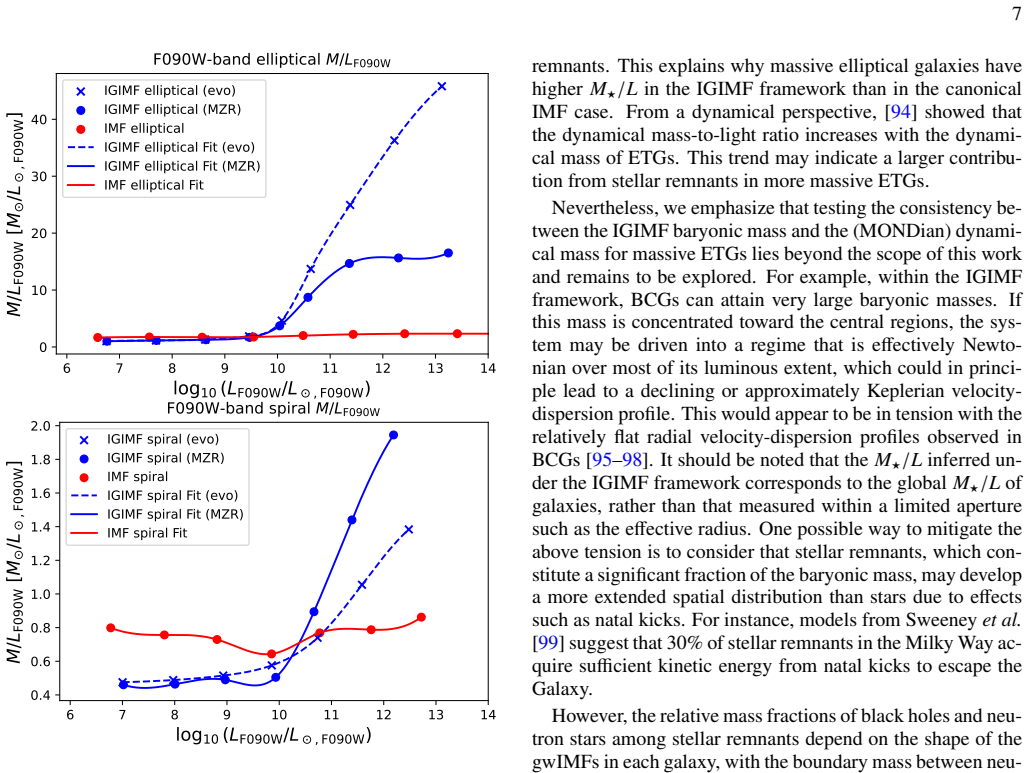
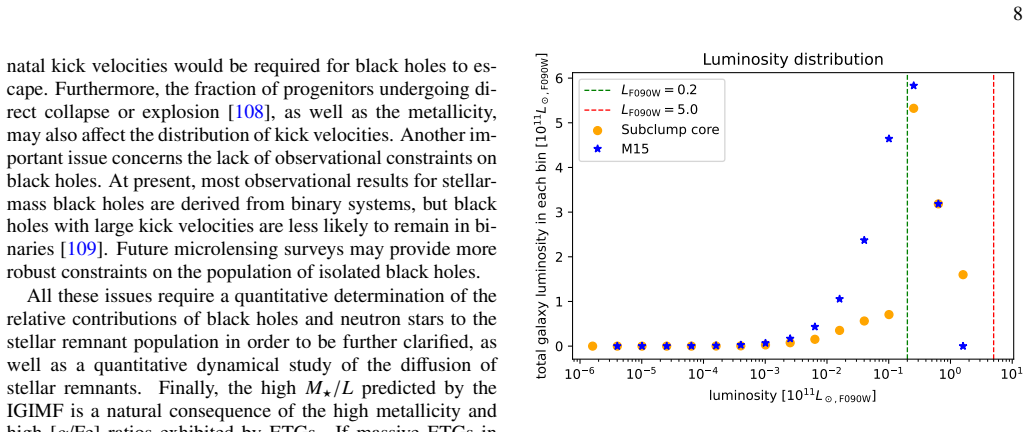
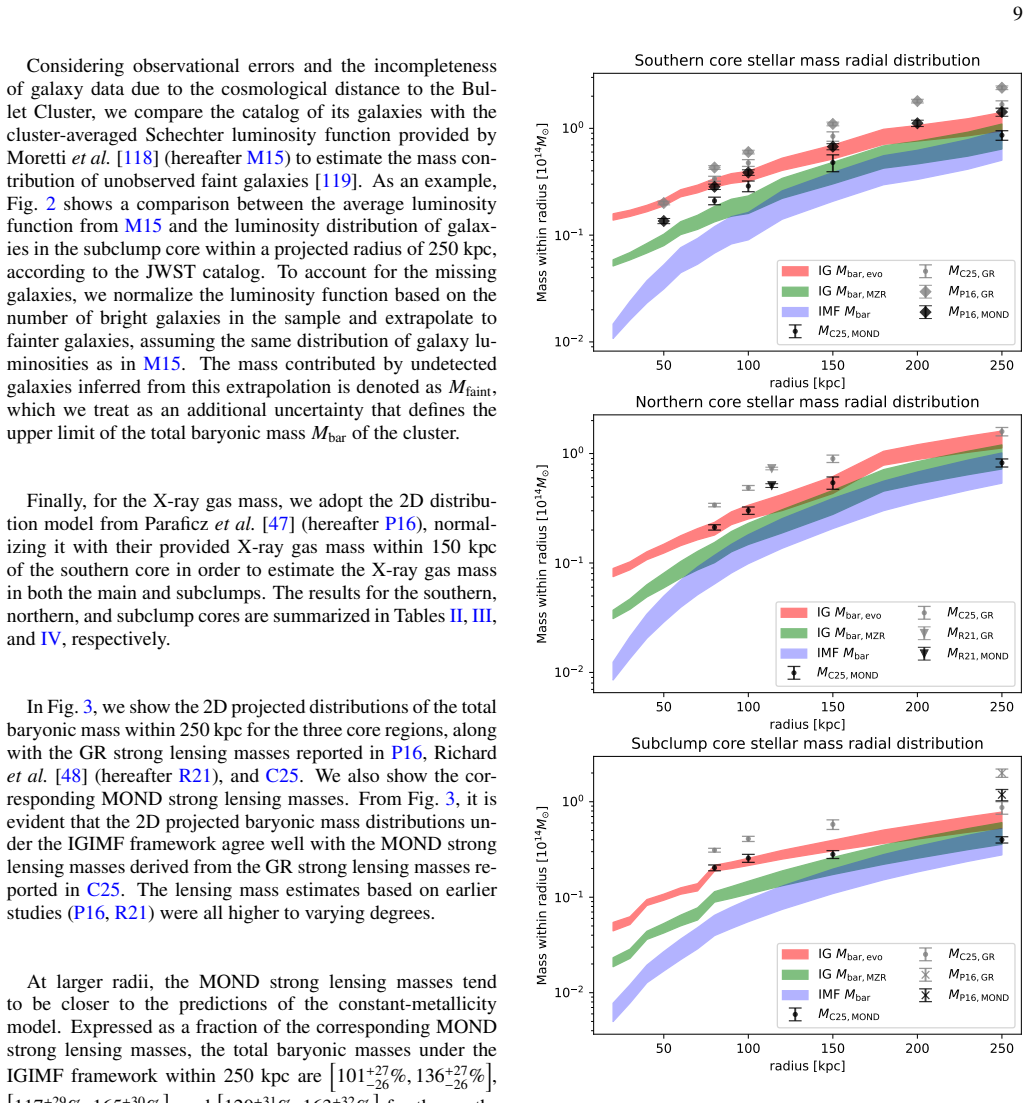
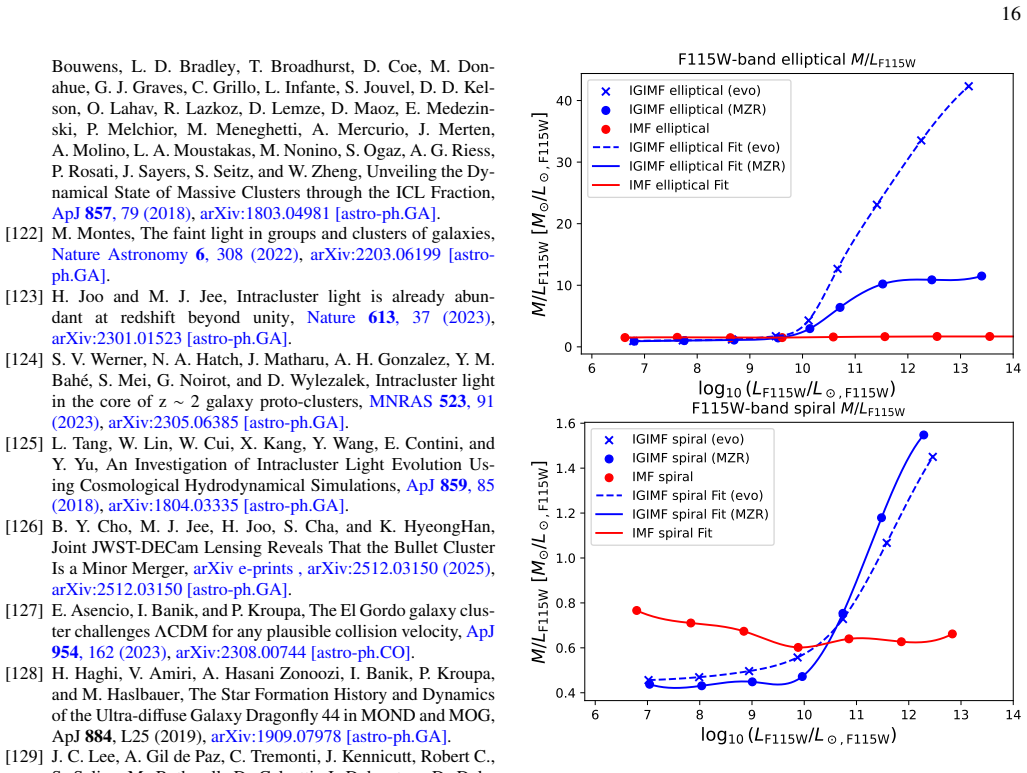
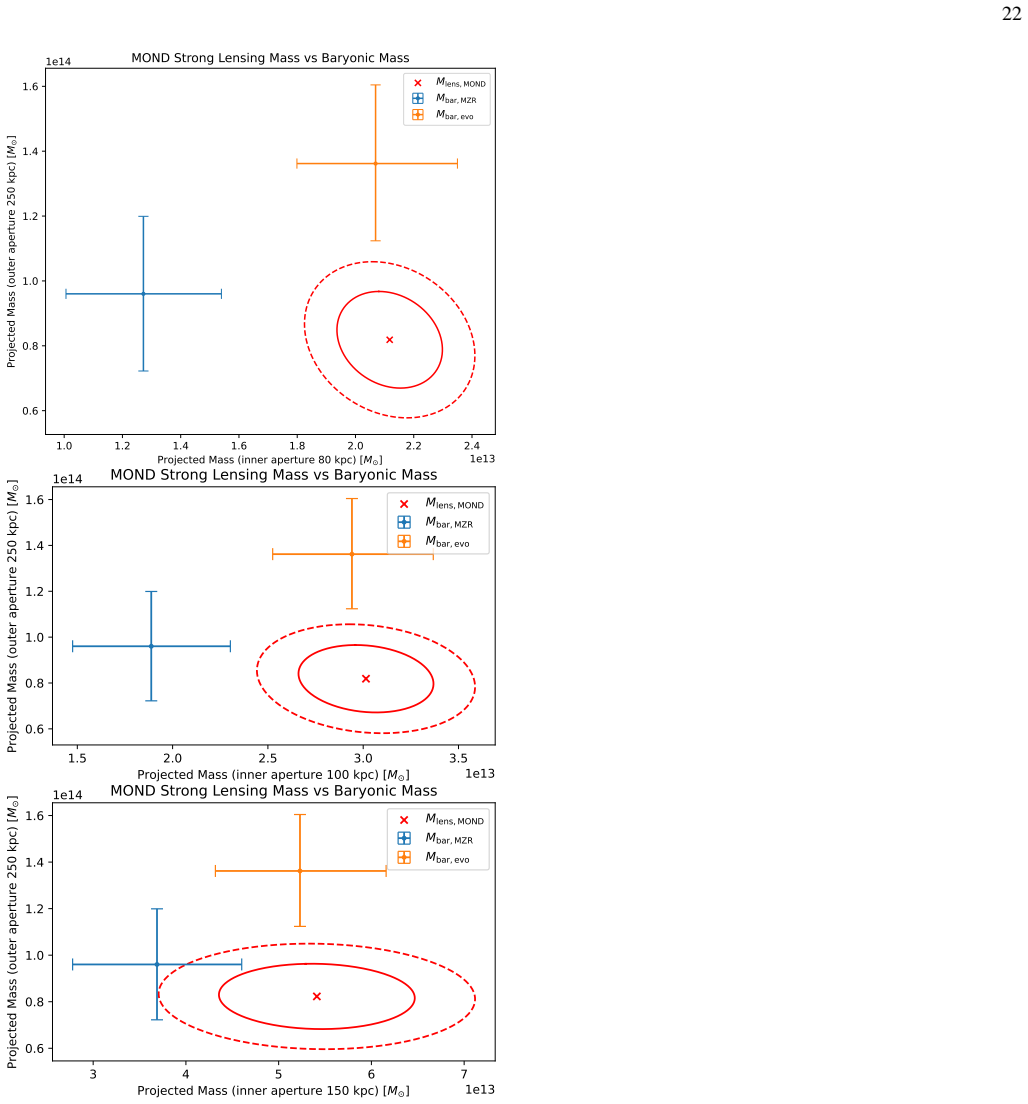
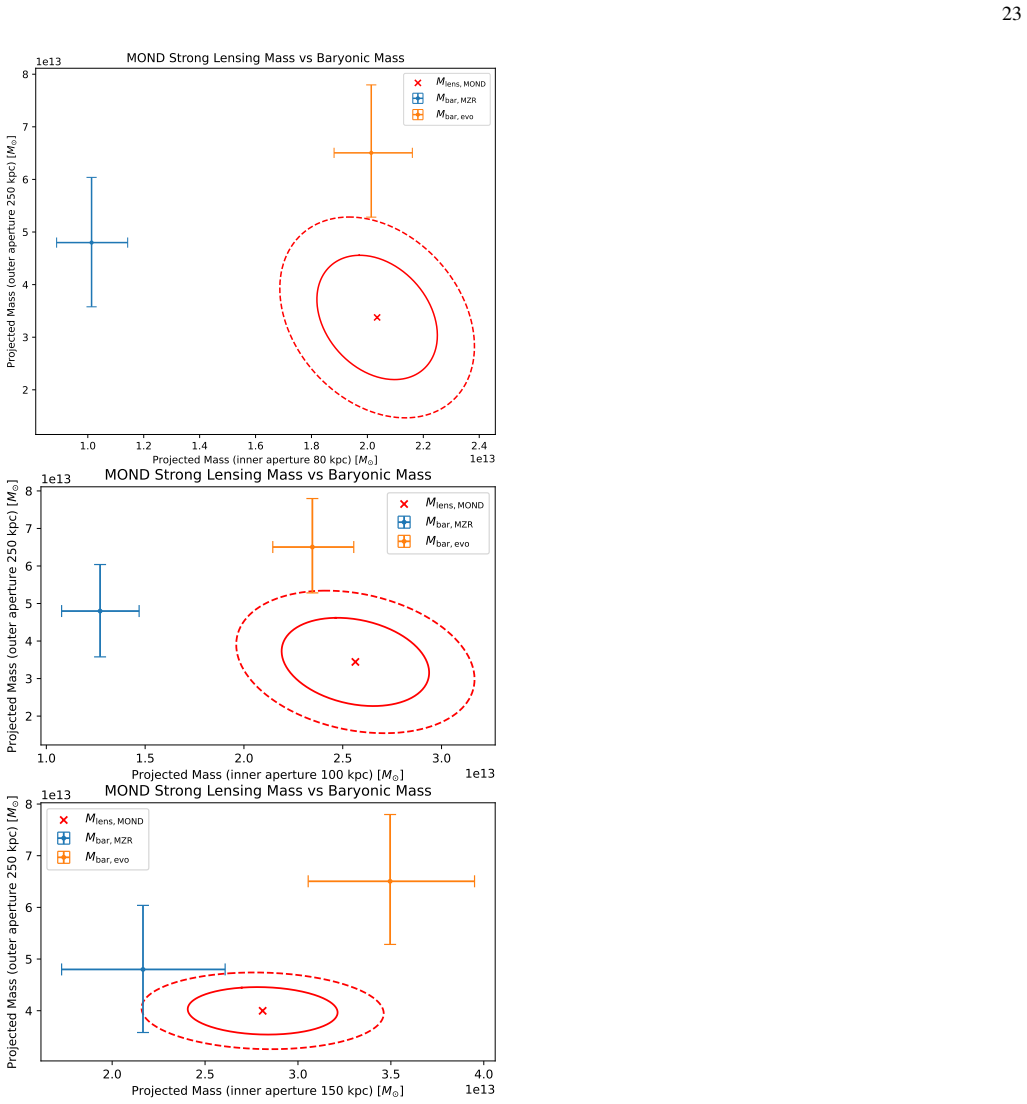
Using recent JWST photometry and stellar population synthesis models with constant and self-enriched metallicities as lower and upper limits, the baryonic masses predicted by IGIMF theory for the three BCG-centred cores encompass the MOND strong-lensing mass estimates.
What carries the argument
The integrated galaxy-wide initial mass function (IGIMF) theory, which predicts substantially higher baryonic masses by incorporating a top-heavy IMF for massive stars in high-metallicity, dense environments and the resulting stellar remnants.
If this is right
- The MOND strong-lensing masses of all three cores lie within the range predicted by the IGIMF models.
- The baryonic mass budget is consistent with MOND requirements from strong-lensing observations in the core regions.
- Regardless of MOND validity, less dark matter may be required than previously inferred from the lensing data.
- High observed metallicities imply a past stellar population dominated by massive stars whose remnants add significant baryonic mass.
Where Pith is reading between the lines
- If remnant distributions can be shown to align with lensing peaks, the scenario would extend to other merging clusters exhibiting similar mass offsets.
- Future high-resolution imaging of stellar remnant tracers could directly test whether the extra baryonic mass is located where lensing requires it.
- The same IGIMF adjustment might reduce inferred dark-matter fractions in other high-metallicity galaxy groups and clusters.
Load-bearing premise
The evolved stellar remnants must be spatially distributed and dynamically moving in a way that can produce the observed strong-lensing signal.
What would settle it
Dynamical simulations or direct observations showing that the remnant population cannot concentrate enough to reproduce the measured lensing mass peaks at the BCG locations.
Figures
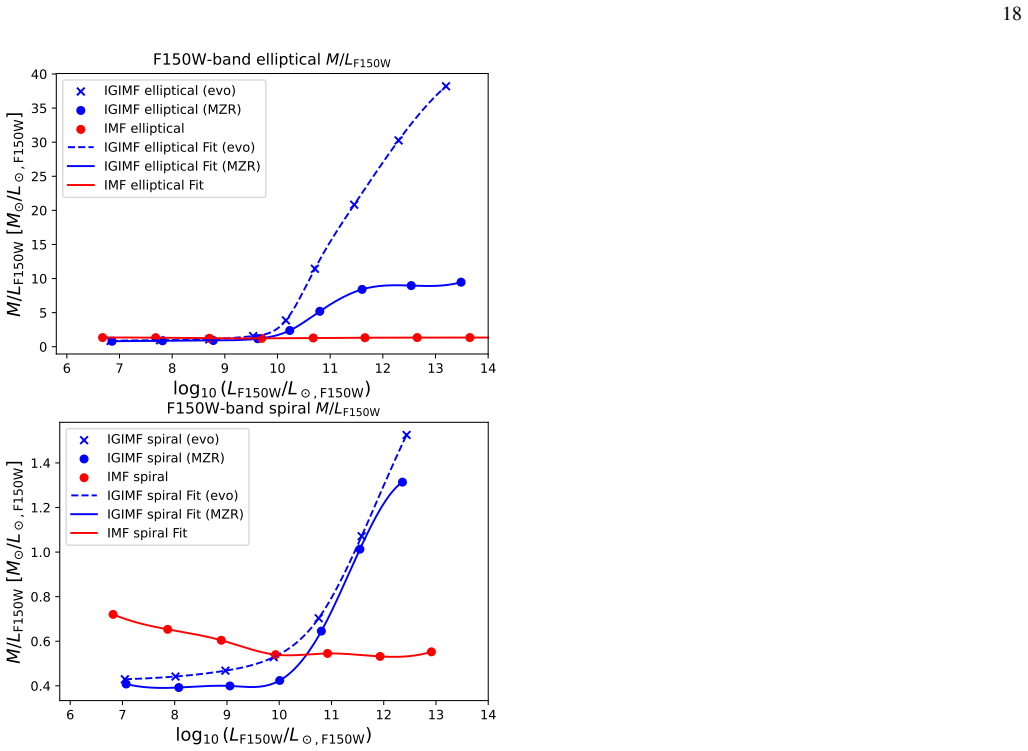
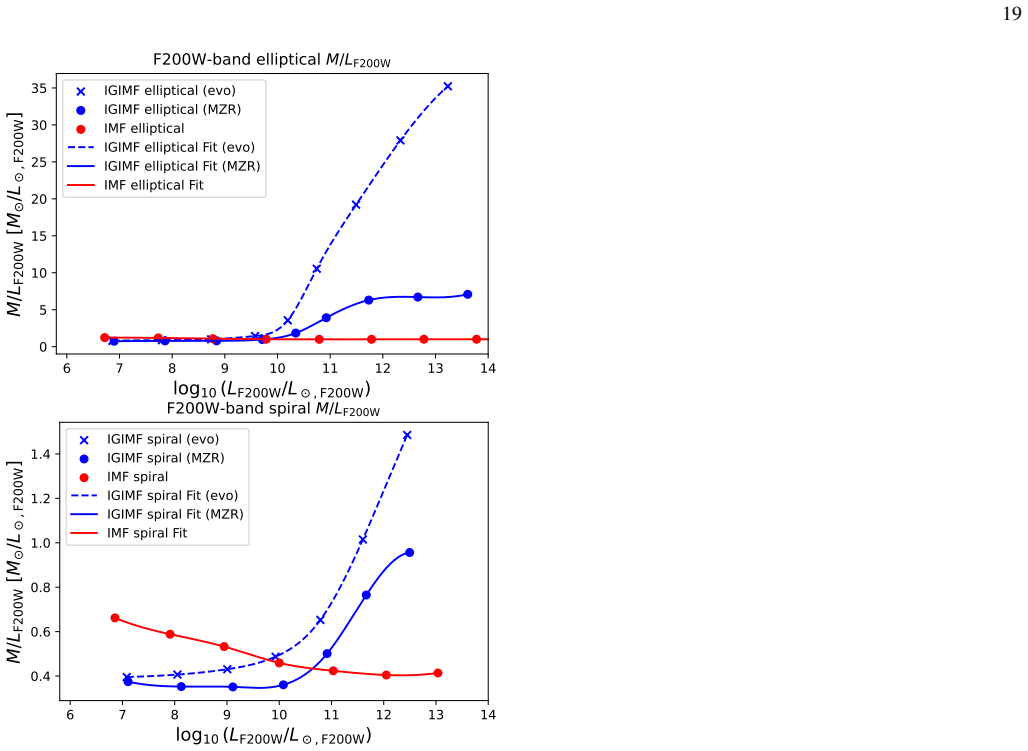
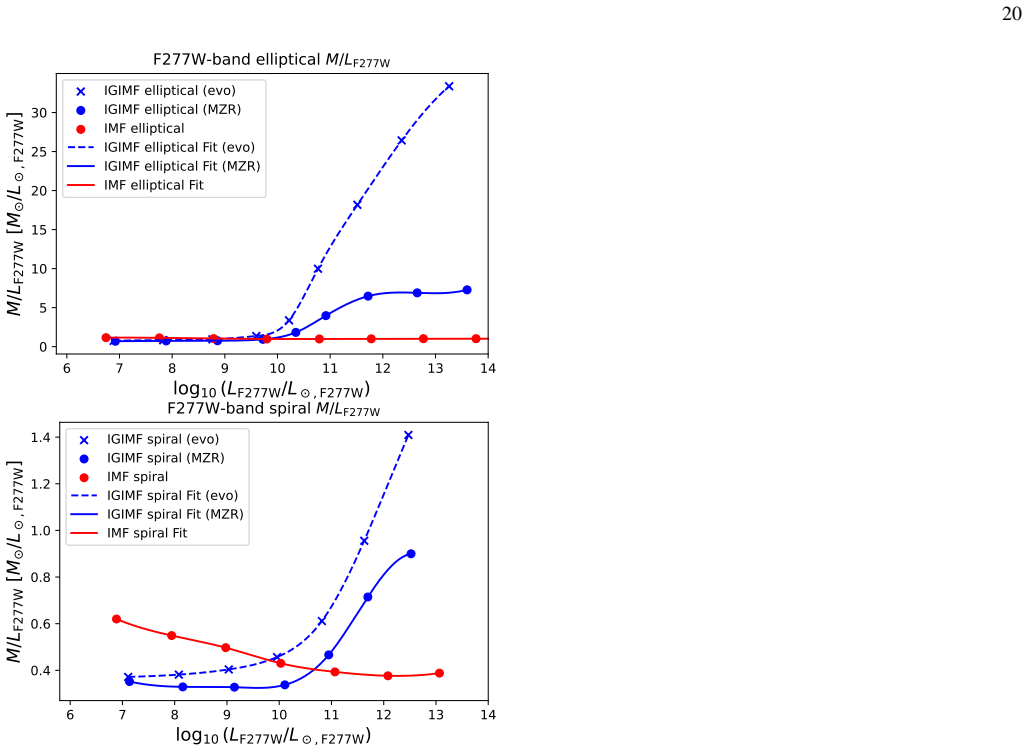
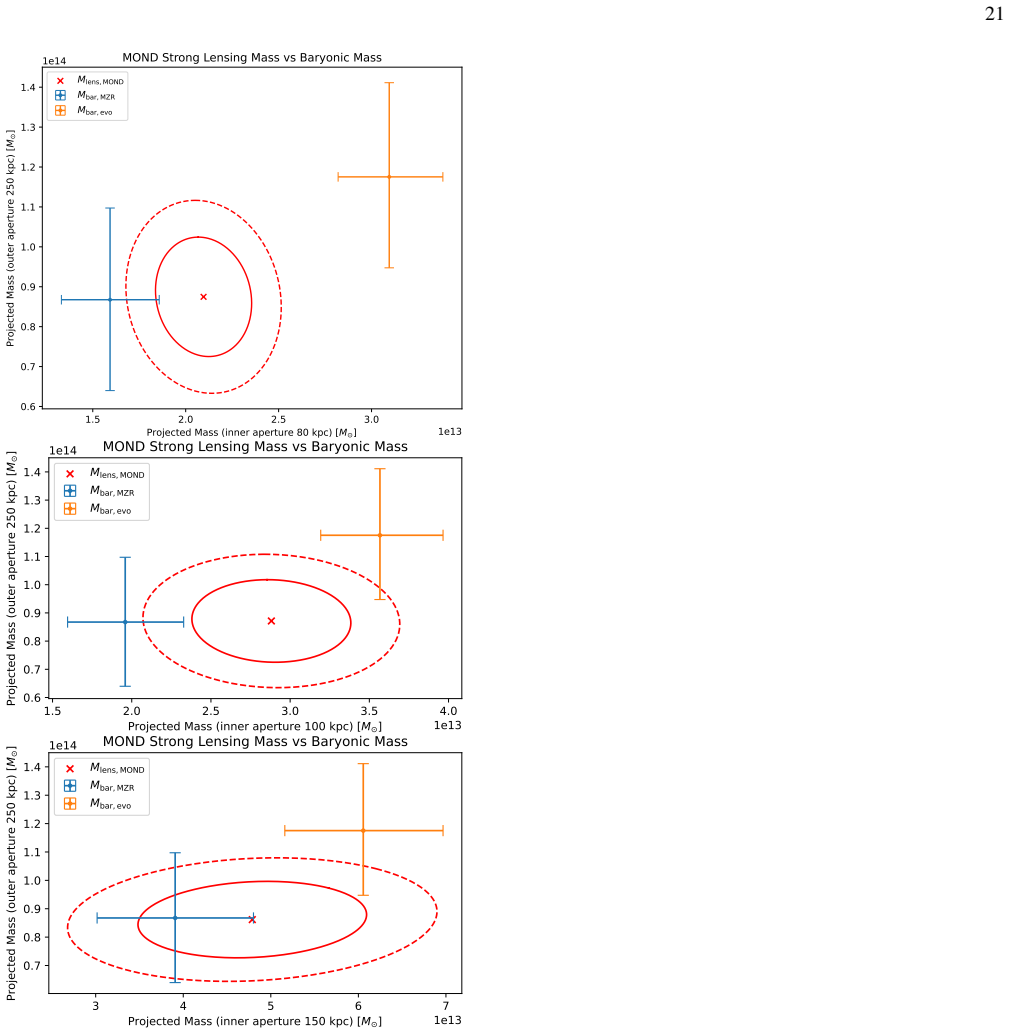
read the original abstract
Strong lensing observations of the Bullet Cluster have traditionally been regarded as strong evidence for dark matter and a major challenge to Milgromian dynamics (MOND). The offset between the lensing mass and the X-ray gas centroids implies a substantial amount of unseen mass near the brightest cluster galaxies (BCGs). However, the high metallicities observed in both the intracluster gas and the massive early-type member galaxies suggest a past stellar population dominated by massive stars, whose evolved remnants contribute additional baryonic mass. This effect is naturally incorporated in the integrated galaxy-wide initial mass function (IGIMF) theory, which predicts substantially larger baryonic masses than a canonical IMF. In this work, we re-estimate the baryonic masses of the three BCG-centred core regions of the Bullet Cluster using recent JWST photometry and compare them with MOND strong-lensing masses. We derive IGIMF masses using stellar population synthesis models with constant and (self-) enriched metallicities, representing lower and upper mass limits, respectively. We find that the MOND strong-lensing masses of all three cores lie within the range predicted by the IGIMF models. These results suggest that the baryonic mass budget is consistent with MOND requirements from strong-lensing observations in the core regions of the Bullet Cluster. However, the physical viability of this scenario also depends on the spatial distribution and dynamical behavior of the remnant population, which remain to be established. More generally, regardless of the validity of MOND, the results imply that less dark matter may be required than previously inferred.
Editorial analysis
A structured set of objections, weighed in public.
Referee Report
Summary. The paper claims that baryonic masses estimated for the three BCG cores in the Bullet Cluster using JWST photometry and IGIMF models (with constant and self-enriched metallicities as lower and upper bounds) encompass the masses inferred from strong lensing under MOND. This is taken to indicate consistency between the baryonic mass budget and MOND lensing requirements, with the caveat that the spatial distribution of stellar remnants must still be shown to reproduce the lensing signal. The work suggests that less dark matter may be required than previously inferred.
Significance. If the mass comparison is robust, this work would demonstrate that IGIMF theory can reconcile baryonic masses with MOND strong-lensing estimates in the Bullet Cluster cores, offering a potential baryonic explanation for what has been seen as a challenge to MOND. The incorporation of recent JWST data and the explicit acknowledgment of the untested distribution assumption are positive features. The result bears on the broader question of dark matter requirements in galaxy clusters.
major comments (2)
- [Abstract] Abstract: The statement that the MOND strong-lensing masses of all three cores 'lie within the range predicted by the IGIMF models' is made without accompanying error bars or uncertainty ranges on the lensing masses or the IGIMF bounds. This omission is load-bearing for assessing the robustness of the central consistency claim.
- [Abstract] Abstract: The consistency with strong lensing is asserted on the basis of total mass agreement alone. However, strong lensing constrains the projected surface density distribution rather than the integrated mass. The manuscript notes that the spatial distribution and dynamical behavior of the remnant population remain to be established but provides no test (e.g., via ray-tracing) of whether any distribution within the mass range can reproduce the observed lensing features. This is a load-bearing issue for the claim of consistency with strong lensing in MOND.
minor comments (1)
- The abstract would benefit from specifying the names or positions of the three BCG cores for improved clarity.
Simulated Author's Rebuttal
We thank the referee for the constructive comments on our manuscript. We address each major comment below and indicate where revisions will be made to improve clarity.
read point-by-point responses
-
Referee: [Abstract] Abstract: The statement that the MOND strong-lensing masses of all three cores 'lie within the range predicted by the IGIMF models' is made without accompanying error bars or uncertainty ranges on the lensing masses or the IGIMF bounds. This omission is load-bearing for assessing the robustness of the central consistency claim.
Authors: We agree that the abstract would benefit from explicit reference to the nature of the ranges. The IGIMF bounds are defined by the constant-metallicity (lower) and self-enriched (upper) cases, while the strong-lensing masses are taken directly from the cited literature values. In the revised version we will amend the abstract to state that the lensing masses lie within the IGIMF-derived bounds, with the detailed values and ranges provided in the main text and tables. revision: yes
-
Referee: [Abstract] Abstract: The consistency with strong lensing is asserted on the basis of total mass agreement alone. However, strong lensing constrains the projected surface density distribution rather than the integrated mass. The manuscript notes that the spatial distribution and dynamical behavior of the remnant population remain to be established but provides no test (e.g., via ray-tracing) of whether any distribution within the mass range can reproduce the observed lensing features. This is a load-bearing issue for the claim of consistency with strong lensing in MOND.
Authors: We concur that strong lensing constrains the projected distribution and that total mass agreement alone does not constitute a full reproduction of the lensing signal. The manuscript already states that the spatial distribution and dynamical behavior of the remnants remain to be established and limits its claim to the baryonic mass budget being consistent with the MOND-inferred total masses. A ray-tracing validation lies outside the scope of the present work, which focuses on the mass comparison using JWST photometry and IGIMF models; we will expand the discussion to reiterate this boundary explicitly. revision: partial
Circularity Check
No significant circularity; independent mass estimates compared
full rationale
The paper derives baryonic mass estimates for the Bullet Cluster cores from JWST photometry fed into IGIMF stellar-population synthesis models (an external framework) and compares the resulting range to MOND strong-lensing masses taken from prior observational literature. Neither quantity is obtained from the other inside this manuscript; the agreement is presented as an empirical consistency check rather than a derivation that reduces to its own inputs by construction. The paper explicitly flags that spatial distribution of remnants must still be verified, avoiding any claim that the numerical match alone proves the lensing signal. No self-citation load-bearing step, fitted-input prediction, or ansatz smuggling is present in the reported chain. This is the normal non-circular outcome for a comparative study against external benchmarks.
Axiom & Free-Parameter Ledger
free parameters (1)
- IGIMF metallicity enrichment parameter
axioms (2)
- domain assumption IGIMF theory correctly predicts a higher fraction of massive stars and therefore more remnants in dense, high-metallicity environments
- domain assumption Strong-lensing mass estimates under MOND are reliable once the baryonic distribution is known
Reference graph
Works this paper leans on
-
[1]
suggest that 30% of stellar remnants in the Milky Way ac- quire sufficient kinetic energy from natal kicks to escape the Galaxy. However, the relative mass fractions of black holes and neu- tron stars among stellar remnants depend on the shape of the gwIMFs in each galaxy, with the boundary mass between neu- tron stars and black holes depending also on th...
-
[2]
The short-to-long axis ratio>0.5
-
[3]
A galaxy is classified as an early-type (elliptical) galaxy if at least two of these three criteria are satisfied; otherwise, it is classified as a late-type (spiral) galaxy
The Sérsic index>2; and 3.m F606W −m F814W >1.2, wherem F606W andm F814W denote the observed apparent magnitudes in the Vega system in the F606W and F814W bands, respectively, withoutK-correction [113]. A galaxy is classified as an early-type (elliptical) galaxy if at least two of these three criteria are satisfied; otherwise, it is classified as a late-t...
-
[4]
(21) [40], which is based on the results of Thomaset al.[86] and McDermidet al.[87]
The SFTs of elliptical galaxies used in this work fol- low the empirical downsizing relation of Eq. (21) [40], which is based on the results of Thomaset al.[86] and McDermidet al.[87]. In reality, however, galaxies may experience longer and more complex SFTs due to en- vironmental processes, internal feedback, or continued gas accretion. Longer SFTs tend ...
-
[5]
Although this is supported as a dominant for- mation channel for massive ellipticals, real galaxies may also undergo mergers, tidal interactions, or ex- tended gas infall
The model further assumes that galaxies evolve as iso- lated systems forming through a pure downsizing se- quence. Although this is supported as a dominant for- mation channel for massive ellipticals, real galaxies may also undergo mergers, tidal interactions, or ex- tended gas infall. These processes generally prolong star formation and modify the pathwa...
-
[6]
Moreover, the ICL still remains an active topic of research, with both its definition and observational techniques still un- der development [see, e.g., 120]
pointed out that the fact that the hot gas is not in dynami- cal equilibrium can lead to overestimations in the X-ray mass. Moreover, the ICL still remains an active topic of research, with both its definition and observational techniques still un- der development [see, e.g., 120]. In our estimation, the ICL luminosity fraction accounts for about 20–30% o...
-
[7]
W. Tucker, P. Blanco, S. Rappoport, L. David, D. Fabri- cant, E. E. Falco, W. Forman, A. Dressler, and M. Ramella, 1E 0657-56: A Contender for the Hottest Known Cluster of Galaxies, ApJ496, L5 (1998), arXiv:astro-ph/9801120 [astro- ph]
Pith/arXiv arXiv 1998
- [8]
-
[9]
Efstathiou, W
G. Efstathiou, W. J. Sutherland, and S. J. Maddox, The cosmo- logical constant and cold dark matter, Nature348, 705 (1990)
1990
-
[10]
J. P. Ostriker and P. J. Steinhardt, The observational case for a low-density Universe with a non-zero cosmological constant, Nature377, 600 (1995)
1995
-
[11]
Milgrom, A modification of the Newtonian dynamics as a possible alternative to the hidden mass hypothesis, ApJ270, 365 (1983)
M. Milgrom, A modification of the Newtonian dynamics as a possible alternative to the hidden mass hypothesis, ApJ270, 365 (1983)
1983
-
[12]
Bekenstein and M
J. Bekenstein and M. Milgrom, Does the missing mass prob- lem signal the breakdown of Newtonian gravity?, ApJ286, 7 (1984)
1984
-
[13]
K. G. Begeman, A. H. Broeils, and R. H. Sanders, Extended rotation curves of spiral galaxies - Dark haloes and modified dynamics, MNRAS249, 523 (1991)
1991
-
[14]
G. Gentile, B. Famaey, and W. J. G. de Blok, THINGS about MOND, A&A527, A76 (2011), arXiv:1011.4148 [astro- ph.CO]
Pith/arXiv arXiv 2011
-
[15]
S. S. McGaugh, F. Lelli, and J. M. Schombert, Radial Accel- eration Relation in Rotationally Supported Galaxies, Physical Review Letters117, 201101 (2016), arXiv:1609.05917 [astro- ph.GA]
Pith/arXiv arXiv 2016
-
[16]
B. Famaey and S. S. McGaugh, Modified Newtonian Dynam- ics (MOND): Observational Phenomenology and Relativis- tic Extensions, Living Reviews in Relativity15, 10 (2012), arXiv:1112.3960
Pith/arXiv arXiv 2012
-
[17]
I. Banik and H. Zhao, From Galactic Bars to the Hubble Ten- sion: Weighing Up the Astrophysical Evidence for Milgro- mian Gravity, Symmetry14, 1331 (2022), arXiv:2110.06936 [astro-ph.CO]
arXiv 2022
-
[18]
P. Kroupa, E. Gjergo, E. Asencio, M. Haslbauer, J. Pflamm- Altenburg, N. Wittenburg, N. Samaras, I. Thies, and W. Oehm, The many tensions with dark-matter based models and impli- cations on the nature of the Universe, inSchool and Work- shops on Elementary Particle Physics and Gravity(2023) p. 231, arXiv:2309.11552 [astro-ph.CO]
arXiv 2023
-
[19]
L. S. The and S. D. M. White, Modified Newtonian Dymanics and the Coma Cluster, AJ95, 1642 (1988)
1988
-
[20]
Gerbal, F
D. Gerbal, F. Durret, M. Lachieze-Rey, and G. Lima-Neto, Analysis of X-ray galaxy clusters in the framework of modi- fied Newtonian dynamics., A&A262, 395 (1992)
1992
-
[21]
R. H. Sanders, The Virial Discrepancy in Clusters of Galaxies in the Context of Modified Newtonian Dynamics, ApJ512, L23 (1999), arXiv:astro-ph/9807023 [astro-ph]
Pith/arXiv arXiv 1999
-
[22]
R. H. Sanders, Clusters of galaxies with modified Newtonian dynamics, MNRAS342, 901 (2003), astro-ph/0212293
Pith/arXiv arXiv 2003
-
[23]
E. Pointecouteau and J. Silk, New constraints on modified Newtonian dynamics from galaxy clusters, MNRAS364, 654 (2005), arXiv:astro-ph/0505017 [astro-ph]
Pith/arXiv arXiv 2005
-
[24]
P. Natarajan and H. Zhao, MOND plus classical neutrinos are not enough for cluster lensing, MNRAS389, 250 (2008), arXiv:0806.3080 [astro-ph]
Pith/arXiv arXiv 2008
-
[25]
G. W. Angus, Dwarf spheroidals in MOND, MNRAS387, 1481 (2008), arXiv:0804.3812 [astro-ph]
Pith/arXiv arXiv 2008
-
[26]
S. Ettori, V . Ghirardini, D. Eckert, E. Pointecouteau, F. Gastaldello, M. Sereno, M. Gaspari, S. Ghizzardi, M. Ron- carelli, and M. Rossetti, Hydrostatic mass profiles in X-COP galaxy clusters, A&A621, A39 (2019), arXiv:1805.00035 [astro-ph.CO]
Pith/arXiv arXiv 2019
- [27]
-
[28]
R. Kelleher and F. Lelli, Galaxy clusters in Milgromian dy- namics: Missing matter, hydrostatic bias, and the external field effect, A&A688, A78 (2024), arXiv:2405.08557 [astro- ph.CO]
arXiv 2024
-
[29]
G. W. Angus, Is an 11eV sterile neutrino consistent with clus- ters, the cosmic microwave background and modified Newto- nian dynamics?, MNRAS394, 527 (2009), arXiv:0805.4014
Pith/arXiv arXiv 2009
-
[30]
H. Katz, S. McGaugh, P. Teuben, and G. W. Angus, Galaxy Cluster Bulk Flows and Collision Velocities in QUMOND, 13 ApJ772, 10 (2013), arXiv:1305.3651 [astro-ph.CO]
Pith/arXiv arXiv 2013
-
[31]
N. Wittenburg, P. Kroupa, I. Banik, G. Candlish, and N. Sama- ras, Hydrodynamical structure formation in Milgromian cos- mology, MNRAS523, 453 (2023), arXiv:2305.05696 [astro- ph.CO]
arXiv 2023
-
[32]
N. Samaras, S. Grandis, and P. Kroupa, On the initial condi- tions of theνHDM cosmological model, MNRAS541, 784 (2025), arXiv:2506.19196 [astro-ph.CO]
arXiv 2025
-
[33]
A. Russell, I. Banik, O. Cray, and H. Zhao, How does a MOND cosmology fare on Gpc scales? - Collisionless N-body simulations ofνHDM, Mon. Not. R. Astron. Soc. 10.1093/mn- ras/stag399 (2026), arXiv:2602.21975 [astro-ph.CO]
work page doi:10.1093/mn- 2026
-
[34]
G. W. Angus, B. Famaey, and A. Diaferio, Equilibrium config- urations of 11 eV sterile neutrinos in MONDian galaxy clus- ters, MNRAS402, 395 (2010), arXiv:0906.3322
Pith/arXiv arXiv 2010
-
[35]
M. Haslbauer, I. Banik, and P. Kroupa, The KBC void and Hubble tension contradictΛCDM on a Gpc scale - Milgro- mian dynamics as a possible solution, MNRAS499, 2845 (2020), arXiv:2009.11292 [astro-ph.CO]
arXiv 2020
-
[36]
M. Haslbauer, I. Banik, P. Kroupa, H. Zhao, and E. Asencio, The Magellanic Clouds Are Very Rare in the IllustrisTNG Simulations, Universe10, 385 (2024), arXiv:2409.17259 [astro-ph.GA]
arXiv 2024
-
[37]
X. Hernandez and P. Kroupa, Dynamical Friction Constraints on the Dark Matter Hypothesis Across Astronomical Scales, Universe11, 367 (2025), arXiv:2511.03776 [astro-ph.GA]
arXiv 2025
- [38]
-
[39]
E. Asencio, I. Banik, S. Mieske, A. Venhola, P. Kroupa, and H. Zhao, The distribution and morphologies of Fornax Cluster dwarf galaxies suggest they lack dark matter, MNRAS515, 2981 (2022), arXiv:2208.02265 [astro-ph.GA]
arXiv 2022
-
[40]
J. Pflamm-Altenburg, Asymmetry in the tidal tails of open star clusters from direct N-body integrations in Milgrom-law dynamics, A&A693, A127 (2025), arXiv:2411.13675 [astro- ph.GA]
arXiv 2025
-
[41]
M. Markevitch, A. H. Gonzalez, L. David, A. Vikhlinin, S. Murray, W. Forman, C. Jones, and W. Tucker, A Text- book Example of a Bow Shock in the Merging Galaxy Clus- ter 1E 0657-56, ApJ567, L27 (2002), arXiv:astro-ph/0110468 [astro-ph]
Pith/arXiv arXiv 2002
-
[42]
A. E. Blackwell, J. N. Bregman, and S. L. Snowden, The Missing Metal Problem in Galaxy Clusters: Characteriz- ing the Early Enrichment Population, ApJ927, 104 (2022), arXiv:2105.04638 [astro-ph.GA]
arXiv 2022
-
[43]
P. Kroupa and C. Weidner, Galactic-Field Initial Mass Func- tions of Massive Stars, ApJ598, 1076 (2003), arXiv:astro- ph/0308356 [astro-ph]
arXiv 2003
-
[44]
Kroupa, On the variation of the initial mass function, MN- RAS322, 231 (2001), astro-ph/0009005
P. Kroupa, On the variation of the initial mass function, MN- RAS322, 231 (2001), astro-ph/0009005
Pith/arXiv arXiv 2001
-
[45]
T. Je ˇrábková, A. Hasani Zonoozi, P. Kroupa, G. Beccari, Z. Yan, A. Vazdekis, and Z. Y . Zhang, Impact of metallic- ity and star formation rate on the time-dependent, galaxy- wide stellar initial mass function, A&A620, A39 (2018), arXiv:1809.04603 [astro-ph.GA]
Pith/arXiv arXiv 2018
-
[46]
Z. Yan, T. Je ˇrábková, and P. Kroupa, Downsizing revised: Star formation timescales for elliptical galaxies with an environment-dependent IMF and a number of SNIa, A&A 655, A19 (2021), arXiv:2107.03388 [astro-ph.GA]
arXiv 2021
-
[47]
A. H. Zonoozi, H. Haghi, and P. Kroupa, Stellar population synthesis models with a physically varying IMF, MNRAS 537, 2782 (2025), arXiv:2502.03529 [astro-ph.GA]
arXiv 2025
- [48]
-
[49]
M. Loewenstein, Perspectives on Intracluster Enrichment and the Stellar Initial Mass Function in Elliptical Galaxies, ApJ 773, 52 (2013), arXiv:1301.3200 [astro-ph.CO]
Pith/arXiv arXiv 2013
-
[50]
D. Kraljic and S. Sarkar, How rare is the Bullet Cluster (in a ΛCDM universe)?, JCAP4, 050, arXiv:1412.7719
-
[51]
Asencio, I
E. Asencio, I. Banik, and P. Kroupa, A massive blow for ΛCDM - the high redshift, mass, and collision velocity of the interacting galaxy cluster El Gordo contradicts concordance cosmology, MNRAS500, 5249 (2021)
2021
-
[52]
S. Cha, B. Y . Cho, H. Joo, W. Lee, K. HyeongHan, Z. P. Scofield, K. Finner, and M. J. Jee, A High-Caliber View of the Bullet Cluster through JWST Strong and Weak Lensing Analyses, ApJL987, L15 (2025), arXiv:2503.21870 [astro- ph.GA]
arXiv 2025
-
[53]
D. Paraficz, J. P. Kneib, J. Richard, A. Morandi, M. Limousin, E. Jullo, and J. Martinez, The Bullet cluster at its best: weigh- ing stars, gas, and dark matter, A&A594, A121 (2016), arXiv:1209.0384 [astro-ph.CO]
Pith/arXiv arXiv 2016
-
[54]
J. Richard, A. Claeyssens, D. Lagattuta, L. Guaita, F. E. Bauer, R. Pello, D. Carton, R. Bacon, G. Soucail, G. P. Lyon, J.-P. Kneib, G. Mahler, B. Clément, W. Mercier, A. Variu, A. Tamone, H. Ebeling, K. B. Schmidt, T. Nanayakkara, M. Maseda, P. M. Weilbacher, N. Bouché, R. J. Bouwens, L. Wisotzki, G. de la Vieuville, J. Martinez, and V . Patrício, An atl...
arXiv 2021
-
[55]
Einstein, Die Feldgleichungen der Gravitation, Sitzungs- berichte der Königlich Preußischen Akademie der Wis- senschaften (Berlin)6, 844 (1915)
A. Einstein, Die Feldgleichungen der Gravitation, Sitzungs- berichte der Königlich Preußischen Akademie der Wis- senschaften (Berlin)6, 844 (1915)
1915
-
[56]
J. D. Bekenstein, Relativistic gravitation theory for the mod- ified Newtonian dynamics paradigm, Physical Review D70, 083509 (2004), astro-ph/0403694
Pith/arXiv arXiv 2004
-
[57]
Virgo & LIGO Collaborations, GW170817: Observa- tion of Gravitational Waves from a Binary Neutron Star Inspiral, Physical Review Letters119, 161101 (2017), arXiv:1710.05832 [gr-qc]
Pith/arXiv arXiv 2017
-
[58]
C. Skordis and T. Zło ´snik, Gravitational alternatives to dark matter with tensor mode speed equaling the speed of light, Physical Review D100, 104013 (2019), arXiv:1905.09465 [gr-qc]
arXiv 2019
-
[59]
G. W. Angus, H. Y . Shan, H. S. Zhao, and B. Famaey, On the Proof of Dark Matter, the Law of Gravity, and the Mass of Neutrinos, ApJ654, L13 (2007), astro-ph/0609125
Pith/arXiv arXiv 2007
-
[60]
T. Bernal, S. Capozziello, J. C. Hidalgo, and S. Mendoza, Re- covering MOND from extended metric theories of gravity, Eu- ropean Physical Journal C71, 1794 (2011), arXiv:1108.5588 [astro-ph.CO]
Pith/arXiv arXiv 2011
-
[61]
C. Skordis and T. Zło´snik, New Relativistic Theory for Mod- ified Newtonian Dynamics, Physical Review Letters127, 161302 (2021), arXiv:2007.00082 [astro-ph.CO]
arXiv 2021
-
[62]
R. Monjo, Galaxy rotation curve in hyperconical universes: a natural relativistic MOND, Classical and Quantum Gravity40, 235002 (2023), arXiv:2410.05477 [gr-qc]
arXiv 2023
-
[63]
R. Monjo, Hydrostatic Equilibrium Constraints in X-COP Galaxy Clusters: Testing Hyperconical Modified Grav- ity in Hot-gas-dominated Regions, ApJ981, 195 (2025), arXiv:2408.08102 [astro-ph.CO]
arXiv 2025
-
[64]
R. Monjo and I. Banik, Distinct Acceleration Relations of Galaxies and Galaxy Clusters from Hyperconical Modi- 14 fied Gravity, ApJ992, 35 (2025), arXiv:2405.10019 [astro- ph.CO]
arXiv 2025
-
[65]
H. C. Plummer, On the problem of distribution in globular star clusters, MNRAS71, 460 (1911)
1911
-
[66]
I. Ferreras, M. Sakellariadou, and M. F. Yusaf, Necessity of Dark Matter in Modified Newtonian Dynamics within Galactic Scales, Physical Review Letters100, 031302 (2008), arXiv:0709.3189 [astro-ph]
Pith/arXiv arXiv 2008
-
[67]
I. Ferreras, N. E. Mavromatos, M. Sakellariadou, and M. F. Yusaf, Confronting MOND and TeVeS with strong gravita- tional lensing over galactic scales: An extended survey, Phys- ical Review D86, 083507 (2012), arXiv:1205.4880 [astro- ph.CO]
Pith/arXiv arXiv 2012
-
[68]
Z. Chang, M.-H. Li, X. Li, H.-N. Lin, and S. Wang, Finslerian MOND versus the strong gravitational lensing of the early- type galaxies, European Physical Journal C73, 2550 (2013), arXiv:1309.1343 [astro-ph.GA]
Pith/arXiv arXiv 2013
-
[69]
B. Famaey and J. Binney, Modified Newtonian dynamics in the Milky Way, MNRAS363, 603 (2005), astro-ph/0506723
Pith/arXiv arXiv 2005
- [70]
-
[71]
A. Hees, W. M. Folkner, R. A. Jacobson, and R. S. Park, Con- straints on modified Newtonian dynamics theories from radio tracking data of the Cassini spacecraft, Physical Review D89, 102002 (2014), arXiv:1402.6950 [gr-qc]
Pith/arXiv arXiv 2014
-
[72]
A. Hees, B. Famaey, G. W. Angus, and G. Gentile, Combined Solar system and rotation curve constraints on MOND, MN- RAS455, 449 (2016), arXiv:1510.01369
Pith/arXiv arXiv 2016
-
[73]
H. Desmond, A. Hees, and B. Famaey, On the tension between the radial acceleration relation and Solar system quadrupole in modified gravity MOND, MNRAS530, 1781 (2024), arXiv:2401.04796 [astro-ph.GA]
arXiv 2024
-
[74]
D. V okrouhlický, D. Nesvorný, and S. Tremaine, Testing MOND on Small Bodies in the Remote Solar System, ApJ 968, 47 (2024), arXiv:2403.09555 [astro-ph.CO]
arXiv 2024
-
[75]
P. Kroupa, The Initial Mass Function of Stars: Evidence for Uniformity in Variable Systems, Science295, 82 (2002), arXiv:astro-ph/0201098 [astro-ph]
Pith/arXiv arXiv 2002
-
[76]
E. Gjergo, Z.-Y . Zhang, P. Kroupa, A. Sorokin, Z. Yan, Z. Guo, T. Jerabkova, A. H. Zonoozi, and H. Haghi, Massive Star For- mation at Supersolar Metallicities: Constraints on the Initial Mass Function, Research in Astronomy and Astrophysics26, 025003 (2026), arXiv:2509.20440 [astro-ph.GA]
arXiv 2026
-
[77]
M. Haslbauer, Z. Yan, T. Jerabkova, E. Gjergo, P. Kroupa, and A. Hasani Zonoozi, The effect of the environment- dependent stellar initial mass function on the photometric properties of star-forming galaxies, A&A689, A221 (2024), arXiv:2405.05313 [astro-ph.GA]
arXiv 2024
-
[78]
A. H. Zonoozi, H. Haghi, P. Kroupa, S. Yousefizadeh, Z. Yan, T. Jerabkova, and E. Gjergo, The effect of the environment-dependent stellar initial mass function on the baryonic Tully–Fisher relation, MNRAS542, 1864 (2025), arXiv:2507.12521 [astro-ph.GA]
arXiv 2025
- [79]
-
[80]
Z. Yan, T. Jerabkova, and P. Kroupa, Chemical evolution of ultra-faint dwarf galaxies in the self-consistently calcu- lated integrated galactic IMF theory, A&A637, A68 (2020), arXiv:2003.11029 [astro-ph.GA]
arXiv 2020
discussion (0)
Sign in with ORCID, Apple, or X to comment. Anyone can read and Pith papers without signing in.