REVIEW 3 major objections 5 minor 142 references
Multiwavelength study of observed and predicted pulsation properties of First overtone Cepheids in the Magellanic Clouds
T0 review · 3 major / 5 minor · reviewed 2026-08-15 · deepseek-v4-flash
Pith's one-line read First-overtone Cepheids in the Magellanic Clouds show statistically significant break-points near 2.5 days in period-colour, period-luminosity, and amplitude-colour relations, plus a 0.58-day break for LMC stars, so the relations need…
desk verdict A solid multiwavelength extension of known FO Cepheid break-points with a large but preliminary MESA-RSP grid, whose central statistical claim is weakened by data-driven break-point selection tested with fixed-location F-tests. read the letter →
The pith
A machine-rendered reading of the paper's core claim, the machinery that carries it, and where it could break.
The reading
What carries the argument
The argument is carried by segmented (piecewise) regression with an F-test that compares a single straight line against two lines separated at a fitted break-point, applied to mean-light colours and magnitudes in seven bands; the statistical machinery identifies the break locations and the F-test decides significance. On the theoretical side, the machinery is a grid of about one thousand non-linear, full-amplitude stable pulsation models computed for LMC and SMC chemical compositions with two convective parameter sets, from which the same PC/PL/AC relations are built and compared to observations using $t$-tests on slopes. The physical link connecting the relations is the Stefan–Boltzmann relation $\log T_{\max} - \log T_{\min} = (V_{\max}-V_{\min})/10$, which connects a flat period–colour relation to the observed amplitude–colour correlations at maximum and minimum light.
What would settle it
Recompute the period–colour, period–luminosity, and amplitude–colour relations using an independent reddening estimate (for example, per-star spectral-energy-distribution fits or a different reddening map) and check whether the F-test still rejects a single straight line at $P \simeq 2.5$ d and $P \simeq 0.58$ d; an even cleaner test would be a larger sample of SMC first-overtone Cepheids with $P < 0.58$ d, since the paper notes that only about 2% of its SMC sample lies there, so the absence of a 0.58-d break in the SMC is currently underpowered.
Extended reading notes
Core claim
On the paper's own terms, the central discovery is that the period–colour, period–luminosity, and amplitude–colour relations of first-overtone Cepheids in the LMC and SMC are piecewise rather than single straight lines. Piecewise regression identifies break-points near $P = 2.5$ d across all seven photometric bands ($V$, $I$, $G$, $G_{RP}$, $Y$, $J$, $K_s$), with the exact location varying slightly from band to band (for example, 2.39–2.75 d in the SMC), and F-tests reject the single-line null hypothesis at the 95% confidence level for most colour indices and bands. For LMC first-overtone Cepheids, a further break-point near $P = 0.58$ d appears in the $V$, $I$, $Y$, $J$, and $K_s$ bands, and the period–colour slopes in the interval $0.58 < P < 2.5$ d are shallow in $V-I$, $V-G$, and $V-G_{RP}$ while steeper outside. Non-linear full-amplitude pulsation models with two convection prescriptions reproduce the break near $P = 2.5$ d in the theoretical PC/PL/AC relations, and the observed flat PC slope is tied to the narrow width of the colour–magnitude diagram in that period range.
Load-bearing premise
The load-bearing assumption is that the adopted reddening map and the fixed extinction law with $R_V = 3.23$ correctly de-redden every star; if the true reddening is systematically different for Magellanic Cloud stars, the colours and magnitudes shift and the break-points could move or disappear.
Editorial extensions
If this is right
- Distance moduli derived from first-overtone Cepheid period–luminosity relations must use separate calibrations for $P < 2.5$ d and $P > 2.5$ d, and for LMC stars also for $P < 0.58$ d, otherwise the distance scale will carry a systematic bias.
- The break near $P = 2.5$ d is a physical feature of first-overtone pulsation, not an artifact of the samples, because non-linear models with the same convection physics reproduce it in the theoretical PC/PL/AC relations.
- The SMC's first-overtone Cepheids have systematically higher $V$-band amplitudes than the LMC's (mean amplitude about 0.47 mag versus two LMC components near 0.30 and 0.38 mag), supporting a metallicity–amplitude connection across the Clouds.
- The flat period–colour slope of LMC first-overtone Cepheids between $0.58$ and $2.5$ days implies a narrow colour–magnitude-diagram width in that interval: stars there share nearly the same colour despite different periods and magnitudes.
Reading between the lines
- If the break-points are real, then single-slope period–luminosity calibrations for first-overtone Cepheids in other metal-poor galaxies would also be biased; re-fitting published PL relations piecewise could shift distance estimates to the LMC and SMC by a few percent, which matters for the local distance ladder.
- The band-to-band variation of the break location (about 2.39–2.75 d in the SMC) suggests the transition is gradual rather than a sharp period cut; a testable extension is to check whether the break position tracks the wavelength-dependent depth of the hydrogen ionization front or the $P_1/P_4 = 2$ resonance near $P \simeq 4$ d.
- The paper excludes theoretical models with $P < 0.58$ d; extending the same non-linear grid to shorter periods would show whether the 0.58-d break is also present in the models, providing a sharper test of the proposed first-to-second-crossing explanation.
Signed reviews
Editorial analysis
A structured set of objections, weighed in public.
Referee Report
Summary. This paper presents a multiwavelength empirical and theoretical study of first-overtone (FO) Cepheids in the Large and Small Magellanic Clouds. The observational analysis uses OGLE-IV optical, Gaia DR3, and VMC near-infrared light curves, with Fourier decomposition, 3-sigma clipping, and dereddening via the Skowron et al. (2021) map and a Cardelli et al. (1989) law. The authors fit period-amplitude, period-colour, period-luminosity, and amplitude-colour relations at maximum, minimum, and mean light, and use piecewise regression with F-tests to claim statistically significant break-points near P=2.5 d and P=0.58 d, with shallow period-colour slopes for LMC FO Cepheids in 0.58<P<2.5 d. They complement this with ~1,200 nonlinear full-amplitude MESA-RSP FO models using four convection sets and compare model predictions with observations, also computing evolutionary tracks to interpret the short-period break-point.
Significance. If the claimed break-points are robust, the piecewise nature of the PC/PL/AC relations is important both for Cepheid distance calibration and for testing pulsation theory, and the paper would provide a useful multiwavelength dataset and a large FO model grid. The empirical analysis exploits high-quality public data and applies standard Fourier and regression tools, and some fixed-location tests (e.g., P=2.5 d and P=0.58 d) are statistically significant even under conventional assumptions. The theoretical model grid is one of the larger FO grids computed with MESA-RSP, and the authors make inlists available on GitHub. However, the central significance claims are weakened by the use of an F-test critical value that is not valid when the break-point is estimated from the same data, and the t-test formula used for model-observation slope comparisons appears to contain a sign error.
major comments (3)
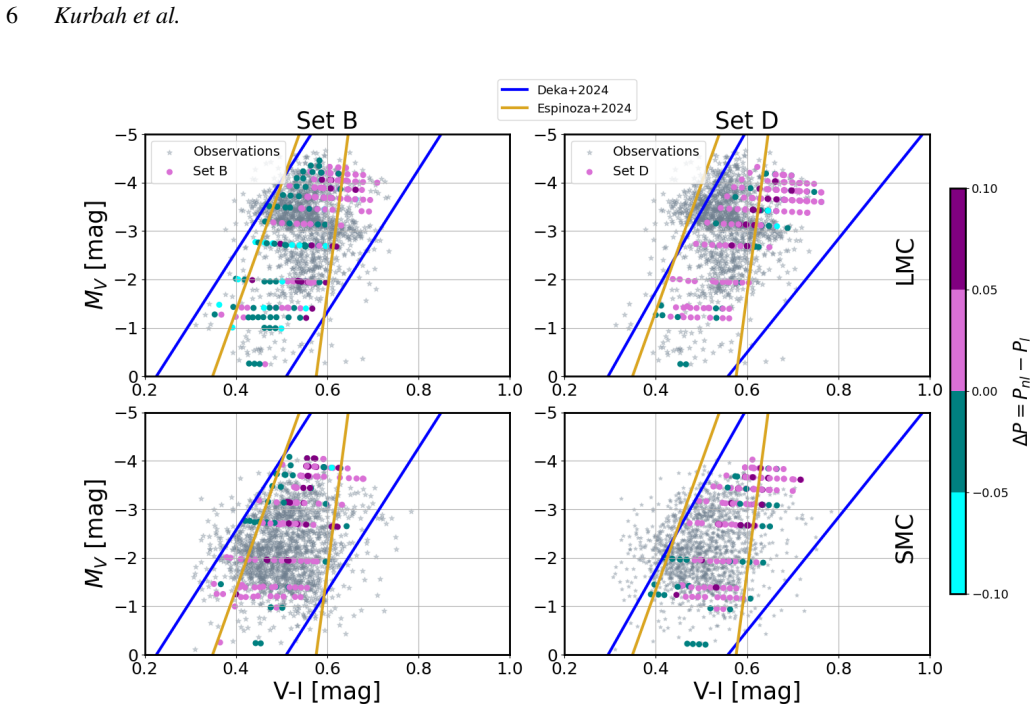
- [Section 3, Tables C1-C4 and Tables 4-6] The statistical significance of the data-driven break-points is overstated because the F-test is evaluated at break-point locations selected from the same data. The paper states 'F_c = F_{2,n-4}' and rejects the null when p(F)<0.05, but this is only valid for a pre-specified break-point. The piecewise-regression Model Selection routine chooses the break-point by optimizing the fit, so the maximized F statistic follows the sup-F/Davies distribution, whose critical values are larger. Consequently, entries such as P=2.440 d with p(F)=0.000 and P=2.576 d with p(F)=0.000 in Tables 4, 5, C1, and C3 are anti-conservative. The fixed-location tests at P=2.5 d and P=0.58 d (included for comparative purposes in the Appendix tables) remain valid, but the paper's headline claims of 'multiple break-points' and the data-driven locations are not supported as reported. The authors should re-analyse with a sup-F test, a Davies bound, or a bootstrap procedure that accounts for break-point estimation, or restrict significance claims to fixed, pre-specified periods.
- [Section 3, Eq. (3)] The two-sample t-test formula for comparing regression slopes is incorrect as printed: the denominator is written as sqrt(Var(W_n) - Var(W_m)), but the correct form is sqrt(Var(W_n) + Var(W_m)) (or an appropriate pooled standard error). With the printed minus sign, the denominator can be zero or negative, producing undefined or misleading t-statistics. This formula underlies the slope comparisons in Tables D1 and D2 and the supplementary material, so the reported p(t) values need to be recomputed after correcting this error.
- [Section 2.2, Table 3 and Section 3.2.2] The theoretical support for the break-point claims is weaker than the abstract's language suggests. The authors state that the model grid does not encompass the full instability strip, that theoretical PC/PL/AC relations are 'preliminary', and that models with P<0.58 d are omitted because of small numbers. As a result, the theoretical models cannot test the P=0.58 d break-point, and the 'confirmation' of the P=2.5 d break-point is obtained by imposing a break-point near 2.5 d rather than detecting it from the model data. This should be stated explicitly in the abstract and conclusions, and the claims of model confirmation should be tempered accordingly.
minor comments (5)
- [Section 2.2] The description of the convection sets contains a duplicated parameter: 'a_t = 0.0, a_t = 0.0, gamma_r = 0.0' appears for both Set A and Set B; the second parameter should presumably be a different quantity (e.g., a_p or a_c). Please check and clarify.
- [Summary vs. Section 2.2] The abstract/conclusions mention MESA-RSP 'version r15410', while Section 2.2 states 'r15140'; please verify which version was used and make the text consistent.
- [Appendix B, Fig. B2] The y-axis limits of Fig. B2 for the SMC include negative values (approximately -0.1 to 0.1), but p(F) is a probability and cannot be negative; this makes the plotted p(F) values unreadable and may indicate an axis scaling error.
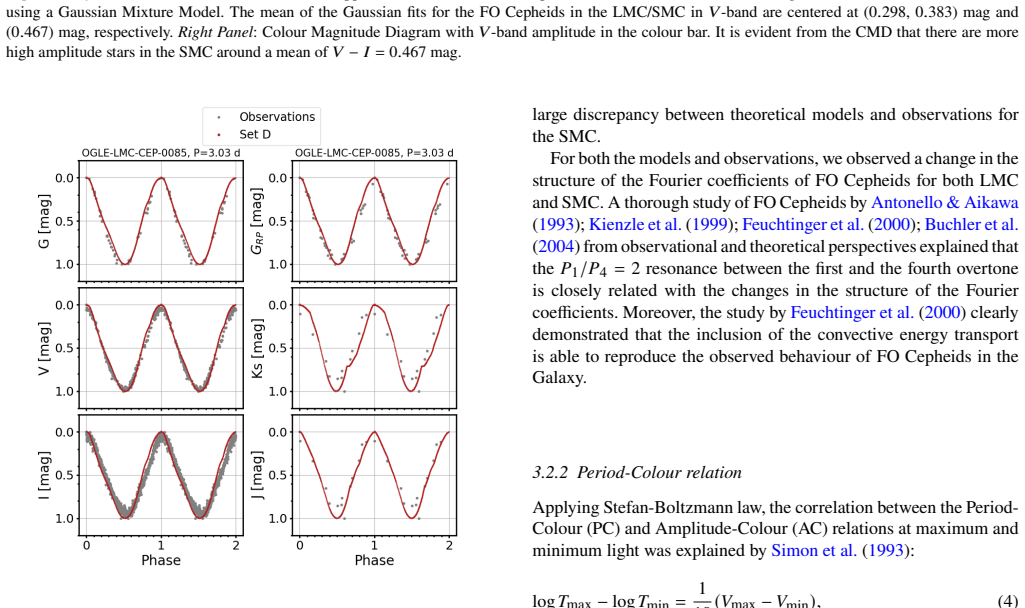
- [Section 3.1] The text says that high-amplitude SMC FO Cepheids are found at a mean of V-I = 0.467 mag, but 0.467 mag is also reported as the mean of the V-band amplitude distribution. Please confirm which quantity is intended for the colour.
- [Appendix C tables] Several entries report p(F)=0.000, which is numerically implausible; these should be reported as p<0.001, and any p-values obtained after the corrected break-point testing procedure should replace them.
Circularity Check
Break-point 'significance' partly reuses the same data that selected the break-point; fixed-period tests remain valid.
-
fitted input called prediction
[Section 3, paragraph on F-test; Tables 4-6; Appendix C (Tables C1-C3)]
"The significance of the break-points at multiple locations obtained using piecewise regression has been tested using a statistical F-test. ... The critical value of the F statistic at 95% confidence level is defined as F_c = F_{2,n-4}. ... The remaining rows represent the F-test result for break-points obtained using piecewise regression."
The breakpoint locations are fitted to the same data by piecewise regression (e.g., 2.440, 2.466, 2.576 d in Tables 4/6 and C1/C3), and the F-test is then evaluated at these fitted locations using the fixed-breakpoint critical value F_{2,n-4}. Because the breakpoint was chosen to maximize the fit, the resulting F statistic is the maximum over candidate breakpoints and has the sup-F/Davies distribution under the null hypothesis; comparing with F_{2,n-4} makes p(F) systematically too small. The reported p(F)=0.000 values for data-driven breakpoints therefore present a fitted parameter as if it were an independently tested prediction.
full rationale
The theoretical modeling side is self-contained: MESA-RSP models use the Anderson et al. (2014) mass-luminosity relation, Paxton et al. (2019) convection sets, and an internally calibrated alpha_m; no observed PC/PL/AC slope is fed back into the models as a constraint, and the appearance of a break-point near 2.5 d in the models is an independent result. The empirical detection at the literature periods 2.5 d and 0.58 d is supported by fixed-location F-tests, which are not circular. The partial circularity lies in the data-driven break-point locations: the paper selects each break-point by maximizing the piecewise-regression fit to the same data and then tests that same fitted location with an F-test whose null distribution assumes a pre-specified break-point. This inflates the reported significance and makes the 'multiple break-point' claim partly an artifact of fitting. No self-citation is load-bearing, and the model-data comparison is not inverted from the data it claims to predict.
Assumptions & free parameters
free parameters (1)
- alpha_m (turbulent convection parameter) =
0.25 for set A, 0.50 for set B, 0.40 for set C, 0.70 for set D
assumptions (4)
- domain assumption Anderson et al. (2014) rotation-averaged mass-luminosity relation is used to assign luminosity to each model mass.
- domain assumption The four convection parameter sets A-D from Paxton et al. (2019) adequately describe turbulent convection in FO Cepheid envelopes.
- domain assumption The Skowron et al. (2021) reddening map and Cardelli et al. (1989) extinction law with R_V=3.23 are correct for the Magellanic Clouds.
- domain assumption The instability strip edges adopted from Deka et al. (2024) and Espinoza-Arancibia et al. (2024) correctly mark the FO Cepheid instability strip.
Cite this review
Pith. "Pith review of Multiwavelength study of observed and predicted pulsation properties of First overtone Cepheids in the Magellanic Clouds." pith.science (2026). https://pith.science/paper/PSW6SW2S
@misc{pith2026250615171,
  author       = {Pith},
  title        = {Pith review of: Multiwavelength study of observed and predicted pulsation properties of First overtone Cepheids in the Magellanic Clouds},
  year         = {2026},
  howpublished = {\url{https://pith.science/paper/PSW6SW2S}},
  note         = {Machine review of arXiv:2506.15171}
}
read the original abstract
We present a detailed analysis of the light curves and pulsation properties of First Overtone (FO) Cepheids in the Magellanic Clouds (MCs) obtained using observations and predictions from stellar pulsation models. Multiwavelength observational light curves were compiled from the literature (OGLE-IV, Gaia and VMC). We investigate the period-amplitude (PA), period-colour (PC), period-luminosity (PL), and amplitude-colour (AC) relations for FO Cepheids at multiwavelengths. We find that the PA distribution of FO Cepheids in the MCs modelled using a Gaussian Mixture Model shows that the SMC consists of higher amplitude stars than the LMC. We find multiple break-points in the PC/PL/AC relations for FO/FU Cepheids in the optical and near-infrared bands including the one near to P = 2.5 d in the MCs using piecewise regression analysis and F- test statistics. Similarly, for the LMC FO Cepheids, we find a break-point in the PC/PL/AC relations near P = 0.58 d. The slopes of the PC relations for LMC FO Cepheids are found to be shallow for 0.58 < P(d) < 2.5 but steeper for P < 0.58 d and P > 2.5 d. We complemented the observed relations using theoretical models for FO Cepheids with chemical compositions Z = 0.008 and Z = 0.004, appropriate for the LMC and SMC, respectively computed with MESA-RSP. Our results show that the pulsation properties of FO Cepheids in PC/PL/AC relations and colour-magnitude diagram are strongly correlated and their connections can provide stringent constraints for the theoretical pulsation models.
Figures


Figures from the paper (8 more)



Reference graph
Works this paper leans on
-
[1]
Anderson R. I., Ekstr \"o m S., Georgy C., Meynet G., Mowlavi N., Eyer L., 2014, @doi [ ] 10.1051/0004-6361/201322988 , https://ui.adsabs.harvard.edu/abs/2014A&A...564A.100A 564, A100
-
[2]
Antonello E., Aikawa T., 1993, , https://ui.adsabs.harvard.edu/abs/1993A&A...279..119A 279, 119
1993
-
[3]
L., 1982, j-IMA-J-NUMER-ANAL, 2, 241
Baart M. L., 1982, j-IMA-J-NUMER-ANAL, 2, 241
1982
-
[4]
Bai J., 1997, The Review of Economics and Statistics, 79, 551
1997
-
[5]
Beaton R. L., et al., 2018, @doi [ ] 10.1007/s11214-018-0542-1 , https://ui.adsabs.harvard.edu/abs/2018SSRv..214..113B 214, 113
-
[6]
S., 1990, @doi [ ] 10.1086/132749 , https://ui.adsabs.harvard.edu/abs/1990PASP..102.1181B 102, 1181
Bessell M. S., 1990, @doi [ ] 10.1086/132749 , https://ui.adsabs.harvard.edu/abs/1990PASP..102.1181B 102, 1181
doi:10.1086/132749 1990
-
[7]
Bhardwaj A., Kanbur S. M., Singh H. P., Ngeow C.-C., 2014, @doi [ ] 10.1093/mnras/stu1941 , https://ui.adsabs.harvard.edu/abs/2014MNRAS.445.2655B 445, 2655
-
[8]
Bhardwaj A., Kanbur S. M., Macri L. M., Singh H. P., Ngeow C.-C., Ishida E. E. O., 2016a, @doi [ ] 10.1093/mnras/stw040 , https://ui.adsabs.harvard.edu/abs/2016MNRAS.457.1644B 457, 1644
Show all 142 references
-
[9]
M., Singh H
Bhardwaj A., Ngeow C.-C., Kanbur S. M., Singh H. P., 2016b, @doi [ ] 10.1093/mnras/stw579 , https://ui.adsabs.harvard.edu/abs/2016MNRAS.458.3705B 458, 3705
-
[10]
M., Rejkuba M., Kanbur S
Bhardwaj A., Macri L. M., Rejkuba M., Kanbur S. M., Ngeow C.-C., Singh H. P., 2017a, @doi [ ] 10.3847/1538-3881/aa5e4f , https://ui.adsabs.harvard.edu/abs/2017AJ....153..154B 153, 154
-
[11]
M., Marconi M., Rejkuba M., Singh H
Bhardwaj A., Kanbur S. M., Marconi M., Rejkuba M., Singh H. P., Ngeow C.-C., 2017b, @doi [ ] 10.1093/mnras/stw3256 , https://ui.adsabs.harvard.edu/abs/2017MNRAS.466.2805B 466, 2805
-
[12]
J., Singh H
Bhardwaj A., Rejkuba M., de Grijs R., Herczeg G. J., Singh H. P., Kanbur S., Ngeow C.-C., 2020, @doi [ ] 10.3847/1538-3881/abb3f9 , https://ui.adsabs.harvard.edu/abs/2020AJ....160..220B 160, 220
2020 doi
-
[13]
M., Bellinger E
Bhuyan G., Deb S., Kanbur S. M., Bellinger E. P., Deka M., Bhardwaj A., 2024, @doi [ ] 10.1093/mnras/stad3772 , https://ui.adsabs.harvard.edu/abs/2024MNRAS.527.8671B 527, 8671
2024 doi
-
[14]
Z., et al., 2010, @doi [ ] 10.1088/0004-6256/140/2/416 , https://ui.adsabs.harvard.edu/abs/2010AJ....140..416B 140, 416
Bonanos A. Z., et al., 2010, @doi [ ] 10.1088/0004-6256/140/2/416 , https://ui.adsabs.harvard.edu/abs/2010AJ....140..416B 140, 416
2010 doi
-
[15]
Bono G., Caputo F., Marconi M., 1998, @doi [ ] 10.1086/311270 , https://ui.adsabs.harvard.edu/abs/1998ApJ...497L..43B 497, L43
1998 doi
-
[16]
F., 1999a, @doi [ ] 10.1086/313207 , https://ui.adsabs.harvard.edu/abs/1999ApJS..122..167B 122, 167
Bono G., Marconi M., Stellingwerf R. F., 1999a, @doi [ ] 10.1086/313207 , https://ui.adsabs.harvard.edu/abs/1999ApJS..122..167B 122, 167
-
[17]
Bono G., Caputo F., Castellani V., Marconi M., 1999b, @doi [ ] 10.1086/306815 , https://ui.adsabs.harvard.edu/abs/1999ApJ...512..711B 512, 711
-
[18]
F., 2000a, , https://ui.adsabs.harvard.edu/abs/2000A&A...360..245B 360, 245
Bono G., Marconi M., Stellingwerf R. F., 2000a, , https://ui.adsabs.harvard.edu/abs/2000A&A...360..245B 360, 245
- [19]
-
[20]
Bono G., Castellani V., Marconi M., 2002, @doi [ ] 10.1086/339420 , https://ui.adsabs.harvard.edu/abs/2002ApJ...565L..83B 565, L83
2002 doi
-
[21]
G., Kervella P., Anderson R
Breuval L., Riess A. G., Kervella P., Anderson R. I., Romaniello M., 2022, @doi [ ] 10.3847/1538-4357/ac97e2 , https://ui.adsabs.harvard.edu/abs/2022ApJ...939...89B 939, 89
2022 doi
-
[22]
R., Koll \'a th Z., 2000, in Buchler J
Buchler J. R., Koll \'a th Z., 2000, in Buchler J. R., Kandrup H., eds, Vol. 898, Astrophysical Turbulence and Convection. p. 39 ( @eprint arXiv astro-ph/9909024 ), @doi 10.1111/j.1749-6632.2000.tb06162.x
2000 arXiv
-
[23]
R., Kovacs G., 1986, @doi [ ] 10.1086/164122 , https://ui.adsabs.harvard.edu/abs/1986ApJ...303..749B 303, 749
Buchler J. R., Kovacs G., 1986, @doi [ ] 10.1086/164122 , https://ui.adsabs.harvard.edu/abs/1986ApJ...303..749B 303, 749
1986 doi
-
[24]
R., Moskalik P., Kovacs G., 1990, @doi [ ] 10.1086/168500 , https://ui.adsabs.harvard.edu/abs/1990ApJ...351..617B 351, 617
Buchler J. R., Moskalik P., Kovacs G., 1990, @doi [ ] 10.1086/168500 , https://ui.adsabs.harvard.edu/abs/1990ApJ...351..617B 351, 617
1990 doi
-
[25]
R., Koll \'a th Z., Beaulieu J
Buchler J. R., Koll \'a th Z., Beaulieu J. P., 2004, @doi [ ] 10.1051/0004-6361:20047105 , https://ui.adsabs.harvard.edu/abs/2004A&A...423..643B 423, 643
2004 doi
-
[26]
J., 1976, , https://ui.adsabs.harvard.edu/abs/1976A&AS...24..299B 24, 299
Butler C. J., 1976, , https://ui.adsabs.harvard.edu/abs/1976A&AS...24..299B 24, 299
1976
-
[27]
J., 1978, , https://ui.adsabs.harvard.edu/abs/1978A&AS...32...83B 32, 83
Butler C. J., 1978, , https://ui.adsabs.harvard.edu/abs/1978A&AS...32...83B 32, 83
1978
-
[28]
A., Clayton G
Cardelli J. A., Clayton G. C., Mathis J. S., 1989, @doi [ ] 10.1086/167900 , https://ui.adsabs.harvard.edu/abs/1989ApJ...345..245C 345, 245
1989 doi
-
[29]
R., Capitanio N., 1993, @doi [ ] 10.1086/191790 , https://ui.adsabs.harvard.edu/abs/1993ApJS...86..541C 86, 541
Chiosi C., Wood P. R., Capitanio N., 1993, @doi [ ] 10.1086/191790 , https://ui.adsabs.harvard.edu/abs/1993ApJS...86..541C 86, 541
1993 doi
-
[30]
D., 2016, @doi [ ] 10.3847/0004-637X/823/2/102 , https://ui.adsabs.harvard.edu/abs/2016ApJ...823..102C 823, 102
Choi J., Dotter A., Conroy C., Cantiello M., Paxton B., Johnson B. D., 2016, @doi [ ] 10.3847/0004-637X/823/2/102 , https://ui.adsabs.harvard.edu/abs/2016ApJ...823..102C 823, 102
2016 doi
-
[31]
Choi Y., et al., 2018, @doi [ ] 10.3847/1538-4357/aae083 , https://ui.adsabs.harvard.edu/abs/2018ApJ...866...90C 866, 90
2018 doi
-
[32]
Cioni M. R. L., et al., 2011, @doi [ ] 10.1051/0004-6361/201016137 , https://ui.adsabs.harvard.edu/abs/2011A&A...527A.116C 527, A116
2011 doi
-
[33]
C., 1980, @doi [ ] 10.1086/158182 , https://ui.adsabs.harvard.edu/abs/1980ApJ...239..941C 239, 941
Cogan B. C., 1980, @doi [ ] 10.1086/158182 , https://ui.adsabs.harvard.edu/abs/1980ApJ...239..941C 239, 941
1980 doi
-
[34]
Cusano F., et al., 2021, @doi [ ] 10.1093/mnras/stab901 , https://ui.adsabs.harvard.edu/abs/2021MNRAS.504....1C 504, 1
2021 doi
-
[35]
M., Singh H
Das S., Bhardwaj A., Kanbur S. M., Singh H. P., Marconi M., 2018, @doi [ ] 10.1093/mnras/sty2358 , https://ui.adsabs.harvard.edu/abs/2018MNRAS.481.2000D 481, 2000
2018 doi
-
[36]
Das S., et al., 2020, @doi [ ] 10.1093/mnras/staa182 , https://ui.adsabs.harvard.edu/abs/2020MNRAS.493...29D 493, 29
2020 doi
-
[37]
M., Smolec R., Bhardwaj A., Singh H
Das S., Kanbur S. M., Smolec R., Bhardwaj A., Singh H. P., Rejkuba M., 2021, @doi [ ] 10.1093/mnras/staa3694 , https://ui.adsabs.harvard.edu/abs/2021MNRAS.501..875D 501, 875
2021 doi
- [38]
-
[39]
De Somma G., Marconi M., Molinaro R., Cignoni M., Musella I., Ripepi V., 2020, @doi [ ] 10.3847/1538-4365/ab7204 , https://ui.adsabs.harvard.edu/abs/2020ApJS..247...30D 247, 30
2020 doi
-
[40]
De Somma G., Marconi M., Molinaro R., Ripepi V., Leccia S., Musella I., 2022, @doi [ ] 10.3847/1538-4365/ac7f3b , https://ui.adsabs.harvard.edu/abs/2022ApJS..262...25D 262, 25
2022 doi
-
[41]
P., 2009, @doi [ ] 10.1051/0004-6361/200912851 , https://ui.adsabs.harvard.edu/abs/2009A&A...507.1729D 507, 1729
Deb S., Singh H. P., 2009, @doi [ ] 10.1051/0004-6361/200912851 , https://ui.adsabs.harvard.edu/abs/2009A&A...507.1729D 507, 1729
2009 doi
-
[42]
P., 2014, @doi [ ] 10.1093/mnras/stt2361 , https://ui.adsabs.harvard.edu/abs/2014MNRAS.438.2440D 438, 2440
Deb S., Singh H. P., 2014, @doi [ ] 10.1093/mnras/stt2361 , https://ui.adsabs.harvard.edu/abs/2014MNRAS.438.2440D 438, 2440
2014 doi
-
[43]
P., Kumar S., Kanbur S
Deb S., Singh H. P., Kumar S., Kanbur S. M., 2015, @doi [ ] 10.1093/mnras/stv358 , https://ui.adsabs.harvard.edu/abs/2015MNRAS.449.2768D 449, 2768
2015 doi
-
[44]
M., Singh H
Deb S., Ngeow C.-C., Kanbur S. M., Singh H. P., Wysocki D., Kumar S., 2018, @doi [ ] 10.1093/mnras/sty1124 , https://ui.adsabs.harvard.edu/abs/2018MNRAS.478.2526D 478, 2526
2018 doi
-
[45]
P., Kanbur S
Deb S., Kurbah K., Singh H. P., Kanbur S. M., Ngeow C.-C., Medhi B. J., Kumar S., 2019, @doi [ ] 10.1093/mnras/stz2328 , https://ui.adsabs.harvard.edu/abs/2019MNRAS.489.3725D 489, 3725
2019 doi
-
[46]
M., Deb S., Das S., Kurbah K., Bellinger E
Deka M., Kanbur S. M., Deb S., Das S., Kurbah K., Bellinger E. P., Bhardwaj A., 2022, @doi [ ] 10.1093/mnras/stac2457 , https://ui.adsabs.harvard.edu/abs/2022MNRAS.517.2251D 517, 2251
2022 doi
-
[47]
P., Kanbur S
Deka M., Bellinger E. P., Kanbur S. M., Deb S., Bhardwaj A., Randall H. R., Kalici S., Das S., 2024, @doi [ ] 10.1093/mnras/stae1136 , https://ui.adsabs.harvard.edu/abs/2024MNRAS.tmp.1147D
2024 doi
-
[48]
A., Feuchtinger M
Dorfi E. A., Feuchtinger M. U., 1991, , https://ui.adsabs.harvard.edu/abs/1991A&A...249..417D 249, 417
1991
-
[49]
Dotter A., 2016, @doi [ ] 10.3847/0067-0049/222/1/8 , https://ui.adsabs.harvard.edu/abs/2016ApJS..222....8D 222, 8
2016 doi
-
[50]
M., 2024, @doi [arXiv e-prints] 10.48550/arXiv.2406.09127 , https://ui.adsabs.harvard.edu/abs/2024arXiv240609127D p
Drimmel R., Khanna S., Poggio E., Skowron D. M., 2024, @doi [arXiv e-prints] 10.48550/arXiv.2406.09127 , https://ui.adsabs.harvard.edu/abs/2024arXiv240609127D p. arXiv:2406.09127
-
[52]
Espinoza-Arancibia F., Pilecki B., Pietrzy \'n ski G., Smolec R., Kervella P., 2024, @doi [ ] 10.1051/0004-6361/202347804 , https://ui.adsabs.harvard.edu/abs/2024A&A...682A.185E 682, A185
2024 doi
-
[53]
D., 1970, @doi [ ] 10.1086/150569 , https://ui.adsabs.harvard.edu/abs/1970ApJ...161..679F 161, 679
Fernie J. D., 1970, @doi [ ] 10.1086/150569 , https://ui.adsabs.harvard.edu/abs/1970ApJ...161..679F 161, 679
1970 doi
-
[54]
D., 1990, @doi [ ] 10.1086/168689 , https://ui.adsabs.harvard.edu/abs/1990ApJ...354..295F 354, 295
Fernie J. D., 1990, @doi [ ] 10.1086/168689 , https://ui.adsabs.harvard.edu/abs/1990ApJ...354..295F 354, 295
1990 doi
-
[55]
U., 1999a, @doi [ ] 10.1051/aas:1999462 , https://ui.adsabs.harvard.edu/abs/1999A&AS..136..217F 136, 217
Feuchtinger M. U., 1999a, @doi [ ] 10.1051/aas:1999462 , https://ui.adsabs.harvard.edu/abs/1999A&AS..136..217F 136, 217
-
[56]
U., 1999b, , https://ui.adsabs.harvard.edu/abs/1999A&A...351..103F 351, 103
Feuchtinger M. U., 1999b, , https://ui.adsabs.harvard.edu/abs/1999A&A...351..103F 351, 103
-
[57]
R., Koll \'a th Z., 2000, @doi [ ] 10.1086/317260 , https://ui.adsabs.harvard.edu/abs/2000ApJ...544.1056F 544, 1056
Feuchtinger M., Buchler J. R., Koll \'a th Z., 2000, @doi [ ] 10.1086/317260 , https://ui.adsabs.harvard.edu/abs/2000ApJ...544.1056F 544, 1056
2000 doi
-
[58]
Fiorentino G., Marconi M., Musella I., Caputo F., 2007, @doi [ ] 10.1051/0004-6361:20077587 , https://ui.adsabs.harvard.edu/abs/2007A&A...476..863F 476, 863
2007 doi
-
[59]
Gaia Collaboration et al., 2016a, @doi [ ] 10.1051/0004-6361/201629272 , https://ui.adsabs.harvard.edu/abs/2016A&A...595A...1G 595, A1
-
[60]
Gaia Collaboration et al., 2016b, @doi [ ] 10.1051/0004-6361/201629512 , https://ui.adsabs.harvard.edu/abs/2016A&A...595A...2G 595, A2
-
[61]
Gaia Collaboration et al., 2023, @doi [ ] 10.1051/0004-6361/202243940 , https://ui.adsabs.harvard.edu/abs/2023A&A...674A...1G 674, A1
2023 doi
-
[62]
Graczyk D., et al., 2020, @doi [ ] 10.3847/1538-4357/abbb2b , https://ui.adsabs.harvard.edu/abs/2020ApJ...904...13G 904, 13
2020 doi
-
[63]
K., Duffau S., 2012, @doi [ ] 10.1088/0004-6256/144/4/107 , https://ui.adsabs.harvard.edu/abs/2012AJ....144..107H 144, 107
Haschke R., Grebel E. K., Duffau S., 2012, @doi [ ] 10.1088/0004-6256/144/4/107 , https://ui.adsabs.harvard.edu/abs/2012AJ....144..107H 144, 107
2012 doi
-
[64]
Inno L., et al., 2013, @doi [ ] 10.1088/0004-637X/764/1/84 , https://ui.adsabs.harvard.edu/abs/2013ApJ...764...84I 764, 84
2013 doi
-
[65]
Inno L., et al., 2016, @doi [ ] 10.3847/0004-637X/832/2/176 , https://ui.adsabs.harvard.edu/abs/2016ApJ...832..176I 832, 176
2016 doi
-
[66]
Iwanek P., et al., 2022, @doi [ ] 10.3847/1538-4365/ac6676 , https://ui.adsabs.harvard.edu/abs/2022ApJS..260...46I 260, 46
2022 doi
-
[67]
Jordi C., et al., 2010, @doi [ ] 10.1051/0004-6361/201015441 , https://ui.adsabs.harvard.edu/abs/2010A&A...523A..48J 523, A48
2010 doi
-
[68]
M., Hendry M
Kanbur S. M., Hendry M. A., 1996, , https://ui.adsabs.harvard.edu/abs/1996A&A...305....1K 305, 1
1996
-
[69]
S., Perryman M
Kanbur S., Ngeow C., 2005, in Turon C., O'Flaherty K. S., Perryman M. A. C., eds, ESA Special Publication Vol. 576, The Three-Dimensional Universe with Gaia. p. 691
2005
-
[70]
M., Ngeow C.-C., 2006, @doi [ ] 10.1111/j.1365-2966.2006.10317.x , https://ui.adsabs.harvard.edu/abs/2006MNRAS.369..705K 369, 705
Kanbur S. M., Ngeow C.-C., 2006, @doi [ ] 10.1111/j.1365-2966.2006.10317.x , https://ui.adsabs.harvard.edu/abs/2006MNRAS.369..705K 369, 705
2006
-
[71]
M., Ngeow C., Nikolaev S., Tanvir N
Kanbur S. M., Ngeow C., Nikolaev S., Tanvir N. R., Hendry M. A., 2003, @doi [ ] 10.1051/0004-6361:20031373 , https://ui.adsabs.harvard.edu/abs/2003A&A...411..361K 411, 361
2003 doi
-
[72]
M., Ngeow C.-C., Buchler J
Kanbur S. M., Ngeow C.-C., Buchler J. R., 2004, @doi [ ] 10.1111/j.1365-2966.2004.08183.x , https://ui.adsabs.harvard.edu/abs/2004MNRAS.354..212K 354, 212
2004
-
[73]
M., Ngeow C., Nanthakumar A., Stevens R., 2007, @doi [ ] 10.1086/519290 , https://ui.adsabs.harvard.edu/abs/2007PASP..119..512K 119, 512
Kanbur S. M., Ngeow C., Nanthakumar A., Stevens R., 2007, @doi [ ] 10.1086/519290 , https://ui.adsabs.harvard.edu/abs/2007PASP..119..512K 119, 512
2007 doi
-
[74]
Kanbur S. M., Marconi M., Ngeow C., Musella I., Turner M., James A., Magin S., Halsey J., 2010, @doi [ ] 10.1111/j.1365-2966.2010.17159.x , https://ui.adsabs.harvard.edu/abs/2010MNRAS.408..695K 408, 695
2010
-
[75]
Kienzle F., Moskalik P., Bersier D., Pont F., 1999, , https://ui.adsabs.harvard.edu/abs/1999A&A...341..818K 341, 818
1999
-
[76]
Klagyivik P., Szabados L., 2009, @doi [ ] 10.1051/0004-6361/200811464 , https://ui.adsabs.harvard.edu/abs/2009A&A...504..959K 504, 959
2009 doi
-
[77]
R., Feuchtinger M., 2000, @doi [ ] 10.1086/309330 , https://ui.adsabs.harvard.edu/abs/2000ApJ...540..468K 540, 468
Koll \'a th Z., Buchler J. R., Feuchtinger M., 2000, @doi [ ] 10.1086/309330 , https://ui.adsabs.harvard.edu/abs/2000ApJ...540..468K 540, 468
2000 doi
-
[78]
B., Nuspl J., Szab \'o R., 2023, @doi [ ] 10.1093/mnras/stad884 , https://ui.adsabs.harvard.edu/abs/2023MNRAS.521.4878K 521, 4878
Kov \'a cs G. B., Nuspl J., Szab \'o R., 2023, @doi [ ] 10.1093/mnras/stad884 , https://ui.adsabs.harvard.edu/abs/2023MNRAS.521.4878K 521, 4878
2023 doi
-
[79]
B., Nuspl J., Szab \'o R., 2024, @doi [ ] 10.1093/mnrasl/slad131 , https://ui.adsabs.harvard.edu/abs/2024MNRAS.527L...1K 527, L1
Kov \'a cs G. B., Nuspl J., Szab \'o R., 2024, @doi [ ] 10.1093/mnrasl/slad131 , https://ui.adsabs.harvard.edu/abs/2024MNRAS.527L...1K 527, L1
2024 doi
-
[80]
Kuhfuss R., 1986, , https://ui.adsabs.harvard.edu/abs/1986A&A...160..116K 160, 116
1986
-
[81]
M., Das S., Deka M., Bhardwaj A., Randall H
Kurbah K., Deb S., Kanbur S. M., Das S., Deka M., Bhardwaj A., Randall H. R., Kalici S., 2023, @doi [ ] 10.1093/mnras/stad806 , https://ui.adsabs.harvard.edu/abs/2023MNRAS.521.6034K 521, 6034
2023 doi
-
[82]
L., 1970, SAO Special Report, https://ui.adsabs.harvard.edu/abs/1970SAOSR.309.....K 309
Kurucz R. L., 1970, SAO Special Report, https://ui.adsabs.harvard.edu/abs/1970SAOSR.309.....K 309
1970
-
[83]
Kurucz R., 1993, Robert Kurucz CD-ROM, https://ui.adsabs.harvard.edu/abs/1993KurCD..18.....K 18
1993
-
[84]
S., 1908, Annals of Harvard College Observatory, https://ui.adsabs.harvard.edu/abs/1908AnHar..60...87L 60, 87
Leavitt H. S., 1908, Annals of Harvard College Observatory, https://ui.adsabs.harvard.edu/abs/1908AnHar..60...87L 60, 87
1908
-
[85]
S., Pickering E
Leavitt H. S., Pickering E. C., 1912, Harvard College Observatory Circular, https://ui.adsabs.harvard.edu/abs/1912HarCi.173....1L 173, 1
1912
-
[86]
Lejeune T., Cuisinier F., Buser R., 1998, @doi [ ] 10.1051/aas:1998405 , https://ui.adsabs.harvard.edu/abs/1998A&AS..130...65L 130, 65
1998 doi
-
[87]
Lemasle B., et al., 2022, @doi [ ] 10.1051/0004-6361/202243273 , https://ui.adsabs.harvard.edu/abs/2022A&A...668A..40L 668, A40
2022 doi
-
[88]
Leys C., Ley C., Klein O., Bernard P., Licata L., 2013, @doi [Journal of Experimental Social Psychology] https://doi.org/10.1016/j.jesp.2013.03.013 , 49, 764
2013 doi
-
[89]
F., 1976, The Observatory, https://ui.adsabs.harvard.edu/abs/1976Obs....96..245M 96, 245
Madore B. F., 1976, The Observatory, https://ui.adsabs.harvard.edu/abs/1976Obs....96..245M 96, 245
1976
-
[90]
F., Freedman W
Madore B. F., Freedman W. L., 1991, @doi [ ] 10.1086/132911 , https://ui.adsabs.harvard.edu/abs/1991PASP..103..933M 103, 933
1991 doi
-
[91]
F., Freedman W
Madore B. F., Freedman W. L., Moak S., 2017, @doi [ ] 10.3847/1538-4357/aa6e4d , https://ui.adsabs.harvard.edu/abs/2017ApJ...842...42M 842, 42
2017 doi
-
[92]
Majaess D., Turner D., Gieren W., Berdnikov L., Lane D., 2013, @doi [ ] 10.1007/s10509-012-1331-z , https://ui.adsabs.harvard.edu/abs/2013Ap&SS.344..381M 344, 381
2013 doi
-
[93]
Marconi M., et al., 2013, @doi [ ] 10.1088/2041-8205/768/1/L6 , https://ui.adsabs.harvard.edu/abs/2013ApJ...768L...6M 768, L6
2013 doi
-
[94]
Marconi M., et al., 2024, @doi [ ] 10.1093/mnras/stae734 , https://ui.adsabs.harvard.edu/abs/2024MNRAS.529.4210M 529, 4210
2024 doi
-
[95]
H., et al., 2021, @doi [ ] 10.1051/0004-6361/202039512 , https://ui.adsabs.harvard.edu/abs/2021A&A...654A.138M 654, A138
Minniti J. H., et al., 2021, @doi [ ] 10.1051/0004-6361/202039512 , https://ui.adsabs.harvard.edu/abs/2021A&A...654A.138M 654, A138
2021 doi
-
[96]
I., et al., 2014, @doi [ ] 10.1093/mnras/stt2081 , https://ui.adsabs.harvard.edu/abs/2014MNRAS.437.2702M 437, 2702
Moretti M. I., et al., 2014, @doi [ ] 10.1093/mnras/stt2081 , https://ui.adsabs.harvard.edu/abs/2014MNRAS.437.2702M 437, 2702
2014 doi
-
[97]
R., Marom A., 1992, @doi [ ] 10.1086/170975 , https://ui.adsabs.harvard.edu/abs/1992ApJ...385..685M 385, 685
Moskalik P., Buchler J. R., Marom A., 1992, @doi [ ] 10.1086/170975 , https://ui.adsabs.harvard.edu/abs/1992ApJ...385..685M 385, 685
1992 doi
-
[98]
Muraveva T., et al., 2018, @doi [ ] 10.1093/mnras/stx2514 , https://ui.adsabs.harvard.edu/abs/2018MNRAS.473.3131M 473, 3131
2018 doi
-
[99]
R., et al., 2017, @doi [ ] 10.3847/1538-4357/aa713d , https://ui.adsabs.harvard.edu/abs/2017ApJ...841...84N 841, 84
Neeley J. R., et al., 2017, @doi [ ] 10.3847/1538-4357/aa713d , https://ui.adsabs.harvard.edu/abs/2017ApJ...841...84N 841, 84
2017 doi
-
[100]
M., 2010, @doi [ ] 10.1088/0004-637X/720/1/626 , https://ui.adsabs.harvard.edu/abs/2010ApJ...720..626N 720, 626
Ngeow C.-C., Kanbur S. M., 2010, @doi [ ] 10.1088/0004-637X/720/1/626 , https://ui.adsabs.harvard.edu/abs/2010ApJ...720..626N 720, 626
2010 doi
-
[101]
M., Singh H
Ngeow C.-C., Sarkar S., Bhardwaj A., Kanbur S. M., Singh H. P., 2015, @doi [ ] 10.1088/0004-637X/813/1/57 , https://ui.adsabs.harvard.edu/abs/2015ApJ...813...57N 813, 57
2015 doi
-
[102]
J., Keller S
Nikolaev S., Drake A. J., Keller S. C., Cook K. H., Dalal N., Griest K., Welch D. L., Kanbur S. M., 2004, @doi [ ] 10.1086/380439 , https://ui.adsabs.harvard.edu/abs/2004ApJ...601..260N 601, 260
2004 doi
-
[103]
Paxton B., Bildsten L., Dotter A., Herwig F., Lesaffre P., Timmes F., 2011, @doi [ ] 10.1088/0067-0049/192/1/3 , https://ui.adsabs.harvard.edu/abs/2011ApJS..192....3P 192, 3
2011 doi
-
[104]
Paxton B., et al., 2013, @doi [ ] 10.1088/0067-0049/208/1/4 , https://ui.adsabs.harvard.edu/abs/2013ApJS..208....4P 208, 4
2013 doi
-
[105]
Paxton B., et al., 2015, @doi [ ] 10.1088/0067-0049/220/1/15 , https://ui.adsabs.harvard.edu/abs/2015ApJS..220...15P 220, 15
2015 doi
-
[106]
Paxton B., et al., 2018, @doi [ ] 10.3847/1538-4365/aaa5a8 , https://ui.adsabs.harvard.edu/abs/2018ApJS..234...34P 234, 34
2018 doi
-
[107]
Paxton B., et al., 2019, @doi [ ] 10.3847/1538-4365/ab2241 , https://ui.adsabs.harvard.edu/abs/2019ApJS..243...10P 243, 10
2019 doi
-
[108]
O., 1986, , https://ui.adsabs.harvard.edu/abs/1986A&A...170...59P 170, 59
Petersen J. O., 1986, , https://ui.adsabs.harvard.edu/abs/1986A&A...170...59P 170, 59
1986
-
[109]
Pietrukowicz P., Soszy \'n ski I., Udalski A., 2021, @doi [ ] 10.32023/0001-5237/71.3.2 , https://ui.adsabs.harvard.edu/abs/2021AcA....71..205P 71, 205
2021 doi
-
[110]
Pietrzy \'n ski G., et al., 2019, @doi [ ] 10.1038/s41586-019-0999-4 , https://ui.adsabs.harvard.edu/abs/2019Natur.567..200P 567, 200
2019 doi
-
[111]
Pilgrim C., 2021, @doi [Journal of Open Source Software] 10.21105/joss.03859 , 6, 3859
2021 doi
-
[113]
G., et al., 2022b, @doi [ ] 10.3847/2041-8213/ac5c5b , https://ui.adsabs.harvard.edu/abs/2022ApJ...934L...7R 934, L7
Riess A. G., et al., 2022b, @doi [ ] 10.3847/2041-8213/ac5c5b , https://ui.adsabs.harvard.edu/abs/2022ApJ...934L...7R 934, L7
-
[114]
Ripepi V., et al., 2016, @doi [ ] 10.3847/0067-0049/224/2/2110.48550/arXiv.1602.09005 , https://ui.adsabs.harvard.edu/abs/2016ApJS..224...21R 224, 21
2016
-
[115]
Ripepi V., et al., 2017, @doi [ ] 10.1093/mnras/stx2096 , https://ui.adsabs.harvard.edu/abs/2017MNRAS.472..808R 472, 808
2017 doi
-
[116]
Ripepi V., et al., 2022, @doi [ ] 10.1093/mnras/stac595 , https://ui.adsabs.harvard.edu/abs/2022MNRAS.512..563R 512, 563
2022 doi
-
[117]
A., 1971, @doi [ ] 10.1086/151031 , https://ui.adsabs.harvard.edu/abs/1971ApJ...167..293S 167, 293
Sandage A., Tammann G. A., 1971, @doi [ ] 10.1086/151031 , https://ui.adsabs.harvard.edu/abs/1971ApJ...167..293S 167, 293
1971 doi
-
[118]
A., 1993, @doi [ ] 10.1086/173137 , https://ui.adsabs.harvard.edu/abs/1993ApJ...415....1S 415, 1
Sandage A., Tammann G. A., 1993, @doi [ ] 10.1086/173137 , https://ui.adsabs.harvard.edu/abs/1993ApJ...415....1S 415, 1
1993 doi
-
[119]
A., Reindl B., 2004, @doi [ ] 10.1051/0004-6361:20040222 , https://ui.adsabs.harvard.edu/abs/2004A&A...424...43S 424, 43
Sandage A., Tammann G. A., Reindl B., 2004, @doi [ ] 10.1051/0004-6361:20040222 , https://ui.adsabs.harvard.edu/abs/2004A&A...424...43S 424, 43
2004 doi
-
[120]
A., Reindl B., 2009, @doi [ ] 10.1051/0004-6361:200810550 , https://ui.adsabs.harvard.edu/abs/2009A&A...493..471S 493, 471
Sandage A., Tammann G. A., Reindl B., 2009, @doi [ ] 10.1051/0004-6361:200810550 , https://ui.adsabs.harvard.edu/abs/2009A&A...493..471S 493, 471
2009 doi
-
[121]
R., 1985, @doi [ ] 10.1086/163737 , https://ui.adsabs.harvard.edu/abs/1985ApJ...299..723S 299, 723
Simon N. R., 1985, @doi [ ] 10.1086/163737 , https://ui.adsabs.harvard.edu/abs/1985ApJ...299..723S 299, 723
1985 doi
-
[122]
R., Schmidt E
Simon N. R., Schmidt E. G., 1976, @doi [ ] 10.1086/154259 , https://ui.adsabs.harvard.edu/abs/1976ApJ...205..162S 205, 162
1976 doi
-
[123]
R., Kanbur S
Simon N. R., Kanbur S. M., Mihalas D., 1993, @doi [ ] 10.1086/173077 , https://ui.adsabs.harvard.edu/abs/1993ApJ...414..310S 414, 310
1993 doi
-
[124]
M., et al., 2019, @doi [ ] 10.32023/0001-5237/69.4.1 , https://ui.adsabs.harvard.edu/abs/2019AcA....69..305S 69, 305
Skowron D. M., et al., 2019, @doi [ ] 10.32023/0001-5237/69.4.1 , https://ui.adsabs.harvard.edu/abs/2019AcA....69..305S 69, 305
2019 doi
-
[125]
M., et al., 2021, @doi [The Astrophysical Journal Supplement Series] 10.3847/1538-4365/abcb81 , 252, 23
Skowron D. M., et al., 2021, @doi [The Astrophysical Journal Supplement Series] 10.3847/1538-4365/abcb81 , 252, 23
2021 doi
-
[126]
Smolec R., Moskalik P., 2008, , https://ui.adsabs.harvard.edu/abs/2008AcA....58..193S 58, 193
2008
-
[127]
Smolec R., Moskalik P., 2010, @doi [ ] 10.1051/0004-6361/201014494 , https://ui.adsabs.harvard.edu/abs/2010A&A...524A..40S 524, A40
2010 doi
-
[128]
A., Catelan M., eds, IAU Symposium Vol
Soszy \'n ski I., 2024, in de Grijs R., Whitelock P. A., Catelan M., eds, IAU Symposium Vol. 376, IAU Symposium. pp 48--67, @doi 10.1017/S1743921323002557
2024 doi
-
[129]
Soszy \'n ski I., et al., 2015, , https://ui.adsabs.harvard.edu/abs/2015AcA....65..297S 65, 297
2015
-
[130]
Soszy \'n ski I., et al., 2017, @doi [ ] 10.32023/0001-5237/67.2.1 , https://ui.adsabs.harvard.edu/abs/2017AcA....67..103S 67, 103
2017 doi
-
[131]
S., 1969, @doi [ ] 10.1093/mnras/144.4.485 , https://ui.adsabs.harvard.edu/abs/1969MNRAS.144..485S 144, 485
Stobie R. S., 1969, @doi [ ] 10.1093/mnras/144.4.485 , https://ui.adsabs.harvard.edu/abs/1969MNRAS.144..485S 144, 485
1969 doi
-
[132]
Subramanian S., Subramaniam A., 2012, @doi [ ] 10.1088/0004-637X/744/2/128 , https://ui.adsabs.harvard.edu/abs/2012ApJ...744..128S 744, 128
2012 doi
-
[133]
Subramanian S., Subramaniam A., 2015, @doi [ ] 10.1051/0004-6361/201424248 , https://ui.adsabs.harvard.edu/abs/2015A&A...573A.135S 573, A135
2015 doi
-
[134]
Szabados L., Klagyivik P., 2012, @doi [ ] 10.1051/0004-6361/201117815 , https://ui.adsabs.harvard.edu/abs/2012A&A...537A..81S 537, A81
2012 doi
-
[135]
A., Sandage A., Reindl B., 2003, @doi [ ] 10.1051/0004-6361:20030354 , https://ui.adsabs.harvard.edu/abs/2003A&A...404..423T 404, 423
Tammann G. A., Sandage A., Reindl B., 2003, @doi [ ] 10.1051/0004-6361:20030354 , https://ui.adsabs.harvard.edu/abs/2003A&A...404..423T 404, 423
2003 doi
-
[136]
A., Reindl B., Sandage A., 2011, @doi [aap] 10.1051/0004-6361/201016382 , https://ui.adsabs.harvard.edu/abs/2011A&A...531A.134T 531, A134
Tammann G. A., Reindl B., Sandage A., 2011, @doi [aap] 10.1051/0004-6361/201016382 , https://ui.adsabs.harvard.edu/abs/2011A&A...531A.134T 531, A134
2011 doi
-
[137]
L., et al., 2021, @doi [ ] 10.1093/mnras/staa3857 , https://ui.adsabs.harvard.edu/abs/2021MNRAS.504.2983T 504, 2983
Tatton B. L., et al., 2021, @doi [ ] 10.1093/mnras/staa3857 , https://ui.adsabs.harvard.edu/abs/2021MNRAS.504.2983T 504, 2983
2021 doi
-
[138]
G., Abdel-Sabour Abdel-Latif M., Berdnikov L
Turner D. G., Abdel-Sabour Abdel-Latif M., Berdnikov L. N., 2006, @doi [ ] 10.1086/499501 , https://ui.adsabs.harvard.edu/abs/2006PASP..118..410T 118, 410
2006 doi
-
[139]
Wang S., Chen X., 2019, @doi [ ] 10.3847/1538-4357/ab1c61 , https://ui.adsabs.harvard.edu/abs/2019ApJ...877..116W 877, 116
2019 doi
-
[140]
Yanchulova Merica-Jones P., et al., 2021, @doi [ ] 10.3847/1538-4357/abc48b , https://ui.adsabs.harvard.edu/abs/2021ApJ...907...50Y 907, 50
2021 doi
- [141]
-
[142]
S., Hocd \'e V., 2024, @doi [ ] 10.3847/1538-4365/ad614d , https://ui.adsabs.harvard.edu/abs/2024ApJS..274...30Z 274, 30
Zi \'o kowska O., Smolec R., Thoul A., Farrell E., Rathour R. S., Hocd \'e V., 2024, @doi [ ] 10.3847/1538-4365/ad614d , https://ui.adsabs.harvard.edu/abs/2024ApJS..274...30Z 274, 30
2024 doi
-
[143]
P., 2021, @doi [ ] 10.3847/1538-4357/abe1bb , https://ui.adsabs.harvard.edu/abs/2021ApJ...910...36Z 910, 36
Zivick P., Kallivayalil N., van der Marel R. P., 2021, @doi [ ] 10.3847/1538-4357/abe1bb , https://ui.adsabs.harvard.edu/abs/2021ApJ...910...36Z 910, 36
2021 doi
-
[144]
write newline
" write newline "" before.all 'output.state := FUNCTION fin.entry write newline FUNCTION new.block output.state before.all = 'skip after.block 'output.state := if FUNCTION new.sentence output.state after.block = 'skip output.state before.all = 'skip after.sentence 'output.stat...
Reviewed August 15, 2026 · model on record in the stance chip above.
Discussion (0). Continue with ORCID to comment.