REVIEW 3 major objections 5 minor 41 references
Are there broad absorption-line blazars?
T0 review · 3 major / 5 minor · reviewed 2026-08-14 · deepseek-v4-flash
Pith's one-line read Ten flat-spectrum, highly radio-polarized BAL quasars show no intra-night optical flicker across 30 sessions, arguing against a population of BAL blazars.
desk verdict Solid observational null, but the central contrast with normal blazar duty cycles rests on an untested timescale extrapolation that the authors explicitly flag. read the letter →
The pith
A machine-rendered reading of the paper's core claim, the machinery that carries it, and where it could break.
The reading
What carries the argument
The load-bearing tool is the intra-night optical variability (INOV) test: differential light curves of the target quasar against two comparison stars are built from CCD photometry, and the $F_\eta$ statistic, the variance of each quasar-minus-star light curve divided by the mean photometric error, is compared with critical values at 95% and 99% confidence to classify sessions as variable, probably variable, or non-variable. The paper also uses a duty-cycle estimator, $\mathrm{DC} = 100 \sum K_i / T_{\rm int} \big/ \sum 1/T_{\rm int}$, which weights each session by its rest-frame duration and measures the fraction of sessions in which INOV appears. Together these give a common, quantitative definition of 'blazar-like flickering' that can be applied uniformly to BAL candidates and normal blazars.
What would settle it
A decisive experiment is to monitor the same or a larger set of flat-spectrum, high-polarization BAL quasars in sessions with rest-frame durations of at least 3 hours, matching the shortest bin where normal blazars still show about a 45% duty cycle; detecting comparable INOV would make the reported null a duration artifact, while a persistent null would confirm that BAL jets genuinely suppress intra-night flickering. A simpler statistical check is that 30 null sessions under the 41.2% duty cycle would occur with probability roughly $0.588^{30} \approx 10^{-7}$, but that calculation assumes the duty cycle is duration-independent, which is precisely the assumption in question.
Extended reading notes
Core claim
The central claim is a null result: in 30 intra-night monitoring sessions of 10 carefully selected BAL-blazar candidates, not one showed statistically significant intra-night optical variability, whereas the same test applied to a matched sample of 15 normal blazars produced an INOV duty cycle of 41.2%. The candidates were chosen to maximize the chance of finding a blazar—flat or inverted radio spectra and radio polarization greater than 3%, placing them in the high-polarization tail where blazar-like cores are found—so the absence of flickering is a genuine test of the polar outflow model. The paper interprets the null as evidence that BAL quasars do not preferentially host jets pointed near our line of sight, or that the interaction between the jet and the dense BAL outflow suppresses the shock-driven turbulence thought to power optical microvariability. It also explicitly leaves open the possibility that the effect is an artifact of short rest-frame monitoring durations, since the BAL-candidate sessions had a median rest-frame duration of only 1.2 hours, while normal-blazar duty cycles are measured mainly at 3 hours or longer.
Load-bearing premise
The comparison assumes that the high intra-night variability duty cycle of normal blazars persists at rest-frame monitoring durations as short as the 1.2-hour median of the BAL-candidate sessions; if the duty cycle drops steeply below about 2 hours, the null detection is exactly what normal blazars would show and the central contrast disappears.
Editorial extensions
If this is right
- If the null holds, the polar model of BAL outflows predicts a population of jet-aligned BAL blazars that is not observed, so polar ejection geometry becomes less plausible for the bulk of BAL quasars.
- Blazar-like behavior among BAL quasars, if it exists at all, must be much rarer than the roughly 40–50% INOV duty cycle of normal blazars, and the flat-spectrum/high-polarization selection does not by itself identify it.
- The absence of INOV in BAL jets indicates that the inner-jet interaction with the dense BAL outflow either dampens shock turbulence or prevents the particle acceleration needed for optical synchrotron flares.
- Longer rest-frame monitoring sessions of the same candidates would directly discriminate the duration effect from a physical suppression, because normal blazars retain about a 45% duty cycle even at the shortest durations for which they are measured.
Reading between the lines
- A testable extension not pursued in the paper would be to monitor a larger sample of BAL-blazar candidates in sessions whose rest-frame durations match the comparison sample; a persistent null would then remove the duration caveat and tighten the case against the polar model.
- The result hints that high radio polarization in BAL quasars may trace the outflow itself or an aligned foreground screen rather than a Doppler-boosted jet; correlating multi-epoch polarization position angles with absorption-trough variability would test this directly.
- A Bayesian analysis treating the unknown duty cycle at rest-frame durations near 1.2 hours as a nuisance parameter could combine the 30 null sessions with the normal-blazar duration bins to formally constrain how steeply the duty cycle must fall to explain the data.
Signed reviews
Editorial analysis
A structured set of objections, weighed in public.
Referee Report
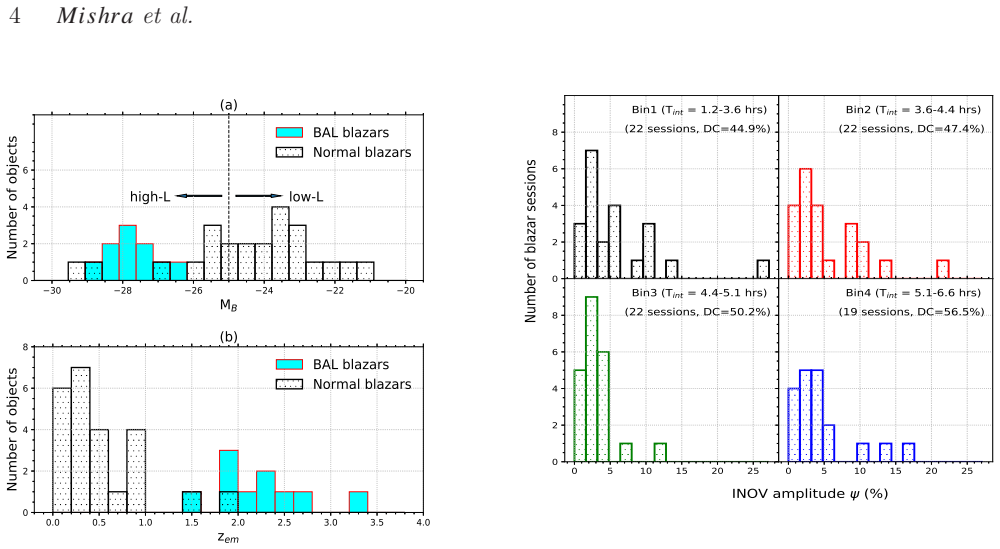
Summary. The paper presents an intranight optical variability (INOV) search for blazars among broad-absorption-line (BAL) quasars. From 56 radio-detected BALQSOs in the literature, the authors select 10 candidates with flat/inverted radio spectra and high radio polarization (p_rad > 3%), and monitor each on three nights, obtaining 30 sessions with the 1.3-m DFOT, 1.04-m ST, and 2.0-m HCT. Using the standard F_eta test applied to differential light curves, they find no positive INOV detection in any of the 30 sessions. They compare this null result with a sample of 28 rms-error-matched sessions of 15 'normal' blazars from Goyal et al. (2013), for which they compute an INOV duty cycle of 41.2%. They also examine luminosity and redshift effects, binning the normal-blazar sample by rest-frame monitoring duration and finding duty cycles of 44.9-56.5% for bins with median T_int from 3.0 to 5.6 hr. The paper explicitly acknowledges that a drastic drop in INOV strength for T_int below about 1-2 hr cannot be ruled out, and it offers two alternative interpretations: that the polar model of BAL outflows is undermined, or that jets in BAL quasars are intrinsically less conducive to strong INOV.
Significance. The paper addresses a well-posed question: do flat-spectrum, highly polarized BAL quasars exhibit blazar-like intranight optical variability? The null result is based on a systematic, well-defined sample and standard photometric analysis, and the comparison with normal blazars is carefully matched in rms error. If the claimed contrast with the normal-blazar duty cycle holds at matched rest-frame durations, the result would constrain the geometry of BAL outflows and the physics of jets in BAL quasars. A notable strength is that the authors explicitly discuss the main caveat, namely the unmatched distribution of rest-frame monitoring durations, and they are appropriately cautious in their interpretation. However, because the central contrast with the normal-blazar duty cycle depends on an assumption about INOV behavior at T_int ~1.2 hr that is not tested by the data, the significance of the result is presently limited.
major comments (3)
- [Section 5, Fig. 3, Eq. (2)] The central claim that the null detection in the BAL-blazar sample contrasts with the 41.2% duty cycle of normal blazars is not supported at matched rest-frame monitoring durations. The BAL-blazar sessions have median T_int = 1.2 hr, while the shortest T_int bin for the normal-blazar sample has median 3.0 hr (range 1.2-3.6 hr). The authors state that 'a drastic drop in INOV strength for T_int less than about 1-2 hrs... cannot be ruled out at present.' This is a load-bearing caveat: if the normal-blazar duty cycle falls steeply below about 2 hr, then 0/30 detections would be consistent with normal blazar behavior, and the contrast that motivates the conclusions would collapse. The authors should quantify this possibility directly, for example by computing the INOV duty cycle for the Goyal et al. (2013) sessions with T_int < 2 hr, or by re-weighting the comparison sample to match the T_int distribution of the BAL-blazar sessions. Without such an analysis, the abstract's 'striking contrast' is an extrapolation, not a demonstrated result.
- [Section 5, Eq. (2) and online Table 2] The statistical significance of the null result is not quantified in a way that accounts for the short T_int. The probability of obtaining zero detections among 30 sessions depends strongly on the assumed duty cycle at T_int = 1.2 hr. For the 41.2% duty cycle measured at longer durations, 0/30 is extremely unlikely, but for a duty cycle of, say, 10% (plausible if INOV is timescale dependent), the probability is about 4%, which is not significant. The paper should present a confidence upper limit on the duty cycle at the actual monitoring duration, or a binomial calculation that explicitly uses the T_int-dependent comparison data. This would make the strength of the constraint quantitative rather than qualitative.
- [Section 2, Table 1] The sample selection uses radio polarization measurements at heterogeneous frequencies (1.4, 8.46, 22, and 43 GHz) and applies a 3% threshold motivated by the 15 GHz distribution of Hodge et al. (2018). Some polarization measurements have large uncertainties (e.g., 17.6 ± 14.0% for J162559.90+485817.5). This heterogeneity could dilute the 'blazar candidate' selection, making the sample less representative of true blazar-like BAL quasars. Please discuss whether the threshold is robust across frequencies and whether the large-error entries affect the selection.
minor comments (5)
- [Section 1] Typo: 'equitorian' should be 'equatorial'.
- [Section 4, Eq. (1)] The equation contains a LaTeX rendering artifact ('N/summationdisplay.1'); the summation notation should be cleaned up so the definition of the mean square error is unambiguous.
- [Section 3] The sentence 'monitored in 3 separate sessions continuously for a minimum duration of 3-hours' is ambiguous; it could be read as each session being at least 3 hours, but the online tables are needed to confirm. Please clarify the actual session durations and note that the rest-frame durations are shorter by a factor (1+z).
- [References] In the reference list, entries such as 'Gopal-Krishna Wiita P. J., 2018' are missing the ampersand or comma expected in author lists; please check the bibliography style for consistency.
- [Figure 2] The caption labels the filled histogram as 'BAL blazars' and the dotted as 'Normal blazars', which is clear, but the text refers to 'BAL-blazar candidates' and 'normal blazars'; please use consistent terminology throughout the figure and text.
Circularity Check
No circular derivation: the INOV null result is new observational data, and the comparison duty cycle is computed from a prior published dataset rather than from the present sample's fitted values.
full rationale
The paper's central chain is: (1) monitor 10 BAL-blazar candidates in 30 sessions; (2) find no positive INOV detection; (3) compare with a duty cycle computed from Goyal et al. (2013) for normal blazars. Step (1) is new photometry, and step (2) is a null result read directly from the DLCs with the F_eta test. Step (3) uses Eq. 2 applied to the published table 1 of Goyal et al. (2013), not to values fitted in this paper, so the 41.2% duty cycle is an external empirical quantity, not an output of the present observations. The F_eta test and the NV/PV/V classification are common methodology applied to both samples; using the same statistical procedure does not make the comparison circular. The authorship overlap is real: Gopal-Krishna is a co-author of both this paper and Goyal et al. (2013), and Gopal-Krishna & Wiita (2018) is cited for the typical blazar INOV duty cycle. But these are prior observational results and reviews, not self-citations invoked as unverified uniqueness theorems or fitted inputs, so they do not constitute circularity. The paper itself flags the main threat to its contrast in Section 5: 'a drastic drop in INOV strength for T_int less than about 1-2 hrs... cannot be ruled out at present' (median T_int = 1.2 hr for the BAL candidates versus 3.0 hr for the shortest comparison bin). That is a scientific limitation about timescale extrapolation, not a circular step. No equation in the paper reduces to its own input, and no fitted parameter is renamed as a prediction.
Assumptions & free parameters
free parameters (3)
- eta in F-eta test =
1.5
- rms matching tolerance =
+-0.5%
- radio polarization threshold p_rad =
3%
assumptions (5)
- standard math The F-eta test with eta=1.5 correctly separates variable from non-variable DLCs under the photometric errors
- domain assumption The Goyal et al. 2013 sample of normal blazars provides a valid baseline for the duty cycle comparison
- domain assumption INOV duty cycle does not drop drastically for rest-frame monitoring durations below about 2 hr
- domain assumption The literature classifications and measured fluxes/redshifts of the 10 BAL quasars are accurate
- domain assumption Photometric error estimates from DAOPHOT adequately represent the noise
Cite this review
Pith. "Pith review of Are there broad absorption-line blazars?." pith.science (2026). https://pith.science/paper/PTGONNPO
@misc{pith2026190801015,
  author       = {Pith},
  title        = {Pith review of: Are there broad absorption-line blazars?},
  year         = {2026},
  howpublished = {\url{https://pith.science/paper/PTGONNPO}},
  note         = {Machine review of arXiv:1908.01015}
}
read the original abstract
We report the first systematic search for blazars among broad-absorption-line (BAL) quasars. This is based on our intranight optical monitoring of a well-defined sample of 10 candidates selected on the criteria of a flat spectrum and an abnormally high linear polarization at radio wavelengths. A small population of BAL blazars can be expected in the 'polar model' of BAL quasars. However, no such case is found, since none of our 30 monitoring sessions devoted to the 10 candidates yielded a positive detection of intra-night optical variability (INOV), which is uncharacteristic of blazars. This lack of INOV detection contrasts with the high duty cycle of INOV observed for a comparison sample of 15 'normal' (i.e., non-BAL) blazars. Some possible implications of this are pointed out.
Figures

Reference graph
Works this paper leans on
-
[1]
write newline
" write newline "" before.all 'output.state := FUNCTION fin.entry write newline FUNCTION new.block output.state before.all = 'skip after.block 'output.state := if FUNCTION new.sentence output.state after.block = 'skip output.state before.all = 'skip after.sentence 'output.state := if if FUNCTION not #0 #1 if FUNCTION and 'skip pop #0 if FUNCTION or pop #1...
-
[2]
Becker R. H., White R. L., Gregg M. D., Brotherton M. S., Laurent-Muehleisen S. A., Arav N., 2000, @doi [ ] 10.1086/309099 , http://adsabs.harvard.edu/abs/2000ApJ...538...72B 538, 72
-
[3]
R., Carballo R., Holt J., Vigotti M., Gonz \'a lez-Serrano J
Benn C. R., Carballo R., Holt J., Vigotti M., Gonz \'a lez-Serrano J. I., Mack K.-H., Perley R. A., 2005, @doi [ ] 10.1111/j.1365-2966.2005.09143.x , http://adsabs.harvard.edu/abs/2005MNRAS.360.1455B 360, 1455
arXiv 2005
-
[4]
Brotherton M. S., De Breuck C., Schaefer J. J., 2006, @doi [ ] 10.1111/j.1745-3933.2006.00226.x , http://adsabs.harvard.edu/abs/2006MNRAS.372L..58B 372, L58
arXiv 2006
-
[5]
Bruni G., et al., 2012, @doi [ ] 10.1051/0004-6361/201219056 , http://adsabs.harvard.edu/abs/2012A
-
[6]
Bruni G., Dallacasa D., Mack K.-H., Montenegro-Montes F. M., Gonz \'a lez-Serrano J. I., Holt J., Jim \'e nez-Luj \'a n F., 2013, @doi [ ] 10.1051/0004-6361/201321341 , http://adsabs.harvard.edu/abs/2013A
-
[7]
M., Brienza M., Gonz \'a lez-Serrano J
Bruni G., Mack K.-H., Montenegro-Montes F. M., Brienza M., Gonz \'a lez-Serrano J. I., 2015, @doi [ ] 10.1051/0004-6361/201526596 , http://adsabs.harvard.edu/abs/2015A
-
[8]
Cohen M. H., Ogle P. M., Tran H. D., Vermeulen R. C., Miller J. S., Goodrich R. W., Martel A. R., 1995, @doi [ ] 10.1086/309602 , http://adsabs.harvard.edu/abs/1995ApJ...448L..77C 448, L77
Show all 41 references
-
[9]
Doi A., et al., 2009, @doi [ ] 10.1093/pasj/61.6.1389 , http://adsabs.harvard.edu/abs/2009PASJ...61.1389D 61, 1389
2009 doi
-
[10]
Elvis M., 2000, @doi [ ] 10.1086/317778 , http://adsabs.harvard.edu/abs/2000ApJ...545...63E 545, 63
2000 doi
-
[11]
Fugmann W., 1988, , http://adsabs.harvard.edu/abs/1988A
1988
-
[12]
K., Punsly B., 2007, @doi [ ] 10.1086/518859 , http://adsabs.harvard.edu/abs/2007ApJ...661L.139G 661, L139
Ghosh K. K., Punsly B., 2007, @doi [ ] 10.1086/518859 , http://adsabs.harvard.edu/abs/2007ApJ...661L.139G 661, L139
2007 doi
-
[13]
W., Miller J
Goodrich R. W., Miller J. S., 1995, @doi [ ] 10.1086/309600 , http://adsabs.harvard.edu/abs/1995ApJ...448L..73G 448, L73
1995 doi
-
[14]
J., 2018, Bulletin de la Societe Royale des Sciences de Liege, http://adsabs.harvard.edu/abs/2018BSRSL..87..281G 87, 281
Gopal-Krishna Wiita P. J., 2018, Bulletin de la Societe Royale des Sciences de Liege, http://adsabs.harvard.edu/abs/2018BSRSL..87..281G 87, 281
2018
-
[15]
J., Anupama G
Gopal-Krishna Goyal A., Joshi S., Karthick C., Sagar R., Wiita P. J., Anupama G. C., Sahu D. K., 2011, @doi [ ] 10.1111/j.1365-2966.2011.19014.x , http://adsabs.harvard.edu/abs/2011MNRAS.416..101G 416, 101
2011
-
[16]
J., Anupama G
Goyal A., Gopal-Krishna Wiita P. J., Anupama G. C., Sahu D. K., Sagar R., Joshi S., 2012, @doi [ ] 10.1051/0004-6361/201218888 , http://adsabs.harvard.edu/abs/2012A
2012 doi
-
[17]
W., Stalin C
Goyal A., Gopal-Krishna Paul J. W., Stalin C. S., Sagar R., 2013, @doi [ ] 10.1093/mnras/stt1373 , http://adsabs.harvard.edu/abs/2013MNRAS.435.1300G 435, 1300
2013 doi
-
[18]
D., Becker R
Gregg M. D., Becker R. H., de Vries W., 2006, @doi [ ] 10.1086/500381 , http://adsabs.harvard.edu/abs/2006ApJ...641..210G 641, 210
2006 doi
-
[19]
B., et al., 2002, @doi [ ] 10.1086/340546 , https://ui.adsabs.harvard.edu/abs/2002ApJS..141..267H 141, 267
Hall P. B., et al., 2002, @doi [ ] 10.1086/340546 , https://ui.adsabs.harvard.edu/abs/2002ApJS..141..267H 141, 267
2002 doi
-
[20]
Hamann F., Chartas G., Reeves J., Nardini E., 2018, @doi [ ] 10.1093/mnras/sty043 , https://ui.adsabs.harvard.edu/abs/2018MNRAS.476..943H 476, 943
2018 doi
-
[21]
J., Doi A., Nagai H., 2013, @doi [ ] 10.1088/0004-637X/772/1/4 , http://adsabs.harvard.edu/abs/2013ApJ...772....4H 772, 4
Hayashi T. J., Doi A., Nagai H., 2013, @doi [ ] 10.1088/0004-637X/772/1/4 , http://adsabs.harvard.edu/abs/2013ApJ...772....4H 772, 4
2013 doi
-
[22]
A., Lister M
Hodge M. A., Lister M. L., Aller M. F., Aller H. D., Kovalev Y. Y., Pushkarev A. B., Savolainen T., 2018, @doi [ ] 10.3847/1538-4357/aacb2f , http://adsabs.harvard.edu/abs/2018ApJ...862..151H 862, 151
2018 doi
-
[23]
R., Wang T
Jiang D. R., Wang T. G., 2003, @doi [ ] 10.1051/0004-6361:20021765 , http://adsabs.harvard.edu/abs/2003A
2003 doi
-
[24]
Joshi R., Chand H., 2013, @doi [ ] 10.1093/mnras/sts459 , http://adsabs.harvard.edu/abs/2013MNRAS.429.1717J 429, 1717
2013 doi
-
[25]
Kunert-Bajraszewska M., Ceg owski M., Katarzy \'n ski K., Roskowi \'n ski C., 2015, @doi [ ] 10.1051/0004-6361/201526091 , http://adsabs.harvard.edu/abs/2015A
2015 doi
-
[26]
L., Smith P
Lister M. L., Smith P. S., 2000, @doi [ ] 10.1086/309413 , http://adsabs.harvard.edu/abs/2000ApJ...541...66L 541, 66
2000 doi
-
[27]
P., et al., 2008, @doi [ ] 10.1038/nature06895 , http://adsabs.harvard.edu/abs/2008Natur.452..966M 452, 966
Marscher A. P., et al., 2008, @doi [ ] 10.1038/nature06895 , http://adsabs.harvard.edu/abs/2008Natur.452..966M 452, 966
2008 doi
-
[28]
M., Mack K.-H., Vigotti M., Benn C
Montenegro-Montes F. M., Mack K.-H., Vigotti M., Benn C. R., Carballo R., Gonz \'a lez-Serrano J. I., Holt J., Jim \'e nez-Luj \'a n F., 2008, @doi [ ] 10.1111/j.1365-2966.2008.13520.x , http://adsabs.harvard.edu/abs/2008MNRAS.388.1853M 388, 1853
2008
-
[29]
A., Voit G
Murray N., Chiang J., Grossman S. A., Voit G. M., 1995, @doi [ ] 10.1086/176238 , http://adsabs.harvard.edu/abs/1995ApJ...451..498M 451, 498
1995 doi
-
[30]
P \^a ris I., et al., 2012, @doi [ ] 10.1051/0004-6361/201220142 , http://adsabs.harvard.edu/abs/2012A
2012 doi
-
[31]
J., 2016, @doi [ ] 10.3847/0004-637X/820/1/12 , http://adsabs.harvard.edu/abs/2016ApJ...820...12P 820, 12
Pollack M., Pauls D., Wiita P. J., 2016, @doi [ ] 10.3847/0004-637X/820/1/12 , http://adsabs.harvard.edu/abs/2016ApJ...820...12P 820, 12
2016 doi
-
[32]
P., Anupama G
Prabhu T. P., Anupama G. C., 2010, in Astronomical Society of India Conference Series
2010
-
[33]
M., Kallman T
Proga D., Stone J. M., Kallman T. R., 2000, @doi [ ] 10.1086/317154 , http://adsabs.harvard.edu/abs/2000ApJ...543..686P 543, 686
2000 doi
-
[34]
Punsly B., 1999, @doi [ ] 10.1086/308095 , http://adsabs.harvard.edu/abs/1999ApJ...527..609P 527, 609
1999 doi
-
[35]
E., Cellone S
Romero G. E., Cellone S. A., Combi J. A., Andruchow I., 2002, @doi [ ] 10.1051/0004-6361:20020743 , http://adsabs.harvard.edu/abs/2002A
2002 doi
-
[36]
Sagar R., 1999, Current Science, http://adsabs.harvard.edu/abs/1999CSci...77..643S 77, 643
1999
-
[37]
Sagar R., et al., 2011, Current Science, http://adsabs.harvard.edu/abs/2011CSci..101.1020S 101, 1020
2011
-
[38]
B., 1987, @doi [ ] 10.1086/131977 , http://adsabs.harvard.edu/abs/1987PASP...99..191S 99, 191
Stetson P. B., 1987, @doi [ ] 10.1086/131977 , http://adsabs.harvard.edu/abs/1987PASP...99..191S 99, 191
1987 doi
-
[39]
J., Morris S
Weymann R. J., Morris S. L., Foltz C. B., Hewett P. C., 1991, @doi [ ] 10.1086/170020 , http://adsabs.harvard.edu/abs/1991ApJ...373...23W 373, 23
1991 doi
-
[40]
Yang J., Wu F., Paragi Z., An T., 2012, @doi [ ] 10.1111/j.1745-3933.2011.01182.x , http://adsabs.harvard.edu/abs/2012MNRAS.419L..74Y 419, L74
2012
-
[41]
Zhou H., Wang T., Wang H., Wang J., Yuan W., Lu Y., 2006, @doi [ ] 10.1086/499768 , http://adsabs.harvard.edu/abs/2006ApJ...639..716Z 639, 716
2006 doi
Reviewed August 14, 2026 · model on record in the stance chip above.
Discussion (0). Continue with ORCID to comment.