Unlocking Realism and Interpretability in Wireless Channel Synthesis: A Physics-Guided Generative Approach
Pith reviewed 2026-06-26 06:25 UTC · model grok-4.3
The pith
Integrating a parametric physics-based geometric channel model with generative methods produces realistic wireless channel matrices with interpretable physical parameters.
A machine-rendered reading of the paper's core claim, the machinery that carries it, and where it could break.
Core claim
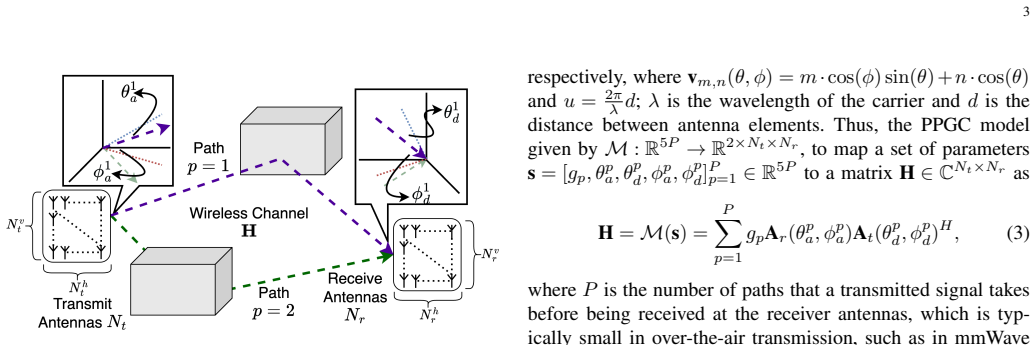
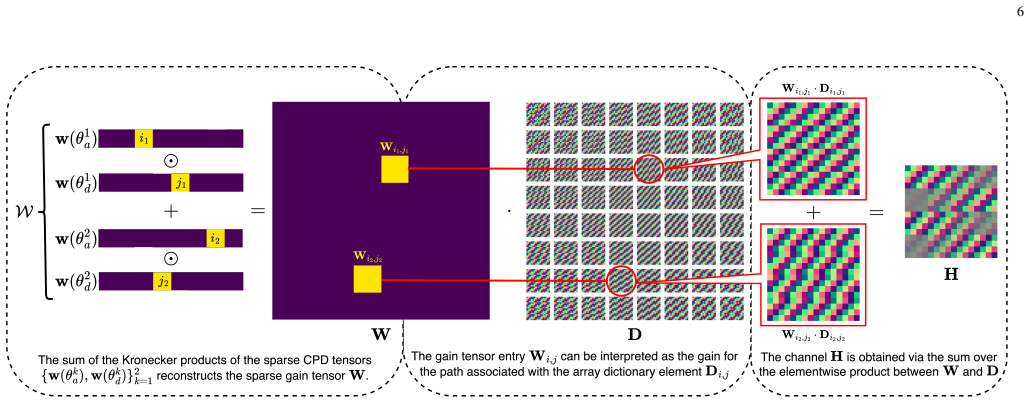
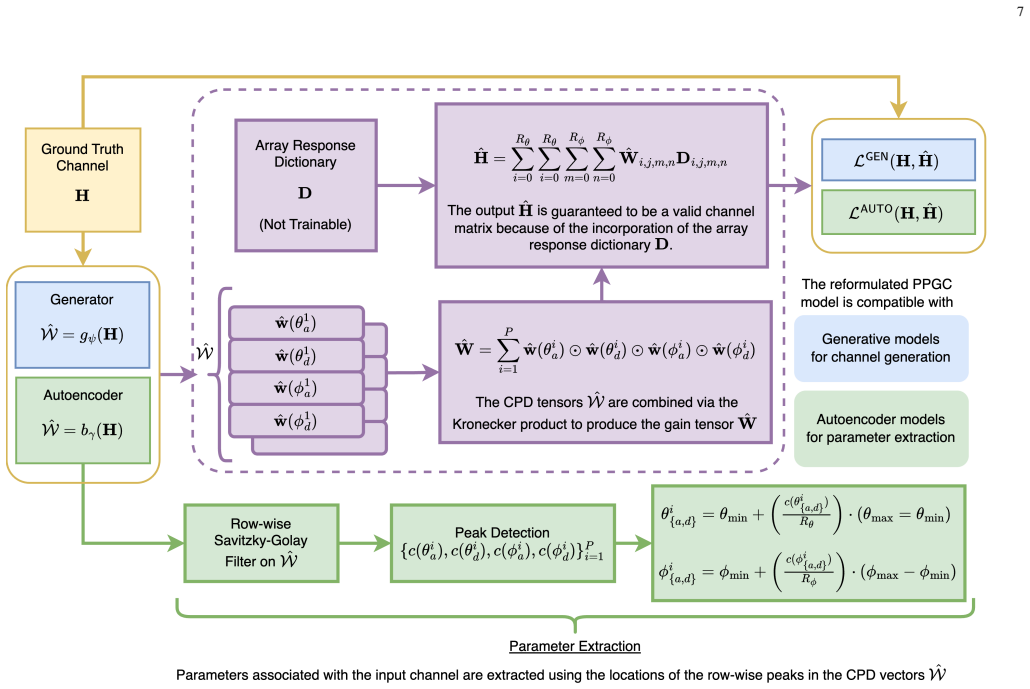
Integrating a parametric, physics-based geometric channel (PPGC) modeling framework derived from planar wave propagation equations with generative methods, together with a linearized reformulation and tensor decomposition, produces realistic channel matrices that admit interpretable representations in the parameter domain and remain compatible with parameter extraction tasks.
What carries the argument
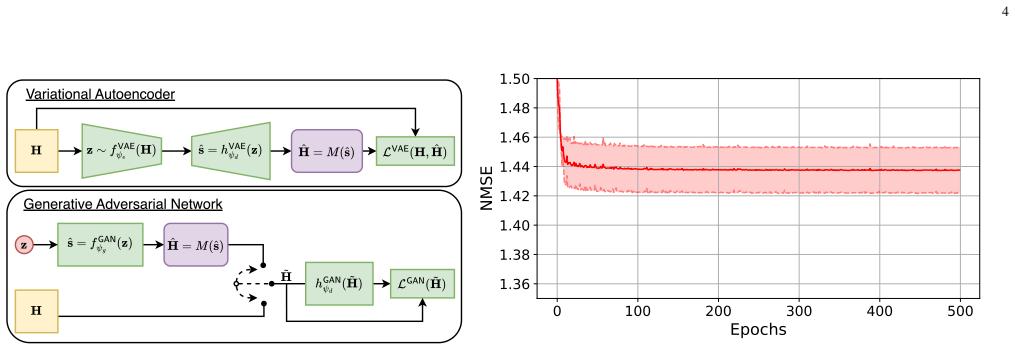
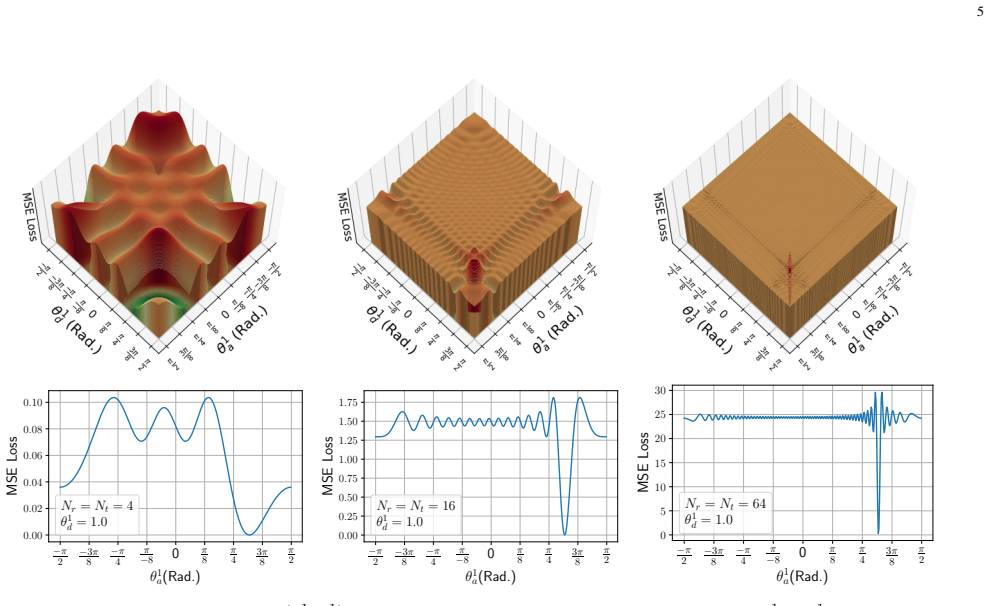
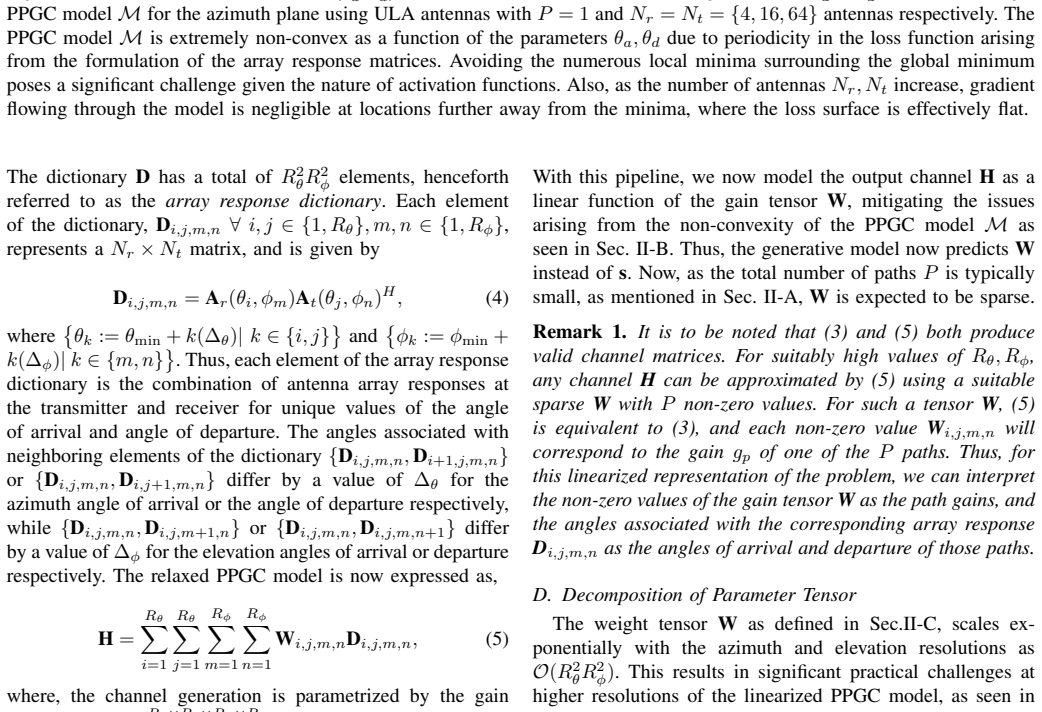
The linearized reformulation of the PPGC model, which replaces the original non-convex optimization landscape with one that supports smooth gradient flow during generative training while retaining physical viability.
If this is right
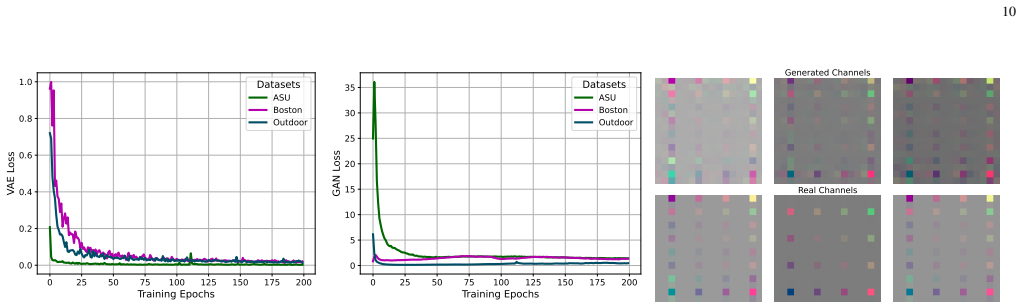
- Generated samples achieve higher similarity to true scenario-specific channels than prior baselines.
- The outputs improve performance in downstream compression tasks relative to existing generative methods.
- The model supports parameter extraction without requiring additional labeled data.
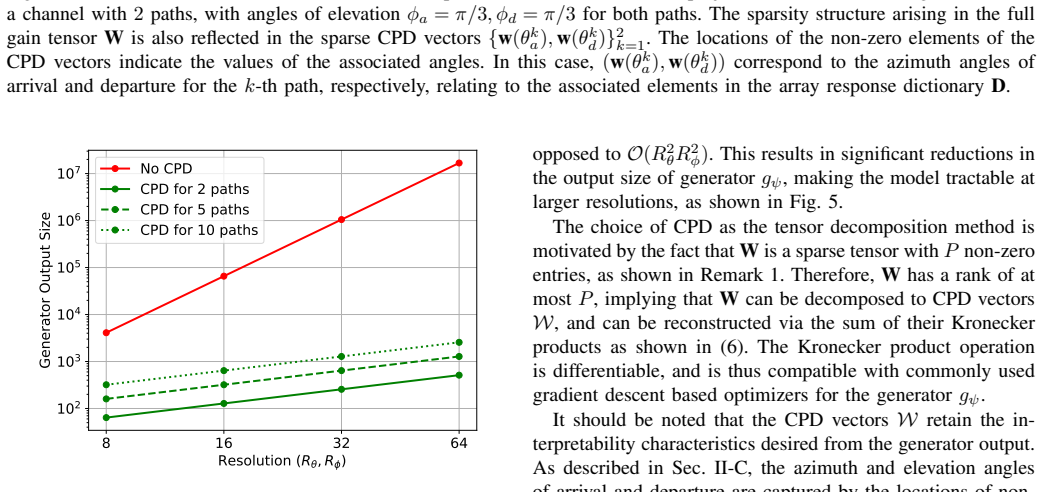
- Tensor decomposition in the reformulation allows the number of channel parameters to vary flexibly across scenarios.
Where Pith is reading between the lines
- The same linearized physics-guided structure could be tested for enforcing physical constraints in generative models outside wireless communications, such as in acoustic or optical propagation synthesis.
- Parameter interpretability opens the possibility of feeding the extracted values back into standard ray-tracing simulators for hybrid data-model pipelines.
- If the approach scales to higher-frequency bands, it would directly reduce the volume of OTA measurements needed to train beamforming or localization networks.
Load-bearing premise
The linearized reformulation of the PPGC model preserves physical viability and interpretability of the original nonlinear model while enabling stable gradient-based training of the generative component.
What would settle it
Generate channels from the model for a known physical scenario, extract the parameter values, and compare them directly to ground-truth geometry and propagation parameters measured in that same scenario; mismatch on viability or parameter accuracy would falsify the claim.
Figures
read the original abstract
In recent years, machine learning (ML) methods have become increasingly popular for wireless communication systems. These require large amounts of data reflecting the behavior of realistic channels with high fidelity. However, sampling over-the-air (OTA) channel data is an extremely resource-intensive process which cannot accurately represent the variety of real world channels. This results in the need for realistic training data for ML systems. To this end, generative models have been proposed to synthesize channel data. However,(i) the outputs produced by such methods may not correspond to physically viable channels, (ii) the outputs may not provide insights into the associated environment, and (iii) training the generative model may need labeled data, requiring resource intensive data annotation. Through this work, we address these issues by integrating a parametric, physics-based geometric channel (PPGC) modeling framework derived from planar wave propagation equations, with generative methods to produce realistic channel matrices with interpretable representations in the parameter domain. To overcome the limitations of the resulting non-convex optimization landscape, we propose a linearized reformulation of the PPGC model to ensure smooth gradient flow during training, while also providing insights into the underlying physical environment. We incorporate a tensor decomposition framework into the linearized reformulation to allow for flexibility in the number of wireless channel parameters. We also show the compatibility of this reformulation with parameter extraction tasks. We evaluate our model against prior baselines by comparing generated, scenario-specific samples to true channels in terms of their similarity and through their utility in downstream compression tasks.
Editorial analysis
A structured set of objections, weighed in public.
Referee Report
Summary. The paper claims that integrating a parametric physics-based geometric channel (PPGC) model derived from planar-wave propagation equations with generative methods yields realistic wireless channel matrices that remain interpretable in the parameter domain. A linearized reformulation of PPGC is introduced to enable stable gradient-based training and tensor decomposition for variable numbers of parameters; the approach is asserted to be compatible with parameter extraction and is evaluated on similarity to ground-truth channels plus utility in downstream compression tasks.
Significance. If the linearized PPGC preserves physical viability and parameter interpretability while the generative component produces high-fidelity samples, the work would offer a principled route to physics-constrained synthetic data for ML-based wireless systems, addressing non-physical outputs and lack of environmental insight in purely data-driven generators. The combination of established planar-wave axioms with tensor flexibility and gradient compatibility is a potentially useful technical contribution.
major comments (2)
- [Proposed Approach] § Proposed Approach (linearized reformulation paragraph): the claim that the linearized PPGC remains a valid approximation to the original nonlinear planar-wave geometry is load-bearing for both realism and interpretability, yet the abstract provides no derivation, error bound, or regime-of-validity analysis (e.g., far-field or multipath) showing that the mapping from angles/delays/gains to the channel matrix is preserved outside the small-perturbation regime; without this, the central guarantee collapses even if training succeeds.
- [Evaluation] Evaluation section: the abstract states that generated samples were compared to true channels on similarity metrics and downstream compression utility, but supplies no quantitative results, baselines, error bars, or statistical tests; these numbers are required to substantiate the performance claims and must appear with explicit definitions of the similarity measures and compression task.
minor comments (2)
- [Proposed Approach] Notation for the tensor decomposition and the mapping from physical parameters to the channel matrix should be introduced with explicit equations rather than prose descriptions.
- [Abstract] The abstract mentions compatibility with parameter extraction but does not indicate whether this is demonstrated empirically or only conceptually; a brief statement or reference to the relevant experiment would improve clarity.
Simulated Author's Rebuttal
We thank the referee for the constructive and detailed comments. We address each major comment below and indicate where revisions will be made to strengthen the manuscript.
read point-by-point responses
-
Referee: [Proposed Approach] § Proposed Approach (linearized reformulation paragraph): the claim that the linearized PPGC remains a valid approximation to the original nonlinear planar-wave geometry is load-bearing for both realism and interpretability, yet the abstract provides no derivation, error bound, or regime-of-validity analysis (e.g., far-field or multipath) showing that the mapping from angles/delays/gains to the channel matrix is preserved outside the small-perturbation regime; without this, the central guarantee collapses even if training succeeds.
Authors: We agree that explicit justification of the approximation is required for the claims on realism and interpretability. The linearized reformulation is obtained in the main text by a first-order Taylor expansion of the phase terms in the planar-wave model around nominal parameter values. This preserves the mapping from angles, delays, and gains to the channel matrix under the standard far-field assumption (array aperture much smaller than link distance). We acknowledge that the abstract omits both the derivation sketch and any error-bound or regime statement. We will revise the abstract to include a concise statement of the far-field regime and add a short error analysis paragraph (with bound) to the Proposed Approach section, referencing the full derivation already present in the manuscript body. revision: yes
-
Referee: [Evaluation] Evaluation section: the abstract states that generated samples were compared to true channels on similarity metrics and downstream compression utility, but supplies no quantitative results, baselines, error bars, or statistical tests; these numbers are required to substantiate the performance claims and must appear with explicit definitions of the similarity measures and compression task.
Authors: The referee is correct that the abstract summarizes the evaluation without numerical values. The Evaluation section of the manuscript reports quantitative results using normalized mean-squared error and cosine similarity for channel fidelity, plus normalized compression gain for the downstream task, with comparisons against standard GAN and VAE baselines, error bars from 10 independent runs, and paired t-tests for significance. Definitions of all metrics and the compression protocol are provided in that section. To address the comment, we will expand the abstract to include the key numerical outcomes and metric definitions while preserving brevity. revision: yes
Circularity Check
No circularity: derivation from planar-wave equations is independent of outputs
full rationale
The paper presents the PPGC model as derived from established planar wave propagation equations, with the linearized reformulation introduced explicitly to enable gradient-based training and tensor decomposition. No quoted step equates a claimed prediction, interpretability result, or generated channel matrix to a fitted parameter or self-citation by construction. The central integration with generative methods remains an independent modeling choice whose validity can be checked against external channel data and physics benchmarks, satisfying the self-contained criterion.
Axiom & Free-Parameter Ledger
axioms (1)
- domain assumption Planar wave propagation equations accurately describe the wireless channels of interest
Reference graph
Works this paper leans on
-
[1]
Deep learning for massive mimo csi feedback,
C.-K. Wen, W.-T. Shih, and S. Jin, “Deep learning for massive mimo csi feedback,”IEEE Wireless Commun. Letters, vol. 7, no. 5, pp. 748–751, 2018
2018
-
[2]
Deep learning-based channel estimation,
M. Soltani, V . Pourahmadi, A. Mirzaei, and H. Sheikhzadeh, “Deep learning-based channel estimation,”IEEE Commun. Letters, vol. 23, no. 4, pp. 652–655, 2019
2019
-
[3]
Fast beamforming design via deep learning,
H. Huang, Y . Peng, J. Yang, W. Xia, and G. Gui, “Fast beamforming design via deep learning,”IEEE Trans. on Vehicular Tech., vol. 69, no. 1, pp. 1065–1069, 2019
2019
-
[4]
Key focus areas and enabling technologies for 6g,
C. G. Brinton, M. Chiang, K. T. Kim, D. J. Love, M. Beesley, M. Repeta, J. Roese, P. Beming, E. Ekudden, C. Liet al., “Key focus areas and enabling technologies for 6g,”IEEE Commun. Mag., vol. 63, no. 3, pp. 84–91, 2025
2025
-
[5]
A review of wireless channel estimation techniques: challenges and solutions,
M. Drakshayini and M. R. Kounte, “A review of wireless channel estimation techniques: challenges and solutions,”Inter. Jrnl. of Wireless and Mobile Computing, vol. 23, no. 2, pp. 193–203, 2022
2022
-
[6]
Insights into maximum likelihood detection for one-bit massive mimo communications,
A. Sant and B. D. Rao, “Insights into maximum likelihood detection for one-bit massive mimo communications,”IEEE Trans. on Wireless Commun., 2024
2024
-
[7]
Model- driven deep learning for physical layer communication,
H. He, S. Jin, C.-K. Wen, F. Gao, G. Y . Li, and Z. Xu, “Model- driven deep learning for physical layer communication,”IEEE Wireless Commun., vol. 26, no. 5, pp. 77–83, 2019
2019
-
[8]
Wireless networks design in the era of deep learning: Model-based, ai-based, or both?
A. Zappone, M. Di Renzo, and M. Debbah, “Wireless networks design in the era of deep learning: Model-based, ai-based, or both?”IEEE Trans. on Commun., vol. 67, no. 10, pp. 7331–7376, 2019
2019
-
[9]
A survey on model- based, heuristic, and machine learning optimization approaches in ris- aided wireless networks,
H. Zhou, M. Erol-Kantarci, Y . Liu, and H. V . Poor, “A survey on model- based, heuristic, and machine learning optimization approaches in ris- aided wireless networks,”IEEE Commun. Surveys & Tutorials, vol. 26, no. 2, pp. 781–823, 2024
2024
-
[10]
142 ghz multipath propagation measurements and path loss channel modeling in factory buildings,
S. Ju and T. S. Rappaport, “142 ghz multipath propagation measurements and path loss channel modeling in factory buildings,” inICC 2023 - IEEE Inter. Conf. on Commun., 2023, pp. 5048–5053
2023
-
[11]
Sub-terahertz channel measurements and characterization in a factory building,
S. Ju, Y . Xing, O. Kanhere, and T. S. Rappaport, “Sub-terahertz channel measurements and characterization in a factory building,” inICC 2022 - IEEE Inter. Conf. on Commun., 2022, pp. 2882–2887
2022
-
[12]
Channel parameter estima- tion in wireless communication: A deep learning perspective,
S. Kumar, A. Malhotra, and S. Hamidi-Rad, “Channel parameter estima- tion in wireless communication: A deep learning perspective,” in2024 IEEE Inter. Conf. on Mach. Learn. for Communication and Networking (ICMLCN), 2024, pp. 511–516
2024
-
[13]
Ota measurement for iot wireless device performance evaluation: Challenges and solutions,
P. Shen, Y . Qi, W. Yu, J. Fan, and F. Li, “Ota measurement for iot wireless device performance evaluation: Challenges and solutions,”IEEE Internet of Things Jrnl., vol. 6, no. 1, pp. 1223–1237, 2019
2019
-
[14]
Adapting to reality: Over-the-air validation of ai-based receivers trained with simulated channels,
R. Luostari, D. Korpi, M. Honkala, and J. M. J. Huttunen, “Adapting to reality: Over-the-air validation of ai-based receivers trained with simulated channels,” 2025
2025
-
[15]
Over-the-air deep learning based radio signal classification,
T. J. O’Shea, T. Roy, and T. C. Clancy, “Over-the-air deep learning based radio signal classification,”IEEE Jrnl. of Selected Topics in Sig. Proc., vol. 12, no. 1, pp. 168–179, 2018
2018
-
[16]
Ex- posing the fingerprint: Dissecting the impact of the wireless channel on radio fingerprinting,
A. Al-Shawabka, F. Restuccia, S. D’Oro, T. Jian, B. Costa Rendon, N. Soltani, J. Dy, S. Ioannidis, K. Chowdhury, and T. Melodia, “Ex- posing the fingerprint: Dissecting the impact of the wireless channel on radio fingerprinting,” inIEEE INFOCOM 2020 - IEEE Conf. on Computer Commun., 2020, pp. 646–655
2020
-
[17]
Sionna research kit: A gpu-accelerated research platform for ai-ran,
S. Cammerer, G. Marcus, T. Zirr, F. A. Aoudia, L. Maggi, J. Hoydis, and A. Keller, “Sionna research kit: A gpu-accelerated research platform for ai-ran,” 2025. [Online]. Available: https://arxiv.org/abs/2505.15848 13
arXiv 2025
-
[19]
Dynamical variational autoencoders: A comprehensive review,
L. Girin, S. Leglaive, X. Bie, J. Diard, T. Hueber, and X. Alameda- Pineda, “Dynamical variational autoencoders: A comprehensive review,” Found. and Trends in Mach. Learn., vol. 15, no. 1-2, pp. 1–175, 2021
2021
-
[20]
Learning in implicit generative models,
S. Mohamed and B. Lakshminarayanan, “Learning in implicit generative models,”arXiv preprint arXiv:1610.03483, 2016
Pith/arXiv arXiv 2016
-
[21]
Channelgan: Deep learning- based channel modeling and generating,
H. Xiao, W. Tian, W. Liu, and J. Shen, “Channelgan: Deep learning- based channel modeling and generating,”IEEE Wireless Commun. Letters, vol. 11, no. 3, pp. 650–654, 2022
2022
-
[22]
Mimo-gan: Generative mimo channel modeling,
T. Orekondy, A. Behboodi, and J. B. Soriaga, “Mimo-gan: Generative mimo channel modeling,” inICC 2022 - IEEE Inter. Conf. on Commun., 2022, pp. 5322–5328
2022
-
[23]
Gen- erative diffusion models for radio wireless channel modelling and sampling,
U. Sengupta, C. Jao, A. Bernacchia, S. Vakili, and D.-s. Shiu, “Gen- erative diffusion models for radio wireless channel modelling and sampling,” inGLOBECOM 2023 - 2023 IEEE Global Commun. Conf., 2023, pp. 4779–4784
2023
-
[24]
Score-based generative models for wireless channel modeling and estimation,
M. Arvinte and J. Tamir, “Score-based generative models for wireless channel modeling and estimation,” inICLR Workshop on Deep Gener- ative Models for Highly Structured Data, 2022
2022
-
[25]
Generative adversarial estimation of channel covariance in vehicular millimeter wave systems,
X. Li, A. Alkhateeb, and C. Tepedelenlio ˘glu, “Generative adversarial estimation of channel covariance in vehicular millimeter wave systems,” in2018 52nd Asilomar Conf. on Signals, Sys., and Computers, 2018, pp. 1572–1576
2018
-
[26]
Model-driven gan-based channel modeling for irs-aided wireless communication,
Y . Wei, M.-M. Zhao, and M.-J. Zhao, “Model-driven gan-based channel modeling for irs-aided wireless communication,” in2021 IEEE Global Commun. Conf. (GLOBECOM), 2021, pp. 1–6
2021
-
[27]
Physics-informed generative modeling of wireless channels,
B. B ¨ock, A. Oeldemann, T. Mayer, F. Rossetto, and W. Utschick, “Physics-informed generative modeling of wireless channels,” 2025. [Online]. Available: https://arxiv.org/abs/2502.10137
arXiv 2025
-
[28]
Generative neural network channel modeling for millimeter-wave uav communication,
W. Xia, S. Rangan, M. Mezzavilla, A. Lozano, G. Geraci, V . Semkin, and G. Loianno, “Generative neural network channel modeling for millimeter-wave uav communication,”IEEE Trans. on Wireless Com- mun., vol. 21, no. 11, pp. 9417–9431, 2022
2022
-
[29]
Multi-frequency channel modeling for millimeter wave and thz wireless communication via generative adversarial networks,
Y . Hu, M. Yin, W. Xia, S. Rangan, and M. Mezzavilla, “Multi-frequency channel modeling for millimeter wave and thz wireless communication via generative adversarial networks,” in2022 56th Asilomar Conf. on Signals, Systems, and Computers, 2022, pp. 670–676
2022
-
[30]
Modeling time-varying and frequency-selective channels with generative adversarial networks,
D. Singh and A. K. Reddy Chavva, “Modeling time-varying and frequency-selective channels with generative adversarial networks,” in ICC 2022 - IEEE Inter. Conf. on Commun., 2022, pp. 5329–5334
2022
-
[31]
Channel gain map reconstruction based on virtual scatterer model,
H. Sun, L. Zhu, J. Xu, and R. Zhang, “Channel gain map reconstruction based on virtual scatterer model,” 2026. [Online]. Available: https://arxiv.org/abs/2602.12602
arXiv 2026
-
[32]
Channel gain map estimation for wireless networks based on scatterer model,
H. Sun, L. Zhu, and R. Zhang, “Channel gain map estimation for wireless networks based on scatterer model,”IEEE Transactions on Wireless Communications, vol. 24, no. 8, pp. 7012–7028, 2025
2025
-
[35]
Generative- adversarial-network-based wireless channel modeling: Challenges and opportunities,
Y . Yang, Y . Li, W. Zhang, F. Qin, P. Zhu, and C.-X. Wang, “Generative- adversarial-network-based wireless channel modeling: Challenges and opportunities,”IEEE Commun. Mag., vol. 57, no. 3, pp. 22–27, 2019
2019
-
[36]
Generative ai for the optimization of next-generation wireless networks: Basics, state-of-the-art, and open challenges,
F. Khoramnejad and E. Hossain, “Generative ai for the optimization of next-generation wireless networks: Basics, state-of-the-art, and open challenges,”IEEE Commun. Surveys & Tutorials, pp. 1–1, 2025
2025
-
[37]
NR; Physical Layer Procedures for Data,
3rd Generation Partnership Project (3GPP), “NR; Physical Layer Procedures for Data,” 3rd Generation Partnership Project (3GPP), Technical Specification TS 38.214, 2024, release 15 and subsequent releases, Section 5.2.2 (UE CSI Reporting Procedures). [Online]. Available: https://www.3gpp.org/dynareport/38214.htm
2024
-
[38]
S. Wagle, A. Malhotra, S. Hamidi-Rad, A. Sant, D. J. Love, and C. G. Brinton, “Physics-based generative models for geometrically consistent and interpretable wireless channel synthesis,” inProc. of the Thirty-Fourth Inter. Joint Conf. on Artificial Intelligence, IJCAI 2025, Montreal, Canada, August 16-22, 2025. ijcai.org, 2025, pp. 9384–9392. [Online]. Av...
-
[39]
Physics-informed generative approaches for wireless channel modeling,
——, “Physics-informed generative approaches for wireless channel modeling,” inInter. Conf. on Learn. Repres. (ICLR), Workshop on Deep Generative Model in Machine Learning: Theory, Principle and Efficacy, April 24-28, 2025
2025
-
[40]
T. S. Rappaport,Wireless communications: principles and practice. Cambridge University Press, 2024
2024
-
[41]
NR; Physical Channels and Modulation,
3rd Generation Partnership Project (3GPP), “NR; Physical Channels and Modulation,” 3rd Generation Partnership Project (3GPP), Technical Specification TS 38.211, 2024, release 17, Section 5.3 (OFDM Baseband Signal Generation). [Online]. Available: https://www.3gpp. org/dynareport/38211.htm
2024
-
[42]
The design and applications of high-performance ray-tracing simulation platform for 5g and beyond wireless commun.: A tutorial,
D. He, B. Ai, K. Guan, L. Wang, Z. Zhong, and T. K ¨urner, “The design and applications of high-performance ray-tracing simulation platform for 5g and beyond wireless commun.: A tutorial,”IEEE Commun. Surveys & Tutorials, vol. 21, no. 1, pp. 10–27, 2019
2019
-
[43]
A comprehensive review of efficient ray- tracing techniques for wireless communication,
T. K. Geok, F. Hossain, M. Kamaruddin, N. Rahman, S. Thiagarajah, A. T. W. Chiat, and C. Liew, “A comprehensive review of efficient ray- tracing techniques for wireless communication,”Inter. Jrnl. on Commun. Ant. and Prop., vol. 8, no. 2, pp. 123–136, 2018
2018
-
[44]
Simplified spatial correlation models for clustered mimo channels with different array configurations,
A. Forenza, D. J. Love, and R. W. Heath, “Simplified spatial correlation models for clustered mimo channels with different array configurations,” IEEE Trans. on Vehicular Tech., vol. 56, no. 4, pp. 1924–1934, 2007
1924
-
[45]
On the physical interpretation of the saleh–valenzuela model and the definition of its power delay profiles,
A. Meijerink and A. F. Molisch, “On the physical interpretation of the saleh–valenzuela model and the definition of its power delay profiles,” IEEE Trans. on Ants. and Prop., vol. 62, no. 9, pp. 4780–4793, 2014
2014
-
[46]
Propagation parameter estimation, modeling and measurements for ultrawideband mimo radar,
J. Salmi and A. F. Molisch, “Propagation parameter estimation, modeling and measurements for ultrawideband mimo radar,”IEEE Trans. on Ants. and Prop., vol. 59, no. 11, pp. 4257–4267, 2011
2011
-
[47]
Millimeter wave mobile communications for 5G cellular: It will work!
T. S. Rappaport, S. Sun, R. Mayzus, H. Zhao, Y . Azar, K. Wang, G. N. Wong, J. K. Schulz, M. Samimi, and F. Gutierrez, “Millimeter wave mobile communications for 5G cellular: It will work!”IEEE Access, vol. 1, pp. 335–349, 2013
2013
-
[48]
Millimeter-wave cellular wireless networks: Potentials and challenges,
S. Rangan, T. S. Rappaport, and E. Erkip, “Millimeter-wave cellular wireless networks: Potentials and challenges,”Proceedings of the IEEE, vol. 102, no. 3, pp. 366–385, 2014
2014
-
[49]
Y . Xing, T. S. Rappaport, and A. Ghosh, “Millimeter wave and sub-THz indoor radio propagation channel measurements, models, and comparisons in an office environment,”IEEE Communications Letters, vol. 25, no. 10, pp. 3151–3155, 2021. [Online]. Available: https://arxiv.org/abs/2103.00385
arXiv 2021
-
[50]
Auto-encoding variational bayes,
D. P. Kingma and M. Welling, “Auto-encoding variational bayes,”arXiv preprint arXiv:1312.6114, 2014
Pith/arXiv arXiv 2014
-
[51]
Normalizing flows for probabilistic modeling and inference,
G. Papamakarios, E. Nalisnick, D. J. Rezende, S. Mohamed, and B. Lakshminarayanan, “Normalizing flows for probabilistic modeling and inference,”Jrnl. of Mach. Learn. Research, vol. 22, no. 57, pp. 1–64, 2021
2021
-
[52]
Variational diffusion mod- els,
D. Kingma, T. Salimans, B. Poole, and J. Ho, “Variational diffusion mod- els,” inAdvances in Neural Info. Proc. Sys., M. Ranzato, A. Beygelzimer, Y . Dauphin, P. Liang, and J. W. Vaughan, Eds., vol. 34. Curran Associates, Inc., 2021, pp. 21 696–21 707
2021
-
[53]
Rectified linear units improve restricted boltzmann machines,
V . Nair and G. E. Hinton, “Rectified linear units improve restricted boltzmann machines,” inProc. of the 27th Inter. Conf. on Mach. Learn., ser. ICML’10. Madison, WI, USA: Omnipress, 2010, p. 807–814
2010
-
[54]
A guide to convolution arithmetic for deep learning,
V . Dumoulin and F. Visin, “A guide to convolution arithmetic for deep learning,”arXiv preprint arXiv:1603.07285, 2016
Pith/arXiv arXiv 2016
-
[55]
The expression of a tensor or a polyadic as a sum of products,
F. L. Hitchcock, “The expression of a tensor or a polyadic as a sum of products,”Jrnl. of Mathematics and Physics, vol. 6, no. 1-4, pp. 164– 189, 1927
1927
-
[56]
Smoothing and differentiation of data by simplified least squares procedures
A. Savitzky and M. J. E. Golay, “Smoothing and differentiation of data by simplified least squares procedures.”Analytical Chemistry, vol. 36, no. 8, pp. 1627–1639, 1964
1964
-
[57]
DeepMIMO: A generic deep learning dataset for mil- limeter wave and massive MIMO applications,
A. Alkhateeb, “DeepMIMO: A generic deep learning dataset for mil- limeter wave and massive MIMO applications,” inProc. of Info. Theory and App. Workshop (ITA), San Diego, CA, Feb 2019, pp. 1–8
2019
-
[58]
Wireless InSite,
Remcom, “Wireless InSite,” http://www.remcom.com/wireless-insite
-
[59]
Glow: generative flow with invertible 1×1 convolutions,
D. P. Kingma and P. Dhariwal, “Glow: generative flow with invertible 1×1 convolutions,” inProc. of the 32nd Inter. Conf. on Neural Info. Proc. Sys., ser. NIPS’18. Red Hook, NY , USA: Curran Associates Inc., 2018, p. 10236–10245
2018
-
[60]
Statistical aspects of wasserstein distances,
V . M. Panaretos and Y . Zemel, “Statistical aspects of wasserstein distances,”Annual review of statistics and its application, vol. 6, no. 1, pp. 405–431, 2019
2019
-
[61]
Training generative neural networks via maximum mean discrepancy optimization,
G. K. Dziugaite, D. M. Roy, and Z. Ghahramani, “Training generative neural networks via maximum mean discrepancy optimization,” inProc. of the Thirty-First Conf. on Uncertainty in Artificial Intelligence, ser. UAI’15. Arlington, Virginia, USA: AUAI Press, 2015, p. 258–267
2015
-
[62]
Distributed deep convo- lutional compression for massive mimo csi feedback,
M. B. Mashhadi, Q. Yang, and D. G ¨und¨uz, “Distributed deep convo- lutional compression for massive mimo csi feedback,”IEEE Trans. on Wireless Commun., vol. 20, no. 4, pp. 2621–2633, 2020
2020
-
[63]
Physics-based channel transformation for wireless configura- tions,
S. Wagle, A. Malhotra, S. Hamidi-Rad, A. Sant, D. J. Love, and C. G. Brinton, “Physics-based channel transformation for wireless configura- tions,” into appear in Proc. of IEEE Int. Conf. on Acoustics, Speech, and Sig. Proc., Barcelona, Spain, May 4-8, 2026
2026
discussion (0)
Sign in with ORCID, Apple, or X to comment. Anyone can read and Pith papers without signing in.