REVIEW 2 major objections 5 minor 37 references
Discovery of Faint Nebulosity Around a Z Camelopardalis-type Cataclysmic Variable in Antlia: Nova Shell or Ancient Planetary Nebula?
T0 review · 2 major / 5 minor · reviewed 2026-08-07 · deepseek-v4-flash
Pith's one-line read Deep imaging reveals a faint bipolar nebula around the Z Cam-type cataclysmic variable ASASSN-19ds, argued to be either the shell of an unrecorded 18th-century nova or an ancient planetary nebula.
desk verdict A solid CV-nebula discovery with an honest association problem, but a real unit conversion error inflates the inferred size and age by ~3x. read the letter →
The pith
A machine-rendered reading of the paper's core claim, the machinery that carries it, and where it could break.
The reading
What carries the argument
The key evidence is a set of very long-exposure narrow-band images from a $0.6$ m telescope (55.4 hours in R, G, B, H$\alpha$, and [OIII]), which resolves the nebula into a hollow, bipolar shell with thin arcs at the ends of the major axis; the arcs are read as snowplow deceleration of ejecta against the interstellar medium. On top of that morphology, two external anchors carry the argument: the Gaia parallax, which places the star at $557$ pc and converts the observed $0.59' \times 0.96'$ angular size into a physical size of $0.29 \times 0.47$ pc, and the S25 radius–age relation (the empirical relation from the Santamaría et al. 2025 atlas of nova remnants), which converts the mean radius of roughly $0.19$ pc into an age of $\sim$260 yr for the nova interpretation. The planetary-nebula alternative is carried by the V458 Vul analogy, in which a CV was shown to lie inside a pre-existing PN.
What would settle it
Measure the emission-line spectrum of the nebula: if the lines show a broad expansion velocity of hundreds of km/s, the nebula is a nova shell; if the lines are narrow (roughly 20–30 km/s), it is a planetary nebula. A proper-motion measurement of nebular knots over a decade would give a complementary test.
Extended reading notes
Core claim
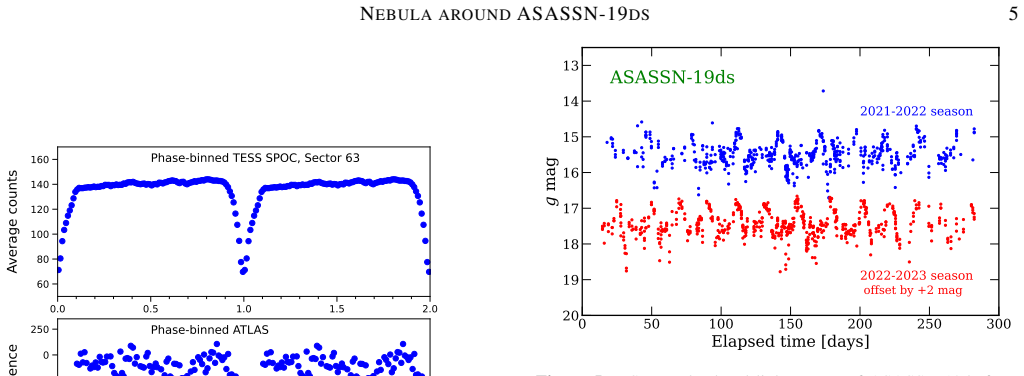
The central claim is that ASASSN-19ds is a nearby ($557^{+7.3}_{-9.2}$ pc) eclipsing Z Cam-type cataclysmic variable (CV) surrounded by a real, very faint bipolar nebula, and that the nebula was almost certainly ejected or shaped by the star rather than encountered by chance. The stellar classification rests on the SAAO spectrum (strong Balmer, He I, He II, and a C III/N III blend), on the eclipse ephemeris $T_{\rm eclipse} = \mathrm{BJD}_{TDB}\,2460726.5888(1) + 0.13903490(2)E$, and on the sawtooth light curve with outburst spacings of roughly three to five weeks. For the nebula, the authors reject their own earlier bow-shock scenario because the proper motion is almost perpendicular to the outflow axis and no bow shock is seen; they then weigh a nova shell against a planetary nebula. Using the S25 radius–age relation, a nova-shell interpretation gives an age of about $260 \pm 40$ yr, though the relation is being extrapolated to ages beyond its calibrated range. The planetary-nebula interpretation is kept alive by the V458 Vul precedent. The paper deliberately does not choose between the two.
Load-bearing premise
The load-bearing assumption is that the nebula is physically attached to ASASSN-19ds and sits at the same distance; if it is a foreground or background cloud along the same line of sight, the physical size and the age estimate both collapse.
Editorial extensions
If this is right
- If the nebula is a nova shell, the star erupted around 1765 (with an uncertainty of at least ±40 yr), and the outburst would have been a naked-eye event at apparent magnitude roughly 1.5.
- If the nebula is a planetary nebula, ASASSN-19ds becomes the second known CV embedded in a PN, following V458 Vul.
- Spectroscopy of the nebula is the decisive test, since nova shells expand at much higher velocities than planetary nebulae.
- The eclipse ephemeris provides a precise clock with residuals below 20 s, making ASASSN-19ds an excellent target for future time-resolved studies.
- At $P=0.139$ d, ASASSN-19ds is one of the shortest-period Z Cam variables known, comparable only to BX Puppis.
Reading between the lines
- One consequence not drawn in the paper: if the nebula is old nova ejecta, the age estimate depends on an extrapolation of the S25 relation beyond its calibrated range, and deceleration could make the true age several centuries larger.
- A null search of 18th-century southern-sky observing records would weigh against the nova scenario, since an eruption to apparent magnitude ~1.5 would have been a naked-eye event.
- If the nebula is a planetary nebula, the binary would join V458 Vul as a possible Type Ia supernova progenitor, a claim that could be tested by measuring the total system mass.
Editorial analysis
A structured set of objections, weighed in public.
Referee Report
Summary. The paper reports the discovery of faint bipolar nebulosity surrounding ASASSN-19ds, a 15th-magnitude variable star in Antlia. New spectroscopy from SAAO confirms the star as a cataclysmic variable, and new plus archival photometry (TESS, ATLAS, ASAS-SN) establish an eclipse ephemeris with period 0.13903490 d and residuals below 20 s. The out-of-eclipse 'sawtooth' light curve, with intervals between maxima of about 21-34 days, supports classification as a Z Camelopardalis-type CV. Deep narrow-band imaging from a 0.6 m telescope at a dark site reveals faint [O III] and H-alpha nebulosity with angular axes of roughly 0.59' x 0.96'. The authors consider three origins: bow-shock interaction with the ISM, ejecta from an unobserved classical-nova outburst, or an ancient planetary nebula. They argue that the bipolar morphology and arcuate features favor ejection, and they use the empirical S25 radius-age relation to estimate a nova-shell age of roughly 260 yr if the nebula is associated with the star. They conclude that future spectroscopy and proper-motion measurements are needed to distinguish a nova shell from a planetary nebula.
Significance. If the nebula is physically associated with ASASSN-19ds, this is a rare and interesting object: a Z Camelopardalis-type CV at only ~557 pc surrounded by faint nebulosity, potentially the remnant of a centuries-old classical-nova outburst or an ancient planetary nebula. The CV classification is well supported by the spectrum, the eclipse ephemeris, and the sawtooth light curve. The paper is also commendably explicit about the ambiguity between the nova-shell and planetary-nebula interpretations and about the need for follow-up observations. The quantitative interpretation, however, currently rests on an incorrect angular-to-linear size conversion and on an assumed physical association that has not been spectroscopically or astrometrically confirmed.
major comments (2)
- [Section 3 and Section 4] The conversion of the measured angular axes to physical sizes is incorrect by a factor of about 3. At d = 557 pc, 1 arcmin subtends approximately 557 pc x (1/3438) ~ 0.162 pc, so 0.59' and 0.96' correspond to roughly 0.096 pc and 0.156 pc, not 0.29 pc and 0.47 pc as stated. Consequently, the mean semiaxis r used in Section 4 should be about 0.063 pc rather than 0.19 pc, and the S25 relation gives an age of roughly 90 yr rather than 260 yr. This propagates to the abstract and Section 5, where the event is described as occurring 'several centuries' ago; the corrected estimate is closer to one century, and the authors should revisit the caveats about extrapolation and deceleration in light of the corrected value.
- [Section 4 and Section 5] The physical association between the nebulosity and ASASSN-19ds is not established. The inference that the nebula lies at the star's distance of 557 pc, and hence has the quoted linear size, rests entirely on angular coincidence with the CV. No nebular spectrum or proper-motion measurement is presented, as the authors acknowledge in Section 5. A foreground Galactic cirrus cloud or an unrelated background planetary nebula projected within about one arcminute of the star could reproduce the observed morphology, in which case the Gaia parallax of the star would not apply to the nebula. The paper should either present data that test the association, or consistently frame the nebulosity as a candidate association and correspondingly qualify or remove the distance-dependent size and age estimates.
minor comments (5)
- [Section 2.4] The statement that 'the residuals from the linear fit given above were all less than 20 s' is ambiguous: it should specify whether this refers to the scatter of the individual eclipse timings or to the binned/combined residuals, given the very different numbers of points from ATLAS and ASAS-SN.
- [Section 3] The angular axes are written as '0.′59×0.′96', which is an unusual notation; the authors should use standard arcminute notation (0.59' x 0.96').
- [Figure 6] The scale bar at the lower right of Figure 6 repeats the incorrect 0.29 x 0.47 pc conversion; it should be updated consistently with the corrected angular-to-linear conversion.
- [Section 4] In the discussion of the S25 relation, the paper should quote the scatter of the empirical relation (not just the slope uncertainty) and should explicitly state that the corrected age of ~90 yr is obtained by extrapolating the relation to ages much larger than the calibrators, as the current caveat only mentions the extrapolation without the corrected number.
- [Section 5] The statement that bipolar morphologies 'are common in PNe' would benefit from a specific reference or quantitative support, since it is used as part of the argument that the nebula could be a planetary nebula.
Circularity Check
No circularity: the nebula discovery, CV classification, and age estimate rest on independent observations and an external empirical relation; self-citations are contextual.
full rationale
The derivation chain is self-contained. ASASSN-19ds is classified as an eclipsing Z Cam CV from new SAAO spectroscopy, SAAO time-series photometry, and archival TESS/ATLAS/ASAS-SN light curves; the eclipse ephemeris is fitted to independent eclipse timings, and the sawtooth classification is compared with published Z Cam light-curve behavior. No quantity needed for the nebula interpretation is fitted to the nebula and then presented as a prediction. The nebula's physical size is obtained by applying the Gaia parallax distance to the measured angular axes; this is a geometric conversion, not a circular definition, and the subsequent age estimate uses the externally calibrated S25 radius-age relation with the converted radius as input. The paper explicitly leaves the association of the nebula with the star and the nova-versus-PN choice undecided, calling for future nebular spectroscopy and proper-motion measurements, so the central claim is not forced by construction. Self-citations to Papers I and II supply comparison objects and context; they are not the evidence that the nebula exists or that the star is a Z Cam CV. A separate arithmetic issue in Section 3 (0.96 arcmin at 557 pc is about 0.156 pc, not 0.47 pc) affects the quoted size and age, but it is an error in applying the conversion, not a circular step. No circularity is found.
Assumptions & free parameters
assumptions (4)
- domain assumption The nebula is spatially coincident with ASASSN-19ds and lies at the same distance.
- domain assumption The S25 radius-age relation extrapolates to ages of a few hundred years.
- domain assumption The classification criteria for ZCVs are standard and apply here.
- domain assumption The Gaia parallax distance is correct.
Cite this review
Pith. "Pith review of Discovery of Faint Nebulosity Around a Z Camelopardalis-type Cataclysmic Variable in Antlia: Nova Shell or Ancient Planetary Nebula?." pith.science (2026). https://pith.science/paper/PUHHGO4F
@misc{pith2026250611306,
  author       = {Pith},
  title        = {Pith review of: Discovery of Faint Nebulosity Around a Z Camelopardalis-type Cataclysmic Variable in Antlia: Nova Shell or Ancient Planetary Nebula?},
  year         = {2026},
  howpublished = {\url{https://pith.science/paper/PUHHGO4F}},
  note         = {Machine review of arXiv:2506.11306}
}
abstract
We report our discovery of a faint nebula surrounding a previously little-studied 15th-mag variable star, ASASSN-19ds, in the southern-hemisphere constellation Antlia. Spectra verify that the star is a cataclysmic variable (CV). Using new and archival photometry, we confirm that ASASSN-19ds is an eclipsing binary with an orbital period of 0.139 days (3.34 hr). Moreover, its out-of-eclipse brightness shows a "sawtooth" light curve with an amplitude of $\sim$1~mag and an interval between peaks that varies between about three to nearly five weeks. Its mean absolute magnitude in the Gaia system is $M_G=+6.5$. These combined properties lead to a classification of ASASSN-19ds as a Z Camelopardalis-type CV. We obtained deep narrow-band images of the nebulosity, using modest-sized telescopes and extremely long exposure times. Our imagery reveals a bipolar morphology, with thin arcs at the ends of the major axis, likely indicating an interaction with the interstellar medium. We consider several scenarios for the origin of the nebula, but from the existing information we are unable to distinguish between it being ejecta from an unobserved classical-nova outburst several centuries ago, or an ancient planetary nebula. Future observations should be able to decide between these possibilities. At the star's distance of only $\sim$557 pc, a nova eruption would have been a spectacular naked-eye event.
Figures


Figures from the paper (4 more)


Reference graph
Works this paper leans on
-
[1]
Amôres, E. B., Jesus, R. M., Moitinho, A., et al. 2021, MNRAS, 508, 1788
work page 2021
-
[2]
Bailer-Jones, C. A. L., Rybizki, J., Fouesneau, M., Demleitner, M., & Andrae, R. 2021, AJ, 161, 147
2021
-
[3]
N., Corcoran, K
Barlow, B. N., Corcoran, K. A., Parker, I. M., et al. 2022, ApJ, 928, 20
2022
-
[4]
2017, ApJS, 230, 24
Bianchi, L., Shiao, B., & Thilker, D. 2017, ApJS, 230, 24
2017
-
[5]
Two More Bow Shocks and Off-Center Halpha Nebulae Associated with Nova-like Cataclysmic Variables
Bond, H. E., Carter, C., Coles, E., et al. 2025, arXiv e-prints, arXiv:2505.02760, (Paper II)
work page Pith review arXiv 2025
-
[6]
Bond, H. E., Carter, C., Elmore, D. F., et al. 2024, AJ, 168, 249, (Paper I)
work page 2024
-
[7]
Bond, H. E., Werner, K., Zeimann, G. R., & Talbot, J. 2023, MNRAS, 523, 3699
work page 2023
-
[8]
2023, AJ, 165, 163
Canbay, R., Bilir, S., Özdönmez, A., & Ak, T. 2023, AJ, 165, 163
2023
Show all 37 references
-
[9]
Coppejans, R., Gulbis, A. A. S., Kotze, M. M., et al. 2013, PASP, 125, 976
2013
-
[10]
A., Gilbank, D., Gend, C
Crause, L. A., Gilbank, D., Gend, C. v., et al. 2019, Journal of Astronomical Telescopes, Instruments, and Systems, 5, 024007
2019
-
[11]
2022, A&A, 662, A40 de Miguel, E., Patterson, J., Cejudo, D., et al
Culpan, R., Geier, S., Reindl, N., et al. 2022, A&A, 662, A40 de Miguel, E., Patterson, J., Cejudo, D., et al. 2016, MNRAS, 457, 1447
2022
-
[12]
Duerbeck, H. W. 1987, Ap&SS, 131, 461 Gaia Collaboration, Prusti, T., de Bruijne, J. H. J., et al. 2016, A&A, 595, A1 Gaia Collaboration, Vallenari, A., Brown, A. G. A., et al. 2023, A&A, 674, A1
1987
-
[13]
E., McCullough, P
Gaustad, J. E., McCullough, P. R., Rosing, W., & Van Buren, D. 2001, PASP, 113, 1326
2001
-
[14]
P., & Marsh, T
Geier, S., Raddi, R., Gentile Fusillo, N. P., & Marsh, T. R. 2019, A&A, 621, A38
2019
-
[15]
A., Sabin, L., Tovmassian, G., et al
Guerrero, M. A., Sabin, L., Tovmassian, G., et al. 2018, ApJ, 857, 80
2018
-
[16]
R., Suntzeff, N
Hamuy, M., Walker, A. R., Suntzeff, N. B., et al. 1992, PASP, 104, 533 Iłkiewicz, K., Mikołajewska, J., Shara, M. M., Faherty, J. K., &
1992
-
[17]
2024, ApJL, 972, L14
Scaringi, S. 2024, ApJL, 972, L14
2024
-
[18]
S., Shappee, B
Kochanek, C. S., Shappee, B. J., Stanek, K. Z., et al. 2017, PASP, 129, 104502 Lightkurve Collaboration, Cardoso, J. V . d. M., Hedges, C., et al. 2018, Lightkurve: Kepler and TESS time series analysis in
2017
-
[19]
R., del Palacio, S., & Bosch-Ramon, V
Python, Astrophysics Source Code Library, record ascl:1812.013, , Martínez, J. R., del Palacio, S., & Bosch-Ramon, V . 2023, A&A, 680, A99
2023
-
[20]
A., Littlefair, S
Miszalski, B., Woudt, P. A., Littlefair, S. P., et al. 2016, MNRAS, 456, 633
2016
-
[21]
Oort, J. H. 1946, MNRAS, 106, 159
1946
-
[22]
R., Winn, J
Ricker, G. R., Winn, J. N., Vanderspek, R., et al. 2015, Journal of Astronomical Telescopes, Instruments, and Systems, 1, 014003 Rodríguez-Gil, P., Santander-García, M., Knigge, C., et al. 2010, MNRAS, 407, L21 Santamaría, E., Guerrero, M. A., Ramos-Larios, G., Toalá, J. A., &
2015
-
[23]
2025, MNRAS, 539, 246, (S25) Santamaría, E., Guerrero, M
Sabin, L. 2025, MNRAS, 539, 246, (S25) Santamaría, E., Guerrero, M. A., Ramos-Larios, G., et al. 2020, ApJ, 892, 60
2025
-
[24]
2019, A&A, 622, A186
Selvelli, P., & Gilmozzi, R. 2019, A&A, 622, A186
2019
-
[25]
W., Cannizzo, J
Shafter, A. W., Cannizzo, J. K., & Waagen, E. O. 2005, PASP, 117, 931
2005
-
[26]
J., Prieto, J
Shappee, B. J., Prieto, J. L., Grupe, D., et al. 2014, ApJ, 788, 48
2014
-
[27]
M., Martin, C
Shara, M. M., Martin, C. D., Seibert, M., et al. 2007, Nature, 446, 159
2007
-
[28]
M., Lanzetta, K
Shara, M. M., Lanzetta, K. M., Garland, J. T., et al. 2024, MNRAS, 529, 212
2024
-
[29]
W., Young, D
Shingles, L., Smith, K. W., Young, D. R., et al. 2021, Transient Name Server AstroNote, 7, 1
2021
-
[30]
2014, JAA VSO, 42, 177
Simonsen, M., Boyd, D., Goff, W., et al. 2014, JAA VSO, 42, 177
2014
-
[31]
Sion, E. M. 2023, Accreting White Dwarfs; From exoplanetary probes to classical novae and Type 1a supernovae, doi:10.1088/2514-3433/ac930c
2023 doi
-
[32]
2020, MNRAS, 497, 1475
Subebekova, G., Zharikov, S., Tovmassian, G., et al. 2020, MNRAS, 497, 1475
2020
-
[33]
Szkody, P., & Gaensicke, B. T. 2012, JAA VSO, 40, 563
2012
-
[34]
2020, A&A, 641, A122
Tappert, C., V ogt, N., Ederoclite, A., et al. 2020, A&A, 641, A122
2020
-
[35]
L., Denneau, L., Heinze, A
Tonry, J. L., Denneau, L., Heinze, A. N., et al. 2018, PASP, 130, 064505
2018
-
[36]
1995, Cataclysmic variable stars, V ol
Warner, B. 1995, Cataclysmic variable stars, V ol. 28
1995
-
[37]
J., Corradi, R
Wesson, R., Barlow, M. J., Corradi, R. L. M., et al. 2008, ApJL, 688, L21
2008
Reviewed August 7, 2026 · model on record in the stance chip above.
Discussion (0). Sign in to comment.