REVIEW 4 major objections 6 minor 24 references
Movie Recommendation using Web Crawling
T0 review · 4 major / 6 minor · reviewed 2026-08-11 · deepseek-v4-flash
Pith's one-line read This paper proposes adding web-crawled real-time movie data to static datasets so that hybrid recommendations track new releases and current trends.
desk verdict An honest but unevaluated design sketch that asserts the value of real-time web-crawled data in movie recommendation without any experiment; the central claim is unsupported. read the letter →
The pith
A machine-rendered reading of the paper's core claim, the machinery that carries it, and where it could break.
The reading
What carries the argument
The central mechanism is a two-tier data pipeline: a history tier built on a large static movie dataset and a live tier fed by scraping and API requests to movie-rating websites. The recommendation machinery combines content-based cosine similarity on genre, director, and cast vectors with SVD-based collaborative filtering, and then merges them in a hybrid model defined as collaborative-filtering output refined by content-based criteria. That hybrid is the object meant to keep recommendations both personalized and current, and the paper's running example is the system identifying a new biopic as trending and surfacing it for the right audience.
What would settle it
Run the paper's collection code against the two movie-rating websites for a week and count how many requests return valid, schema-consistent records; if the sites block automated queries, return empty JSON, or change their HTML structure so the selectors fail, the dynamic-data layer as described does not function. Separately, compare the share of recommended titles released in the last month for the hybrid with and without the live-data layer to test the freshness claim.
Extended reading notes
Core claim
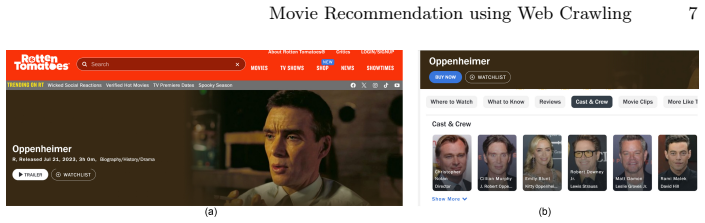
The central claim is that a movie recommender can be made more responsive and more satisfying by merging a static historical dataset with real-time data pulled from movie websites through web crawling and APIs. The static layer supplies the base for content-based and collaborative models, while the dynamic layer is meant to catch recently released and trending movies, illustrated in the paper by Oppenheimer (2023) being picked up as trending and recommended to users interested in biographical dramas. The paper states that this combination 'boosts user satisfaction' and keeps recommendations aligned with current viewing trends, but the text does not report measured results from the real-time pipeline. Read in good faith, the contribution is a proposed architecture for adding freshness to hybrid filtering.
Load-bearing premise
The entire real-time layer rests on the unverified assumption that movie-rating websites will serve scrapeable or API-accessible data at scale; the paper itself concedes that these sites actively block scraping and that the code examples are hypothetical.
Editorial extensions
If this is right
- Streaming services could surface new releases and trending titles without waiting for ratings to accumulate, if the live-data layer functions as described.
- The hybrid ordering (collaborative candidates, then content-based refinement) would let a system balance broad popularity with individual taste in one pass.
- Web-crawled critic and audience scores could make recommendations sensitive to seasonal and holiday-specific viewing patterns, as the paper suggests.
- Static-only recommenders would be at a structural freshness disadvantage, making licensed API access a natural part of production recommendation pipelines.
- Because no evaluation is reported, these consequences hold conditionally on the scraping and API calls returning valid data at scale.
Reading between the lines
- Editorial inference: the freshness claim could be checked by comparing the share of recommended titles released in the last 30 days for the hybrid with and without the live-data layer.
- Editorial inference: since the two movie sites restrict automated access, the practical contribution is probably the API-access pattern (keys, JSON-LD parsing, offline HTML fallback) rather than crawling per se.
- Editorial inference: the hybrid's order means any popularity bias in the collaborative step carries into the final list, a side effect the paper does not discuss.
- Editorial inference: a natural extension would be feeding seasonal and holiday trends into the live layer as an explicit third input, something the paper lists as future work.
Editorial analysis
A structured set of objections, weighed in public.
Referee Report
Summary. The paper proposes a movie recommendation system that combines static datasets (TMDB 930K movies and MovieLens 25M) with real-time data collected from Rotten Tomatoes and IMDb via scraping and APIs. It outlines content-based, collaborative (SVD), and hybrid filtering components, and includes illustrative Python code snippets for data collection. The central claim, stated in the abstract and repeated in Section 4, is that incorporating dynamic web-crawled data boosts user satisfaction and aligns recommendations with current viewing trends. No experimental evaluation is provided; Section 3.2 describes datasets and Figure 3 shows example top-5 lists, but there are no metrics, baselines, or temporal train/test comparisons.
Significance. If the central claim were established, a validated static-plus-real-time hybrid recommender would be a useful engineering contribution. The paper has some strengths: it explicitly acknowledges that Rotten Tomatoes blocks scraping (Sec. 3.1.1), it recommends API access as a legal alternative, and it provides code snippets that illustrate the intended data-collection workflow. However, because the paper contains no experimental evidence that real-time data improves recommendation quality, the significance is currently potential rather than demonstrated.
major comments (4)
- [Abstract and Sec. 4] The headline claim that incorporating dynamic data 'boosts user satisfaction' and 'aligns recommendations with current viewing trends' is causal and empirical, but the manuscript provides no evaluation comparing a static-only recommender against a static-plus-real-time recommender. There is no temporal train/test split, no metrics, no baselines, and no error analysis. Figure 3 shows example top-5 lists but supplies no ground truth or accuracy measure, so the central contribution is asserted rather than supported.
- [Sec. 3.1.1 and Sec. 3.1.2] The dynamic-data pipeline is explicitly hypothetical. Section 3.1.1 states that Rotten Tomatoes 'actively blocks scraping attempts' and that the code examples are 'based on a hypothetical or similar site-scraping approach.' Section 3.1.2 presents API and scraping code snippets but reports no crawled dataset, no collection timestamps, and no evidence that any real-time feed was actually fetched. The Oppenheimer example is illustrative only, so the paper does not validate the feasibility of the real-time component at any scale.
- [Sec. 3.2] The paper claims to have 'evaluated our approach' on the TMDB 930K dataset and MovieLens 25M and to 'demonstrate robustness across various movie pools and feature sets,' but no evaluation protocol, performance metrics, or comparisons with prior recommendation methods are given. Without quantitative results, these statements cannot be checked, and Section 3.2 functions as a data description rather than an evaluation.
- [Sec. 3.3] The three recommendation models are described only at a conceptual level (cosine similarity for content-based filtering, SVD for collaborative filtering, and a sequential combination for the hybrid model). No implementation details, hyperparameters, or validation procedure are reported, making it impossible to reproduce the claimed recommendations or to assess whether the hybrid model actually combines the two signals.
minor comments (6)
- [Headers and Sec. 3.1] The heading 'W eb Scrapping' contains a typo, and 'Scrapping' should be 'Scraping' in Section 3.1 and its subsections (e.g., the subsection labeled 'Scrapping.').
- [Sec. 1 and Sec. 3.3] The term 'context-based filtering' is used where 'content-based filtering' appears to be meant (Scope and Contributions; Sec. 3.3 first paragraph). Please make the terminology consistent.
- [Sec. 2.2] There are typographical errors such as 'featureed' and 'useing' in the sentence describing Kumar et al.; these should be corrected.
- [Sec. 3.1.2] The code snippets contain typographic curly quotes (e.g., `{'query': query}`) that are not valid Python string delimiters and would cause syntax errors if copied directly.
- [Sec. 3.1.2] The API key placeholders such as 'ACTUAL_API_KEY_FROM_ROTTEN_TOMATOES' are fine as placeholders, but the text should recommend reading keys from environment variables rather than hard-coding them, and should note that the Rotten Tomatoes public API has been discontinued.
- [Sec. 2.3] The comparison with existing work is entirely qualitative and would benefit from a table contrasting prior systems in terms of data sources, real-time capability, and evaluation methodology.
Circularity Check
No circular derivation: the dynamic-data benefit is asserted rather than derived, and neither self-citation nor fitted-parameter renaming forces the conclusion.
full rationale
The paper's central claim, stated in the abstract and Section 4, is that incorporating real-time web-crawled data 'not only boosts user satisfaction but also aligns recommendations with current viewing trends.' This claim is empirical and causal, but the paper never demonstrates it with an experiment; Section 3.1.1 explicitly says the scraping examples are 'based on a hypothetical or similar site-scraping approach,' and Section 3.2 reports only static Kaggle/MovieLens processing. However, absence of evidence is not circularity. There is no fitted parameter that is later renamed as a prediction, no quantity defined in terms of the target result, and no load-bearing self-citation: the cited related work is external and descriptive, and no uniqueness theorem or prior author result is invoked to force the recommendation design. The derivation chain, to the extent one exists, consists of standard content-based, collaborative, and hybrid filtering descriptions that are independent of the headline claim. The headline claim is unsupported, but that is a soundness/evidence gap, not a circular step. Therefore the circularity score is 0.
Assumptions & free parameters
assumptions (4)
- domain assumption The static datasets (TMDB 930k and MovieLens 25M) are accurate and representative enough to train the recommender.
- domain assumption The Rotten Tomatoes and IMDb data sources remain accessible through the APIs and scraping methods described.
- ad hoc to paper Adding real-time trend data improves user satisfaction or recommendation quality.
- standard math SVD and cosine similarity are appropriate models for the recommendation task.
Cite this review
Pith. "Pith review of Movie Recommendation using Web Crawling." pith.science (2026). https://pith.science/paper/PVFGTOQJ
@misc{pith2026241210714,
  author       = {Pith},
  title        = {Pith review of: Movie Recommendation using Web Crawling},
  year         = {2026},
  howpublished = {\url{https://pith.science/paper/PVFGTOQJ}},
  note         = {Machine review of arXiv:2412.10714}
}
read the original abstract
In today's digital world, streaming platforms offer a vast array of movies, making it hard for users to find content matching their preferences. This paper explores integrating real time data from popular movie websites using advanced HTML scraping techniques and APIs. It also incorporates a recommendation system trained on a static Kaggle dataset, enhancing the relevance and freshness of suggestions. By combining content based filtering, collaborative filtering, and a hybrid model, we create a system that utilizes both historical and real time data for more personalized suggestions. Our methodology shows that incorporating dynamic data not only boosts user satisfaction but also aligns recommendations with current viewing trends.
Figures


Reference graph
Works this paper leans on
-
[1]
Amangeldieva,A.,Kharmyssov,C.:AHybridApproachforAMovieRecommender System using Content-Based, Collaborative and Knowledge-Based Filtering Meth- ods. In: 2024 IEEE 4th Int’l Conf. on Smart Information Systems and Technologies (SIST). pp. 93–99. IEEE (2024)
work page 2024
-
[2]
Barwal, D., Joshi, S., Obaid, A.J., et al.: The Impact of Netflix Recommendation EngineonCustomerExperience.In:AIPConf.Proceedings.AIPPublishing(2023)
work page 2023
-
[3]
User Modeling and User-Adapted Interaction17, 217–255 (2007)
Degemmis, M., Lops, P., Semeraro, G.: A Content-Collaborative Recommender that Exploits Wordnet-Based User Profiles for Neighborhood Formation. User Modeling and User-Adapted Interaction17, 217–255 (2007)
work page 2007
-
[4]
Dikilitaş, Y., Çakal, Ç., et al.: Performance Analysis for Web Scraping Tools: Case Studies on Beautifulsoup, Scrapy, Htmlunit and Jsoup. In: Int’l Conf. on Emerging Trends and Applications in Artificial Intelligence. pp. 471–480. Springer (2023) 12 P. Raj, C. Kumar, H. Shekhar, A. Kumar, K, Paul and D. Jana
work page 2023
-
[5]
Hooda, R., Singh, K., Dhawan, S.: A Study of Recommender Systems on Social Networks and Content-Based Web Systems. IJCA97(4), 23–28 (2014)
work page 2014
-
[6]
Jarmul, K., Lawson, R.: Python Web Scraping. Packt Publishing Ltd (2017)
work page 2017
-
[7]
Int’l Journal of Emerging Technologies in Learning (iJET)16(3), 274–306 (2021)
Javed, U., Shaukat, K., Hameed, I.A., Iqbal, F., et al.: A Review of Content- Based and Context-Based Recommendation System. Int’l Journal of Emerging Technologies in Learning (iJET)16(3), 274–306 (2021)
work page 2021
-
[8]
Int’l Journal of Adv in Soft Comput
Khder, M.A.: Web Scraping or Web Crawling: State Of Art, Techniques, Ap- proaches and Appl. Int’l Journal of Adv in Soft Comput. & Its Appl.13(3) (2021)
work page 2021
Show all 24 references
-
[9]
In: Statistical Modeling in Machine Learning, pp
Kumar, S., Roy, U.B.: A Technique Of Data Collection: Web Scraping With Python. In: Statistical Modeling in Machine Learning, pp. 23–36. Elsevier (2023)
2023
-
[10]
Maidel, V., Shoval, P., et al.: Ontological Content-based Filtering for Personalised Newspapers:AMethodanditsEvaluation.OnlineInfo. Rev. 34(5),729–756(2010)
2010
-
[11]
IEEE Access 10, 86578–86623 (2022)
Marcuzzo, M., Zangari, A., Albarelli, A., Gasparetto, A.: Recommendation Sys- tems: An Insight Into Current Development And Future Research Challenges. IEEE Access 10, 86578–86623 (2022)
2022
-
[12]
Foundations and Trends® in Infor- mation Retrieval 4(3), 175–246 (2010)
Olston, C., Najork, M., et al.: Web Crawling. Foundations and Trends® in Infor- mation Retrieval 4(3), 175–246 (2010)
2010
-
[13]
arXiv preprint arXiv:2109.00656 (2021)
Onyenwe,I.,Onyedinma,E.,Nwafor,C.,Agbata,O.:DevelopingProductsUpdate- AlertSystemForE-CommerceWebsitesUsersUsingHtmlDataAndWebScraping Technique. arXiv preprint arXiv:2109.00656 (2021)
2021 arXiv
-
[14]
In: 2024 Int’l Conf
Pant, S., Yadav, E.N., Sharma, M., Bedi, Y., Raturi, A., et al.: Web scraping using beautiful soup. In: 2024 Int’l Conf. on Knowledge Engineering and Communication Systems (ICKECS). vol. 1, pp. 1–6. IEEE (2024)
2024
-
[15]
Int’l’ Journal on Information and Communication Tech
Permana, A.H.J.P.J., Wibowo, A.T.: Movie Recommendation System Based on Synopsis Using Content-Based Filtering with TF-IDF and Cosine Similarity. Int’l’ Journal on Information and Communication Tech. (IJoICT)9(2), 1–14 (2023)
2023
-
[16]
In: IOSR Journal of Engineering (IOSRJEN)
Rathod, U., Pavate, A., Patil, V.: Recommendation System Using Product Rank Algorithm For E-Commerce. In: IOSR Journal of Engineering (IOSRJEN). vol. 5, pp. 56–61 (March 2018),http://www.iosrjen.org
2018
-
[17]
Reitz, K.: Requests: HTTP for Humans (2024), https://pypi.org/project/ requests/
2024
-
[18]
Richardson, L.: Beautiful Soup (2007), https://pypi.org/project/ beautifulsoup4/
2007
-
[19]
and Online Television
Shattuc, J.: Netflix, Inc. and Online Television. In: A Companion to Television. pp. 145–164. Wiley Online Library (2020)
2020
-
[20]
Multimedia Tools and Appl.83(2) (2024)
Singh, K.K., Makhania, J., et al.: Impact of Ratings of Content on OTT Platforms and Prediction of Its Success Rate. Multimedia Tools and Appl.83(2) (2024)
2024
-
[21]
In: 2017 IEEE Int’l Conf
Sunny, B.K., Janardhanan, P., Francis, A.B., Murali, R.: Implementation of A Self-Adaptive Real Time Recommendation System using Spark Machine Learning Libraries. In: 2017 IEEE Int’l Conf. on Signal Processing, Informatics, Communi- cation and Energy Systems (SPICES). pp. 1–7....
2017
-
[22]
Applied Artif
Wang, Z.: Intelligent Recommendation Model of Tourist Places based on Collabo- rative Filtering and User Preferences. Applied Artif. Intell.37(1), 2203574 (2023)
2023
-
[23]
ACM Computing Surveys55(8), 1–38 (2022)
Zangerle, E., Bauer, C.: Evaluating Recommender Systems: Survey and Frame- work. ACM Computing Surveys55(8), 1–38 (2022)
2022
-
[24]
Journal of Emerging Tech- nologies in Web Intelligence2(4) (2010)
Zhuhadar, L., Nasraoui, O.: A Hybrid Recommender System Guided By Semantic User Profiles For Search In The E-Learning Domain. Journal of Emerging Tech- nologies in Web Intelligence2(4) (2010)
2010
Reviewed August 11, 2026 · model on record in the stance chip above.
Discussion (0). Continue with ORCID to comment.