REVIEW 4 major objections 6 minor 96 references
Backpropagation through Soft Body: Investigating Information Processing in Brain-Body Coupling Systems
T0 review · 4 major / 6 minor · reviewed 2026-08-10 · deepseek-v4-flash
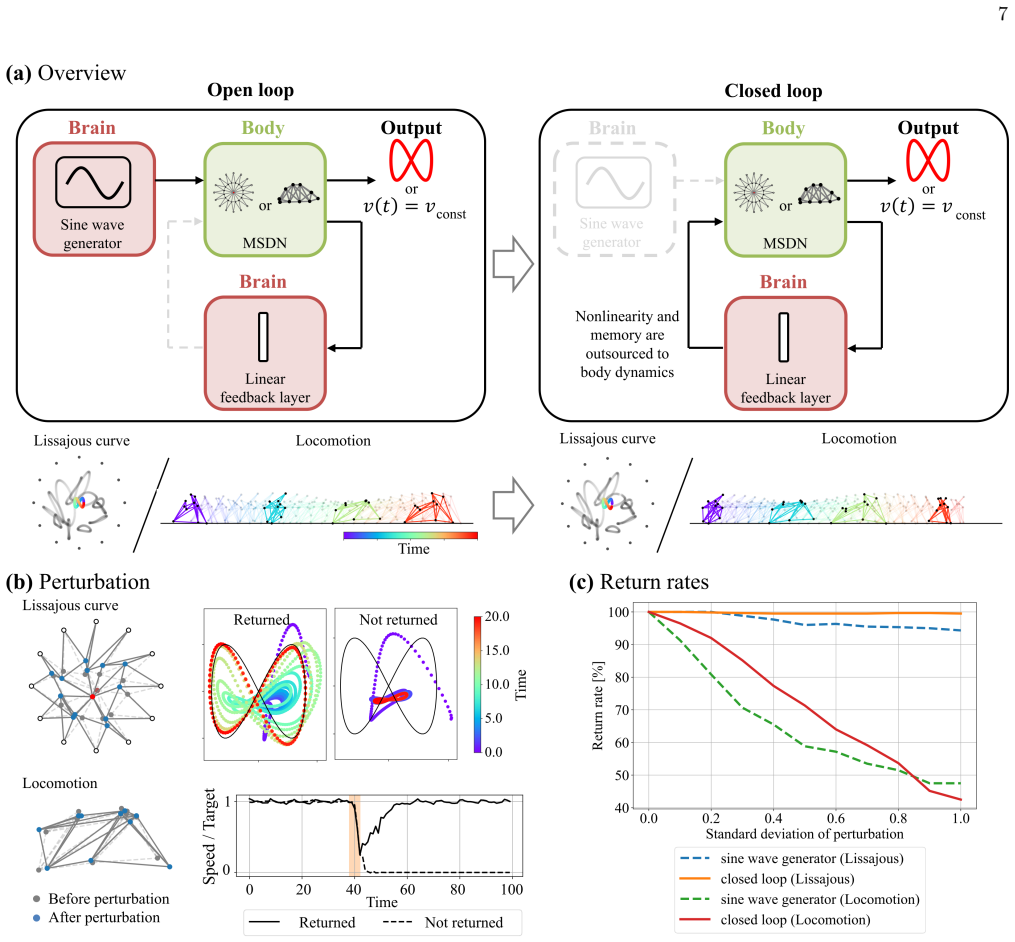
Pith's one-line read This paper shows that when a simple neural controller and a soft body are trained together by backpropagation through physics, the pair distributes recognition, memory, and nonlinearity across both components instead of keeping a clean…
desk verdict A solid co-design pipeline with useful diagnostics, but the 'reciprocal relationships' claim rests on a qualitative PCA comparison and needs baselines before it can carry the paper's conclusions. read the letter →
The pith
A machine-rendered reading of the paper's core claim, the machinery that carries it, and where it could break.
The reading
What carries the argument
The machinery is a differentiable mass-spring-damper network embedded in a backpropagation loop. Each spring has trainable stiffness, damping, and rest length, and the brain's weights or sine-wave amplitudes and phases are updated by the same chain rule as the body, so gradients pass through the Velocity Verlet time integration. Nonlinearity arises from geometric terms such as spring angles even though the springs themselves are linear, and a fitted feedback layer closes the loop by mapping measured spring lengths to control signals.
What would settle it
Run the same three tasks in a physics simulator that includes mass-point collisions, spring self-intersection, and a non-sinking contact model, or on a physical soft robot, and check whether the body still sharpens MNIST label separation and whether feedback-layer closed-loop locomotion still succeeds at a similar rate.
Extended reading notes
Core claim
The central claim is that co-designed brain–body systems do not evolve a top-down division of labor; instead, information processing is distributed reciprocally. In the MNIST drawing task, the body improves class separation beyond what the brain's initial positions already produce. In time-series emulation, the body generates memory and higher-order nonlinearities, while a multilayer perceptron brain compensates for nonlinearity that the body alone cannot supply. In locomotion and limit-cycle tasks, a trained sine-wave generator's command can be transferred to a feedback layer, yielding closed-loop autonomous behavior whose response to perturbations is comparable to the open-loop drive.
Load-bearing premise
The results depend on the fidelity of the mass-spring-damper simulation: collisions between mass points and spring intersections are ignored, and the locomotion ground force is a differentiable exponential that lets objects sink, so a real soft body might not show the same division of labor.
Editorial extensions
If this is right
- If the division-of-labor finding holds, performance comparisons of controllers should account for the body's share of computation; a weaker controller plus a well-tuned body can match a stronger controller.
- A feed-forward brain with no internal memory can still produce memory-dependent outputs because the soft body stores past inputs in its transient dynamics.
- Closed-loop control can be obtained without pre-specified feedback targets: optimize an open-loop generator first, then regress a feedback layer onto its outputs.
- Body geometry, such as multiple-circle versus double-circle connectivity and the number of movable masses, measurably changes nonlinear capacity and memory, so topology choice is a design lever.
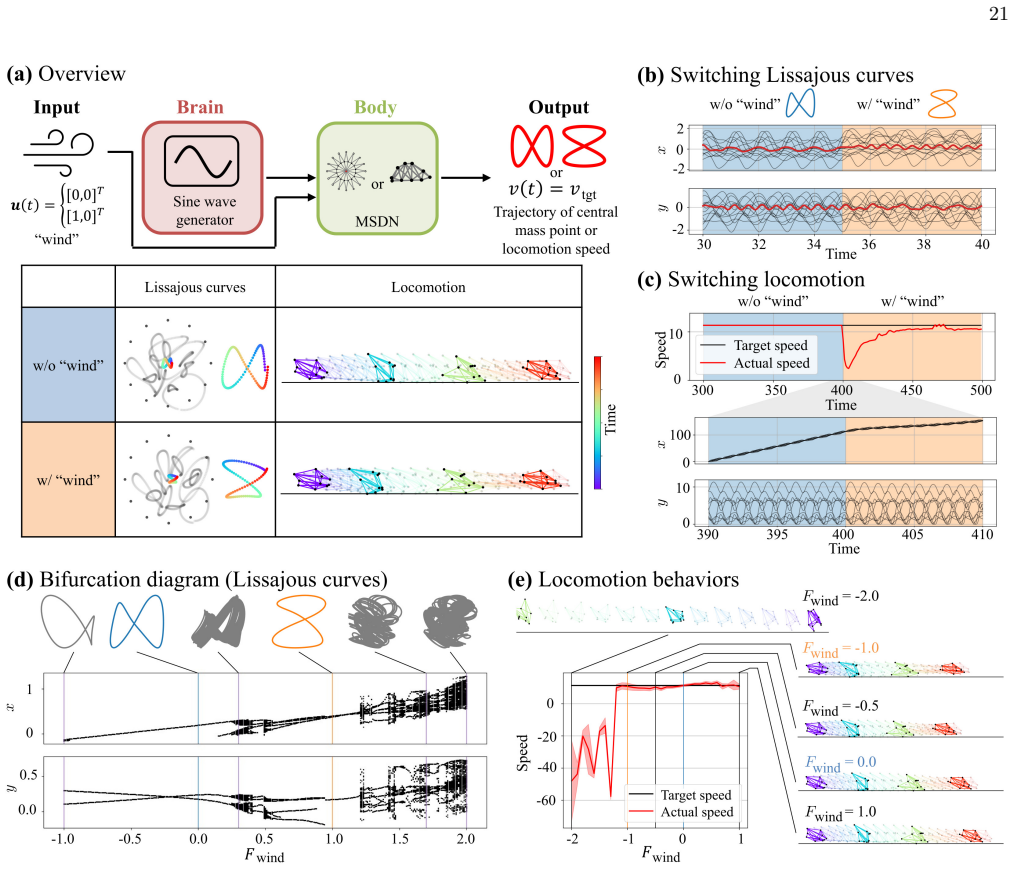
- Behavioral switching can be embedded through constant external inputs such as a simulated wind, and the system shows untrained bifurcation structure beyond the learned regimes.
Reading between the lines
- A testable extension is to run the same tasks in a simulator with mass-point collisions, spring self-intersection, and a non-sinking ground contact; if the complementary division of labor persists, it is likely a generic property of soft-body co-design rather than an artifact of the simplified model.
- The label-map result that sensitivity concentrates at mass points directly connected to the output suggests a design heuristic: place sensors or actuation where memory and nonlinearity are needed, rather than distributing them uniformly.
- The 40% closed-loop locomotion success rate points to the brain-to-body transfer procedure itself as the bottleneck, and the simultaneous training schemes tested here rarely improved on regression, suggesting the feedback layer needs a genuinely co-trained optimization scheme.
Editorial analysis
A structured set of objections, weighed in public.
Referee Report
Summary. The paper introduces 'backpropagation through soft body' (BPTSB), a differentiable simulation framework that trains a neural-network or sine-wave-generator 'brain' jointly with a mass-spring-damper 'body' by gradient descent. Three task families are studied: MNIST classification with drawing behavior, time-series emulation using a custom 'expanded NARMA' target, and autonomous generation of Lissajous and locomotion behaviors with a feedback layer that replaces the trained open-loop sine-wave generator. The authors use PCA, label maps, and information processing capacity (IPC) to argue that recognition/control and memory/nonlinearity are distributed reciprocally between brain and body, and they report a closed-loop functional-transfer result.
Significance. If the reciprocal-role claim were established, the paper would be a useful contribution to morphological computation and differentiable co-design, because it attempts to localize information-processing function inside a trained embodied agent rather than treating the body as an actuation-only plant. The closed-loop feedback-layer construction is a distinctive, potentially practical result, and the geometric nonlinearity proof in Section V.A is clean and explicit. The availability of source code and supplementary videos strengthens reproducibility. However, the headline claim is currently supported mainly by qualitative comparisons and lacks the controlled baselines needed to rule out trivial explanations.
major comments (4)
- [Section II.C, Fig. 2(c)] The claim that 'label classification was not completed solely in the brain' rests on a visual PCA comparison between the brain output (initial positions of 2(Nmov-1) movable masses) and the body output (a time-indexed CMP trajectory), which have different dimensionalities and are projected onto their top two principal components. Because the training loss directly supervises the CMP trajectory to match label-specific target drawings, stronger visual label separation in the body panel may simply reflect that the loss is defined on the trajectory, not a body-side computational contribution. Please add a quantitative separation index (silhouette score or linear-readout accuracy on both representations) and at least two controls: a fixed/random body with a trained brain, and a brain-only mapping from input to trajectory (or an untrained-body system), to support the division-of-roles conclusion.
- [Section II.D and SI V.C.2] The expanded NARMA target in Eq. (1) was designed so that second- and third-order nonlinear profiles are large relative to standard NARMA (SI V.C.2), and the IPC in Fig. 3(c) is then measured on the very same fitted system and compared with the target's IPC. As a result, the observation that the trained system acquires higher-order IPC partly reflects the target construction rather than an emergent reciprocal distribution of functions. Please add a control with standard NARMA2/NARMA10 targets, or with random static target profiles, and report IPC of the untrained body/brain as a baseline. Also, the statement that 'memory was generated by the body since the brain was an FNN' is true by architecture; what needs support is the stronger claim that the body specifically elevates nonlinearity into nonlinear memory.
- [Section II.E and IV.G] The closed-loop locomotion success rate is reported as 8/20 agents (40%) with success defined by a speed ratio threshold of 0.7, and Fig. 4(c) shows return-rate curves without confidence intervals or statistical comparison to the open-loop condition. Because the closed-loop transfer claim is a central positive result, please report per-seed curves, standard errors, and a statistical test (e.g., a paired test on the 20 seeds) for the comparison between sinusoidal drive and closed-loop control.
- [Section IV.A] The Methods explicitly state that collisions between mass points and spring intersections are ignored, and the ground reaction force in Eq. (20) is a differentiable exponential that permits sinking into the ground. These idealizations are acceptable for a simulation study, but they should be discussed as threats to the real-robot transfer implied by 'embedding brain functionalities into bodies'; please either add a paragraph in the Discussion or temper the stated generality.
minor comments (6)
- [Global] There are several typographical errors, including 'Coupl ing' in the title, 'folllowing' in Section IV.C, and 'Ttime-series' in Table III(b).
- [Fig. 2(b)] The table reports 'errors of the best samples' without indicating how many seeds were run or the distribution; please state the number of initializations and show mean/standard deviation.
- [Section II.C and V.B.3] The label-map analysis is qualitative and not accompanied by error bars over seeds or input samples; the conclusions about robustness would be better supported by a quantitative summary, such as mean label-map size with variance.
- [Section IV.E] The statement that 'the total capacity reached the rank of one in all cases' is unexplained; a brief justification or a reference for why the total IPC equals the rank would help readers interpret the IPC profiles.
- [Section IV.D] The definition of 'label map size' would benefit from a formal equation; the current description ('proportion of the original label area') is ambiguous about how the discretization of the displacement grid is handled.
- [Section II.E and V.D.2] The SWG frequency is fixed at 2π, but the switching-timing formula in Eq. (46) uses 2π/ω; please ensure the notation is consistent and clarify whether ω denotes angular frequency in radians per unit time.
Circularity Check
No significant circularity: the paper's claims rest on post-hoc analyses of trained systems and external metrics, not on self-citation or by-construction equivalence.
full rationale
The paper's derivation chain is not circular. BPTSB jointly optimizes brain and body parameters against external task losses (drawing MSE, target speed, reconstruction error), and the main conclusions are post-hoc analyses of the resulting trained systems. The MNIST division-of-roles claim is based on PCA separation and label maps comparing the learned brain output with the body output; this could in principle have shown that the brain output was already fully separated, so the observed body-side enhancement is an empirical finding rather than a construction. The time-series task uses an externally defined IPC measure and compares LIL versus MLP brains; the expanded NARMA target is explicitly designed to contain higher-order nonlinearity, and fitting that target is the task itself, not a hidden circular input to the conclusion. The statement that memory must reside in the body because the brain is an FNN is a logical consequence of the architecture, but it is corroborated by independent memory-task and IPC experiments, so it is not used as a self-supporting prediction. The closed-loop feedback layer is trained by regression to imitate the SWG and then evaluated under novel perturbed conditions in closed loop, which is a genuine transfer test. Self-citations by Nakajima and colleagues appear, but none of the load-bearing steps relies on an unverified, self-cited uniqueness theorem or ansatz; the results are anchored by external benchmarks (MNIST, NARMA, IPC) and by the paper's own ablations. The skeptic's concerns about the strength of the PCA evidence or the fidelity of the simulation are validity issues, not circularity.
Assumptions & free parameters
free parameters (7)
- Expanded NARMA model coefficients =
0.3, 0.2, 0.1, m (memory length)
- Closed-loop success thresholds =
speed ratio >= 0.7; E/E_orig < 2
- Per-task learning rates =
Table III, e.g., spring constant 1e4 for MNIST and 1e2 for locomotion; brain rates from 1e0 to 1e-5
- Initial spring and damping ranges =
k in [1, 100], d in [0, 10], rest length at equilibrium
- SWG frequency and initial amplitude/phase =
omega = 2*pi, A init = 0.4 or 0.5, phase init uniform(0, 2*pi)
- Target locomotion speed schedule =
v_target(t) = 0.004t for forward motion; v_tgt = v_max/2 for switching
- Input hold time tau =
tau = 20 simulation steps (0.2 s)
assumptions (6)
- domain assumption Velocity Verlet integration with dt = 0.01 is stable and accurate for all trained parameter values
- domain assumption Collisions between mass points and intersections of springs can be neglected
- domain assumption The differentiable ground-contact model c exp(-c r_iy) adequately represents ground interaction
- domain assumption Geometric coupling of linear springs is the only source of body nonlinearity relevant to the tasks
- standard math Information Processing Capacity is a meaningful measure of computational role distribution
- domain assumption MNIST drawing targets and hand-set stroke trajectories are a valid probe for recognition versus control division
Cite this review
Pith. "Pith review of Backpropagation through Soft Body: Investigating Information Processing in Brain-Body Coupling Systems." pith.science (2026). https://pith.science/paper/PWFHISZD
@misc{pith2026250305601,
  author       = {Pith},
  title        = {Pith review of: Backpropagation through Soft Body: Investigating Information Processing in Brain-Body Coupling Systems},
  year         = {2026},
  howpublished = {\url{https://pith.science/paper/PWFHISZD}},
  note         = {Machine review of arXiv:2503.05601}
}
read the original abstract
Animals achieve sophisticated behavioral control through dynamic coupling of the brain, body, and environment. Accordingly, the co-design approach, in which both the controllers and the physical properties are optimized simultaneously, has been suggested for generating refined agents without designing each component separately. In this study, we aim to reveal how the function of the information processing is distributed between brains and bodies while applying the co-design approach. Using a framework called ``backpropagation through soft body," we developed agents to perform specified tasks and analyzed their mechanisms. The tasks included classification and corresponding behavioral association, nonlinear dynamical system emulation, and autonomous behavioral generation. In each case, our analyses revealed reciprocal relationships between the brains and bodies. In addition, we show that optimized brain functionalities can be embedded into bodies using physical reservoir computing techniques. Our results pave the way for efficient designs of brain--body coupling systems.
Figures


Figures from the paper (9 more)




Reference graph
Works this paper leans on
-
[1]
A system composed of an SWG and an MSDN is trained for an object ive behavior by BPTSB
-
[2]
The weights of a feedback layer (FL) are calculated via ridge regr ession based on the error between the output of the SWG and that of the FL
-
[3]
successful return
A closed loop is formed by replacing control signals with feedback s ignals. An SWG has trainable parameters, namely, an amplitude Aij and phase φij, and the signals generated by the brain modulate the rest length of each spring to drive a body [45]. In Sect ion V D 1 and V D 2, we investigate open-loop systems with SWGs. Utilizing the spring lengths as f...
-
[4]
The classification was performed by reading out the states of the system with linear weigh ts
MNIST classification by reading states out While the experiment in Section II C worked with MNIST classification by regarding physical behaviors as the output, we also tackled this task using a standard method of physic al reservoir computing. The classification was performed by reading out the states of the system with linear weigh ts. The aim of this exper...
-
[5]
MNIST classification with specific inputs In Section II C, classification performance was evaluated with a dat aset that was not used for the training. In the experiment reported here, we examined the classification task usin g only 100 input images (10 pieces for each number from zero to nine), which were randomly chosen from the MNIST tra ining dataset. The...
-
[6]
Label maps The label maps of the mass points with the maximum and minimum label ma p sizes for a system trained using only 100 specific images and a system trained using all the training dat a in Fig. 7. These systems have an MLP and a multiple-circle-structure MSDN ( Nmov = 17). The mass point with the maximum label map size does not connec t to the CMP d...
-
[7]
time step
Memory task We verified the properties of a system’s memory in this task. A brain w as set to be an FNN, so there was no mechanism for retaining memories in the brain itself. Whether the bra in is an LIL or an MLP has no effect on the investigation of memory. Hence, the brain was fixed as an LIL, and it reconstructed the past input together with a body. Eith...
-
[8]
The target IPC Nonlinear autoregressive moving average (NARMA) [73] is a benchma rk task at the measure memory properties and nonlinearity in recurrent neural networks. The NARMA model is calculated as follows: y(t + 1) = 0.4y(t) + 0.4y(t)y(t− 1) + 0.6u3(t) + 0.1 ( m = 2), 0.3y(t) + 0.05y(t) m− 1∑ i=0 y(t− i) + 1.5u(t− m + 1)u(t) + 0.1 ( m > 2),...
Show all 96 references
-
[9]
wind” as the external inputs. In particular, blowing “wind
Behavioral switching First, we took on a Lissajous curve drawing task. A system compos ed of a double-circle MSDN ( Nmov = 13) was trained such that the CMP drew a Lissajous curve. In other wo rds, the objective was to embed a limit cycle into a brain–body coupling system. Thi...
-
[10]
The acq uired maximum speed is vmax
A brain–body coupling system is trained to move forward. The acq uired maximum speed is vmax
-
[11]
This value was arbitrarily determined as a feasible speed
The target speed is set to vtgt = vmax/2. This value was arbitrarily determined as a feasible speed. 21 Fig. 10. Training behaviors of an SWG. (a) The input is the external f orce of “wind” in the x-direction, and the output is the trajectory of the CMP or locomotion speed. In...
-
[12]
wind” ( Fwind = 0,−1; Fig. 10 (a)). As shown in Fig. 10 (c), the locomotion speed began to slow down immediately after the “wind
The system parameters are updated by propagating error bac kwards. The error is calculated based on the target speed vtgt and the actual speed, and the “wind” blows periodically. The third step was additional training. As a result, we obtained an ag ent that maintained constan...
-
[13]
wind ” started blowing and the time when it stopped blowing. In the experiment above, they were set to be inde terminate, that is, the timing for switching the “wind
Switching timing During training, the trigger for switching was the time when the “wind ” started blowing and the time when it stopped blowing. In the experiment above, they were set to be inde terminate, that is, the timing for switching the “wind” and the period of the contr...
-
[14]
However, the weights of the feedback layer (FL) were train ed using regression, which did not involve simulta- neous optimization with the body
Simultaneous training for a closed loop In Section II E, closed-loop control through sensorimotor couplin g was realized through functional transfer of the brain. However, the weights of the feedback layer (FL) were train ed using regression, which did not involve simulta- neo...
-
[15]
Without SWG, a closed-loop system including an FL and a body was tr ained using BPTSB
-
[16]
wind” is fixed (left) and random (right). Each line stands for the magnitude of the “wind,
After the preliminary training, the SWG, the body, and the FL (st ill open-loop) were optimized using BPTSB, and then the output of the FL was assigned to the input to the body (closed-loop). 23 Fig. 11. System behaviors with fixed or random timing for switching. T he drawn tra...
-
[17]
This pr ocedure was repeated many times and a closed loop was formed
After the preliminary training, the SWG and the body were optimize d with BPTSB, and the FL was optimized with regression every time BPTSB updated the parameters. This pr ocedure was repeated many times and a closed loop was formed. Especially in the second scheme, not only th...
-
[18]
Paul, Morphological computation: A basis for the anal ysis of morphology and control requirements, Robotics and Autonomous Systems 54, 619 (2006)
C. Paul, Morphological computation: A basis for the anal ysis of morphology and control requirements, Robotics and Autonomous Systems 54, 619 (2006)
2006
-
[19]
Pfeifer and J
R. Pfeifer and J. Bongard, How the body shapes the way we think: a new view of intelligenc e (MIT press, 2006)
2006
-
[20]
Pfeifer and G
R. Pfeifer and G. G´ omez, Morphological computation–co nnecting brain, body, and environment, Creating brain-lik e intel- ligence: From basic principles to complex intelligent syst ems , 66 (2009)
2009
-
[21]
S. H. Collins, M. Wisse, and A. Ruina, A three-dimensiona l passive-dynamic walking robot with two legs and knees, The International Journal of Robotics Research 20, 607 (2001)
2001
-
[22]
J. C. Liao, Neuromuscular control of trout swimming in a v ortex street: implications for energy economy during the ka rman gait, Journal of Experimental Biology 207, 3495 (2004)
2004
-
[23]
Pfeifer, M
R. Pfeifer, M. Lungarella, and F. Iida, Self-organizati on, embodiment, and biologically inspired robotics, scien ce 318, 1088 (2007)
2007
-
[24]
Pfeifer and C
R. Pfeifer and C. Scheier, Understanding intelligence (MIT press, 2001)
2001
-
[25]
Suzumori, K
K. Suzumori, K. Fukuda, R. Niiyama, and K. Nakajima, The Science of Soft Robots: Design, Materials and Informati on Processing (Springer Nature, 2023). 25 Table II. The results of simultaneous training for a closed loop. Expe riments were conducted with five different random see...
2023
-
[26]
R. H. Lee, E. A. Mulder, and J. B. Hopkins, Mechanical neur al networks: Architected materials that learn behaviors, Science Robotics 7, eabq7278 (2022)
2022
-
[27]
Nakajima, Physical reservoir computing—an introdu ctory perspective, Japanese Journal of Applied Physics 59, 060501 (2020)
K. Nakajima, Physical reservoir computing—an introdu ctory perspective, Japanese Journal of Applied Physics 59, 060501 (2020)
2020
-
[28]
Nakajima and I
K. Nakajima and I. Fischer, Reservoir Computing (Springer, 2021)
2021
-
[29]
Fernando and S
C. Fernando and S. Sojakka, Pattern recognition in a buc ket, in European conference on artificial life (Springer, 2003) pp. 588–597
2003
-
[30]
K. Goto, K. Nakajima, and H. Notsu, Twin vortex computer in fluid flow, New Journal of Physics 23, 063051 (2021)
2021
-
[31]
Nakajima, H
K. Nakajima, H. Hauser, R. Kang, E. Guglielmino, D. G. Ca ldwell, and R. Pfeifer, A soft body as a reservoir: case studi es in a dynamic model of octopus-inspired soft robotic arm, Fro ntiers in computational neuroscience 7, 91 (2013)
2013
-
[32]
Nakajima, H
K. Nakajima, H. Hauser, T. Li, and R. Pfeifer, Informati on processing via physical soft body, Scientific reports 5, 10487 (2015)
2015
-
[33]
Nakajima, T
K. Nakajima, T. Li, H. Hauser, and R. Pfeifer, Exploitin g short-term memory in soft body dynamics as a computational resource, Journal of The Royal Society Interface 11, 20140437 (2014)
2014
-
[34]
Nakajima, H
K. Nakajima, H. Hauser, T. Li, and R. Pfeifer, Exploitin g the dynamics of soft materials for machine learning, Soft r obotics 5, 339 (2018)
2018
-
[35]
Hasegawa, M
T. Hasegawa, M. Austin, H. Sumioka, Y. Kuniyoshi, and K. Nakajima, Takorobo: Towards closed-loop body-driven locomotion processing, in ALIFE 2024: Proceedings of the 2024 Artificial Life Conferen ce (MIT Press, 2024)
2024
-
[36]
Q. Zhao, K. Nakajima, H. Sumioka, H. Hauser, and R. Pfeif er, Spine dynamics as a computational resource in spine-dri ven quadruped locomotion, in 2013 IEEE/RSJ International Conference on Intelligent Rob ots and Systems (IEEE, 2013) pp. 26 1445–1451
2013
-
[37]
Akashi, Y
N. Akashi, Y. Kuniyoshi, T. Jo, M. Nishida, R. Sakurai, Y . Wakao, and K. Nakajima, Embedding bifurcations into pneumatic artificial muscle, Advanced Science , 2304402 (20 24)
-
[38]
M. Eder, F. Hisch, and H. Hauser, Morphological computa tion-based control of a modular, pneumatically driven, sof t robotic arm, Advanced Robotics 32, 375 (2018)
2018
-
[39]
Hayashi, T
H. Hayashi, T. Kawase, T. Miyazaki, M. Sogabe, Y. Nakaji ma, and K. Kawashima, Online assistance control of a pneumat ic gait assistive suit using physical reservoir computing exp loiting air dynamics, in 2022 International Conference on Robotics and Automation (ICRA) (IEEE, 2...
2022
-
[40]
Sakurai, M
R. Sakurai, M. Nishida, T. Jo, Y. Wakao, and K. Nakajima, Durable pneumatic artificial muscles with electric conduct ivity for reliable physical reservoir computing, Journal of Robo tics and Mechatronics 34, 240 (2022)
2022
-
[41]
Shinkawa, T
H. Shinkawa, T. Kawase, T. Miyazaki, T. Kanno, M. Sogabe , and K. Kawashima, Limit cycle generation with pneumatical ly driven physical reservoir computing, in 2023 IEEE International Conference on Robotics and Automat ion (ICRA) (IEEE,
2023
-
[42]
Kawase, T
T. Kawase, T. Miyazaki, T. Kanno, K. Tadano, Y. Nakajima , and K. Kawashima, Pneumatic reservoir computing for sensing soft body: Computational ability of air in tube and i ts application to posture estimation of soft exoskeleton., Sensors & Materials 33 (2021)
2021
-
[43]
Horii, K
Y. Horii, K. Inoue, S. Nishikawa, K. Nakajima, R. Niiyam a, and Y. Kuniyoshi, Physical reservoir computing in a soft swimming robot, in Artificial Life Conference Proceedings 33 , Vol. 2021 (2021)
2021
-
[44]
He and P
S. He and P. Musgrave, Physical reservoir computing on a soft bio-inspired swimmer, Neural Networks 181, 106766 (2025)
2025
-
[45]
Caluwaerts, J
K. Caluwaerts, J. Despraz, A. I¸ s¸ cen, A. P. Sabelhaus, J. Bruce, B. Schrauwen, and V. SunSpiral, Design and control of compliant tensegrity robots through simulation and hardwa re validation, Journal of the royal society interface 11, 20140520 (2014)
2014
-
[46]
Caluwaerts, M
K. Caluwaerts, M. D’Haene, D. Verstraeten, and B. Schra uwen, Locomotion without a brain: physical reservoir compu ting in tensegrity structures, Artificial life 19, 35 (2013)
2013
-
[47]
Bhovad and S
P. Bhovad and S. Li, Physical reservoir computing with o rigami and its application to robotic crawling, Scientific R eports 11, 13002 (2021)
2021
-
[48]
Wang and S
J. Wang and S. Li, Building intelligence in the mechanic al domain—harvesting the reservoir computing power in orig ami to achieve information perception tasks, Advanced Intelli gent Systems 5, 2300086 (2023)
2023
-
[49]
Tanaka, S.-H
K. Tanaka, S.-H. Yang, Y. Tokudome, Y. Minami, Y. Lu, T. A rie, S. Akita, K. Takei, and K. Nakajima, Flapping-wing dynamics as a natural detector of wind direction, Advanced I ntelligent Systems 3, 2000174 (2021)
2021
-
[50]
Sims, Evolving virtual creatures, in Proceedings of the 21st Annual Conference on Computer Graph ics and Interactive Techniques (Association for Computing Machinery, 1994) pp
K. Sims, Evolving virtual creatures, in Proceedings of the 21st Annual Conference on Computer Graph ics and Interactive Techniques (Association for Computing Machinery, 1994) pp. 15–22
1994
-
[51]
Cheney, J
N. Cheney, J. Bongard, V. SunSpiral, and H. Lipson, Scal able co-optimization of morphology and control in embodied machines, Journal of The Royal Society Interface 15, 20170937 (2018)
2018
-
[52]
T. Du, J. Hughes, S. Wah, W. Matusik, and D. Rus, Underwat er soft robot modeling and control with differentiable simulation, IEEE Robotics and Automation Letters 6, 4994 (2021)
2021
-
[53]
Y. Hu, J. Liu, A. Spielberg, J. B. Tenenbaum, W. T. Freema n, J. Wu, D. Rus, and W. Matusik, Chainqueen: A real-time differentiable physical simulator for soft robotics, in International conference on robotics and automation (ICRA ) (IEEE,
-
[54]
P. Ma, T. Du, J. Z. Zhang, K. Wu, A. Spielberg, R. K. Katzsc hmann, and W. Matusik, Diffaqua: A differentiable computational design pipeline for soft underwater swimmer s with shape interpolation, ACM Transactions on Graphics (TOG) 40, 1 (2021)
2021
-
[55]
T. H. Wang, P. Ma, A. E. Spielberg, Z. Xian, H. Zhang, J. B. Tenenbaum, D. Rus, and C. Gan, Softzoo: A soft robot co-design benchmark for locomotion in diverse environment s, arXiv preprint arXiv:2303.09555 (2023)
2023 arXiv
-
[56]
Bielawski, J
K. Bielawski, J. Rozlivek, M. Hoffmann, and J. Bongard, B est practices for differentiable soft robot modeling and opt i- mization with the material point method, in Artificial Life Conference Proceedings 36 , Vol. 2024 (MIT Press One Rogers Street, Cambridge, MA 02142-1209, USA ...
2024
-
[57]
Hermans, B
M. Hermans, B. Schrauwen, P. Bienstman, and J. Dambre, A utomated design of complex dynamic systems, PloS one 9, e86696 (2014)
2014
-
[58]
Hauser, A
H. Hauser, A. J. Ijspeert, R. M. F¨ uchslin, R. Pfeifer, a nd W. Maass, Towards a theoretical foundation for morpholog ical computation with compliant bodies, Biological cybernetic s 105, 355 (2011)
2011
-
[59]
Hauser, A
H. Hauser, A. J. Ijspeert, R. M. F¨ uchslin, R. Pfeifer, a nd W. Maass, The role of feedback in morphological computati on with compliant bodies, Biological cybernetics 106, 595 (2012)
2012
-
[60]
Haghshenas-Jaryani, Exploiting morphology of an un deractuated two-segment soft-bodied arm for swing-up cont rol, Journal of Intelligent & Robotic Systems 105, 92 (2022)
M. Haghshenas-Jaryani, Exploiting morphology of an un deractuated two-segment soft-bodied arm for swing-up cont rol, Journal of Intelligent & Robotic Systems 105, 92 (2022)
2022
-
[61]
Hauser and G
H. Hauser and G. Griesbacher, Moving a robot arm by explo iting its complex compliant morphology, in Proceedings of the 2nd International Conference on Morphological Computatio n (University of Zurich, 2011)
2011
-
[62]
Urbain, J
G. Urbain, J. Degrave, B. Carette, J. Dambre, and F. Wyffe ls, Morphological properties of mass–spring networks for optimal locomotion learning, Frontiers in neurorobotics 11, 16 (2017)
2017
-
[63]
softness
M. Komatsu, T. Yaguchi, and K. Nakajima, Algebraic appr oach towards the exploitation of “softness”: The input–out put equation for morphological computation, The Internationa l Journal of Robotics Research 40, 99 (2021)
2021
-
[64]
LeCun, L
Y. LeCun, L. Bottou, Y. Bengio, and P. Haffner, Gradient- based learning applied to document recognition, Proceedin gs of the IEEE 86, 2278 (1998). 27
1998
-
[65]
Dambre, D
J. Dambre, D. Verstraeten, B. Schrauwen, and S. Massar, Information processing capacity of dynamical systems, Sci entific reports 2, 514 (2012)
2012
-
[66]
Subramoney, F
A. Subramoney, F. Scherr, and W. Maass, Reservoirs lear n to learn, Reservoir Computing: Theory, Physical Implemen ta- tions, and Applications , 59 (2021)
2021
-
[67]
Pinskier and D
J. Pinskier and D. Howard, From bioinspiration to compu ter generation: Developments in autonomous soft robot desi gn, Advanced Intelligent Systems 4, 2100086 (2022)
2022
-
[68]
Hermans, M
M. Hermans, M. Burm, T. Van Vaerenbergh, J. Dambre, and P . Bienstman, Trainable hardware for dynamical computing using error backpropagation through physical media, Natur e communications 6, 1 (2015)
2015
-
[69]
L. G. Wright, T. Onodera, M. M. Stein, T. Wang, D. T. Schac hter, Z. Hu, and P. L. McMahon, Deep physical neural networks trained with backpropagation, Nature 601, 549 (2022)
2022
-
[70]
Wagner and D
K. Wagner and D. Psaltis, Multilayer optical learning n etworks, Applied Optics 26, 5061 (1987)
1987
-
[71]
Wagner and T
K. Wagner and T. M. Slagle, Optical competitive learnin g with vlsi/liquid-crystal winner-take-all modulators, A pplied Optics 32, 1408 (1993)
1993
-
[72]
T. W. Hughes, M. Minkov, Y. Shi, and S. Fan, Training of ph otonic neural networks through in situ backpropagation and gradient measurement, Optica 5, 864 (2018)
2018
-
[73]
X. Guo, T. D. Barrett, Z. M. Wang, and A. Lvovsky, Backpro pagation through nonlinear units for the all-optical train ing of neural networks, Photonics Research 9, B71 (2021)
2021
-
[74]
de Avila Belbute-Peres, K
F. de Avila Belbute-Peres, K. Smith, K. Allen, J. Tenenb aum, and J. Z. Kolter, End-to-end differentiable physics for learning and control, Advances in neural information proce ssing systems 31 (2018)
2018
-
[75]
Degrave, M
J. Degrave, M. Hermans, J. Dambre, et al. , A differentiable physics engine for deep learning in roboti cs, Frontiers in neurorobotics , 6 (2019)
2019
-
[76]
C. D. Freeman, E. Frey, A. Raichuk, S. Girgin, I. Mordatc h, and O. Bachem, Brax–a differentiable physics engine for la rge scale rigid body simulation, arXiv preprint arXiv:2106.13 281 (2021)
2021
-
[77]
T. Du, K. Wu, P. Ma, S. Wah, A. Spielberg, D. Rus, and W. Mat usik, Diffpd: Differentiable projective dynamics, ACM Transactions on Graphics (TOG) 41, 1 (2021)
2021
-
[78]
T. Du, K. Wu, A. Spielberg, W. Matusik, B. Zhu, and E. Sifa kis, Functional optimization of fluidic devices with differe n- tiable stokes flow, ACM Transactions on Graphics (TOG) 39, 1 (2020)
2020
-
[79]
Heiden, D
E. Heiden, D. Millard, E. Coumans, Y. Sheng, and G. S. Suk hatme, Neuralsim: Augmenting differentiable simulators wi th neural networks, in International conference on robotics and automation (ICRA ) (IEEE, 2021) pp. 9474–9481
2021
-
[80]
Y. Hu, L. Anderson, T. Li, Q. Sun, N. Carr, J. Ragan-Kelle y, and F. Durand, Difftaichi: Differentiable programming for physical simulation, arXiv preprint arXiv:1910.00935 (20 19)
1910 arXiv
-
[81]
Y. Qiao, J. Liang, V. Koltun, and M. Lin, Differentiable s imulation of soft multi-body systems, Advances in neural information processing systems 34, 17123 (2021)
2021
-
[82]
Floreano and C
D. Floreano and C. Mattiussi, Bio-inspired artificial intelligence: theories, methods, and technologies (MIT press, 2008)
2008
-
[83]
Nolfi and D
S. Nolfi and D. Floreano, Evolutionary robotics: The biology, intelligence, and tec hnology of self-organizing machines (MIT press, 2000)
2000
-
[84]
J. W. Rocks, N. Pashine, I. Bischofberger, C. P. Goodric h, A. J. Liu, and S. R. Nagel, Designing allostery-inspired r esponse in mechanical networks, Proceedings of the National Academ y of Sciences 114, 2520 (2017)
2017
-
[85]
Stern, C
M. Stern, C. Arinze, L. Perez, S. E. Palmer, and A. Muruga n, Supervised learning through physical changes in a mechan ical system, Proceedings of the National Academy of Sciences 117, 14843 (2020)
2020
-
[86]
Nakajima, K
M. Nakajima, K. Inoue, K. Tanaka, Y. Kuniyoshi, T. Hashi moto, and K. Nakajima, Physical deep learning with biologic ally inspired training method: gradient-free approach for phys ical hardware, Nature communications 13, 7847 (2022)
2022
-
[87]
Verlet, Computer” experiments” on classical fluids
L. Verlet, Computer” experiments” on classical fluids. i. thermodynamical properties of lennard-jones molecules , Physical review 159, 98 (1967)
1967
-
[88]
Glorot and Y
X. Glorot and Y. Bengio, Understanding the difficulty of t raining deep feedforward neural networks, in Proceedings of the thirteenth international conference on artificial intelli gence and statistics (JMLR Workshop and Conference Proceedings,
-
[89]
Nakajima, H
K. Nakajima, H. Hauser, R. Kang, E. Guglielmino, D. G. Ca ldwell, and R. Pfeifer, Computing with a muscular-hydrosta t system, in 2013 IEEE international conference on robotics and automat ion (IEEE, 2013) pp. 1504–1511
2013
-
[90]
A. F. Atiya and A. G. Parlos, New results on recurrent net work training: unifying the algorithms and accelerating convergence, IEEE transactions on neural networks 11, 697 (2000)
2000
-
[91]
Kubota, H
T. Kubota, H. Takahashi, and K. Nakajima, Unifying fram ework for information processing in stochastically driven dy- namical systems, Physical Review Research 3, 043135 (2021)
2021
-
[92]
J. Z. Kim, Z. Lu, E. Nozari, G. J. Pappas, and D. S. Bassett , Teaching recurrent neural networks to infer global tempor al structure from local examples, Nature Machine Intelligenc e 3, 316 (2021)
2021
-
[93]
Flynn, V
A. Flynn, V. A. Tsachouridis, and A. Amann, Multifuncti onality in a reservoir computer, Chaos: An Interdisciplina ry Journal of Nonlinear Science 31 (2021)
2021
-
[94]
Kong, H.-W
L.-W. Kong, H.-W. Fan, C. Grebogi, and Y.-C. Lai, Machin e learning prediction of critical transition and system col lapse, Physical Review Research 3, 013090 (2021)
2021
-
[95]
Kabayama, Y
T. Kabayama, Y. Kuniyoshi, K. Aihara, and K. Nakajima, D esigning chaotic attractors: A semi-supervised approach, arXiv preprint arXiv:2407.09545 (2024)
2024 arXiv
-
[96]
Terasaki and K
Y. Terasaki and K. Nakajima, Thermodynamic limit in lea rning period three, arXiv preprint arXiv:2405.08825 (2024 ). 28 VI. ACKNOWLEDGEMENTS K. N. is supported by JSPS KAKENHI Grant Numbers 21KK0182 and 2 3K18472 and by JST CREST Grant Number JPMJCR2014
2024 arXiv
Reviewed August 10, 2026 · model on record in the stance chip above.
Discussion (0). Continue with ORCID to comment.