REVIEW 3 major objections 4 minor 37 references
Conceal Truth while Show Fake: T/F Frequency Multiplexing based Anti-Intercepting Transmission
T0 review · 3 major / 4 minor · reviewed 2026-08-07 · deepseek-v4-flash
Pith's one-line read The paper proposes a true/false frequency multiplexing scheme that hides confidential signals inside decoy signals, so an eavesdropper locks onto the fake while the true bits stay secure.
desk verdict Interesting deception-plus-secrecy scheme, but the P1→P2 reformulation drops Eve channel gains and the α-fit is circular, so the performance claims don't yet hold up. read the letter →
The pith
A machine-rendered reading of the paper's core claim, the machinery that carries it, and where it could break.
The reading
What carries the argument
The load-bearing objects are the T/F frequency multiplexing factor $\alpha$ and the induced correlation coefficient $c_i = \left| \frac{\operatorname{sinc}(\alpha(i-k))}{\operatorname{sinc}(\alpha(i-k)/K)} \right|^2$, which measures how much two frequency bands overlap and therefore how much interference a signal in band $i$ creates in band $k$. The optimization substitutes $\xi_i = p_i c_i$, converting the decoy-dominance constraint $p_n|h_{e,n}|^2 \geq p_k|h_{e,k}|^2$ into $\xi_n \geq \xi_k$; the bi-stage alternating dual-domain optimization then alternates between solving for auxiliary ratio variables and for $\xi_i$, each subproblem being convex. A Newton iteration later fits $\alpha$ from the optimized correlation coefficients.
What would settle it
Take a Rician-faded channel realization with $|h_{e,n}|^2 < |h_{e,k}|^2$ on the eavesdropper link, run the proposed optimization, and check whether the output satisfies $p_n|h_{e,n}|^2 \geq p_k|h_{e,k}|^2$ whenever $\xi_n \geq \xi_k$; a single realization where the optimized powers satisfy $\xi_n \geq \xi_k$ but violate the original dominance inequality would show the reformulation is not equivalent and the deception guarantee does not hold.
Extended reading notes
Core claim
The authors claim that the 'conceal truth while show fake' goal is achievable as a single optimization problem: maximize the sum secrecy rate of true signals while forcing the decoy signal received by the eavesdropper to be stronger than any true signal it is trying to intercept. The mechanism is non-orthogonal frequency multiplexing: true and decoy signals share overlapping bands, so at the legitimate receiver the known decoys are cancelled and only true-signal interference remains, while at the eavesdropper all overlapping signals interfere and can be steered so the decoy dominates. The paper formalizes interception and deception probabilities and shows numerically that, for a certain deception-threshold range, the deceptive probability stays at one while the interception probability falls to zero.
Load-bearing premise
The reformulated constraint $\xi_n \geq \xi_k$ is treated as equivalent to the decoy-dominance condition $p_n|h_{e,n}|^2 \geq p_k|h_{e,k}|^2$, which silently assumes the eavesdropper's channel gains on true and fake frequencies are comparable or cancel out; under Rician fading they generally do not, and if they differ enough the optimized power allocation can fail to make the decoy dominant.
Editorial extensions
If this is right
- Secrecy and deception can be pursued in one physical-layer design: the same overlapping-band transmission that hides the true signal makes the decoy the strongest signal at the eavesdropper.
- With the deception threshold in the reported range, the simulated system achieves perfect deception probability along with zero interception probability.
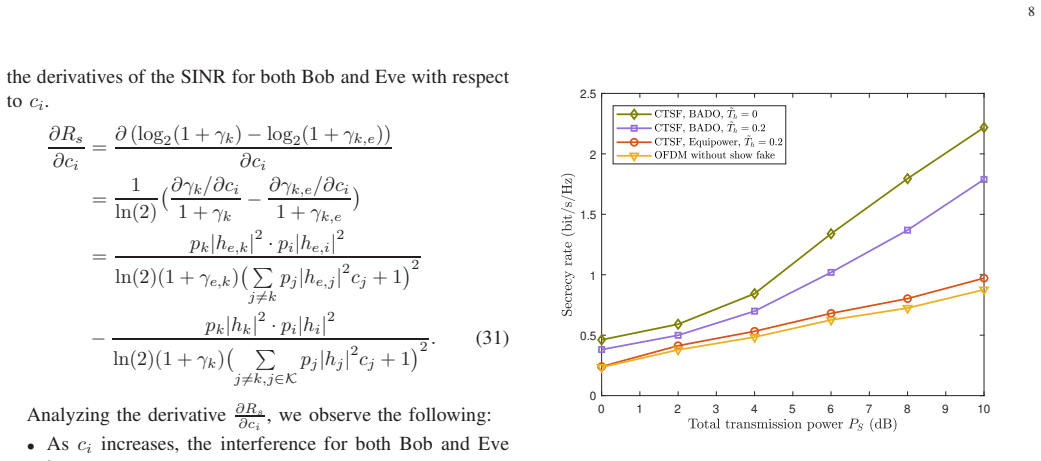
- The proposed optimization outperforms both OFDM and equal-power allocation in sum secrecy rate and in decoy dominance at the eavesdropper.
- Increasing the required decoy quality first helps secrecy by degrading the eavesdropper's channel through overlap interference, then hurts it as decoy power crowds out true-signal power.
- The optimized correlation coefficients can be realized by fitting the single frequency multiplexing factor with Newton's method, so only one physical parameter needs to be set.
Reading between the lines
- The paper assumes Bob knows the decoy signals exactly and cancels them; with imperfect cancellation, residual decoy interference would reduce true-signal SINR, so the secrecy-rate gains are an upper bound until cancellation errors are modeled.
- A natural extension the paper does not pursue is to optimize the frequency multiplexing factor jointly inside the secrecy-rate problem instead of fitting it after power allocation, which could reveal whether the overlap factor itself is the main deception lever.
- The equivalence gap between $\xi_n \geq \xi_k$ and decoy dominance suggests a reformulation that keeps the eavesdropper's channel gains in the constraint, or optimizes over channel uncertainty, would be needed before deployment in fading channels.
- If Eve is modeled as adaptive and able to estimate the correlation coefficients, the deception guarantee weakens; testing the scheme against such an informed eavesdropper is left for future work.
Editorial analysis
A structured set of objections, weighed in public.
Referee Report
Summary. The paper proposes a 'conceal truth while show fake' (CTSF) transmission scheme in which multiple sources transmit true and decoy signals over non-orthogonal frequency bands. It defines interception and deception probabilities, formulates an optimization problem P1 that maximizes the sum secrecy rate of the true signals subject to a decoy-dominance constraint at the eavesdropper, and proposes a bi-stage alternating dual-domain optimization (BADO) algorithm together with a Newton's method for fitting the T/F frequency-multiplexing factor alpha. Numerical simulations compare the proposed scheme with OFDM and equal-power allocation and report higher secrecy rate and better deception performance.
Significance. The basic idea of simultaneously hiding true information in overlapping spectrum and actively deceiving an eavesdropper is timely and practically relevant for adversarial wireless scenarios. The paper provides an explicit multi-source signal model, probability-based performance metrics, a complexity analysis of the proposed algorithms, and a systematic set of simulation comparisons. However, the central optimization reformulation is not equivalent to the original problem, and the proposed Newton fit for alpha is tautological. Because the numerical results are generated by solving the weakened reformulated problem, the claimed advantages over the benchmarks are not established. As presented, the contribution is therefore not ready for publication.
major comments (3)
- [Section IV, Eqs. (11c) and (15e)] The reformulation of P1 into P2 is not equivalent. Constraint (11c) is p_n |h_e,n|^2 >= p_k |h_e,k|^2 for all n in \tilde{K} and k in K; substituting xi_i = p_i c_i gives (xi_n/c_n)|h_e,n|^2 >= (xi_k/c_k)|h_e,k|^2, and with c_n=c_k=1 for the reference bands, xi_n |h_e,n|^2 >= xi_k |h_e,k|^2. The P2 constraint (15e) is simply xi_n >= xi_k, which drops the Eve channel gains |h_e,n|^2 and |h_e,k|^2. Under the Rician fading model these gains are generally unequal, so the P2 feasible set is strictly larger than that of P1; a P2-optimal solution can violate the decoy-dominance condition (11c), and the Section V results therefore do not certify the claimed deception guarantee.
- [Section IV, Eq. (18) and Algorithm 2] The Newton fit is circular and does not implement joint optimization over alpha. The quantity c_i in (18) is the same quantity defined in (4) as the squared sinc ratio, so minimizing the squared error between c_i and that expression simply recovers the alpha that produced c_i; it is a definitional identity, not an independent optimization. Moreover, after the substitution xi_i = p_i c_i, P2 is solved with c_i absorbed into xi_i, so alpha is no longer a decision variable; fitting alpha after recovering p_i and c_i cannot restore the joint optimization over {p_i} and alpha stated in P1. The paper therefore does not support the claim that power allocation and the T/F multiplexing factor are jointly optimized.
- [Section IV, Theorem 1] The theorem is not correct as stated. The derivative in (25) is dR_{s,k}/dp_k = a_k/(C_k ln2(1 + a_k p_k/C_k)) - a_{k,e}/(C_{k,e} ln2(1 + a_{k,e} p_k/C_{k,e})), whose sign depends on the relative magnitudes of the Bob and Eve channel gains and the interference denominators. The proof's assertion that this derivative is positive is unjustified, and the subsequent interpretations of Figs. 3 and 5 rely on this monotonicity.
minor comments (4)
- [Section IV, Eq. (16a)] The displayed T1 objective appears malformed; it should presumably be a sum over k of log(b_k mu_k), not the logarithm of a sum of logarithms, and b depends on k although the notation in (16a) suggests a single b.
- [Section IV, Eq. (24)] The symbols alpha_k and alpha_{k,e} are introduced without definition and appear to conflict with the frequency-multiplexing factor alpha; they should be renamed to the channel gains used in (25).
- [Section V] The simulation section reports no error bars, confidence intervals, or number of channel realizations, so it is difficult to assess the statistical significance of the observed advantages over the benchmarks.
- [Remark 1, Eq. (8)] The equivalence leading to (8) should state its implicit assumptions, namely c_n=c_k=1 and equal noise powers at Eve, so that the subsequent constraint derivation can be checked.
Circularity Check
Newton-based α fitting is a self-referential inversion of the defining Eq. (4), so the claimed joint optimization of the T/F multiplexing factor reduces to inverting c_i; P2's dropped |h_e,i|² factors are a separate non-equivalence.
-
self definitional
[Section III, Eq. (4) and Section IV, Algorithm 2, Eq. (18)]
"ci = |sinc(α(i−k))/sinc(α(i−k)/K)|^2. (4) ... Keep (4) in mind, we further to fit a α based on the value of ci... f(α) = Σ_{i=0}^{K−1}( ci − (sinc(α(i−k))/sinc(α(i−k)/K))^2 )^2, (18) where {ci} are known data, and K and k are constants. We seek the parameter α that minimizes f(α)."
The objective (18) minimizes the difference between c_i and the exact expression in Eq. (4), which is the definition of c_i. The 'known data' c_i are not measured independently: they are obtained from the substitution ξ_i=p_i c_i, i.e., c_i=ξ_i/p_i, after solving P2. Hence Algorithm 2 does not optimize α over the design space; it inverts the defining relation c_i(α). If P2 returns c_i values that lie on the (4) manifold, the fit just recovers the α that generated them; if not, no α realizes the optimized c_i. The manuscript's claim that the T/F multiplexing factor is jointly optimized with power allocation therefore reduces to a self-referential fitting step, and the final α is not guaranteed to achieve the P2-optimized secrecy/deception performance.
full rationale
One genuinely circular step was found: the Newton-based α recovery is a self-referential inversion of Eq. (4), so the 'joint optimization' of the frequency multiplexing factor reduces to fitting c_i against its own defining formula. I score this as partial circularity (6) because the power-allocation half of BADO is an independent convex optimization over ξ_i and the numerical comparisons contain content beyond the α fit; however, the claimed joint-optimization contribution and the resulting anti-interception guarantee are not fully supported. A separate, non-circular correctness issue is that the P1→P2 reformulation replaces (11c), p_n|h_e,n|² ≥ p_k|h_e,k|², with (15e), ξ_n ≥ ξ_k; since ξ_i=p_i c_i and the |h_e,i|² factors are dropped, P2 is not equivalent to P1, so P2-optimal powers can violate the decoy-dominance condition. I do not count this as circularity, but it reinforces that Section V's simulations evaluate a weakened problem. No load-bearing self-citations appear; author self-citations in [12], [14], [23] are related-work background only.
Assumptions & free parameters
free parameters (3)
- alpha (T/F frequency multiplexing factor) =
Fitted by Newton's method (Algorithm 2) to match optimized correlation coefficients; no closed-form value given
- Initial feasible solution {xi_i^0} for Algorithm 1 =
Not specified; set by user at algorithm start
- Deception SINR threshold tilde_Th =
Varied in simulations (e.g., 0.2 to 0.9), not optimized
assumptions (4)
- domain assumption Rician fading with known statistics and instantaneous CSI available to the transmitter for both Bob and Eve channels
- domain assumption Bob has perfect knowledge of the decoy signals and can eliminate their interference completely
- ad hoc to paper The constraint p_n|h_e,n|^2 >= p_k|h_e,k|^2 is equivalent to xi_n >= xi_k when xi_i = p_i c_i
- domain assumption Eve is a passive, non-adaptive receiver that demodulates whichever signal has higher SINR and does not attempt to cancel or jointly decode true and decoy signals
Cite this review
Pith. "Pith review of Conceal Truth while Show Fake: T/F Frequency Multiplexing based Anti-Intercepting Transmission." pith.science (2026). https://pith.science/paper/PWLQ76VA
@misc{pith2026250600811,
  author       = {Pith},
  title        = {Pith review of: Conceal Truth while Show Fake: T/F Frequency Multiplexing based Anti-Intercepting Transmission},
  year         = {2026},
  howpublished = {\url{https://pith.science/paper/PWLQ76VA}},
  note         = {Machine review of arXiv:2506.00811}
}
read the original abstract
In wireless communication adversarial scenarios, signals are easily intercepted by non-cooperative parties, exposing the transmission of confidential information. This paper proposes a true-and-false (T/F) frequency multiplexing based anti-intercepting transmission scheme capable of concealing truth while showing fake (CTSF), integrating both offensive and defensive strategies. Specifically, through multi-source cooperation, true and false signals are transmitted over multiple frequency bands using non-orthogonal frequency division multiplexing. The decoy signals are used to deceive non-cooperative eavesdropper, while the true signals are hidden to counter interception threats. Definitions for the interception and deception probabilities are provided, and the mechanism of CTSF is discussed. To improve the secrecy performance of true signals while ensuring decoy signals achieve their deceptive purpose, we model the problem as maximizing the sum secrecy rate of true signals, with constraint on the decoy effect. Furthermore, we propose a bi-stage alternating dual-domain optimization approach for joint optimization of both power allocation and correlation coefficients among multiple sources, and a Newton's method is proposed for fitting the T/F frequency multiplexing factor. In addition, simulation results verify the efficiency of anti-intercepting performance of our proposed CTSF scheme.
Figures


Figures from the paper (4 more)


Reference graph
Works this paper leans on
-
[1]
Fair subcarrier alloca tion for securing OFDMA in IoT against full-duplex hybrid attacker,
B. Ahuja, D. Mishra, and R. Bose, “Fair subcarrier alloca tion for securing OFDMA in IoT against full-duplex hybrid attacker, ” IEEE Trans. Inf. F orensics Security, vol. 16, pp. 2898–2911, 2021
work page 2021
-
[2]
Full -duplex jamming and interception analysis of UA V-based intrusion l inks,
M. Abughalwa, L. Samara, M. O. Hasna, and R. Hamila, “Full -duplex jamming and interception analysis of UA V-based intrusion l inks,” IEEE Commun. Lett. , vol. 24, no. 5, pp. 1105–1109, 2020
work page 2020
-
[3]
Air-gap electromagnetic covert channel,
M. Guri, “Air-gap electromagnetic covert channel,” IEEE Trans. Depend. Sec. Comput. , pp. 1–18, 2023
work page 2023
-
[4]
Rethinking wireless communication security in seman tic internet of things,
H. Du, J. Wang, D. Niyato, J. Kang, Z. Xiong, M. Guizani, an d D. I. Kim, “Rethinking wireless communication security in seman tic internet of things,” IEEE Wireless Commun. , vol. 30, no. 3, pp. 36–43, 2023
work page 2023
-
[5]
Counter-unmanned aircraft system(s) (c-uas): State of the art, challenges, and future trends,
J. Wang, Y . Liu, and H. Song, “Counter-unmanned aircraft system(s) (c-uas): State of the art, challenges, and future trends,” IEEE Aerosp. Electron. Syst. Mag. , vol. 36, no. 3, pp. 4–29, 2021
work page 2021
-
[6]
Survey and taxonomy of adversarial reconnaissance techni ques,
S. Roy, N. Sharmin, J. C. Acosta, C. Kiekintveld, and A. La szka, “Survey and taxonomy of adversarial reconnaissance techni ques,” ACM Comput. Surv., vol. 55, no. 6, pp. 1–38, 2022
work page 2022
-
[7]
S. V enkatesh, X. Lu, B. Tang, and K. Sengupta, “Secure spa ce-time- modulated millimetre-wave wireless links that are resilie nt to distributed eavesdropper attacks,” Nature Electronics, vol. 4, no. 11, pp. 827–836, 2021
work page 2021
-
[8]
Control of elect romagnetic radiation on coexisting smart radio environment,
M. M. S ¸ ahin, H. Arslan, and K.-C. Chen, “Control of elect romagnetic radiation on coexisting smart radio environment,” IEEE Open Journal of the Communications Society , vol. 3, pp. 557–573, 2022
work page 2022
Show all 37 references
-
[9]
Multicarrier sp read spectrum for mega-constellation satellite networks: Chal lenges, oppor- tunities, and future trends,
W. Y an, J. An, J. Song, Y . Li, and S. Wang, “Multicarrier sp read spectrum for mega-constellation satellite networks: Chal lenges, oppor- tunities, and future trends,” IEEE Internet Things J. , vol. 10, no. 23, pp. 20 358–20 367, 2023
2023
-
[10]
Security and privacy for 6g: A survey on prospective techno logies and challenges,
V .-L. Nguyen, P .-C. Lin, B.-C. Cheng, R.-H. Hwang, and Y .-D. Lin, “Security and privacy for 6g: A survey on prospective techno logies and challenges,” IEEE Commun. Surv. & Tutor . , vol. 23, no. 4, pp. 2384– 2428, 2021
2021
-
[11]
Frequency-hopping wave engineering with m etasur- faces,
H. Takeshita, A. A. Fathnan, D. Nita, A. Nagata, S. Sugiu ra, and H. Wakatsuchi, “Frequency-hopping wave engineering with m etasur- faces,” Nat Commun , vol. 15, no. 1, p. 196, 2024
2024
-
[12]
Dt-ass isted multi-point symbiotic security in space-air-ground integ rated networks,
Z. Yin, N. Cheng, T. H. Luan, Y . Song, and W. Wang, “Dt-ass isted multi-point symbiotic security in space-air-ground integ rated networks,” IEEE Trans. Inf. F orensics Security , vol. 18, pp. 5721–5734, 2023
2023
-
[13]
Physical la yer security enhancement with reconfigurable intelligent surf ace-aided net- works,
J. Zhang, H. Du, Q. Sun, B. Ai, and D. W. K. Ng, “Physical la yer security enhancement with reconfigurable intelligent surf ace-aided net- works,” IEEE Trans. Inf. F orensics Security , vol. 16, pp. 3480–3495, 2021. 11
2021
-
[14]
Uav- assisted physical layer security in multi-beam satellite- enabled vehicle communications,
Z. Yin, M. Jia, N. Cheng, W. Wang, F. Lyu, Q. Guo, and X. She n, “Uav- assisted physical layer security in multi-beam satellite- enabled vehicle communications,” IEEE Trans. Intell. Transp. Syst. , vol. 23, no. 3, pp. 2739–2751, 2022
2022
-
[15]
Minimization of secrecy outage probability in reconfigurable intelligent surface- assisted mimome system,
Y . Liu, Z. Su, C. Zhang, and H.-H. Chen, “Minimization of secrecy outage probability in reconfigurable intelligent surface- assisted mimome system,” IEEE Trans. Wireless Commun. , vol. 22, no. 2, pp. 1374–1387, 2023
2023
-
[16]
Covert communication of star-ris aided noma net works,
X. Li, Z. Tian, W. He, G. Chen, M. C. Gursoy, S. Mumtaz, and A. Nal- lanathan, “Covert communication of star-ris aided noma net works,” IEEE Trans. V eh. Technol., vol. 73, no. 6, pp. 9055–9060, 2024
2024
-
[17]
Covert communication in uav-assisted air-ground networks,
X. Jiang, X. Chen, J. Tang, N. Zhao, X. Y . Zhang, D. Niyato , and K.- K. Wong, “Covert communication in uav-assisted air-ground networks,” IEEE Wireless Commun. , vol. 28, no. 4, pp. 190–197, 2021
2021
-
[19]
Covert and secure co mmuni- cations in noma networks with internal eavesdropping,
Q. Li, D. Xu, K. Navaie, and Z. Ding, “Covert and secure co mmuni- cations in noma networks with internal eavesdropping,” IEEE Wireless Commun. Lett. , vol. 12, no. 12, pp. 2178–2182, 2023
2023
-
[20]
Adversarial attacks and defenses in 6g network- assisted iot systems,
B. D. Son, N. T. Hoa, T. V . Chien, W. Khalid, M. A. Ferrag, W . Choi, and M. Debbah, “Adversarial attacks and defenses in 6g network- assisted iot systems,” IEEE Internet of Things Journal , vol. 11, no. 11, pp. 19 168– 19 187, 2024
2024
-
[21]
Rob ust secure transmission for satellite communications,
B. Jiang, Y . Y an, L. Y ou, J. Wang, W. Wang, and X. Gao, “Rob ust secure transmission for satellite communications,” IEEE Trans. Aerosp. Electron. Syst. , vol. 59, no. 2, pp. 1598–1612, 2023
2023
-
[22]
Ro bust secure transmission for active ris enabled symbiotic radio multicast communications,
B. Lyu, C. Zhou, S. Gong, D. T. Hoang, and Y .-C. Liang, “Ro bust secure transmission for active ris enabled symbiotic radio multicast communications,” IEEE Trans. Wireless Commun. , vol. 22, no. 12, pp. 8766–8780, 2023
2023
-
[23]
Multi-domain resource multiplexing based sec ure transmis- sion for satellite-assisted iot: Ao-sca approach,
Z. Yin, N. Cheng, Y . Hui, W. Wang, L. Zhao, K. Aldubaikhy, and A. Alqasir, “Multi-domain resource multiplexing based sec ure transmis- sion for satellite-assisted iot: Ao-sca approach,” IEEE Trans. Wireless Commun., vol. 22, no. 11, pp. 7319–7330, 2023
2023
-
[24]
Phys ical layer security for visible light communication in reflected indoo r environments with inter-symbol interference,
C. Albayrak, S. Cetinkaya, K. Turk, and H. Arslan, “Phys ical layer security for visible light communication in reflected indoo r environments with inter-symbol interference,” IEEE Trans. Inf. F orensics Security , vol. 18, pp. 2709–2722, 2023
2023
-
[25]
Applications of absorp tive reconfig- urable intelligent surfaces in interference mitigation an d physical layer security,
F. Wang and A. L. Swindlehurst, “Applications of absorp tive reconfig- urable intelligent surfaces in interference mitigation an d physical layer security,” IEEE Trans. Wireless Commun., vol. 23, no. 5, pp. 3918–3931, 2024
2024
-
[26]
Artificial no ise assisted secure transmission for uplink mimo rate splitting healthc are systems,
J. Zhou, W. Hou, Y . Mao, and C. Tellambura, “Artificial no ise assisted secure transmission for uplink mimo rate splitting healthc are systems,” IEEE Commun. Lett. , vol. 27, no. 12, pp. 3176–3180, 2023
2023
-
[27]
Emf-constrained artificial nois e for secrecy rates with stochastic eavesdropper channels,
S. Roth and A. Sezgin, “Emf-constrained artificial nois e for secrecy rates with stochastic eavesdropper channels,” IEEE Wireless Commun. Lett. , pp. 1–1, 2024
2024
-
[28]
Full-duplex c onstant-envelope jamceiver and self-interference suppression by highpass fi lter: Exper- imental validation for wi-fi security,
J. Marin, M. Bernhardt, and T. Riihonen, “Full-duplex c onstant-envelope jamceiver and self-interference suppression by highpass fi lter: Exper- imental validation for wi-fi security,” IEEE J. Sel. Areas Commun. , vol. 41, no. 9, pp. 2937–2950, 2023
2023
-
[29]
Physical layer secure key distribution based on a rtificial amplitude noise in qam/qnsc optical communication systems ,
S. Wei, Y . Li, K. Zhu, C. Lei, Y . Li, M. Pan, W. Wang, Y . Zhao , and J. Zhang, “Physical layer secure key distribution based on a rtificial amplitude noise in qam/qnsc optical communication systems ,” IEEE Commun. Lett. , vol. 27, no. 9, pp. 2288–2292, 2023
2023
-
[30]
Physical lay er covert communication in b5g wireless networks—its research, appl ications, and challenges,
Y . Jiang, L. Wang, H.-H. Chen, and X. Shen, “Physical lay er covert communication in b5g wireless networks—its research, appl ications, and challenges,” Proc. IEEE , vol. 112, no. 1, pp. 47–82, 2024
2024
-
[31]
Covert communications: A comprehensive survey ,
X. Chen, J. An, Z. Xiong, C. Xing, N. Zhao, F. R. Y u, and A. N al- lanathan, “Covert communications: A comprehensive survey ,” IEEE Commun. Surv. & Tutor ., vol. 25, no. 2, pp. 1173–1198, 2023
2023
-
[32]
Covert communication for spa tially sparse mmwave massive mimo channels,
L. Bai, J. Xu, and L. Zhou, “Covert communication for spa tially sparse mmwave massive mimo channels,” IEEE Trans. Commun., vol. 71, no. 3, pp. 1615–1630, 2023
2023
-
[33]
Achiev ing covert communication in large-scale swipt-enabled d2d networks,
S. Feng, X. Lu, D. Niyato, E. Hossain, and S. Sun, “Achiev ing covert communication in large-scale swipt-enabled d2d networks, ” IEEE Trans. Wireless Commun., vol. 23, no. 5, pp. 5272–5286, 2024
2024
-
[34]
Cov ert commu- nication and secure transmission over untrusted relaying n etworks in the presence of multiple wardens,
M. Forouzesh, P . Azmi, A. Kuhestani, and P . L. Y eoh, “Cov ert commu- nication and secure transmission over untrusted relaying n etworks in the presence of multiple wardens,” IEEE Trans. Commun. , vol. 68, no. 6, pp. 3737–3749, 2020
2020
-
[35]
Cove rt communication with relay selection,
Y . Su, H. Sun, Z. Zhang, Z. Lian, Z. Xie, and Y . Wang, “Cove rt communication with relay selection,” IEEE Wireless Commun. Lett. , vol. 10, no. 2, pp. 421–425, 2021
2021
-
[36]
Sens ing aided covert communications: Turning interference into allies,
X. Wang, Z. Fei, P . Liu, J. A. Zhang, Q. Wu, and N. Wu, “Sens ing aided covert communications: Turning interference into allies, ” IEEE Trans. Wireless Commun., pp. 1–1, 2024
2024
-
[37]
Covert communicatio n over adversarially jammed channels,
Q. Zhang, M. Bakshi, and S. Jaggi, “Covert communicatio n over adversarially jammed channels,” IEEE Trans. Inf. Theory , vol. 67, no. 9, pp. 6096–6121, 2021
2021
-
[38]
Simultaneous secure and covert transmissions a gainst two attacks under practical assumptions,
M. Forouzesh, F. Samsami Khodadad, P . Azmi, A. Kuhestan i, and H. Ahmadi, “Simultaneous secure and covert transmissions a gainst two attacks under practical assumptions,” IEEE Internet Things J. , vol. 10, no. 12, pp. 10 160–10 171, 2023
2023
Reviewed August 7, 2026 · model on record in the stance chip above.
Discussion (0). Sign in to comment.