Distributed Massive MIMO with 1-Bit Radio-over-Fiber Fronthaul: Uplink Spectral Efficiency and Power Control
Pith reviewed 2026-06-26 02:46 UTC · model grok-4.3
The pith
Bussgang decomposition yields rate expressions for uplink in 1-bit RoF distributed MIMO without MMSE estimates
A machine-rendered reading of the paper's core claim, the machinery that carries it, and where it could break.
Core claim
Using the Bussgang decomposition to linearize the input-output relation of dithered, oversampled, 1-bit quantized passband signals, the paper derives achievable-rate expressions that do not depend on MMSE channel estimates. These expressions determine the optimal signal-to-dither ratio maximizing rates in single- and multiuser scenarios, assess oversampling effects, and solve the max-min fairness problem under dynamic range limitations at the access points.
What carries the argument
Bussgang decomposition for linearizing the nonlinear 1-bit quantized fronthaul signals
If this is right
- The optimal signal-to-dither ratio maximizes the achievable rates in both single- and multiuser scenarios.
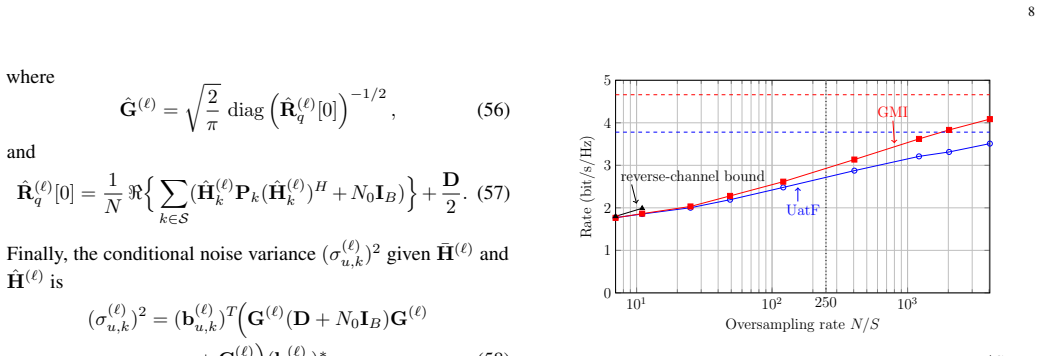
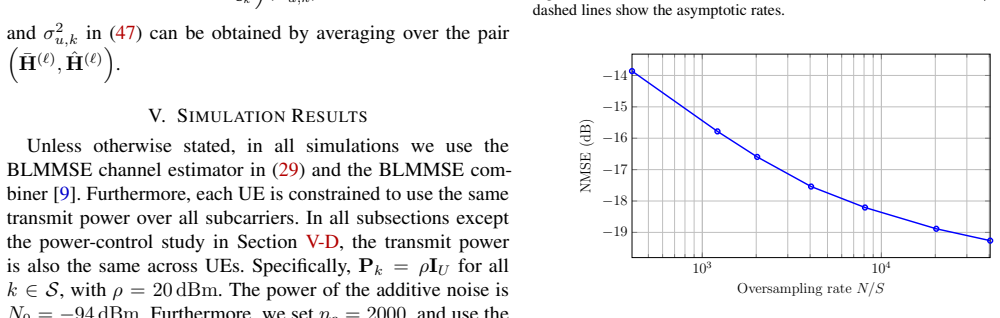
- The impact of oversampling on the achievable rates can be quantified using the expressions.
- One of the expressions supports investigation of the max-min fairness problem when access points cannot maintain the optimal SDR due to dynamic range limits.
Where Pith is reading between the lines
- The 1-bit RoF architecture could reduce hardware costs by eliminating local oscillators and synchronization needs if the expressions are accurate.
- The linearization technique may apply to other quantized fronthaul configurations.
- Rate-based power control may enhance fairness in distributed systems with varying channels.
Load-bearing premise
The Bussgang decomposition accurately linearizes the nonlinear input-output relation of the dithered, oversampled, 1-bit quantized passband signal received at the access points, allowing the proposed expressions to bound achievable rates without MMSE channel estimates.
What would settle it
Simulations or measurements comparing the spectral efficiency predicted by the proposed expressions against the actual performance of a 1-bit radio-over-fiber distributed MIMO system would test the validity of the linearization and rate bounds.
Figures
read the original abstract
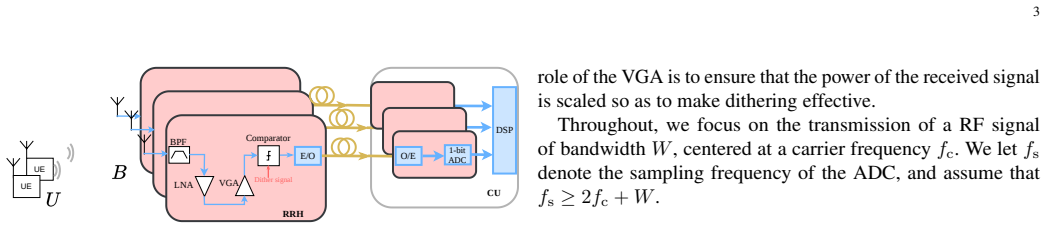
We analyze the uplink spectral efficiency achievable in a distributed multiple-input multiple-output (D-MIMO) architecture employing a 1-bit radio-over-fiber fronthaul. This architecture eliminates the need for local oscillators at the access points, hence enabling coherent-phase transmission without costly over-the-air synchronization. With this fronthaul architecture, the uplink signal at the central processing unit is a dithered, oversampled, and 1-bit quantized version of the passband signal received at the access points. This makes some of the conventional spectral-efficiency expressions used in the D-MIMO literature not directly applicable for two key reasons: the nonlinearity of the input-output relation and the practical unavailability of minimum mean square error (MMSE) channel estimates. To address this issue, we propose novel achievable-rate expressions that do not require MMSE channel estimates and rely on the Bussgang decomposition to linearize the input-output relation. We use these expressions to determine the optimal signal-to-dither ratio (SDR) that maximizes the achievable rates in both single- and multiuser scenarios and to assess the impact of oversampling. We then use one of the proposed achievable-rate expressions to investigate the max-min fairness problem when the access points cannot maintain the optimal SDR because of limitations in their dynamic range.
Editorial analysis
A structured set of objections, weighed in public.
Referee Report
Summary. The paper analyzes uplink spectral efficiency in a distributed massive MIMO system using 1-bit radio-over-fiber fronthaul. The architecture avoids local oscillators at access points by sending dithered, oversampled, 1-bit quantized passband signals to the CPU. Novel achievable-rate expressions are derived via the Bussgang decomposition to linearize the nonlinear quantizer input-output map; these expressions avoid MMSE channel estimates. The expressions are used to optimize the signal-to-dither ratio (SDR) in single- and multi-user settings, quantify oversampling gains, and solve a max-min fairness power-control problem under per-AP dynamic-range constraints.
Significance. If the Bussgang linearization is rigorously justified for the dithered oversampled passband case, the closed-form rates and the resulting SDR optimization would supply practical design guidelines for low-cost coherent D-MIMO deployments. The avoidance of MMSE estimates is a useful practical feature. The max-min fairness formulation under dynamic-range limits is a realistic extension. The work therefore has moderate significance for fronthaul-constrained massive MIMO literature, provided the core modeling assumption holds.
major comments (2)
- [derivation of achievable-rate expressions (Bussgang linearization step)] The central claim rests on the Bussgang decomposition producing an effective linear model (gain × signal + uncorrelated distortion) after dithering, oversampling, and passband-to-baseband conversion. The manuscript must explicitly verify that the quantization error remains uncorrelated with the desired signal after the subsequent digital filtering and multi-AP combining steps; the abstract and the described construction do not indicate such a verification. Without this check, the achievable-rate expressions and the subsequent SDR optimization rest on an unconfirmed modeling assumption.
- [SDR optimization and oversampling analysis sections] The optimization of SDR and the assessment of oversampling impact both rely on the same linearized model. If the uncorrelated-distortion property does not survive the oversampling filter, the reported optimal SDR values and the claimed spectral-efficiency gains from oversampling become unreliable.
minor comments (2)
- [system model] Notation for the dither process and the oversampling factor should be introduced earlier and used consistently when stating the input-output relation.
- [Bussgang decomposition subsection] The paper should clarify whether the Bussgang gain is computed analytically or numerically for the passband 1-bit quantizer; an explicit formula or algorithm would improve reproducibility.
Simulated Author's Rebuttal
We thank the referee for the constructive feedback on our manuscript analyzing uplink spectral efficiency in distributed massive MIMO with 1-bit RoF fronthaul. The comments focus on the justification of the Bussgang linearization after filtering and combining. We address each point below and will incorporate clarifications in the revision.
read point-by-point responses
-
Referee: [derivation of achievable-rate expressions (Bussgang linearization step)] The central claim rests on the Bussgang decomposition producing an effective linear model (gain × signal + uncorrelated distortion) after dithering, oversampling, and passband-to-baseband conversion. The manuscript must explicitly verify that the quantization error remains uncorrelated with the desired signal after the subsequent digital filtering and multi-AP combining steps; the abstract and the described construction do not indicate such a verification. Without this check, the achievable-rate expressions and the subsequent SDR optimization rest on an unconfirmed modeling assumption.
Authors: We agree that an explicit verification strengthens the presentation. The Bussgang decomposition is applied directly to the dithered 1-bit quantized passband signal at each AP, producing a linear gain times the received signal plus a distortion term that is uncorrelated with the input by construction of the theorem (under the Gaussian dither assumption). The subsequent digital filtering (oversampling filter and passband-to-baseband conversion) and multi-AP combining are strictly linear operations. Because the cross-correlation E[distortion · signal] = 0 holds at the quantizer output, and linearity preserves the zero cross-correlation in the effective baseband model (i.e., the filtered distortion remains uncorrelated with the filtered desired signal component), the achievable-rate expressions remain valid. Nevertheless, to address the concern directly, we will add a short remark in Section III and a brief appendix deriving that the uncorrelated property is preserved after the linear stages. This does not change the rate expressions or numerical results. revision: yes
-
Referee: [SDR optimization and oversampling analysis sections] The optimization of SDR and the assessment of oversampling impact both rely on the same linearized model. If the uncorrelated-distortion property does not survive the oversampling filter, the reported optimal SDR values and the claimed spectral-efficiency gains from oversampling become unreliable.
Authors: The SDR optimization (both single- and multi-user) and the oversampling analysis are performed using the same Bussgang-linearized model derived in Section III. As noted in the response to the first comment, the uncorrelated property is preserved under the linear oversampling filter; therefore the optimal SDR values and the reported spectral-efficiency gains remain reliable. In the revision we will add an explicit cross-reference in Sections IV and V to the new verification appendix, ensuring the optimization steps are clearly grounded. revision: yes
Circularity Check
No circularity; uses standard Bussgang decomposition on dithered 1-bit signals without self-referential reduction
full rationale
The derivation applies the established Bussgang theorem to obtain an effective linear model (gain plus uncorrelated distortion) for the quantized passband signal. This is a standard technique for Gaussian inputs and does not reduce to a fitted parameter or self-citation chain within the paper. Novel rate expressions are derived from this model without MMSE estimates, and SDR optimization follows directly from the resulting closed forms. No load-bearing step equates a claimed prediction to its own input by construction, and the abstract explicitly positions the work as extending conventional D-MIMO analysis rather than re-deriving its premises. Per rules, this self-contained application of an external result warrants score 0.
Axiom & Free-Parameter Ledger
axioms (1)
- domain assumption Bussgang decomposition applies to linearize the nonlinear input-output relation of the dithered oversampled 1-bit quantized signal.
Reference graph
Works this paper leans on
-
[1]
Massive MIMO Networks: Spectral, Energy, and Hardware Efficiency,
E. Bj¨ornson, J. Hoydis, and L. Sanguinetti, “Massive MIMO Networks: Spectral, Energy, and Hardware Efficiency,”Foundations and Trends in Signal Processing, vol. 11, no. 3–4, pp. 154–655, 2017
2017
-
[2]
Real-time distributed MIMO systems,
E. Hamed, H. Rahul, M. A. Abdelghany, and D. Katabi, “Real-time distributed MIMO systems,” inProc. ACM SIGCOMM Conf., New York, NY , USA, 2016, pp. 412–425
2016
-
[3]
Massive synchrony in distributed antenna systems,
E. G. Larsson, “Massive synchrony in distributed antenna systems,”IEEE Trans. Signal Process., vol. 72, pp. 855–866, Jan. 2024
2024
-
[4]
Decentralized picosecond synchronization for distributed wireless systems,
N. Shandi, J. M. Merlo, and J. A. Nanzer, “Decentralized picosecond synchronization for distributed wireless systems,”IEEE Trans. Commun., vol. 73, no. 6, pp. 4425–4438, Jun. 2025
2025
-
[5]
A TDD distributed MIMO testbed using a 1-bit radio-over-fiber fronthaul architecture,
L. Aabel, S. Jacobsson, M. Coldrey, F. Olofsson, G. Durisi, and C. Fager, “A TDD distributed MIMO testbed using a 1-bit radio-over-fiber fronthaul architecture,”IEEE Trans. Microw. Theory Tech., vol. 72, no. 10, pp. 6140– 6152, Oct. 2024
2024
-
[6]
Insights on the uplink operation of a 1-bit radio-over-fiber architecture in multi-user D-MIMO communication,
L. Aabel, G. Durisi, F. Olofsson, E. B¨orjeson, M. Coldrey, and C. Fager, “Insights on the uplink operation of a 1-bit radio-over-fiber architecture in multi-user D-MIMO communication,”IEEE Trans. Microw. Theory Tech., vol. 74, no. 3, pp. 2957 – 2967, Mar. 2025
2025
-
[7]
A bi-directional distributed multi-user MIMO testbed using digital sigma–delta–over–fiber,
A. Vandierendonck, K.-L. Chiu, C. Meysmans, F. Zardosht, X. Wang, H. Li, P. Demeester, and G. Torfs, “A bi-directional distributed multi-user MIMO testbed using digital sigma–delta–over–fiber,”J. Lightw. Technol., vol. 43, no. 4, pp. 1595–1603, Feb. 2025
2025
-
[8]
Bit efficiency of distributed- and collocated-massive MIMO base station systems in OTA measurement and simulation,
T. Kaneko, T. Kuwabara, N. Tawa, and Y . Maruta, “Bit efficiency of distributed- and collocated-massive MIMO base station systems in OTA measurement and simulation,”Int. J. Microw. Wireless Technol., vol. 17, no. 2, pp. 234–245, 2025
2025
-
[9]
EVM analysis of distributed massive MIMO with 1-bit radio-over-fiber fronthaul,
A. Hu, L. Aabel, G. Durisi, S. Jacobsson, M. Coldrey, and C. Fager, “EVM analysis of distributed massive MIMO with 1-bit radio-over-fiber fronthaul,” IEEE Trans. Commun., vol. 72, no. 11, pp. 7342–7356, Nov. 2024
2024
-
[10]
Deep-learning- based channel-estimation for distributed MIMO with 1-bit radio-over-fiber fronthaul,
A. Bordbar, L. Aabel, C. H¨ager, C. Fager, and G. Durisi, “Deep-learning- based channel-estimation for distributed MIMO with 1-bit radio-over-fiber fronthaul,” inProc. IEEE Int. Symp. Wirel. Comm. Syst. (ISWCS), Rio de Janeiro, Brazil, Jul. 2024, pp. 1–5
2024
-
[11]
Generalized Bussgang LMMSE channel estimator for one-bit massive MIMO systems,
Q. Wan, J. Fang, Z. Chen, and H. Li, “Generalized Bussgang LMMSE channel estimator for one-bit massive MIMO systems,” inProc. IEEE Global Telecommun. Conf. (GLOBECOM). Waikoloa, HI, USA: IEEE, Dec. 2019, pp. 1–6
2019
-
[12]
Crosscorrelation functions of amplitude-distorted Gaus- sian signals,
J. J. Bussgang, “Crosscorrelation functions of amplitude-distorted Gaus- sian signals,” Res. Lab. Elec., Cambridge, MA, Tech. Rep. 216, Mar. 1952
1952
-
[13]
Foundations of user-centric cell-free massive MIMO,
¨U. T. Demir, E. Bj¨ornson, and L. Sanguinetti, “Foundations of user-centric cell-free massive MIMO,”Foundations and Trends in Signal Processing, vol. 14, no. 3–4, pp. 162–472, 2021
2021
-
[14]
Throughput analysis of massive MIMO uplink with low-resolution ADCs,
S. Jacobsson, G. Durisi, M. Coldrey, U. Gustavsson, and C. Studer, “Throughput analysis of massive MIMO uplink with low-resolution ADCs,” IEEE Trans. Wireless Commun., vol. 16, no. 6, pp. 4038–4051, Jun. 2017
2017
-
[15]
Quan- tized precoding for massive MU-MIMO,
S. Jacobsson, G. Durisi, M. Coldrey, T. Goldstein, and C. Studer, “Quan- tized precoding for massive MU-MIMO,”IEEE Trans. Commun., vol. 65, no. 11, pp. 4670–4684, Nov. 2017
2017
-
[16]
Hardware distortion corre- lation has negligible impact on UL massive MIMO spectral efficiency,
E. Bj ¨ornson, L. Sanguinetti, and J. Hoydis, “Hardware distortion corre- lation has negligible impact on UL massive MIMO spectral efficiency,” IEEE Trans. Commun., vol. 67, no. 2, pp. 1085–1098, Feb. 2019
2019
-
[17]
Uplink performance of wideband massive MIMO with one-bit ADCs,
C. Moll´en, J. Choi, E. G. Larsson, and R. W. Heath, “Uplink performance of wideband massive MIMO with one-bit ADCs,”IEEE Trans. Wireless Commun., vol. 16, no. 1, pp. 87–100, Jan. 2017
2017
-
[18]
Mixed-ADC massive MIMO,
N. Liang and W. Zhang, “Mixed-ADC massive MIMO,”IEEE J. Sel. Areas Commun., vol. 34, no. 4, pp. 983–997, Apr. 2016
2016
-
[19]
On the performance of cell-free massive MIMO with low-resolution ADCs,
Y . Zhang, M. Zhou, X. Qiao, H. Cao, and L. Yang, “On the performance of cell-free massive MIMO with low-resolution ADCs,”IEEE Access, vol. 7, pp. 117 968–117 977, Aug. 2019
2019
-
[20]
Information rates for channels with fading, side information and adaptive codewords,
G. Kramer, “Information rates for channels with fading, side information and adaptive codewords,”Entropy, vol. 25, no. 5, Apr. 2023
2023
-
[21]
A framework for uplink power control in cellular radio systems,
R. Yates, “A framework for uplink power control in cellular radio systems,” IEEE J. Sel. Areas Commun., vol. 13, no. 7, pp. 1341 – 1347, Sep. 1995
1995
-
[22]
A unified framework for wireless max-min utility optimization with general mono- tonic constraints,
Y .-W. P. Hong, C. W. Tan, L. Zheng, C. Hsieh, and C. Lee, “A unified framework for wireless max-min utility optimization with general mono- tonic constraints,” inProc. IEEE Conf. Comput. Commun. (INFOCOM), Toronto, ON, Canada, Apr. 2014, pp. 2076–2084
2014
-
[23]
Boyd and L
S. Boyd and L. Vandenberghe,Convex Optimization. Cambridge, UK: Cambridge University Press, 2004
2004
-
[24]
Max- min fairness optimization in uplink cell-free massive MIMO using meta- heuristics,
F. Conceicao, C. H. Antunes, M. Gomes, V . Silva, and R. Dinis, “Max- min fairness optimization in uplink cell-free massive MIMO using meta- heuristics,”IEEE Trans. Commun., vol. 70, no. 3, pp. 1792–1807, Mar. 2022. 13
2022
-
[25]
Transformer-based power opti- mization for max-min fairness in cell-free massive MIMO,
I. Chafaa, G. Bacci, and L. Sanguinetti, “Transformer-based power opti- mization for max-min fairness in cell-free massive MIMO,”IEEE Wireless Commun. Lett., vol. 14, no. 8, pp. 2316–2320, Aug. 2025
2025
-
[26]
Uplink spectral efficiency of distributed mimo with 1-bit radio-over-fiber fronthaul,
A. Bordbar, A. Hu, and G. Durisi, “Uplink spectral efficiency of distributed mimo with 1-bit radio-over-fiber fronthaul,” inIEEE Int. Workshop Signal Process. Advances Wireless Commun. (SPAWC), Athens, Greece, Sep. 2026, to appear
2026
-
[27]
All- digital, radio-over-fiber, communication link architecture for time-division duplex distributed antenna systems,
I. C. Sezgin, L. Aabel, S. Jacobsson, G. Durisi, Z. S. He, and C. Fager, “All- digital, radio-over-fiber, communication link architecture for time-division duplex distributed antenna systems,”J. Lightw. Technol., vol. 39, no. 9, pp. 2769–2779, Feb. 2021
2021
-
[28]
The spectrum of clipped noise,
J. H. Van Vleck and D. Middleton, “The spectrum of clipped noise,”Proc. IEEE, vol. 54, no. 1, pp. 2–19, Jan. 1966
1966
-
[29]
Downlink achievable rate analysis in massive MIMO systems with one-bit DACs,
Y . Li, C. Tao, A. Lee Swindlehurst, A. Mezghani, and L. Liu, “Downlink achievable rate analysis in massive MIMO systems with one-bit DACs,” IEEE Commun. Lett., vol. 21, no. 7, pp. 1669–1672, Jul. 2017
2017
-
[30]
Mismatched decoding revisited: general alphabets, channels with memory, and the wide-band limit,
A. Ganti, A. Lapidoth, and I. Telatar, “Mismatched decoding revisited: general alphabets, channels with memory, and the wide-band limit,”IEEE Trans. Inf. Theory, vol. 46, no. 7, pp. 2315–2328, Nov. 2000
2000
-
[31]
Energy and spectral efficiency of very large multiuser MIMO systems,
H. Q. Ngo, E. G. Larsson, and T. L. Marzetta, “Energy and spectral efficiency of very large multiuser MIMO systems,”IEEE Trans. Commun., vol. 61, no. 4, pp. 1436–1449, Apr. 2013
2013
-
[32]
Evolved Universal Terrestrial Radio Access (E-UTRA); Further Advancements for E-UTRA Physical Layer Aspects,
3rd Generation Partnership Project (3GPP), “Evolved Universal Terrestrial Radio Access (E-UTRA); Further Advancements for E-UTRA Physical Layer Aspects,” 3GPP, Technical Report TR 36.814, Mar. 2010, release 9, Annex A.2.1.1.2, Table A.2.1.1.2-8, pp. 67–68
2010
-
[33]
A. E. Eiben and J. E. Smith,Introduction to Evolutionary Computing, 2nd ed., ser. Natural Computing Series. Berlin, Heidelberg: Springer, 2015
2015
-
[34]
Capacity per unit energy of fading channels with a peak constraint,
V . Sethuraman and B. Hajek, “Capacity per unit energy of fading channels with a peak constraint,”IEEE Trans. Inf. Theory, vol. 51, no. 9, pp. 3102– 3120, Sep. 2005
2005
-
[35]
Fading channels: how perfect need ‘perfect side information’ be?
A. Lapidoth and S. Shamai (Shitz), “Fading channels: how perfect need ‘perfect side information’ be?”IEEE Trans. Inf. Theory, vol. 48, no. 5, pp. 1118–1134, May 2002
2002
-
[36]
URLLC with massive MIMO: analysis and design at finite blocklength,
J. ¨Ostman, A. Lancho, G. Durisi, and L. Sanguinetti, “URLLC with massive MIMO: analysis and design at finite blocklength,”IEEE Trans. Wireless Commun., vol. 20, no. 10, pp. 6387–6401, Oct. 2021
2021
discussion (0)
Sign in with ORCID, Apple, or X to comment. Anyone can read and Pith papers without signing in.