Improving Muon-Scattering Material Identification via Coarse Momentum Encoding and Unsupervised Domain Adaptation
Pith reviewed 2026-06-30 03:45 UTC · model grok-4.3
The pith
Coarse momentum binning plus unsupervised domain adaptation raises cross-domain muon material identification accuracy from 71.71% to 89%.
A machine-rendered reading of the paper's core claim, the machinery that carries it, and where it could break.
Core claim
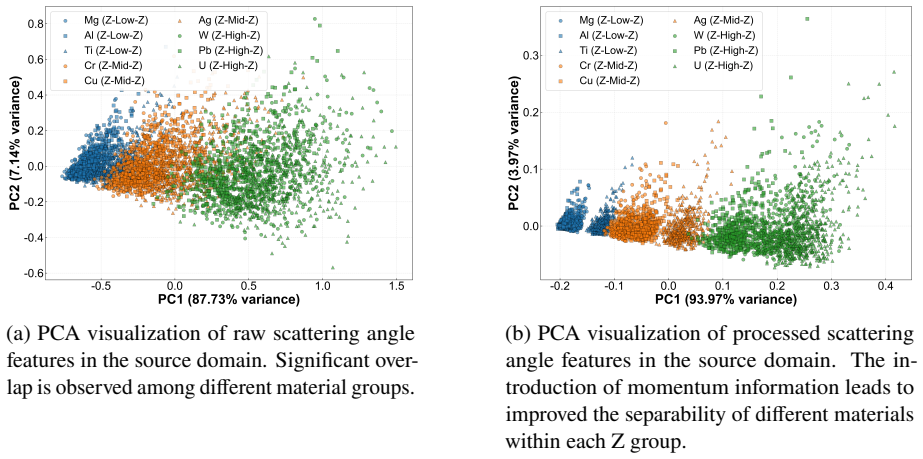
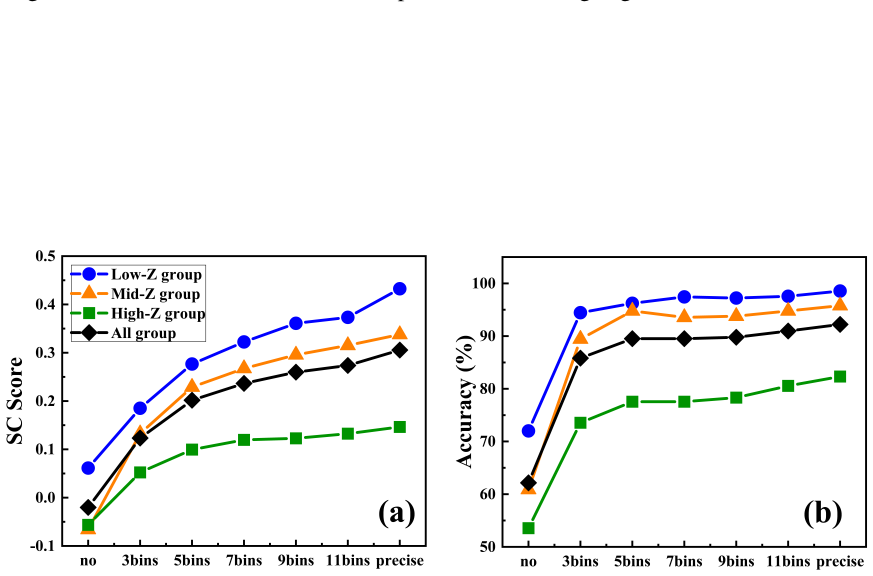
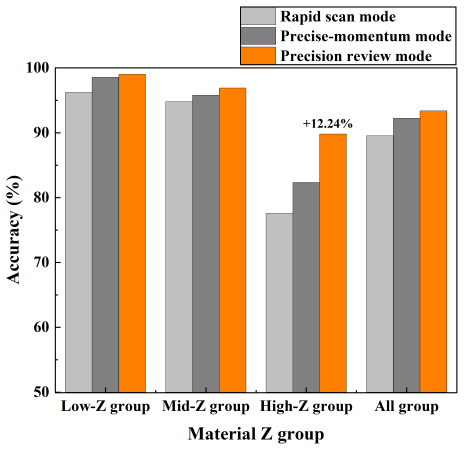
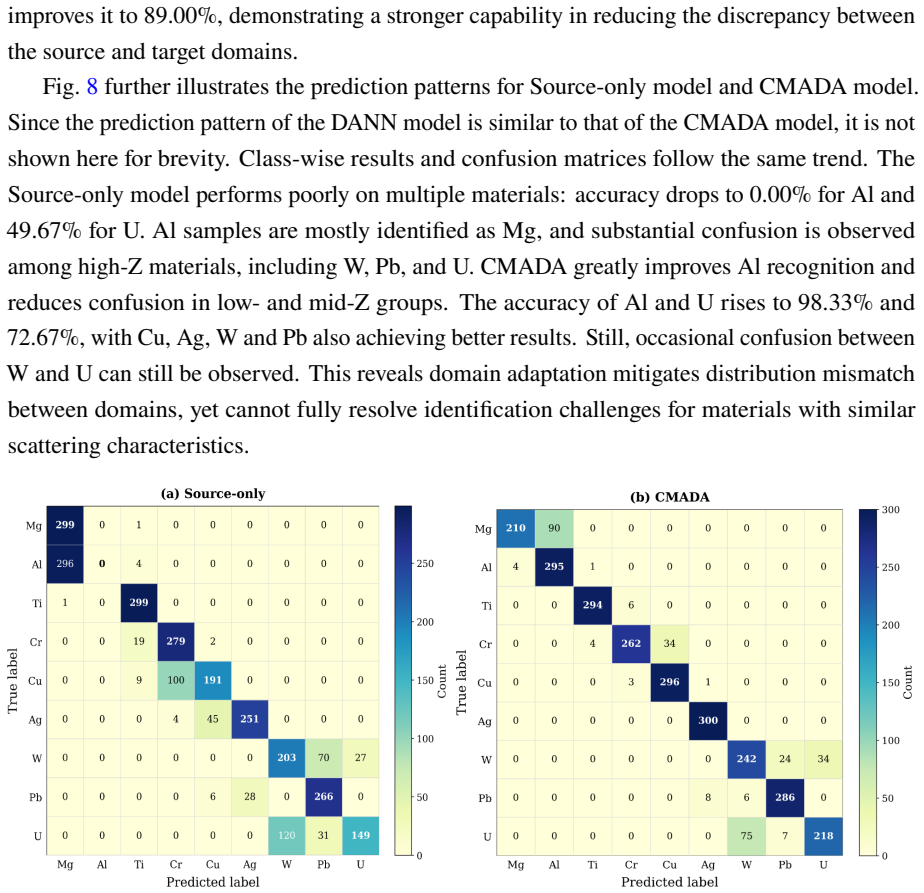
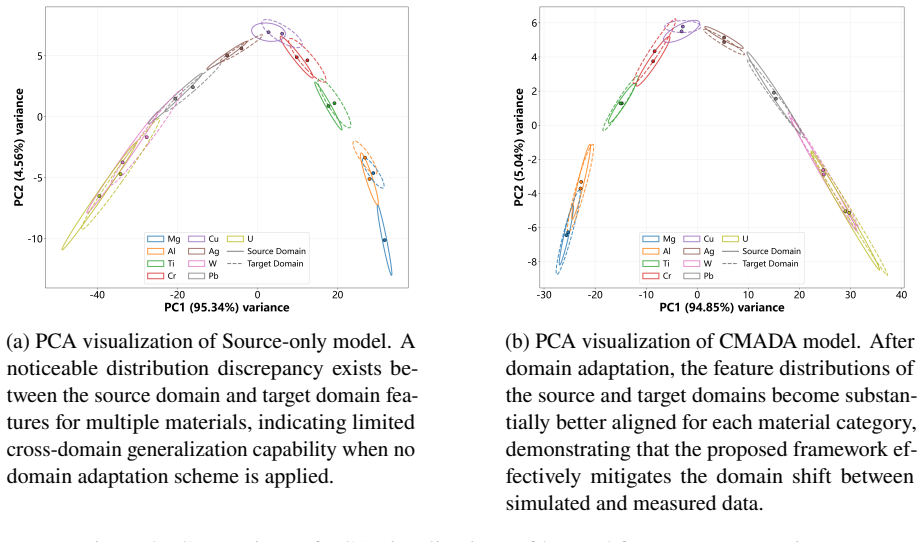
The CMADA framework shows that coarse momentum binning combined with unsupervised domain adaptation produces transferable scattering representations, lifting same-domain accuracy from 62.15% (no momentum data) to 89.52% (five bins) and further to 93.37% with precision review, while cross-domain accuracy rises from 71.71% (source-only) to 89.00% without target labels.
What carries the argument
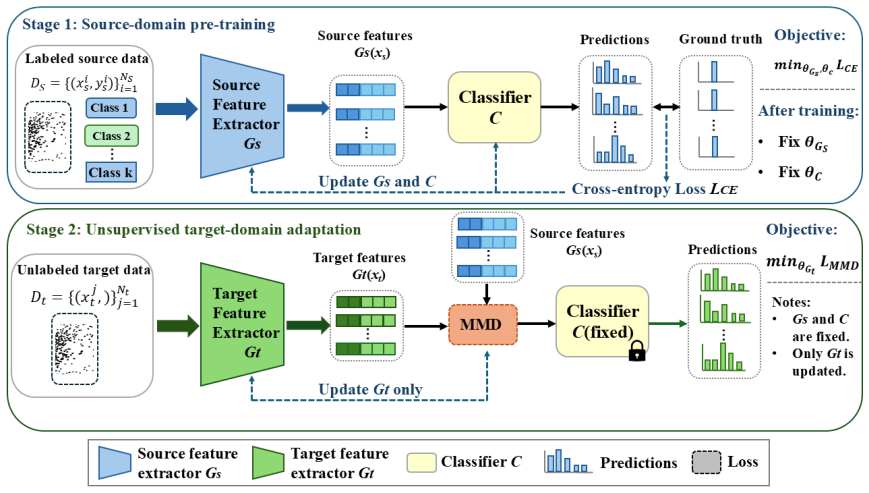
Coarse Momentum-Aware Domain Adaptation (CMADA), which bins muon momentum coarsely and uses unsupervised domain adaptation to align feature distributions across source and target momentum regimes.
If this is right
- Same-domain identification accuracy rises sharply once momentum is binned into five levels.
- Cross-domain accuracy reaches levels close to same-domain performance without collecting any labeled target samples.
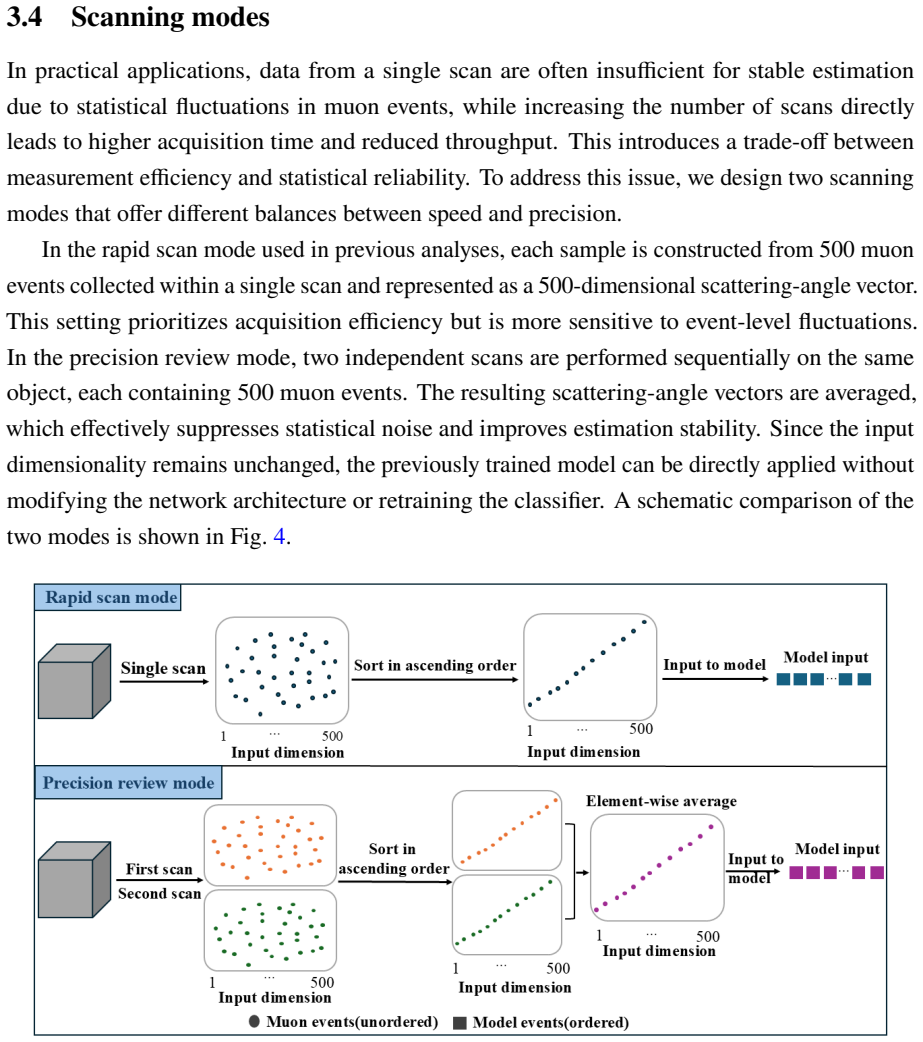
- Averaging repeated measurements in precision-review mode supplies additional accuracy gains on top of the adapted model.
- The method removes the need for high-precision momentum spectrometers in practical muon-scattering systems.
Where Pith is reading between the lines
- The same coarse-binning-plus-adaptation pattern could be tested on real cosmic-ray data collected at different geographic sites or altitudes.
- If momentum distributions in a new deployment site lie far outside the training range, the number of bins or the adaptation loss may need adjustment.
- Combining the adapted scattering classifier with other modalities such as gamma spectroscopy could produce more robust contraband screening.
Load-bearing premise
The observed domain shift between muon datasets is caused mainly by differences in momentum distributions that unsupervised feature adaptation can correct without target labels or explicit physics modeling of the scattering.
What would settle it
Running the adapted model on a new target domain whose momentum spectrum differs markedly from the source and finding accuracy below the 71.71% source-only baseline would show the adaptation failed to handle the shift.
Figures
read the original abstract
Cosmic-ray muon scattering has shown considerable potential for detecting nuclear materials and other dense contraband, but practical deployment remains challenging. A major difficulty arises from the coupling between material properties and muon momentum, since the broad natural momentum distribution influences the scattering angle and prevents unambiguous material identification. In this work, we propose a Coarse Momentum-Aware Domain Adaptation (CMADA) method to enable precise identification of materials. Instead of relying on high-precision momentum measurements, the proposed framework adopts coarse momentum binning combined with unsupervised domain adaptation to learn transferable scattering representations. In addition, a precision review mode based on averaging repeated samplings was proposed to further enhances identification performance. The coarse momentum binning strategy improves same-domain identification accuracy from 62.15% without momentum information to 89.52% with 5-bin momentum information, and further to 93.37% (precision review mode). Furthermore, the proposed unsupervised domain adaptation framework improves the cross-domain identification accuracy from 71.71% for the source-only baseline to 89.00% without requiring target domain labels.
Editorial analysis
A structured set of objections, weighed in public.
Referee Report
Summary. The paper proposes the Coarse Momentum-Aware Domain Adaptation (CMADA) framework for cosmic-ray muon scattering tomography. It combines coarse momentum binning (instead of high-precision measurements) with unsupervised domain adaptation to learn transferable scattering features across domains without target labels, plus a precision review mode based on repeated samplings. Reported results include same-domain accuracy rising from 62.15% (no momentum) to 89.52% (5-bin momentum) and 93.37% (precision review), and cross-domain accuracy improving from 71.71% (source-only) to 89.00% via UDA.
Significance. If the empirical gains hold under rigorous validation, the method could enable more deployable muon-based material identification by mitigating the momentum-material coupling without requiring precise spectrometers or labeled target data. The coarse-binning-plus-UDA strategy is a pragmatic response to a known practical barrier in the field.
major comments (2)
- [Abstract] Abstract: The central cross-domain claim (71.71% o 89.00%) and same-domain numbers are presented without error bars, dataset sizes/compositions, momentum spectra, or ablation studies that isolate momentum binning from UDA. This makes it impossible to evaluate whether the 17.29 pp gain is statistically robust or reproducible.
- [Abstract] Abstract: The claim that unsupervised feature adaptation aligns the domain shift rests on the untested assumption that momentum distribution is the dominant unmodeled factor. No evidence or test is supplied that detector response, multiple-scattering model mismatch, or material-composition differences are not the primary drivers; a concrete ablation or physics-informed regularizer would be needed to support the conclusion.
minor comments (1)
- [Abstract] Abstract: The clause 'further enhances identification performance' is grammatically inconsistent ('enhances' should agree with 'was proposed').
Simulated Author's Rebuttal
We thank the referee for the constructive comments on our manuscript. We address each major comment point by point below and indicate where revisions will be made to improve clarity and support for our claims.
read point-by-point responses
-
Referee: [Abstract] Abstract: The central cross-domain claim (71.71% o 89.00%) and same-domain numbers are presented without error bars, dataset sizes/compositions, momentum spectra, or ablation studies that isolate momentum binning from UDA. This makes it impossible to evaluate whether the 17.29 pp gain is statistically robust or reproducible.
Authors: We agree that the abstract would benefit from these details to allow better evaluation. In the revised manuscript we will expand the abstract to report standard deviations from repeated runs (providing error bars), dataset sizes and compositions, and the momentum spectra employed. We will also explicitly reference the ablation studies already present in the main text (Sections 4.2 and 4.3) that isolate the contribution of 5-bin momentum encoding from the subsequent UDA step. The same-domain results (62.15% o 89.52%) isolate momentum binning alone, while the cross-domain improvement quantifies the additional UDA gain on top of that encoding. revision: yes
-
Referee: [Abstract] Abstract: The claim that unsupervised feature adaptation aligns the domain shift rests on the untested assumption that momentum distribution is the dominant unmodeled factor. No evidence or test is supplied that detector response, multiple-scattering model mismatch, or material-composition differences are not the primary drivers; a concrete ablation or physics-informed regularizer would be needed to support the conclusion.
Authors: The work is grounded in the well-established physics that the broad natural momentum spectrum is the dominant source of ambiguity in scattering-angle-based material identification. The large same-domain gains from coarse momentum binning alone provide direct empirical support for this factor. Nevertheless, we acknowledge that the abstract does not contain explicit tests ruling out other possible contributors to domain shift. In the revision we will add a dedicated paragraph in the discussion section that addresses detector response, multiple-scattering model mismatch, and material-composition differences, and we will include a limited ablation (or physics-informed analysis) where data permit. If space or scope constraints prevent a full new experiment, we will qualify the claim to reflect the current evidence. revision: partial
Circularity Check
No circularity: reported accuracies are measured experimental outcomes, not reductions of inputs by construction.
full rationale
The provided abstract and context present identification accuracies (e.g., 62.15% to 89.52% with binning, 71.71% to 89.00% with UDA) as results obtained by applying the CMADA framework to muon scattering datasets. No equations, derivations, or self-citations are shown that would make any 'prediction' equivalent to a fitted parameter or input by definition. The central claims rest on empirical performance metrics rather than any self-referential loop, satisfying the condition for a self-contained result against external benchmarks.
Axiom & Free-Parameter Ledger
Reference graph
Works this paper leans on
-
[1]
Cosmic-ray particles of intermediate mass
Seth H Neddermeyer and Carl D Anderson. Cosmic-ray particles of intermediate mass. Physical Review, 54(1):88, 1938
1938
-
[2]
Review of possible applications of cosmic muon tomography.Journal of Instrumentation, 11(12):C12072, 2016
Paolo Checchia. Review of possible applications of cosmic muon tomography.Journal of Instrumentation, 11(12):C12072, 2016
2016
-
[3]
Haochen Wang, Pei Yu, Liangwen Chen, Weibo He, Yu Zhang, Yuhong Yu, Xueheng Zhang, Lei Yang, and Zhiyu Sun. U-net based image enhancement for short-time muon scattering tomography.arXiv preprint arXiv:2602.07060, 2026
arXiv 2026
-
[4]
Statistical reconstruction for cosmic ray muon tomography.IEEE transactions on Image Processing, 16(8):1985–1993, 2007
Larry J Schultz, Gary S Blanpied, Konstantin N Borozdin, Andrew M Fraser, Nicolas W Hengartner, Alexei V Klimenko, Christopher L Morris, Chris Orum, and Michael J Sossong. Statistical reconstruction for cosmic ray muon tomography.IEEE transactions on Image Processing, 16(8):1985–1993, 2007
1985
-
[5]
Nuclear waste imaging and spent fuel verification by muon tomography.Annals of Nuclear Energy, 53:267–273, 2013
G Jonkmans, VNP Anghel, C Jewett, and M Thompson. Nuclear waste imaging and spent fuel verification by muon tomography.Annals of Nuclear Energy, 53:267–273, 2013
2013
-
[6]
Analysis of spent nuclear fuel imaging using multiple coulomb scattering of cosmic muons.IEEE Transactions on Nuclear Science, 63(6):2866–2874, 2016
Stylianos Chatzidakis, Chan K Choi, and Lefteri H Tsoukalas. Analysis of spent nuclear fuel imaging using multiple coulomb scattering of cosmic muons.IEEE Transactions on Nuclear Science, 63(6):2866–2874, 2016
2016
-
[7]
Detection of high-z objects using multiple scattering of cosmic ray muons
Gary E Hogan, Konstantin N Borozdin, John Gomez, Christopher Morris, William C Priedhorsky, Alexander Saunders, Larry J Schultz, and Margaret E Teasdale. Detection of high-z objects using multiple scattering of cosmic ray muons. InAIP Conference Proceedings, volume 698, pages 755–758. American Institute of Physics, 2004
2004
-
[8]
Muography of different structures using muon scatter- ing and absorption algorithms.Philosophical Transactions of the Royal Society A, 377(2137):20180051, 2019
S Vanini, P Calvini, P Checchia, A Rigoni Garola, J Klinger, G Zumerle, G Bonomi, A Donzella, and A Zenoni. Muography of different structures using muon scatter- ing and absorption algorithms.Philosophical Transactions of the Royal Society A, 377(2137):20180051, 2019
2019
-
[9]
Nuclear material accountancy using momentum-informed muon scattering tomography.Annals of Nuclear Energy, 197:110240, 2024
JungHyun Bae, Rose Montgomery, and Stylianos Chatzidakis. Nuclear material accountancy using momentum-informed muon scattering tomography.Annals of Nuclear Energy, 197:110240, 2024
2024
-
[10]
Momentum-dependent cosmic ray muon computed tomography using a fieldable muon spectrometer.Energies, 15(7):2666, 2022
Junghyun Bae and Stylianos Chatzidakis. Momentum-dependent cosmic ray muon computed tomography using a fieldable muon spectrometer.Energies, 15(7):2666, 2022
2022
-
[11]
Angle statistics reconstruction: a robust reconstruction algorithm for muon scattering tomography.Journal of instrumentation, 9(11):P11019–P11019, 2014
M Stapleton, J Burns, S Quillin, C Steer, et al. Angle statistics reconstruction: a robust reconstruction algorithm for muon scattering tomography.Journal of instrumentation, 9(11):P11019–P11019, 2014. 21
2014
-
[12]
Pei Yu, Ziwen Pan, Jiajia Zhai, Yu Xu, Li Deng, Zhengyang He, Zhe Chen, Zechao Kang, Yuhong Yu, Xueheng Zhang, et al. Improving muon scattering tomography performance with a muon momentum measurement scheme.arXiv preprint arXiv:2509.12800, 2025
arXiv 2025
-
[13]
Unsupervised domain adaptation via regularized conditional alignment
Safa Cicek and Stefano Soatto. Unsupervised domain adaptation via regularized conditional alignment. InProceedings of the IEEE/CVF international conference on computer vision, pages 1416–1425, 2019
2019
-
[14]
Return of frustratingly easy domain adaptation
Baochen Sun, Jiashi Feng, and Kate Saenko. Return of frustratingly easy domain adaptation. InProceedings of the AAAI conference on artificial intelligence, volume 30, 2016
2016
-
[15]
Multi-adversarial domain adaptation
Zhongyi Pei, Zhangjie Cao, Mingsheng Long, and Jianmin Wang. Multi-adversarial domain adaptation. InProceedings of the AAAI conference on artificial intelligence, volume 32, 2018
2018
-
[16]
Domain adaptation via transfer component analysis.IEEE transactions on neural networks, 22(2):199–210, 2010
Sinno Jialin Pan, Ivor W Tsang, James T Kwok, and Qiang Yang. Domain adaptation via transfer component analysis.IEEE transactions on neural networks, 22(2):199–210, 2010
2010
-
[17]
Learning transferable features with deep adaptation networks
Mingsheng Long, Yue Cao, Jianmin Wang, and Michael Jordan. Learning transferable features with deep adaptation networks. InInternational conference on machine learning, pages 97–105. PMLR, 2015
2015
-
[18]
Transfer learning empowers material z classification with muon tomography: Hc wang et al.Nuclear Science and Techniques, 37(5):77, 2026
Hao-Chen Wang, Zhao Zhang, Pei Yu, Yu-Xin Bao, Jia-Jia Zhai, Yu Xu, Li Deng, Sa Xiao, Xue-Heng Zhang, Yu-Hong Yu, et al. Transfer learning empowers material z classification with muon tomography: Hc wang et al.Nuclear Science and Techniques, 37(5):77, 2026
2026
-
[19]
Precise muon detection with novel micropattern gaseous detectors
Kerstin Hoepfner. Precise muon detection with novel micropattern gaseous detectors. Progress in Particle and Nuclear Physics, page 104187, 2025
2025
-
[20]
Detection of high-z objects using multiple scattering of cosmic ray muons.Review of Scientific Instruments, 74(10):4294–4297, 2003
William C Priedhorsky, Konstantin N Borozdin, Gary E Hogan, Christopher Morris, Alexander Saunders, Larry J Schultz, and Margaret E Teasdale. Detection of high-z objects using multiple scattering of cosmic ray muons.Review of Scientific Instruments, 74(10):4294–4297, 2003
2003
-
[21]
Scattering-based machine learning algorithms for momentum estimation in muon tomography.Particles, 8(2):43, 2025
Florian Bury and Maxime Lagrange. Scattering-based machine learning algorithms for momentum estimation in muon tomography.Particles, 8(2):43, 2025
2025
-
[22]
Geant4–a simulation toolkit.Nucl
GEANT Collaboration, S Agostinelli, et al. Geant4–a simulation toolkit.Nucl. Instrum. Meth. A, 506(25):0, 2003
2003
-
[23]
Geant4 developments and applications.IEEE Transactions on nuclear science, 53(1):270–278, 2006
John Allison, Katsuya Amako, JEA Apostolakis, HAAH Araujo, P Arce Dubois, MAAM Asai, GABG Barrand, RACR Capra, SACS Chauvie, RACR Chytracek, et al. Geant4 developments and applications.IEEE Transactions on nuclear science, 53(1):270–278, 2006. 22
2006
-
[24]
Simulation-to-reality transferability framework for operating-parameter forecasting in nuclear reactors using domain adaptation.Nuclear Science and Techniques, 36(5):77, 2025
Wei-Qing Lin, Xi-Ren Miao, Jing Chen, Ming-Xin Ye, Yong Xu, Hao Jiang, and Yan-Zhen Lu. Simulation-to-reality transferability framework for operating-parameter forecasting in nuclear reactors using domain adaptation.Nuclear Science and Techniques, 36(5):77, 2025
2025
-
[25]
A kernel two-sample test.The journal of machine learning research, 13(1):723–773, 2012
Arthur Gretton, Karsten M Borgwardt, Malte J Rasch, Bernhard Sch¨olkopf, and Alexander Smola. A kernel two-sample test.The journal of machine learning research, 13(1):723–773, 2012
2012
-
[26]
Do we really need to access the source data? source hypothesis transfer for unsupervised domain adaptation
Jian Liang, Dapeng Hu, and Jiashi Feng. Do we really need to access the source data? source hypothesis transfer for unsupervised domain adaptation. InInternational conference on machine learning, pages 6028–6039. PMLR, 2020
2020
-
[27]
Domain-adversarial training of neural networks.Journal of machine learning research, 17(59):1–35, 2016
Yaroslav Ganin, Evgeniya Ustinova, Hana Ajakan, Pascal Germain, Hugo Larochelle, Franc ¸ois Laviolette, Mario March, and Victor Lempitsky. Domain-adversarial training of neural networks.Journal of machine learning research, 17(59):1–35, 2016
2016
-
[28]
Rousseeuw
Peter J. Rousseeuw. Silhouettes: A graphical aid to the interpretation and validation of cluster analysis.Journal of Computational and Applied Mathematics, 20:53–65, 1987. 23
1987
discussion (0)
Sign in with ORCID, Apple, or X to comment. Anyone can read and Pith papers without signing in.