REVIEW 4 major objections 5 minor 32 references
Schr\"odinger Bridge Consistency Trajectory Models for Speech Enhancement
T0 review · 4 major / 5 minor · reviewed 2026-08-06 · deepseek-v4-flash
Pith's one-line read Melding the Schrödinger bridge with consistency trajectory training gives one-step speech enhancement that matches a 16-step diffusion teacher's PESQ while running about 16x faster.
desk verdict Solid CTM-for-Schrödinger-bridge SE extension with credible 16x RTF gain; quality match is metric-dependent but transparently traded off. read the letter →
The pith
A machine-rendered reading of the paper's core claim, the machinery that carries it, and where it could break.
The reading
What carries the argument
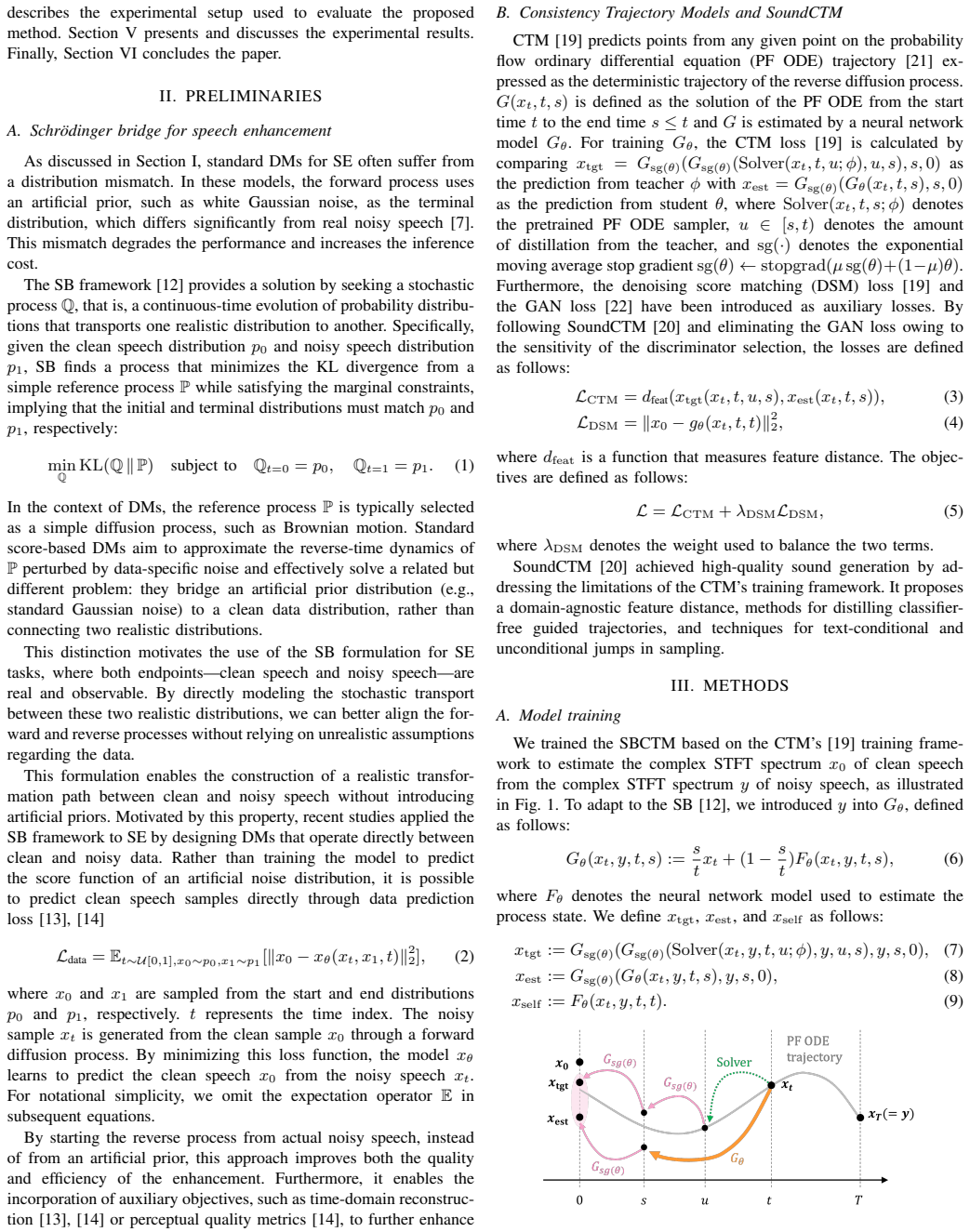
The central object is the trajectory map $G_\theta(x_t, y, t, s) = \frac{s}{t} x_t + (1-\frac{s}{t}) F_\theta(x_t, y, t, s)$, which jumps from time $t$ to an earlier time $s<t$ on the Schrödinger bridge between noisy input $y$ and clean target $x_0$. Training compares a student prediction $x_{\mathrm{est}} = G_{\bar\theta}(G_\theta(x_t,y,t,s),y,s,0)$ with a teacher-guided target $x_{\mathrm{tgt}}$ obtained from a pretrained SB-PESQ ODE solver, using an $\ell^2$ consistency term, an $\ell^1$ time-domain term, and the differentiable PESQ loss $L_{\mathrm{PESQ}}$; a denoising score-matching term $L^{\mathrm{SB}}_{\mathrm{DSM}}$ with the same auxiliary losses is added with adaptive weighting. The network is the NCSN++ architecture conditioned on the noisy complex STFT and both time indices, with exponential-moving-average weights used at inference.
What would settle it
Run a blind listening test on VB-DMD test clips where human raters compare SBCTM one-step output with the 16-step teacher output; if raters do not clearly prefer or match the SBCTM output despite its equal PESQ, the perceptual-loss claim is falsified. A complementary check is evaluating on a noisy corpus whose distortions are poorly captured by PESQ, where a large PESQ gain without corresponding DNSMOS or intelligibility gain would signal metric overfitting.
Extended reading notes
Core claim
The central claim is that Schrödinger bridge models for speech enhancement can be distilled with consistency trajectory training so that a single function evaluation produces output as perceptually good as the teacher's sixteen-step generation. On VB-DMD, SBCTM at NFE=1 achieves PESQ 3.56, identical to the SB-PESQ teacher at NFE=16, and improves to 3.58 at NFE=16, so quality keeps rising with more steps rather than saturating or degrading as in plain consistency models. The paper also reports that removing the proposed auxiliary loss drops one-step PESQ from 3.57 to 3.13, establishing that the perceptual and time-domain terms are what carry the quality gain.
Load-bearing premise
The load-bearing premise is that the differentiable PESQ loss is a faithful stand-in for perceived speech quality; if optimizing that proxy inflates the PESQ score without improving what listeners actually hear, the quality part of the paper's central claim is overstated.
Editorial extensions
If this is right
- SBCTM at NFE=1 matches the teacher's 16-step PESQ of 3.56, so diffusion-based speech enhancement becomes feasible in real-time or low-latency settings.
- Because PESQ keeps improving from 3.56 at one step to 3.58 at sixteen steps, users can run extra refinement steps only when one-step output is insufficient, trading compute for quality.
- The weight $\lambda_p$ on the PESQ loss trades PESQ against SI-SDR, letting practitioners tune the model for perceptual quality (e.g., telephony) or signal fidelity (e.g., downstream separation).
- The ablation study shows every part of the auxiliary loss is needed: removing both CTM and DSM auxiliary losses drops one-step PESQ from 3.57 to 3.13, while removing the PESQ loss alone drops it to 3.19.
Reading between the lines
- Because PESQ is both the training objective and a primary evaluation metric, part of the reported PESQ gain may be metric overfitting; a human listening test is the natural way to check whether the perceptual improvement is real.
- The same 'CTM distillation over a Schrödinger bridge between two observed distributions' recipe should transfer to other restoration tasks such as dereverberation and declipping, where paired noisy/clean endpoints are available.
- The reported 16x speed-up is measured on a desktop GPU at batch size 1; on mobile or embedded hardware the real-time factor gap could shrink or grow, so deployment latency needs separate measurement.
- Since the student is distilled from a fixed teacher, the student inherits the teacher's failure modes on noise types outside the training distribution, except where the auxiliary losses happen to compensate.
Editorial analysis
A structured set of objections, weighed in public.
Referee Report
Summary. The paper proposes SBCTM, a speech-enhancement model that applies consistency trajectory model (CTM) training to a Schrödinger bridge (SB) formulation. The model is distilled from a pretrained SB-PESQ teacher, with auxiliary time-domain and differentiable PESQ losses added to the original CTM objective. On VoiceBank+Demand, the authors report that SBCTM at one function evaluation achieves PESQ 3.56, matching the teacher at 16 steps, while the real-time factor drops from 0.713 to 0.045, an approximately 16x speedup. A multi-step refinement option and ablations on the auxiliary losses are also presented. Code, pretrained models, and audio samples are released.
Significance. If the quality claim holds, the paper makes a practically useful contribution: it shows that CTM-style distillation can be applied to Schrödinger-bridge speech enhancement, yielding one-step inference with a large RTF improvement and a quality-speed trade-off controlled by an auxiliary-loss weight. The release of code, pretrained models, and audio samples, together with a clearly described RTF measurement protocol, are strengths. The ablations in Table II are informative and show that each loss component contributes. However, the central 'high-quality one-step inference' claim currently rests on PESQ, which is also used as a training loss, and no independent perceptual validation is provided; this is the main risk to the paper's significance.
major comments (4)
- [Section V-A, Table I, Eqs. (10)-(11)] The central claim that SBCTM at NFE=1 matches the teacher's 16-step quality is supported only by PESQ (3.56 vs 3.56). Because LPESQ, a differentiable approximation of PESQ, is part of the training objective, the model is partially optimized toward the same metric used for evaluation. This is not merely hypothetical: the ablation in Table II shows that removing the PESQ loss (row e) decreases PESQ from 3.57 to 3.19 while increasing SI-SDR from 12.6 to 17.3 dB, and removing both auxiliary losses (row c) increases SI-SDR further to 18.9 dB. Table I also shows that on SI-SDR the one-step SBCTM is below the teacher at NFE=16 (12.2 vs 13.2 dB), while ESTOI and DNSMOS are identical (0.87 and 3.55). Thus no metric other than PESQ supports the quality-match claim. Please provide an independent perceptual evaluation (e.g., a listening test) or explicitly restrict the claim to PESQ-optimized quality.
- [Section III-A, Eqs. (6), (9), (11)] The definition of the self-consistency target xself is ambiguous. From Eq. (6), Gθ(xt,y,t,s) is an interpolation between xt and Fθ(xt,y,t,s) with weight s/t on xt, so at s=t one has Gθ(xt,y,t,t)=xt. Equation (9) defines xself := Fθ(xt,y,t,t), and Eq. (11) compares x0 with xself. If Fθ is intended to be an x0 predictor even when s=t, this should be stated explicitly; if not, the DSM loss should use Fθ(xt,y,t,0), equivalently Gθ(xt,y,t,0). In addition, Eq. (4) uses a symbol gθ(xt,t,t) that is never defined in the paper. Please clarify the roles of gθ, Fθ, and Gθ and correct the equations or the text, since this affects the actual training objective implemented.
- [Section V-A, Table I] The SBCM baseline degrades sharply as NFE increases (PESQ falls from 3.00 at NFE=1 to 1.97 at NFE=16; SI-SDR falls from 14.0 to 1.6 dB). The text attributes this to 'our simple training strategies' without providing any supporting detail or reference. Since SBCM is the main baseline for the argument that consistency training, unlike CTM-style training, fails at multi-step refinement, this unexplained behavior leaves the comparison inconclusive. Please describe the SBCM training recipe (teacher model, discretization, stop-gradient schedule, loss weights) or temper the comparison accordingly.
- [Section V-A, Table I] All metric values are reported as means with no error bars, significance tests, or multiple seeds. The RTF is reported as an average over 10 runs but no variance is given. This is not fatal for the direct speed measurement, but for the quality-parity claim it makes it impossible to judge whether the PESQ tie (3.56 vs 3.56) is meaningful. Please report standard deviations or confidence intervals at least for the main comparison between SBCTM at NFE=1 and the teacher at NFE=16.
minor comments (5)
- [Section IV-B] The dataset name is typeset as 'V oiceBank+Demand' with a space; it should be 'VoiceBank+Demand'.
- [Section III-A] The sentence 'The underlined characters represent the corresponding time-domain signals' refers to formatting that is not visible in the plain text; please use a distinct notation or explain the conversion explicitly.
- [Section V-C, Fig. 2] The legend labels i), ii), and iii) for the λp variations should be listed in the figure caption or in the main text so the reader can identify the curves without guessing.
- [Section IV-A] The teacher model 'M7' from [14] is not described; a brief sentence identifying its configuration would aid reproducibility.
- [Section V-A] The ratio 0.713/0.045 is approximately 15.8, so 'approximately 16×' is accurate; stating the raw ratio alongside the rounded number would avoid potential confusion.
Circularity Check
The PESQ-based quality-match claim is partly a read-out of the LPESQ training loss; the 16x RTF speed claim is independent and not circular.
-
fitted input called prediction
[Section III-A (Eqs. 10-11); Section IV-C; Section V-A (Tables I and II)]
"we modify the losses from the original CTM as follows: LSB CTM := ∥xtgt − xest∥2 2 + λtd∥xtgt − xest∥1 + λpLPESQ(xtgt, xest), LSB DSM := ∥x0 − xself∥2 2 + λtd∥x0 − xself∥1 + λpLPESQ(x0, xself) ... We used PESQ with an extended bandwidth [26] as an intrusive SE metric."
The student model is trained with LPESQ, a differentiable PESQ-based loss, inside both the CTM objective (Eq. 10) and the DSM objective (Eq. 11), and the paper's central quality claim (one-step PESQ 3.56 matching the 16-step teacher) is then read from PESQ (Sec. IV-C, V-A). The PESQ match is therefore partly a consequence of optimizing for PESQ rather than an independent measurement of 'high quality'. Table II quantifies the substitution: dropping the PESQ loss lowers PESQ from 3.57 to 3.19 while SI-SDR rises from 12.6 to 17.3 dB, and Table I shows the one-step student's SI-SDR (12.2 dB) is below the 16-step teacher (13.2 dB) with ESTOI and DNSMOS equal. Thus the 'quality match' sub-claim reduces, in the reported numbers, to the same metric used as training signal.
full rationale
The 16x RTF improvement is a direct wall-clock measurement and is not circular. The construction of SBCTM from the SB and CTM frameworks is not circular: the paper reuses published training and inference machinery from prior work rather than importing a load-bearing self-citation to forbid alternatives. However, the auxiliary loss LPESQ is the same metric family as the primary evaluation metric PESQ, and the headline 'matching teacher at 16 steps' is supported by PESQ alone. The ablation in Table II confirms that the PESQ gain is traded against SI-SDR, so the quality sub-claim is metric-specific. This is a partial fitted-input-called-prediction circularity limited to the quality claim; the speed, controllability, and flexibility claims remain independent.
Assumptions & free parameters
free parameters (2)
- λp (PESQ loss weight) =
5e-4 (varied to 4e-4 and 6e-4 in Section V-C)
- λtd (time-domain loss weight) =
1e-3
assumptions (4)
- domain assumption The data-prediction loss in Eq. (2) is a valid way to train a Schrödinger bridge for speech enhancement.
- domain assumption The teacher model M7 and its ODE solver provide accurate trajectory targets for distillation.
- ad hoc to paper LPESQ, a differentiable approximation of PESQ, is a valid perceptual-quality loss.
- domain assumption CTM training objectives transfer to Schrödinger bridges for speech enhancement.
Cite this review
Pith. "Pith review of Schr\"odinger Bridge Consistency Trajectory Models for Speech Enhancement." pith.science (2026). https://pith.science/paper/PXT7TS42
@misc{pith2026250711925,
  author       = {Pith},
  title        = {Pith review of: Schr\"odinger Bridge Consistency Trajectory Models for Speech Enhancement},
  year         = {2026},
  howpublished = {\url{https://pith.science/paper/PXT7TS42}},
  note         = {Machine review of arXiv:2507.11925}
}
read the original abstract
Speech enhancement (SE) utilizing diffusion models is a promising technology that improves speech quality in noisy speech data. Furthermore, the Schr\"odinger bridge (SB) has recently been used in diffusion-based SE to improve speech quality by resolving a mismatch between the endpoint of the forward process and the starting point of the reverse process. However, the SB still exhibits slow inference owing to the necessity of a large number of function evaluations (NFE) for inference to obtain high-quality results. While Consistency Models (CMs) address this issue by employing consistency training that uses distillation from pretrained models in the field of image generation, it does not improve generation quality when the number of steps increases. As a solution to this problem, Consistency Trajectory Models (CTMs) not only accelerate inference speed but also maintain a favorable trade-off between quality and speed. Furthermore, SoundCTM demonstrates the applicability of CTM techniques to the field of sound generation. In this paper, we present Schr\"odinger bridge Consistency Trajectory Models (SBCTM) by applying the CTM's technique to the Schr\"odinger bridge for SE. Additionally, we introduce a novel auxiliary loss, including a perceptual loss, into the original CTM's training framework. As a result, SBCTM achieves an approximately 16x improvement in the real-time factor (RTF) compared to the conventional Schr\"odinger bridge for SE. Furthermore, the favorable trade-off between quality and speed in SBCTM allows for time-efficient inference by limiting multi-step refinement to cases where 1-step inference is insufficient. Our code, pretrained models, and audio samples are available at https://github.com/sony/sbctm/.
Figures

Reference graph
Works this paper leans on
-
[1]
Real time speech enhancement in the waveform domain,
A. Defossez, G. Synnaeve, and Y . Adi, “Real time speech enhancement in the waveform domain,” in Interspeech, 2020, pp. 3291–3295
2020
-
[2]
MP-SENet: A Speech Enhancement Model with Parallel Denoising of Magnitude and Phase Spectra,
Y .-X. Lu, Y . Ai, and Z.-H. Ling, “MP-SENet: A Speech Enhancement Model with Parallel Denoising of Magnitude and Phase Spectra,” in Interspeech, 2023
work page 2023
-
[3]
CMGAN: Conformer-based metric- gan for monaural speech enhancement,
S. Abdulatif, R. Cao, and B. Yang, “CMGAN: Conformer-based metric- gan for monaural speech enhancement,” IEEE/ACM Transactionson Audio, Speech, and Language Processing , vol. 32, pp. 2477–2493, 2024
work page 2024
-
[4]
Deep unsupervised learning using nonequilibrium thermodynamics,
J. Sohl-Dickstein, E. A.Weiss, N. Maheswaranathan, and S. Ganguli, “Deep unsupervised learning using nonequilibrium thermodynamics,” in ICML, 2015
work page 2015
-
[5]
Conditional diffusion probabilistic model for speech enhancement,
Y .-J. L. et al., “Conditional diffusion probabilistic model for speech enhancement,” in ICASSP, 2022, pp. 7402–7406
work page 2022
-
[6]
Speech enhancement with score-based generative models in the complex STFT domain,
S. Welker, J. Richter, and T. Gerkmann, “Speech enhancement with score-based generative models in the complex STFT domain,” in In- terspeech, 2022
work page 2022
-
[7]
Speech enhancement and dereverberation with diffusion-based genera- tive models,
J. Richter, S. Welker, J.-M. Lemercier, B. Lay, and T. Gerkmann, “Speech enhancement and dereverberation with diffusion-based genera- tive models,” IEEE/ACM Transactions on Audio, Speech, and Language Processing, vol. 31, pp. 2351–2364, 2023
work page 2023
-
[8]
StoRM: A Diffusion-based Stochastic Regenera- tion Model for Speech Enhancement and Dereverberation,
J.-M. L. M. et al., “StoRM: A Diffusion-based Stochastic Regenera- tion Model for Speech Enhancement and Dereverberation,” IEEE/ACM Trans. on Audio, Speech, and Language Process, vol. 31, pp. 2724–2737, 2023
work page 2023
Show all 32 references
-
[9]
Reducing the Prior Mismatch of Stochastic Differential Equations for Diffusion-based Speech Enhancement,
B. L. et al., “Reducing the Prior Mismatch of Stochastic Differential Equations for Diffusion-based Speech Enhancement,” in Interspeech, 2023
2023
-
[10]
Diffusion Models for Audio Restoration: A review,
J. M. Lemercier, J. Richter, S. Welker, E. Moliner, V . V ¨alim¨aki, and T. Gerkmann, “Diffusion Models for Audio Restoration: A review,”IEEE Signal Processing Magazine , vol. 41, pp. 72–84, 2024
2024
-
[11]
Denoising diffusion bridge models,
L. Zhou, A. Lou, S. Khanna, and S. Ermon, “Denoising diffusion bridge models,” arXiv preprint, 2023
2023
-
[12]
Likelihood training of Schr¨odinger bridge using forward-backward SDEs theory,
T. Chen, G.-H. Liu, and E. Theodorou, “Likelihood training of Schr¨odinger bridge using forward-backward SDEs theory,” in ICLR, 2021
2021
-
[13]
Schr ¨odinger bridge for generative speech enhancement,
A. Juki ´c, R. Korostik, J. Balam, and B. Ginsburg, “Schr ¨odinger bridge for generative speech enhancement,” in Interspeech, 2024, p. 1175–1179
2024
-
[14]
Investigating training objectives for generative speech enhancement,
J. Richter, D. D. Oliveira, and T. Gerkmann, “Investigating training objectives for generative speech enhancement,” in ICASSP, 2025
2025
-
[15]
Diffusion-based Speech Enhancement: Demonstration of Performance and Generalization,
J. Richter and T. Gerkmann, “Diffusion-based Speech Enhancement: Demonstration of Performance and Generalization,” in Proceedings of the NeurIPS 2024 Workshop on Audio Imagination , 2024. [Online]. Available: https://openreview.net/pdf?id=rv5LuElUic
2024
-
[16]
Consistency Models,
Y . Song, P. Dhariwal, M. Chen, and I. Sutskever, “Consistency Models,” in ICML, 2023
2023
-
[17]
Consistency Diffusion Bridge Models,
G. He, K. Zheng, J. Chen, F. Bao, and J. Zhu, “Consistency Diffusion Bridge Models,” in NeurIPS, 2024
2024
-
[18]
SE-Bridge: Speech Enhancement with Consistent Brownian Bridge,
Z. Qiu, M. Fu, F. Sun, G. Altenbek, and H. Huang, “SE-Bridge: Speech Enhancement with Consistent Brownian Bridge,” arXiv preprint, 2023
2023
-
[19]
Consistency trajectory models: Learning probability flow ode trajectory of diffusion,
D. Kim, C.-H. Lai, W.-H. Liao, N. Murata, Y . Takida, T. Uesaka, Y . He, Y . Mitsufuji, and S. Ermon, “Consistency trajectory models: Learning probability flow ode trajectory of diffusion,” in ICLR, 2024
2024
-
[20]
SoundCTM: Uniting Score-based and Consistency Models for Text-to-Sound Generation,
K. Saito, D. Kim, T. Shibuya, C.-H. Lai, Z. Zhong, Y . Takida, and Y . Mitsufuji, “SoundCTM: Uniting Score-based and Consistency Models for Text-to-Sound Generation,” arXiv preprint arXiv:2405.18503 , 2024
2024 arXiv
-
[21]
Score-based generative modeling through stochastic differential equa- tions,
J. S.-D. Y . Song, D. P. Kingma, A. Kumar, S. Ermon, and B. Poole, “Score-based generative modeling through stochastic differential equa- tions,” in International Conference on Learning Representations , 2021
2021
-
[22]
Generative adversarial networks,
I. J. Goodfellow, J. Pouget-Abadie, M. Mirza, B. Xu, D. Warde-Farley, S. Ozair, A. Courville, and Y . Bengio, “Generative adversarial networks,” in NeurIPS, 2014
2014
-
[23]
Loss function inspired by the PESQ score,
L. Schmidt, N. Werner, and M. L. Quatra, “Loss function inspired by the PESQ score,” 2022. [Online]. Available: https://github.com/ audiolabs/torch-pesq
2022
-
[24]
On the variance of the adaptive learning rate and beyond,
L. Liu, H. Jiang, P. He, W. Chen, X. Liu, J. Gao, and JiaweiHan, “On the variance of the adaptive learning rate and beyond,” in ICLR, 2020
2020
-
[25]
Investi- gating RNN-based speech enhancement methods for noise-robust textto- speech,
C. Valentini-Botinhao, X. Wang, S. Takaki, and J. Yamagishi, “Investi- gating RNN-based speech enhancement methods for noise-robust textto- speech,” in ISCA Speech Synthesis Workshop , 2016, p. 146–152
2016
-
[26]
Perceptual evaluation of speech quality (PESQ) - a new method for speech quality assessment of telephone networks and codecs,
A. Rix, J. Beerends, M. Hollier, and A. Hekstra, “Perceptual evaluation of speech quality (PESQ) - a new method for speech quality assessment of telephone networks and codecs,” in ICASSP, 2001, p. 749–752
2001
-
[27]
An algorithm for predicting the intelligibility of speech masked by modulated noise maskers,
J. Jensen and C. H. Taal, “An algorithm for predicting the intelligibility of speech masked by modulated noise maskers,” IEEE/ACM Transac- tions on Audio, Speech, and Language Processing , vol. 24, pp. 2009– 2022, 2016
2009
-
[28]
DNSMOS: A non-intrusive percep- tual objective speech quality metric to evaluate noise suppressors,
K. Reddy, V . Gopal, and R. Cutler, “DNSMOS: A non-intrusive percep- tual objective speech quality metric to evaluate noise suppressors,” in ICASSP, 2021, p. 6493–6497
2021
-
[29]
Subjective evaluation of speech quality with a crowdsourcing approach,
I.-T. R. P.808, “Subjective evaluation of speech quality with a crowdsourcing approach,” 2021, int. Telecom. Union (ITU). [Online]. Available: https://www.itu.int/rec/T-REC-P.808-202106-I/en
2021
-
[30]
Objective Measures of Perceptual Audio Quality Reviewed: An Evaluation of Their Application Domain Dependence,
M. Torcoli, T. Kastner, and J. Herre, “Objective Measures of Perceptual Audio Quality Reviewed: An Evaluation of Their Application Domain Dependence,” IEEE/ACM Trans. on Audio, Speech, and Language Pro- cessing, vol. 29, 2021
2021
-
[31]
DPT-FSNet: Dual-path transformer based full-band and sub-band fusion network for speechenhancement,
F. Dang, H. Chen, and P. Zhang, “DPT-FSNet: Dual-path transformer based full-band and sub-band fusion network for speechenhancement,” in ICASSP, 2022, pp. 6857–6861
2022
-
[32]
An investigation of incorporating Mamba for speech enhancement,
R. Chao, W.-H. Cheng, M. L. Quatra, S. M. Siniscalchi, S.-W. F. C.-H. H. Yang, and Y . Tsao, “An investigation of incorporating Mamba for speech enhancement,” IEEE Spoken Language Technology Workshop , 2024
2024
Reviewed August 6, 2026 · model on record in the stance chip above.
Discussion (0). Sign in to comment.