REVIEW 4 major objections 4 minor 1 cited by
Where is the Super-virial Gas? II: Insight from the Survey of Galactic Sightlines
T0 review · 4 major / 4 minor · reviewed 2026-08-12 · deepseek-v4-flash
Pith's one-line read This paper argues that the super-virial temperature gas at $\log(T/\mathrm{K}) \sim 7$ recently detected in the Milky Way is not a widespread component of the interstellar medium, and must instead reside in extraplanar regions or the…
desk verdict The expanded XRB survey makes a credible case against a widespread ISM component for the super-virial gas, but the 'rule out' language outruns the data and the claimed 30–50x sensitivity needs to be shown, not asserted. read the letter →
The pith
A machine-rendered reading of the paper's core claim, the machinery that carries it, and where it could break.
The reading
What carries the argument
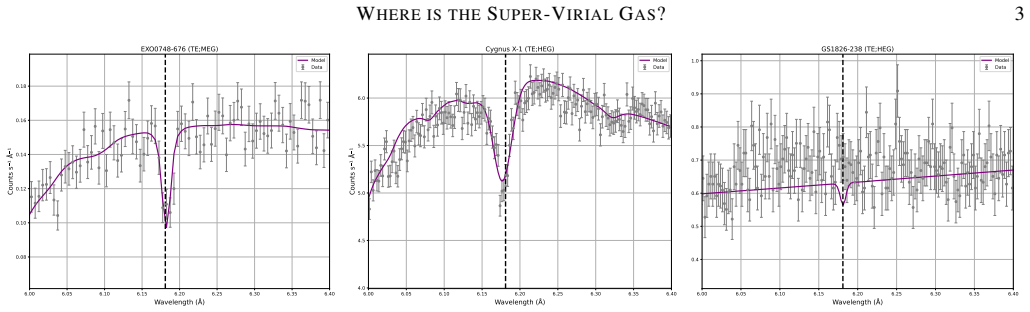
The load-bearing instrument is a survey: 27 archival Chandra ACIS-S HETG observations of Galactic X-ray binaries, stacked into 108 spectra (HEG and MEG, CC and TE modes) covering the rest wavelengths of SXVI K$\alpha$ (4.729 \AA), SiXIV K$\alpha$ (6.182 \AA), and NeX K$\alpha$ (12.134 \AA). Because XRBs are bright, the grating spectra yield equivalent-width upper limits that the authors state are 30\textendash50 times smaller than the super-virial line strengths detected toward extragalactic sightlines, making these sightlines a sensitive null test for a widespread ISM component. Three diagnostic tests separate interstellar absorption from lines intrinsic to the binaries: temporal variability of the equivalent width across observing epochs, line-width analysis contrasting thermal and non-thermal broadening, and the absence of correlation between equivalent width and distance, height above the plane, or Galactic latitude.
What would settle it
A concrete test: measure the equivalent-width upper limits for the XRB sightlines and overplot them against the super-virial line equivalent widths from the extragalactic sightlines (e.g., the stacked sample of Lara-DI et al. 2023). If the XRB limits are not actually below those detections for a substantial fraction of the sky, the null result loses its force. Conversely, detecting a narrow, non-variable SiXIV or SXVI absorption line at the extragalactic strength toward a low-latitude, low-height XRB with a well-determined distance would place the super-virial gas back inside the disk.
Extended reading notes
Core claim
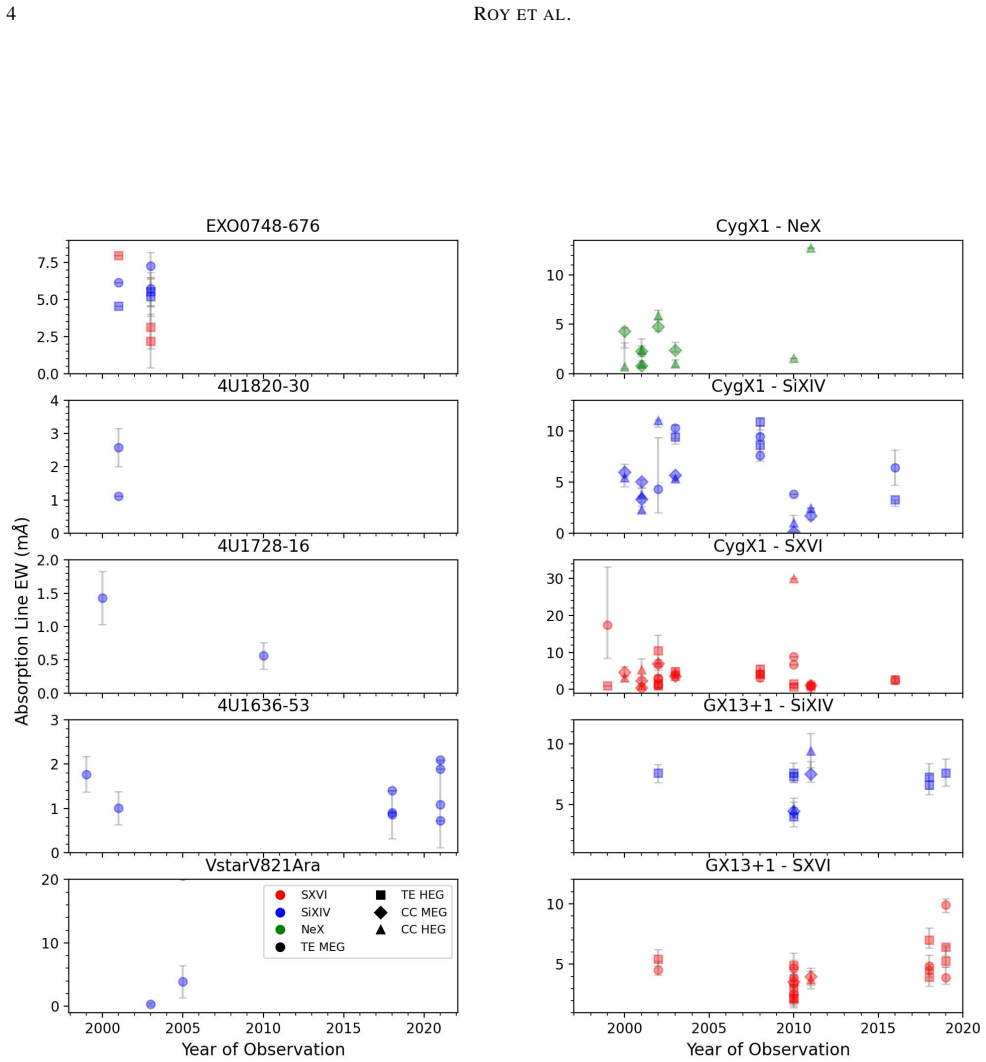
The paper's central claim is that the recently discovered super-virial temperature gas at $\log(T/\mathrm{K}) \sim 7$ in the Milky Way does not reside in the interstellar medium. Out of 27 Galactic X-ray binary sightlines observed with Chandra HETG, absorption lines of the three tell-tale ions (SXVI K$\alpha$, SiXIV K$\alpha$, NeX K$\alpha$) appear in only 7 sources; among these, most lines vary with time, two sources show broad features likely intrinsic to the binary, and equivalent widths show no correlation with distance, Galactic height, or latitude. Taking the non-detections at face value, the authors argue that the ISM contributes negligibly to the super-virial absorption seen toward extragalactic sightlines, and they conclude that the gas must be located in extraplanar regions or the extended CGM, consistent with simulations that place the hottest phase above the disk.
Load-bearing premise
The argument that the hot gas is absent from the ISM rests on the claim that the upper limits from these 27 sightlines are genuinely 30\textendash50 times more sensitive than the extragalactic detections, a comparison that is asserted in the text but not shown in a table or figure, so a reader cannot independently verify the survey was sensitive enough to catch a pervasive disk component.
Editorial extensions
If this is right
- The covering fraction of super-virial gas in the ISM must be below roughly 25 percent, the fraction of XRB sightlines with any line detection, even if every detected line were interstellar.
- The super-virial X-ray absorption seen toward extragalactic sightlines and blank-sky emission fields cannot be assigned to the disk; the gas must reside in the extraplanar region or extended CGM.
- Galaxy-formation models will need to match a hot phase that is produced and sustained above the disk, not in it, consistent with simulations that generate the phase through stellar feedback or infall compression in the extraplanar region.
- The few genuinely broad and variable lines toward Cygnus X-1 and GX 13+1 are likely outflow or wind signatures intrinsic to those binaries and should not be counted as interstellar absorption.
Reading between the lines
- A natural extension the authors do not pursue: stacking all 27 XRB spectra jointly, rather than per source, could push the ISM column-density upper limit down further and settle whether a tenuous super-virial component exists in the disk below current sensitivity.
- The same diagnostics could be applied to the virial-temperature OVII absorption: if OVII is confirmed in the ISM while the hotter ions are not, the transition between the warm-hot ISM and the super-virial CGM marks a genuine temperature divide between disk and halo.
- If the super-virial phase is confined to extraplanar and CGM regions, then measurements of its column density toward extragalactic sightlines are clean tracers of the Galaxy's mass and feedback budget, free of a disk contamination term that would otherwise have to be subtracted.
- A testable prediction follows: sightlines that pass through known extraplanar structures, such as the Fermi bubbles or the Magellanic Stream, should show enhanced super-virial absorption compared with sightlines that avoid them, which future grating observations could check.
Signed reviews
Editorial analysis
A structured set of objections, weighed in public.
Referee Report
Summary. The paper analyzes archival Chandra HETG spectra of 27 Galactic X-ray binaries (XRBs) to search for absorption lines of S XVI Kα, Si XIV Kα, and Ne X Kα, the tracers of the recently discovered super-virial temperature gas at log(T/K) ~ 7. The lines are detected in only 7 of the 27 targets, and most detected lines are time-variable or broad, suggesting an origin intrinsic to the XRBs. The authors argue that the non-detections, combined with equivalent-width upper limits they state are 30–50 times lower than the extragalactic detections, indicate that the super-virial gas is not a widespread component of the ISM and conclude that it must reside in extraplanar regions or the extended CGM.
Significance. The question of where the super-virial gas resides is important for understanding the baryon cycle and structure of the Milky Way's halo. If the null result is robust, this would be the first direct test to exclude the ISM as the dominant reservoir of this phase, redirecting searches to extraplanar or extended-CGM origins and supporting recent simulations that place the phase outside the disk. The paper leverages a large archival dataset (~5.8 Ms of exposure) and a falsifiable prediction: if the gas were distributed through the ISM, the absorption equivalent width should scale with path length through the disk. The strength of this constraint, however, depends on the reliability of the upper limits and on the stated sensitivity comparison, both of which need to be demonstrated more explicitly in the manuscript. With those revisions, the result would be a valuable constraint on the location of the super-virial gas.
major comments (4)
- [§5 (sensitivity comparison)] The central null result rests on the claim that 'narrow line EW limits are ~30–50 times lower than extragalactic sightlines,' but this comparison is asserted without a table, figure, or even a list of the extragalactic equivalent widths. A reader cannot independently verify that the survey was actually sensitive enough to detect a pervasive interstellar component. Please provide a side-by-side comparison (e.g., a table or figure showing the XRB upper limits and the extragalactic detections, referencing Lara-DI et al. 2023 Table 2), and state explicitly the expected ISM absorption as a function of path length so that the scaling test is quantified.
- [§4/Table 3] Many reported 1σ upper limits are large negative values, e.g., Ne X TE HEG: -2968 mÅ for GX 13+1, -1806 mÅ for GX 340+00, -1134 mÅ for GX 3+1, -736 mÅ for 4U 1728-34, and numerous extreme negative entries for Cygnus X-1 in Table 4. A negative equivalent width is not a physically meaningful upper limit for an absorption line and indicates that the local power-law continuum model is failing in those spectral windows. If the continuum is mis-modeled, the derived upper limits and the claimed 30–50× sensitivity are unreliable. The analysis should be repeated with a more robust continuum prescription (e.g., including absorption edges, a broken power law, or a likelihood-based upper limit), or the pathological cases should be explicitly flagged and excluded from the sensitivity comparison.
- [§6 (Conclusion)] The conclusion states 'we rule out ISM as a possible location of this gas phase,' but this is stronger than the evidence presented. The same section gives a covering fraction of '<25%' even if all detected lines are assigned to the ISM. A covering fraction of up to ~25% is not 'ruled out'; the data exclude a homogeneous, widespread ISM component but permit a clumpy or low-filling-factor ISM component. Please revise the conclusion to state that the ISM is not the dominant reservoir (or to quantify the excluded covering fraction at a stated confidence level), matching the more cautious language used in the abstract.
- [§5.1/Table 4] The variability classification is qualitative, based on visual inspection of whether 1σ error bars overlap between a small number of epochs. For example, 4U1636-53 Si XIV is labelled 'Yes' although several individual epochs are consistent with the stacked value within 1σ. Because the 'intrinsic to XRB' interpretation of the detected lines rests on this classification, a formal variability test (e.g., χ² against a constant equivalent width, or a likelihood-based variability statistic) should be reported for each detected line, or the variability claim should be softened.
minor comments (4)
- [General] Typos and grammar issues include 'becuase' in §5, 'extra-planer' in §5.4, 'supervirial got gas phase' in §5.4, and 'Vary' appearing to be a truncated column header in Table 4. Additionally, in §5.1 the bullet for EXO 0748-676 refers to 'SiXVI' when the context suggests 'SiXIV'.
- [§5.3/Figure 4] The correlation analysis uses only 7 detected sources for Si XIV and 3 for S XVI, and several sources in Table 2 lack distance measurements (e.g., Swift J1753.5-0127, XTE J1650-500, 4U 1957+11). The absence of a correlation is expected at this sample size and should be discussed accordingly. Figure 4 should also distinguish detections from upper limits with different symbols.
- [Table 3] The caption does not define 'NE' entries (e.g., XTE J1650-500 TE observations). Please clarify whether these spectra were not analyzed and why, or state the reason in the text.
- [References] The page range for Tumlinson et al. (2017) is listed as '389432'; this appears to be a typo for 389–432.
Circularity Check
No significant circularity: the XRB absorption survey is an externally falsifiable null test; same-group prior detections are used as reference measurements, not as fitted inputs.
full rationale
The paper's central claim, that super-virial gas is not a widespread ISM component, is tested with a new dataset of 27 Chandra HETG XRB sightlines that is not used to fit the prediction. The expected behavior, that absorption equivalent width should scale with path length through the disk if the gas is in the diffuse ISM and should be detectable at limits 30-50 times below extragalactic sightlines, is a physical inference rather than a quantity derived from the same measurements. The reference detections and comparison EWs come largely from prior papers by the same group, but those are independent observations used as reference values, not as fitted parameters of this paper, so the argument does not reduce to its inputs by construction. The line variability and line-width arguments are auxiliary; even if they were weak, the main null result would rest on the non-detections, subject to the caveat that the covering fraction bound is <25% rather than zero. The paper asserts rather than demonstrates the 30-50x sensitivity comparison, and some Table 3 upper limits are unphysically negative, which weakens the sensitivity argument as a support issue; similarly, the conclusion that the ISM is ruled out is stronger than the <25% covering-fraction bound strictly allows, since a clumpy or low-filling-factor ISM component is not excluded. These are correctness and evidence concerns, not circularity. No load-bearing step is defined in terms of the conclusion, and no fitted parameter is renamed as a prediction, so the circularity score is 0.
Assumptions & free parameters
assumptions (5)
- domain assumption The transitions SXVI Kalpha at 4.729 Angstrom, SiXIV Kalpha at 6.182 Angstrom, and NeX Kalpha at 12.134 Angstrom are unambiguous tracers of super-virial (log T/K ~ 7) gas.
- domain assumption If super-virial gas were a widespread ISM component, absorption equivalent width would increase with distance and height through the disk and decrease with Galactic latitude.
- domain assumption Time variability of an absorption line indicates the line is intrinsic to the X-ray binary, not from the interstellar medium.
- domain assumption Pileup and continuum distortion have minimal impact on narrow absorption lines in Chandra grating spectra, so stacked TE and CC spectra can be fitted with a simple power-law plus Gaussians.
- domain assumption The literature distances and heights in Table 2 are accurate enough for the correlation test.
Cite this review
Pith. "Pith review of Where is the Super-virial Gas? II: Insight from the Survey of Galactic Sightlines." pith.science (2026). https://pith.science/paper/PY2BBMD2
@misc{pith2026241115394,
  author       = {Pith},
  title        = {Pith review of: Where is the Super-virial Gas? II: Insight from the Survey of Galactic Sightlines},
  year         = {2026},
  howpublished = {\url{https://pith.science/paper/PY2BBMD2}},
  note         = {Machine review of arXiv:2411.15394}
}
abstract
Recent observations have revealed a super-virial temperature gas phase at log(T/K) $\sim7$ in the Milky Way, challenging existing galaxy-formation models. This hot gas phase was discovered toward extragalactic absorption sightlines and blank-sky emission fields, both at high galactic latitudes. The location of this hot component is unknown; is it in the extended circumgalactic medium (CGM) or in the interstellar medium (ISM) instead? We analyzed X-ray spectra from Chandra's High-Energy Transmission Grating (HETG) observations of 27 Galactic X-ray binaries (XRBs) to investigate whether the hot gas component is present in the ISM. We searched for absorption lines of SXVI K$\alpha$, SiXIV K$\alpha$, and NeX K$\alpha$, which are the tell-tale signatures of the hot gas and which have been detected toward extragalactic sightlines. Of the 27 targets, these lines were detected in the spectra of only 7, with two sources displaying broad line features likely intrinsic to the XRB systems. Additionally, most of the detected lines are time-variable, reinforcing their likely association with the XRBs. Our results suggest that the super-virial temperature gas is not a widespread component of the ISM but may instead be located in extraplanar regions or the extended CGM, in line with some recent simulation results.
Figures

Figures from the paper (1 more)

Forward citations
Cited by 1 Pith paper
-
Where is the Supervirial Gas? III. Insights from X-ray Shadow Observations and a revised Model for the Soft Diffuse X-ray Background
X-ray shadows show the excess N VII and super-virial hot emission in the soft diffuse X-ray background lie beyond the local clouds, in a nitrogen-rich (N/O 2.6±0.5 solar) circumgalactic medium.
Reference graph
Works this paper leans on
-
[1]
2023, , 952, 41, 10.3847/1538-4357/acd337
Bhattacharyya , J., Das , S., Gupta , A., Mathur , S., & Krongold , Y. 2023, , 952, 41, 10.3847/1538-4357/acd337
-
[2]
Bisht , M. S., Nath , B. B., & Mathur , S. 2024, , 975, 49, 10.3847/1538-4357/ad77c0
-
[3]
Bluem , J., Kaaret , P., Kuntz , K. D., et al. 2022, VizieR Online Data Catalog: HaloSat survey of the Galactic CGM (Bluem+, 2022) , VizieR On-line Data Catalog: J/ApJ/936/72. Originally published in: 2022ApJ...936...72B, 10.26093/cds/vizier.19360072
-
[4]
2024, , 963, L48, 10.3847/2041-8213/ad2a43
Das , S. 2024, , 963, L48, 10.3847/2041-8213/ad2a43
-
[5]
2021, , 918, 83, 10.3847/1538-4357/ac0e8e
Das , S., Mathur , S., Gupta , A., & Krongold , Y. 2021, , 918, 83, 10.3847/1538-4357/ac0e8e
-
[6]
2019 a , , 887, 257, 10.3847/1538-4357/ab5846
Das , S., Mathur , S., Gupta , A., Nicastro , F., & Krongold , Y. 2019 a , , 887, 257, 10.3847/1538-4357/ab5846
-
[7]
2019 b , , 882, L23, 10.3847/2041-8213/ab3b09
Das , S., Mathur , S., Nicastro , F., & Krongold , Y. 2019 b , , 882, L23, 10.3847/2041-8213/ab3b09
-
[8]
2015, , 217, 21, 10.1088/0067-0049/217/2/21
Fang , T., Buote , D., Bullock , J., & Ma , R. 2015, , 217, 21, 10.1088/0067-0049/217/2/21
Show all 30 references
-
[9]
A., & Kallman , T
Gatuzz , E., Garc \' a , J. A., & Kallman , T. R. 2021, , 504, 4460, 10.1093/mnras/stab1185
2021 doi
-
[10]
2021, , 909, 164, 10.3847/1538-4357/abdbb6
Gupta , A., Kingsbury , J., Mathur , S., et al. 2021, , 909, 164, 10.3847/1538-4357/abdbb6
2021 doi
-
[11]
2023, Nature Astronomy, 7, 799, 10.1038/s41550-023-01963-5
Gupta , A., Mathur , S., Kingsbury , J., Das , S., & Krongold , Y. 2023, Nature Astronomy, 7, 799, 10.1038/s41550-023-01963-5
2023 doi
-
[12]
2012, , 756, L8, 10.1088/2041-8205/756/1/L8
Gupta , A., Mathur , S., Krongold , Y., Nicastro , F., & Galeazzi , M. 2012, , 756, L8, 10.1088/2041-8205/756/1/L8
2012 doi
-
[13]
B., Shelton , R
Henley , D. B., Shelton , R. L., Kwak , K., Joung , M. R., & Mac Low , M.-M. 2010, , 723, 935, 10.1088/0004-637X/723/1/935
2010 doi
-
[14]
2024, , 533, 287, 10.1093/mnras/stae1845
Lara-DI , A., Krongold , Y., Mathur , S., et al. 2024, , 533, 287, 10.1093/mnras/stae1845
2024 doi
-
[15]
2023, , 946, 55, 10.3847/1538-4357/acbf40
Lara-DI , A., Mathur , S., Krongold , Y., Das , S., & Gupta , A. 2023, , 946, 55, 10.3847/1538-4357/acbf40
2023 doi
-
[16]
2022 (Springer Nature Singapore), 10.1007/978-981-16-4544-0_112-1
Mathur, S. 2022 (Springer Nature Singapore), 10.1007/978-981-16-4544-0_112-1
2022 doi
-
[17]
L., Mathur , S., Das , S., Krongold , Y., & Gupta , A
McClain , R. L., Mathur , S., Das , S., Krongold , Y., & Gupta , A. 2024, , 527, 5093, 10.1093/mnras/stad3497
2024 doi
-
[18]
2016 a , , 457, 676, 10.1093/mnras/stv2923
Nicastro , F., Senatore , F., Gupta , A., et al. 2016 a , , 457, 676, 10.1093/mnras/stv2923
2016 doi
-
[19]
2016 b , , 828, L12, 10.3847/2041-8205/828/1/L12
Nicastro , F., Senatore , F., Krongold , Y., Mathur , S., & Elvis , M. 2016 b , , 828, L12, 10.3847/2041-8205/828/1/L12
2016 doi
-
[20]
2002, , 573, 157, 10.1086/340489
Nicastro , F., Zezas , A., Drake , J., et al. 2002, , 573, 157, 10.1086/340489
2002 doi
-
[21]
2023, , 674, A195, 10.1051/0004-6361/202243992
Ponti , G., Zheng , X., Locatelli , N., et al. 2023, , 674, A195, 10.1051/0004-6361/202243992
2023 doi
-
[22]
E., Fox , A
Richter , P., Nuza , S. E., Fox , A. J., et al. 2017, , 607, A48, 10.1051/0004-6361/201630081
2017 doi
-
[23]
2021, , 645, A98, 10.1051/0004-6361/202037773
Rogantini , D., Costantini , E., Mehdipour , M., et al. 2021, , 645, A98, 10.1051/0004-6361/202037773
2021 doi
- [24]
-
[25]
2003, The Astrophysical Journal Supplement Series, 146, 165
Sembach, K., Wakker, B., Savage, B., et al. 2003, The Astrophysical Journal Supplement Series, 146, 165
2003
-
[26]
S., & Werk, J
Tumlinson, J., Peeples, M. S., & Werk, J. K. 2017, , 55, 389–432, 10.1146/annurev-astro-091916-055240
2017 doi
-
[27]
K., et al
Tumlinson , J., Thom , C., Werk , J. K., et al. 2011, Science, 334, 948, 10.1126/science.1209840
2011 doi
-
[28]
2022, , 510, 568, 10.1093/mnras/stab3413
Vijayan , A., & Li , M. 2022, , 510, 568, 10.1093/mnras/stab3413
2022 doi
-
[29]
K., Prochaska , J
Werk , J. K., Prochaska , J. X., Cantalupo , S., et al. 2016, , 833, 54, 10.3847/1538-4357/833/1/54
2016 doi
-
[30]
J., Mathur , S., & Nicastro , F
Williams , R. J., Mathur , S., & Nicastro , F. 2005, in American Astronomical Society Meeting Abstracts, Vol. 207, American Astronomical Society Meeting Abstracts, 203.04
2005
Reviewed August 12, 2026 · model on record in the stance chip above.
Discussion (0). Continue with ORCID to comment.