REVIEW 4 minor 92 references
Non-Equilibrium Spectrum Formation Affecting Solar Irradiance
T0 review · 0 major / 4 minor · reviewed 2026-08-14 · deepseek-v4-flash
Pith's one-line read This review claims that solar irradiance modeling requires non-equilibrium spectrum formation, with the ultraviolet line haze and retarded hydrogen recombination as the two controlling obstacles.
desk verdict A useful, honest overview that reframes known non-equilibrium physics as two concrete obstacles for irradiance modeling; the 1D FALC demonstrations are illustrative, not decisive, but the paper earns a serious referee. read the letter →
The pith
A machine-rendered reading of the paper's core claim, the machinery that carries it, and where it could break.
The reading
What carries the argument
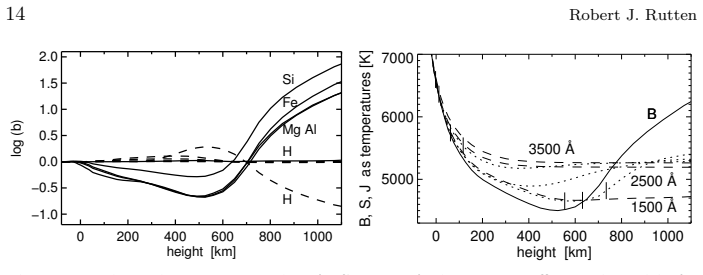
The load-bearing machinery is the split between where a spectral feature forms and what its source function is. The where is set by extinction, expressed through NLTE departure coefficients $b_l$ and $b_u$ so that line extinction scales with $b_l$ and the line source function with $b_u/b_l$; the what is set by the scattering source function $S=(1-\epsilon-\eta)J+\epsilon B+\eta S_d$, which couples the local mean intensity $J$ to the source function through the $\Lambda$ operator. From these identities follow both central demonstrations: ultraviolet continuum scattering imprints its $J/B$ and $b$-departure pattern on the metals that make the line haze, and hydrogen's delayed recombination is governed by the slow collisional settling across the 10 eV Lyman-$\alpha$ jump that controls its $n=2$ population and hence its ionization.
What would settle it
A full three-dimensional, time-dependent simulation with explicit non-equilibrium hydrogen and complete line-haze radiative transfer would settle the opacity claims: if its synthetic ultraviolet brightness-temperature histograms still lie above the calibrated observations, then the line haze is not underestimated in the way the paper argues. On the millimeter side, time-resolved maps of a cooling post-shock region would falsify the retarded-hydrogen claim if the delayed opacity enhancement beyond the instantaneous temperature is absent.
Extended reading notes
Core claim
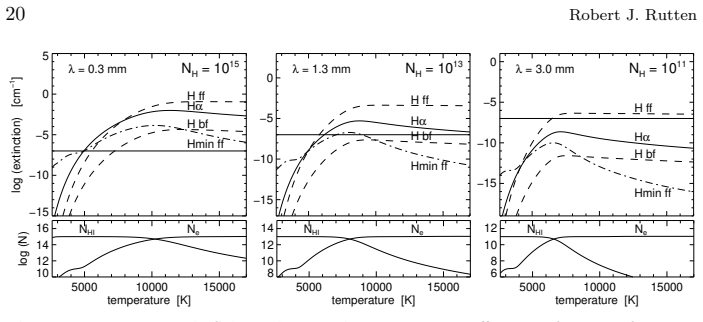
The central claim is that the ultraviolet line haze is not a minor blanketing nuisance but the controlling agent for non-equilibrium opacity departures throughout the solar spectrum. In the quiet-Sun model, the bound-free continua of iron, silicon, magnesium, and aluminum scatter ultraviolet radiation, driving minority ground-state populations out of Saha-Boltzmann equilibrium; every line of these species inherits the resulting $b_l$ extinction departure, starting already in the deep photosphere. The paper shows that assuming $S=B$ therefore overestimates ultraviolet continuum intensities and limb darkening, while even a two-level scattering treatment underestimates the depth of the line haze and leaves the mean brightness histograms above the observed ones. For long wavelengths, the paper claims hydrogen's $n=2$ population settles slowly across the large Lyman-$\alpha$ energy jump, so cooling gas retains an over-population that keeps H$\alpha$ and free-free extinction high for minutes; millimeter-wave maps of such gas therefore measure a memory of past heating rather than the instantaneous temperature.
Load-bearing premise
The demonstrations are computed in a one-dimensional, static, plane-parallel model atmosphere, and the paper assumes that the scattering and opacity conclusions carry over to the real three-dimensional, time-dependent Sun; it concedes that any treatment short of full 3D time-dependent radiative transfer is only an approximation.
Editorial extensions
If this is right
- LTE synthesis overestimates ultraviolet continuum intensities and limb darkening, so irradiance reconstructions that keep $S=B$ will misassign the ultraviolet contrast of network and plage.
- The failure of two-level scattering to match the observed haze implies that irradiance synthesis needs multi-level interlocking, or a representative model atom whose departures are applied to all lines in the atomic line list.
- At millimeter wavelengths, optically thick emission measures gas temperature, but the opacity is non-local in time because of retarded hydrogen recombination; interpreting such maps requires non-equilibrium hydrogen populations, not instantaneous Saha-Boltzmann values.
- Hydrogen over-population in cooling gas makes H$\alpha$ fibrils and millimeter continuum bright together, linking irradiance modeling to high-resolution chromospheric imaging.
- The suggested tractability recipes, a fudge element carrying representative departures and a peak-value memory for hydrogen $n=2$, give a testable route to 3D time-dependent irradiance synthesis before brute-force full NLTE becomes feasible.
Reading between the lines
- An implication the author leaves implicit: if the ultraviolet haze controls the departures of iron and other minority species, then abundance analyses of cool stars using Fe I lines may carry a systematic error unless the haze coupling is modeled along with the individual lines.
- Retarded hydrogen recombination should operate in other late-type stars with dynamic chromospheres, so millimeter observations of Sun-like stars may require non-equilibrium opacities to interpret their variability.
- A natural extension is to apply the suggested fudge-element recipe in a 3D magnetohydrodynamic simulation and compare synthetic network and plage contrasts against 1700 Å and Ca II images.
- The paper's hint that the line list may be incomplete suggests that improved atomic data, not only better radiative transfer, is a next step; high-resolution near-ultraviolet spectra could count the missing lines.
Signed reviews
Editorial analysis
A structured set of objections, weighed in public.
Referee Report
Summary. This invited review argues that moving solar-irradiance modeling of network and plage contributions from static 1D LTE models to 3D time-dependent simulation-based interpretation requires explicit treatment of non-equilibrium spectrum formation. After a compact refresher of LTE, coronal equilibrium, NLTE, and non-E concepts and of the basic radiative-transfer equations with departure coefficients, the paper presents RH calculations for the 1D FALC model: extinction at several heights, ultraviolet continuum departures, formation of two Fe I lines, and synthetic line-haze spectra compared with FTS observations. It then discusses two main obstacles: the violet/ultraviolet line haze, whose scattering nature requires NLTE evaluation, and non-equilibrium hydrogen ionization and recombination, which produce retarded n=2 and free-free opacities in cooling gas and are relevant to ALMA mm observations. The conclusion states that the ultraviolet line haze requires detailed NLTE evaluation and that long-wavelength continua require non-E hydrogen treatment; two tractability recipes are proposed.
Significance. If judged as what it is, an invited overview article rather than a new quantitative research result, the paper is a valuable and clearly organized synthesis. The radiative-transfer equations in Sections 2-4 are standard and correctly stated, and the RH/FALC demonstrations are internally consistent and benchmarked against calibrated FTS spectra. The paper is unusually explicit about its limitations: FALC is called a 'hypothetical plane-parallel star' (Section 5), and the transfer of conclusions from 1D to the real time-dependent 3D atmosphere is acknowledged as an approximation (Section 5.2). The ALMA-related prediction that cooling gas retains enhanced free-free opacity is falsifiable. The weakest point is indeed the 1D-to-3D extrapolation, but the manuscript itself flags it, and the qualitative conclusion is independently supported by prior 3D and 2D non-equilibrium simulations cited in Section 6.2 (Carlsson and Stein 2002; Leenaarts et al. 2007). In my assessment this concern does not land as a fatal or blocking objection.
minor comments (4)
- [Section 5.2] The sentence 'In the actual time-dependent 3D solar atmosphere comparable ultraviolet S-B scattering divergences occur' is an assertion rather than a demonstrated result. Because the paper elsewhere stresses that any treatment short of detailed 3D(t) radiative transfer is an approximation, I suggest either citing a relevant 3D non-LTE synthesis study at this point (Uitenbroek and Criscuoli 2011 is already cited in Section 5 and is pertinent) or explicitly marking the sentence as an expectation for future work.
- [Section 6.1, Figure 10] The residual offset between the synthesized and observed mean histograms is attributed to either line-list incompleteness or calibration uncertainty. This ambiguity should be stated more explicitly as not affecting the paper's qualitative conclusion that two-level scattering improves but does not cure the line-haze problem.
- [Section 2] The sentence 'LTE is valid throughout the Sun up to its surface' is a simplification that appears to conflict with the NLTE departures demonstrated later in Figures 7-9. Qualifying the phrase (for example, 'in the deep photosphere') would avoid an apparent internal inconsistency.
- [Footnote 3 and title page] The invitation to teach in footnote 3 and the editorial remark about the publisher on the title page are out of place in a formal journal article and should be removed or rephrased neutrally.
Circularity Check
No significant circularity: an overview with external benchmarks and acknowledged limitations.
full rationale
This paper is a review/overview rather than a derivation of new predictions from fitted parameters. Its Section 5 demonstrations are computed with the external FALC model and the RH code, and the central claim that the ultraviolet line haze requires detailed NLTE treatment is supported by comparison with external FTS/Neckel-Labs calibrated observations (Figure 10), not by fitting those observations. The non-E hydrogen retardation argument relies on external simulations (Carlsson and Stein 2002; Leenaarts et al. 2007). Self-citations such as the RTSA lecture notes and Rutten and Uitenbroek (2012) are pedagogical background or supporting side remarks, not load-bearing inputs to the central conclusion. The paper explicitly calls FALC a 'hypothetical plane-parallel star' and acknowledges that 'any treatment short of detailed 3D(t) radiative transfer is an approximation', which is an honest limitation rather than a circular step. No fitted parameter is renamed as a prediction, no uniqueness theorem is imported from the authors, and no ansatz is smuggled in via citation.
Assumptions & free parameters
assumptions (4)
- standard math Standard radiative transfer equations (Eddington-Barbier approximation, Schwarzschild/Lambda operator) apply in 1D plane-parallel form.
- domain assumption FALC is an adequate stand-in for the quiet solar atmosphere for illustrating NLTE effects.
- domain assumption The Van Regemorter estimate gives adequate collisional rates for the line-haze scattering demonstration.
- domain assumption The Kurucz (2009) line list is essentially complete for the near-UV/optical comparison.
Cite this review
Pith. "Pith review of Non-Equilibrium Spectrum Formation Affecting Solar Irradiance." pith.science (2026). https://pith.science/paper/PYJWRRDR
@misc{pith2026190804624,
  author       = {Pith},
  title        = {Pith review of: Non-Equilibrium Spectrum Formation Affecting Solar Irradiance},
  year         = {2026},
  howpublished = {\url{https://pith.science/paper/PYJWRRDR}},
  note         = {Machine review of arXiv:1908.04624}
}
read the original abstract
This is an overview of non-equilibrium aspects of the formation of solar continua and lines affecting the contributions by magnetic network and plage to spectrally resolved solar irradiance. After a brief summary of these contributions and a compact refresher of solar spectrum formation, the emphasis is on graphical exposition. Major obstacles for simulation-based irradiance studies are how to cope with NLTE scattering in the violet and ultraviolet line haze and how to cope with retarded hydrogen opacities in infrared and mm radiation.
Figures


Figures from the paper (8 more)




Reference graph
Works this paper leans on
-
[1]
: 1989 , Line blanketing without local thermodynamic equilibrium
barticle Anderson , L.S. : 1989 , Line blanketing without local thermodynamic equilibrium. II. A solar-type model in radiative equilibrium . 339 , 558 . https://doi.org/10.1086/167317 . 1989ApJ...339..558Anote https://ui.adsabs.harvard.edu/abs/1989ApJ...339..558A . barticle
doi:10.1086/167317 1989
-
[2]
barticle Asplund , M. , Grevesse , N. , Sauval , A.J. , Scott , P. : 2009 , The chemical composition of the Sun . 47 ( 1 ), 481 . https://doi.org/10.1146/annurev.astro.46.060407.145222 . 2009ARA&A..47..481Anote https://ui.adsabs.harvard.edu/abs/2009ARA&A..47..481A . barticle
arXiv 2009
-
[3]
: 1965 , Solutions of the two-level line transfer problem with complete redistribution
barticle Avrett , E.H. : 1965 , Solutions of the two-level line transfer problem with complete redistribution . SAO Special Report 174 ( 167 ), 101 . 1965SAOSR.174..101Anote https://ui.adsabs.harvard.edu/abs/1965SAOSR.174..101A . barticle
1965
-
[4]
: 1990 , Models of the solar outer photosphere
bchapter Avrett , E.H. : 1990 , Models of the solar outer photosphere . In: Stenflo , J.O. (ed.) Solar Photosphere: Structure, Convection, and Magnetic Fields , IAU Symp. 138 , 3 . 1990IAUS..138....3Anote https://ui.adsabs.harvard.edu/abs/1990IAUS..138....3A . bchapter
1990
-
[5]
barticle Avrett , E.H. , Loeser , R. : 2008 , Models of the solar chromosphere and transition region from SUMER and HRTS observations: Formation of the extreme-ultraviolet spectrum of hydrogen, carbon, and oxygen . 175 ( 1 ), 229 . https://doi.org/10.1086/523671 . 2008ApJS..175..229Anote https://ui.adsabs.harvard.edu/abs/2008ApJS..175..229A . barticle
doi:10.1086/523671 2008
-
[6]
: 1989 , How deep can one see into the Sun? 124 ( 1 ), 15
barticle Ayres , T.R. : 1989 , How deep can one see into the Sun? 124 ( 1 ), 15 . https://doi.org/10.1007/BF00146516 . 1989SoPh..124...15Anote https://ui.adsabs.harvard.edu/abs/1989SoPh..124...15A . barticle
-
[7]
: 1943 , Sur la th \'e orie du spectre continu des \'e toiles
barticle Barbier , D. : 1943 , Sur la th \'e orie du spectre continu des \'e toiles . Annales d'Astrophysique 6 , 113 . 1943AnAp....6..113Bnote https://ui.adsabs.harvard.edu/abs/1943AnAp....6..113B . barticle
1943
-
[8]
, Rouppe van der Voort , L.H.M
barticle Berger , T.E. , Rouppe van der Voort , L.H.M. , L \"o fdahl , M.G. , Carlsson , M. , Fossum , A. , Hansteen , V.H. , Marthinussen , E. , Title , A. , Scharmer , G. : 2004 , Solar magnetic elements at 0.1 arcsec resolution. General appearance and magnetic structure . 428 , 613 . https://doi.org/10.1051/0004-6361:20040436 . 2004A&A...428..613Bnote ...
Show all 92 references
-
[9]
, Rutten , R.J
barticle Bruls , J.H.M.J. , Rutten , R.J. , Shchukina , N.G. : 1992 , The formation of helioseismology lines. I. NLTE effects in alkali spectra. 265 ( 1 ), 237 . 1992A&A...265..237Bnote https://ui.adsabs.harvard.edu/abs/1992A&A...265..237B . barticle
1992
-
[10]
: 1973 , Frequency-quadrature perturbations in radiative-transfer theory
barticle Cannon , C.J. : 1973 , Frequency-quadrature perturbations in radiative-transfer theory . 185 , 621 . https://doi.org/10.1086/152442 . 1973ApJ...185..621Cnote https://ui.adsabs.harvard.edu/abs/1973ApJ...185..621C . barticle
1973 doi
-
[11]
: 1986, A computer program for solving multi-level non-LTE radiative transfer problems in moving or static atmospheres
botherref Carlsson , M. : 1986, A computer program for solving multi-level non-LTE radiative transfer problems in moving or static atmospheres. Uppsala Astron.\ Obs.\ Reports 33. 1986UppOR..33.....Cnote https://ui.adsabs.harvard.edu/abs/1986UppOR..33.....C . botherref
1986
-
[12]
, Stein , R.F
barticle Carlsson , M. , Stein , R.F. : 1995 , Does a nonmagnetic solar chromosphere exist? 440 , L29 . https://doi.org/10.1086/187753 . 1995ApJ...440L..29Cnote https://ui.adsabs.harvard.edu/abs/1995ApJ...440L..29C . barticle
1995 doi
-
[13]
, Stein , R.F
barticle Carlsson , M. , Stein , R.F. : 2002 , Dynamic hydrogen ionization . 572 ( 1 ), 626 . https://doi.org/10.1086/340293 . 2002ApJ...572..626Cnote https://ui.adsabs.harvard.edu/abs/2002ApJ...572..626C . barticle
2002 doi
-
[14]
, Stein , R.F
barticle Carlsson , M. , Stein , R.F. , Nordlund , A . , Scharmer , G.B. : 2004 , Observational manifestations of solar magnetoconvection: Center-to-limb variation . 610 ( 2 ), L137 . https://doi.org/10.1086/423305 . 2004ApJ...610L.137Cnote https://ui.adsabs.harvard.edu/abs/20...
2004 doi
-
[15]
, Hansteen , V.H
barticle Carlsson , M. , Hansteen , V.H. , Gudiksen , B.V. , Leenaarts , J. , De Pontieu , B. : 2016 , A publicly available simulation of an enhanced network region of the Sun . 585 , A4 . https://doi.org/10.1051/0004-6361/201527226 . 2016A&A...585A...4Cnote https://ui.adsabs....
2016 doi
-
[16]
: 1970 , On the physical conditions in the photospheric network: An improved model of solar faculae , 14 ( 2 ), 315
barticle Chapman , G.A. : 1970 , On the physical conditions in the photospheric network: An improved model of solar faculae , 14 ( 2 ), 315 . https://doi.org/10.1007/BF00221317 . 1970SoPh...14..315Cnote https://ui.adsabs.harvard.edu/abs/1970SoPh...14..315C . barticle
1970 doi
-
[17]
: 1926 , The Internal Constitution of the Stars , Cambridge Univ.\ Press , Cambridge
bbook Eddington , A.S. : 1926 , The Internal Constitution of the Stars , Cambridge Univ.\ Press , Cambridge . 1926ics..book.....Enote http://esoads.eso.org/abs/1926ics..book.....E . bbook
1926
-
[18]
: 1929 , The formation of absorption lines
barticle Eddington , A.S. : 1929 , The formation of absorption lines . 89 , 620 . https://doi.org/10.1093/mnras/89.7.620 . 1929MNRAS..89..620Enote https://ui.adsabs.harvard.edu/abs/1929MNRAS..89..620E . barticle
1929 doi
-
[19]
, Avrett , E.H
barticle Fontenla , J.M. , Avrett , E.H. , Loeser , R. : 1993 , Energy balance in the solar transition region. III. Helium emission in hydrostatic, constant-abundance models with diffusion . 406 , 319 . https://doi.org/10.1086/172443 . 1993ApJ...406..319Fnote https://ui.adsabs...
1993 doi
-
[20]
, Stancil , P.C
barticle Fontenla , J.M. , Stancil , P.C. , Landi , E. : 2015 , Solar spectral irradiance, solar activity, and the near-ultra-violet . 809 ( 2 ), 157 . https://doi.org/10.1088/0004-637X/809/2/157 . 2015ApJ...809..157Fnote https://ui.adsabs.harvard.edu/abs/2015ApJ...809..157F ....
2015 doi
-
[21]
, Curdt , W
barticle Fontenla , J.M. , Curdt , W. , Haberreiter , M. , Harder , J. , Tian , H. : 2009 , Semiempirical models of the solar atmosphere. III. Set of non-LTE models for far-ultraviolet/extreme-ultraviolet irradiance computation . 707 ( 1 ), 482 . https://doi.org/10.1088/0004-6...
2009 doi
-
[22]
, Stenflo , J.O
barticle Frazier , E.N. , Stenflo , J.O. : 1978 , Magnetic, velocity and brightness structure of solar faculae. 70 ( 6 ), 789 . 1978A&A....70..789Fnote https://ui.adsabs.harvard.edu/abs/1978A&A....70..789F . barticle
1978
-
[23]
, Solanki , S.K
barticle Gadun , A.S. , Solanki , S.K. , Sheminova , V.A. , Ploner , S.R.O. : 2001 , A formation mechanism of magnetic elements in regions of mixed polarity . 203 ( 1 ), 1 . https://doi.org/10.1023/A:1012729811113 . 2001SoPh..203....1Gnote https://ui.adsabs.harvard.edu/abs/200...
2001 doi
-
[24]
, Carlsson , M
barticle Golding , T.P. , Carlsson , M. , Leenaarts , J. : 2014 , Detailed and simplified nonequilibrium helium ionization in the solar atmosphere . 784 ( 1 ), 30 . https://doi.org/10.1088/0004-637X/784/1/30 . 2014ApJ...784...30Gnote https://ui.adsabs.harvard.edu/abs/2014ApJ.....
2014 doi
-
[25]
, Zwaan , C
barticle Greve , A. , Zwaan , C. : 1980 , Methods for the analysis of stellar spectra veiled by lines (III). 90 ( 3 ), 239 . 1980A&A....90..239Gnote https://ui.adsabs.harvard.edu/abs/1980A&A....90..239G . barticle
1980
-
[26]
, Sch \" u ssler , M
barticle Grossmann-Doerth , U. , Sch \" u ssler , M. , Steiner , O. : 1998 , Convective intensification of solar surface magnetic fields: results of numerical experiments . 337 , 928 . 1998A&A...337..928Gnote https://ui.adsabs.harvard.edu/abs/1998A&A...337..928G . barticle
1998
-
[27]
o lker , M. , Sch \
barticle Grossmann-Doerth , U. , Kn \" o lker , M. , Sch \" u ssler , M. , Solanki , S.K. : 1994 , The deep layers of solar magnetic elements . 285 , 648 . 1994A&A...285..648Gnote https://ui.adsabs.harvard.edu/abs/1994A&A...285..648G . barticle
1994
-
[28]
, M \" u ller , E.A
barticle Holweger , H. , M \" u ller , E.A. : 1974 , The photospheric barium spectrum: Solar abundance and collision broadening of Ba II lines by hydrogen . 39 ( 1 ), 19 . https://doi.org/10.1007/BF00154968 . 1974SoPh...39...19Hnote https://ui.adsabs.harvard.edu/abs/1974SoPh.....
1974 doi
-
[29]
: 1942, The variations in the profiles of strong Fraunhofer lines along a radius of the solar disc
botherref Houtgast , J. : 1942, The variations in the profiles of strong Fraunhofer lines along a radius of the solar disc. PhD thesis Utrecht University, 1942PhDT........12Hnote https://ui.adsabs.harvard.edu/abs/1942PhDT........12H . botherref
1942
-
[30]
: 1987 , Probabilistic interpretation of radiative transfer
barticle Huben \' y , I. : 1987 , Probabilistic interpretation of radiative transfer. I - The square root of epsilon law. II - Rybicki equation . 185 ( 1-2 ), 332 . 1987A&A...185..332Hnote https://ui.adsabs.harvard.edu/abs/1987A&A...185..332H . barticle
1987
-
[31]
, Mihalas , D
bbook Huben \' y , I. , Mihalas , D. : 2014 , Theory of Stellar Atmospheres , Princeton Univ.\ Press , Princeton . 2014tsa..book.....Hnote http://esoads.eso.org/abs/2014tsa..book.....H . bbook
2014
-
[32]
: 1973 , Transfer of radiation in spectral lines , NBS Special Publication , Washington
bbook Ivanov , V.V. : 1973 , Transfer of radiation in spectral lines , NBS Special Publication , Washington . 1973trsl.book.....Inote http://esoads.eso.org/abs/1973trsl.book.....I . bbook
1973
-
[33]
: 1968 , Spectral line formation , Blaisdell , Waltham
bbook Jefferies , J.T. : 1968 , Spectral line formation , Blaisdell , Waltham . 1968slf..book.....Jnote http://esoads.eso.org/abs/1968slf..book.....J . bbook
1968
-
[34]
u ssler , M. , V \
barticle Keller , C.U. , Sch \"u ssler , M. , V \"o gler , A. , Zakharov , V. : 2004 , On the origin of solar faculae . 607 ( 1 ), L59 . https://doi.org/10.1086/421553 . 2004ApJ...607L..59Knote https://ui.adsabs.harvard.edu/abs/2004ApJ...607L..59K . barticle
2004 doi
-
[35]
: 1952 , Basic methods in transfer problems; radiative equilibrium and neutron diffusion , Clarendon Press , Oxford
bbook Kourganoff , V. : 1952 , Basic methods in transfer problems; radiative equilibrium and neutron diffusion , Clarendon Press , Oxford . 1952bmtp.book.....Knote http://esoads.eso.org/abs/1952bmtp.book.....K . bbook
1952
-
[36]
: 1993, Atlas9 stellar atmosphere programs and 2 km/s grid
botherref Kurucz , R. : 1993, Atlas9 stellar atmosphere programs and 2 km/s grid. Kurucz CD-ROM 13, SAO, 1993KurCD..13.....Knote https://ui.adsabs.harvard.edu/abs/1993KurCD..13.....K . botherref
1993
-
[37]
: 1970, Atlas: a computer program for calculating model stellar atmospheres
botherref Kurucz , R.L. : 1970, Atlas: a computer program for calculating model stellar atmospheres. SAO Special Report 309. 1970SAOSR.309.....Knote https://ui.adsabs.harvard.edu/abs/1970SAOSR.309.....K . botherref
1970
-
[38]
: 2009 , Including all the lines
bchapter Kurucz , R.L. : 2009 , Including all the lines . In: Huben \' y , I. , Stone , J.M. , MacGregor , K. , Werner , K. (eds.) Am.\ Inst. Phys.\ Conf.\ Series 1171 , 43 . https://doi.org/10.1063/1.3250087 . 2009AIPC.1171...43Knote http://esoads.eso.org/abs/2009AIPC.1171......
2009 doi
-
[39]
, Neckel , H
barticle Labs , D. , Neckel , H. : 1972 , Remarks on the convergency of photospheric model conceptions and the solar quasi continuum . 22 ( 1 ), 64 . https://doi.org/10.1007/BF00145462 . 1972SoPh...22...64Lnote https://ui.adsabs.harvard.edu/abs/1972SoPh...22...64L . barticle
1972 doi
-
[40]
: 2018 , Tracing the evolution of radiation-MHD simulations of solar and stellar atmospheres in the Lagrangian frame
barticle Leenaarts , J. : 2018 , Tracing the evolution of radiation-MHD simulations of solar and stellar atmospheres in the Lagrangian frame . 616 , A136 . https://doi.org/10.1051/0004-6361/201833176 . 2018A&A...616A.136Lnote https://ui.adsabs.harvard.edu/abs/2018A&A...616A.13...
2018 doi
-
[41]
, Carlsson , M
bchapter Leenaarts , J. , Carlsson , M. : 2009 , Multi3d: A domain-decomposed 3D radiative transfer code . In: Lites , B. , Cheung , M. , Magara , T. , Mariska , J. , Reeves , K. (eds.) Beyond Discovery-Toward Understanding , Astron.\ Soc.\ Pacific Conf.\ Series 415 , 87 . 200...
2009
-
[42]
, Carlsson , M
barticle Leenaarts , J. , Carlsson , M. , Rouppe van der Voort , L. : 2012 , The formation of the H line in the solar chromosphere . 749 ( 2 ), 136 . https://doi.org/10.1088/0004-637X/749/2/136 . 2012ApJ...749..136Lnote https://ui.adsabs.harvard.edu/abs/2012ApJ...749..136L . barticle
2012 doi
-
[43]
, Rutten , R.J
barticle Leenaarts , J. , Rutten , R.J. , Carlsson , M. , Uitenbroek , H. : 2006 , A comparison of solar proxy-magnetometry diagnostics . 452 ( 2 ), L15 . https://doi.org/10.1051/0004-6361:20065182 . 2006A&A...452L..15Lnote https://ui.adsabs.harvard.edu/abs/2006A&A...452L..15L...
2006 doi
-
[44]
, Carlsson , M
barticle Leenaarts , J. , Carlsson , M. , Hansteen , V. , Rutten , R.J. : 2007 , Non-equilibrium hydrogen ionization in 2D simulations of the solar atmosphere . 473 ( 2 ), 625 . https://doi.org/10.1051/0004-6361:20078161 . 2007A&A...473..625Lnote https://ui.adsabs.harvard.edu/...
2007 doi
-
[45]
: 1868 , Spectroscopic observation of the Sun II
barticle Lockyer , J.N. : 1868 , Spectroscopic observation of the Sun II. Procs Royal Soc.\ London Series I 17 , 131 . 1868RSPS...17..131Lnote https://ui.adsabs.harvard.edu/abs/1868RSPS...17..131L . barticle
-
[46]
, De Pontieu , B
barticle Mart \' nez-Sykora , J. , De Pontieu , B. , Carlsson , M. , Hansteen , V.H. , N \'o brega-Siverio , D. , Gudiksen , B.V. : 2017 , Two-dimensional radiative magnetohydrodynamic simulations of partial ionization in the chromosphere. II. Dynamics and energetics of the lo...
2017 doi
-
[47]
, Cilli \'e , G.G
barticle Menzel , D.H. , Cilli \'e , G.G. : 1937 , Hydrogen emission in the chromosphere . 85 , 88 . https://doi.org/10.1086/143804 . 1937ApJ....85...88Mnote https://ui.adsabs.harvard.edu/abs/1937ApJ....85...88M . barticle
1937 doi
-
[48]
: 1970 , Stellar atmospheres , W
bbook Mihalas , D. : 1970 , Stellar atmospheres , W. H. Freeman and Co , San Francisco . 1970stat.book.....Mnote http://esoads.eso.org/abs/1970stat.book.....M . bbook
1970
-
[49]
: 1978 , Stellar atmospheres, 2nd edition , W
bbook Mihalas , D. : 1978 , Stellar atmospheres, 2nd edition , W. H. Freeman and Co , San Francisco . 1978stat.book.....Mnote http://esoads.eso.org/abs/1978stat.book.....M . bbook
1978
-
[50]
: 1921 , Radiative equilibrium in the outer layers of a star
barticle Milne , E.A. : 1921 , Radiative equilibrium in the outer layers of a star . 81 , 361 . https://doi.org/10.1093/mnras/81.5.361 . 1921MNRAS..81..361Mnote https://ui.adsabs.harvard.edu/abs/1921MNRAS..81..361M . barticle
1921 doi
-
[51]
: 1999 , Announcement
barticle Neckel , H. : 1999 , Announcement . 184 , 421 . https://doi.org/10.1023/A:1017165208013 . 1999SoPh..184..421Nnote https://ui.adsabs.harvard.edu/abs/1999SoPh..184..421N . barticle
1999 doi
-
[52]
, Labs , D
barticle Neckel , H. , Labs , D. : 1984 , The solar radiation between 3300 and 12500 A . 90 ( 2 ), 205 . https://doi.org/10.1007/BF00173953 . 1984SoPh...90..205Nnote https://ui.adsabs.harvard.edu/abs/1984SoPh...90..205N . barticle
1984 doi
-
[53]
, Moreno-Insertis , F
barticle N \'o brega-Siverio , D. , Moreno-Insertis , F. , Mart \' nez-Sykora , J. : 2018 , On the importance of the nonequilibrium ionization of Si IV and O IV and the line of sight in solar surges . 858 ( 1 ), 8 . https://doi.org/10.3847/1538-4357/aab9b9 . 2018ApJ...858....8...
2018 doi
-
[54]
, Beeck , B
barticle Norris , C.M. , Beeck , B. , Unruh , Y.C. , Solanki , S.K. , Krivova , N.A. , Yeo , K.L. : 2017 , Spectral variability of photospheric radiation due to faculae. I. The Sun and Sun-like stars . 605 , A45 . https://doi.org/10.1051/0004-6361/201629879 . 2017A&A...605A..4...
2017 doi
-
[55]
: 2018 , On Milne-Barbier-Uns \"o ld relationships
barticle Paletou , F. : 2018 , On Milne-Barbier-Uns \"o ld relationships . Open Astronomy 27 ( 1 ), 76 . https://doi.org/10.1515/astro-2018-0018 . 2018OAst...27...76Pnote https://ui.adsabs.harvard.edu/abs/2018OAst...27...76P . barticle
2018 doi
-
[56]
: 2019 , The dynamic chromosphere: pushing the boundaries of observations and models
barticle Pereira , T.M.D. : 2019 , The dynamic chromosphere: pushing the boundaries of observations and models . Advances in Space Research 63 ( 4 ), 1434 . https://doi.org/10.1016/j.asr.2018.09.030 . 2019AdSpR..63.1434Pnote https://ui.adsabs.harvard.edu/abs/2019AdSpR..63.1434...
2019 doi
-
[57]
, Uitenbroek , H
barticle Pereira , T.M.D. , Uitenbroek , H. : 2015 , RH 1.5d: a massively parallel code for multi-level radiative transfer with partial frequency redistribution and Zeeman polarisation . 574 , A3 . https://doi.org/10.1051/0004-6361/201424785 . 2015A&A...574A...3Pnote https://u...
2015 doi
-
[58]
, Leenaarts , J
barticle Rouppe van der Voort , L. , Leenaarts , J. , de Pontieu , B. , Carlsson , M. , Vissers , G. : 2009 , On-disk counterparts of type II spicules in the Ca II 854.2 nm and H lines . 705 ( 1 ), 272 . https://doi.org/10.1088/0004-637X/705/1/272 . 2009ApJ...705..272Rnote htt...
2009 doi
-
[59]
: 1988 , The NLTE formation of iron lines in the solar photosphere
bchapter Rutten , R.J. : 1988 , The NLTE formation of iron lines in the solar photosphere . In: Viotti , R. , Vittone , A. , Friedjung , M. (eds.) Physics of Formation of Fe II Lines Outside LTE , Astrophys.\ Space Sci.\ Library 138 , 185 . https://doi.org/10.1007/978-94-009-4...
1988 doi
-
[60]
: 1999 , Inter-),network structure and dynamics
bchapter Rutten , R.J. : 1999 , Inter-),network structure and dynamics . In: Schmieder , B. , Hofmann , A. , Staude , J. (eds.) Magnetic Fields and Oscillations , Astron.\ Soc.\ Pacific Conf.\ Series 184 , 181 . 1999ASPC..184..181Rnote https://ui.adsabs.harvard.edu/abs/1999ASP...
1999
-
[61]
: 2003 , Epsilon
bchapter Rutten , R.J. : 2003 , Epsilon . In: Andreasian , N. (ed.) Richard Nelson Thomas: NonEquilibrium Thermodynamical Astrophysicist , University of Colorado , Boulder , Rutten2003anote 78 . bchapter
2003
-
[62]
: 2003 , Radiative transfer in stellar atmospheres
bbook Rutten , R.J. : 2003 , Radiative transfer in stellar atmospheres . Lecture notes , Utrecht University . 2003rtsa.book.....Rnote https://ui.adsabs.harvard.edu/abs/2003rtsa.book.....R . bbook
2003
-
[63]
: 2016 , H features with hot onsets
barticle Rutten , R.J. : 2016 , H features with hot onsets. I. Ellerman bombs . 590 , A124 . https://doi.org/10.1051/0004-6361/201526489 . 2016A&A...590A.124Rnote https://ui.adsabs.harvard.edu/abs/2016A&A...590A.124R . barticle
2016 doi
-
[64]
: 2017 a, Solar ALMA predictions: tutorial
bchapter Rutten , R.J. : 2017 a, Solar ALMA predictions: tutorial . In: Vargas Dom \' nguez , S. , Kosovichev , A.G. , Antolin , P. , Harra , L. (eds.) Fine structure and dynamics of the solar atmosphere , IAU Symp. 327 , 1 . https://doi.org/10.1017/S1743921317000072 . 2017IAU...
2017 doi
-
[65]
: 2017 b, Solar H-alpha features with hot onsets
barticle Rutten , R.J. : 2017 b, Solar H-alpha features with hot onsets. III. Long fibrils in Lyman-alpha and with ALMA . 598 , A89 . https://doi.org/10.1051/0004-6361/201629238 . 2017A&A...598A..89Rnote 2017A\ barticle
2017 doi
-
[66]
, Rouppe van der Voort , L.H.M
barticle Rutten , R.J. , Rouppe van der Voort , L.H.M. : 2017 , Solar H features with hot onsets. II. A contrail fibril . 597 , A138 . https://doi.org/10.1051/0004-6361/201527560 . 2017A&A...597A.138Rnote https://ui.adsabs.harvard.edu/abs/2017A&A...597A.138R . barticle
2017 doi
-
[67]
, Uitenbroek , H
barticle Rutten , R.J. , Uitenbroek , H. : 2012 , Chromospheric backradiation in ultraviolet continua and H . 540 , A86 . https://doi.org/10.1051/0004-6361/201118525 . 2012A&A...540A..86Rnote https://ui.adsabs.harvard.edu/abs/2012A&A...540A..86R . barticle
2012 doi
-
[68]
, Hummer , D.G
barticle Rybicki , G.B. , Hummer , D.G. : 1992 , An accelerated lambda iteration method for multilevel radiative transfer. II. Overlapping transitions with full continuum. 262 , 209 . 1992A&A...262..209Rnote https://ui.adsabs.harvard.edu/abs/1992A&A...262..209R . barticle
1992
-
[69]
, Lightman , A.P
bbook Rybicki , G.B. , Lightman , A.P. : 1986 , Radiative Processes in Astrophysics , Wiley , New York , 400 . 1986rpa..book.....Rnote http://esoads.eso.org/abs/1986rpa..book.....R . bbook
1986
-
[70]
, Rouppe van der Voort , L
barticle Sekse , D.H. , Rouppe van der Voort , L. , De Pontieu , B. , Scullion , E. : 2013 , Interplay of three kinds of motion in the disk counterpart of type-II spicules: upflow, transversal, and torsional motions . 769 ( 1 ), 44 . https://doi.org/10.1088/0004-637X/769/1/44 ...
2013 doi
-
[71]
, Rutten , R.J
barticle Sheminova , V.A. , Rutten , R.J. , Rouppe van der Voort , L.H.M. : 2005 , The wings of Ca II H and K as solar fluxtube diagnostics . 437 ( 3 ), 1069 . https://doi.org/10.1051/0004-6361:20042593 . 2005A&A...437.1069Snote https://ui.adsabs.harvard.edu/abs/2005A&A...437....
2005 doi
-
[72]
, Hauschildt , P.H
barticle Short , C.I. , Hauschildt , P.H. : 2005 , A non-LTE line-blanketed model of a solar-type star . 618 ( 2 ), 926 . https://doi.org/10.1086/426128 . 2005ApJ...618..926Snote https://ui.adsabs.harvard.edu/abs/2005ApJ...618..926S . barticle
2005 doi
-
[73]
: 1993 , Small-scale solar magnetic fields - an overview
barticle Solanki , S.K. : 1993 , Small-scale solar magnetic fields - an overview . 63 ( 1-2 ), 1 . https://doi.org/10.1007/BF00749277 . 1993SSRv...63....1Snote https://ui.adsabs.harvard.edu/abs/1993SSRv...63....1S . barticle
1993 doi
-
[74]
: 1976 , Pressure equilibrium and energy balance of small photospheric fluxtubes
barticle Spruit , H.C. : 1976 , Pressure equilibrium and energy balance of small photospheric fluxtubes. 50 ( 2 ), 269 . https://doi.org/10.1007/BF00155292 . 1976SoPh...50..269Snote https://ui.adsabs.harvard.edu/abs/1976SoPh...50..269S . barticle
1976 doi
-
[75]
: 2005 , Radiative properties of magnetic elements
barticle Steiner , O. : 2005 , Radiative properties of magnetic elements. II. Center to limb variation of the appearance of photospheric faculae . 430 , 691 . https://doi.org/10.1051/0004-6361:20041286 . 2005A&A...430..691Snote https://ui.adsabs.harvard.edu/abs/2005A&A...430.....
2005 doi
-
[76]
o lker , M. , Sch \
barticle Steiner , O. , Grossmann-Doerth , U. , Kn \"o lker , M. , Sch \"u ssler , M. : 1998 , Dynamical interaction of solar magnetic elements and granular convection: results of a numerical simulation . 495 ( 1 ), 468 . https://doi.org/10.1086/305255 . 1998ApJ...495..468Snot...
1998 doi
-
[77]
: 1973 , Magnetic-field structure of the photospheric network
barticle Stenflo , J.O. : 1973 , Magnetic-field structure of the photospheric network . 32 ( 1 ), 41 . https://doi.org/10.1007/BF00152728 . 1973SoPh...32...41Snote https://ui.adsabs.harvard.edu/abs/1973SoPh...32...41S . barticle
1973 doi
-
[78]
: 1975 , A model of the supergranulation network and of active region plages
barticle Stenflo , J.O. : 1975 , A model of the supergranulation network and of active region plages . 42 ( 1 ), 79 . https://doi.org/10.1007/BF00153287 . 1975SoPh...42...79Snote https://ui.adsabs.harvard.edu/abs/1975SoPh...42...79S . barticle
1975 doi
-
[79]
, Leenaarts , J
barticle Sukhorukov , A.V. , Leenaarts , J. : 2017 , Partial redistribution in 3D non-LTE radiative transfer in solar-atmosphere models . 597 , A46 . https://doi.org/10.1051/0004-6361/201629086 . 2017A&A...597A..46Snote https://ui.adsabs.harvard.edu/abs/2017A&A...597A..46S . barticle
2017 doi
-
[80]
: 1957 , The source function in a non-equilibrium atmosphere
barticle Thomas , R.N. : 1957 , The source function in a non-equilibrium atmosphere. I. The resonance lines. 125 , 260 . https://doi.org/10.1086/146299 . 1957ApJ...125..260Tnote https://ui.adsabs.harvard.edu/abs/1957ApJ...125..260T . barticle
1957 doi
-
[81]
, Berger , T.E
barticle Title , A.M. , Berger , T.E. : 1996 , Double-gaussian models of bright points or why bright points are usually dark . 463 , 797 . https://doi.org/10.1086/177291 . 1996ApJ...463..797Tnote https://ui.adsabs.harvard.edu/abs/1996ApJ...463..797T . barticle
1996 doi
-
[82]
: 2001 , Multilevel radiative transfer with partial frequency redistribution
barticle Uitenbroek , H. : 2001 , Multilevel radiative transfer with partial frequency redistribution . 557 ( 1 ), 389 . https://doi.org/10.1086/321659 . 2001ApJ...557..389Unote https://ui.adsabs.harvard.edu/abs/2001ApJ...557..389U . barticle
2001 doi
-
[83]
, Bruls , J.H.M.J
barticle Uitenbroek , H. , Bruls , J.H.M.J. : 1992 , The formation of helioseismology lines. III. Partial redistribution effects in weak solar resonance lines. 265 ( 1 ), 268 . 1992A&A...265..268Unote https://ui.adsabs.harvard.edu/abs/1992A&A...265..268U . barticle
1992
-
[84]
, Criscuoli , S
barticle Uitenbroek , H. , Criscuoli , S. : 2011 , Why one-dimensional models fail in the diagnosis of average spectra from inhomogeneous stellar atmospheres . 736 ( 1 ), 69 . https://doi.org/10.1088/0004-637X/736/1/69 . 2011ApJ...736...69Unote https://ui.adsabs.harvard.edu/ab...
2011 doi
-
[85]
, Solanki , S.K
barticle Unruh , Y.C. , Solanki , S.K. , Fligge , M. : 1999 , The spectral dependence of facular contrast and solar irradiance variations . 345 , 635 . 1999A&A...345..635Unote https://ui.adsabs.harvard.edu/abs/1999A&A...345..635U . barticle
1999
-
[86]
, Avrett , E.H
barticle Vernazza , J.E. , Avrett , E.H. , Loeser , R. : 1981 , Structure of the solar chromosphere. III. Models of the EUV brightness components of the quiet Sun. 45 , 635 . https://doi.org/10.1086/190731 . 1981ApJS...45..635Vnote https://ui.adsabs.harvard.edu/abs/1981ApJS......
1981 doi
-
[87]
, Viticchi \`e , B
barticle Vitas , N. , Viticchi \`e , B. , Rutten , R.J. , V \"o gler , A. : 2009 , Explanation of the activity sensitivity of Mn I 5394.7 A . 499 ( 1 ), 301 . https://doi.org/10.1051/0004-6361/200810600 . 2009A&A...499..301Vnote https://ui.adsabs.harvard.edu/abs/2009A&A...499....
2009 doi
-
[88]
o gler , A. , Shelyag , S. , Sch \
barticle V \"o gler , A. , Shelyag , S. , Sch \"u ssler , M. , Cattaneo , F. , Emonet , T. , Linde , T. : 2005 , Simulations of magneto-convection in the solar photosphere. Equations, methods, and results of the MURaM code . 429 , 335 . https://doi.org/10.1051/0004-6361:200415...
2005 doi
-
[89]
, Deetjen , J.L
bchapter Werner , K. , Deetjen , J.L. , Dreizler , S. , Nagel , T. , Rauch , T. , Schuh , S.L. : 2003 , Model photospheres with accelerated lambda iteration . In: Huben \' y , I. , Mihalas , D. , Werner , K. (eds.) Stellar Atmosphere Modeling , Astron.\ Soc.\ Pacific Conf.\ Se...
2003
-
[90]
, Zwaan , C
barticle Wijbenga , J.W. , Zwaan , C. : 1972 , Empirical NLTE analyses of solar spectral lines. I: A method and some applications to earlier analyses . 23 ( 2 ), 265 . https://doi.org/10.1007/BF00148089 . 1972SoPh...23..265Wnote https://ui.adsabs.harvard.edu/abs/1972SoPh...23....
1972 doi
-
[91]
, Solanki , S.K
barticle Yelles Chaouche , L. , Solanki , S.K. , Sch \"u ssler , M. : 2009 , Comparison of the thin flux tube approximation with 3D MHD simulations . 504 ( 2 ), 595 . https://doi.org/10.1051/0004-6361/200912390 . 2009A&A...504..595Ynote https://ui.adsabs.harvard.edu/abs/2009A&...
2009 doi
-
[92]
: 1967 , Small-scale solar magnetic fields and ``invisible sunspots''
barticle Zwaan , C. : 1967 , Small-scale solar magnetic fields and ``invisible sunspots'' . 1 ( 3-4 ), 478 . https://doi.org/10.1007/BF00151372 . 1967SoPh....1..478Znote https://ui.adsabs.harvard.edu/abs/1967SoPh....1..478Z . barticle
1967 doi
Reviewed August 14, 2026 · model on record in the stance chip above.
Discussion (0). Continue with ORCID to comment.