REVIEW 2 major objections 6 minor 4 cited by
Evolution of Supernova Remnants in a Cloudy Multiphase Interstellar Medium
T0 review · 2 major / 6 minor · reviewed 2026-08-12 · deepseek-v4-flash
Pith's one-line read This paper reports that supernova remnants in a cloudy interstellar medium still expand roughly like Sedov-Taylor blasts (radius ∝ t^(2/5)), but they lose energy continuously where their shocks hit cold clouds, ending with less hot gas…
desk verdict Solid simulation paper with a credible central result, but the novel flat energy sink and its scaling are calibrated rather than converged; the qualitative conclusion that mass-loading-only 1D models are incomplete is robust. read the letter →
The pith
A machine-rendered reading of the paper's core claim, the machinery that carries it, and where it could break.
The reading
What carries the argument
The load-bearing machinery is a set of direct 3D hydrodynamic simulations with radiative cooling and saturating thermal conduction, run at up to Δx = 1/64 pc so that shock-cloud interactions for most clouds are resolved. The key diagnostic is the direct measurement of the mass and energy source/sink terms in the angle-averaged evolution equations: a mass loading rate and an energy sink rate whose time scalings ($t^{{-1}}$ and $t^{{-11/5}}$, respectively) match the conditions for a self-similar solution with impurity terms. These measured rates are then used to construct a minimal 1D spherical model with both a mass source and an energy sink.
What would settle it
Run the same cloudy-medium SNR at Δx = 1/128 pc and directly measure the angle-averaged energy sink ė(r). If the flat, ≈ -0.2 ė_S profile changes by more than the ~20% spread already seen between 1/8 pc and 1/64 pc runs, or if its time scaling departs from $t^{{-11/5}}$, then the claimed energy sink and the calibrated 1D model constants are numerical artifacts rather than converged physics.
Extended reading notes
Core claim
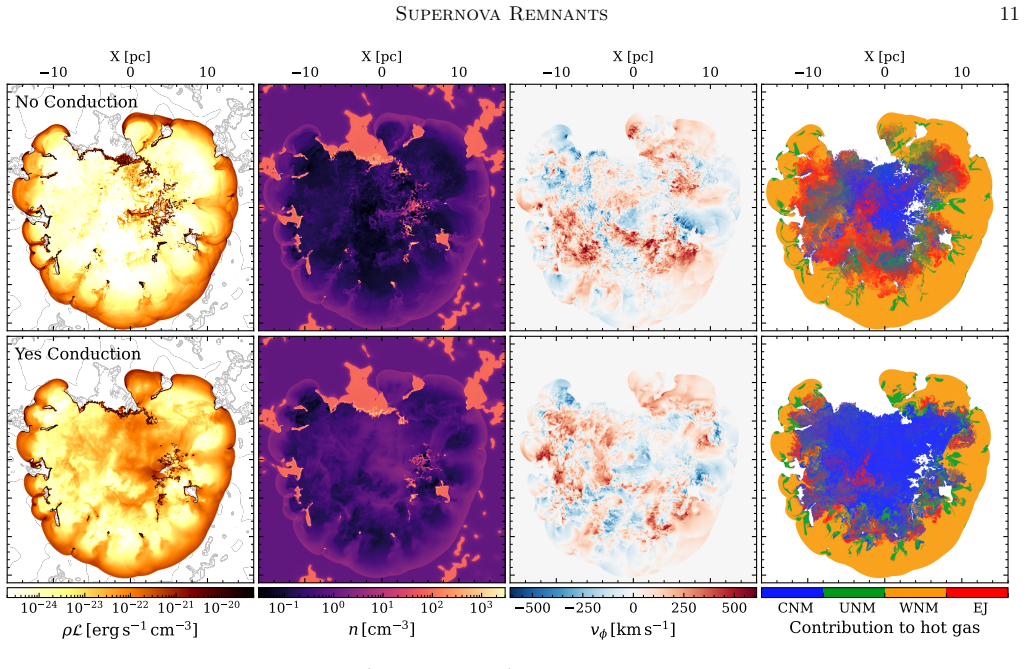
On the paper's own terms, the discovery is that the energetics of a supernova remnant in a cloudy medium are controlled by radiative cooling in shock-cloud interfaces, not just by mass loading. Direct measurements from the simulations show a mass loading rate ṗ ≈ 0.5 ṗ_S that scales with the Sedov reference rate (and hence as $t^{{-1}}$), and a spatially flat energy loss rate ė ≈ -0.2 ė_S scaling as $t^{{-11/5}}$, where ṗ_S and ė_S are the standard reference rates for a uniform medium. This energy sink persists throughout the nominal Sedov-Taylor stage, so the hot gas mass, thermal energy, and terminal momentum are all reduced compared with uniform-medium predictions even though the expansion law stays close to r ∝ $t^{{2/5}}$. Thermal conduction is a secondary effect: it smooths the morphology and raises the hot-gas density by a factor of 3-5, but does not change the global dynamics.
Load-bearing premise
The central assumption is that unresolved structure at the cold-cloud/hot-gas interface—cooling lengths of order $10^{{-5}}$ pc and the associated Field length—does not change the integrated mass and energy exchange rates, so the measured flat energy sink is real physics and not a resolution artifact.
Editorial extensions
If this is right
- Radius-based estimates of SNR age and energy using the mean ambient density remain approximately valid, since the expansion stays near r ∝ t^{2/5}.
- Mass, thermal energy, and momentum at shell formation are reduced by roughly factors of 2, 2-3, and 1.1-1.25 relative to uniform mean-density expectations, and the pressure-driven snowplow stage essentially disappears.
- Thermal conduction mainly changes observable morphology (denser, smoother hot gas and enhanced central X-ray emission) without altering the global momentum budget.
- One-dimensional impurity models need both a mass source and an energy sink, with rates ≈0.5 ṗ_S and ≈-0.2 ė_S, to describe the hot gas structure.
- The suppression of the late momentum boost implies that the momentum delivered to the interstellar medium may be lower than classical uniform-medium predictions.
Reading between the lines
- If the t^{-11/5} flat energy sink is a robust feature of turbulent mixing layers, galaxy-scale simulations that do not resolve cloud interfaces are likely missing a distributed cooling channel; a subgrid prescription assigning a fixed ~20% of the Sedov energy flux to interface cooling would encode this cheaply.
- The measured mass-loading time dependence (t^{-1}) matches the earlier evaporation-based self-similar ansatz, suggesting that framework can be rehabilitated simply by adding the measured energy sink rather than by abandoning impurity models.
- The suppression of the momentum boost implies feedback implementations that tie star-formation regulation to SNR momentum may need to lower the momentum per supernova in clumpy, metal-rich environments, while mixed-morphology remnants should appear brighter and denser toward the center.
- A testable extension is to vary the cloud volume filling factor or metallicity (cooling strength) and check whether the coefficients 0.5 and -0.2 change systematically, which would reveal whether the energy sink is set by interface surface area or by the cooling curve.
Signed reviews
Editorial analysis
A structured set of objections, weighed in public.
Referee Report
Summary. Guo, Kim, and Stone present 3D AthenaK simulations of a single supernova remnant expanding into a two-phase, thermally unstable cloudy medium (mean density 10 cm^-3), with radiative cooling and saturated isotropic thermal conduction, at grid resolutions up to 1/64 pc, and compare with a uniform-medium run and analytic Sedov-Taylor theory. The central claim is that in the cloudy medium the remnant still expands roughly as r ∝ t^(2/5) but sweeps up more mass and continuously loses energy at shock-cloud interfaces, yielding less hot gas mass, thermal energy, and radial momentum by the WNM shell-formation time than in a uniform medium of the same mean density. The authors measure a hot-gas mass-loading rate ~0.5 dM_S/dt and a spatially flat energy sink ~−0.2 de_S/dt, and use these measured rates to construct a minimal 1D spherical model with mass source and energy sink terms that they compare with the ST, White-Long, and Pittard solutions.
Significance. If the quantitative sink measurement is correct, this is an important and timely result: it identifies a physical process omitted from standard mass-loading treatments of SNR evolution and offers a simple parameterization for 1D models. The paper's strengths are the uniform-medium control, the comparison to the analytic ST solution, the multiple initial-condition seeds, the passive-scalar phase diagnostics, and the honest discussion of resolution limitations. The qualitative conclusion that interface cooling is energetically important is well supported. However, the specific claims of a flat cooling profile and the fitted constants A=0.5, C=−0.2 are not yet on secure footing because the cooling and Field lengths at the cloud interfaces are unresolved by two orders of magnitude, and the 1D model is calibrated to the very simulations it is then used to describe. These issues make the quantitative part of the paper provisional but do not invalidate the main qualitative message.
major comments (2)
- [§4.3, Figs. 8–9] The central quantitative claim, that the interface energy sink is spatially flat at d(e)/dt ≈ −0.2 d(e_S)/dt and follows t^(−11/5), is not established by the resolution study as presented. The manuscript states in §4.3 that the cooling length and Field length at the cloud interface are l_cool ≈ 7×10^(−5) pc and l_F ≈ 3×10^(−5) pc, while the finest cells are Δx = 1/64 pc, so these scales are unresolved by roughly two orders of magnitude. The same section explicitly disclaims formal numerical convergence, and Figs. 8 and 9 show ~20% changes in hot-gas mass per resolution doubling and systematically higher density, pressure, and cooling rates in the conduction runs at higher resolution. Since the flat cooling profile is the direct input to the fitted constants in Eqs. (30)–(31), a resolution-dependent surface cooling rate would change the inferred sink shape and normalization. I ask for a quantitative resolution study of the radial cooling profile itself (not only the global mass and energy), and for a test of whether the Fielding et al. (2020) / Tan et al. (2021) convergence argument for sustained mixing layers applies to the transient, shock-dominated interaction studied here. The qualitative conclusion that cooling is important is likely to survive, but the specific shape and amplitude of the sink are not yet secure.
- [§5, Eqs. (30)–(31)] The 1D model is explicitly calibrated to the simulations: the constants A=0.5 and C=−0.2, the radial shapes k=φ=1, and the activation times for the source and sink terms are all chosen to match the measured mass-loading and cooling rates in Fig. 12. As a result, the statement that this model “better describes the structure of the simulated SNR” is a consistency check rather than an independent validation. To make the model scientifically load-bearing, the authors should demonstrate at least one out-of-sample prediction—for example, using the same A and C for the different heating-rate or larger-scale perturbation runs (T...-h10, T...-w16) and comparing the predicted radial structure with the simulations. If that is not possible, the calibrated and illustrative nature of the model should be stated more prominently in the abstract and conclusions.
minor comments (6)
- [§4.4] In the sentence reporting the seed-to-seed scatter, “~ %30 in energy” appears to be a typo for “~30% in energy”; please fix.
- [Fig. 8 caption] The caption contains the fragment “The is a change by a factor of ~20% when doubling the resolution”; this should read “There is a change...”.
- [Fig. 13 legend] The legend entry “Yed cond” should read “Yes cond”.
- [Eq. (29)] The notation Ω_i in Eq. (29) is not defined; please specify that it is the solid angle of the spherical shell used for the angle average and how the finite-difference time derivative is computed.
- [§3.1 and Table 2] The bullet list in §3.1 uses “T able 1” with a line break; also, the “Thermal Cond.” column in Table 2 could be labeled more clearly, and the notation “T...-2048” used in §4.3 and captions should be defined once (it appears to mean both the TN and TY series).
- [§5, after Eq. (30)] The phrase “we suggest the constants A = 0.5 and C = −0.2” understates the fact that these values are fitted to the simulations; “we adopt” or “we calibrate” would be more accurate.
Circularity Check
Main simulation findings are independently anchored, but the illustrative 1D model reduces to a fit of measured source terms and is labeled a 'prediction'.
-
fitted input called prediction
[Section 5, Eqs. (30)-(31) and Fig. 13]
"Motivated by the mass loading rate and cooling rate measured in Figure 12, we construct a time-dependent model in which mass loading and energy loss are considered, i.e., ˙ρ(r,t)=A˙ρS k(r/rS), and ˙e(r,t)=C˙eS φ(r/rS), where k and φ are functions of order unity and we suggest the constants A=0.5 and C=−0.2. ... In Figure 13, we compare the simulation with the prediction of our time-dependent model at 10 kyr."
The source amplitudes A=0.5 and C=−0.2 are read directly from the same simulation's measured histories and radial profiles (Figure 12: ˙M∼0.5˙MS, ˙E∼−0.2˙ES, spatially flat cooling and mass-loading profiles). The 1D model solving Eqs. (26)-(28) with these fitted source terms is then presented as a 'prediction' in Figure 13. The agreement is a consistency check of the parametrization, not an independent test: the source terms are by construction equal to the measured rates, so the model output is statistically forced to resemble the simulation. The paper is transparent that the terms 'are directly calibrated to the simulation' and describes the model as 'as an illustration,' which limits the severity, but the word 'prediction' overstates the evidential value of the comparison.
full rationale
The central simulation results are not circular: the claims of Sedov-Taylor-like expansion (r∝t^2/5), increased swept-up mass, reduced hot-gas mass, thermal energy, and terminal momentum are benchmarked against a uniform-medium run and the analytic ST solution, both of which are external anchors. The measured importance of an interface energy sink is a simulation diagnostic, not an input. The circular element is confined to Section 5's illustrative 1D model: its source terms use amplitudes and spatial shapes measured from the same simulations, and the comparison labeled 'prediction' in Figure 13 therefore cannot independently confirm the model. The t^-11/5 scaling is inherited from the ST self-similar assumption in Appendix B once the normalized cooling rate is constant, so it is a dimensional consequence rather than a separate circular step. The resolution-convergence discussion cites Fielding et al. (2020) and Tan et al. (2021), which are external, and Lancaster et al. (2024) has an author overlap but is not load-bearing because the paper presents its own resolution dependence and explicitly disclaims formal convergence. These factors support a moderate score: partial circularity in the fitted 1D model, with the paper's principal physical claims remaining independent.
Assumptions & free parameters
free parameters (3)
- A (mass loading coefficient) =
0.5
- C (energy sink coefficient) =
-0.2
- Source/sink activation times =
t ≈ 0.3 kyr and t ≈ 3 kyr
assumptions (6)
- domain assumption The adopted cooling function and constant heating rate represent the relevant microphysics of the ISM.
- domain assumption The gas is fully ionized with constant mean molecular weight mu = 0.618.
- domain assumption Isotropic Spitzer conductivity with flux saturation is a maximal but adequate model for thermal conduction.
- domain assumption The thermally unstable pre-simulation initial conditions are representative of the solar-neighborhood cloudy ISM.
- domain assumption Unresolved cooling and Field lengths do not affect the integrated interface cooling and mass exchange.
- domain assumption Magnetic fields, nonequilibrium ionization, and cosmic rays are negligible for the conclusions.
Cite this review
Pith. "Pith review of Evolution of Supernova Remnants in a Cloudy Multiphase Interstellar Medium." pith.science (2026). https://pith.science/paper/PZE24C4F
@misc{pith2026241112809,
  author       = {Pith},
  title        = {Pith review of: Evolution of Supernova Remnants in a Cloudy Multiphase Interstellar Medium},
  year         = {2026},
  howpublished = {\url{https://pith.science/paper/PZE24C4F}},
  note         = {Machine review of arXiv:2411.12809}
}
abstract
We investigate the evolution of supernova remnants (SNRs) in a two-phase cloudy medium by performing a series of high-resolution (up to $\Delta x\approx0.01\,\mathrm{pc}$), 3D hydrodynamical simulations including radiative cooling and thermal conduction. We aim to reach a resolution that directly captures the shock-cloud interactions for the majority of the clouds initialized by the saturation of thermal instability. In comparison to the SNR in a uniform medium with the volume filling warm medium, the SNR expands similarly (following $\propto t^{2/5}$) but sweeps up more mass as the cold clouds contribute before shocks in the warm medium become radiative. However, the SNR in a cloudy medium continuously loses energy after shocks toward the cold clouds cool, resulting in less hot gas mass, thermal energy, and terminal momentum. Thermal conduction has little effect on the dynamics of the SNR but smooths the morphology and modifies the internal structure by increasing the density of hot gas by a factor of $\sim 3-5$. The simulation results are not fully consistent with many previous 1D models describing the SNR in a cloudy medium including a mass loading term. By direct measurement in the simulations, we find that, apart from the mass source, the energy sink is also important with a spatially flat cooling rate $\dot{e}\propto t^{-11/5}$. As an illustration, we show an example 1D model including both mass source and energy sink terms (in addition to the radiative cooling in the volume filling component) that better describes the structure of the simulated SNR.
Figures


Figures from the paper (11 more)



Forward citations
Cited by 4 Pith papers
-
Nonthermal Signatures of Radiative Supernova Remnants II: The Impact of Cosmic Rays and Magnetic Fields
Cosmic ray and magnetic pressure in radiative supernova remnants disrupts dense shell formation and suppresses the predicted nonthermal brightening, explaining the lack of observed complete shells.
-
FRANZ: Framework for analytical one-zone blastwave dynamics
A local thin-shell blastwave framework recovers classical SNR limits and shows galactic shear, gravity, and filaments deform remnants and can systematically overestimate ages in structured media.
-
Protostellar disks in their natural habitat -- the formation of protostars and their accretion disks in the turbulent and magnetized interstellar medium
Simulations from a supernova-driven turbulent ISM show ideal MHD prevents disks larger than 10 au, while ambipolar diffusion permits large disks in two of six protostellar cores.
-
SDSS-V LVM: Collisionless Shocks in the Supernova Remnant RCW86
The first IFU observations of RCW86's southwestern Balmer-dominated shock map shock velocities of 500-1500 km/s and show electron-ion equilibration decreasing with shock speed, plus a new intermediate H-alpha component.
Reference graph
Works this paper leans on
-
[1]
Abruzzo, M. W., Bryan, G. L., & Fielding, D. B. 2022, ApJ, 925, 199, doi: 10.3847/1538-4357/ac3c48
-
[2]
2016, MNRAS, 462, 4157, doi: 10.1093/mnras/stw1930 Banda-Barrag´ an, W
Armillotta, L., Fraternali, F., & Marinacci, F. 2016, MNRAS, 462, 4157, doi: 10.1093/mnras/stw1930 Banda-Barrag´ an, W. E., Br¨ uggen, M., Federrath, C., et al. 2020, MNRAS, 499, 2173, doi: 10.1093/mnras/staa2904
-
[3]
Bedogni, R., & Woodward, P. R. 1990, A&A, 231, 481
work page 1990
-
[4]
Cioffi, D. F., McKee, C. F., & Bertschinger, E. 1988, ApJ, 334, 252, doi: 10.1086/166834
doi:10.1086/166834 1988
-
[5]
Cowie, L. L., & McKee, C. F. 1977, ApJ, 211, 135, doi: 10.1086/154911
doi:10.1086/154911 1977
-
[6]
Cowie, L. L., McKee, C. F., & Ostriker, J. P. 1981, ApJ, 247, 908, doi: 10.1086/159100
-
[7]
Cox, D. P. 1972, ApJ, 178, 159, doi: 10.1086/151775 —. 2005, ARA&A, 43, 337, doi: 10.1146/annurev.astro.43.072103.150615
arXiv 1972
-
[8]
Cox, D. P., & Smith, B. W. 1974, ApJL, 189, L105, doi: 10.1086/181476
doi:10.1086/181476 1974
Show all 64 references
- [9]
-
[10]
Draine, B. T. 2011, Physics of the Interstellar and Intergalactic Medium
2011
-
[11]
E., Arthur, S
Dyson, J. E., Arthur, S. J., & Hartquist, T. W. 2002, A&A, 390, 1063, doi: 10.1051/0004-6361:20020731
2002 doi
-
[12]
Weisz, D. R. 2019, MNRAS, 490, 1961, doi: 10.1093/mnras/stz2773
2019 doi
-
[13]
Field, G. B. 1965, ApJ, 142, 531, doi: 10.1086/148317
1965 doi
-
[14]
B., Goldsmith, D
Field, G. B., Goldsmith, D. W., & Habing, H. J. 1969, ApJL, 155, L149, doi: 10.1086/180324
1969 doi
-
[15]
B., & Bryan, G
Fielding, D. B., & Bryan, G. L. 2022, ApJ, 924, 82, doi: 10.3847/1538-4357/ac2f41
2022 doi
-
[16]
B., Ostriker, E
Fielding, D. B., Ostriker, E. C., Bryan, G. L., & Jermyn, A. S. 2020, ApJL, 894, L24, doi: 10.3847/2041-8213/ab8d2c
2020 doi
-
[17]
2013, ApJ, 765, 49, doi: 10.1088/0004-637X/765/1/49
Gazol, A., & Kim, J. 2013, ApJ, 765, 49, doi: 10.1088/0004-637X/765/1/49
2013 doi
-
[18]
Goldsmith, K. J. A., & Pittard, J. M. 2017, MNRAS, 470, 2427, doi: 10.1093/mnras/stx1431
2017 doi
-
[19]
Gregori, G., Miniati, F., Ryu, D., & Jones, T. W. 1999, ApJL, 527, L113, doi: 10.1086/312402
1999 doi
-
[20]
Gronke, M., & Oh, S. P. 2018, MNRAS, 480, L111, doi: 10.1093/mnrasl/sly131
2018 doi
-
[21]
P., Ji, S., & Norman, C
Gronke, M., Oh, S. P., Ji, S., & Norman, C. 2022, MNRAS, 511, 859, doi: 10.1093/mnras/stab3351
2022 doi
- [22]
-
[23]
2015, A&A, 576, A95, doi: 10.1051/0004-6361/201424556
Iffrig, O., & Hennebelle, P. 2015, A&A, 576, A95, doi: 10.1051/0004-6361/201424556
2015 doi
-
[24]
Kim, C.-G., Kim, J.-G., Gong, M., & Ostriker, E. C. 2023, ApJ, 946, 3, doi: 10.3847/1538-4357/acbd3a
2023 doi
-
[25]
Kim, C.-G., & Ostriker, E. C. 2015, ApJ, 802, 99, doi: 10.1088/0004-637X/802/2/99 —. 2017, ApJ, 846, 133, doi: 10.3847/1538-4357/aa8599
2015 doi
-
[26]
C., & Raileanu, R
Kim, C.-G., Ostriker, E. C., & Raileanu, R. 2017, ApJ, 834, 25, doi: 10.3847/1538-4357/834/1/25 24 Guo et al
2017 doi
-
[27]
C., Somerville, R
Kim, C.-G., Ostriker, E. C., Somerville, R. S., et al. 2020, ApJ, 900, 61, doi: 10.3847/1538-4357/aba962
2020 doi
-
[28]
I., McKee, C
Klein, R. I., McKee, C. F., & Colella, P. 1994, ApJ, 420, 213, doi: 10.1086/173554
1994 doi
-
[29]
2002, ApJL, 564, L97, doi: 10.1086/338978
Koyama, H., & Inutsuka, S.-i. 2002, ApJL, 564, L97, doi: 10.1086/338978
2002 doi
-
[30]
Bryan, G. L. 2024, ApJ, 970, 18, doi: 10.3847/1538-4357/ad47f6
2024 doi
-
[31]
C., Kim, J.-G., & Kim, C.-G
Lancaster, L., Ostriker, E. C., Kim, J.-G., & Kim, C.-G. 2021a, ApJ, 914, 89, doi: 10.3847/1538-4357/abf8ab —. 2021b, ApJ, 914, 90, doi: 10.3847/1538-4357/abf8ac
-
[32]
N., & Stone, J
Lemaster, M. N., & Stone, J. M. 2009, ApJ, 691, 1092, doi: 10.1088/0004-637X/691/2/1092
2009 doi
-
[33]
P., Cen, R., Bryan, G
Li, M., Ostriker, J. P., Cen, R., Bryan, G. L., & Naab, T. 2015, ApJ, 814, 4, doi: 10.1088/0004-637X/814/1/4
2015 doi
-
[34]
F., Squire, J., & Hummels, C
Li, Z., Hopkins, P. F., Squire, J., & Hummels, C. 2020, MNRAS, 492, 1841, doi: 10.1093/mnras/stz3567 Mac Low, M.-M., McKee, C. F., Klein, R. I., Stone, J. M., & Norman, M. L. 1994, ApJ, 433, 757, doi: 10.1086/174685
2020 doi
-
[35]
2015, MNRAS, 450, 504, doi: 10.1093/mnras/stv562
Martizzi, D., Faucher-Gigu` ere, C.-A., & Quataert, E. 2015, MNRAS, 450, 504, doi: 10.1093/mnras/stv562
2015 doi
- [36]
-
[37]
2008, ApJ, 678, 274, doi: 10.1086/529420
Orlando, S., Bocchino, F., Reale, F., Peres, G., & Pagano, P. 2008, ApJ, 678, 274, doi: 10.1086/529420
2008 doi
-
[38]
2005, A&A, 444, 505, doi: 10.1051/0004-6361:20052896
Orlando, S., Peres, G., Reale, F., et al. 2005, A&A, 444, 505, doi: 10.1051/0004-6361:20052896
2005 doi
-
[39]
C., Stone, J
Ostriker, E. C., Stone, J. M., & Gammie, C. F. 2001, ApJ, 546, 980, doi: 10.1086/318290
2001 doi
-
[40]
P., & McKee, C
Ostriker, J. P., & McKee, C. F. 1988, Reviews of Modern Physics, 60, 1, doi: 10.1103/RevModPhys.60.1
1988 doi
-
[41]
Parker, E. N. 1953, ApJ, 117, 431, doi: 10.1086/145707
1953 doi
-
[42]
Pittard, J. M. 2019, MNRAS, 488, 3376, doi: 10.1093/mnras/stz1885
2019 doi
-
[43]
M., Arthur, S
Pittard, J. M., Arthur, S. J., Dyson, J. E., et al. 2003, A&A, 401, 1027, doi: 10.1051/0004-6361:20030157
2003 doi
-
[44]
M., & Parkin, E
Pittard, J. M., & Parkin, E. R. 2016, MNRAS, 457, 4470, doi: 10.1093/mnras/stw025
2016 doi
-
[45]
2021, MNRAS, 504, 1039, doi: 10.1093/mnras/stab900
Rathjen, T.-E., Naab, T., Girichidis, P., et al. 2021, MNRAS, 504, 1039, doi: 10.1093/mnras/stab900
2021 doi
-
[46]
M., & Hester, J
Rho, J., Petre, R., Schlegel, E. M., & Hester, J. J. 1994, ApJ, 430, 757, doi: 10.1086/174446
1994 doi
-
[47]
E., & Robertson, B
Schneider, E. E., & Robertson, B. E. 2018, ApJ, 860, 135, doi: 10.3847/1538-4357/aac329
2018 doi
-
[48]
2009, A&A, 508, 751, doi: 10.1051/0004-6361/200912495
Vink, J. 2009, A&A, 508, 751, doi: 10.1051/0004-6361/200912495
2009 doi
-
[49]
Sedov, L. I. 1959, Similarity and Dimensional Methods in Mechanics
1959
-
[50]
M., & Snyder, G
Shin, M.-S., Stone, J. M., & Snyder, G. F. 2008, ApJ, 680, 336, doi: 10.1086/587775
2008 doi
-
[51]
D., Smith, R
Slavin, J. D., Smith, R. K., Foster, A., et al. 2017, ApJ, 846, 77, doi: 10.3847/1538-4357/aa8552
2017 doi
-
[52]
2020, MNRAS, 499, 4261, doi: 10.1093/mnras/staa3177
Sparre, M., Pfrommer, C., & Ehlert, K. 2020, MNRAS, 499, 4261, doi: 10.1093/mnras/staa3177
2020 doi
-
[53]
1962, Physics of Fully Ionized Gases
Spitzer, L. 1962, Physics of Fully Ionized Gases
1962
-
[54]
M., Tomida, K., White, C
Stone, J. M., Tomida, K., White, C. J., & Felker, K. G. 2020, ApJS, 249, 4, doi: 10.3847/1538-4365/ab929b
2020 doi
- [55]
-
[56]
Tan, B., & Fielding, D. B. 2024, MNRAS, 527, 9683, doi: 10.1093/mnras/stad3793
2024 doi
-
[57]
P., & Gronke, M
Tan, B., Oh, S. P., & Gronke, M. 2021, MNRAS, 502, 3179, doi: 10.1093/mnras/stab053
2021 doi
-
[58]
1950, Proceedings of the Royal Society of London Series A, 201, 159, doi: 10.1098/rspa.1950.0049
Taylor, G. 1950, Proceedings of the Royal Society of London Series A, 201, 159, doi: 10.1098/rspa.1950.0049
1950
-
[59]
2012, A&A Rv, 20, 49, doi: 10.1007/s00159-011-0049-1
Vink, J. 2012, A&A Rv, 20, 49, doi: 10.1007/s00159-011-0049-1
2012 doi
-
[60]
2015, MNRAS, 451, 2757, doi: 10.1093/mnras/stv1155
Walch, S., & Naab, T. 2015, MNRAS, 451, 2757, doi: 10.1093/mnras/stv1155
2015 doi
- [61]
-
[62]
G., Hollenbach, D., McKee, C
Wolfire, M. G., Hollenbach, D., McKee, C. F., Tielens, A. G. G. M., & Bakes, E. L. O. 1995, ApJ, 443, 152, doi: 10.1086/175510
1995 doi
-
[63]
1972, ARA&A, 10, 129, doi: 10.1146/annurev.aa.10.090172.001021
Woltjer, L. 1972, ARA&A, 10, 129, doi: 10.1146/annurev.aa.10.090172.001021
1972
-
[64]
Zhang, D., & Chevalier, R. A. 2019, MNRAS, 482, 1602, doi: 10.1093/mnras/sty2769
2019 doi
Reviewed August 12, 2026 · model on record in the stance chip above.
Discussion (0). Continue with ORCID to comment.