REVIEW 2 major objections 6 minor 1 cited by
Neutron-capture elements in dwarf galaxies I: Chemical clocks & the short timescale of the r-process
T0 review · 2 major / 6 minor · reviewed 2026-08-14 · deepseek-v4-flash
Pith's one-line read This paper claims that the rapid neutron-capture process, the source of about half of the heavy elements, acts on the same short timescale as massive-star supernovae, and that neutron star mergers are therefore unlikely to be its dominant…
desk verdict A substantial new dataset with a clean, potentially important claim — flat [Eu/Mg] — that deserves refereeing, provided the unmodeled Eu detection bias is addressed. read the letter →
The pith
A machine-rendered reading of the paper's core claim, the machinery that carries it, and where it could break.
The reading
What carries the argument
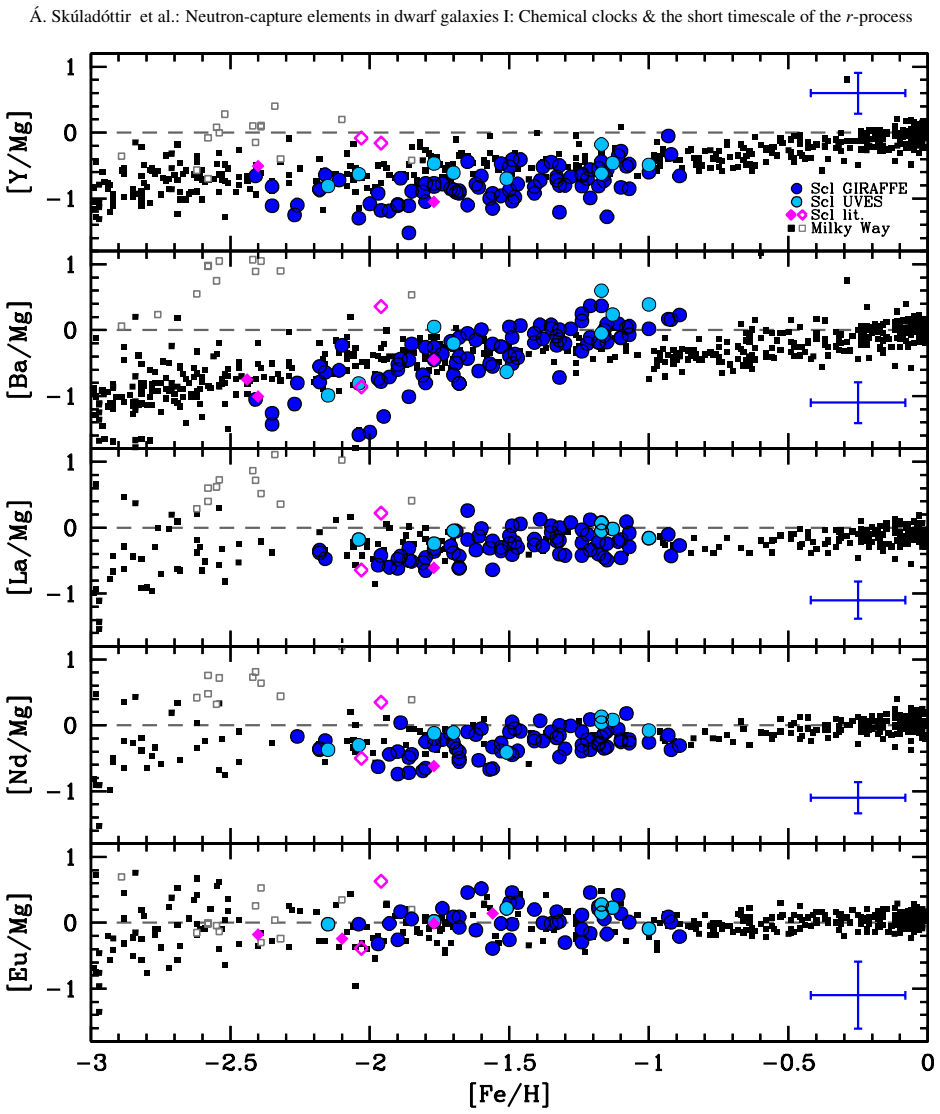
The argument is carried by the abundance ratio $[\mathrm{Eu}/\mathrm{Mg}]$ used as a relative clock: europium is about 94% r-process in solar composition and magnesium is about 99% a core-collapse supernova product, so any r-process source with a significant delay should make the ratio climb with metallicity and age, just as $[\mathrm{Y}/\mathrm{Mg}]$ and $[\mathrm{Ba}/\mathrm{Mg}]$ climb once AGB stars contribute. The second piece of machinery is a simple two-channel decomposition, Eqs. (1)-(6), that uses pure s- and r-process ratios to split the observed growth of barium and europium into the two channels and shows that the europium growth is more than 90% r-process. Stellar ages from the Sculptor star-formation history convert the $[\mathrm{Fe}/\mathrm{H}]$ sequence into time, enabling the direct comparison of chemical clocks with Milky Way stars. Together the flat $[\mathrm{Eu}/\mathrm{Mg}]$ trend and this decomposition support the no-delay conclusion.
What would settle it
Measure europium in the 47 Sculptor stars where the weak europium line was not detected, or model their upper limits with survival analysis; if [Eu/Mg] declines significantly toward lower [Fe/H] once upper limits are included, the flat trend disappears and the no-delay conclusion fails.
Extended reading notes
Core claim
The paper's central claim is that the r-process has no significant time delay relative to core-collapse supernovae. In Sculptor, $[\mathrm{Eu}/\mathrm{Mg}]$ has a fitted slope of $0.03 \pm 0.10$ per dex in $[\mathrm{Fe}/\mathrm{H}]$ and sits near the solar value, while the Milky Way shows $[\mathrm{Eu}/\mathrm{Mg}] \approx 0$ from $[\mathrm{Fe}/\mathrm{H}] \approx +0.5$ down to $-2.5$. Because a delayed source would produce an increasing or decreasing ratio with metallicity, as the s-process does for $[\mathrm{Y}/\mathrm{Mg}]$ and $[\mathrm{Ba}/\mathrm{Mg}]$, the flat trend places the dominant r-process event on the timescale of massive stars. A two-component calculation splitting the observed Ba and Eu increases into s- and r-process contributions shows that more than 90% of the europium increase in Sculptor is r-process, so the flat trend is not an s-process artifact. The paper therefore concludes that neutron star mergers, which carry a $\sim t^{-1}$ delay distribution and are observed in old host galaxies, are unlikely to be the dominant or only site of the r-process, and that massive-star-related sites such as collapsars or magnetorotationally driven supernovae are the straightforward alternative.
Load-bearing premise
The flat trend rests on the assumption that the stars where europium was measured fairly represent the whole Sculptor population, but europium was detected in only 51 of 98 stars, and if the 47 non-detections have systematically lower europium-to-magnesium ratios, the flat trend could be a selection artifact rather than a true timescale signature.
Editorial extensions
If this is right
- The s-process contribution to Sculptor's barium becomes dominant only at $[\mathrm{Fe}/\mathrm{H}] \gtrsim -2$; below that, barium tracks the r-process, so the r-process enriched Sculptor throughout its entire chemical evolution.
- Chemical clocks built on s-process delays must be recalibrated for each galaxy: $[\mathrm{Y}/\mathrm{Mg}]$ at a given age is lower in Sculptor than in the Milky Way, and Fornax sits higher still, so environment and metallicity both matter.
- Chemical evolution models should use $[\mathrm{Eu}/\mathrm{Mg}]$ rather than $[\mathrm{Eu}/\mathrm{Fe}]$ when testing r-process sites, because iron is contaminated by Type Ia supernovae that make no europium.
- If the r-process is dominated by massive-star sites, r-process yields should track the star-formation rate; the supersolar $[\mathrm{Eu}/\mathrm{Mg}]$ in Fornax and Sagittarius then becomes an unexplained anomaly.
Reading between the lines
- A decisive observational extension would be to measure europium in the Sculptor stars where the weak europium line was not detected; if those upper limits reveal a declining $[\mathrm{Eu}/\mathrm{Mg}]$ toward low metallicity, the no-delay conclusion would need to be revised.
- The same flat-$[\mathrm{Eu}/\mathrm{Mg}]$ test could be applied to other dwarf spheroidals with well-determined star-formation histories; a system that kept forming stars recently should show whether europium tracks current star formation or lags behind it.
- The argument tightens the theoretical space: any model that keeps neutron star mergers as the main r-process source must include a delay-hiding mechanism that is metallicity-independent and acts identically in the Milky Way and a much smaller galaxy; otherwise collapsar- or magnetorotational-supernova models are favored.
- If confirmed, nucleosynthetic yield tables for galactic chemical evolution should associate a substantial r-process component with the core-collapse supernova rate rather than with a separate delay-time distribution, changing predictions for the earliest and latest phases of galaxy enrichment.
Signed reviews
Editorial analysis
A structured set of objections, weighed in public.
Referee Report
Summary. This paper presents a homogeneous LTE abundance analysis of Mg, Y, Ba, La, Nd, and Eu in 98 red-giant stars in the Sculptor dwarf spheroidal galaxy using VLT/FLAMES (GIRAFFE and UVES) spectra, with stellar parameters taken from Hill et al. (2019). The authors use [X/Mg] ratios to trace enrichment timescales: [Y/Mg] and [Ba/Mg] increase with [Fe/H] and age in Sculptor, mirroring Milky Way trends but with offsets that make these chemical clocks environment- and metallicity-dependent. The s-process contribution to Ba becomes significant at [Fe/H] about -2. In contrast, [Eu/Mg] is flat around the solar value in Sculptor (slope 0.03 +/- 0.10 per dex in [Fe/H]) and in the Milky Way, which the authors interpret as evidence that the r-process is not significantly delayed relative to core-collapse supernovae. They further decompose the [Ba/H] and [Eu/H] increases into s- and r-process contributions using solar-scaled pure-process ratios, and use Local Group [Eu/Mg] data to argue against neutron-star mergers as the dominant r-process site, favoring a massive-star-associated site such as collapsars or magnetorotational supernovae. The paper also discusses the Eu ceiling hypothesis and disagrees with the Duggan et al. (2018) conclusion based on Ba time delays.
Significance. The paper is valuable: it provides the first large, homogeneously analyzed sample of n-capture elements in a dwarf spheroidal galaxy, cross-checks against Hill et al. (2019), and produces an empirical [Eu/Mg] trend that is not tied to a fitted chemical evolution model. If the flat trend is robust, it is a strong constraint on r-process delay-time distributions and on proposed r-process sites, because Sculptor has a star formation history very different from the Milky Way. The demonstration that [Y/Mg] and [Ba/Mg] age calibrations depend on environment and metallicity is a useful contribution in its own right. The paper is transparent about stellar parameter choices, line lists, and known caveats for Y, Ba, La, and Nd; however, it does not extend that transparency to the Eu non-detections, which are load-bearing for the main conclusion. The manuscript therefore needs a completeness or upper-limit analysis before the no-delay claim can be fully supported.
major comments (2)
- [Sec. 2.3 and Sec. 3.1 (Figs. 2, 3)] The flat [Eu/Mg] trend, which is the empirical basis for the no-delay and anti-NSM conclusions, is computed from detections only, and the 47 non-detections are not modeled. Section 2.3 states that Eu was detected in only 51 of 98 stars and typically in stars with average or above-average S/N and [Fe/H] > -2.2. Because the Eu ii line at 6645.1 Å is weak, the detection probability depends on S/N and on [Eu/H]; since [Eu/H] increases with [Fe/H] (Fig. 5), non-detections are expected to be concentrated at low [Fe/H] and possibly at low [Eu/Mg]. If the missing stars are preferentially low in [Eu/Mg], the measured slope of 0.03 ± 0.10 could be an artifact of censoring. The manuscript explicitly guards against this for Y and Ba and acknowledges the same risk for La and Nd (Sec. 3.1), but gives no equivalent caveat or upper-limit treatment for Eu. This is a load-bearing gap: a survival analysis, or an explicit test of the conclusion under extreme assumptions for the non-detections, is needed before the strongest claim is supported.
- [Sec. 4 and Conclusions (Figs. 5, 6)] The related claim that the r-process was active throughout the entire chemical evolution of Sculptor is also based on the Eu detections in Fig. 5. The decomposition of the [Ba/H] and [Eu/H] increases (Eqs. 1-6) starts at the lowest metallicity bin with available Eu measurements, [Fe/H] about -2 (Sec. 4), so it cannot directly probe the earliest enrichment epoch; the statement that the r-process contributed throughout the entire history extends beyond the detections. This claim should either be restricted to the sampled metallicity range or be supported by an upper-limit treatment.
minor comments (6)
- [Sec. 2.3 and Table B.1] The entries with N_Eu = 0 are not accompanied by upper limits; please add a column with detection limits or state explicitly that upper limits are not available, so readers can assess the censoring quantitatively.
- [Sec. 5.2] GW170807 should be GW170817; the confirmed neutron-star merger discussed earlier in the paper is GW170817.
- [Sec. 6] Two-phased IMF appears to be a typo; the mechanism discussed in Sec. 5.3 is the two-phase ISM proposed by Schönrich and Weinberg (2019).
- [Sec. 2.2] Owning to the low signal-to-noise ratio should read Owing to the low signal-to-noise ratio.
- [Sec. 4 and Conclusions] Please rephrase throughout the entire chemical evolution of Sculptor to throughout the sampled metallicity range, since Eu is mostly detected at [Fe/H] > -2.2.
- [Fig. 3 caption] For the Eu panels, several bins contain fewer than seven stars; please list the number of Eu detections per bin in the caption or text, because the flatness statement is sensitive to bin population.
Circularity Check
No significant circularity: the central [Eu/Mg] result is an empirical measurement and the s/r decomposition uses external solar-process ratios, not fitted Sculptor parameters.
full rationale
The paper's central claim—that the r-process shows no significant time delay relative to core-collapse supernovae—rests on the measured flat [Eu/Mg] trend in Sculptor (slope 0.03 ± 0.10, Sec. 3.1) and the similar flat trend in the Milky Way. This is an observed abundance pattern, not a quantity derived from a fitted model. The s/r decomposition in Eqs. 1–6 combines observed bin-to-bin increments of [Ba/H] and [Eu/H] with pure s- and r-process ratios taken from Bisterzo et al. (2014); those external ratios are inputs, not quantities fitted to the Sculptor data, and the derived α is solved from the data rather than chosen to produce the conclusion. The inference from a flat [Eu/Mg] trend to 'no significant delay' is a physical interpretation explicitly contrasted with the rising [Y/Mg] and [Ba/Mg] trends expected from delayed s-process enrichment, so it is not a tautology. Stellar parameters, ages, and reduction procedures are adopted from previous papers, some with overlapping authorship (e.g., Hill et al. 2019; Skúladóttir et al. 2017), but these are standard data-processing inputs and do not predetermine the r-process timescale result. The unmodeled Eu non-detections (47 of 98 stars) are a legitimate completeness/selection-bias concern about the flat trend, but they represent a data-quality risk, not circular reasoning. No load-bearing step reduces to its own input by construction, and no self-citation chain is invoked to force the conclusion.
Assumptions & free parameters
free parameters (1)
- initial metallicity bin for s/r decomposition =
[Fe/H] near -2
assumptions (4)
- domain assumption Mg is produced almost entirely by core-collapse supernovae.
- domain assumption [Fe/H] is a good proxy for evolutionary state and age in the central Sculptor sample.
- domain assumption Eu and Ba trace the r- and s-processes with solar proportions (94% and 85%), and the Bisterzo et al. (2014) pure-process ratios apply to Sculptor.
- domain assumption Eu detections are representative of the full Sculptor population despite non-detections.
Cite this review
Pith. "Pith review of Neutron-capture elements in dwarf galaxies I: Chemical clocks & the short timescale of the r-process." pith.science (2026). https://pith.science/paper/PZEKR4S2
@misc{pith2026190810729,
  author       = {Pith},
  title        = {Pith review of: Neutron-capture elements in dwarf galaxies I: Chemical clocks & the short timescale of the r-process},
  year         = {2026},
  howpublished = {\url{https://pith.science/paper/PZEKR4S2}},
  note         = {Machine review of arXiv:1908.10729}
}
abstract
The heavy elements (Z>30) are created in neutron-capture processes which happen at very different nucleosynthetic sites. To study them in an environment different from the Milky Way, we target these elements in RGB stars in the Sculptor dwarf spheroidal galaxy. Using ESO VLT/FLAMES spectra, we measure the chemical abundances of Y, Ba, La, Nd, and Eu, in 98 stars covering $-2.4<\text{[Fe/H]}<-0.9$. This is the first paper in a series about the $n$-capture elements in dwarf galaxies, and here we focus on the relative and absolute timescales of the slow ($s$)- and rapid ($r$)-processes in Sculptor. From the abundances of the $s$-process element Ba and the $r$-process element Eu, it is clear that the $r$-process enrichment occurred throughout the entire chemical evolution history of Sculptor. Furthermore, there is no evidence for the $r$-process to have a significant time delay relative to core-collapse supernovae. Neutron star mergers are therefore unlikely the dominant (or only) nucleosynthetic site of the $r$-process. However, the products of the $s$-process only become apparent at $\text{[Fe/H]}\approx-2$ in Sculptor, and the $s$-process becomes the dominant source of Ba at $\text{[Fe/H]}\gtrsim-2$. We test the use of [Y/Mg] and [Ba/Mg] as chemical clocks in Sculptor. Similarly to what is observed in the Milky Way, [Y/Mg] and [Ba/Mg] increase towards younger ages. However, there is an offset, where the abundance ratios of [Y/Mg] in Sculptor are significantly lower than those of the Milky Way at any given age. This is most likely caused by metallicity dependence of yields from the $s$-process, as well as different relative contribution of the $s$-process to core-collapse supernovae in these galaxies. Comparisons of our data with that of the Milky Way and the Fornax dwarf spheroidal galaxy furthermore show that these chemical clocks are both metallicity and environment dependent.
Figures


Figures from the paper (3 more)


Forward citations
Cited by 1 Pith paper
-
Reconstructing Critical Current Density in Josephson Junctions with Phase Non-linearity
The standard Dynes-Fulton reconstruction of critical current density breaks down for junctions with nonlinear phase distributions, and the authors propose an iterative algorithm that incorporates prior knowledge to fix it.
Reference graph
Works this paper leans on
-
[1]
& Plez, B
Alvarez, R. & Plez, B. 1998, A&A, 330, 1109
1998
-
[2]
M., Korotin, S
Andrievsky, S. M., Korotin, S. A., Hill, V ., & Zhukova, A. V . 2017, arXiv e-prints
2017
-
[3]
2008, ApJ, 681, L13
Battaglia, G., Helmi, A., Tolstoy, E., et al. 2008, ApJ, 681, L13
2008
-
[4]
Bensby, T., Feltzing, S., & Oey, M. S. 2014, A&A, 562, A71
2014
-
[5]
2014, ARA&A, 52, 43
Berger, E. 2014, ARA&A, 52, 43
2014
-
[6]
L., Cassisi, S., et al
Bettinelli, M., Hidalgo, S. L., Cassisi, S., et al. 2019, MNR AS, 1642
2019
-
[7]
2014, ApJ, 787, 10
Bisterzo, S., Travaglio, C., Gallino, R., Wiescher, M., & Kä ppeler, F. 2014, ApJ, 787, 10
2014
-
[8]
K., Berger, E., Fong, W., et al
Blanchard, P . K., Berger, E., Fong, W., et al. 2017, ApJ, 848, L22
2017
Show all 112 references
-
[9]
2019, arXi v e-prints, arXiv:1905.12016
Bonetti, M., Perego, A., Dotti, M., & Cescutti, G. 2019, arXi v e-prints, arXiv:1905.12016
2019 arXiv
-
[10]
2000, A&A, 359, 663
Bonifacio, P ., Hill, V ., Molaro, P ., et al. 2000, A&A, 359, 663
2000
-
[11]
Cameron, A. G. W. 2003, ApJ, 587, 327
2003
-
[12]
2015, A&A, 577, A139
Cescutti, G., Romano, D., Matteucci, F., Chiappini, C., & Hi rschi, R. 2015, A&A, 577, A139
2015
-
[13]
Chaplin, W. J. & Miglio, A. 2013, ARA&A, 51, 353
2013
-
[14]
D., Frebel, A., et al
Chiti, A., Simon, J. D., Frebel, A., et al. 2018, ApJ, 856, 142
2018
-
[15]
2017, ApJ, 848, L1 9
Chornock, R., Berger, E., Kasen, D., et al. 2017, ApJ, 848, L1 9
2017
-
[16]
Cohen, J. G. & Huang, W. 2009, ApJ, 701, 1053
2009
-
[17]
Cohen, J. G. & Huang, W. 2010, ApJ, 719, 931 Côté, B., Belczynski, K., Fryer, C. L., et al. 2017, ApJ, 836, 230 Côté, B., Eichler, M., Arcones, A., et al. 2019, ApJ, 875, 106
2010
-
[18]
A., Foley, R
Coulter, D. A., Foley, R. J., Kilpatrick, C. D., et al. 2017, S cience, 358, 1556
2017
-
[19]
S., Berger, E., Villar, V
Cowperthwaite, P . S., Berger, E., Villar, V . A., et al. 2017,ApJ, 848, L17 da Silva, R., Porto de Mello, G. F., Milone, A. C., et al. 2012, A&A, 542, A84 de Boer, T. J. L., Tolstoy, E., Hill, V ., et al. 2012a, A&A, 539 , A103 de Boer, T. J. L., Tolstoy, E., Hill, V ., et al...
2017
-
[20]
R., Piro, A
Drout, M. R., Piro, A. L., Shappee, B. J., et al. 2017, Science , 358, 1570
2017
-
[21]
E., Kirby, E
Duggan, G. E., Kirby, E. N., Andrievsky, S. M., & Korotin, S. A . 2018, ApJ, 869, 50
2018
-
[22]
M., McMillan, P
Feltzing, S., Howes, L. M., McMillan, P . J., & Stonkut˙e, E. 2017, MNRAS, 465, L109
2017
-
[23]
K., et al
Fong, W., Berger, E., Blanchard, P . K., et al. 2017, ApJ, 848, L23 François, P ., Depagne, E., Hill, V ., et al. 2007, A&A, 476, 935
2017
-
[24]
2018, Annual Review of Nuclear and Particle Scien ce, 68, 237
Frebel, A. 2018, Annual Review of Nuclear and Particle Scien ce, 68, 237
2018
-
[25]
E., Gilmore, G., & Wyse, R
Frebel, A., Norris, J. E., Gilmore, G., & Wyse, R. F. G. 2016, A pJ, 826, 110
2016
-
[26]
D., & Kirby, E
Frebel, A., Simon, J. D., & Kirby, E. N. 2014, ApJ, 786, 74
2014
-
[27]
P ., Rich, R
Fulbright, J. P ., Rich, R. M., & Castro, S. 2004, ApJ, 612, 447
2004
-
[28]
V ., Wallerstein, G., Gonzalez, G., & Charbonnel, C
Geisler, D., Smith, V . V ., Wallerstein, G., Gonzalez, G., & Charbonnel, C. 2005, AJ, 129, 1428
2005
-
[29]
& Sauval, A
Grevesse, N. & Sauval, A. J. 1998, Space Science Reviews, 85, 161
1998
-
[30]
2008, A &A, 486, 951
Gustafsson, B., Edvardsson, B., Eriksson, K., et al. 2008, A &A, 486, 951
2008
-
[31]
J., Primas, F., Hartman, H., et al
Hansen, C. J., Primas, F., Hartman, H., et al. 2012, A&A, 545, A31
2012
-
[32]
T., Andersen, J., Nordström, B., et al
Hansen, T. T., Andersen, J., Nordström, B., et al. 2016, A&A, 588, A3
2016
-
[33]
T., Simon, J
Hansen, T. T., Simon, J. D., Marshall, J. L., et al. 2017, ApJ, 838, 44
2017
-
[34]
2005, ARA&A, 43, 435
Herwig, F. 2005, ARA&A, 43, 435
2005
-
[35]
C., et al
Hill, V ., Christlieb, N., Beers, T. C., et al. 2017, A&A, 607, A91
2017
-
[36]
2002, A&A, 387, 560
Hill, V ., Plez, B., Cayrel, R., et al. 2002, A&A, 387, 560
2002
-
[37]
2019, A&A, 626, A15
Hill, V ., Skúladóttir, Á., Tolstoy, E., et al. 2019, A&A, 626, A15
2019
-
[38]
R., et al
Hirai, Y ., Ishimaru, Y ., Saitoh, T. R., et al. 2015, ApJ, 814,41
2015
-
[39]
2018, International Journal of Modern Physics D, 27, 1842005
Hotokezaka, K., Beniamini, P ., & Piran, T. 2018, International Journal of Modern Physics D, 27, 1842005
2018
-
[40]
J., et al
Im, M., Y oon, Y ., Lee, S.-K. J., et al. 2017, ApJ, 849, L16
2017
-
[41]
Ishimaru, Y ., Wanajo, S., Aoki, W., & Ryan, S. G. 2004, ApJ, 600, L47
2004
-
[42]
G., & Prantzos, N
Ishimaru, Y ., Wanajo, S., Aoki, W., Ryan, S. G., & Prantzos, N . 2005, Nucl. Phys. A, 758, 603
2005
-
[43]
2015, ApJ, 804, L35
Ishimaru, Y ., Wanajo, S., & Prantzos, N. 2015, ApJ, 804, L35
2015
-
[44]
1999, ApJS, 12 5, 439
Iwamoto, K., Brachwitz, F., Nomoto, K., et al. 1999, ApJS, 12 5, 439
1999
-
[45]
2015, A&A, 583, A67
Jablonka, P ., North, P ., Mashonkina, L., et al. 2015, A&A, 583, A67
2015
-
[46]
Karakas, A. I. & Lattanzio, J. C. 2014, PASA, 31, e030
2014
-
[47]
Kirby, E. N. & Cohen, J. G. 2012, AJ, 144, 168
2012
-
[48]
2013, A&A, 5 54, A5
Koch, A., Feltzing, S., Adén, D., & Matteucci, F. 2013, A&A, 5 54, A5
2013
-
[49]
K., Zucker, D
Koch, A., McWilliam, A., Grebel, E. K., Zucker, D. B., & Belok urov, V . 2008, ApJ, 688, L13
2008
-
[50]
& Shigeyama, T
Komiya, Y . & Shigeyama, T. 2016, ApJ, 830, 76
2016
-
[51]
A., Andrievsky, S
Korotin, S. A., Andrievsky, S. M., Hansen, C. J., et al. 2015, A&A, 581, A70
2015
-
[52]
A., Stempels, H
Kupka, F., Piskunov, N., Ryabchikova, T. A., Stempels, H. C. , & Weiss, W. W. 1999, A&AS, 138, 119
1999
-
[53]
Lemasle, B., de Boer, T. J. L., Hill, V ., et al. 2014, A&A, 572, A88
2014
-
[54]
2012, A&A, 538, A10 0
Lemasle, B., Hill, V ., Tolstoy, E., et al. 2012, A&A, 538, A10 0
2012
-
[55]
2010, A&A, 523, A17
Letarte, B., Hill, V ., Tolstoy, E., et al. 2010, A&A, 523, A17
2010
-
[56]
2018, A&A, 613, C1
Letarte, B., Hill, V ., Tolstoy, E., et al. 2018, A&A, 613, C1
2018
-
[57]
J., Lyman, J
Levan, A. J., Lyman, J. D., Tanvir, N. R., et al. 2017, ApJ, 848 , L28
2017
-
[58]
C., et al
Lucatello, S., Tsangarides, S., Beers, T. C., et al. 2005, Ap J, 625, 825
2005
-
[59]
2014, MNRAS, 438, 2177
Matteucci, F., Romano, D., Arcones, A., Korobkin, O., & Ross wog, S. 2014, MNRAS, 438, 2177
2014
-
[60]
McConnachie, A. W. 2012, AJ, 144, 4
2012
-
[61]
2013, ApJ, 778 , 149
McWilliam, A., Wallerstein, G., & Mottini, M. 2013, ApJ, 778 , 149
2013
-
[62]
V ., Pignatari, M., Korotin, S
Mishenina, T. V ., Pignatari, M., Korotin, S. A., et al. 2013, A&A, 552, A128 Mösta, P ., Roberts, L. F., Halevi, G., et al. 2018, ApJ, 864, 1 71
2013
-
[63]
P ., Pillepich, A., Springel, V ., et al
Naiman, J. P ., Pillepich, A., Springel, V ., et al. 2018, MNRAS, 477, 1206
2018
-
[64]
Nishimura, N., Sawai, H., Takiwaki, T., Y amada, S., & Thielemann, F. K. 2017, ApJ, 836, L21
2017
-
[65]
2015, ApJ, 810, 109
Nishimura, N., Takiwaki, T., & Thielemann, F.-K. 2015, ApJ, 810, 109
2015
-
[66]
Nissen, P . E. 2015, A&A, 579, A52
2015
-
[67]
Nissen, P . E. 2016, A&A, 593, A65
2016
-
[68]
Nissen, P . E. & Gustafsson, B. 2018, A&A Rev., 26, 6
2018
-
[69]
E., Silva Aguirre, V ., Christensen-Dalsgaard, J ., et al
Nissen, P . E., Silva Aguirre, V ., Christensen-Dalsgaard, J ., et al. 2017, A&A, 608, A112
2017
-
[70]
2013, ARA&A, 51, 45 7
Nomoto, K., Kobayashi, C., & Tominaga, N. 2013, ARA&A, 51, 45 7
2013
-
[71]
E., Y ong, D., V enn, K
Norris, J. E., Y ong, D., V enn, K. A., et al. 2017, ApJS, 230, 28
2017
-
[72]
2012, A&A, 541, A45
North, P ., Cescutti, G., Jablonka, P ., et al. 2012, A&A, 541, A45
2012
-
[73]
C., Kilpatrick, C
Pan, Y . C., Kilpatrick, C. D., Simon, J. D., et al. 2017, ApJ, 8 48, L30
2017
-
[74]
2017, Nature, 551 , 67 Pietrzy´nski, G., Gieren, W., Szewczyk, O., et al
Pian, E., D’Avanzo, P ., Benetti, S., et al. 2017, Nature, 551 , 67 Pietrzy´nski, G., Gieren, W., Szewczyk, O., et al. 2008, AJ, 135, 1993 Article number, page 12 of 17 Á. Skúladóttir et al.: Neutron-capture elements in dwarf ga laxies I: Chemical clocks & the short timescale ...
2017
-
[75]
2012, Turbospectrum: Code for spectral synthesis, astrophysics Source Code Library
Plez, B. 2012, Turbospectrum: Code for spectral synthesis, astrophysics Source Code Library
2012
-
[76]
E., Lambert, D
Reddy, B. E., Lambert, D. L., & Allende Prieto, C. 2006, MNRAS , 367, 1329
2006
-
[77]
E., Tomkin, J., Lambert, D
Reddy, B. E., Tomkin, J., Lambert, D. L., & Allende Prieto, C. 2003, MNRAS, 340, 304
2003
-
[78]
Roederer, I. U. & Kirby, E. N. 2014, MNRAS, 440, 2665
2014
-
[79]
2018, A&A, 615 , A132
Rosswog, S., Sollerman, J., Feindt, U., et al. 2018, A&A, 615 , A132
2018
-
[80]
2004, PASJ, 56, 1 041
Sadakane, K., Arimoto, N., Ikuta, C., et al. 2004, PASJ, 56, 1 041
2004
-
[81]
M., Placco, V
Sakari, C. M., Placco, V . M., Farrell, E. M., et al. 2018, ApJ, 868, 110
2018
-
[82]
Savino, A., de Boer, T. J. L., Salaris, M., & Tolstoy, E. 2018,MNRAS, 480, 1587 Schönrich, R. A. & Weinberg, D. H. 2019, MNRAS, 1083
2018
-
[83]
J., Ramirez-Ruiz, E., et al
Shen, S., Cooke, R. J., Ramirez-Ruiz, E., et al. 2015, ApJ, 80 7, 115
2015
-
[84]
A., Tolstoy, E., et al
Shetrone, M., V enn, K. A., Tolstoy, E., et al. 2003, AJ, 125, 6 84
2003
-
[85]
D., Côté, P ., & Stetson, P
Shetrone, M. D., Côté, P ., & Stetson, P . B. 2001, PASP , 113, 1122
2001
-
[86]
Siegel, D. M. 2019, arXiv e-prints, arXiv:1901.09044
2019 arXiv
-
[87]
M., Barnes, J., & Metzger, B
Siegel, D. M., Barnes, J., & Metzger, B. D. 2019, Nature, 569, 241 Silva Aguirre, V ., Bojsen-Hansen, M., Slumstrup, D., et al. 2018, MNRAS, 475, 5487
2019
-
[88]
D., Jacobson, H
Simon, J. D., Jacobson, H. R., Frebel, A., et al. 2015, ApJ, 80 2, 93
2015
-
[89]
20 19, MNRAS, 486, 2896 Skúladóttir, Á., Andrievsky, S
Simonetti, P ., Matteucci, F., Greggio, L., & Cescutti, G. 20 19, MNRAS, 486, 2896 Skúladóttir, Á., Andrievsky, S. M., Tolstoy, E., et al. 2015 a, A&A, 580, A129 Skúladóttir, Á., Salvadori, S., Pettini, M., Tolstoy, E., & Hill, V . 2018, A&A, 615, A137 Skúladóttir, Á., Tolstoy...
2015
-
[90]
2017, A&A, 604, L8
Slumstrup, D., Grundahl, F., Brogaard, K., et al. 2017, A&A, 604, L8
2017
-
[91]
J., & Gallino, R
Sneden, C., Cowan, J. J., & Gallino, R. 2008, ARA&A, 46, 241
2008
-
[92]
J., Lawler, J
Sneden, C., Cowan, J. J., Lawler, J. E., et al. 2003, ApJ, 591, 936
2003
-
[93]
Soderblom, D. R. 2010, ARA&A, 48, 581
2010
-
[94]
I., et al
Spina, L., Meléndez, J., Karakas, A. I., et al. 2018, MNRAS, 4 74, 2580
2018
-
[95]
2013, A&A, 549, A88
Starkenburg, E., Hill, V ., Tolstoy, E., et al. 2013, A&A, 549, A88
2013
-
[96]
D., McConnachie, A
Starkenburg, E., Shetrone, M. D., McConnachie, A. W., & V enn , K. A. 2014, MNRAS, 441, 1217
2014
-
[97]
2008, PASJ, 60, 1159
Suda, T., Katsuta, Y ., Y amada, S., et al. 2008, PASJ, 60, 1159
2008
-
[98]
2017, A&A, 606, A112
Susmitha, A., Koch, A., & Sivarani, T. 2017, A&A, 606, A112
2017
-
[99]
2010, A&A, 524, A58+
Tafelmeyer, M., Jablonka, P ., Hill, V ., et al. 2010, A&A, 524, A58+
2010
-
[100]
A., et al
Tanaka, M., Utsumi, Y ., Mazzali, P . A., et al. 2017, PASJ, 69,102
2017
-
[101]
M., Kramer, M., Freire, P
Tauris, T. M., Kramer, M., Freire, P . C. C., et al. 2017, ApJ, 8 46, 170
2017
-
[102]
, & Guiglion, G
Titarenko, A., Recio-Blanco, A., de Laverny, P ., Hayden, M. , & Guiglion, G. 2019, A&A, 622, A59
2019
-
[103]
2009, ARA&A, 47, 371
Tolstoy, E., Hill, V ., & Tosi, M. 2009, ARA&A, 47, 371
2009
-
[104]
J., Helmi, A., et al
Tolstoy, E., Irwin, M. J., Helmi, A., et al. 2004, ApJ, 617, L1 19
2004
-
[105]
2004, ApJ, 601 , 864
Travaglio, C., Gallino, R., Arnone, E., et al. 2004, ApJ, 601 , 864
2004
-
[106]
N., & Shig eyama, T
Tsujimoto, T., Matsuno, T., Aoki, W., Ishigaki, M. N., & Shig eyama, T. 2017, ApJ, 850, L12
2017
-
[107]
& Nishimura, N
Tsujimoto, T. & Nishimura, N. 2015, ApJ, 811, L10
2015
-
[108]
1995, MNRAS, 277, 945 Tucci Maia, M., Ramírez, I., Meléndez, J., et al
Tsujimoto, T., Nomoto, K., Y oshii, Y ., et al. 1995, MNRAS, 277, 945 Tucci Maia, M., Ramírez, I., Meléndez, J., et al. 2016, A&A, 5 90, A32 van de V oort, F., Quataert, E., Hopkins, P . F., Kereš, D., & Fa ucher-Giguère, C.-A. 2015, MNRAS, 447, 140 V enn, K. A., Irwin, M., Sh...
1995
-
[109]
A., Guillochon, J., Berger, E., et al
Villar, V . A., Guillochon, J., Berger, E., et al. 2017, ApJ, 8 51, L21
2017
-
[110]
T., Kitaura, F
Wanajo, S., Nomoto, K., Janka, H. T., Kitaura, F. S., & Müller , B. 2009, ApJ, 695, 208
2009
-
[111]
R., Dolphin, A
Weisz, D. R., Dolphin, A. E., Skillman, E. D., et al. 2014, ApJ , 789, 147
2014
-
[112]
2012, ApJ, 750, L22 Article number, page 13 of 17 A&A proofs: manuscript no
Winteler, C., Käppeli, R., Perego, A., et al. 2012, ApJ, 750, L22 Article number, page 13 of 17 A&A proofs: manuscript no. Skuladottir19a_AA Fig. A.1: Comparison of measurements in this work and Hill et al. (2019). ∆[X/Fe] = [X/Fe] − [X/Fe] Hill. Appendix A: Comparison with pr...
2019
Reviewed August 14, 2026 · model on record in the stance chip above.
Discussion (0). Continue with ORCID to comment.