Dark Matter in Draco and Bo\"otes I: Hints of a Core in an Ultra-Faint Dwarf from Simulation-Based Inference
Pith reviewed 2026-06-26 01:49 UTC · model grok-4.3
The pith
GraphNPE recovers a low central density in Boötes I consistent with a dark matter core by using higher-order velocity moments.
A machine-rendered reading of the paper's core claim, the machinery that carries it, and where it could break.
Core claim
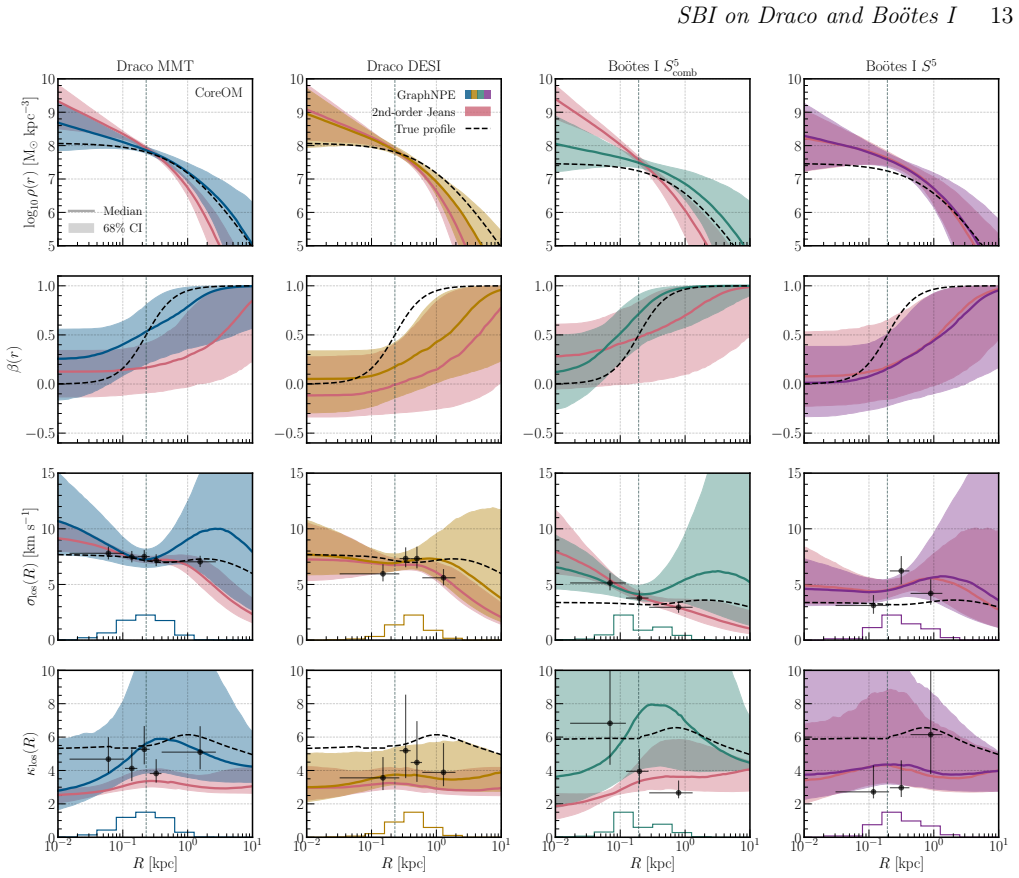
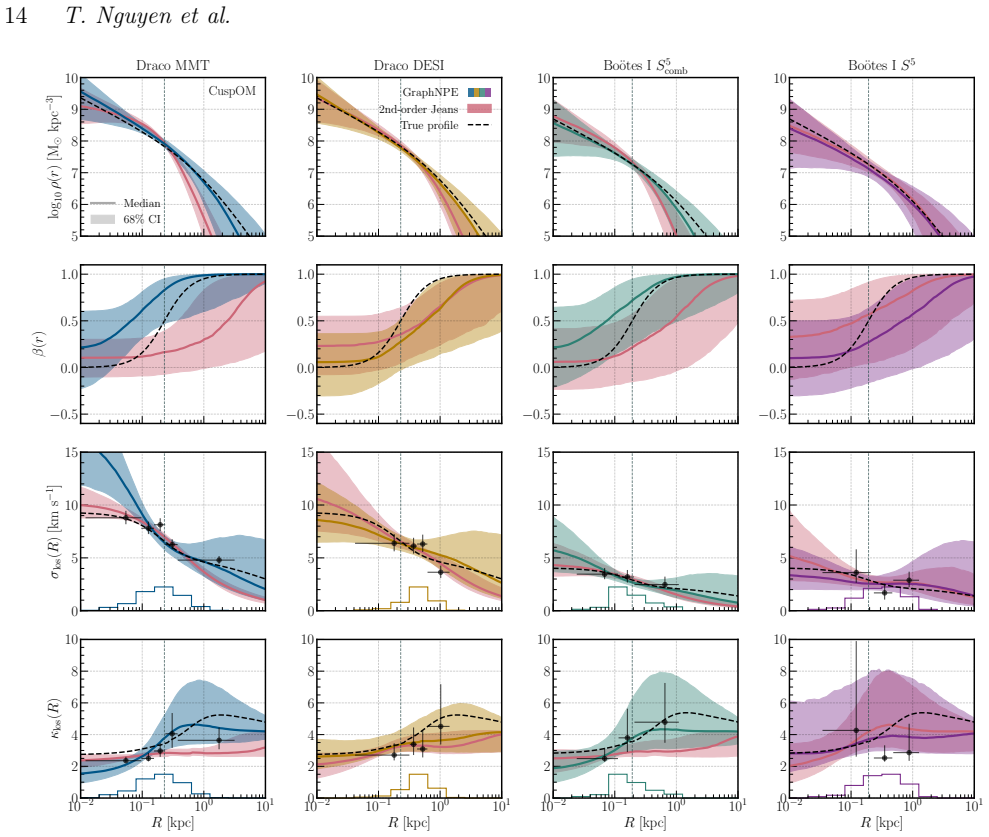
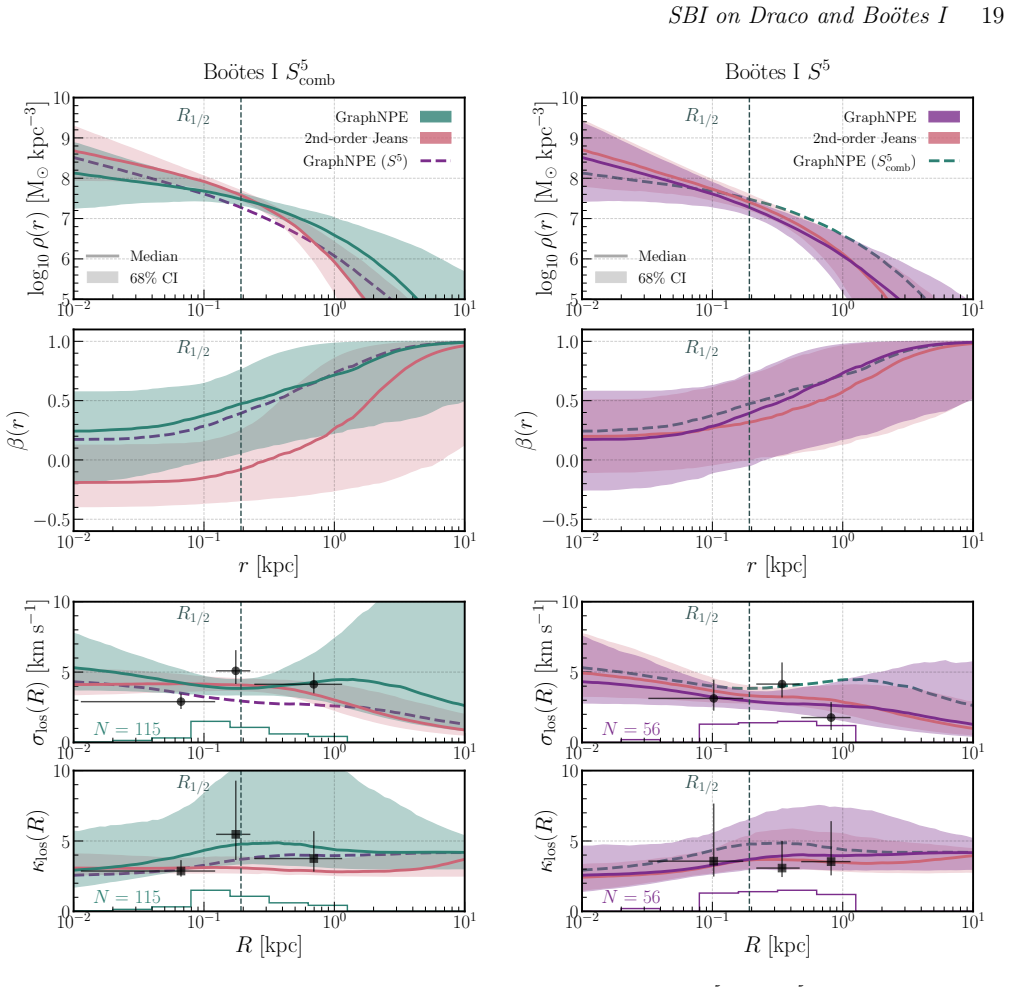
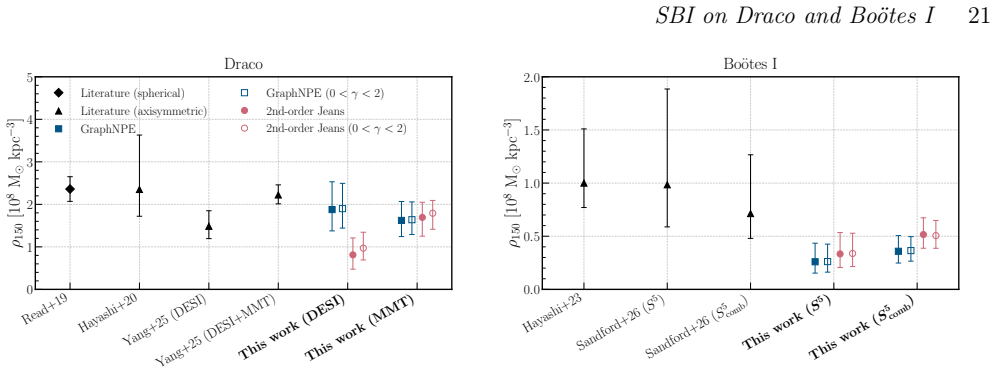
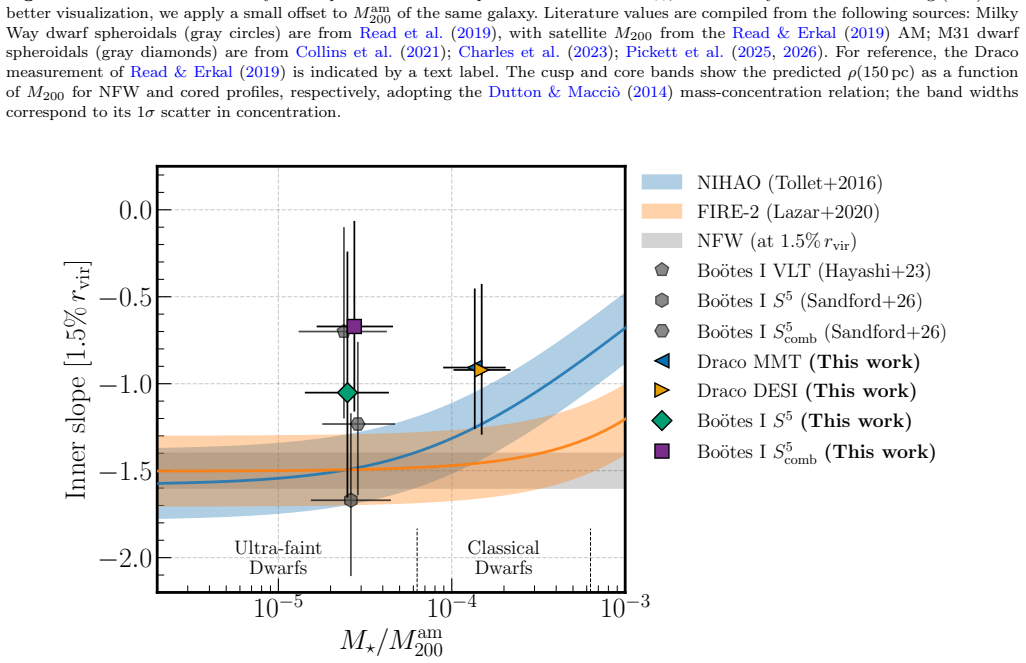
GraphNPE embeds the full survey selection function and error model inside a simulation-based forward model. Mock tests demonstrate that dispersion-only methods remain biased toward cusps even without mass-anisotropy degeneracy, whereas access to kurtosis allows recovery of the true density profile. Applied to Draco with two independent datasets, GraphNPE finds rho_150 approximately 1.6-1.9 times 10^8 solar masses per cubic kiloparsec and a marginally cuspy inner slope. For Boötes I it recovers rho_150 equal to 0.36 plus 0.15 minus 0.11 times 10^8 solar masses per cubic kiloparsec, lower than literature values and consistent with a cored profile.
What carries the argument
GraphNPE, a simulation-based inference method that incorporates spectroscopic selection functions and measurement uncertainties in the forward model and uses line-of-sight kurtosis together with dispersion to constrain the dark matter density profile.
If this is right
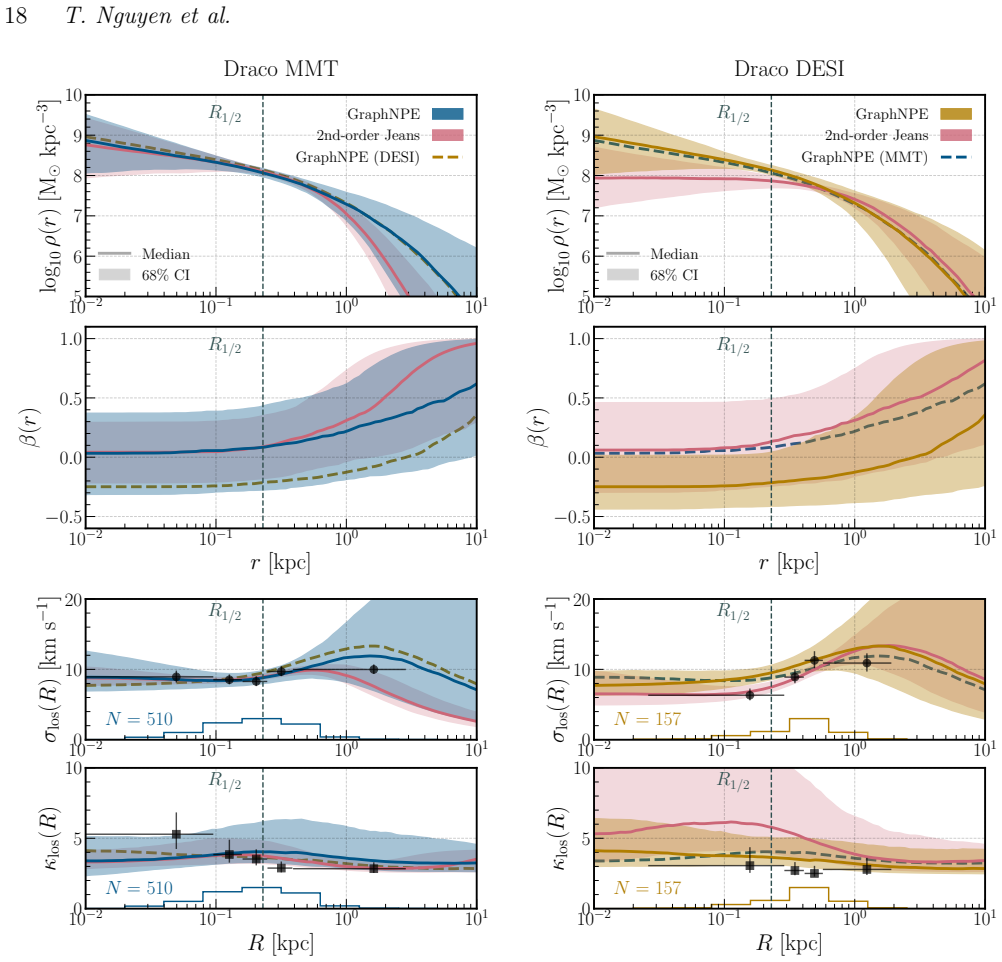
- Dispersion-only Jeans modeling can fit the observed dispersion yet fail to reproduce the observed kurtosis.
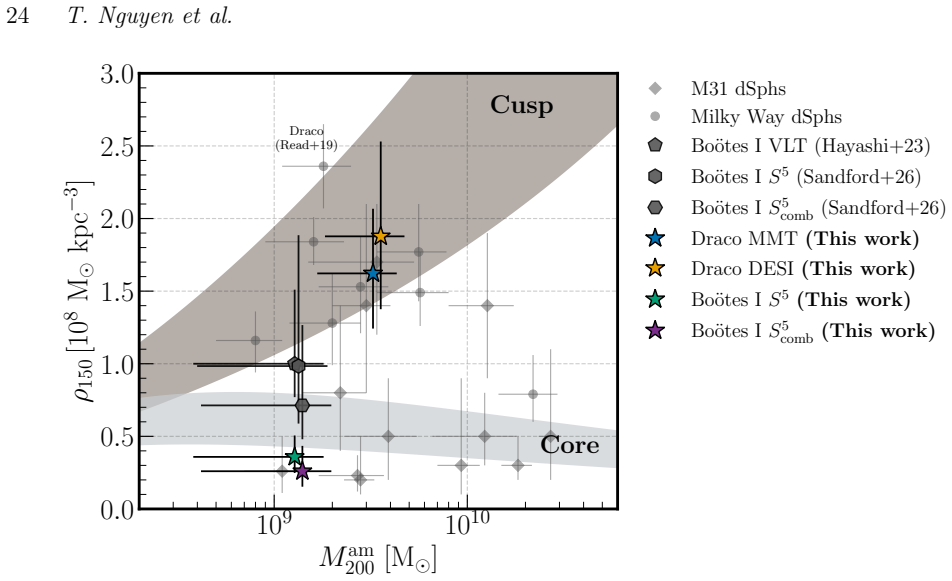
- Boötes I has one of the lowest central dark matter densities among dwarfs at comparable stellar mass.
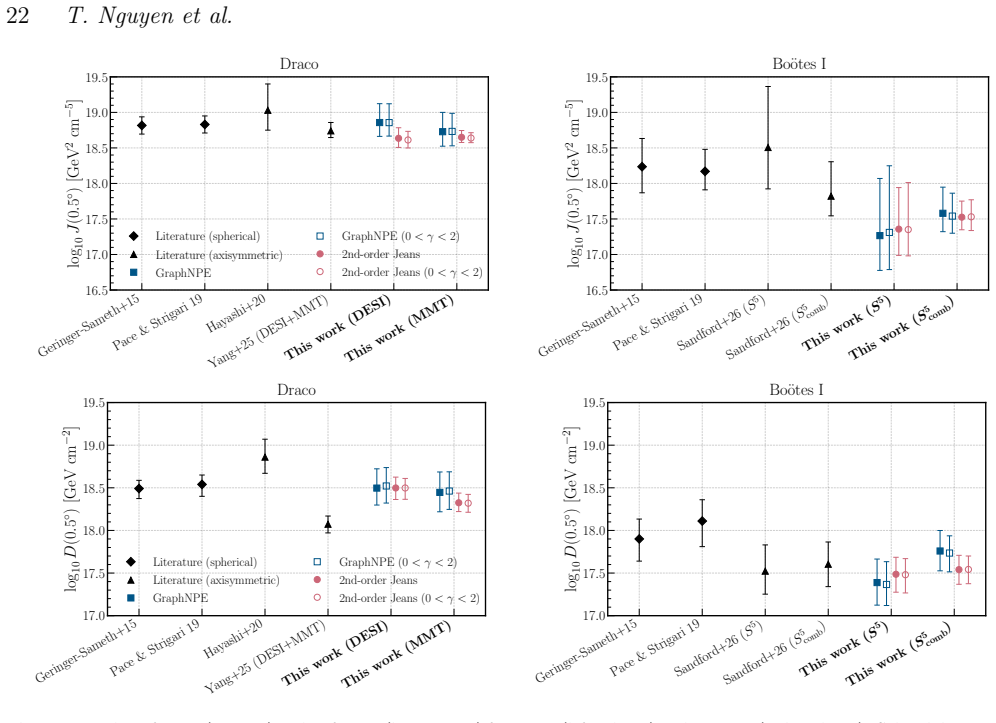
- J- and D-factors for indirect detection can be derived from the inferred profiles for both galaxies.
- Higher-order velocity moments become essential once statistical power is limited.
Where Pith is reading between the lines
- Extending GraphNPE to additional ultra-faint dwarfs would test whether cored profiles are common at low stellar masses.
- If the core signal survives improved selection modeling, it would increase tension with pure cold dark matter predictions for the smallest galaxies.
- The method could be used to re-examine other dwarfs where dispersion-only analyses have produced unexpectedly high central densities.
Load-bearing premise
The forward model in GraphNPE correctly captures the full spectroscopic selection function and measurement uncertainties of the S5 survey for Boötes I and the MMT/DESI data for Draco, so that mismatches in higher-order moments arise from the dark matter profile rather than unmodeled observational effects.
What would settle it
New observations of Boötes I with an independently verified selection function that, when fed through GraphNPE, produce a kurtosis consistent with a cuspy profile would falsify the core inference.
Figures
read the original abstract
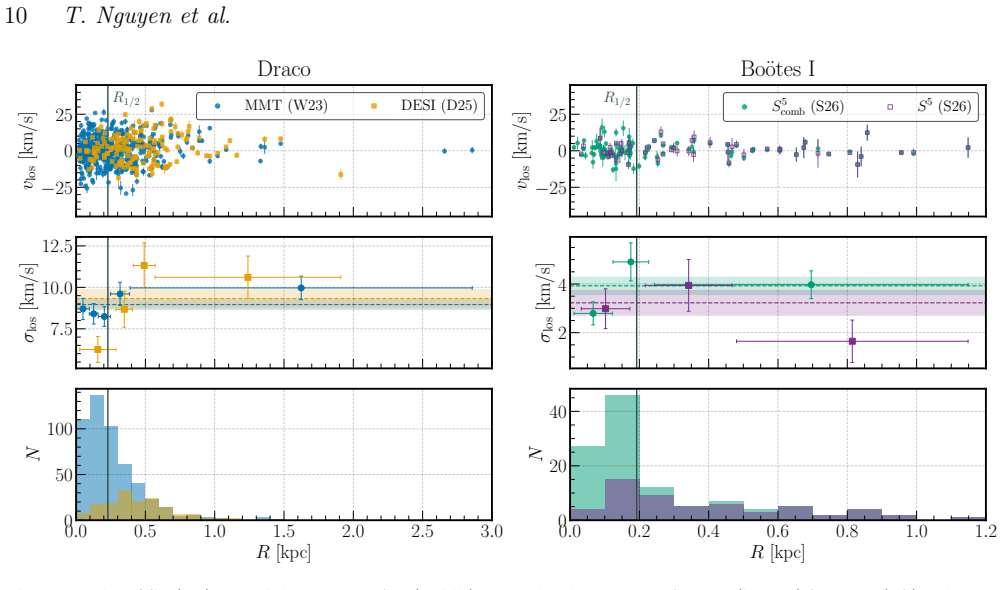
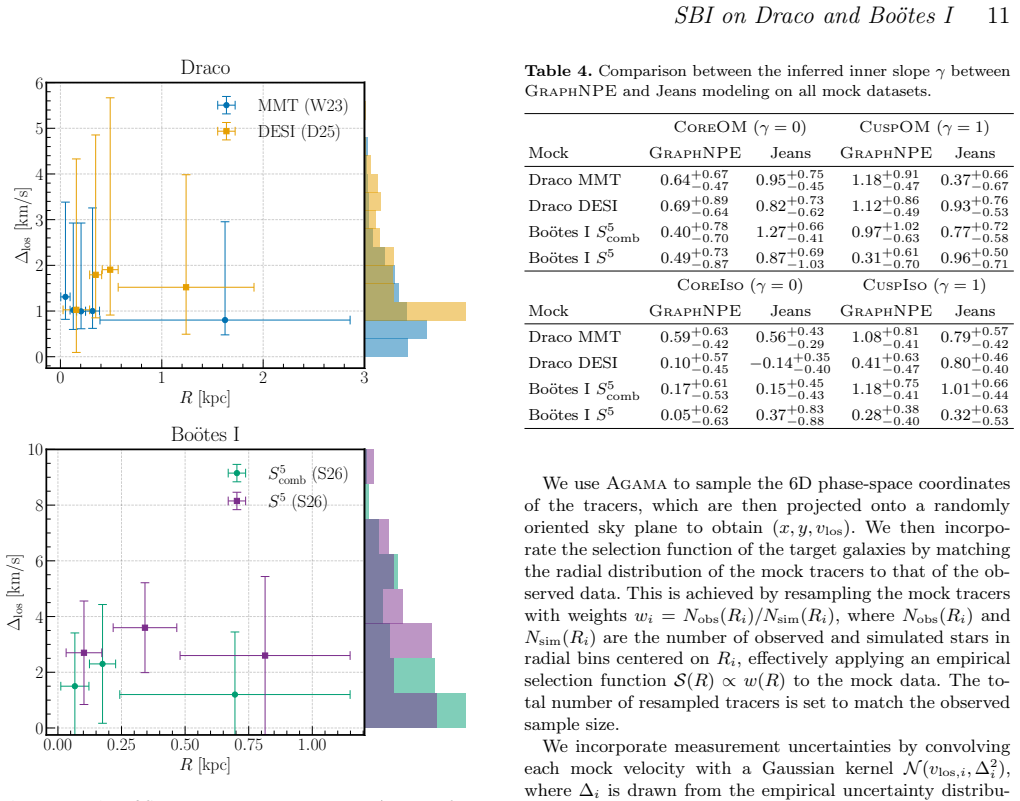
The density profiles of dwarf spheroidal galaxies are among the most sensitive probes of dark matter physics, yet extracting them from noisy stellar kinematics remains a fundamental obstacle. We present GraphNPE, a simulation-based inference method for dynamical mass modeling that incorporates measurement uncertainties and spectroscopic selection functions in the forward model. Using mock data, we show that methods relying solely on line-of-sight velocity dispersion are biased toward cuspy density profiles, even in the absence of the mass-anisotropy degeneracy. By accessing higher-order velocity moments, particularly line-of-sight kurtosis, GraphNPE breaks key degeneracies and recovers density profiles with substantially less bias. We apply GraphNPE to Draco and Bo\"otes I using MMT/Hectochelle and DESI for Draco, and the S5 survey for Bo\"otes I. For each, we report density profiles and dark matter $J$- and $D$-factors. For Draco, GraphNPE yields consistent results across datasets, marginally preferring a cuspy inner profile ($\rho_{150} \sim 1.6-1.9 \times 10^8\,\mathrm{M}_\odot\,\mathrm{kpc}^{-3}$) in agreement with literature. On DESI, however, second-order Jeans modeling fits the dispersion but fails to reproduce the kurtosis, demonstrating higher-order moments are essential. For Bo\"otes I, limited statistical power prevents definitive determination of the inner slope. GraphNPE recovers $\rho_{150} = 0.36^{+0.15}_{-0.11} \times 10^8\,\mathrm{M}_\odot\,\mathrm{kpc}^{-3}$, significantly lower than literature and consistent with a cored inner profile. This places Bo\"otes I among the lowest density dwarfs at comparable stellar masses.
Editorial analysis
A structured set of objections, weighed in public.
Referee Report
Summary. The paper introduces GraphNPE, a simulation-based inference method for dynamical mass modeling of dwarf spheroidals that incorporates measurement uncertainties and spectroscopic selection functions in the forward model. Mock tests show that including line-of-sight kurtosis reduces bias toward cuspy profiles relative to dispersion-only approaches. Applied to Draco (MMT/Hectochelle and DESI), results are consistent across datasets and marginally favor cuspy inner profiles; for Boötes I (S5 survey), the method recovers ρ_150 = 0.36^{+0.15}_{-0.11} × 10^8 M_⊙ kpc^{-3}, lower than literature values and consistent with a core, though statistical power is limited.
Significance. If the forward model is accurate, GraphNPE offers a route to less-biased density profiles in ultra-faint dwarfs by leveraging higher-order moments. The mock-data tests explicitly demonstrate reduced bias when kurtosis is included, and the multi-survey consistency for Draco provides a useful internal check. The Boötes I result, if robust, would place it among the lowest-density dwarfs at its stellar mass, with implications for dark-matter models. These elements are strengths of the work.
major comments (2)
- [Application to Boötes I] The headline Boötes I result (ρ_150 = 0.36^{+0.15}_{-0.11} × 10^8 M_⊙ kpc^{-3}, consistent with a core) is load-bearing for the paper's claim of a low-density ultra-faint dwarf. This inference requires that the GraphNPE forward model exactly reproduces the S5 survey's magnitude limits, spatial sampling, fiber allocation, velocity error distribution, and position-dependent completeness; any mismatch would be misattributed to the dark-matter profile rather than observational effects. The manuscript states limited statistical power for Boötes I but does not provide explicit validation that the mocks replicate these precise S5 characteristics (as opposed to generic selection functions).
- [Mock data tests] The mock-data tests demonstrate reduced bias when kurtosis is included, but the description indicates these are generic mocks. It is unclear whether the validation mocks incorporate the specific selection functions and uncertainty distributions of the S5 survey (or MMT/DESI) used for the real Boötes I and Draco data; this affects how directly the mock results support the real-data inferences.
minor comments (2)
- [Draco DESI analysis] The abstract states that second-order Jeans modeling on DESI fits the dispersion but fails to reproduce the kurtosis; a quantitative measure of this failure (e.g., χ² or residual plot reference) would clarify the strength of the demonstration that higher-order moments are essential.
- Notation for ρ_150 and the exact radial scale (150 pc) should be defined at first use in the main text for readers unfamiliar with the convention.
Simulated Author's Rebuttal
We thank the referee for their careful reading and constructive comments, which help clarify the validation requirements for our forward-modeling approach. We address the major comments point by point below.
read point-by-point responses
-
Referee: [Application to Boötes I] The headline Boötes I result (ρ_150 = 0.36^{+0.15}_{-0.11} × 10^8 M_⊙ kpc^{-3}, consistent with a core) is load-bearing for the paper's claim of a low-density ultra-faint dwarf. This inference requires that the GraphNPE forward model exactly reproduces the S5 survey's magnitude limits, spatial sampling, fiber allocation, velocity error distribution, and position-dependent completeness; any mismatch would be misattributed to the dark-matter profile rather than observational effects. The manuscript states limited statistical power for Boötes I but does not provide explicit validation that the mocks replicate these precise S5 characteristics (as opposed to generic selection functions).
Authors: We agree that the manuscript would benefit from explicit validation showing that the forward model reproduces the S5 survey's specific characteristics. The current text describes incorporation of selection functions and uncertainties but does not include side-by-side quantitative comparisons (e.g., distributions of magnitudes, positions, velocities, or completeness maps) between mocks and S5 data. In the revised manuscript we will add an appendix with such comparisons to directly address this point. We already note the limited statistical power for Boötes I, which we will emphasize further in interpreting the low central density. revision: yes
-
Referee: [Mock data tests] The mock-data tests demonstrate reduced bias when kurtosis is included, but the description indicates these are generic mocks. It is unclear whether the validation mocks incorporate the specific selection functions and uncertainty distributions of the S5 survey (or MMT/DESI) used for the real Boötes I and Draco data; this affects how directly the mock results support the real-data inferences.
Authors: The mock tests use generic but realistic selection functions to isolate the effect of including higher-order moments on bias reduction, independent of any particular survey. This controlled demonstration supports the general validity of accessing kurtosis. For the real-data applications the GraphNPE forward model is customized to the exact selection functions and error distributions of each survey (MMT/Hectochelle, DESI, S5), as stated in the methods. We will revise the text to make this distinction explicit and to clarify that the generic mocks provide supporting evidence for the method rather than direct validation of the survey-specific inferences. revision: partial
Circularity Check
No significant circularity; GraphNPE is a validated SBI method with independent mocks
full rationale
The derivation uses simulation-based inference (GraphNPE) with a forward model that includes selection functions and uncertainties, validated on separate mock datasets before application to real Draco and Boötes I observations. No self-definitional steps, fitted inputs renamed as predictions, load-bearing self-citations, or ansatzes smuggled via citation appear in the abstract or described chain. The reported ρ_150 for Boötes I is a posterior inference from data, not a reduction to inputs by construction. The method remains self-contained against external benchmarks.
Axiom & Free-Parameter Ledger
Reference graph
Works this paper leans on
-
[1]
A discrete chemo-dynamical model of the dwarf spheroidal galaxy Sculptor: mass profile, velocity anisotropy and internal rotation. , keywords =. doi:10.1093/mnras/stw2081 , archivePrefix =. 1608.08239 , primaryClass =
work page internal anchor Pith review Pith/arXiv arXiv doi:10.1093/mnras/stw2081
-
[2]
A discrete chemo-dynamical model of the giant elliptical galaxy NGC 5846: dark matter fraction, internal rotation, and velocity anisotropy out to six effective radii. , keywords =. doi:10.1093/mnras/stw1931 , archivePrefix =. 1608.08238 , primaryClass =
work page internal anchor Pith review Pith/arXiv arXiv doi:10.1093/mnras/stw1931
-
[3]
Is the Core-cusp Problem a Matter of Perspective? Jeans Anisotropic Modeling against Numerical Simulations. , keywords =. doi:10.3847/1538-4357/ac9b19 , archivePrefix =. 2206.12121 , primaryClass =
-
[4]
Unraveling the Complexity of Dwarf Galaxy Dynamics: A Study of Binary Orbital Motions. , keywords =. doi:10.3847/1538-4357/acf314 , archivePrefix =. 2306.04311 , primaryClass =
-
[5]
The binary fraction of stars in dwarf galaxies: the case of Leo II
The Binary Fraction of Stars in Dwarf Galaxies: The Case of Leo II. , keywords =. doi:10.3847/1538-3881/aa6d51 , archivePrefix =. 1706.04184 , primaryClass =
work page internal anchor Pith review Pith/arXiv arXiv doi:10.3847/1538-3881/aa6d51
-
[6]
Constraints on the properties of warm dark matter using the satellite galaxies of the Milky Way. , keywords =. doi:10.1088/1475-7516/2021/08/062 , archivePrefix =. 2011.08865 , primaryClass =
-
[7]
Dark Matter Constraints from a Unified Analysis of Strong Gravitational Lenses and Milky Way Satellite Galaxies. , keywords =. doi:10.3847/1538-4357/abf9a3 , archivePrefix =. 2101.07810 , primaryClass =
-
[8]
A New Era in the Quest for Dark Matter
A new era in the search for dark matter. , keywords =. doi:10.1038/s41586-018-0542-z , archivePrefix =. 1810.01668 , primaryClass =
work page internal anchor Pith review Pith/arXiv arXiv doi:10.1038/s41586-018-0542-z
-
[9]
Particle Dark Matter: Evidence, Candidates and Constraints
Particle dark matter: evidence, candidates and constraints. , keywords =. doi:10.1016/j.physrep.2004.08.031 , archivePrefix =. hep-ph/0404175 , primaryClass =
work page internal anchor Pith review Pith/arXiv arXiv doi:10.1016/j.physrep.2004.08.031 2004
-
[10]
Disentangling - : The Fourth-order Velocity Moments Based on Spherical Jeans Analysis. , keywords =. doi:10.3847/1538-4357/adb8e4 , archivePrefix =. 2404.12671 , primaryClass =
-
[11]
Scaling Relations for Dark Matter Annihilation and Decay Profiles in Dwarf Spheroidal Galaxies
Scaling relations for dark matter annihilation and decay profiles in dwarf spheroidal galaxies. , keywords =. doi:10.1093/mnras/sty2839 , archivePrefix =. 1802.06811 , primaryClass =
work page internal anchor Pith review Pith/arXiv arXiv doi:10.1093/mnras/sty2839
-
[12]
Excluding fuzzy dark matter with sizes and stellar kinematics of ultrafaint dwarf galaxies. , keywords =. doi:10.1103/PhysRevD.106.063517 , archivePrefix =. 2203.05750 , primaryClass =
-
[13]
Confronting fuzzy dark matter with the rotation curves of nearby dwarf irregular galaxies
Confronting fuzzy dark matter with the rotation curves of nearby dwarf irregular galaxies. , keywords =. doi:10.1051/0004-6361/202346686 , archivePrefix =. 2304.05793 , primaryClass =
work page internal anchor Pith review Pith/arXiv arXiv doi:10.1051/0004-6361/202346686
-
[14]
New constraints on the central mass contents of Omega Centauri from combined stellar kinematics and pulsar timing. , keywords =. doi:10.1051/0004-6361/202451763 , archivePrefix =. 2408.00939 , primaryClass =
work page internal anchor Pith review Pith/arXiv arXiv doi:10.1051/0004-6361/202451763
-
[15]
HSTPROMO Internal Proper-motion Kinematics of Dwarf Spheroidal Galaxies. II. Velocity Anisotropy and Dark Matter Cusp Slope of Sculptor. , keywords =. doi:10.3847/1538-4357/ae1f8a , archivePrefix =. 2508.20711 , primaryClass =
-
[16]
, journal =
Abel, N.H. , journal =. Auflösung einer mechanischen Aufgabe. , url =
-
[17]
A realistic assessment of the CTA sensitivity to dark matter annihilation
A realistic assessment of the CTA sensitivity to dark matter annihilation. , keywords =. doi:10.1088/1475-7516/2015/03/055 , archivePrefix =. 1408.4131 , primaryClass =
work page internal anchor Pith review Pith/arXiv arXiv doi:10.1088/1475-7516/2015/03/055 2015
-
[18]
Design Concepts for the Cherenkov Telescope Array
Design concepts for the Cherenkov Telescope Array CTA: an advanced facility for ground-based high-energy gamma-ray astronomy. Experimental Astronomy , keywords =. doi:10.1007/s10686-011-9247-0 , archivePrefix =. 1008.3703 , primaryClass =
work page internal anchor Pith review Pith/arXiv arXiv doi:10.1007/s10686-011-9247-0
-
[19]
Astroparticle Physics , keywords =
Dark matter and fundamental physics with the Cherenkov Telescope Array. Astroparticle Physics , keywords =. doi:10.1016/j.astropartphys.2012.08.002 , archivePrefix =. 1208.5356 , primaryClass =
-
[20]
It's Not Just Star Formation: A trend of low dark matter densities in the Andromeda dwarf galaxy system. arXiv e-prints , keywords =. doi:10.48550/arXiv.2606.00221 , archivePrefix =. 2606.00221 , primaryClass =
work page internal anchor Pith review Pith/arXiv arXiv doi:10.48550/arxiv.2606.00221
-
[21]
Dark Matter in the Classical Dwarf Spheroidal Galaxies: A Robust Constraint on the Astrophysical Factor for -Ray Flux Calculations. , keywords =. doi:10.1088/2041-8205/733/2/L46 , archivePrefix =. 1104.0411 , primaryClass =
work page internal anchor Pith review Pith/arXiv arXiv doi:10.1088/2041-8205/733/2/l46 2041
-
[22]
The radial acceleration relation at the EDGE of galaxy formation: Testing its universality in low-mass dwarf galaxies. , keywords =. doi:10.1051/0004-6361/202557106 , archivePrefix =. 2510.06905 , primaryClass =
-
[23]
The coupling between the core/cusp and missing satellite problems
The Coupling between the Core/Cusp and Missing Satellite Problems. , keywords =. doi:10.1088/2041-8205/759/2/L42 , archivePrefix =. 1207.2772 , primaryClass =
work page internal anchor Pith review Pith/arXiv arXiv doi:10.1088/2041-8205/759/2/l42 2041
-
[24]
The impact of baryonic physics on the structure of dark matter haloes: the view from the FIRE cosmological simulations. , keywords =. doi:10.1093/mnras/stv2165 , archivePrefix =. 1507.02282 , primaryClass =
work page internal anchor Pith review Pith/arXiv arXiv doi:10.1093/mnras/stv2165
-
[25]
Broken expectations: the effects of modelling assumptions on the inferred dark matter distribution in the Milky Way's satellites. , keywords =. doi:10.1093/mnras/stag279 , archivePrefix =. 2504.18617 , primaryClass =
-
[26]
Strong Constraints on Fuzzy Dark Matter from Ultrafaint Dwarf Galaxy Eridanus II. , keywords =. doi:10.1103/PhysRevLett.123.051103 , archivePrefix =. 1810.08543 , primaryClass =
-
[27]
Fuzzy Cold Dark Matter: The Wave Properties of Ultralight Particles. , keywords =. doi:10.1103/PhysRevLett.85.1158 , archivePrefix =. astro-ph/0003365 , primaryClass =
work page internal anchor Pith review Pith/arXiv arXiv doi:10.1103/physrevlett.85.1158
-
[28]
The structure and evolution of weakly self-interacting cold dark matter halos
The Structure and Evolution of Weakly Self-interacting Cold Dark Matter Halos. , keywords =. doi:10.1086/312674 , archivePrefix =. astro-ph/0002409 , primaryClass =
work page internal anchor Pith review Pith/arXiv arXiv doi:10.1086/312674
-
[29]
Can tides disrupt cold dark matter subhaloes?. , keywords =. doi:10.1093/mnras/stz3349 , archivePrefix =. 1906.01642 , primaryClass =
-
[30]
Disruption of Dark Matter Substructure: Fact or Fiction?
Disruption of dark matter substructure: fact or fiction?. , keywords =. doi:10.1093/mnras/stx2956 , archivePrefix =. 1711.05276 , primaryClass =
work page internal anchor Pith review Pith/arXiv arXiv doi:10.1093/mnras/stx2956
-
[31]
Extragalactic science, cosmology, and Galactic archaeology with the Subaru Prime Focus Spectrograph. PASJ , keywords =. doi:10.1093/pasj/pst019 , archivePrefix =. 1206.0737 , primaryClass =
work page internal anchor Pith review Pith/arXiv arXiv doi:10.1093/pasj/pst019
-
[32]
4MOST: Project overview and information for the First Call for Proposals
4MOST: Project overview and information for the First Call for Proposals. The Messenger , keywords =. doi:10.18727/0722-6691/5117 , archivePrefix =. 1903.02464 , primaryClass =
work page internal anchor Pith review Pith/arXiv arXiv doi:10.18727/0722-6691/5117 1903
-
[33]
Formation and structure of halos in a warm dark matter cosmology
Formation and Structure of Halos in a Warm Dark Matter Cosmology. , keywords =. doi:10.1086/322411 , archivePrefix =. astro-ph/0010525 , primaryClass =
work page internal anchor Pith review Pith/arXiv arXiv doi:10.1086/322411
-
[34]
Hints against the cold and collisionless nature of dark matter from the galaxy velocity function
Hints against the cold and collisionless nature of dark matter from the galaxy velocity function. , keywords =. doi:10.1093/mnras/stx1294 , archivePrefix =. 1611.09362 , primaryClass =
work page internal anchor Pith review Pith/arXiv arXiv doi:10.1093/mnras/stx1294
-
[35]
The phase space density of fermionic dark matter haloes
The phase-space density of fermionic dark matter haloes. , keywords =. doi:10.1093/mnras/stt053 , archivePrefix =. 1209.5563 , primaryClass =
work page internal anchor Pith review Pith/arXiv arXiv doi:10.1093/mnras/stt053
-
[36]
Cores in warm dark matter haloes: a Catch 22 problem. , keywords =. doi:10.1111/j.1365-2966.2012.21284.x , archivePrefix =. 1202.1282 , primaryClass =
-
[37]
Understanding the Core-Halo Relation of Quantum Wave Dark Matter, $\psi$DM, from 3D Simulations
Understanding the Core-Halo Relation of Quantum Wave Dark Matter from 3D Simulations. , keywords =. doi:10.1103/PhysRevLett.113.261302 , archivePrefix =. 1407.7762 , primaryClass =
work page internal anchor Pith review Pith/arXiv arXiv doi:10.1103/physrevlett.113.261302
-
[38]
Cosmic Structure as the Quantum Interference of a Coherent Dark Wave
Cosmic structure as the quantum interference of a coherent dark wave. Nature Physics , keywords =. doi:10.1038/nphys2996 , archivePrefix =. 1406.6586 , primaryClass =
work page internal anchor Pith review Pith/arXiv arXiv doi:10.1038/nphys2996
-
[39]
The hidden giant: discovery of an enormous Galactic dwarf satellite in Gaia DR2
The hidden giant: discovery of an enormous Galactic dwarf satellite in Gaia DR2. , keywords =. doi:10.1093/mnras/stz1624 , archivePrefix =. 1811.04082 , primaryClass =
work page internal anchor Pith review Pith/arXiv arXiv doi:10.1093/mnras/stz1624
-
[40]
The feeble giant. Discovery of a large and diffuse Milky Way dwarf galaxy in the constellation of Crater. , keywords =. doi:10.1093/mnras/stw733 , archivePrefix =. 1601.07178 , primaryClass =
work page internal anchor Pith review Pith/arXiv arXiv doi:10.1093/mnras/stw733
-
[41]
The impact of dark matter cusps and cores on the satellite galaxy population around spiral galaxies. , keywords =. doi:10.1111/j.1365-2966.2010.16762.x , archivePrefix =. 1002.3376 , primaryClass =
-
[42]
The tidal stripping of satellites. , keywords =. doi:10.1111/j.1365-2966.2005.09861.x , archivePrefix =. astro-ph/0506687 , primaryClass =
-
[43]
The Quenching of the Ultra-Faint Dwarf Galaxies in the Reionization Era
The Quenching of the Ultra-faint Dwarf Galaxies in the Reionization Era. , keywords =. doi:10.1088/0004-637X/796/2/91 , archivePrefix =. 1410.0681 , primaryClass =
work page internal anchor Pith review Pith/arXiv arXiv doi:10.1088/0004-637x/796/2/91
-
[44]
Scaling relations and the fundamental line of the local group dwarf galaxies. , keywords =. doi:10.1111/j.1365-2966.2008.13770.x , archivePrefix =. 0807.1331 , primaryClass =
-
[45]
The stellar mass-halo mass relation of isolated field dwarfs: a critical test of CDM at the edge of galaxy formation. , keywords =. doi:10.1093/mnras/stx147 , archivePrefix =. 1607.03127 , primaryClass =
work page internal anchor Pith review Pith/arXiv arXiv doi:10.1093/mnras/stx147
-
[46]
Dark matter cores all the way down
Dark matter cores all the way down. , keywords =. doi:10.1093/mnras/stw713 , archivePrefix =. 1508.04143 , primaryClass =
work page internal anchor Pith review Pith/arXiv arXiv doi:10.1093/mnras/stw713
-
[47]
Cold dark matter haloes in the Planck era: evolution of structural parameters for Einasto and NFW profiles. , keywords =. doi:10.1093/mnras/stu742 , archivePrefix =. 1402.7073 , primaryClass =
work page internal anchor Pith review Pith/arXiv arXiv doi:10.1093/mnras/stu742
-
[48]
Andromeda XXV - a dwarf galaxy with a low central dark matter density. , keywords =. doi:10.1093/mnras/stad752 , archivePrefix =. 2209.15022 , primaryClass =
-
[49]
Quantifying Scatter in Galaxy Formation at the Lowest Masses. , keywords =. doi:10.3847/1538-4357/ac0db6 , archivePrefix =. 2101.05822 , primaryClass =
-
[50]
Mass modelling the Andromeda Dwarf Galaxies: Andromeda VI and Andromeda XXIII. , keywords =. doi:10.1093/mnras/staf796 , archivePrefix =. 2505.04475 , primaryClass =
-
[51]
Near-Gaussian distributions for modelling discrete stellar velocity data with heteroskedastic uncertainties. , keywords =. doi:10.1093/mnras/staa2860 , archivePrefix =. 2009.07858 , primaryClass =
-
[52]
emcee: The MCMC Hammer. , keywords =. doi:10.1086/670067 , archivePrefix =. 1202.3665 , primaryClass =
work page internal anchor Pith review Pith/arXiv arXiv doi:10.1086/670067
-
[53]
Constraints on velocity anisotropy of spherical systems with separable augmented densities
Constraints on Velocity Anisotropy of Spherical Systems with Separable Augmented Densities. , keywords =. doi:10.1088/0004-637X/736/2/151 , archivePrefix =. 1104.0014 , primaryClass =
work page internal anchor Pith review Pith/arXiv arXiv doi:10.1088/0004-637x/736/2/151
-
[54]
On the augmented density of a spherical anisotropic dynamic system. , keywords =. doi:10.1111/j.1365-2966.2011.18324.x , archivePrefix =. 1101.0006 , primaryClass =
-
[55]
Dark matter distribution in dwarf spheroidal galaxies. , keywords =. doi:10.1046/j.1365-8711.2002.05457.x , archivePrefix =. astro-ph/0112023 , primaryClass =
-
[56]
Analytical solutions to the mass-anisotropy degeneracy with higher order Jeans analysis: a general method. , keywords =. doi:10.1093/mnras/stt686 , archivePrefix =. 1207.1709 , primaryClass =
work page internal anchor Pith review Pith/arXiv arXiv doi:10.1093/mnras/stt686
-
[57]
Tailored mass estimators for Milky Way dwarf Spheroidals. arXiv e-prints , keywords =. doi:10.48550/arXiv.2602.11273 , archivePrefix =. 2602.11273 , primaryClass =
-
[58]
Modelling the dynamical evolution of the Bootes dwarf spheroidal galaxy. , keywords =. doi:10.1111/j.1365-2966.2008.12921.x , archivePrefix =. 0801.2657 , primaryClass =
-
[59]
The asymptotic tidal remnants of cold dark matter subhaloes. , keywords =. doi:10.1093/mnras/stab1215 , archivePrefix =. 2011.07077 , primaryClass =
-
[60]
Dark matter annihilation and decay from non-spherical dark halos in the Galactic dwarf satellites
Dark matter annihilation and decay from non-spherical dark halos in galactic dwarf satellites. , keywords =. doi:10.1093/mnras/stw1457 , archivePrefix =. 1603.08046 , primaryClass =
work page internal anchor Pith review Pith/arXiv arXiv doi:10.1093/mnras/stw1457
-
[61]
Chemical Enrichment in the Faintest Galaxies: The Carbon and Iron Abundance Spreads in the Bo \"o tes I Dwarf Spheroidal Galaxy and the Segue 1 System. , keywords =. doi:10.1088/0004-637X/723/2/1632 , archivePrefix =. 1008.0137 , primaryClass =
work page internal anchor Pith review Pith/arXiv arXiv doi:10.1088/0004-637x/723/2/1632
-
[62]
NIHAO IV: Core creation and destruction in dark matter density profiles across cosmic time
NIHAO - IV: core creation and destruction in dark matter density profiles across cosmic time. , keywords =. doi:10.1093/mnras/stv2856 , archivePrefix =. 1507.03590 , primaryClass =
work page internal anchor Pith review Pith/arXiv arXiv doi:10.1093/mnras/stv2856
-
[63]
Measuring Dark Matter Profiles Non-Parametrically in Dwarf Spheroidals: An Application to Draco
Measuring Dark Matter Profiles Non-Parametrically in Dwarf Spheroidals: An Application to Draco. , keywords =. doi:10.1088/0004-637X/763/2/91 , archivePrefix =. 1211.5376 , primaryClass =
work page internal anchor Pith review Pith/arXiv arXiv doi:10.1088/0004-637x/763/2/91
-
[64]
Dark Matter Halo Properties of the Galactic Dwarf Satellites: Implication for Chemo-dynamical Evolution of the Satellites and a Challenge to Lambda Cold Dark Matter. , keywords =. doi:10.3847/1538-4357/ace33e , archivePrefix =. 2206.02821 , primaryClass =
-
[65]
Kleyna, J. and Wilkinson, M. I. and Evans, N. W. and Gilmore, G. and Frayn, C. , title =. Monthly Notices of the Royal Astronomical Society , volume =. 2002 , month =. doi:10.1046/j.1365-8711.2002.05155.x , url =
-
[66]
Too big to fail in light of Gaia. , keywords =. doi:10.1093/mnras/stz2511 , archivePrefix =. 1904.04939 , primaryClass =
-
[67]
Optimal neural summarization for full-field weak lensing cosmological implicit inference. , keywords =. doi:10.1051/0004-6361/202451535 , archivePrefix =. 2407.10877 , primaryClass =
-
[68]
International Conference on Machine Learning , year=
Rectified Linear Units Improve Restricted Boltzmann Machines , author=. International Conference on Machine Learning , year=
-
[69]
Convolutional Neural Networks on Graphs with Fast Localized Spectral Filtering
Convolutional Neural Networks on Graphs with Fast Localized Spectral Filtering. arXiv e-prints , keywords =. doi:10.48550/arXiv.1606.09375 , archivePrefix =. 1606.09375 , primaryClass =
work page internal anchor Pith review Pith/arXiv arXiv doi:10.48550/arxiv.1606.09375
-
[70]
, year = 1961, month = jan, volume =
Analysis of radial velocities of stars and nebulae in the Magellanic Clouds. , year = 1961, month = jan, volume =. doi:10.1093/mnras/122.5.433 , adsurl =
-
[71]
New Understanding of Large Magellanic Cloud Structure, Dynamics, and Orbit from Carbon Star Kinematics. , keywords =. doi:10.1086/343775 , archivePrefix =. astro-ph/0205161 , primaryClass =
work page internal anchor Pith review Pith/arXiv arXiv doi:10.1086/343775
-
[72]
Kinematics of Antlia 2 and Crater 2 from the Southern Stellar Stream Spectroscopic Survey (S ^ 5 ). , keywords =. doi:10.3847/1538-4357/ac1869 , archivePrefix =. 2106.12656 , primaryClass =
-
[73]
Multiple chemodynamic stellar populations of the Ursa Minor dwarf spheroidal galaxy. , keywords =. doi:10.1093/mnras/staa1419 , archivePrefix =. 2002.09503 , primaryClass =
-
[74]
Systemic Proper Motions of Milky Way Satellites from Stellar Redshifts: The Carina, Fornax, Sculptor, and Sextans Dwarf Spheroidals. , keywords =. doi:10.1086/595586 , archivePrefix =. 0810.1511 , primaryClass =
work page internal anchor Pith review Pith/arXiv arXiv doi:10.1086/595586
-
[75]
Proper Motion of Milky Way Dwarf Spheroidals from Line-of-Sight Velocities
Proper Motion of Milky Way Dwarf Spheroidals from Line-of-Sight Velocities. , keywords =. doi:10.1086/591052 , archivePrefix =. 0805.0795 , primaryClass =
work page internal anchor Pith review Pith/arXiv arXiv doi:10.1086/591052
-
[76]
Stellar Variability and Distance Indicators in the Near-infrared in Nearby Galaxies. I. RR Lyrae and Anomalous Cepheids in Draco Dwarf Spheroidal. , keywords =. doi:10.3847/1538-3881/ad38b6 , archivePrefix =. 2404.01394 , primaryClass =
-
[77]
Variable stars in the newly discovered Milky Way satellite in Bootes
Variable Stars in the Newly Discovered Milky Way Satellite in Bootes. , keywords =. doi:10.1086/510665 , archivePrefix =. astro-ph/0611285 , primaryClass =
work page internal anchor Pith review Pith/arXiv arXiv doi:10.1086/510665
-
[78]
Analytical Models For Galactic Nuclei
Analytical models for galactic nuclei. , keywords =. doi:10.1093/mnras/278.2.488 , archivePrefix =. astro-ph/9509122 , primaryClass =
work page internal anchor Pith review Pith/arXiv arXiv doi:10.1093/mnras/278.2.488
-
[79]
Overview of the DESI Milky Way Survey. , keywords =. doi:10.3847/1538-4357/acb3c0 , archivePrefix =. 2208.08514 , primaryClass =
-
[80]
Probing the outskirts of the dwarf galaxy Bo \"o tes I
The Pristine dwarf galaxy survey - IV. Probing the outskirts of the dwarf galaxy Bo \"o tes I. , keywords =. doi:10.1093/mnras/stac1827 , archivePrefix =. 2107.10849 , primaryClass =
discussion (0)
Sign in with ORCID, Apple, or X to comment. Anyone can read and Pith papers without signing in.