REVIEW 4 major objections 6 minor 25 references
THINC-scaling scheme that unifies VOF and level set methods
T0 review · 4 major / 6 minor · reviewed 2026-08-14 · deepseek-v4-flash
Pith's one-line read The volume-of-fluid and level set interface methods are two views of one object: THINC-scaling converts each into the other, so one procedure keeps volume conservation and geometrical faithfulness at the same time.
desk verdict A clean, genuinely useful unification of VOF and level set via THINC scaling, but the paper undersells its own novelty and oversells geometric faithfulness without measuring it. read the letter →
The pith
A machine-rendered reading of the paper's core claim, the machinery that carries it, and where it could break.
The reading
What carries the argument
The machinery is the THINC scaling identity and its inverse: $H(x)=\frac{1}{2}(1+\tanh(\beta P(x)))$ with $P$ a polynomial matching the level set derivatives, and $\varphi(x)=\frac{1}{\beta}\tanh^{-1}(2H-1)$. The scheme's working object is the cell-wise THINC function constructed under the exact VOF constraint, whose unknown shift $\varphi_\Delta$ is fixed by solving for the cell average, making the piecewise zero contour of $P+\varphi_\Delta$ the sub-cell interface. This one function does double duty: the finite volume update of the cell-averaged VOF uses it directly, and the semi-Lagrangian level set update evaluates it at the departure point through the inverse scaling, so no separate reconstruction operator is introduced. The steepness parameter $\beta$ controls interface thickness, and the paper uses $\beta\approx 6$ for a three-cell-thick transition layer.
What would settle it
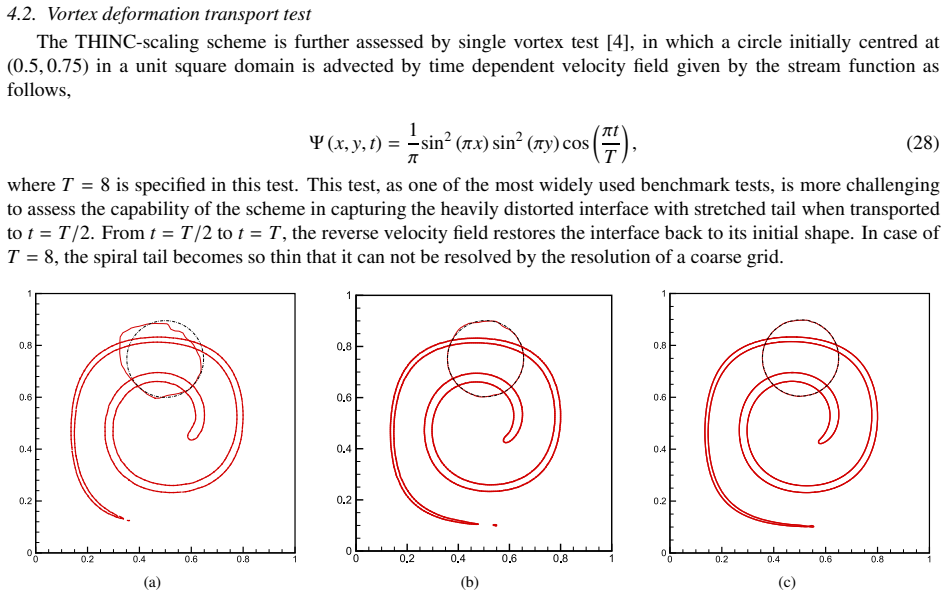
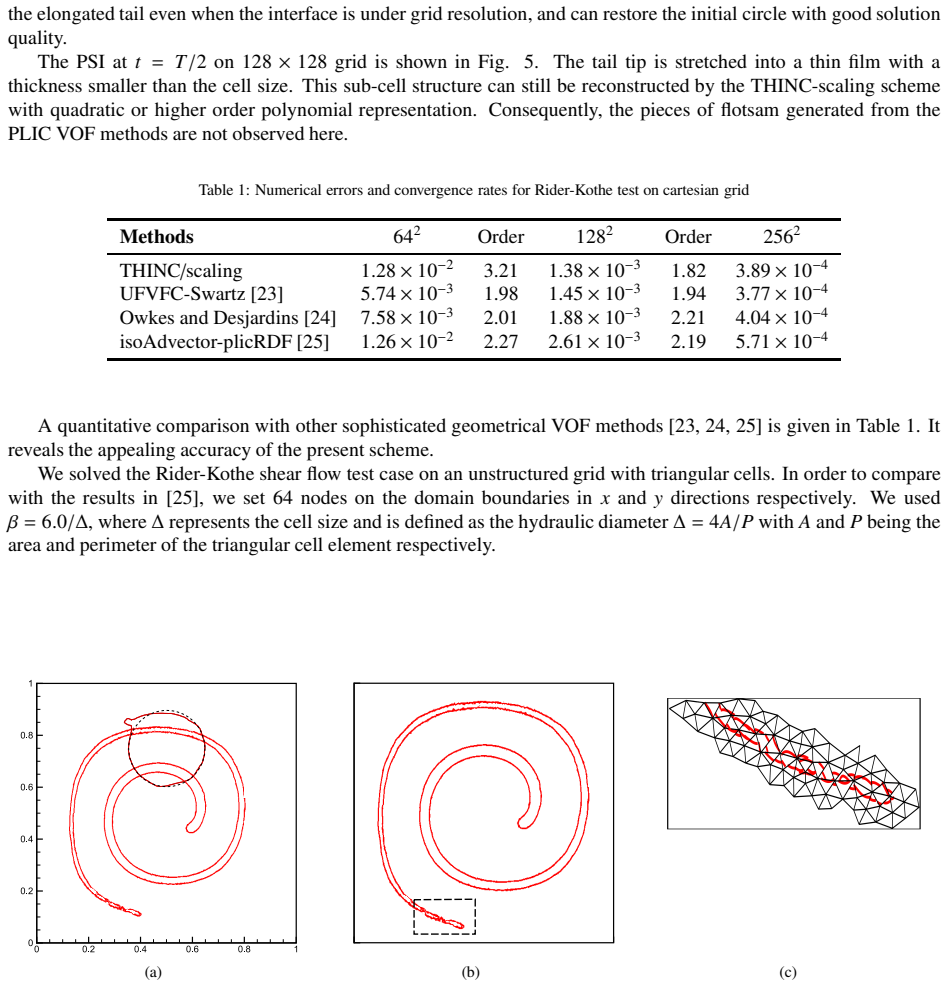
Run the Rider\u2013Kothe single-vortex test on a 128 by 128 grid for the full forward\u2013reverse cycle, measuring total VOF and the L1 error of the returned circle against the exact initial shape: if volume drifts beyond the reported L1 level or the tail region fails to return to the circle, the claimed simultaneous conservation and geometry are not achieved. A sharper check is to compare the stretched tail at $t=T/2$ on the same grid against a high-resolution reference; if the under-resolved filament is not reproduced, the polynomial reconstruction assumption fails.
Extended reading notes
Core claim
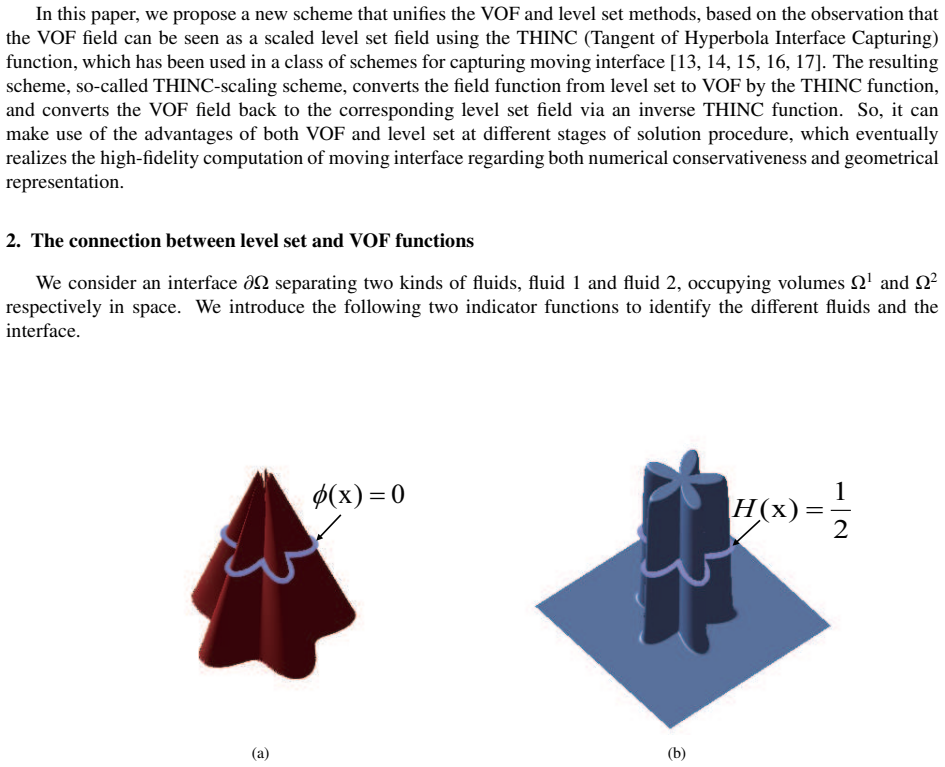
The central claim is that the THINC function $H(x)=\frac{1}{2}(1+\tanh(\beta P(x)))$, built from a level set polynomial $P$ constrained by the derivatives of the level set field, is exactly the object that connects the two methods. Given a cell-wise VOF value, the unknown shift $\varphi_\Delta$ in the polynomial argument is solved so that the cell average of $H$ matches the VOF value, which enforces volume conservation by construction. The inverse formula $\varphi(x)=\frac{1}{\beta}\tanh^{-1}(2H-1)$ then supplies the level set value at any point in the cell, including the departure point of a semi-Lagrangian trajectory, so the level set update needs no polynomial interpolation of the level set field itself. The zero contour of the shifted polynomial, called the Polynomial Surface of the Interface, gives the sub-cell interface geometry including position, normal, and curvature inside each interface cell. The paper argues that this two-way scaling unifies VOF and level set into a single conservative and geometrically faithful framework, and supports the argument with advection tests on structured and unstructured grids.
Load-bearing premise
The load-bearing premise is that the cell-wise polynomial fit to the discrete level set values remains accurate inside the cell even when an interface feature is thinner than the grid; if the fit is poor, the inverse THINC step hands an incorrect level set value to the next cycle, and the reinitialization may not fully repair it.
Editorial extensions
If this is right
- A single implementation can carry both the VOF field and the level set field, eliminating the need for two separate advection solvers and specialized coupling logic.
- The sub-cell interface from the polynomial zero contour gives direct access to normals and curvature, so surface-tension and sharp-interface terms can be computed from the same reconstruction that conserves volume.
- On unstructured triangular grids, the scheme reaches L1 errors lower than the compared geometrical VOF methods in the single-vortex test, suggesting that the algebraic tanh construction is not a compromise on unstructured meshes.
- The semi-Lagrangian level set update removes the high-order WENO reconstruction used in earlier coupled THINC/level set schemes, which simplifies the algorithm while keeping sub-cell resolution.
- The framework extends naturally to higher order interface polynomials, since the THINC scaling does not depend on a particular polynomial degree.
Reading between the lines
- A testable extension the paper does not run is a three-dimensional case with topological change; the tanh scaling should in principle handle breakup and merger because the VOF cell average is conserved, but the reinitialization step would need to re-seed the level set after topology changes.
- The conservation claim is exact only in the limit of large $\beta$; at finite $\beta$ the tanh function is a smeared Heaviside, so an editor would expect small volume drift on very long advection runs unless $\beta$ is increased with resolution.
- The same two-way scaling could be used as a post-processing tool: given a VOF field from any method, invert the tanh to obtain a smooth level set field and extract curvature from the polynomial surface, an application the paper only hints at.
- A stress test worth running is vortex deformation with the reverse flow turned off and the filament stretched beyond one cell width; the authors show such a case at $T/2$, but quantitative conservation of the under-resolved tail over long time is not measured.
Signed reviews
Editorial analysis
A structured set of objections, weighed in public.
Referee Report
Summary. This paper proposes a novel interface-capturing scheme, THINC-scaling, that unifies VOF (volume of fluid) and level set methods. The key idea is an analytic conversion between a level set function and a continuous Heaviside-like VOF function via the THINC function: the forward THINC scaling maps a level set polynomial to a VOF field, and the inverse THINC scaling maps the VOF field back to a level set field. The paper gives a solution procedure (Section 3) that reconstructs a cell-wise polynomial from the discrete level set, shifts it to satisfy the VOF conservation constraint, transports the VOF function by a finite volume scheme, updates the level set by a semi-Lagrangian step using the inverse THINC scaling, and reinitializes the level set away from the interface. Numerical tests are presented for Zalesak's solid body rotation and the Rider-Kothe single vortex on both Cartesian and triangular unstructured grids, with VOF L1 errors compared against several geometric VOF methods. The central claim is that the scheme simultaneously preserves the mass/volume conservation of VOF and the geometrical faithfulness of level set methods.
Significance. If the central claim is substantiated, the paper offers a practically useful unification: a conservative interface-capturing method with sub-cell geometric information that is simpler than PLIC-based VOF and avoids the conservation defect of pure level set methods. The analytic conversion formulas (6) and (9) are clean and exact, the VOF constraint (16) enforces conservation by construction, and the scheme extends naturally to unstructured grids. The benchmarks show VOF L1 errors competitive with or better than published geometric VOF methods. However, the geometric-fidelity claim is currently supported only by qualitative contour plots; no quantitative level set or geometric error is reported, and the treatment of the level set in interface cells raises a correctness question that the paper does not address. For these reasons the result is promising but not yet fully established.
major comments (4)
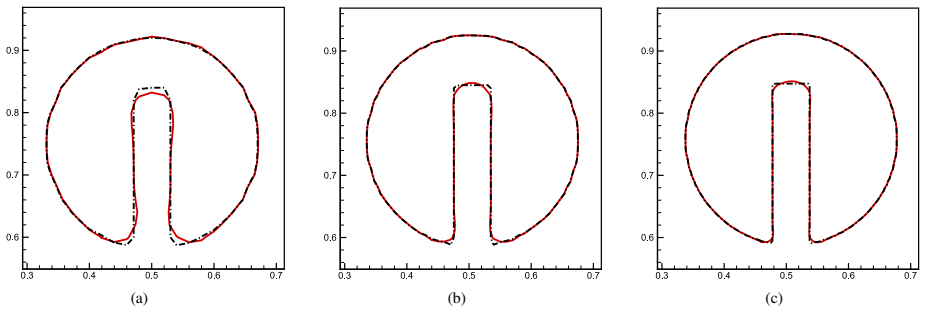
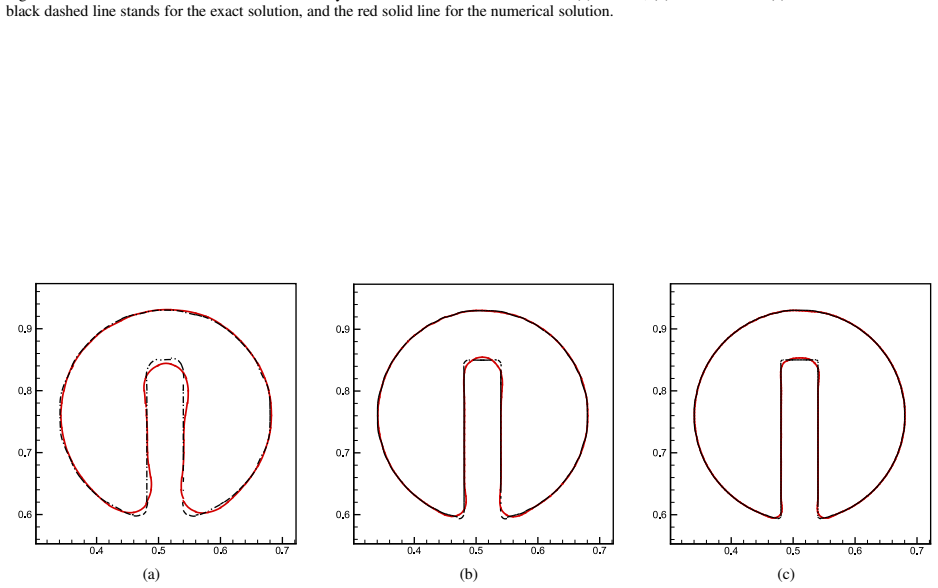
- [Section 4, Eq. (26)] The quantitative assessment is limited to the VOF L1 error defined in Eq. (26). The abstract and Section 5 claim that THINC-scaling preserves the geometrical faithfulness of the level set method, but no error measure for the level set field, interface position, normal, or curvature is reported. Figures 4-6 show qualitative PSI plots only. Since geometric fidelity is the distinguishing advantage over algebraic VOF methods, please add quantitative geometry diagnostics, such as error in the zero-contour position relative to the exact solution, normal and curvature errors, or a measure of signed-distance accuracy in interface cells, for the Zalesak and vortex tests.
- [Section 3, Steps 4.2 and 5] In an interface cell, the inverse THINC scaling (23) yields phi(x) = psi_id(x) = P_id(x) + phi_delta, which is an algebraic distance to the PSI, not a signed distance. Step 5 reinitializes only cells away from the interface, so these non-signed-distance values persist in interface cells. The next Step 1 then fits P_i to a stencil that mixes reinitialized signed-distance values with non-reinitialized algebraic-distance values; this mismatch can bias the polynomial fit, and Step 2 only shifts the polynomial rather than correcting its shape. The paper does not quantify this effect. Please verify that the level set remains a consistent signed-distance-like function in interface cells, for example by reporting |grad phi| in interface cells or by testing sensitivity to the reinitialization band.
- [Section 3, Step 1 and Remark 6] The sub-cell geometric fidelity claim relies on a single polynomial P_i per cell. For a thin filament whose two interface branches pass through the same cell, as in the vortex test at t=T/2 (Fig. 5), a single polynomial zero set can represent the two branches only in special cases; in general the PSI will place the interface on an averaged curve. The manuscript provides no geometry error data for the thin tail region, so this limitation is not assessed. Please add a quantitative study of the filament region or explicitly discuss the topological limitation of a single polynomial representation.
- [Section 4, Tables 1 and 2] No comparison is made with the coupled THINC/level set method of Ref. [17], although Remark 5 identifies the semi-Lagrangian inverse-THINC level set update as the essential difference from [17]. A direct comparison with [17] on the same benchmarks is needed to substantiate that the new update rule is at least as accurate as the HJ-WENO update it replaces.
minor comments (6)
- [Abstract and Section 5] There are typographical errors: 'samectime' in the abstract and 'unstructured and unstructured grids' in Section 5 should read 'structured and unstructured grids'.
- [Section 2 and Fig. 1] The caption of Fig. 1 contains garbled text ('0) x (/g32/g73'), and the phrase 'VOF velue' in Section 2 should be 'VOF value'.
- [Section 2, Eq. (8)] The notation in Eq. (8), using dx, dy, dz and D, is unclear; a multi-index notation would make the constraint condition easier to read.
- [Section 3, Step 2] Existence and uniqueness of the solution phi_delta to Eq. (16) are not discussed. Since the Newton iteration is referenced to [16], a brief remark on the monotonicity of the left-hand side in phi_delta would help.
- [Section 4, Table 1] The header of Table 1 is corrupted ('Methods 642 Order 128 2 Order 256 2'); the formatting should be cleaned up.
- [Section 4] The polynomial order p is fixed at 2 in all numerical tests, and no study of the dependence on p is reported. Since the paper emphasizes high-order interface representation, a p-convergence test or a discussion of the practical range of p would strengthen the claim.
Circularity Check
No significant circularity: the THINC-scaling scheme is self-consistent and validated against external benchmarks.
full rationale
THINC-scaling is a numerical scheme, not an empirical model, and its derivation chain is self-consistent without reusing its inputs as predictions. The conversion formulas (6) and (9) are analytic bijections between the level set and THINC/VOF fields; the polynomial P_i in Step 1 is reconstructed from the discrete level set field, and the cell-wise THINC function (17) is constrained by the VOF value through Eq. (16), which is a conservation constraint rather than a fitted parameter. The level set update in Step 4.2 uses a semi-Lagrangian evaluation of the reconstructed field at the departure point; this is exactly the inverse-THINC evaluation of the same reconstruction, so it does not introduce an independent prediction that could reduce to the input by construction. The only free parameter, beta, is set by the usual THINC practice (Remark 7) and not tuned to benchmark results. The scheme is validated against external benchmarks (Zalesak [22], Rider-Kothe [4]) and compared with independent methods [23,24,25]. Self-citations to [13-17] provide prior implementation details and THINC background, but the central claim—mass-conservative and geometrically faithful interface capturing—does not rest on an unverified self-citation; the numerical tests and analytic formulas carry the argument. Therefore no circular step is identifiable.
Assumptions & free parameters
free parameters (3)
- Steepness parameter beta =
6 (structured), 6/Delta (unstructured)
- Volume fraction threshold epsilon =
1e-8
- Polynomial order p =
2 (quadratic)
assumptions (3)
- domain assumption The interface is advected by a prescribed velocity field without mass transfer, so the VOF and level set evolution equations (11) and (12) hold.
- domain assumption The level set function can be accurately approximated cell-wise by a polynomial of degree p with coefficients obtained from neighboring level set values via Lagrange interpolation or least squares.
- ad hoc to paper The steepness parameter beta=6 gives a sufficiently sharp transition to approximate the Heaviside function while remaining differentiable.
Cite this review
Pith. "Pith review of THINC-scaling scheme that unifies VOF and level set methods." pith.science (2026). https://pith.science/paper/Q2GXA773
@misc{pith2026190804529,
  author       = {Pith},
  title        = {Pith review of: THINC-scaling scheme that unifies VOF and level set methods},
  year         = {2026},
  howpublished = {\url{https://pith.science/paper/Q2GXA773}},
  note         = {Machine review of arXiv:1908.04529}
}
read the original abstract
We present a novel interface-capturing scheme, THINC-scaling, to unify the VOF (volume of fluid) and the level set methods, which have been developed as two completely different approaches widely used in various applications. The THINC-scaling scheme preserves at the samectime the advantages of both VOF and level set methods, i.e. the mass/volume conservation of the VOF method and the geometrical faithfulness of the level set method. THINC-scaling scheme allows to represent interface with high-order polynomials, and has algorithmic simplicity which eases its implementation in unstructured grids.
Figures
Figures from the paper (3 more)

Reference graph
Works this paper leans on
-
[17]
L. Qian, Y . Wei, F. Xiao, Coupled THINC and level set meth od: A conservative interface capturing scheme with high-or der surface represen- tations, Journal of Computational Physics 373 (2018) 284–3 03
work page 2018
-
[1]
C. W. Hirt, B. D. Nichols, V olume of fluid (VOF) method for t he dynamics of free boundaries, Journal of computational ph ysics 39 (1) (1981) 201–225
work page 1981
-
[2]
D. L. Y oungs, Time-dependent multi-material flow with la rge fluid distortion, Numerical methods for fluid dynamics
-
[3]
B. Lafaurie, C. Nardone, R. Scardovelli, S. Zaleski, G. Z anetti, Modelling merging and fragmentation in multiphase flows with SURFER, Journal of Computational Physics 113 (1) (1994) 134–147
work page 1994
-
[4]
W. J. Rider, D. B. Kothe, Reconstructing volume tracking , Journal of computational physics 141 (2) (1998) 112–152
work page 1998
-
[5]
R. Scardovelli, S. Zaleski, Analytical relations conne cting linear interfaces and volume fractions in rectangula r grids, Journal of Computa- tional Physics 164 (1) (2000) 228–237
work page 2000
- [6]
-
[7]
J. A. Sethian, Level set methods and fast marching method s: evolving interfaces in computational geometry, fluid mec hanics, computer vision, and materials science, vol. 3, Cambridge universit y press, 1999
work page 1999
Show all 25 references
-
[8]
Osher, R
S. Osher, R. Fedkiw, Implicit Functions, in: Level Set Me thods and Dynamic Implicit Surfaces, Springer, 3–16, 2003
2003
-
[9]
Sussman, E
M. Sussman, E. G. Puckett, A coupled level set and volume- of-fluid method for computing 3D and axisymmetric incompres sible two-phase flows, Journal of computational physics 162 (2) (2000) 301–3 37
2000
-
[10]
M´ enard, S
T. M´ enard, S. Tanguy, A. Berlemont, Coupling level set/VOF/ghost fluid methods: V alidation and application to 3D simula tion of the primary break-up of a liquid jet, International Journal of Multipha se Flow 33 (5) (2007) 510–524
2007
-
[11]
Y ang, A
X. Y ang, A. J. James, J. Lowengrub, X. Zheng, V . Cristini , An adaptive coupled level-set /volume-of-fluid interface capturing method for unstructured triangular grids, Journal of Computational P hysics 217 (2) (2006) 364–394
2006
-
[12]
D. Sun, W. Tao, A coupled volume-of-fluid and level set (V OSET) method for computing incompressible two-phase flows, International Journal of Heat and Mass Transfer 53 (4) (2010) 645–655
2010
-
[13]
F. Xiao, Y . Honma, T. Kono, A simple algebraic interface capturing scheme using hyperbolic tangent function, Inter national Journal for Numerical Methods in Fluids 48 (9) (2005) 1023–1040
2005
-
[14]
F. Xiao, S. Ii, C. Chen, Revisit to the THINC scheme: a sim ple algebraic VOF algorithm, Journal of Computational Phys ics 230 (19) (2011) 7086–7092
2011
-
[15]
S. Ii, K. Sugiyama, S. Takeuchi, S. Takagi, Y . Matsumoto , F. Xiao, An interface capturing method with a continuous fu nction: The THINC method with multi-dimensional reconstruction, Journal of Computational Physics 231 (5) (2012) 2328–2358
2012
-
[16]
B. Xie, F. Xiao, Toward e fficient and accurate interface capturing on arbitrary hybrid unstructured grids: The THINC method with quadratic surface representation and Gaussian quadrature, Journal o f Computational Physics 349 (2017) 415–440
2017
-
[18]
Shu, Total-variation-diminishing time discret izations, SIAM J
C.-W. Shu, Total-variation-diminishing time discret izations, SIAM J. Sci. Stat. Comput. 9 (1988) 1073–1084
1988
-
[19]
Zhao, A fast sweeping method for eikonal equations, M athematics of computation 74 (250) (2005) 603–627
H. Zhao, A fast sweeping method for eikonal equations, M athematics of computation 74 (250) (2005) 603–627
2005
-
[20]
Dianat, M
M. Dianat, M. Skarysz, A. Garmory, A Coupled Level Set an d V olume of Fluid method for automotive exterior water manag ement applica- tions, International Journal of Multiphase Flow 91 (2017) 1 9–38
2017
-
[21]
Strain, Semi-Lagrange methods for level set equatio ns, Journal of Computational Physics 2 (1999) 498–533
J. Strain, Semi-Lagrange methods for level set equatio ns, Journal of Computational Physics 2 (1999) 498–533
1999
-
[22]
S. T. Zalesak, Fully multidimensional flux-corrected t ransport algorithms for fluids, Journal of computational ph ysics 31 (3) (1979) 335–362
1979
-
[23]
Maric, H
T. Maric, H. Marschall, D. Bothe, An enhanced un-split f ace-vertex flux-based V oF method, Journal of computational physics 371 (2018) 967–993
2018
-
[24]
Owkes, O
M. Owkes, O. Desjardins, A computational framework for conservative, three-dimensional, unsplit, geometric tra nsport with application to the volume-of-fluid (VOF) method, Journal of computational physics 270 (2014) 587–612
2014
-
[25]
Scheufler, J
H. Scheufler, J. Roenby, Accurate and e fficient surface reconstruction from volume fraction data on g eneral meshes, Journal of computational physics 383 (2018) 1–23. 11
2018
Reviewed August 14, 2026 · model on record in the stance chip above.
Discussion (0). Continue with ORCID to comment.