REVIEW 4 major objections 6 minor 1 cited by
Adapting Large Language Models for Improving TCP Fairness over WiFi
T0 review · 4 major / 6 minor · reviewed 2026-08-11 · deepseek-v4-flash
Pith's one-line read A frozen Llama2-7B with a CNN encoder and a linear head can outperform DRL and standard CCAs at TCP fairness over WiFi by dynamically switching among Cubic, BBR, and PCC.
desk verdict A clean LLM-for-TCP recipe whose central claim about pre-training is untested; send to review but require an ablation and artifacts. read the letter →
The pith
A machine-rendered reading of the paper's core claim, the machinery that carries it, and where it could break.
The reading
What carries the argument
The mechanism is an integrated encoder plus a frozen LLM plus lightweight adapters. A 1D-CNN extracts temporal patterns from a four-metric time series (throughput, loss rate, RTT, sending rate); linear projections convert those features into token-like embeddings; layer normalization stabilizes them; the frozen Llama2-7B processes the embeddings; a trainable linear head outputs a probability distribution over the available CCAs in one step; and low-rank matrices update the weights as $W = W_0 + AB$ during fine-tuning. This design bridges the text-to-numbers modality gap, avoids autoregressive token-by-token generation, and keeps trainable parameters at about 1%.
What would settle it
Run TCP-LLM with a randomly initialized transformer of identical architecture, using the same CNN encoder, linear head, LoRA matrices, data, and training procedure, and compare accuracy plus the WiFi fairness metrics against the frozen-Llama2 version; if the random-initialization version performs as well, the paper's attribution of performance to pre-trained knowledge is not supported.
Extended reading notes
Core claim
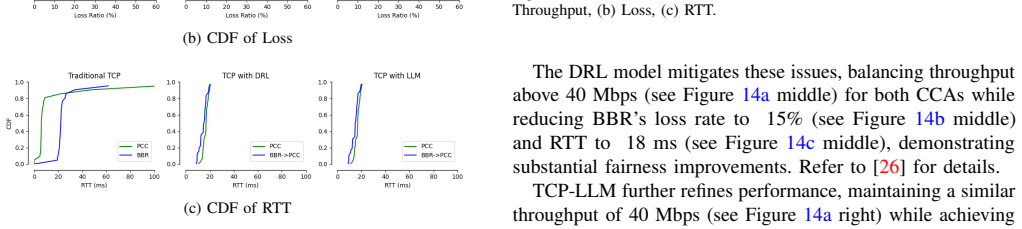
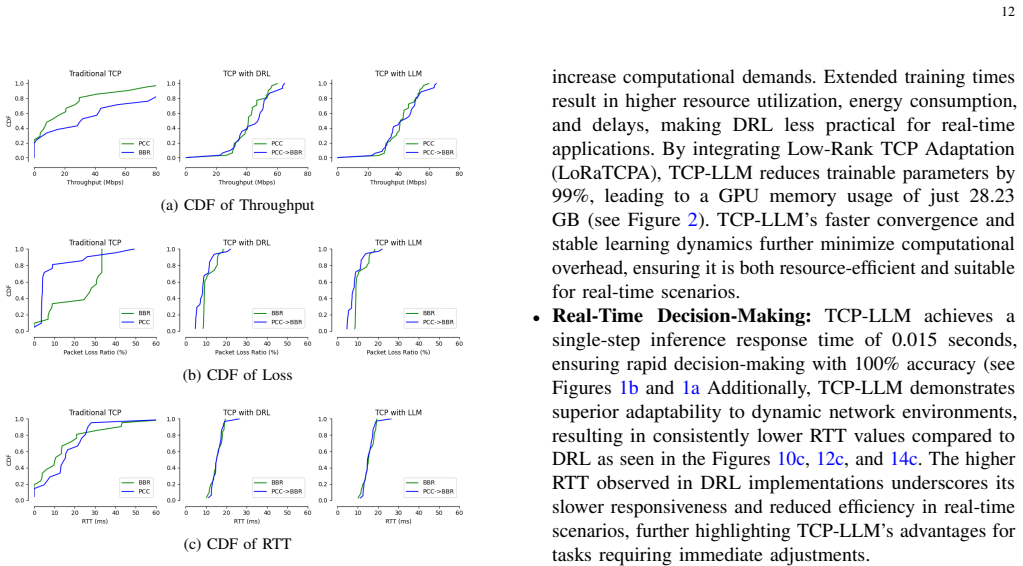
The paper's central claim is that TCP-LLM outperforms state-of-the-art CCAs and a DRL baseline on WiFi fairness, starvation prevention, and CCA selection. In a lab testbed with a 100 Mbps bottleneck and a real WiFi access point, the frozen LLM with CNN encoder, linear head, and LoRA produced more balanced throughput, lower loss, and lower RTT than both fixed algorithms and the DRL model across three CCA-mixing scenarios. The paper also reports that TCP-LLM reaches near-zero loss and near-perfect accuracy within about 40 epochs, and that it makes decisions in a single 0.015-second inference step, while the DRL baseline takes over 50 epochs to stabilize and shows larger oscillations.
Load-bearing premise
The load-bearing premise is that the frozen Llama2-7B's pre-trained knowledge is what produces the reported gains, rather than the small trainable CNN encoder, linear projection, and head; the paper never tests a randomly initialized transformer or a non-LLM control, so if pre-training contributes little, the central claim collapses into ordinary supervised CCA imitation.
Editorial extensions
If this is right
- A single frozen LLM can be adapted to several TCP tasks by swapping the linear head and low-rank matrices, removing the need to design a new neural network per task.
- CCA switching can run in real time because the linear head emits a decision in one forward pass at 0.015 seconds, well below the autoregressive latency the paper measures.
- Fairness and starvation problems caused by BBR, Cubic, and PCC mixing can be reduced without retraining per scenario, since the paper reports near-perfect accuracy after about 40 epochs.
- Adapting a 7-billion-parameter LLM to TCP becomes affordable: 99% of parameters are frozen and GPU memory drops from 65.88 GB to 28.23 GB.
- The same framework can be applied to prediction tasks as well as decision-making tasks, because both use the same encoder and low-rank adaptation pipeline with different loss functions.
Reading between the lines
- Because the paper never compares against a randomly initialized transformer or a non-LLM model with the same CNN encoder and linear head, a clean attribution test would be to run that control and see whether pre-training actually explains the gains.
- The reported numbers come from one WiFi testbed with a 100 Mbps bottleneck; repeating the framework on 5G, satellite, or multi-hop paths would test whether the generalization claim extends beyond this topology.
- The encoder-plus-frozen-LLM pattern may transfer to other numerical time-series control problems in networking, such as adaptive bitrate selection or multipath scheduling, but the paper does not demonstrate that.
- The fair-sharing results on a single access point leave open how the approach would behave with many competing flows, mobile clients, or interference-driven loss, which are natural next experiments.
Signed reviews
Editorial analysis
A structured set of objections, weighed in public.
Referee Report
Summary. The paper proposes TCP-LLM, a framework that adapts a frozen Llama2-7B large language model to TCP control tasks by prepending a trainable 1D-CNN encoder, linear projection, LoRA adapters, and a linear classification head. The authors evaluate it on three tasks: flow fairness, starvation prevention, and CCA selection, using offline learning from datasets collected on a WiFi testbed. They report that TCP-LLM achieves faster convergence, lower loss, higher accuracy, and better throughput/loss/RTT trade-offs than a DRL baseline and than fixed CCAs (Cubic, BBR, PCC) in three transition scenarios.
Significance. If the empirical claims were fully supported, TCP-LLM would be a useful demonstration that a frozen decoder-only LLM can be adapted to CCA selection with a small trainable interface, potentially reducing engineering effort compared with bespoke DRL designs. The paper has concrete strengths: the architecture is described in sufficient detail to be reproduced, the parameter-efficiency claim (99% reduction in trainable parameters, 28.23 GB GPU memory) is quantified, and the single-step inference latency of 0.015 s is a clear and relevant number. The comparison against DRL and classical CCAs is a reasonable first benchmark set. However, the manuscript does not currently provide the ablation, statistical detail, or data/code release needed to verify the central attribution of the gains to the LLM's pre-trained knowledge.
major comments (4)
- [Sections IV, V, VII.A; Figures 8-9] The central claim that TCP-LLM 'leverages pre-trained capabilities' is not supported by the experimental design. All trainable components (the CNN encoder, linear projection, LoRA matrices A and B, and the linear TCP-LLM head) operate outside the frozen Llama2-7B weights. The reported accuracy and performance gains in Figures 8-15 could therefore be produced entirely by these small trainable modules, with the frozen LLM contributing little or nothing. The paper does not compare against a randomly initialized transformer with the same encoder/head, nor against a non-LLM model with the same encoder/head. Without such an ablation, the claim in Section VII.A that TCP-LLM 'leverages pre-trained capabilities to dynamically adapt to unseen conditions' is an attribution that the experiments cannot establish. This is a load-bearing issue because the paper's stated novelty is the use of pre-trained knowledge, not merely the addition of a small supervised network.
- [Section VI.C (Scenario 1) and Section VII.C] There is an internal inconsistency in the reported TCP-LLM throughput for the Cubic/BBR transition. Section VI.C, Scenario 1 states that TCP-LLM achieves 'even higher throughput (42 Mbps; Figure 10a, right)' for the BBR-to-Cubic transition, whereas Section VII.C states that 'TCP-LLM balanced Cubic and BBR flows at 45 Mbps and 40 Mbps (Figure 10a)'. The paper does not reconcile these two numbers. In addition, the surrounding text says Cubic achieves a median throughput of 80 Mbps, which makes the statement that 42 Mbps is 'higher' than the traditional setup confusing unless the comparison is only to BBR's 7 Mbps. These discrepancies undermine the precision of the empirical evidence and need to be corrected and clarified.
- [Figures 8-15 and Section VI] The empirical evaluation lacks the statistical information needed to support the claim of 'significant improvements'. Figures 8 and 9 show training/test loss and accuracy curves without error bars or multiple runs, and Figures 10-15 present box plots and CDFs without stating the number of independent repetitions, seeds, or confidence intervals. The paper also does not report whether the DRL baseline was retrained under exactly the same data collection and testbed conditions as TCP-LLM, or whether the DRL results are taken from the authors' prior work. Without this information, the comparisons cannot be quantitatively assessed. The authors should provide per-run results with error bars or CIs, specify the number of runs, and clearly describe the DRL training setup.
- [Section VI (Experimental Setup) and overall reproducibility] The paper does not release code, training datasets, or the evaluation scripts, and the description of the training data is incomplete (e.g., no dataset size, no sampling procedure, no train/test split details beyond '80 epochs'). Since the paper's conclusions depend entirely on the reported empirical comparisons, the absence of reproducibility artifacts makes it impossible for a reviewer or reader to verify the claims. Releasing the code and data, or at least a detailed data card and training configuration, should be a condition for publication.
minor comments (6)
- [Figure 1 caption] The caption contains a typo: 'Answer Validiy' should be 'Answer Validity'.
- [Figure 2 caption] The caption is grammatically unclear: 'which is evident by the 1% parameters with a GPU of 28.23 GB' should be reworded, for example to 'which is evident from the 1% trainable parameters and the 28.23 GB GPU memory requirement'.
- [Section III] The sentence 'The auto-regressive nature of LLMs' response generation, illustrated in presents significant challenges' is missing a noun after 'in'; it should refer to a specific figure or subsection.
- [Section IV.C.1] The reward formula 'reward = Throughput / Latency + 1 - LossRate' is ambiguous; parentheses should clarify whether it is Throughput/(Latency+1) - LossRate or (Throughput/Latency) + 1 - LossRate, and the units of the quantities should be specified.
- [Section VII.B] The phrase 'see Figures 1b and 1a Additionally' is missing a period and should be split into two sentences; Figure 1a appears to show invalid outputs rather than accuracy, so the reference should be checked.
- [Algorithms 1-4] The algorithms are presented in an informal pseudocode style and contain inconsistencies (e.g., Algorithm 3's teacher-forcing branch is not defined, and Algorithm 4's input mentions a 'TCP-related model' while the text says the pre-trained model is Llama2). Clarify the formal forward pass and the exact role of teacher forcing.
Circularity Check
No significant circularity: TCP-LLM's network-level claims are tested against external CCAs and measured testbed outcomes; the pre-training attribution gap is an experimental control issue, not a derivation that assumes its conclusion.
full rationale
The derivation chain in this paper is not circular. TCP-LLM's outputs—selected CCAs and the resulting throughput, loss, and RTT—are evaluated against measured testbed data and against fixed, external algorithms (Cubic, BBR, PCC). The training objectives in Section IV.C are imitation/offline-RL losses (L_sl = F_sl(y, yhat), L_rl = F_rl(a, ahat)) that fit model predictions to collected trajectory labels, but the paper's headline network-level claims are not computed from those labels; they are measured after deployment. The only self-citation, [26], supplies the DRL baseline and motivation; since the comparison also includes standard CCAs and externally measured metrics, the conclusion does not reduce to that citation. The most serious weakness—the absence of a randomly-initialized-transformer or non-LLM control—means the claim that frozen Llama2 pre-training is causally responsible for the gains is unsupported, and there is also an internal inconsistency in the reported Scenario 1 throughput (42 Mbps in Section VI.C vs 45/40 Mbps in Section VII.C). These are evidence-quality and attribution problems, not definitional or self-referential reductions; no equation or fitted parameter equals the target result by construction. Therefore no circularity step is identified.
Assumptions & free parameters
free parameters (3)
- LoRA rank r and resulting trainable parameter count =
Not reported
- Reward or return formula coefficients =
reward = Throughput/(Latency + 1) - LossRate
- Training hyperparameters =
Not reported
assumptions (4)
- ad hoc to paper Numerical TCP metrics encoded by a 1D-CNN plus linear layers preserve enough temporal structure for Llama2-7B to act on them.
- domain assumption Experience data collected from existing CCAs and an existing non-LLM policy contains correct action labels for fair CCA selection.
- domain assumption A 100-second single-router WiFi testbed with a 100 Mbps bottleneck and FIFO queue is representative of dynamic heterogeneous networks.
- standard math The standard LoRA decomposition W = W0 + A B is a valid parameterization for adapting an LLM to TCP tasks.
Cite this review
Pith. "Pith review of Adapting Large Language Models for Improving TCP Fairness over WiFi." pith.science (2026). https://pith.science/paper/Q2QJQ7GP
@misc{pith2026241218200,
  author       = {Pith},
  title        = {Pith review of: Adapting Large Language Models for Improving TCP Fairness over WiFi},
  year         = {2026},
  howpublished = {\url{https://pith.science/paper/Q2QJQ7GP}},
  note         = {Machine review of arXiv:2412.18200}
}
read the original abstract
The new transmission control protocol (TCP) relies on Deep Learning (DL) for prediction and optimization, but requires significant manual effort to design deep neural networks (DNNs) and struggles with generalization in dynamic environments. Inspired by the success of large language models (LLMs), this study proposes TCP-LLM, a novel framework leveraging LLMs for TCP applications. TCP-LLM utilizes pre-trained knowledge to reduce engineering effort, enhance generalization, and deliver superior performance across diverse TCP tasks. Applied to reducing flow unfairness, adapting congestion control, and preventing starvation, TCP-LLM demonstrates significant improvements over TCP with minimal fine-tuning.
Figures


Figures from the paper (11 more)


Forward citations
Cited by 1 Pith paper
-
Multi-User SLNR-Based Precoding With Gold Nanoparticles in Vehicular VLC Systems
Gold-nanoparticle decorrelation of LED channels plus optimized RGB ratios improves multi-user vehicular visible light communication rate and secrecy.
Reference graph
Works this paper leans on
-
[1]
Josh Achiam, Steven Adler, Sandhini Agarwal, Lama Ahmad, Ilge Akkaya, Florencia Leoni Aleman, Diogo Almeida, Janko Altenschmidt, Sam Altman, Shyamal Anadkat, et al. Gpt-4 technical report. arXiv preprint arXiv:2303.08774, 2023
arXiv 2023
-
[2]
Machine learning with computer networks: Techniques, datasets and models
Haitham Afifi, Sabrina Pochaba, Andreas Boltres, Dominic Laniewski, Janek Haberer, Paeleke Leonard, Reza Poorzare, Daniel Stolpmann, Nikolas Wehner, Adrian Redder, et al. Machine learning with computer networks: Techniques, datasets and models. IEEE access, 2024
work page 2024
-
[3]
Starvation in end-to-end congestion control
Venkat Arun, Mohammad Alizadeh, and Hari Balakrishnan. Starvation in end-to-end congestion control. In Proceedings of the ACM SIGCOMM 2022 Conference, pages 177–192, 2022
work page 2022
-
[4]
An empirical evaluation of generic convolutional and recurrent networks for sequence modeling
Shaojie Bai, J Zico Kolter, and Vladlen Koltun. An empirical evaluation of generic convolutional and recurrent networks for sequence modeling. arXiv preprint arXiv:1803.01271 , 2018
arXiv 2018
-
[5]
Bbr: congestion-based congestion control
Neal Cardwell, Yuchung Cheng, C Stephen Gunn, Soheil Hassas Yeganeh, and Van Jacobson. Bbr: congestion-based congestion control. Communications of the ACM , 60(2):58–66, 2017
work page 2017
-
[6]
Auto: Scaling deep reinforcement learning for datacenter-scale automatic traffic optimization
Li Chen, Justinas Lingys, Kai Chen, and Feng Liu. Auto: Scaling deep reinforcement learning for datacenter-scale automatic traffic optimization. In Proceedings of the 2018 conference of the ACM special interest group on data communication , pages 191–205, 2018
work page 2018
-
[7]
{PCC} vivace:{Online- Learning} congestion control
Mo Dong, Tong Meng, Doron Zarchy, Engin Arslan, Yossi Gilad, Brighten Godfrey, and Michael Schapira. {PCC} vivace:{Online- Learning} congestion control. In 15th USENIX Symposium on Networked Systems Design and Implementation (NSDI 18) , pages 343–356, 2018
work page 2018
-
[8]
Cubic: a new tcp-friendly high- speed tcp variant
Sangtae Ha, Injong Rhee, and Lisong Xu. Cubic: a new tcp-friendly high- speed tcp variant. ACM SIGOPS operating systems review , 42(5):64–74, 2008
work page 2008
Show all 36 references
-
[9]
Lora: Low-rank adaptation of large language models
Edward J Hu, Yelong Shen, Phillip Wallis, Zeyuan Allen-Zhu, Yuanzhi Li, Shean Wang, Lu Wang, and Weizhu Chen. Lora: Low-rank adaptation of large language models. arXiv preprint arXiv:2106.09685 , 2021
2021 arXiv
-
[10]
Survey of hallucination in natural language generation
Ziwei Ji, Nayeon Lee, Rita Frieske, Tiezheng Yu, Dan Su, Yan Xu, Etsuko Ishii, Ye Jin Bang, Andrea Madotto, and Pascale Fung. Survey of hallucination in natural language generation. ACM Computing Surveys , 55(12):1–38, 2023
2023
-
[11]
Improving generalization for neural adaptive video streaming via meta reinforcement learning
Nuowen Kan, Yuankun Jiang, Chenglin Li, Wenrui Dai, Junni Zou, and Hongkai Xiong. Improving generalization for neural adaptive video streaming via meta reinforcement learning. In Proceedings of the 30th ACM International Conference on Multimedia , pages 3006–3016, 2022
2022
-
[12]
Layer normalization
Jimmy Lei Ba, Jamie Ryan Kiros, and Geoffrey E Hinton. Layer normalization. ArXiv e-prints, pages arXiv–1607, 2016
2016
-
[13]
Halueval: A large-scale hallucination evaluation benchmark for large language models
Junyi Li, Xiaoxue Cheng, Wayne Xin Zhao, Jian-Yun Nie, and Ji-Rong Wen. Halueval: A large-scale hallucination evaluation benchmark for large language models. arXiv preprint arXiv:2305.11747 , 2023
2023 arXiv
-
[14]
Chattwin: toward automated digital twin generation for data center via large language models
Minghao Li, Ruihang Wang, Xin Zhou, Zhaomeng Zhu, Yonggang Wen, and Rui Tan. Chattwin: toward automated digital twin generation for data center via large language models. In Proceedings of the 10th ACM International Conference on Systems for Energy-Efficient Buildings, Cities,...
2023
-
[15]
Dollm: How large language models understanding network flow data to detect carpet bombing ddos
Qingyang Li, Yihang Zhang, Zhidong Jia, Yannan Hu, Lei Zhang, Jianrong Zhang, Yongming Xu, Yong Cui, Zongming Guo, and Xinggong Zhang. Dollm: How large language models understanding network flow data to detect carpet bombing ddos. arXiv preprint arXiv:2405.07638 , 2024
2024 arXiv
-
[16]
Evolutionary-scale prediction of atomic-level protein structure with a language model
Zeming Lin, Halil Akin, Roshan Rao, Brian Hie, Zhongkai Zhu, Wenting Lu, Nikita Smetanin, Robert Verkuil, Ori Kabeli, Yaniv Shmueli, et al. Evolutionary-scale prediction of atomic-level protein structure with a language model. Science, 379(6637):1123–1130, 2023
2023
-
[17]
Cav3: Cache-assisted viewport adaptive volumetric video streaming
Junhua Liu, Boxiang Zhu, Fangxin Wang, Yili Jin, Wenyi Zhang, Zihan Xu, and Shuguang Cui. Cav3: Cache-assisted viewport adaptive volumetric video streaming. In 2023 IEEE Conference Virtual Reality and 3D User Interfaces (VR) , pages 173–183. IEEE, 2023
2023
-
[18]
Constrained decision transformer for offline safe reinforcement learning
Zuxin Liu, Zijian Guo, Yihang Yao, Zhepeng Cen, Wenhao Yu, Tingnan Zhang, and Ding Zhao. Constrained decision transformer for offline safe reinforcement learning. In International Conference on Machine Learning, pages 21611–21630. PMLR, 2023
2023
-
[19]
Learning scheduling algorithms for data processing clusters
Hongzi Mao, Malte Schwarzkopf, Shaileshh Bojja Venkatakrishnan, Zili Meng, and Mohammad Alizadeh. Learning scheduling algorithms for data processing clusters. In Proceedings of the ACM Special Interest Group on Data Communication , pages 270–288. Association for Computing Mach...
2019
-
[20]
Realtime mobile bandwidth prediction using lstm neural network and bayesian fusion
Lifan Mei, Runchen Hu, Houwei Cao, Yong Liu, Zifan Han, Feng Li, and Jin Li. Realtime mobile bandwidth prediction using lstm neural network and bayesian fusion. Computer Networks, 182:107515, 2020
2020
-
[21]
Interpreting deep learning-based networking systems
Zili Meng, Minhu Wang, Jiasong Bai, Mingwei Xu, Hongzi Mao, and Hongxin Hu. Interpreting deep learning-based networking systems. In Proceedings of the Annual conference of the ACM Special Interest Group on Data Communication on the applications, technologies, architectures, an...
2020
-
[22]
Towards the deployment of machine learning solutions in network traffic classification: A systematic survey
Fannia Pacheco, Ernesto Exposito, Mathieu Gineste, Cedric Baudoin, and Jose Aguilar. Towards the deployment of machine learning solutions in network traffic classification: A systematic survey. IEEE Communications Surveys & Tutorials, 21(2):1988–2014, 2018
1988
-
[23]
Revisiting tcp congestion control throughput models & fairness properties at scale
Adithya Abraham Philip, Ranysha Ware, Rukshani Athapathu, Justine Sherry, and Vyas Sekar. Revisiting tcp congestion control throughput models & fairness properties at scale. In Proceedings of the 21st ACM Internet Measurement Conference , pages 96–103, 2021
2021
-
[24]
Learning to harness bandwidth with multipath congestion control and scheduling
Shiva Raj Pokhrel and Anwar Walid. Learning to harness bandwidth with multipath congestion control and scheduling. IEEE Transactions on Mobile Computing , 22(2):996–1009, 2023
2023
-
[25]
Track: A new method from a re-examination of deep architectures for head motion prediction in 360 ◦ videos
Miguel Fabián Romero Rondón, Lucile Sassatelli, Ramón Aparicio-Pardo, and Frédéric Precioso. Track: A new method from a re-examination of deep architectures for head motion prediction in 360 ◦ videos. IEEE Transactions on Pattern Analysis and Machine Intelligence , 44(9):5681–...
2021
-
[26]
On the fairness of internet congestion control over wifi with deep reinforcement learning
Shyam Kumar Shrestha, Shiva Raj Pokhrel, and Jonathan Kua. On the fairness of internet congestion control over wifi with deep reinforcement learning. Future Internet, 16(9):330, 2024
2024
-
[27]
Llama 2: Open foundation and fine- tuned chat models
Hugo Touvron, Louis Martin, Kevin Stone, Peter Albert, Amjad Alma- hairi, Yasmine Babaei, Nikolay Bashlykov, Soumya Batra, Prajjwal Bhargava, Shruti Bhosale, et al. Llama 2: Open foundation and fine- tuned chat models. arXiv preprint arXiv:2307.09288 , 2023
2023 arXiv
-
[28]
Attention is all you need
A Vaswani. Attention is all you need. Advances in Neural Information Processing Systems, 2017
2017
-
[29]
Netllm: Adapting large language models for networking
Duo Wu, Xianda Wang, Yaqi Qiao, Zhi Wang, Junchen Jiang, Shuguang Cui, and Fangxin Wang. Netllm: Adapting large language models for networking. In Proceedings of the ACM SIGCOMM 2024 Conference , pages 661–678, 2024
2024
-
[30]
Pairwise proximal policy optimiza- tion: Harnessing relative feedback for llm alignment
Tianhao Wu, Banghua Zhu, Ruoyu Zhang, Zhaojin Wen, Kannan Ramchandran, and Jiantao Jiao. Pairwise proximal policy optimiza- tion: Harnessing relative feedback for llm alignment. arXiv preprint arXiv:2310.00212, 2023
2023 arXiv
-
[31]
Fairness improvement of congestion control with reinforcement learning
Meguru Yamazaki and Miki Yamamoto. Fairness improvement of congestion control with reinforcement learning. Journal of Information Processing, 29:592–595, 2021
2021
-
[32]
Learning in situ: a randomized experiment in video streaming
Francis Y Yan, Hudson Ayers, Chenzhi Zhu, Sadjad Fouladi, James Hong, Keyi Zhang, Philip Levis, and Keith Winstein. Learning in situ: a randomized experiment in video streaming. In 17th USENIX Symposium on Networked Systems Design and Implementation (NSDI 20) , pages 495–511, 2020
2020
-
[33]
Computers can learn from the heuristic designs and master internet congestion control
Chen-Yu Yen, Soheil Abbasloo, and H Jonathan Chao. Computers can learn from the heuristic designs and master internet congestion control. In Proceedings of the ACM SIGCOMM 2023 Conference, pages 255–274, 2023. 14
2023
-
[34]
Mm-llms: Recent advances in multimodal large language models
Duzhen Zhang, Yahan Yu, Chenxing Li, Jiahua Dong, Dan Su, Chenhui Chu, and Dong Yu. Mm-llms: Recent advances in multimodal large language models. arXiv preprint arXiv:2401.13601 , 2024
2024 arXiv
-
[35]
Opt: Open pre-trained transformer language models
Susan Zhang, Stephen Roller, Naman Goyal, Mikel Artetxe, Moya Chen, Shuohui Chen, Christopher Dewan, Mona Diab, Xian Li, Xi Victoria Lin, et al. Opt: Open pre-trained transformer language models. arXiv preprint arXiv:2205.01068, 2022
2022 arXiv
-
[36]
Secrets of rlhf in large language models part i: Ppo
Rui Zheng, Shihan Dou, Songyang Gao, Yuan Hua, Wei Shen, Binghai Wang, Yan Liu, Senjie Jin, Qin Liu, Yuhao Zhou, et al. Secrets of rlhf in large language models part i: Ppo. arXiv preprint arXiv:2307.04964 , 2023
2023 arXiv
Reviewed August 11, 2026 · model on record in the stance chip above.
Discussion (0). Continue with ORCID to comment.