REVIEW 3 major objections 5 minor 65 references
A Graph Approach to the Academic Publishing Network: A Heterogeneous Model and Structural Screening over OpenAlex Open Data
T0 review · 3 major / 5 minor · reviewed 2026-08-12 · deepseek-v4-flash
Pith's one-line read A heterogeneous graph model of scholarly publishing finds that after control matching, broad disciplinary scope is the only surviving structural signal, and graph-based prestige resists citation cartels about ten times better than…
desk verdict A careful, openly honest screening pipeline whose real contributions are the prominence confound and the death of insularity; the field-entropy signal still needs field-matched controls, and the abstract overstates it — but it deserves a serious referee. read the letter →
The pith
A machine-rendered reading of the paper's core claim, the machinery that carries it, and where it could break.
The reading
What carries the argument
The load-bearing machinery is the projection principle: instead of running algorithms directly on a mixed typed graph, the model derives homogeneous graphs—a directed Work-to-Work citation projection, an undirected weighted Author-to-Author co-authorship projection, and a Work-to-Field transitive mapping—and computes structural metrics there. The robust screening signal is field entropy, the Shannon entropy of a venue's field distribution, which operationalises 'disciplinary scope.' The prestige machinery is PageRank on the venue citation network with self-citations excluded, a network-prestige score that discounts citations from low-prestige sources and thereby resists bulk cartel citations. The matched case-control design, comparing delisted venues to size-matched still-indexed venues, is what separates the true signal from the prominence confound, and it is this combination of projection-based structural metrics and matched-control validation that carries the paper's argument.
What would settle it
A concrete test is to repeat the venue discrimination with controls matched additionally by disciplinary field and by age: if field entropy's AUC falls to about 0.5, the paper's main validation claim fails.
Extended reading notes
Core claim
On the paper's own terms, the central discovery is that in a controlled, size-matched comparison of venues delisted by major indexing services against still-indexed venues, most intuitive structural signals—citation counts, self-citation share, output volume—are confounded by prominence and lose their discrimination, leaving the Shannon entropy of the venue's disciplinary field distribution as the one robust structural marker (AUC 0.70). A second discovery is that a PageRank-style prestige score computed on the venue citation graph tracks the standard count-based impact proxy (Spearman 0.49) and is roughly ten times more resistant to an injected citation cartel (an 84-fold inflation of the count metric versus 8.5-fold for graph prestige). These results support the paper's larger claim that graph-based, projection-centred analysis of open bibliometric data can be a practical screening layer for publishing integrity.
Load-bearing premise
The size-matched, still-indexed control venues are an adequate comparison, so the surviving field-entropy signal (AUC 0.70) reflects the problematic nature of delisted venues rather than their different field mix or age.
Editorial extensions
If this is right
- Institutions can obtain research-intelligence outputs—research groups, cross-disciplinary bridges, and anomaly candidates—from open data on commodity hardware, complementing expert review rather than replacing it.
- The three screening detectors should be used to rank candidates with accompanying structural evidence, not to make binary integrity judgments.
- In publishing-integrity research, matched control designs are mandatory; naive case-control comparisons can mistake 'was prominent' for 'is problematic.'
- Venues with broadened disciplinary scope (scope creep) are the most defensible structural target for manual integrity review.
- Open graph-based prestige can serve as a drop-in replacement for count-based impact metrics with substantially greater resistance to simple citation-cartel attacks.
Reading between the lines
- A natural extension, not tested in the paper, is to monitor a venue's field entropy over time; if scope creep precedes delisting, an entropy-trajectory early-warning tool could be built.
- The demonstrated gaming resistance applies to one attack model (bulk fake citations from low-prestige sources); a determined attacker could first build prestige for fake venues, so practical use should pair the metric with cartel detection, as the paper itself notes.
- The prominence confound identified here likely affects several published 'predatory journal detector' results, and reanalysis with size-matched controls could be a low-cost test of that literature.
- Because matching was only by size and indexing status, the field-entropy result needs field- and age-matched replication before it is used operationally.
Editorial analysis
A structured set of objections, weighed in public.
Referee Report
Summary. The paper proposes a heterogeneous graph model of the academic publishing network over OpenAlex, with node/edge types, projections (citation and co-authorship), structural metrics, community detection, and three screening detectors. It demonstrates the methodology on an institutional corpus (VSB-TUO 2020–2025) and a worldwide LLM corpus, then reports a controlled venue-centric study (Study C) using journals delisted by Scopus/DOAJ as ground truth. The central empirical claims are: after size-matching controls, the only robust surviving discriminator of delisted venues is the breadth of disciplinary scope (field entropy, AUC 0.70, 95% CI [0.64;0.75]); and an open graph-based prestige measure (PageRank over the journal citation network) tracks a JIF proxy (Spearman 0.49) while being roughly an order of magnitude more resistant to a synthetic citation-cartel injection than count-based indicators. The paper releases the method as the open-source apnet library and emphasizes screening-with-evidence rather than binary classification.
Significance. If the claims hold, the paper makes two useful contributions: it provides a sober, falsifiable validation showing that a naïve case-control design produces a spurious 'prominence' signal, and it indicates that field-entropy breadth is the one structural feature that survives size matching in the full delisted set. It also demonstrates reproducible, commodity-hardware analysis of an open dataset, which is a concrete strength; the code release and explicit limitations statements support reproducibility. The PageRank gaming experiment is a testable, transparent robustness check. However, the significance of the empirical conclusions is conditional: the field-entropy result is threatened by the lack of field/age matching, and the gaming-resistance claim is based on a single arbitrarily parameterized attack model.
major comments (3)
- [§7.3, §7.5] The claim that 'the only robust surviving signal is the breadth of disciplinary scope (AUC 0.70)' is not yet established, because the controls are matched only by size and indexing status, not by field or age, as the manuscript itself acknowledges in §7.5. Field entropy is computed over OpenAlex fields, so if delisted venues are drawn disproportionately from broad multidisciplinary venues while size-matched still-indexed controls are field-specialized, the median entropy difference (2.33 vs. 1.82) could reflect legitimate differences in disciplinary breadth rather than an integrity-linked 'scope creep.' This is a direct threat to the load-bearing empirical claim. The authors should provide a field-stratified or field/age-matched comparison, or a regression that controls for OpenAlex field composition, and report the AUC within relevant field categories; without such an analysis, the surviving-signal conclusion remains ambiguous.
- [§7.4] The statement that PageRank is 'an order of magnitude more resistant to citation gaming than count-based indicators' is based on a single synthetic injection scenario (1,250 fictitious citations into one mid-prestige venue), giving inflation factors 84x vs. 8.5x. No confidence intervals or sensitivity analysis are reported, and the immediately subsequent Sybil attack (moving the venue from rank 172 to 12) shows that the resistance is highly conditional on the attack model. The claim should be qualified to the specific injection scenario, and the comparison should be repeated over a range of cartel sizes, numbers of fictitious citing venues, and target venue ranks, with identical attack budgets for both metrics.
- [§7.1] The size-matching protocol for the controls is underspecified. The text states that controls are 'size-comparable' and that up to 200 works per venue are sampled, but it does not state the matching variable(s), the matching algorithm (nearest-neighbor, caliper, exact), the matching ratio (one control per positive or several), or whether matching was performed with replacement. Without this information, the AUC values in Table 7 cannot be fully assessed or reproduced. The exact matching procedure and its code should be provided in the repository, along with diagnostics showing that the matching balances work count and other intended variables.
minor comments (5)
- [§6.5] The caption of Figure 7 says candidates for closed citation loops 'lie near the diagonal,' but the detector score is the product of the within-corpus citation share and within-corpus citation count; the relationship between the plotted axes and the score component should be stated more explicitly.
- [§7.3] The phrase 'the only robust signal' in the abstract and in the main text is used for the full positive set, but the following paragraph reports additional surviving features (FWCI, median citations, cites out) in the integrity subset; the wording should clarify that 'only' applies to the full delisted set, not to the integrity subset.
- [Appendix] The labeling of the case studies is inconsistent: the LLM corpus is called 'case study B' in an appendix while Study C is described as 'the third study'; the numbering is confusing and should be harmonized.
- [Table 3] Several author names in Table 3 contain broken or escaped diacritics (e.g., 'R\'obert'), and the table cells would benefit from rendering the names with proper Unicode characters.
- [§7.5] The statement that the evaluation is 'in-sample' is unclear because the study appears to compute descriptive AUCs without fitting any model; if no parameters are estimated, the term should be removed or replaced by a precise description of what is assessed on the same venues.
Circularity Check
No significant circularity: empirical claims are validated against external ground truth; the companion-review self-citation is motivational, not load-bearing.
full rationale
The paper's load-bearing claims (field-entropy AUC 0.70 and PageRank gaming resistance) are empirical measurements against external data—delisted journals from Scopus/DOAJ and an injected citation-cartel simulation—not parameters fitted to reproduce the claims. Study C explicitly refutes its own initial insularity hypothesis (self-citation share AUC 0.38), which is the opposite of a result forced by construction. The companion review [Šamárek & Martinek, under review] is cited as motivation, but none of the reported numbers depend on accepting that review's content; the method is implemented in apnet and checked against independent bibliometric validation studies (OpenAlex coverage, retraction literature, community-topology correspondence). The known weakness—matching "only by size and indexing status (not by field or age)" (Section 7.5)—is a potential confound in the external validation, not a circular reduction: the field-entropy signal could reflect field composition, but the prediction (AUC 0.70) is not definitionally tied to the control-selection rule. Similarly, PageRank's lower sensitivity to low-prestige citations is a designed property, but the 84x vs 8.5x comparison is a simulated outcome, not a tautology. No fitted parameter is renamed as a prediction, and no uniqueness theorem or loaded self-citation is used to force a conclusion.
Assumptions & free parameters
free parameters (5)
- one-hop citation neighbourhood threshold =
2 (minimum citations from corpus)
- per-venue work sample cap =
200 works per venue
- injected citation cartel size =
1,250 fictitious citations
- PageRank damping factor and normalization
- betweenness pivot sampling size
assumptions (5)
- domain assumption Delisting from Scopus or DOAJ is a valid indicator that a journal is problematic.
- domain assumption OpenAlex metadata are sufficiently complete and valid for the structural analysis.
- ad hoc to paper The one-hop citation neighbourhood with threshold >=2 captures the relevant citation context.
- ad hoc to paper The synthetic citation-cartel injection model is representative of real citation gaming.
- domain assumption Standard network algorithms applied to homogeneous projections produce meaningful structural signals.
Cite this review
Pith. "Pith review of A Graph Approach to the Academic Publishing Network: A Heterogeneous Model and Structural Screening over OpenAlex Open Data." pith.science (2026). https://pith.science/paper/Q2TKRNHE
@misc{pith2026260810774,
  author       = {Pith},
  title        = {Pith review of: A Graph Approach to the Academic Publishing Network: A Heterogeneous Model and Structural Screening over OpenAlex Open Data},
  year         = {2026},
  howpublished = {\url{https://pith.science/paper/Q2TKRNHE}},
  note         = {Machine review of arXiv:2608.10774}
}
read the original abstract
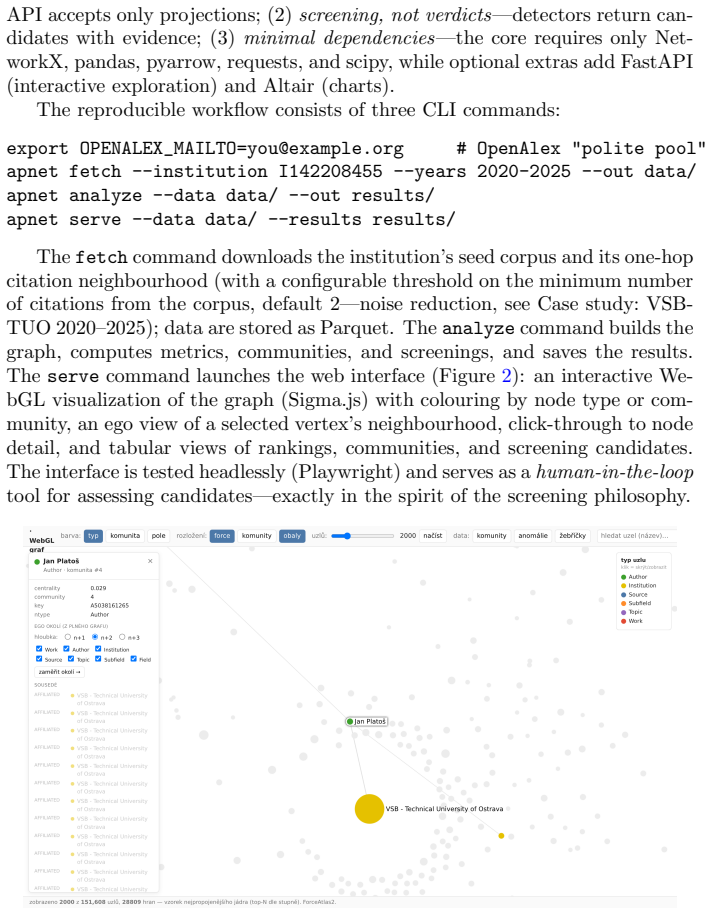
The academic publishing ecosystem is a vast, heterogeneous network of works, authors, institutions, journals, and topics. Traditional scientometrics reduces it to isolated tabular indicators (h-index, Impact Factor) that ignore topological context and are not designed to capture coordinated illegitimate practices. Building on our companion review, which proposed graph analysis of publishing integrity, this paper implements that approach. We define a heterogeneous multivariate graph model over OpenAlex open data (seven node types, seven edge types) and a methodology based on projections (citation and co-authorship networks), interpretable structural metrics, community detection, and three screening detectors of anomalous publishing patterns. We deliberately avoid binary classification: detectors return ranked candidates with explicit structural evidence for human assessment. On the institutional corpus of VSB - Technical University of Ostrava (2020-2025) with its one-hop citation neighbourhood, community detection recovers real research groups, centralities identify cross-disciplinary bridges, and the screenings flag dense co-authorship cliques, locally closed citation loops, and thematically isolated venues. On a second, venue-centric corpus with external ground truth (journals delisted by Scopus and DOAJ) and size-matched controls, a naive case-control design yields seemingly strong but spurious detectors (a prominence confound), whereas after matching the only robust signal is the breadth of disciplinary scope (AUC 0.70); an open graph-based prestige measure (PageRank over the journal citation network) tracks a JIF proxy while being an order of magnitude more resistant to citation gaming than count-based indicators. We release the method as the open-source library apnet with a reproducible CLI workflow and a web interface; the analysis runs on commodity hardware in minutes.
Figures


Figures from the paper (6 more)


Reference graph
Works this paper leans on
-
[1]
J. P. Alperin, J. Portenoy, K. Demes, V. Larivi \` e re, and S. Haustein. An analysis of the suitability of OpenAlex for bibliometric analyses, 2024
work page 2024
-
[5]
C. Candal-Pedreira, J. S. Ross, A. Ruano-Ravina, D. S. Egilman, E. Fern \' a ndez, and M. P \' e rez-R \' i os. Retracted papers originating from paper mills: cross sectional study. BMJ, 379: 0 e071517, 2022. doi:10.1136/bmj-2022-071517
-
[8]
L. Delgado-Quir \' o s and J. L. Ortega. Completeness degree of publication metadata in eight free-access scholarly databases. Quantitative Science Studies, 5 0 (1): 0 31--49, 2024. doi:10.1162/qss_a_00286
-
[10]
Directory of Open Access Journals , 2003
Directory of Open Access Journals . Directory of Open Access Journals , 2003. URL https://doaj.org/. Accessed: 2024-03-02
work page 2003
-
[13]
I. Fister Jr., I. Fister, and M. Perc. Toward the Discovery of Citation Cartels in Citation Networks . Frontiers in Physics, 4: 0 49, 2016. doi:10.3389/fphy.2016.00049
arXiv 2016
-
[15]
S. Fortunato, C. T. Bergstrom, K. B \" o rner, J. A. Evans, D. Helbing, S. Milojevi \' c , A. M. Petersen, F. Radicchi, R. Sinatra, B. Uzzi, A. Vespignani, L. Waltman, D. Wang, and A.-L. Barab \' a si. Science of science. Science, 359 0 (6379): 0 eaao0185, 2018. doi:10.1126/science.aao0185
-
[18]
A. J. Gates and A.-L. Barab \' a si. Reproducible science of science at scale: pyscisci. Quantitative Science Studies, 4 0 (3): 0 700--710, 2023. doi:10.1162/qss_a_00260
-
[19]
Grudniewicz, D
A. Grudniewicz, D. Moher, K. D. Cobey, G. L. Bryson, S. Cukier, K. Allen, C. Ardern, L. Balcom, T. Barros, M. Berger, J. B. Ciro, L. Cugusi, M. R. Donaldson, M. Egger, I. D. Graham, M. Hodgkinson, K. M. Khan, M. Mabizela, A. Manca, K. Milzow, J. Mouton, M. Muchenje, T. Olijhoek, A. Ommaya, B. Patwardhan, D. Poff, L. Proulx, M. Rodger, A. Severin, M. Strin...
2019
Show all 65 references
-
[20]
A. A. Hagberg, D. A. Schult, and P. J. Swart. Exploring Network Structure , Dynamics , and Function using NetworkX . In Proceedings of the 7th Python in Science Conference ( SciPy 2008) , pages 11--15, 2008. URL https://proceedings.scipy.org/articles/TCWV9851
2008
-
[21]
G. Jin, X. Feng, Z. Chen, C. Liu, and S. Salihoglu. K \` u zu Graph Database Management System . In Proceedings of the 13th Conference on Innovative Data Systems Research ( CIDR 2023) , Amsterdam, The Netherlands, 2023. URL https://www.cidrdb.org/cidr2023/papers/p48-jin.pdf
2023
-
[22]
Kitsak, L
M. Kitsak, L. K. Gallos, S. Havlin, F. Liljeros, L. Muchnik, H. E. Stanley, and H. A. Makse. Identification of influential spreaders in complex networks. Nature Physics, 6: 0 888--893, 2010. doi:10.1038/nphys1746
2010 doi
-
[25]
Maddi, M
A. Maddi, M. Maisonobe, and C. Boukacem-Zeghmouri. Geographical and disciplinary coverage of open access journals: Openalex, Scopus , and WoS . PLOS ONE, 20 0 (4): 0 e0320347, 2025. doi:10.1371/journal.pone.0320347
2025 doi
-
[29]
Priem, H
J. Priem, H. Piwowar, and R. Orr. Openalex: A Fully - Open Index of Scholarly Works , Authors , Venues , Institutions , and Concepts . arXiv preprint arXiv:2205.01833, 2022. URL https://arxiv.org/abs/2205.01833
2022 arXiv
-
[31]
R. A. K. Richardson, S. S. Hong, J. A. Byrne, T. Stoeger, and L. A. N. Amaral. The entities enabling scientific fraud at scale are large, resilient, and growing rapidly. Proceedings of the National Academy of Sciences, 122 0 (32): 0 e2420092122, 2025. doi:10.1073/pnas.2420092122
2025 doi
-
[32]
Richtig, M
G. Richtig, M. Berger, M. Koeller, M. Richtig, E. Richtig, J. Scheffel, M. Maurer, and F. Siebenhaar. Predatory Journals : Perception, Impact and Use of Beall 's List by the Scientific Community -- A Bibliometric Big Data Study . PLOS ONE, 18 0 (7): 0 e0287547, 7 2023. ISSN 19...
2023 doi
-
[47]
J. D. West, T. C. Bergstrom, and C. T. Bergstrom. The Eigenfactor Metrics : A Network Approach to Assessing Scholarly Journals . College & Research Libraries, 71 0 (3): 0 236--244, 2010. URL https://crl.acrl.org/index.php/crl/article/view/16080
2010
-
[50]
Fortunato, Santo and Bergstrom, Carl T. and B. Science of science , volume =. Science , doi =. 2018 , pages =
2018
-
[51]
Wang, Dashun and Barab. The. doi:10.1017/9781108610834 , year =
-
[52]
Hundreds of extreme self-citing scientists revealed in new database , volume =
Van Noorden, Richard and Singh Chawla, Dalmeet , journal =. Hundreds of extreme self-citing scientists revealed in new database , volume =. 2019 , pages =. doi:10.1038/d41586-019-02479-7 , number =
2019 doi
-
[53]
Self-citations as strategic response to the use of metrics for career decisions , volume =
Seeber, Marco and Cattaneo, Mattia and Meoli, Michele and Malighetti, Paolo , journal =. Self-citations as strategic response to the use of metrics for career decisions , volume =. 2019 , pages =. doi:10.1016/j.respol.2017.12.004 , number =
2019 doi
-
[54]
Toward the
Fister Jr., Iztok and Fister, Iztok and Perc, Matja. Toward the. Frontiers in Physics , doi =. 2016 , pages =
2016
-
[55]
Detecting anomalous citation groups in journal networks , volume =
Kojaku, Sadamori and Livan, Giacomo and Masuda, Naoki , journal =. Detecting anomalous citation groups in journal networks , volume =. doi:10.1038/s41598-021-93572-3 , year =
-
[56]
Richardson, Reese A. K. and Hong, Spencer S. and Byrne, Jennifer A. and Stoeger, Thomas and Amaral, Lu. The entities enabling scientific fraud at scale are large, resilient, and growing rapidly , volume =. Proceedings of the National Academy of Sciences , doi =. 2025 , pages =
2025
-
[57]
The fight against fake-paper factories that churn out sham science , volume =
Else, Holly and Van Noorden, Richard , journal =. The fight against fake-paper factories that churn out sham science , volume =. 2021 , pages =. doi:10.1038/d41586-021-00733-5 , number =
2021 doi
-
[58]
and Bryson, Gregory L
Grudniewicz, Agnes and Moher, David and Cobey, Kelly D. and Bryson, Gregory L. and Cukier, Samantha and Allen, Kristiann and Ardern, Clare and Balcom, Lesley and Barros, Tiago and Berger, Monica and Ciro, Jairo Buitrago and Cugusi, Lucia and Donaldson, Michael R. and Egger, Ma...
2019
-
[59]
and Tsigaris, Panagiotis and Mousa, Salim , journal =
Teixeira Da Silva, Jaime A. and Tsigaris, Panagiotis and Mousa, Salim , journal =. 2023 , title =. doi:10.2139/ssrn.4391108 , issn =
2023 doi
-
[60]
2022 , title =
Priem, Jason and Piwowar, Heather and Orr, Richard , journal =. 2022 , title =
2022
-
[61]
and Hobert, Anne and Jahn, Najko and Haupka, Nick and Schmidt, Marion and Donner, Paul and Mayr, Philipp , journal =
Culbert, Jack H. and Hobert, Anne and Jahn, Najko and Haupka, Nick and Schmidt, Marion and Donner, Paul and Mayr, Philipp , journal =. Reference coverage analysis of. doi:10.1007/s11192-025-05293-3 , year =
- [62]
-
[63]
Thelwall, Mike , journal =. Is. doi:10.1002/asi.70020 , year =
-
[64]
Geographical and disciplinary coverage of open access journals: OpenAlex,
Maddi, Abdelghani and Maisonobe, Marion and Boukacem-Zeghmouri, Ch. Geographical and disciplinary coverage of open access journals: OpenAlex,. PLOS ONE , doi =. 2025 , pages =
2025
-
[65]
, journal =
Peng, Roger D. , journal =. Reproducible. 2011 , pages =. doi:10.1126/science.1213847 , number =
2011 doi
-
[66]
and Barab
Gates, Alexander J. and Barab. Reproducible science of science at scale: pySciSci , volume =. Quantitative Science Studies , doi =. 2023 , pages =
2023
-
[67]
and Dunleavy, Daniel J
Teixeira Da Silva, Jaime A. and Dunleavy, Daniel J. and Moradzadeh, Mina and Eykens, Joshua , journal =. A. 2021 , month =. doi:10.1007/s11192-021-04118-3 , issn =
2021 doi
-
[68]
Newman, M. E. J. , journal =. The structure of scientific collaboration networks , volume =. 2001 , pages =. doi:10.1073/pnas.98.2.404 , number =
2001 doi
-
[69]
Eugene , journal =
Zeng, An and Shen, Zhesi and Zhou, Jianlin and Wu, Jinshan and Fan, Ying and Wang, Yougui and Stanley, H. Eugene , journal =. The science of science: From the perspective of complex systems , volume =. doi:10.1016/j.physrep.2017.10.001 , year =
-
[70]
, journal =
Shi, Chuan and Li, Yitong and Zhang, Jiawei and Sun, Yizhou and Yu, Philip S. , journal =. A. 2017 , pages =. doi:10.1109/TKDE.2016.2598561 , number =
2017
-
[71]
and Wu, Tianyi , journal =
Sun, Yizhou and Han, Jiawei and Yan, Xifeng and Yu, Philip S. and Wu, Tianyi , journal =. PathSim: Meta. 2011 , pages =. doi:10.14778/3402707.3402736 , number =
2011
-
[72]
Microsoft
Wang, Kuansan and Shen, Zhihong and Huang, Chiyuan and Wu, Chieh-Han and Dong, Yuxiao and Kanakia, Anshul , journal =. Microsoft. 2020 , pages =. doi:10.1162/qss_a_00021 , number =
2020 doi
-
[73]
F. The. The. doi:10.1007/978-3-030-30796-7_8 , year =
-
[74]
Missing institutions in
Zhang, Lin and Cao, Zhe and Shang, Yuanyuan and Sivertsen, Gunnar and Huang, Ying , journal =. Missing institutions in. 2024 , pages =. doi:10.1007/s11192-023-04923-y , number =
2024 doi
-
[75]
Completeness degree of publication metadata in eight free-access scholarly databases , volume =
Delgado-Quir. Completeness degree of publication metadata in eight free-access scholarly databases , volume =. Quantitative Science Studies , doi =. 2024 , pages =
2024
-
[76]
and Guillaume, Jean-Loup and Lambiotte, Renaud and Lefebvre, Etienne , journal =
Blondel, Vincent D. and Guillaume, Jean-Loup and Lambiotte, Renaud and Lefebvre, Etienne , journal =. Fast unfolding of communities in large networks , volume =. 2008 , pages =. doi:10.1088/1742-5468/2008/10/P10008 , number =
2008 doi
-
[77]
and Waltman, Ludo and van Eck, Nees Jan , journal =
Traag, Vincent A. and Waltman, Ludo and van Eck, Nees Jan , journal =. From. doi:10.1038/s41598-019-41695-z , year =
-
[78]
Community detection in graphs , volume =
Fortunato, Santo , journal =. Community detection in graphs , volume =. 2010 , pages =. doi:10.1016/j.physrep.2009.11.002 , number =
2010 doi
-
[79]
A new methodology for constructing a publication-level classification system of science , volume =
Waltman, Ludo and van Eck, Nees Jan , journal =. A new methodology for constructing a publication-level classification system of science , volume =. 2012 , pages =. doi:10.1002/asi.22748 , number =
2012 doi
-
[80]
Finding scientific gems with
Chen, Peng and Xie, Huafeng and Maslov, Sergei and Redner, Sidney , journal =. Finding scientific gems with. 2007 , pages =. doi:10.1016/j.joi.2006.06.001 , number =
2007 doi
-
[81]
PageRank for ranking authors in co-citation networks , volume =
Ding, Ying and Yan, Erjia and Frazho, Arthur and Caverlee, James , journal =. PageRank for ranking authors in co-citation networks , volume =. 2009 , pages =. doi:10.1002/asi.21171 , number =
2009 doi
-
[82]
, journal =
Freeman, Linton C. , journal =. A. 1977 , pages =. doi:10.2307/3033543 , number =
1977 doi
-
[83]
Betweenness centrality as an indicator of the interdisciplinarity of scientific journals , volume =
Leydesdorff, Loet , journal =. Betweenness centrality as an indicator of the interdisciplinarity of scientific journals , volume =. 2007 , pages =. doi:10.1002/asi.20614 , number =
2007 doi
-
[84]
and Havlin, Shlomo and Liljeros, Fredrik and Muchnik, Lev and Stanley, H
Kitsak, Maksim and Gallos, Lazaros K. and Havlin, Shlomo and Liljeros, Fredrik and Muchnik, Lev and Stanley, H. Eugene and Makse, Hern. Identification of influential spreaders in complex networks , volume =. Nature Physics , doi =. 2010 , pages =
2010
-
[85]
A general framework for analysing diversity in science, technology and society , volume =
Stirling, Andy , journal =. A general framework for analysing diversity in science, technology and society , volume =. 2007 , pages =. doi:10.1098/rsif.2007.0213 , number =
2007
-
[86]
Diversity and network coherence as indicators of interdisciplinarity: case studies in bionanoscience , volume =
Rafols, Ismael and Meyer, Martin , journal =. Diversity and network coherence as indicators of interdisciplinarity: case studies in bionanoscience , volume =. 2010 , pages =. doi:10.1007/s11192-009-0041-y , number =
2010 doi
-
[87]
, journal =
Burt, Ronald S. , journal =. Structural. 2004 , pages =. doi:10.1086/421787 , number =
2004 doi
-
[88]
and Ruano-Ravina, Alberto and Egilman, David S
Candal-Pedreira, Cristina and Ross, Joseph S. and Ruano-Ravina, Alberto and Egilman, David S. and Fern. Retracted papers originating from paper mills: cross sectional study , volume =. BMJ , doi =. 2022 , pages =
2022
-
[89]
More than 10,000 research papers were retracted in 2023 --- a new record , volume =
Van Noorden, Richard , journal =. More than 10,000 research papers were retracted in 2023 --- a new record , volume =. doi:10.1038/d41586-023-03974-8 , year =
2023 doi
-
[90]
and McIntosh, Leslie D
Porter, Simon J. and McIntosh, Leslie D. , journal =. Identifying fabricated networks within authorship-for-sale enterprises , volume =. doi:10.1038/s41598-024-71230-8 , year =
-
[91]
Software survey: VOSviewer, a computer program for bibliometric mapping , volume =
van Eck, Nees Jan and Waltman, Ludo , journal =. Software survey: VOSviewer, a computer program for bibliometric mapping , volume =. 2010 , pages =. doi:10.1007/s11192-009-0146-3 , number =
2010 doi
-
[92]
and Schult, Daniel A
Hagberg, Aric A. and Schult, Daniel A. and Swart, Pieter J. , booktitle =. Exploring. 2008 , pages =
2008
-
[93]
Survey of graph database models , volume =
Angles, Renzo and Gutierrez, Claudio , journal =. Survey of graph database models , volume =. 2008 , pages =. doi:10.1145/1322432.1322433 , number =
2008
-
[94]
Cypher: An
Francis, Nadime and Green, Alastair and Guagliardo, Paolo and Libkin, Leonid and Lindaaker, Tobias and Marsault, Victor and Plantikow, Stefan and Rydberg, Mats and Selmer, Petra and Taylor, Andr. Cypher: An. Proceedings of the 2018. doi:10.1145/3183713.3190657 , year =
2018
-
[95]
2023 , title =
Jin, Guodong and Feng, Xiyang and Chen, Ziyi and Liu, Chang and Salihoglu, Semih , booktitle =. 2023 , title =
2023
-
[96]
2003 , note =
Directory of. 2003 , note =
2003
-
[97]
Predatory
Richtig, Georg and Berger, Marina and Koeller, Max and Richtig, Markus and Richtig, Erika and Scheffel, J. Predatory. PLOS ONE , doi =. 2023 , month =
2023
-
[98]
and Bergstrom, Theodore C
West, Jevin D. and Bergstrom, Theodore C. and Bergstrom, Carl T. , journal =. The. 2010 , pages =
2010
Reviewed August 12, 2026 · model on record in the stance chip above.
Discussion (0). Continue with ORCID to comment.