Boosting Water Maser Studies in AGN with the SKA
Pith reviewed 2026-07-01 04:50 UTC · model grok-4.3
The pith
The SKA's sensitivity will detect many more extragalactic water masers, especially at higher redshifts, enabling statistical studies and luminosity functions.
A machine-rendered reading of the paper's core claim, the machinery that carries it, and where it could break.
Core claim
Because of its unprecedented sensitivity, the SKA will allow to significantly increase the number of known water maser sources especially in the more distant Universe. This will lead to the chance of performing statistically-relevant studies of the maser phenomenon and its occurrence, derive extragalactic maser luminosity functions and, ultimately, to perform the aforementioned studies for larger samples and up to cosmological distances.
What carries the argument
Targeted and blind surveys at 22 GHz with the SKA-Mid telescope in AA4 configuration.
If this is right
- The total number of known extragalactic water maser sources will rise sharply, especially beyond the nearby Universe.
- Statistically relevant samples will become available for studying the maser phenomenon and its occurrence rate.
- Extragalactic maser luminosity functions can be constructed from the expanded detections.
- Measurements of accretion disk geometry, black hole masses, and AGN feedback can be applied to larger samples reaching cosmological distances.
Where Pith is reading between the lines
- If the predicted increase materializes, maser-based distance measurements could be applied to many more galaxies without relying on standard candles.
- The specific requirements on array baselines and frequency coverage discussed in the paper will determine how fully the new targets can be exploited for detailed follow-up.
- Blind surveys may uncover maser populations that targeted searches based on current AGN properties have missed.
Load-bearing premise
Detection rates and luminosity functions measured in nearby galaxies can be extrapolated to the SKA's much higher sensitivity and to higher redshifts without large changes in how often masers occur or how bright they are.
What would settle it
An SKA-Mid survey in AA4 configuration that yields far fewer new water maser detections than the numbers predicted by the quantitative analysis in the paper.
Figures
read the original abstract
Extragalactic water maser sources are unique tools to derive fundamental physical quantities of the host galaxies. In nearby and distant active galactic nuclei (AGN), water masers are used to determine the geometry of accretion disks around super-massive black holes, precise black hole masses, and standard-candles-independent distances to the host galaxy. In addition, they allow detailed studies of the interaction between nuclear jets/outflows and the interstellar medium, providing clues on AGN feedback mechanisms. So far, however, extragalactic maser searches have yielded detection rates of few percent, and only relatively few maser sources have been found, mostly in the nearby Universe. Because of its unprecedented sensitivity, the SKA will allow to significantly increase the number of known water maser sources especially in the more distant Universe. This will lead to the chance of performing statistically-relevant studies of the maser phenomenon (and its occurrence), derive extragalactic maser luminosity functions and, ultimately, to perform the aforementioned studies for larger samples and up to cosmological distances. In this Chapter, we will provide a quantitative analysis of the expected number of new extragalactic water maser sources already at the reach of the SKA-Mid telescope (in AA4 configuration) through targeted and blinds surveys. In addition, we will discuss the main requirements for the upcoming SKA design, in terms of baselines and frequency coverage, that may maximize the exploitation of such wealth of new targets, allowing a true step forward in AGN-related maser science.
Editorial analysis
A structured set of objections, weighed in public.
Referee Report
Summary. The manuscript claims that the unprecedented sensitivity of the SKA will substantially increase the number of known extragalactic water maser sources, particularly at higher redshifts, enabling statistically relevant studies of the maser phenomenon, derivation of extragalactic maser luminosity functions, and extension of accretion-disk, black-hole-mass, and AGN-feedback studies to larger samples and cosmological distances. It provides a quantitative analysis of expected detections via targeted and blind surveys with SKA-Mid in AA4 configuration and discusses design requirements for baselines and frequency coverage to maximize scientific return.
Significance. If the extrapolations of local detection rates and luminosity functions are shown to be robust, the quantitative forecasts would offer concrete guidance for SKA survey planning in the AGN-maser field and could accelerate progress toward larger statistical samples. The emphasis on both targeted and blind strategies is a constructive element, though the absence of demonstrated validity for the scaling assumptions limits the immediate utility of the numbers presented.
major comments (2)
- [Quantitative analysis section (targeted/blind surveys in AA4)] Quantitative analysis section (targeted/blind surveys in AA4): the forecasted source counts rest on direct extrapolation of current few-percent detection rates and nearby luminosity functions to SKA-Mid sensitivities and z > 0.1; no evolutionary model, high-redshift observational anchor, or quantitative uncertainty bounds on possible changes in maser occurrence, luminosity, or host-galaxy properties are supplied, rendering the central claim of 'statistically-relevant studies' at cosmological distances dependent on an untested assumption.
- [Quantitative analysis section] The text states specific quantitative numbers for new detections but does not detail the underlying models, input luminosity functions, or scaling relations used to generate those numbers, preventing independent assessment of the robustness of the predictions.
minor comments (2)
- [Abstract] Abstract: 'blinds surveys' should read 'blind surveys'.
- [Quantitative analysis section] Explicit citations to the specific local detection-rate and luminosity-function studies used for the extrapolations should be added in the quantitative-analysis section to allow readers to trace the input data.
Simulated Author's Rebuttal
We thank the referee for the constructive comments on our manuscript. We address the major points below, agreeing where the analysis relies on extrapolations and committing to revisions that increase transparency on assumptions and methods.
read point-by-point responses
-
Referee: Quantitative analysis section (targeted/blind surveys in AA4): the forecasted source counts rest on direct extrapolation of current few-percent detection rates and nearby luminosity functions to SKA-Mid sensitivities and z > 0.1; no evolutionary model, high-redshift observational anchor, or quantitative uncertainty bounds on possible changes in maser occurrence, luminosity, or host-galaxy properties are supplied, rendering the central claim of 'statistically-relevant studies' at cosmological distances dependent on an untested assumption.
Authors: We agree that the forecasts rely on direct extrapolation of local detection rates and luminosity functions without evolutionary models or high-redshift anchors, as such data do not yet exist for water masers. We will revise the text to state this limitation explicitly, add discussion of the assumption's implications, and include rough uncertainty bounds derived from variations within the local sample. The numbers are intended as indicative guidance for SKA survey design based on current knowledge rather than precise predictions. revision: partial
-
Referee: The text states specific quantitative numbers for new detections but does not detail the underlying models, input luminosity functions, or scaling relations used to generate those numbers, preventing independent assessment of the robustness of the predictions.
Authors: We will add a new subsection (or appendix) in the revised version that specifies the input luminosity functions drawn from the literature, the exact scaling relations for flux density and redshift, and the survey simulation assumptions for both targeted and blind cases. This will enable independent evaluation and reproduction of the calculations. revision: yes
- Lack of existing high-redshift observational constraints prevents inclusion of evolutionary models or anchors for maser properties.
Circularity Check
No circularity; forward projections from external rates
full rationale
The paper's quantitative analysis consists of expected source counts for targeted and blind SKA-Mid surveys, derived by scaling published nearby detection rates and luminosity functions to higher sensitivities and redshifts. These are explicit extrapolations relying on external data, not internal equations that reduce to the paper's own fitted parameters or self-citations by construction. No self-definitional loops, fitted-input-called-predictions, or ansatz smuggling appear in the provided text or abstract. The central claims remain independent of any load-bearing self-reference chain.
Axiom & Free-Parameter Ledger
axioms (1)
- domain assumption Detection rates and luminosity functions measured in the nearby Universe apply at higher redshifts and lower flux densities.
Reference graph
Works this paper leans on
-
[1]
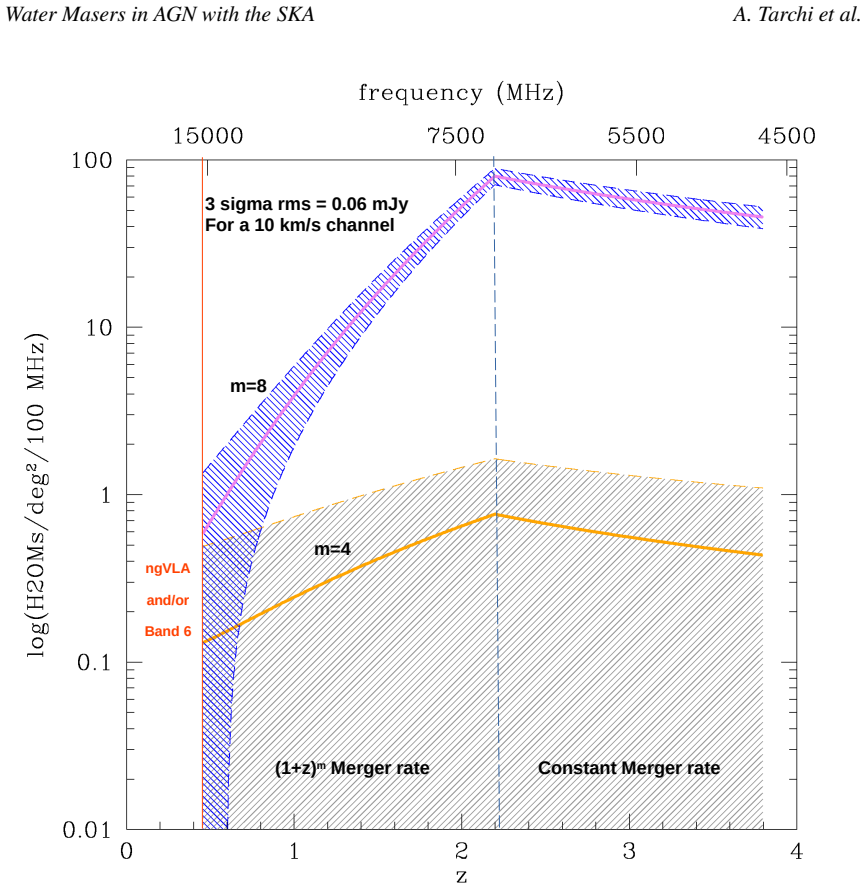
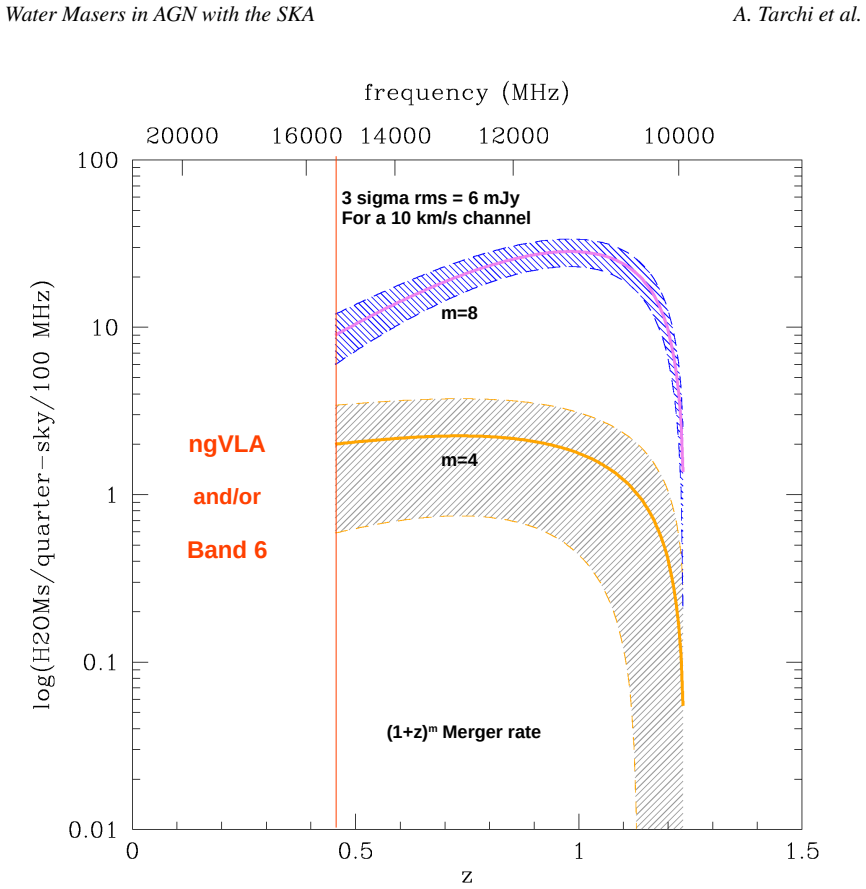
doi: 10.1146/annurev.aa.31.090193.002353. 7 Water Masers in AGN with the SKA A. Tarchi et al. 3 sigma rms = 6 mJy For a 10 km/s channel (1+z)m Merger rate m=4 m=8 ngVLA and/or Band 6 Figure 2:Sky density of detectable water masers with the SKA-Mid telescope (AA4) blind-searching a quarter-sky area at a sensitivity of 6 mJy. Shaded areas indicate the 1𝜎con...
-
[2]
doi: 10.1093/mnras/stac3099. R. Barvainis and R. Antonucci.ApJL, 628(2):L89–L91, Aug
-
[3]
doi: 10.1086/432666. N. Bennert, R. Barvainis, C. Henkel, and R. Antonucci.ApJ, 695:276–286, Apr
-
[4]
doi: 10.1088/0004-637X/695/1/276. J.Braatzetal. InA.Tarchi,M.J.Reid,andP.Castangia,editors,AstrophysicalMasers: Unlocking the Mysteries of the Universe, volume 336 ofIAU Symposium, pages 86–91, Aug
-
[5]
doi: 10.1017/S1743921317010249. J. A. Braatz et al.ApJ, 718(2):657–665, Aug
-
[6]
doi: 10.1088/0004-637X/718/2/657. P. Castangia et al.A&A, 529:A150, May
-
[7]
8 Water Masers in AGN with the SKA A
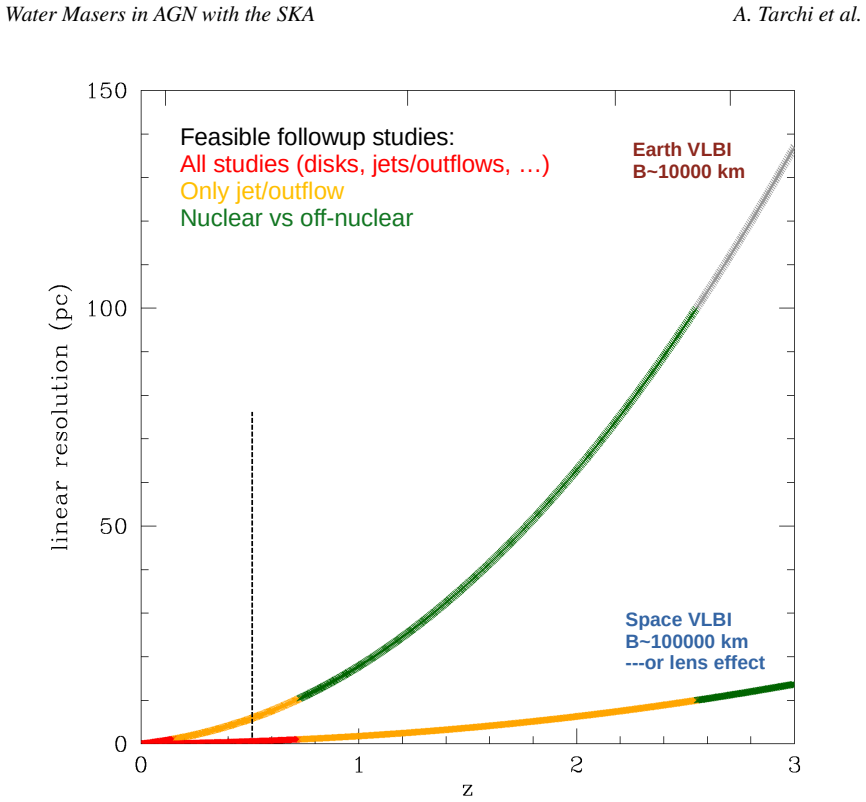
doi: 10.1051/0004-6361/201016403. 8 Water Masers in AGN with the SKA A. Tarchi et al. Feasible followup studies: All studies (disks, jets/outflows, …) Only jet/outflow Nuclear vs off-nuclear Earth VLBI B~10000 km Space VLBI B~100000 km ---or lens effect Figure3:Linearresolutionasafunctionofredshift𝑧necessarytoderiverelevantinformationonthenuclear regionof...
-
[8]
doi: 10.1051/0004-6361/201935421. J. Darling and R. Giovanelli.ApJ, 572(2):810–822, June
-
[9]
doi: 10.1086/340372. F. Gao et al.ApJ, 834:52, Jan
-
[10]
doi: 10.3847/1538-4357/834/1/52. J. E. Greene et al.ApJ, 721(1):26–45, Sept
-
[11]
doi: 10.1088/0004-637X/721/1/26. L. J. Greenhill et al.ApJ, 590(1):162–173, June
-
[12]
doi: 10.1086/374862. C. Henkel et al.Astro. & Space Sci., 295:107–116, Jan
-
[13]
doi: 10.1007/s10509-005-3668-z. J. Herrnstein et al. InAmerican Astronomical Society Meeting Abstracts, volume 191 ofAmerican Astronomical Society Meeting Abstracts, page 25.07, Dec
-
[14]
doi: 10.1038/nature07544. P. T. Kondratko, L. J. Greenhill, and J. M. Moran.ApJ, 618:618–634, Jan
-
[15]
doi: 10.1088/0004-637X/727/1/20. C. Y. Kuo et al.MNRAS, 498(2):1609–1627, Oct
-
[16]
doi: 10.1093/mnras/staa2260. K. Y. Lo.ARA&A, 43(1):625–676, Sept
-
[17]
$S$ wave hidden charm - hidden strangeness production in $e^+e^-$ annihilation
doi: 10.1146/annurev.astro.41.011802.094927. J.P.McKeanetal.MNRAS,410(4):2506–2515,Feb.2011. doi: 10.1111/j.1365-2966.2010.17617. x. M. Miyoshi et al.Nature, 373:127–129, Jan
work page internal anchor Pith review Pith/arXiv arXiv doi:10.1146/annurev.astro.41.011802.094927 2011
-
[18]
doi: 10.1038/373127a0. M. Nenkova et al.ApJ, 685:160–180, Sept
-
[19]
doi: 10.1086/590483. A. Omont et al.A&A, 551:A115, Mar
-
[20]
doi: 10.1051/0004-6361/201220811. F. Panessa et al.A&A, 641:A162, Sept
-
[21]
doi: 10.1051/0004-6361/201937407. A. B. Peck et al.ApJ, 590:149–161, June
-
[22]
doi: 10.1086/374924. D.Pesceetal. InA.Tarchi,M.J.Reid,andP.Castangia,editors,AstrophysicalMasers: Unlocking the Mysteries of the Universe, volume 336 ofIAU Symposium, pages 125–128, Aug
-
[23]
doi: 10.1017/S1743921317009966. C. Ramos Almeida and C. Ricci.Nature Astronomy, 1:679–689, Oct
-
[24]
doi: 10.1088/0004-637X/695/1/287. K. L. J. Rygl et al. InAdvancing Astrophysics with the SKA – II (AASKAII)
-
[25]
doi: 10.1051/0004-6361/200911685. A. Tarchi. In R. S. Booth, W. H. T. Vlemmings, and E. M. L. Humphreys, editors,Cosmic Masers - from OH to H0, volume 287, pages 323–332, July
-
[26]
doi: 10.1017/S1743921312007259. A. Tarchi et al.A&A, 475(2):497–506, Nov
-
[27]
doi: 10.1051/0004-6361:20078317. A. Tarchi et al.A&A, 688:L18, Aug
-
[28]
doi: 10.1051/0004-6361/202451245. C. M. Urry and P. Padovani.PASP, 107:803, Sept
-
[29]
doi: 10.1086/133630. 10
work page internal anchor Pith review doi:10.1086/133630
discussion (0)
Sign in with ORCID, Apple, or X to comment. Anyone can read and Pith papers without signing in.