REVIEW 3 major objections 4 minor 64 references
Modelling the AGN broad line region using single-epoch spectra I. The test case of Arp 151
T0 review · 3 major / 4 minor · reviewed 2026-08-14 · deepseek-v4-flash
Pith's one-line read A single-epoch spectrum can constrain the geometry and dynamics of the broad line region around a supermassive black hole.
desk verdict Solid, honest method paper for single-epoch BLR modelling, but the validation is partly internal and the MBH output is inherited from the size prior. read the letter →
The pith
A machine-rendered reading of the paper's core claim, the machinery that carries it, and where it could break.
The reading
What carries the argument
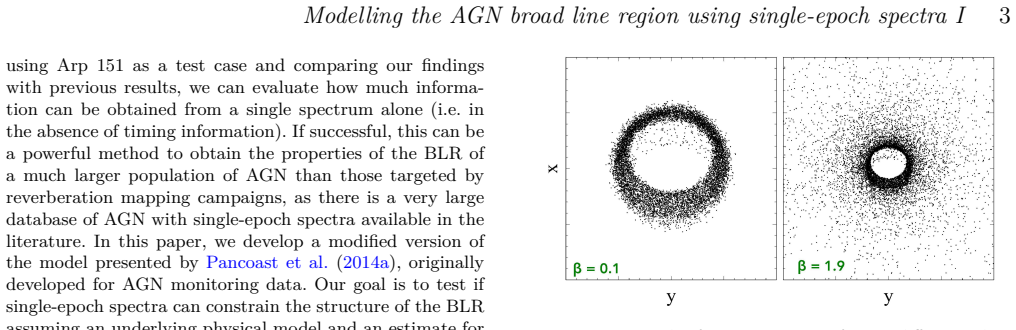
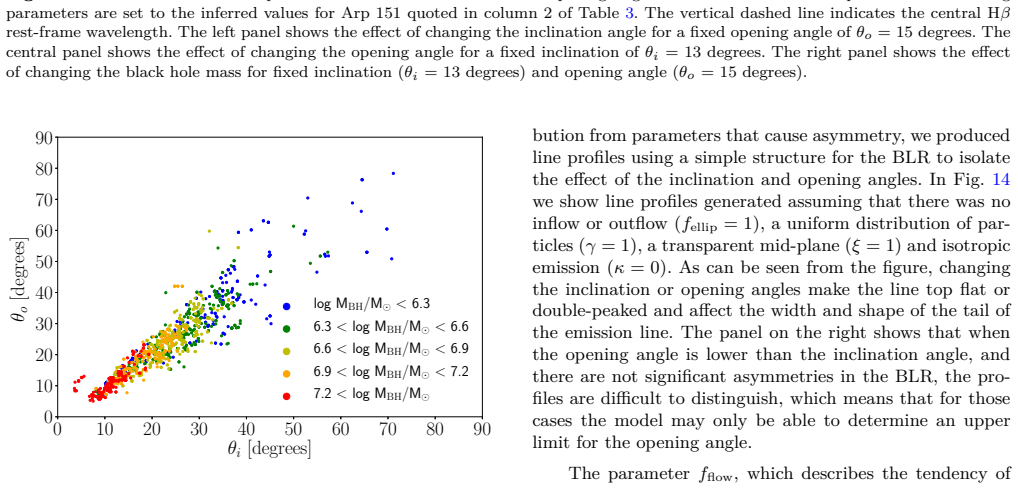
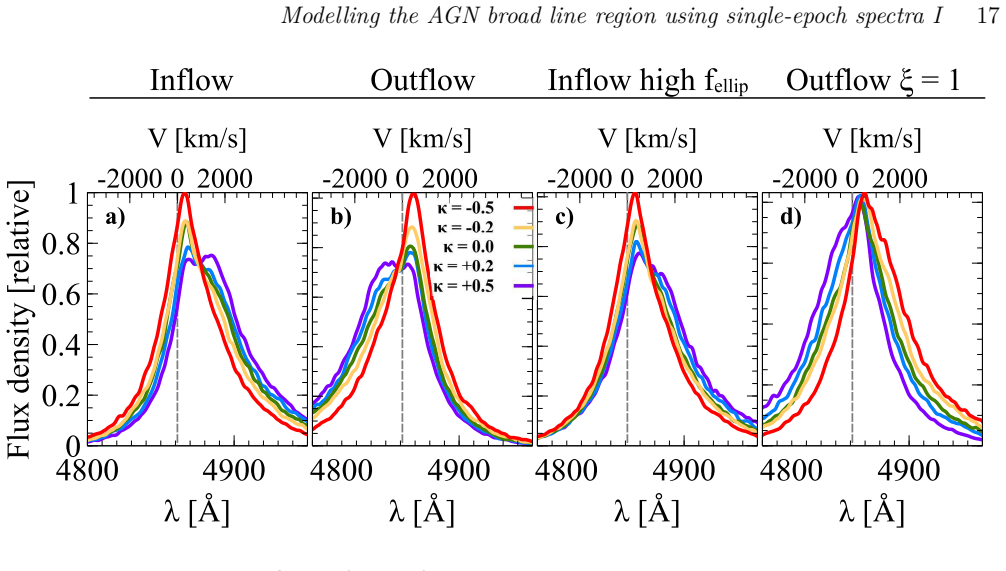
The load-bearing object is a particle-based phenomenological model of the broad line region: thousands of point particles reprocess the ionising continuum, their spatial distribution controlled by parameters such as the opening angle $\theta_o$, inclination $\theta_i$, radial profile shape $\beta$, and mid-plane transparency $\xi$, and their orbits by the black hole mass $M_{\rm BH}$, the elliptical-orbit fraction $f_{\rm ellip}$, the inflow/outflow choice $f_{\rm flow}$, and a rotation angle $\theta_e$. The model maps a set of parameters to a predicted line profile, and Bayesian inference with diffusive nested sampling turns the observed single profile into posterior distributions for the parameters. The key modification for single-epoch use is replacing the temporal information that monitoring light curves supply with a Gaussian prior on the mean time delay $\tau_{\rm mean}$, which fixes the BLR physical scale; in a general application that prior is set by the radius–luminosity relation. What makes the recovery work is that some parameters change the line profile strongly — the angles, transparency, and inflow/outflow direction leave clear asymmetries and profile shapes — while others, such as $\gamma$, barely affect the profile and therefore stay unconstrained.
What would settle it
Generate mock spectra from a BLR simulation that includes radiation pressure, winds, or photoionisation structure, feed those spectra through the single-epoch modelling pipeline, and check whether the recovered $\theta_o$, $\theta_i$, $\xi$, $f_{\rm flow}$, $\theta_e$, and $M_{\rm BH}$ match the simulation's true inputs; a systematic bias in the recovered parameters despite a good line-profile fit would show that the omitted physics is load-bearing. A complementary test is to compare the single-epoch inferred inclinations with independent inclination indicators, such as radio jet orientation, across a sample of AGN.
Extended reading notes
Core claim
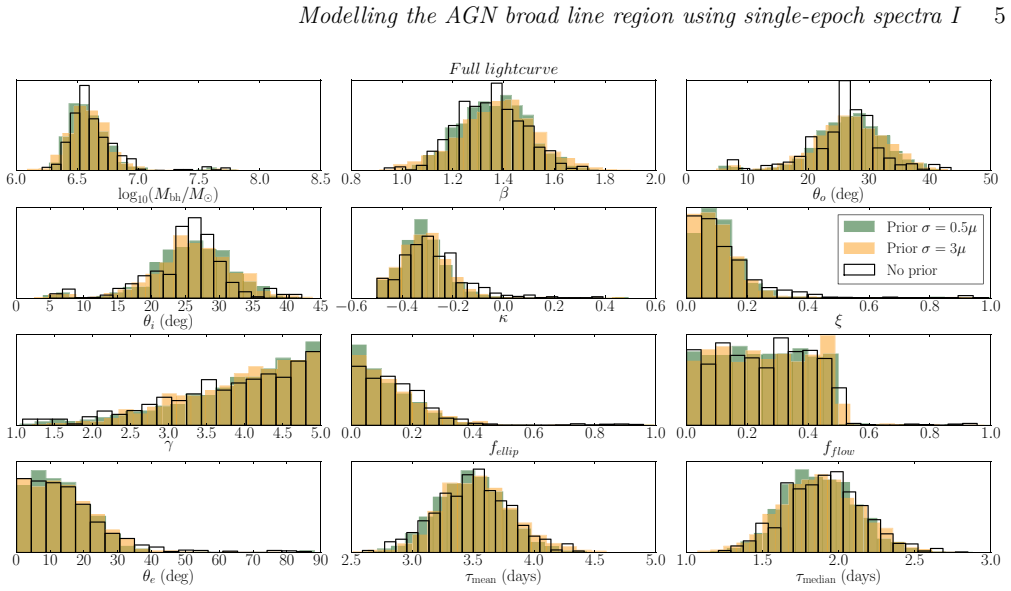
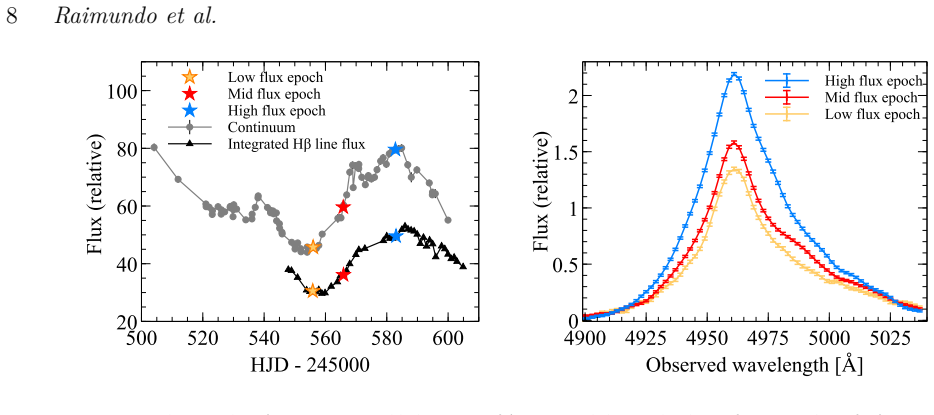
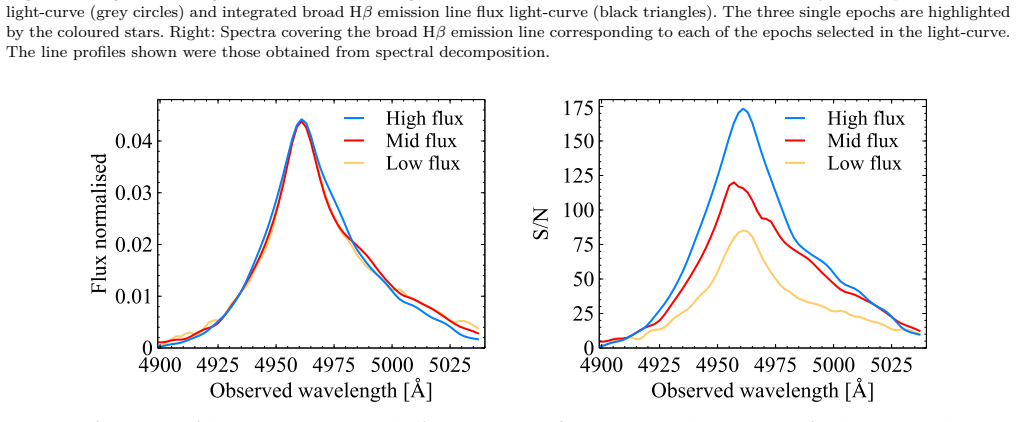
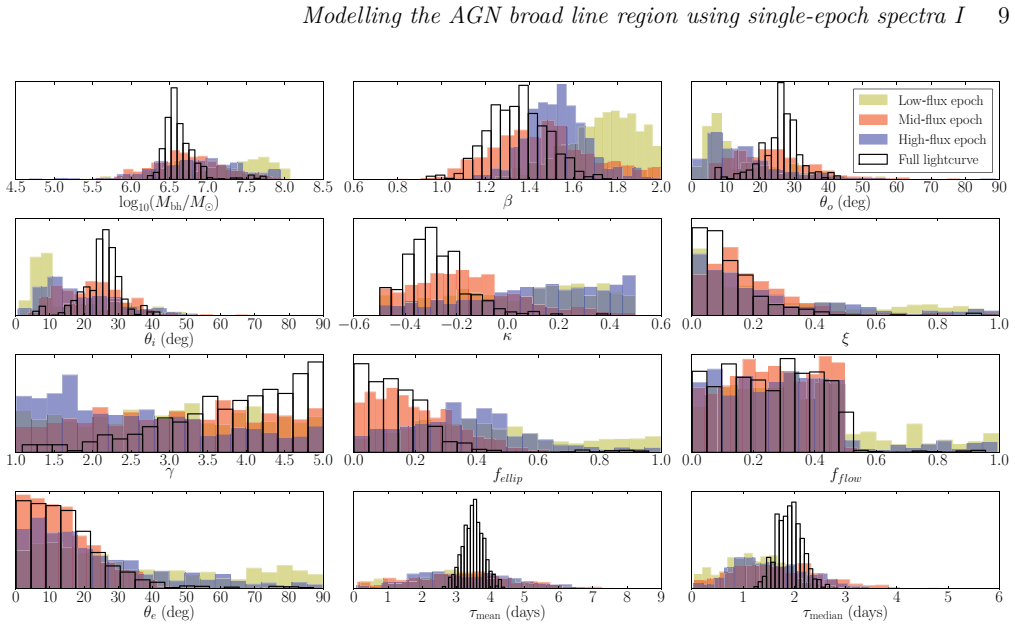
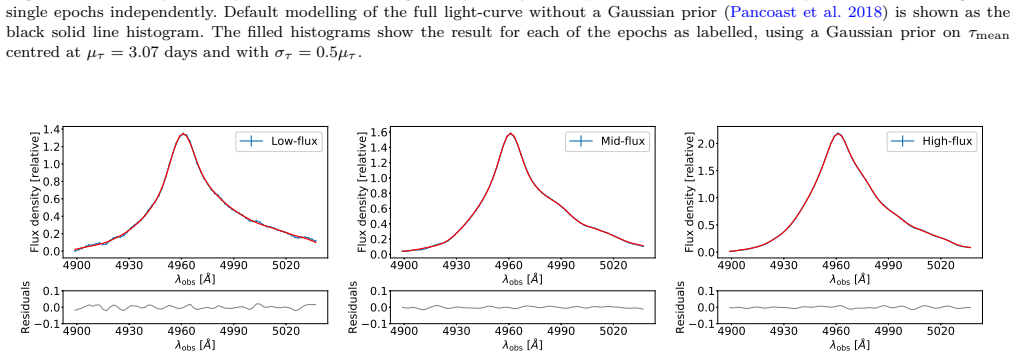
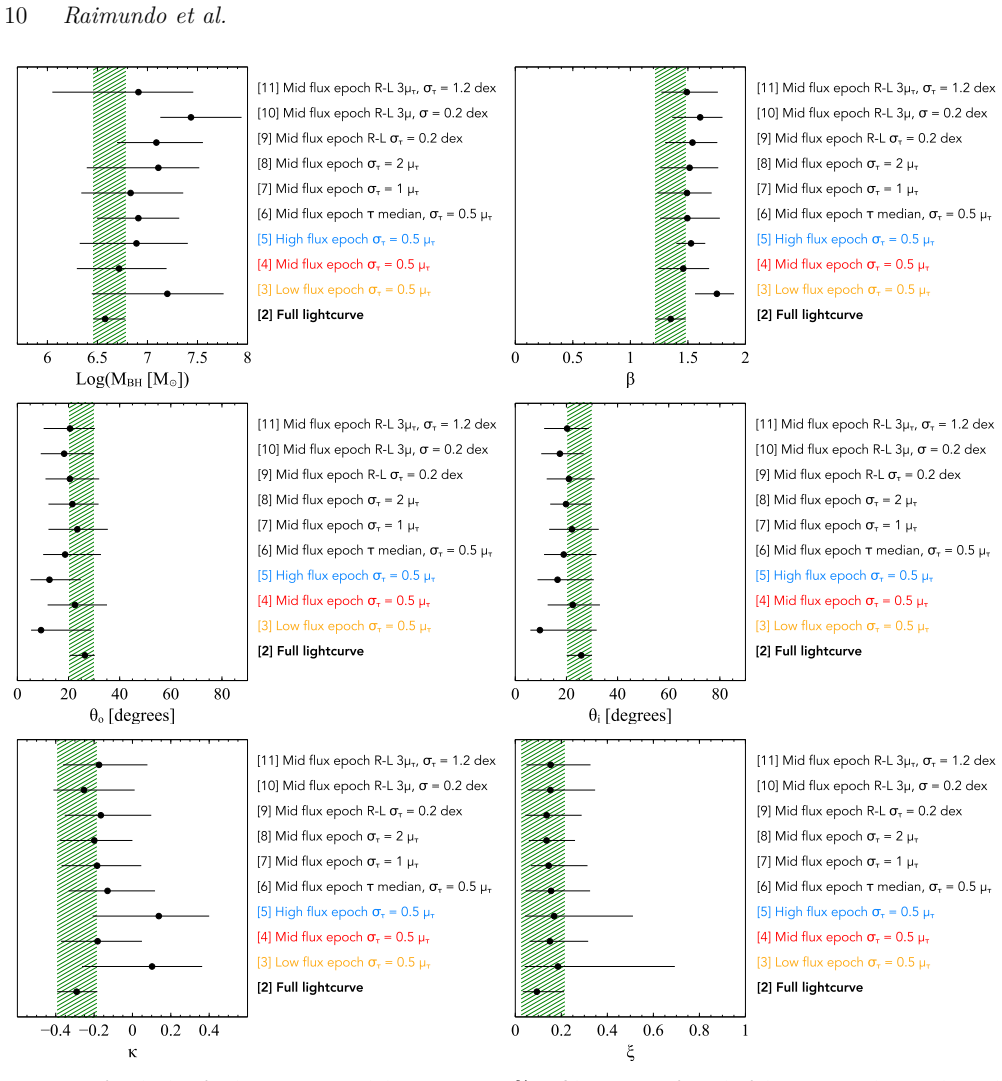
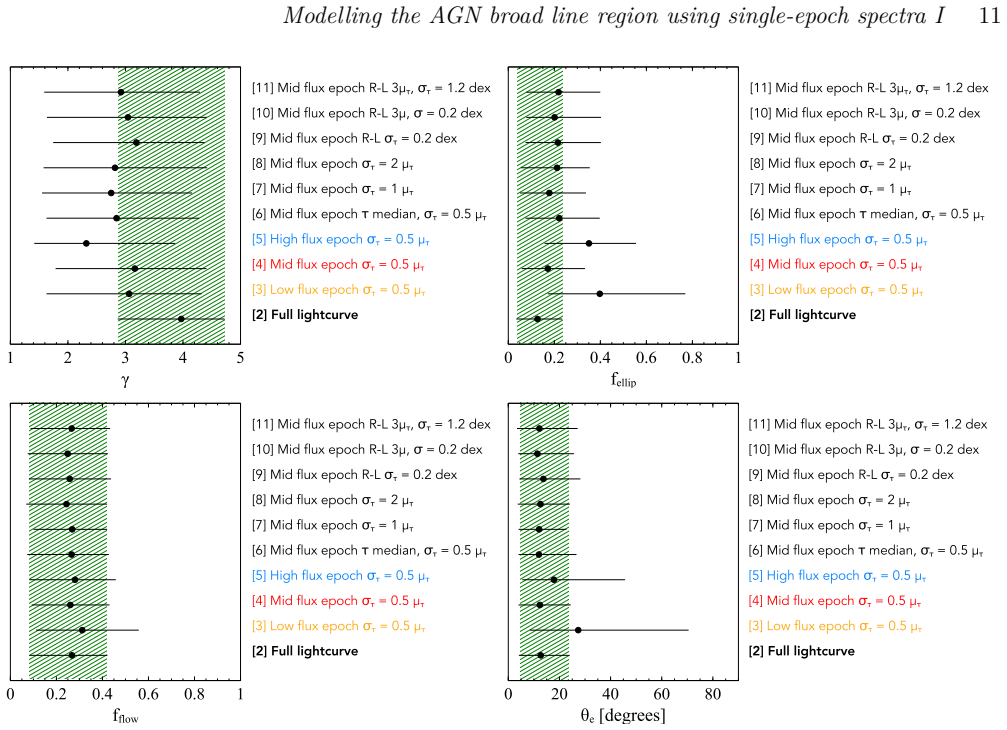
The paper's central claim is that the geometry and dynamics of the broad line region are imprinted strongly enough in the shape of a single broad emission line that a physically parameterised model can extract them without any time-series information. Using one epoch each of low, mid, and high flux for Arp 151, the modified model infers values for the opening angle $\theta_o$, inclination $\theta_i$, mid-plane transparency $\xi$, inflow/outflow fraction $f_{\rm flow}$, and rotation angle $\theta_e$ that agree with the full light-curve result within their 68% confidence ranges; the uncertainties are comparable to or up to a factor of about 3.5 higher, depending on the epoch. The black hole mass is recovered within uncertainties but is coupled to the assumed mean time delay, so a biased or too-narrow prior on that delay can shift the mass. The model also identifies which parameters cannot be recovered from one spectrum: the particle concentration parameter $\gamma$ is essentially unconstrained, and $\beta$, $\kappa$, and $f_{\rm ellip}$ vary with the chosen epoch.
Load-bearing premise
The whole inference depends on the adopted generative BLR model being an adequate description of the real broad line region; the paper states in Section 4.4 that photoionisation physics, radiation pressure, and winds are not included, so if those processes operate in real AGN, the constrained parameters are parameters of an incomplete model rather than direct measurements of the true geometry and dynamics.
Editorial extensions
If this is right
- The method can be applied to the large existing archive of single-epoch AGN spectra, extending BLR structure studies well beyond the roughly one hundred objects with reverberation-mapping campaigns.
- AGN population trends in BLR geometry and dynamics become measurable as functions of luminosity, redshift, and black hole mass, because single-epoch spectra are available for both low- and high-redshift AGN.
- The five parameters $\theta_o$, $\theta_i$, $\xi$, $f_{\rm flow}$, and $\theta_e$ are the useful recovered quantities for such surveys; $\gamma$ should be treated as effectively unconstrained, and $\beta$, $\kappa$, and $f_{\rm ellip}$ as epoch-dependent.
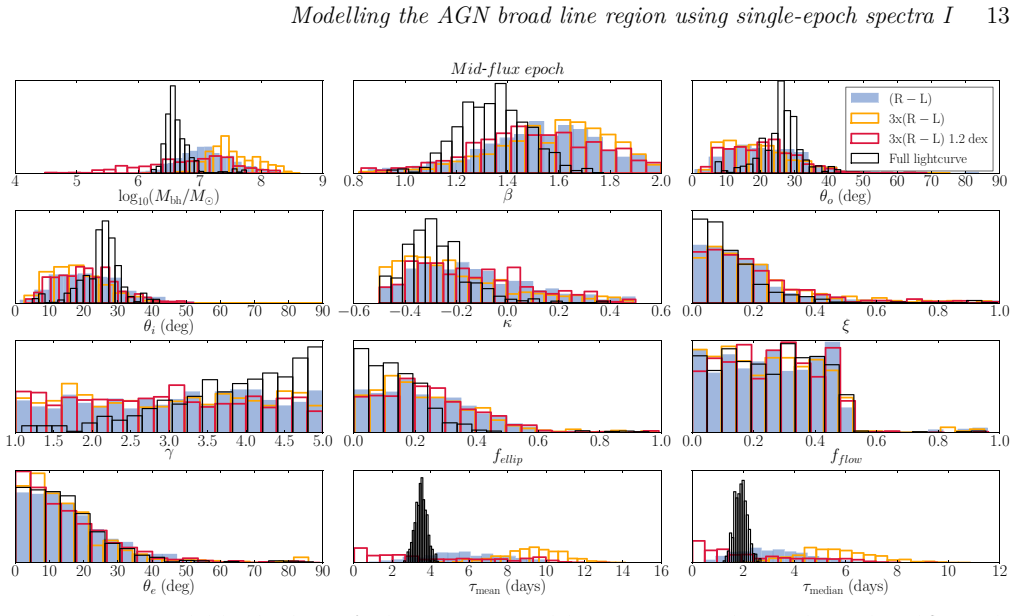
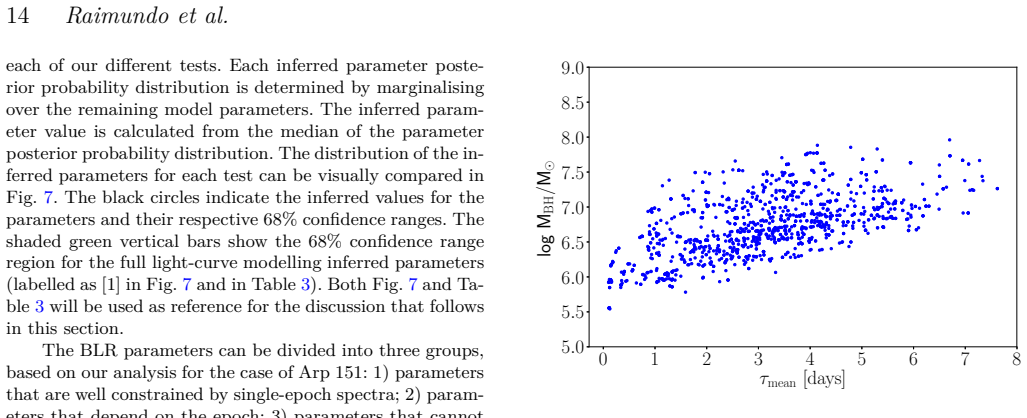
- Black hole masses from this route carry about 1 dex uncertainties, comparable to existing single-epoch scaling relations, and require a conservative, wide prior on the mean time delay to avoid bias when the radius–luminosity relation is offset.
- Even when the radius–luminosity relation overestimates the true BLR size by a factor of three, the recovered structural parameters remain consistent within uncertainties, so the method is robust to moderate errors in the assumed physical scale.
Reading between the lines
- An implication the paper leaves implicit is that the method's weakest link shifts from observing time to the prior on the mean time delay; hierarchical modelling that ties $\tau_{\rm mean}$ to luminosity across a sample could reduce this systematic and let the geometry parameters borrow strength across objects.
- Because the low-flux epoch produced the most discrepant radial profile $\beta$, applying the method to flux-limited samples may introduce a selection effect related to BLR 'breathing'; surveys using archival spectra should check whether their objects' flux states bias the recovered parameters.
- A natural testable extension is to run the same pipeline on the C IV and Mg II lines: those profiles are more blended and their radius–luminosity relations are less well calibrated than H$\beta$, so comparing single-epoch and monitoring-derived parameters for those lines would show how much the method's success depends on line isolation and prior accuracy.
Signed reviews
Editorial analysis
A structured set of objections, weighed in public.
Referee Report
Summary. This paper adapts the Pancoast et al. (2014a) Bayesian BLR dynamical model to single-epoch spectra. The key modification is to add a Gaussian prior on the mean time delay tau_mean, which substitutes for the temporal information normally provided by monitoring data, and to marginalize over Gaussian-process continuum histories whose hyperparameters are given flat priors. The method is applied to three single epochs extracted from the Arp 151 LAMP 2008 dataset, and the resulting posterior distributions are compared with the full light-curve analysis of Pancoast et al. (2018). The authors report that the opening angle, inclination, mid-plane transparency, inflow/outflow fraction, and rotation angle can be constrained from a single spectrum with uncertainties comparable to, or up to roughly 3.5 times larger than, those from monitoring data, while gamma is essentially unconstrained and beta, kappa, and fellip depend on the chosen epoch. Additional tests examine the effect of the tau_mean prior width and mean, the use of tau_median instead of tau_mean, and a radius-luminosity based prior. Appendix A presents simulations with known input parameters, reporting that 34 of 45 parameters are recovered within the 68% credible intervals.
Significance. If the central claim holds, the method would be valuable: it would allow BLR geometry and dynamics constraints to be extracted from the large existing archive of single-epoch AGN spectra, and it would reduce one of the main systematic uncertainties in single-epoch black hole mass estimates. The paper is honest about model limitations in Section 4.4, and it makes an explicit comparison with an independently published full light-curve analysis. The simulation tests with known input parameters are a useful internal consistency check, and the paper clearly identifies which parameters are not constrainable from single-epoch data. However, as argued below, the simulation validation is self-consistent rather than externally grounded, and the recovery statistics overstate how often the parameters are actually informative.
major comments (3)
- [Section 2.1.2 and Appendix A] The single-epoch likelihood marginalizes over Gaussian-process continuum histories with flat hyperpriors, and the Appendix A simulations generate the mock spectra with the same Gaussian-process model. This validates internal consistency, but it cannot detect a systematic degeneracy introduced by an unconstrained continuum history when real AGN variability is not GP-distributed. The paper tests sensitivity to the prior range of the hyperparameters, but that is not a test of whether the GP family adequately spans realistic continuum histories. I request a validation in which mock single-epoch spectra are generated from the observed LAMP continuum light curve (or from a non-GP stochastic process) with known BLR parameters and then fitted with the single-epoch code. This directly tests the paper's central claim that the line profile alone can separate BLR structure from the unknown ionizing continuum history.
- [Appendix A] The aggregate recovery statistics (34 of 45 within 68%, 44 of 44 within 95%) are not, by themselves, evidence that the parameters are constrained. A parameter whose posterior equals its prior will contain the true input value at the stated coverage by construction, and the paper itself labels many simulation outputs as unconstrained (e.g., Simulation 1 reports fflow as unconstrained and Simulation 4 says most parameters are not constrained). The recovery fraction therefore mixes genuinely informative posteriors with uninformative ones. Please report, for each parameter and simulation, a measure of posterior shrinkage relative to the prior (for example, the ratio of posterior to prior width or a Kullback-Leibler divergence), and base the 'constrained' classification on posterior informativeness rather than on coverage alone.
- [Section 4.1.1 and Table 3] The central claim that theta_o, theta_i, xi, fflow, and theta_e can be determined with uncertainties comparable to, or at most a factor of a few higher than, the full light-curve analysis is not uniformly supported by Table 3. For the low-flux epoch, theta_e = 27.3+43.2-18.9 degrees is effectively unconstrained, and xi has an upper uncertainty of 0.51 compared with 0.12 for the full light curve; for the high-flux epoch, theta_o and theta_i also have substantially broader posteriors than the full light-curve values. Since the paper's headline result is based on a subset of epochs and parameters, the abstract and conclusions should either quantify the success rate over all three epochs and all five parameters (for example, the fraction of cases where the posterior width is reduced by a specified factor relative to the prior) or explicitly state that the claim applies only to favorable line shapes and epochs.
minor comments (4)
- [Appendix A] The text states '44 out of 44' parameters are recovered within the 95% confidence range; since 5 simulations times 9 parameters gives 45 parameters, this should presumably be '44 out of 45' (or the counting should be clarified).
- [Section 4.3 and Figure 10] The black hole mass is not an independent single-epoch output: Figure 10 shows a tight MBH-tau_mean correlation and Section 4.3 notes that the MBH posterior is strongly sensitive to the tau_mean prior. The introduction's motivation in terms of black hole masses should be qualified in the conclusions so that readers do not infer that the method provides an independent mass measurement beyond the adopted radius-luminosity prior.
- [Section 3.2] The discussion of the low-flux epoch's high beta value, while plausible as a 'breathing' effect, is speculative; the paper could be clearer that the single-epoch beta posteriors are not necessarily tracing the same physical quantity as the full light-curve beta.
- [Appendix C] The temperature parameter T is chosen post hoc to exclude 'streaks' in the convergence distributions; this is a reasonable practical choice, but the paper should note more explicitly how the value of T affects the reported 68% intervals, since increasing T effectively inflates the data uncertainties by sqrt(T).
Circularity Check
No significant circularity: single-epoch constraints are tested against independent monitoring data and external R-L priors.
full rationale
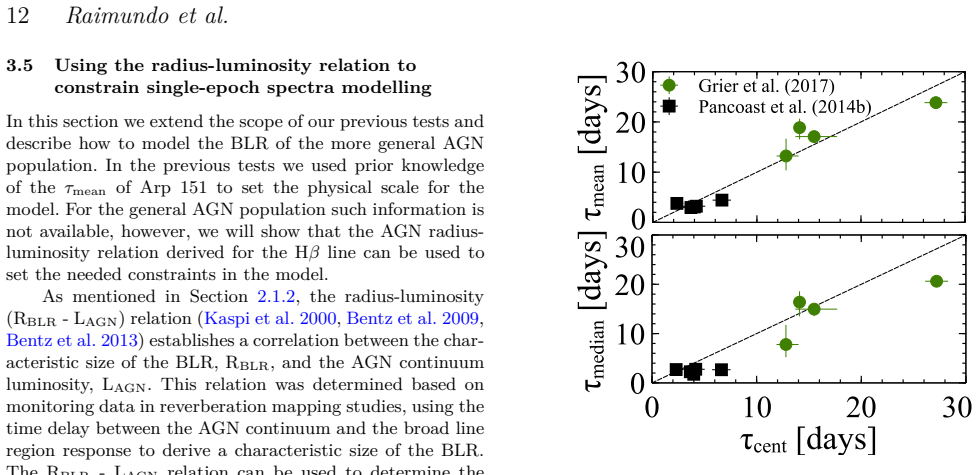
The main claim is that single-epoch spectra can recover several BLR geometry/dynamics parameters within the Pancoast et al. generative model. That claim is not circular: it is an empirical demonstration on Arp 151, benchmarked against full lightcurve modelling of the same object, which is an independent, richer dataset, and against parameter-recovery simulations in Appendix A that use known input parameters. The recovery simulations test the inference machinery; they are not presented as proof that the model is physically complete, and Section 4.4 explicitly lists omitted physics. The MBH output is explicitly acknowledged to be tied to the externally imposed tau_mean prior (Section 4.3), so the paper does not rename a fit as a prediction for MBH. The use of a tau_mean prior centred on the earlier Pancoast et al. (2014b) value is a convenience and is shown not to alter full-lightcurve results; the R-L based tests use an independent empirical relation. The GP continuum marginalisation is a model-robustness limitation, not circular reasoning: the authors test prior sensitivity and acknowledge that real variability may not follow the GP assumption. Self-citations to the authors' previous model papers are methodological continuity, not load-bearing circular evidence. Overall, no load-bearing step reduces by definition or by a self-citation chain to its own inputs.
Assumptions & free parameters
free parameters (3)
- μτ (Gaussian prior centre on τmean) =
3.07 days (RM-based); 5.21 days (R-L); 15.63 days (3x R-L)
- στ (Gaussian prior width on τmean) =
0.5, 1, 2, or 3 times μτ, or 0.2/1.2 dex
- T (temperature) =
1 or 3 for single-epoch; 65 or 80 for light-curve
assumptions (4)
- domain assumption The BLR is adequately described by the Pancoast et al. (2014a) particle model with Gamma radial distribution, point-source continuum, and specified orbit families.
- domain assumption The RBLR-LAGN relation (Bentz et al. 2013) can provide a valid mean time delay prior for arbitrary AGN.
- domain assumption Simulated Gaussian-process continuum light curves, generated from a single flux point and flat hyperpriors, are representative of the true past continuum behaviour.
- domain assumption BLR gas reprocesses the ionising continuum instantaneously.
Cite this review
Pith. "Pith review of Modelling the AGN broad line region using single-epoch spectra I. The test case of Arp 151." pith.science (2026). https://pith.science/paper/Q54Z3VLZ
@misc{pith2026190803230,
  author       = {Pith},
  title        = {Pith review of: Modelling the AGN broad line region using single-epoch spectra I. The test case of Arp 151},
  year         = {2026},
  howpublished = {\url{https://pith.science/paper/Q54Z3VLZ}},
  note         = {Machine review of arXiv:1908.03230}
}
read the original abstract
We show that individual (single-epoch) spectra of AGN can constrain some of the geometry and dynamics of the AGN broad line region. Studies of the cosmic influence of supermassive black holes are limited by the current large uncertainties in the determination of black hole masses. One dominant limitation is the unknown geometry, dynamics and line-of-sight inclination of the broad line region, used to probe the central black hole mass. Recent progress has been made to constrain the spatial and kinematic structure of the broad line region using dynamical modelling of AGN monitoring data and an underlying physical model for the broad line region. In this work we test the ability of a modified version of this dynamical modelling code to constrain the broad line region structure using single-epoch spectra. We test our modelling code on single-epoch spectra of nearby Arp 151 by comparing our results with those obtained with monitoring data of this same object. We find that a significant fraction of the broad line region parameters can indeed be adequately constrained, with uncertainties that are comparable to, or at most a factor of ~ a few higher than those obtained from modelling of monitoring data. Considering the wealth of available single-epoch spectroscopic observations, this method is promising for establishing the overall AGN population trends in the geometry and dynamics of the broad line region. This method can be applied to spectra of AGN at low and high redshift making it valuable for studies of cosmological black hole and AGN evolution.
Figures
Figures from the paper (13 more)



Reference graph
Works this paper leans on
-
[1]
write newline
" write newline "" before.all 'output.state := FUNCTION fin.entry write newline FUNCTION new.block output.state before.all = 'skip after.block 'output.state := if FUNCTION new.sentence output.state after.block = 'skip output.state before.all = 'skip after.sentence 'output.state := if if FUNCTION not #0 #1 if FUNCTION and 'skip pop #0 if FUNCTION or pop #1...
-
[2]
Barth A. J., et al., 2013, @doi [ ] 10.1088/0004-637X/769/2/128 , http://adsabs.harvard.edu/abs/2013ApJ...769..128B 769, 128
-
[3]
Bentz M. C., Katz S., 2015, @doi [ ] 10.1086/679601 , http://adsabs.harvard.edu/abs/2015PASP..127...67B 127, 67
doi:10.1086/679601 2015
-
[4]
Bentz M. C., et al., 2009, @doi [ ] 10.1088/0004-637X/705/1/199 , http://adsabs.harvard.edu/abs/2009ApJ...705..199B 705, 199
-
[5]
Bentz M. C., et al., 2010, @doi [ ] 10.1088/2041-8205/720/1/L46 , http://adsabs.harvard.edu/abs/2010ApJ...720L..46B 720, L46
-
[6]
Bentz M. C., et al., 2013, @doi [ ] 10.1088/0004-637X/767/2/149 , http://adsabs.harvard.edu/abs/2013ApJ...767..149B 767, 149
-
[7]
Blandford R. D., McKee C. F., 1982, @doi [ ] 10.1086/159843 , http://adsabs.harvard.edu/abs/1982ApJ...255..419B 255, 419
doi:10.1086/159843 1982
-
[8]
Brewer B. J., P \'a rtay L. B., Cs \'a nyi G., 2009, preprint, http://adsabs.harvard.edu/abs/2009arXiv0912.2380B ( @eprint arXiv 0912.2380 )
arXiv 2009
Show all 64 references
-
[9]
J., P \'a rtay L
Brewer B. J., P \'a rtay L. B., Cs \'a nyi G., 2010, DNEST: Diffusive Nested Sampling , Astrophysics Source Code Library ( @eprint ascl 1010.029 )
2010
-
[10]
J., et al., 2011, @doi [ ] 10.1088/2041-8205/733/2/L33 , http://adsabs.harvard.edu/abs/2011ApJ...733L..33B 733, L33
Brewer B. J., et al., 2011, @doi [ ] 10.1088/2041-8205/733/2/L33 , http://adsabs.harvard.edu/abs/2011ApJ...733L..33B 733, L33
2011 doi
-
[11]
M., Horne K., 2006, @doi [ ] 10.1111/j.1365-2966.2005.09795.x , https://ui.adsabs.harvard.edu/abs/2006MNRAS.365.1180C 365, 1180
Cackett E. M., Horne K., 2006, @doi [ ] 10.1111/j.1365-2966.2005.09795.x , https://ui.adsabs.harvard.edu/abs/2006MNRAS.365.1180C 365, 1180
2006
-
[12]
Capriotti E., Foltz C., Byard P., 1980, @doi [ ] 10.1086/158404 , https://ui.adsabs.harvard.edu/abs/1980ApJ...241..903C 241, 903
1980 doi
-
[13]
M., Vestergaard M., 2006, @doi [ ] 10.1051/0004-6361:20064878 , http://adsabs.harvard.edu/abs/2006A
Collin S., Kawaguchi T., Peterson B. M., Vestergaard M., 2006, @doi [ ] 10.1051/0004-6361:20064878 , http://adsabs.harvard.edu/abs/2006A
2006 doi
-
[14]
De Rosa G., et al., 2015, @doi [ ] 10.1088/0004-637X/806/1/128 , http://adsabs.harvard.edu/abs/2015ApJ...806..128D 806, 128
2015 doi
-
[15]
D., et al., 2010, @doi [ ] 10.1088/0004-637X/721/1/715 , http://adsabs.harvard.edu/abs/2010ApJ...721..715D 721, 715
Denney K. D., et al., 2010, @doi [ ] 10.1088/0004-637X/721/1/715 , http://adsabs.harvard.edu/abs/2010ApJ...721..715D 721, 715
2010 doi
-
[16]
Du P., et al., 2014, @doi [ ] 10.1088/0004-637X/782/1/45 , http://adsabs.harvard.edu/abs/2014ApJ...782...45D 782, 45
2014 doi
-
[17]
Du P., et al., 2018, @doi [ ] 10.3847/1538-4357/aaae6b , http://adsabs.harvard.edu/abs/2018ApJ...856....6D 856, 6
2018 doi
-
[18]
Elvis M., 2017, @doi [ ] 10.3847/1538-4357/aa82b6 , https://ui.adsabs.harvard.edu/abs/2017ApJ...847...56E 847, 56
2017 doi
-
[19]
P., 1994, @doi [ ] 10.1086/191856 , https://ui.adsabs.harvard.edu/abs/1994ApJS...90....1E 90, 1
Eracleous M., Halpern J. P., 1994, @doi [ ] 10.1086/191856 , https://ui.adsabs.harvard.edu/abs/1994ApJS...90....1E 90, 1
1994 doi
-
[20]
C., 2012, @doi [ ] 10.1146/annurev-astro-081811-125521 , http://adsabs.harvard.edu/abs/2012ARA
Fabian A. C., 2012, @doi [ ] 10.1146/annurev-astro-081811-125521 , http://adsabs.harvard.edu/abs/2012ARA
2012 doi
-
[21]
R., Korista K
Goad M. R., Korista K. T., Ruff A. J., 2012, @doi [ ] 10.1111/j.1365-2966.2012.21808.x , https://ui.adsabs.harvard.edu/abs/2012MNRAS.426.3086G 426, 3086
2012
-
[22]
J., et al., 2012, @doi [ ] 10.1088/0004-637X/755/1/60 , http://adsabs.harvard.edu/abs/2012ApJ...755...60G 755, 60
Grier C. J., et al., 2012, @doi [ ] 10.1088/0004-637X/755/1/60 , http://adsabs.harvard.edu/abs/2012ApJ...755...60G 755, 60
2012 doi
-
[23]
J., et al., 2013, @doi [ ] 10.1088/0004-637X/764/1/47 , http://adsabs.harvard.edu/abs/2013ApJ...764...47G 764, 47
Grier C. J., et al., 2013, @doi [ ] 10.1088/0004-637X/764/1/47 , http://adsabs.harvard.edu/abs/2013ApJ...764...47G 764, 47
2013 doi
-
[24]
J., Pancoast A., Barth A
Grier C. J., Pancoast A., Barth A. J., Fausnaugh M. M., Brewer B. J., Treu T., Peterson B. M., 2017a, @doi [ ] 10.3847/1538-4357/aa901b , http://adsabs.harvard.edu/abs/2017ApJ...849..146G 849, 146
-
[25]
J., et al., 2017b, @doi [ ] 10.3847/1538-4357/aa98dc , http://adsabs.harvard.edu/abs/2017ApJ...851...21G 851, 21
Grier C. J., et al., 2017b, @doi [ ] 10.3847/1538-4357/aa98dc , http://adsabs.harvard.edu/abs/2017ApJ...851...21G 851, 21
-
[26]
S., Netzer H., Maoz D., Jannuzi B
Kaspi S., Smith P. S., Netzer H., Maoz D., Jannuzi B. T., Giveon U., 2000, @doi [ ] 10.1086/308704 , http://adsabs.harvard.edu/abs/2000ApJ...533..631K 533, 631
2000 doi
-
[27]
N., Maoz D., Netzer H., Schneider D
Kaspi S., Brandt W. N., Maoz D., Netzer H., Schneider D. P., Shemmer O., 2007, @doi [ ] 10.1086/512094 , http://adsabs.harvard.edu/abs/2007ApJ...659..997K 659, 997
2007 doi
-
[28]
Kollatschny W., Zetzl M., 2013, @doi [ ] 10.1051/0004-6361/201219411 , https://ui.adsabs.harvard.edu/abs/2013A&A...549A.100K 549, A100
2013 doi
-
[29]
T., Goad M
Korista K. T., Goad M. R., 2004, @doi [ ] 10.1086/383193 , http://adsabs.harvard.edu/abs/2004ApJ...606..749K 606, 749
2004 doi
-
[30]
C., 2013, @doi [ ] 10.1146/annurev-astro-082708-101811 , http://adsabs.harvard.edu/abs/2013ARA
Kormendy J., Ho L. C., 2013, @doi [ ] 10.1146/annurev-astro-082708-101811 , http://adsabs.harvard.edu/abs/2013ARA
2013 doi
-
[31]
Koz owski S., 2017, @doi [ ] 10.3847/1538-4365/228/1/9 , https://ui.adsabs.harvard.edu/abs/2017ApJS..228....9K 228, 9
2017 doi
-
[32]
J., 1982, @doi [ ] 10.1086/160313 , https://ui.adsabs.harvard.edu/abs/1982ApJ...261...25K 261, 25
Kwan J., Carroll T. J., 1982, @doi [ ] 10.1086/160313 , https://ui.adsabs.harvard.edu/abs/1982ApJ...261...25K 261, 25
1982 doi
-
[33]
C., Du P., Bai J.-M., 2013, @doi [ ] 10.1088/0004-637X/779/2/110 , https://ui.adsabs.harvard.edu/abs/2013ApJ...779..110L 779, 110
Li Y.-R., Wang J.-M., Ho L. C., Du P., Bai J.-M., 2013, @doi [ ] 10.1088/0004-637X/779/2/110 , https://ui.adsabs.harvard.edu/abs/2013ApJ...779..110L 779, 110
2013 doi
-
[34]
Lira P., et al., 2018, preprint, http://adsabs.harvard.edu/abs/2018arXiv180608358L ( @eprint arXiv 1806.08358 )
2018 arXiv
-
[35]
Lynden-Bell D., 1969, , http://adsabs.harvard.edu/abs/1969Natur.223..690L 223, 690
1969
-
[36]
J., Jarvis M
McLure R. J., Jarvis M. J., 2002, @doi [ ] 10.1046/j.1365-8711.2002.05871.x , https://ui.adsabs.harvard.edu/abs/2002MNRAS.337..109M 337, 109
2002
-
[37]
Netzer H., Maoz D., 1990, @doi [ ] 10.1086/185875 , http://adsabs.harvard.edu/abs/1990ApJ...365L...5N 365, L5
1990 doi
-
[38]
J., Treu T., 2011, @doi [ ] 10.1088/0004-637X/730/2/139 , http://adsabs.harvard.edu/abs/2011ApJ...730..139P 730, 139
Pancoast A., Brewer B. J., Treu T., 2011, @doi [ ] 10.1088/0004-637X/730/2/139 , http://adsabs.harvard.edu/abs/2011ApJ...730..139P 730, 139
2011 doi
-
[39]
Pancoast A., et al., 2012, @doi [ ] 10.1088/0004-637X/754/1/49 , http://adsabs.harvard.edu/abs/2012ApJ...754...49P 754, 49
2012 doi
-
[40]
J., Treu T., 2014a, @doi [ ] 10.1093/mnras/stu1809 , http://adsabs.harvard.edu/abs/2014MNRAS.445.3055P 445, 3055
Pancoast A., Brewer B. J., Treu T., 2014a, @doi [ ] 10.1093/mnras/stu1809 , http://adsabs.harvard.edu/abs/2014MNRAS.445.3055P 445, 3055
-
[41]
J., Treu T., Park D., Barth A
Pancoast A., Brewer B. J., Treu T., Park D., Barth A. J., Bentz M. C., Woo J.-H., 2014b, @doi [ ] 10.1093/mnras/stu1419 , http://adsabs.harvard.edu/abs/2014MNRAS.445.3073P 445, 3073
-
[42]
Pancoast A., et al., 2018, @doi [ ] 10.3847/1538-4357/aab3c6 , http://adsabs.harvard.edu/abs/2018ApJ...856..108P 856, 108
2018 doi
-
[43]
Pei L., et al., 2017, @doi [ ] 10.3847/1538-4357/aa5eb1 , http://adsabs.harvard.edu/abs/2017ApJ...837..131P 837, 131
2017 doi
-
[44]
J., van Groningen E., Wanders I., 1994, @doi [ ] 10.1093/mnras/271.3.561 , http://adsabs.harvard.edu/abs/1994MNRAS.271..561P 271, 561
Perry J. J., van Groningen E., Wanders I., 1994, @doi [ ] 10.1093/mnras/271.3.561 , http://adsabs.harvard.edu/abs/1994MNRAS.271..561P 271, 561
1994 doi
-
[45]
M., 1993, @doi [ ] 10.1086/133140 , http://adsabs.harvard.edu/abs/1993PASP..105..247P 105, 247
Peterson B. M., 1993, @doi [ ] 10.1086/133140 , http://adsabs.harvard.edu/abs/1993PASP..105..247P 105, 247
1993 doi
-
[46]
M., 1997, An Introduction to Active Galactic Nuclei
Peterson B. M., 1997, An Introduction to Active Galactic Nuclei
1997
-
[47]
M., 2014, @doi [ ] 10.1007/s11214-013-9987-4 , http://adsabs.harvard.edu/abs/2014SSRv..183..253P 183, 253
Peterson B. M., 2014, @doi [ ] 10.1007/s11214-013-9987-4 , http://adsabs.harvard.edu/abs/2014SSRv..183..253P 183, 253
2014 doi
-
[48]
M., Wandel A., 2000, @doi [ ] 10.1086/312862 , http://adsabs.harvard.edu/abs/2000ApJ...540L..13P 540, L13
Peterson B. M., Wandel A., 2000, @doi [ ] 10.1086/312862 , http://adsabs.harvard.edu/abs/2000ApJ...540L..13P 540, L13
2000 doi
-
[49]
M., et al., 2004, @doi [ ] 10.1086/423269 , http://adsabs.harvard.edu/abs/2004ApJ...613..682P 613, 682
Peterson B. M., et al., 2004, @doi [ ] 10.1086/423269 , http://adsabs.harvard.edu/abs/2004ApJ...613..682P 613, 682
2004 doi
-
[50]
I., Fabian A
Raimundo S. I., Fabian A. C., 2009, @doi [ ] 10.1111/j.1365-2966.2009.14796.x , http://adsabs.harvard.edu/abs/2009MNRAS.396.1217R 396, 1217
2009
-
[51]
I., Malkan M
Rosenblatt E. I., Malkan M. A., Sargent W. L. W., Readhead A. C. S., 1994, @doi [ ] 10.1086/192047 , https://ui.adsabs.harvard.edu/abs/1994ApJS...93...73R 93, 73
1994 doi
-
[52]
L., De Zotti G., Danese L., 2004, @doi [ ] 10.1111/j.1365-2966.2004.08261.x , http://adsabs.harvard.edu/abs/2004MNRAS.354.1020S 354, 1020
Shankar F., Salucci P., Granato G. L., De Zotti G., Danese L., 2004, @doi [ ] 10.1111/j.1365-2966.2004.08261.x , http://adsabs.harvard.edu/abs/2004MNRAS.354.1020S 354, 1020
2004
-
[53]
Shen Y., et al., 2011, @doi [ ] 10.1088/0067-0049 , http://adsabs.harvard.edu/abs/2011ApJS..194...45S 194, 45
2011 doi
-
[54]
Shen Y., et al., 2016, @doi [ ] 10.3847/0004-637X/818/1/30 , http://adsabs.harvard.edu/abs/2016ApJ...818...30S 818, 30
2016 doi
-
[55]
Skilling J., 2006, @doi [Bayesian Anal.] 10.1214/06-BA127 , 1, 833
2006 doi
-
[56]
S., Peterson B
Storchi-Bergmann T., Schimoia J. S., Peterson B. M., Elvis M., Denney K. D., Eracleous M., Nemmen R. S., 2017, @doi [ ] 10.3847/1538-4357/835/2/236 , https://ui.adsabs.harvard.edu/abs/2017ApJ...835..236S 835, 236
2017 doi
-
[57]
Vestergaard M., 2002, @doi [ ] 10.1086/340045 , http://adsabs.harvard.edu/abs/2002ApJ...571..733V 571, 733
2002 doi
-
[58]
Vestergaard M., 2004, @doi [ ] 10.1086/379758 , http://adsabs.harvard.edu/abs/2004ApJ...601..676V 601, 676
2004 doi
-
[59]
M., 2006, @doi [ ] 10.1086/500572 , http://adsabs.harvard.edu/abs/2006ApJ...641..689V 641, 689
Vestergaard M., Peterson B. M., 2006, @doi [ ] 10.1086/500572 , http://adsabs.harvard.edu/abs/2006ApJ...641..689V 641, 689
2006 doi
-
[60]
J., Barthel P
Vestergaard M., Wilkes B. J., Barthel P. D., 2000, @doi [ ] 10.1086/312805 , http://adsabs.harvard.edu/abs/2000ApJ...538L.103V 538, L103
2000 doi
-
[61]
L., et al., 2009, @doi [ ] 10.1088/0067-0049/185/1/156 , http://adsabs.harvard.edu/abs/2009ApJS..185..156W 185, 156
Walsh J. L., et al., 2009, @doi [ ] 10.1088/0067-0049/185/1/156 , http://adsabs.harvard.edu/abs/2009ApJS..185..156W 185, 156
2009 doi
-
[62]
R., et al., 2018, @doi [ ] 10.3847/1538-4357/aae086 , https://ui.adsabs.harvard.edu/abs/2018ApJ...866...75W 866, 75
Williams P. R., et al., 2018, @doi [ ] 10.3847/1538-4357/aae086 , https://ui.adsabs.harvard.edu/abs/2018ApJ...866...75W 866, 75
2018 doi
-
[63]
J., Browne I
Wills B. J., Browne I. W. A., 1986, @doi [ ] 10.1086/163973 , http://adsabs.harvard.edu/abs/1986ApJ...302...56W 302, 56
1986 doi
-
[64]
Xiao M., et al., 2018, @doi [ ] 10.3847/1538-4357/aad5e1 , http://adsabs.harvard.edu/abs/2018ApJ...864..109X 864, 109
2018 doi
Reviewed August 14, 2026 · model on record in the stance chip above.
Discussion (0). Continue with ORCID to comment.