REVIEW 3 major objections 5 minor 2 cited by
The Explicit Hypergeometric-Modularity Method II
T0 review · 3 major / 5 minor · reviewed 2026-08-12 · deepseek-v4-flash
Pith's one-line read This paper proves that the degree-four hypergeometric Galois representation attached to each well-poised datum HD4(j/12) at λ=-1 is automorphic, with Frobenius traces equal to products of two explicitly given Hecke eigenvalues.
desk verdict Useful explicit hypergeometric-modularity results, but the main automorphy theorem has a concrete gap: the bridge equality is applied to a datum whose third upper parameter is negative, outside the stated theorem. read the letter →
The pith
A machine-rendered reading of the paper's core claim, the machinery that carries it, and where it could break.
The reading
What carries the argument
The load-bearing object is the well-poised datum $\mathrm{HD}_4(j/12)=\{\frac j{12},\frac j{12},\frac12,\frac12 \mid 1,1,\frac12+\frac j{12},\frac12+\frac j{12}\}$ evaluated at $\lambda=-1$, whose self-duality gives an involution that splits the four-dimensional local system. The argument runs through the classical reduction of well-poised ${}_4F_3(-1)$ and ${}_5F_4(-1)$ to ${}_3F_2(1)$, the finite-field analogue of the same reduction, and the bridge equality (4.13) from the companion paper that identifies $P(\mathrm{HD}_3(r,s);1,\mathfrak p)\iota_p(s-r)(1/16)$ with $a_p(f^\sharp_{3,D})$. The weight-two factor is built from $K_1$-eta-quotients and the weight-three factor from $K_2$-eta-quotients listed in Tables 2 and 3.
What would settle it
Take $j=1$, $D=24$, $M=24$, and a prime $p\equiv1\pmod{24}$ such as $p=73$; compute the finite-field hypergeometric sum $H_p(\mathrm{HD}_4(1/12);-1;\mathfrak p)$ from its definition as a Gauss/Jacobi sum, and compare with the product of the $p$-th coefficients of the two newforms listed in Table 1 for $D=24$. A single mismatch would disprove Theorem 1.4, and the same check tests the imported bridge equality (4.13).
Extended reading notes
Core claim
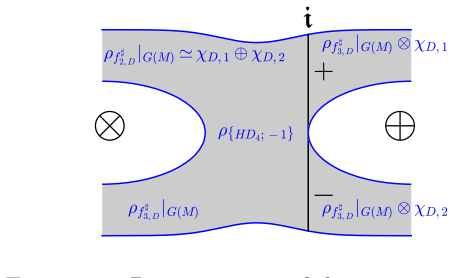
On the paper's own terms, the central discovery is Theorem 1.4: the well-poised length-four hypergeometric datum $\mathrm{HD}_4(j/12)$ at $\lambda=-1$ carries a four-dimensional $\ell$-adic Galois representation of $G(M)$ that splits as $(\chi_{D,1}\oplus\chi_{D,2})\otimes\rho_{f^\sharp_{3,D}}$ when restricted to $G(M)$, and the finite-field trace identity $\Omega_{j,\mathbb F_p} H_p(\mathrm{HD}_4(j/12);-1;\mathfrak p)=a_p(f^\sharp_{2,D})a_p(f^\sharp_{3,D})$ holds for every prime $p\equiv1\pmod M$. The proof converts the four-term hypergeometric sum into two three-term sums via well-poised transformations from the classical and finite-field theories, then identifies each three-term sum with a Hecke eigenvalue using the Explicit Hypergeometric-Modularity Method. Consequently the motivic $L$-function of the hypergeometric datum is the product of two automorphic $L$-functions.
Load-bearing premise
The proof assumes the bridge equality from the companion paper: for the length-three data used here, a certain finite-field hypergeometric sum times a Gauss-sum factor equals the Fourier coefficient of the eta-quotient eigenform; that equality is cited, not re-proved in this paper.
Editorial extensions
If this is right
- For primes $p\equiv1\pmod M$, the finite-field hypergeometric sums are computable as products of two Hecke eigenvalues, giving an exact character-sum formula for the twelve data.
- The hypergeometric Galois representation $\rho_{\mathrm{HD}_4(j/12);-1}$ is automorphic for every $1\le j\le11$, with $L$-function equal to $L(f^\sharp_{2,D}\otimes f^\sharp_{3,D},s)$.
- The truncated classical series satisfy the supercongruences (1.5)–(1.6) modulo $p^2$, with the two p-adic components of $a_p(f^\sharp_{2,D})$ appearing as unit-root and non-unit-root factors.
- The classical evaluations of Theorem 1.1 express $F(\mathrm{HD}_4(j/12);-1)$ and $F(\mathrm{HD}_5(j/12);-1)$ as products of two $L$-values, connecting special values of well-poised hypergeometric functions to critical values of modular forms.
- For the $j=6$ case and the two data defined over $\mathbb Q$, the trace identity extends to all odd primes, giving global representations of $G_{\mathbb Q}$.
Reading between the lines
- The same splitting mechanism may apply to other well-poised data with rational parameters whose denominators divide other integers, since the only ingredients are the involution and the well-poised reductions; one can test whether analogous eta-quotient eigenforms exist for $j/12$ replaced by $k/N$.
- If the factorization of $L$-functions matches Hodge structures, the four-dimensional motives here would be genuine tensor products of a CM motive and a weight-three motive; this could be checked by comparing the Hodge numbers of the threefold (1.8) with the tensor product of the two motives.
- The p-adic perturbation method, used here only modulo $p^2$, likely produces higher-order congruences for some parameter values; the authors note the $j=6$ case already holds modulo $p^3$, and other $j$ could be tested numerically.
- Because the $K_2$-functions have explicit eta-quotient forms, the $L$-value identities in the appendix could be extended to produce new algebraic relations among ${}_3F_2(1)$ values and related periods.
Editorial analysis
A structured set of objections, weighed in public.
Referee Report
Summary. The paper applies the authors' Explicit Hypergeometric-Modularity Method (EHMM) from Part I to well-poised length-four hypergeometric data at λ = −1. It constructs a family of weight-three eta-quotient modular forms K2(r,s), identifies Hecke eigenforms f♯3,D and f♯2,D (Tables 2 and 3), and proves product formulas expressing classical, finite-field, and p-adic hypergeometric functions attached to HD4(j/12) at −1 in terms of Fourier coefficients of f♯2,D and f♯3,D. The central result, Theorem 1.4, asserts that the associated degree-four hypergeometric Galois representation is, after restriction to G(M), isomorphic to (χD,1 ⊕ χD,2) ⊗ ρ_{f♯3,D}. The paper also proves a p-adic supercongruence (Theorem 1.3) and records a number of special L-value identities.
Significance. If correct, Theorem 1.4 gives an explicit infinite family of degree-four hypergeometric Galois representations whose traces are products of modular form coefficients, yielding an automorphy statement at the level of L-functions for well-poised hypergeometric data. The paper is commendably explicit: LMFDB labels are given, the weight-three forms are written as eta quotients, the case j = 6 is worked out completely, and the p-adic perturbation arguments are detailed. The main novelty is the use of Whipple's classical and McCarthy's finite-field well-poised identities to split the four-dimensional representation. The proof, however, depends on the bridge identity (4.13), which is imported from the unpublished-in-this-paper Part I [1], and one of its two invocations in Theorem 1.4 is made outside the stated hypotheses of Theorem 3.1.
major comments (3)
- [§4.4, Eq. (4.13)] The proof of Theorem 1.4 applies the bridge equality (4.13) to the datum HD3(r, r/2), whose third upper parameter is s − r = −r/2 < 0. This is outside the hypothesis 0 < r_n < q_n ≤ 1 of Theorem 3.1, the stated source of (4.13), and it is also outside the S2 and G2 families from which f♯3,D is constructed. No transformation reducing HD3(r, r/2) to admissible data is supplied. Since the subsequent chain leading to (1.7) depends directly on this substitution, the central trace identity is missing a justification at exactly this step. The equality is numerically checkable because the finite-field P-function is still defined for negative parameters, so a concrete verification or a supplied transformation would repair the gap.
- [§5.2, proof of Proposition 5.4] The same bridge identity (4.13) is invoked for the datum HD3(r/2, r), for which q_n = s = r while r_2 = 1/2 is the second upper parameter. The hypothesis r_2 < q_n of Theorem 3.1 fails for every j ≤ 6 (for j = 6, q_n = 1/2 and s is excluded from S2 by definition). Thus the p-adic supercongruence (1.5) inherits the same missing justification as Theorem 1.4. In addition, Theorem 3.1's equality (3.4) is stated only for primes p ≥ 29, whereas Proposition 5.4 claims the congruence for all p ≡ 1 (mod M); the finitely many small primes are not checked in the paper.
- [§3.6, Tables 2 and 3] The identifications of f♯2,D and f♯3,D as Hecke eigenforms, including the linear combinations of K1- and K2-functions in Tables 2 and 3, are imported from the unpublished manuscripts [28] and [29] and from the earlier preprint [1]. These identities are load-bearing for Lemma 4.5 and hence for (4.10), (1.7), and (1.5)–(1.6). The paper should either prove these orbit relations or explicitly state them as assumptions with the relevant computations included or made available, so that the main theorem is not conditional on inaccessible data.
minor comments (5)
- [Abstract and §4.4] The abstract states that the representations 'are shown to be extendable to G_Q', but Theorem 1.4 only proves an isomorphism after restriction to G(M); the extension to G_Q is established in Corollary 4.7 for two special data. Please align the abstract with the theorem statements.
- [§4.4, proof of Theorem 1.4] The notation HD3((r, r+1)/2) is undefined; presumably it means HD3(r, (r+1)/2). Please disambiguate.
- [§2.2] The notation 'cF×q = ⟨ω⟩ be the set of multiplicative characters' should read 'the group of multiplicative characters'; also the convention that A(0)=0 is stated for characters, which is standard but should be applied consistently in (2.5).
- [§4.2, Remark 4.1] The definition of K1(r,s) in (3.14) is used in Theorem 1.1 with negative first argument, e.g., K1(−r/2, 3+r/2). Since K1 was introduced for 0 < r < s, the meaning of the formula for negative r and the sense in which E(r)(τ) is a non-holomorphic modular form should be clarified.
- [Lemma 4.4, Eq. (4.9)] The two displayed Jacobi-sum factors in (4.9) appear identical, while the proof expands a product with gω(r/2) and gω(−r/2), suggesting the intended identity has two different Jacobi sums. Please confirm the correct statement of (4.9).
Circularity Check
No circular derivation: the central finite-field identity is imported from the authors' Part I theorem, but a parameter-range gap in applying it to HD3(r,r/2) is a correctness risk, not a fit or definitional circularity.
full rationale
The proof of Theorem 1.4 rests on equation (4.13), P(HD3(r,s);1,p)ι_p(s-r)(1/16)=a_p(f^♯_{3,D}), quoted from Theorem 3.1 of the authors' Part I [1]. This is a self-citation, but it invokes a separate theorem with stated hypotheses and an independent proof; it is not a restatement of the target equality and no constant is fitted. The subsequent application to HD3(r,r/2) is questionable: Theorem 3.1 assumes 0<r_n<q_n≤1 for the datum {{1/2,1/2,r_n},{1,1,q_n}}, while for HD3(r,r/2) one has r_n=s-r=-r/2<0, and the pair (r,r/2) is not in the G2 family (r+s=1 or 2) that defines f^♯_{3,D}. No transformation is supplied to bring this datum into the admissible range. This is a missing-justification/correctness gap in the central trace identity, not a circularity: the equality is not obtained by construction from its own conclusion, and the surrounding argument uses external anchors (McCarthy's well-poised finite-field formula, Katz's hypergeometric Galois representation theorem, LMFDB form data, and the j=6 case of McCarthy–Papanikolas). Because the derivation chain is not self-definitional and does not fit parameters to the predicted quantities, the circularity burden is low; I assign 2 rather than 0 to flag the load-bearing nature of the self-citation and the unproved parameter extension.
Assumptions & free parameters
assumptions (7)
- domain assumption Theorem 3.1 of Part I [1] (Explicit Hypergeometric-Modularity Method)
- standard math Katz's hypergeometric Galois representation theorem (Theorem 2.3)
- standard math Weil's theorem on Jacobi sums as Grössencharaktere (Theorem 2.1)
- standard math Whipple's well-poised reduction formulas over C (Proposition 4.1)
- standard math McCarthy's finite-field well-poised formula (Theorem 4.2)
- standard math Gross-Koblitz formula as stated in Lemma 2.2 of Part I
- ad hoc to paper Unpublished eigenform decompositions of E. Rosen ([28], [29])
Cite this review
Pith. "Pith review of The Explicit Hypergeometric-Modularity Method II." pith.science (2026). https://pith.science/paper/Q5DQI6LO
@misc{pith2026241115116,
  author       = {Pith},
  title        = {Pith review of: The Explicit Hypergeometric-Modularity Method II},
  year         = {2026},
  howpublished = {\url{https://pith.science/paper/Q5DQI6LO}},
  note         = {Machine review of arXiv:2411.15116}
}
abstract
In the first paper of this sequence, we provided an explicit hypergeometric modularity method by combining different techniques from the classical, $p$-adic, and finite field settings. In this article, we explore an application of this method from a motivic viewpoint through some known hypergeometric well-poised formulae of Whipple and McCarthy. We first use the method to derive a class of special weight three modular forms, labeled as $\mathbb{K}_2$-functions. Then using well-poised hypergeometric formulae we further construct a class of degree four Galois representations of the absolute Galois groups of the corresponding cyclotomic fields. These representations are then shown to be extendable to $G_{\mathbb{Q}}$ and the $L$-function of each extension coincides with the $L$-function of an automorphic form.
Figures
Forward citations
Cited by 2 Pith papers
-
On Some Hypergeometric Modularity Conjectures of Dawsey and McCarthy
The K3 eta-quotients resolve Dawsey-McCarthy conjectures giving explicit identities Hp(HD;1) = psi(p)*ap(f) for five pairs (u,v) with v=3.
-
Modular Forms and Certain ${}_2F_1(1)$ Hypergeometric Series
An explicit family of weight 2 CM Hecke eigenforms is built from hypergeometric data, with exact L-values and Jacobi sum formulas for the Fourier coefficients.
Reference graph
Works this paper leans on
-
[1]
The Explicit Hypergeometric- Modularity Method I, 2024 arXiv: 2404.00711
Michael Allen, Brian Grove, Ling Long, and Fang-Ting Tu. The Explicit Hypergeometric- Modularity Method I, 2024 arXiv: 2404.00711. 42
arXiv 2024
-
[28]
Modular forms and certain 2F1(1) hypergeometric series, (in preparation) 2024
Esme Rosen. Modular forms and certain 2F1(1) hypergeometric series, (in preparation) 2024
work page 2024
-
[29]
Transcendence of 3F2(1) hypergeometric series and L-values of modular forms, (preprint) 2024
Esme Rosen. Transcendence of 3F2(1) hypergeometric series and L-values of modular forms, (preprint) 2024
work page 2024
-
[2]
Andrews, Richard Askey, and Ranjan Roy
George E. Andrews, Richard Askey, and Ranjan Roy. Special functions, volume 71 of Encyclo- pedia of Mathematics and its Applications . Cambridge University Press, Cambridge, 1999
work page 1999
-
[3]
Bruce C. Berndt, Ronald J. Evans, and Kenneth S. Williams.Gauss and Jacobi sums. Canadian Mathematical Society Series of Monographs and Advanced Texts. John Wiley & Sons, Inc., New York, 1998. A Wiley-Interscience Publication
work page 1998
-
[4]
Finite hypergeometric functions
Frits Beukers, Henri Cohen, and Anton Mellit. Finite hypergeometric functions. Pure Appl. Math. Q. , 11(4):559–589, 2015
2015
-
[5]
Duality relations for hypergeometric series
Frits Beukers and Fr´ ed´ eric Jouhet. Duality relations for hypergeometric series. Bull. Lond. Math. Soc., 47(2):343–358, 2015
work page 2015
-
[6]
Jonathan M. Borwein and Peter B. Borwein. Pi and the AGM , volume 4 of Canadian Math- ematical Society Series of Monographs and Advanced Texts . John Wiley & Sons, Inc., New York, 1998. A study in analytic number theory and computational complexity, Reprint of the 1987 original, A Wiley-Interscience Publication
work page 1998
Show all 37 references
-
[7]
Number theory
Henri Cohen. Number theory. Vol. II. Analytic and modern tools , volume 240 of Graduate Texts in Mathematics . Springer, New York, 2007
2007
-
[8]
Computing L-functions: a survey
Henri Cohen. Computing L-functions: a survey. J. Th´ eor. Nombres Bordeaux, 27(3):699–726, 2015
2015
-
[9]
Fuselier, Ling Long, Holly Swisher, and Fang-Ting Tu
Alyson Deines, Jenny G. Fuselier, Ling Long, Holly Swisher, and Fang-Ting Tu. Generalized Legendre curves and quaternionic multiplication. J. Number Theory , 161:175–203, 2016
2016
-
[10]
Special Hypergeomet- ric Motives and Their L-functions: Asai recognition
Lassina Demb´ el´ e, Alexei Panchishkin, John Voight, and Wadim Zudilin. Special Hypergeomet- ric Motives and Their L-functions: Asai recognition. Experimental Mathematics , 0(0):1–23, 2020
2020
-
[11]
p-adic cycles
Bernard Dwork. p-adic cycles. Inst. Hautes ´Etudes Sci. Publ. Math. , 37:27–115, 1969
1969
-
[12]
Hypergeo- metric functions over finite fields
Jenny Fuselier, Ling Long, Ravi Ramakrishna, Holly Swisher, and Fang-Ting Tu. Hypergeo- metric functions over finite fields. Mem. Amer. Math. Soc. , 280(1382), 2022
2022
-
[13]
Hypergeometric functions over finite fields
John Greene. Hypergeometric functions over finite fields. Trans. Amer. Math. Soc., 301(1):77– 101, 1987
1987
-
[14]
On the Hypergeometric Modularity Conjectures of Dawsey and McCarthy, 2024 (preprint)
Brian Grove. On the Hypergeometric Modularity Conjectures of Dawsey and McCarthy, 2024 (preprint)
2024
-
[15]
Nicholas M. Katz. Exponential sums and differential equations , volume 124 of Annals of Math- ematics Studies . Princeton University Press, Princeton, NJ, 1990
1990
-
[16]
Nicholas M. Katz. Another look at the Dwork family. In Algebra, arithmetic, and geometry: in honor of Yu. I. Manin. Vol. II , volume 270 of Progr. Math., pages 89–126. Birkh¨ auser Boston, Boston, MA, 2009
2009
-
[17]
A Whipple 7F6 formula revisited
Wen-Ching Winnie Li, Ling Long, and Fang-Ting Tu. A Whipple 7F6 formula revisited. La Matematica, 1(2):480–530, 2022
2022
-
[18]
The L-functions and modular forms database
The LMFDB Collaboration. The L-functions and modular forms database. http://www. lmfdb.org, 2021. [Online; accessed 25 August 2021]
2021
-
[19]
Hypergeometric evaluation identities and supercongruences
Ling Long. Hypergeometric evaluation identities and supercongruences. Pacific J. Math. , 249(2):405–418, 2011
2011
-
[20]
Some supercongruences occurring in truncated hypergeo- metric series
Ling Long and Ravi Ramakrishna. Some supercongruences occurring in truncated hypergeo- metric series. Adv. Math., 290:773–808, 2016
2016
-
[21]
Hodge numbers of hypergeometric data
Ling Long and Yifan Yang. Hodge numbers of hypergeometric data. arXiv:2404.02834, 2024
2024 arXiv
-
[22]
Transformations of well-poised hypergeometric functions over finite fields
Dermot McCarthy. Transformations of well-poised hypergeometric functions over finite fields. Finite Fields Appl. , 18(6):1133–1147, 2012. 43
2012
-
[23]
Papanikolas
Dermot McCarthy and Matthew A. Papanikolas. A finite field hypergeometric function asso- ciated to eigenvalues of a Siegel eigenform. Int. J. Number Theory , 11(8):2431–2450, 2015
2015
-
[24]
A p-adic analogue of the Γ-function
Yasuo Morita. A p-adic analogue of the Γ-function. J. Fac. Sci. Univ. Tokyo Sect. IA Math. , 22(2):255–266, 1975
1975
-
[25]
Interpolated sequences and critical L-values of modular forms
Robert Osburn and Armin Straub. Interpolated sequences and critical L-values of modular forms. In Elliptic integrals, elliptic functions and modular forms in quantum field theory , Texts Monogr. Symbol. Comput., pages 327–349. Springer, Cham, 2019
2019
-
[26]
Roberts and Fernando Rodriguez Villegas
David P. Roberts and Fernando Rodriguez Villegas. Hypergeometric motives. Notices Amer. Math. Soc., 69(6):914–929, 2022
2022
-
[27]
From L-series of elliptic curves to Mahler measures
Mathew Rogers and Wadim Zudilin. From L-series of elliptic curves to Mahler measures. Compos. Math., 148(2):385–414, 2012
2012
-
[30]
The special values of the zeta functions associated with cusp forms
Goro Shimura. The special values of the zeta functions associated with cusp forms. Comm. Pure Appl. Math. , 29(6):783–804, 1976
1976
-
[31]
Silverman
Joseph H. Silverman. Advanced topics in the arithmetic of elliptic curves , volume 151 of Grad- uate Texts in Mathematics . Springer-Verlag, New York, 1994
1994
-
[32]
Elliptic functions and transcendence
Michel Waldschmidt. Elliptic functions and transcendence. In Surveys in number theory , vol- ume 17 of Dev. Math. , pages 143–188. Springer, New York, 2008
2008
-
[33]
Hypergeometric motives over Q and their L-functions
Mark Watkins. Hypergeometric motives over Q and their L-functions. In MAGMA Documen- tation. http://magma.maths.usyd.edu.au/~watkins/papers/known.pdf, 2017. preprint
2017
-
[34]
Gr¨ ossencharaktere
Andr´ e Weil. Jacobi sums as “Gr¨ ossencharaktere”.Trans. Amer. Math. Soc., 73:487–495, 1952
1952
-
[35]
F. J. W. Whipple. On Well-Poised Series, Generalized Hypergeometric Series having Param- eters in Pairs, each Pair with the Same Sum. Proc. London Math. Soc. (2) , 24(4):247–263, 1925
1925
-
[36]
Elliptic modular forms and their applications
Don Zagier. Elliptic modular forms and their applications. In The 1-2-3 of modular forms , Universitext, pages 1–103. Springer, Berlin, 2008
2008
-
[37]
Well-poised hypergeometric transformations of Euler-type multiple integrals
Wadim Zudilin. Well-poised hypergeometric transformations of Euler-type multiple integrals. J. London Math. Soc. (2) , 70(1):215–230, 2004. Department of Mathematics, Louisiana State University, Baton Rouge, LA 70803, USA allenm3@lsu.edu, https://michaelgallen.com/ bgrove2@lsu...
2004
Reviewed August 12, 2026 · model on record in the stance chip above.
Discussion (0). Continue with ORCID to comment.