REVIEW 5 major objections 4 minor 29 references
Energy Management of Airport Service Electric Vehicles to Match Renewable Generation through Rollout Approach
T0 review · 5 major / 4 minor · reviewed 2026-08-14 · deepseek-v4-flash
Pith's one-line read A customized rollout controller for airport electric baggage vehicles schedules charging to match renewable generation and cuts daily operating cost by about 10% versus a greedy charging heuristic.
desk verdict The new ASEV dynamics model is the real contribution; the rollout application is standard and the scalability claim is unsubstantiated, but the paper deserves a major revision. read the letter →
The pith
A machine-rendered reading of the paper's core claim, the machinery that carries it, and where it could break.
The reading
What carries the argument
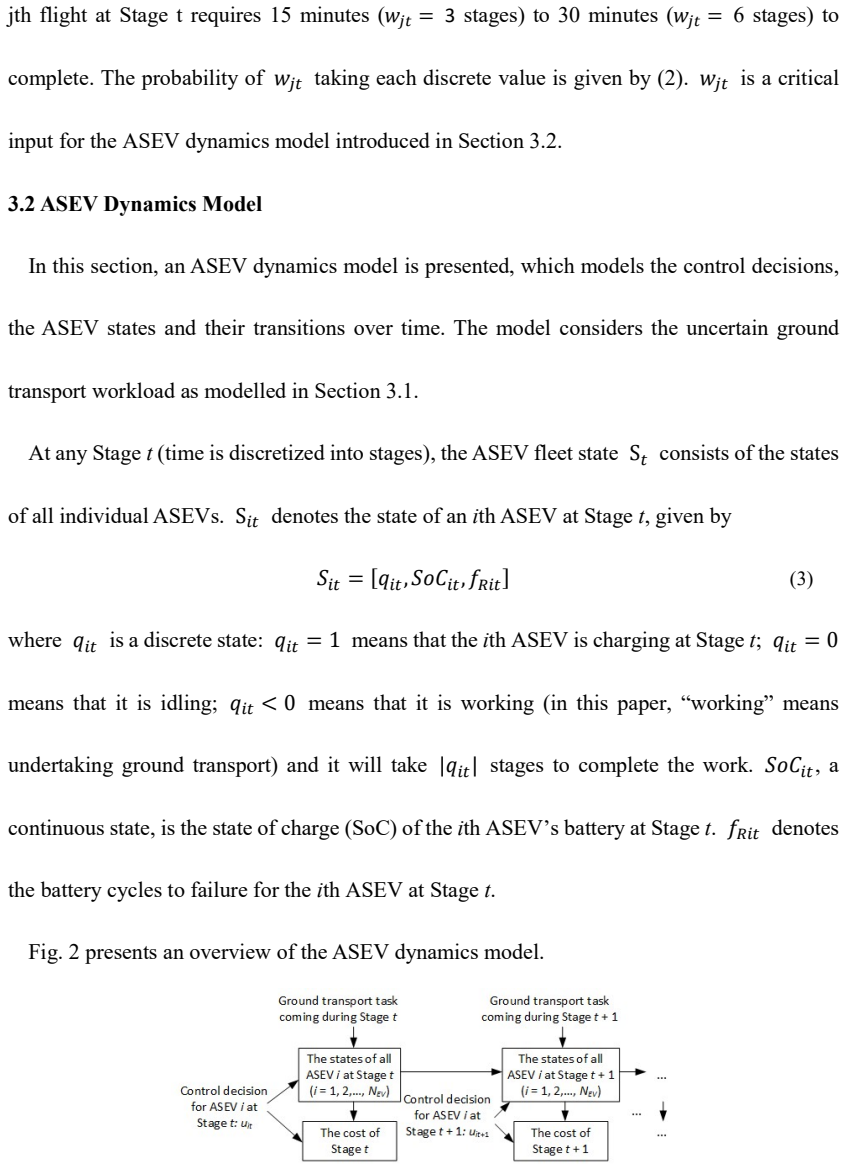
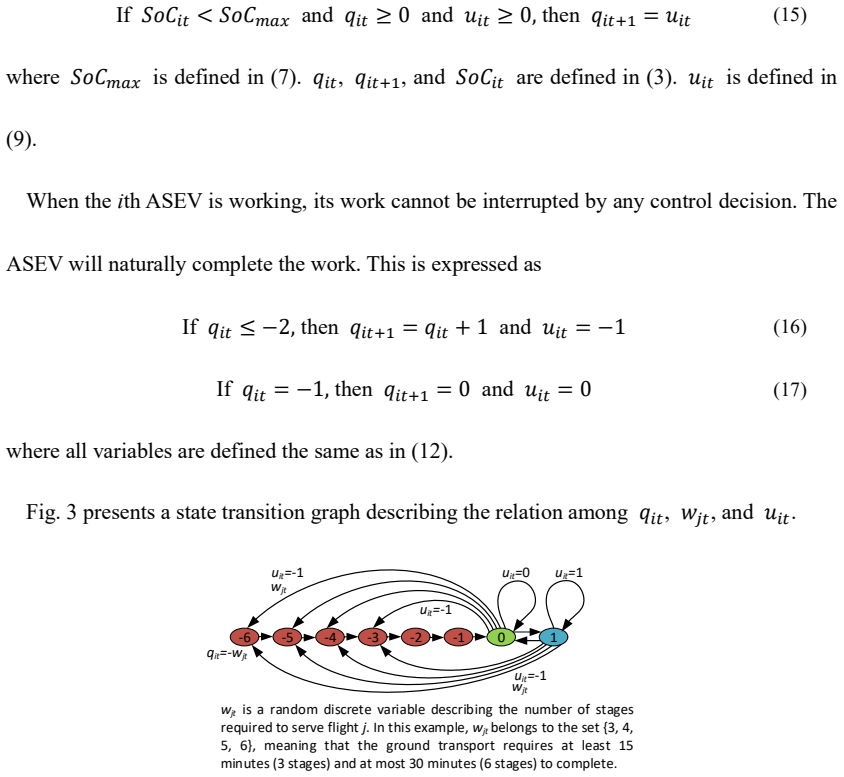
The load-bearing object is the customized rollout algorithm combined with the ASEV dynamics model. The model represents each vehicle by a discrete state $q$ (negative means working with $q$ stages remaining, 0 idling, 1 charging), a continuous state of charge, and a cycle-to-failure count; service times are discrete random variables from a truncated normal distribution. At each stage the rollout algorithm enumerates the set $N(S_t)$ of feasible next fleet states and uses an approximate cost-to-go $\tilde{J}$, computed by simulating the better of two heuristics to the end of the day, to select the next state that minimizes $\tilde{J}$. The work this does is to replace the exact dynamic-programming cost-to-go with a heuristic approximation, making a one-step lookahead decision that captures future charging opportunities while remaining online.
What would settle it
Run the rollout on a small fleet (say four vehicles) where exact dynamic programming is feasible and count the feasible next states at a busy midday stage for 25 vehicles; if the rollout cost exceeds the exact optimum by a wide margin, or if the enumeration cannot finish within a 5-minute stage, the near-optimality or tractability claim fails.
Extended reading notes
Core claim
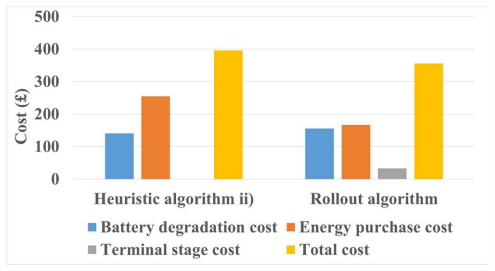
On its own terms, the paper claims that the ASEV energy-management problem can be solved near-optimally by a custom rollout algorithm. Starting from a current fleet state, the algorithm enumerates the feasible next states reachable by choosing charge, idle, or work for each vehicle, estimates the remaining cost-to-go from each candidate by running the better of two heuristics (one that charges only when renewable energy is available, one that charges as soon as possible), and moves to the candidate with the lowest estimated total cost. Repeating this at each 5-minute stage yields an online control strategy that schedules both luggage transport and battery charging. In the Bristol Airport case studies the strategy reduces total daily cost by about 10% compared with greedy charging, achieves this by buying much less grid energy during peak tariff periods, and adapts to flight cancellations on short notice.
Load-bearing premise
The algorithm's tractability depends on being able to enumerate the full set of feasible next fleet states at each 5-minute stage; the paper does not prune or decompose the action space, and with 25 vehicles and three actions per vehicle this candidate set can become astronomically large.
Editorial extensions
If this is right
- An airport operating under similar two-tier tariffs and PV profiles can expect roughly a 10% daily cost reduction from rollout control instead of greedy charging.
- The charging load shifts toward cheap solar and off-peak grid windows, making the fleet's load curve friendlier to local renewable consumption and to the grid.
- The receding-horizon rollout re-plans after flight cancellations, so schedules need not be frozen a day ahead.
- Battery degradation cost rises because the controller allows deeper discharges, even though total cost falls; the net benefit depends on the relative weight of battery replacement cost.
Reading between the lines
- The same rollout template — discrete task assignment, SoC dynamics, and two base heuristics — should transfer to other centrally dispatched electric fleets such as port equipment, warehouse robots, and shuttle buses whose tasks are stochastic and whose charging is price-responsive.
- The paper does not bound the optimality gap; comparing rollout against an exact solution for a small fleet would show how much of the 10% saving comes from the rollout itself rather than from the underlying heuristics.
- A safety-SoC constraint that prevents the renewable-matching heuristic from becoming infeasible might preserve most of the PV benefit while avoiding the failure seen in the summer scenario.
- Because the saving comes partly from deferring charge to off-peak hours, the method's value depends on tariff spread and PV availability; a sensitivity study across tariff ratios would show where rollout ceases to beat greedy charging.
Signed reviews
Editorial analysis
A structured set of objections, weighed in public.
Referee Report
Summary. The paper proposes a dynamics model for airport service electric vehicles (ASEVs) and a rollout-based near-optimal control strategy that jointly decides battery charging and luggage-transport task assignment. The model represents each ASEV by a discrete state (working, charging, idling), a continuous SoC, and a battery-cycle-failure count, with stochastic service-time workload modeled by a discretized truncated normal distribution. The control problem is formulated as a finite-horizon cost minimization over energy purchase, battery degradation, and a terminal SoC penalty. A customized rollout algorithm is built on two base heuristics (renewable-matching and greedy charging), enumerating all feasible next states at each stage and selecting the state with the minimum approximate cost-to-go. Case studies at Bristol Airport with 25 ASEVs on typical summer and winter days report a total daily cost reduction of approximately 10% relative to the greedy-charging heuristic, and a scenario with flight cancellation is used to show adaptability to schedule changes.
Significance. If the central claims hold, the paper would make a useful contribution by addressing a genuinely new application area — centrally controlled airport ground fleets — and by adapting rollout, a classic approximate dynamic programming technique, to a hybrid stochastic system. The ASEV dynamics model with discrete working/charging/idle modes, continuous SoC, and stochastic workload is a reasonable and clearly described formulation. The cost model, including renewable-matching incentives and battery degradation, is plausible and aligned with current interest in grid-friendly EV charging. However, the paper's main quantitative claims — that rollout "effectively overcomes the curse of dimensionality" and yields a "near-optimal" strategy — are not substantiated by the evidence actually presented. The algorithm's tractability for a 25-vehicle fleet is not demonstrated, the treatment of stochasticity is underspecified, and the absence of an optimality benchmark means the reported cost savings over the base heuristic are expected consequences of rollout's construction rather than evidence of near-optimality.
major comments (5)
- [Section 4, Step 2 (Eqs. (19)-(20))] The enumeration of the set N(S_t) of all feasible next states is not shown to be tractable for the 25-ASEV fleet used in the case study. With three control decisions per vehicle, the unfiltered product set has 3^25 ≈ 8.5×10^11 elements; constraints (9)-(12) and (16)-(17) only exclude vehicles that are already committed to work or at SoC bounds, leaving a potentially enormous set of free vehicles. The paper provides no bound, pruning rule, decomposition, or complexity analysis for N(S_t). Without a tractable enumeration, the central claim that the rollout "effectively overcomes the curse of dimensionality" is unsupported, and the algorithm as described may not be executable for the reported case studies.
- [Section 4, Steps 1-2 and Section 3.1] The stochastic workload is not integrated into the rollout algorithm in a well-defined way. Transition (11) uses the random variable w_jt, but the rollout description does not state whether J(S) is evaluated using expected values, Monte Carlo samples, scenario trees, or a single realization. The approximate cost-to-go of a candidate next state depends on the future workload distribution, and without an explicit stochastic rollout formulation the numerical results in Section 5 are not reproducible and the algorithm's behavior under uncertainty is not rigorously specified.
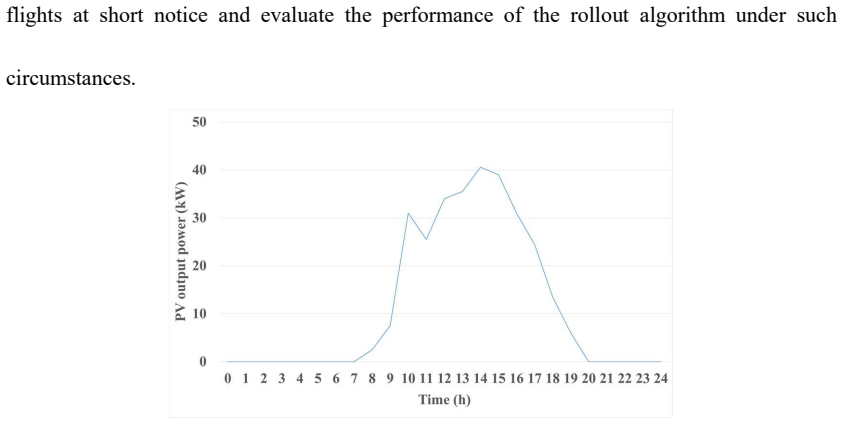
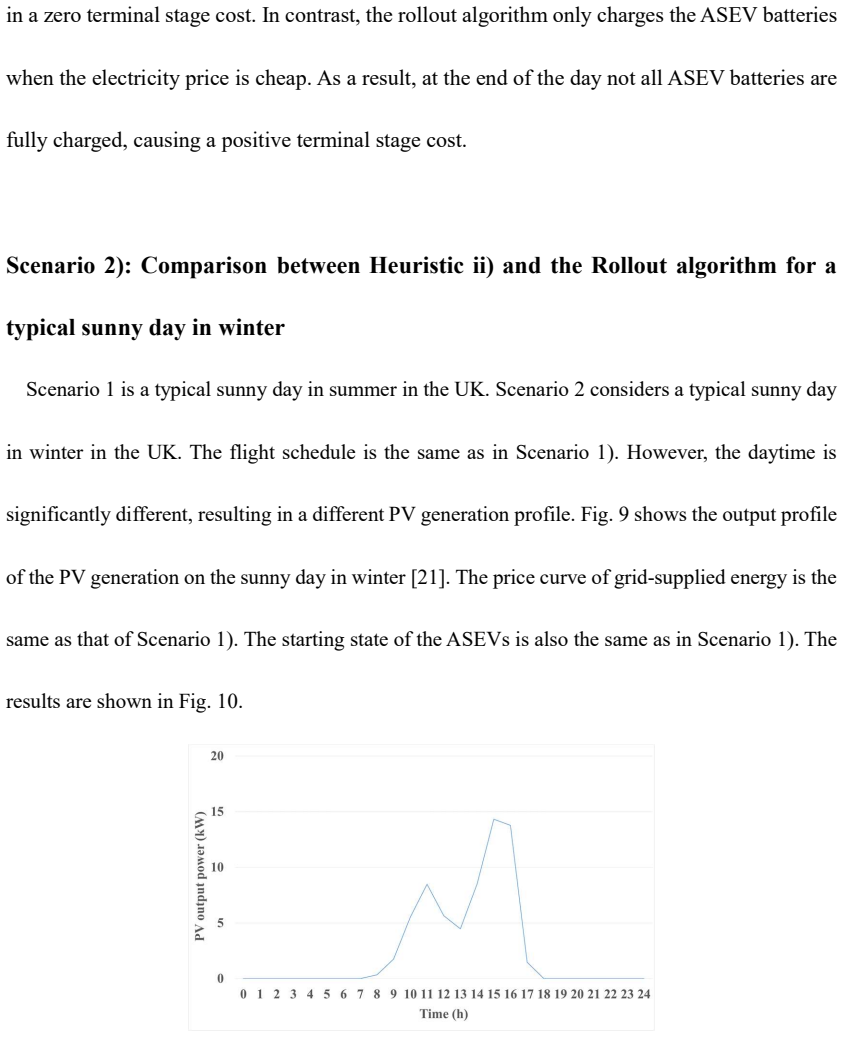
- [Section 5, Scenarios 1-3] The simulation study is missing several key input parameters and is not reproducible from the manuscript: the truncated-normal workload parameters (μ, σ, a, b) are never specified; the two-tier grid tariff shown qualitatively in Fig. 6 is not given numerically; the battery-degradation cost coefficient is only cited to [23] without a value or formula; and the PV generation profiles are referenced to external websites but not provided in a usable form. In addition, each scenario is a single run of a stochastic process, so the reported 10% cost reduction lacks error bars or a statistical comparison across multiple workload realizations.
- [Section 4, Figs. 4 and 5] The pseudo-code for the two base heuristic strategies is referenced as Fig. 4 and Fig. 5, but the figures are not present in the manuscript text provided for review. Since the rollout algorithm's construction depends on the exact behavior of these heuristics, the algorithm cannot be implemented or verified from the description alone. The heuristics must be specified in the text, either as pseudo-code or as a precise step-by-step procedure.
- [Section 5 and Section 6] The claim that the rollout algorithm yields a "near-optimal" control strategy is not supported by any comparison with an optimal solution or a lower bound. The approximately 10% cost improvement over the greedy-charging heuristic is a built-in property of rollout: rollout with a base heuristic is designed to improve upon that heuristic, so observing an improvement does not demonstrate closeness to optimality. To justify the near-optimal label, the authors should compare against an exact dynamic-programming solution on a small fleet size, or provide a formal bound on the rollout cost-to-go approximation.
minor comments (4)
- [Eq. (1)] The notation in the truncated normal density is inconsistent: the text states that a and b are the upper and lower bounds, respectively, but the conditions in (1) use "b < w < a" and the later integration range [b,a] implies that b is the lower bound and a the upper bound. Please correct the definitions and the conditions in (1).
- [Section 4, Eq. (20)] The sentence "S_t, N(S_t), and J(S) are defined in (19)" is slightly inaccurate; J(S) is defined in the text accompanying (19), not in the equation itself. Please rephrase to avoid ambiguity.
- [Section 5, Scenario 3] The statement that the rollout algorithm is "proven to be adaptive" is too strong based on a single flight-cancellation scenario; "demonstrated" or "illustrated" would be more appropriate.
- [Section 5, Tables I-III] The tables show control decisions for one example ASEV, but the formatting is difficult to read. Please present the tables with clear column headers (e.g., Start time, End time, Activity) and consider aligning rows for charging and working periods.
Circularity Check
No circularity: the ASEV cost model, rollout construction, and case-study comparison form a self-contained chain; the 10% saving is a simulated comparison, not a construction-level identity.
full rationale
The derivation chain is: (i) Eqs. (4)-(8) define an explicit cost model from energy prices, renewable availability, battery degradation, and terminal SoC; (ii) Eqs. (3), (9)-(18) define independent ASEV state dynamics; (iii) Section 4 constructs a rollout controller whose approximate cost-to-go is obtained by simulating one of two heuristics; and (iv) Section 5 evaluates the resulting policy under this cost model. The central quantitative claim—a roughly 10% cost reduction over the greedy-charging heuristic—is not a prediction derived from an input; it is the output of simulations on Bristol Airport data using the independently specified cost equations. Rollout is, by design, a one-step improvement scheme over a base heuristic, which makes an improvement over the base plausible, but the paper does not define the improvement into the answer: the costs are computed from the cost model and from the state trajectories, not inferred from the algorithm definition alone. No parameter is fitted to the reported outputs. Citations to Bertsekas [20] and the battery-degradation source [23] are external and not author-overlapping, so no self-citation chain supports the result. The nearest concerns are validation and complexity issues rather than circularity: the label 'near-optimal' is not checked against an exact optimum, and Section 4 Step 2's enumeration of N(S_t) is not accompanied by a complexity bound or pruning analysis for 25 ASEVs. These are legitimate correctness or reproducibility caveats, but they do not make any equation equivalent to its own input. Hence no circular step can be identified under the required standard.
Assumptions & free parameters
free parameters (5)
- Workload distribution parameters (mu, sigma, a, b)
- Grid tariff schedule =
two-tier prices shown in Fig. 6, numeric values absent
- PV generation time series =
external websites [25] and [26]
- Battery degradation cost coefficient =
from [23]
- Flight schedule =
Bristol Airport typical day in 2018 [24]
assumptions (8)
- domain assumption The time to serve a flight follows a truncated normal distribution, and the discretized probability is computed from the parent CDF.
- domain assumption Charging power is constant at 22 kW and battery efficiency is 90%.
- domain assumption Each flight is served by exactly one ASEV, and once working, an ASEV cannot be reassigned until the job completes.
- domain assumption At each stage, renewable energy is consumed first, and grid energy tops up the remainder at a time-of-use tariff.
- domain assumption Battery degradation cost is a linear function of discharge energy, SoC, and cycles to failure.
- domain assumption Any SoC shortfall at the end of the day is penalized linearly at the final grid price.
- domain assumption PV output, grid tariffs, and the flight schedule are known exactly when the day's control is computed.
- domain assumption Service times for different flights are independent draws.
Cite this review
Pith. "Pith review of Energy Management of Airport Service Electric Vehicles to Match Renewable Generation through Rollout Approach." pith.science (2026). https://pith.science/paper/Q5EN3PMJ
@misc{pith2026190807902,
  author       = {Pith},
  title        = {Pith review of: Energy Management of Airport Service Electric Vehicles to Match Renewable Generation through Rollout Approach},
  year         = {2026},
  howpublished = {\url{https://pith.science/paper/Q5EN3PMJ}},
  note         = {Machine review of arXiv:1908.07902}
}
read the original abstract
Traditional diesel-based airport service vehicles are characterized by a heavy-duty, high-usage-frequency nature and a high carbon intensity per vehicle per hour. Transforming these vehicles into electric vehicles would reduce CO2 emissions and potentially save energy costs in the context of rising fuel prices, if a proper energy management of airport service electric vehicles (ASEVs) is performed. To perform such an energy management, this paper proposes a new customized rollout approach, as a near-optimal control method for a new ASEV dynamics model, which models the ASEV states, their transitions over time, and how control decisions affect them. The rollout approach yields a near-optimal control strategy for the ASEVs to transport luggage and to charge batteries, with the objective to minimize the operation cost, which incentivizes the charging of the ASEVs to match renewable generation. Case studies demonstrate that the rollout approach effectively overcomes the "curse of dimensionality". On both typical summer and winter days, the rollout algorithm results in a total cost approximately 10% less than that of the underlying "greedy charging" heuristic, which charges a battery whenever its state of charge is not the maximum. The rollout algorithm is proven to be adaptive towards flight schedule changes at short notice.
Figures

Figures from the paper (8 more)




Reference graph
Works this paper leans on
-
[23]
C. Bordin, H. O. Anuta, A. Crossland, I. L. Gutierrez, C. J. Dent, and D. Vigo, "A linear programming approach for battery degradation analysis and optimization in offgrid power systems with solar energy integration," Renewable Energy, vol. 101, pp. 417-430, 2017/02/01/ 2017
work page 2017
-
[1]
"Electric Vehicles," House of Parliament, 2010, Available: http://researchbriefings.files.parliament.uk/documents/POST-PN-365/POST-PN-365.pdf
work page 2010
-
[2]
Two-Stage Energy Management for Office Buildings With Workplace EV Charging and Renewable Energy,
D. Wu, H. Zeng, C. Lu, and B. Boulet, "Two-Stage Energy Management for Office Buildings With Workplace EV Charging and Renewable Energy," IEEE Transactions on Transportation Electrification, vol. 3, no. 1, pp. 225-237, 2017
work page 2017
-
[3]
Z. Liu, Q. Wu, M. Shahidehpour, C. Li, S. Huang, and W. Wei, "Transactive Real-time Electric Vehicle Charging Management for Commercial Buildings with PV On-site Generation," IEEE Transactions on Smart Grid, pp. 1-1, 2018. 26
work page 2018
-
[4]
C. Lin, D. Deng, C. Kuo, and Y. Liang, "Optimal Charging Control of Energy Storage and Electric Vehicle of an Individual in the Internet of Energy With Energy Trading," IEEE Transactions on Industrial Informatics, vol. 14, no. 6, pp. 2570-2578, 2018
work page 2018
-
[5]
A. Ito, A. Kawashima, T. Suzuki, S. Inagaki, T. Yamaguchi, and Z. Zhou, "Model Predictive Charging Control of In- Vehicle Batteries for Home Energy Management Based on Vehicle State Prediction," IEEE Transactions on Control Systems Technology, vol. 26, no. 1, pp. 51-64, 2018
work page 2018
-
[6]
Stochastic Optimal Energy Management of Smart Home With PEV Energy Storage,
X. Wu, X. Hu, X. Yin, and S. J. Moura, "Stochastic Optimal Energy Management of Smart Home With PEV Energy Storage," IEEE Transactions on Smart Grid, vol. 9, no. 3, pp. 2065-2075, 2018
work page 2018
-
[7]
A Probabilistic Energy Management Scheme for Renewable-Based Residential Energy Hubs,
M. Rastegar, M. Fotuhi-Firuzabad, H. Zareipour, and M. Moeini-Aghtaieh, "A Probabilistic Energy Management Scheme for Renewable-Based Residential Energy Hubs," IEEE Transactions on Smart Grid, vol. 8, no. 5, pp. 2217- 2227, 2017
work page 2017
Show all 29 references
-
[8]
Cooperative Distributed Demand Management for Community Charging of PHEV/PEVs Based on KKT Conditions and Consensus Networks,
N. Rahbari-Asr and M. Chow, "Cooperative Distributed Demand Management for Community Charging of PHEV/PEVs Based on KKT Conditions and Consensus Networks," IEEE Transactions on Industrial Informatics, vol. 10, no. 3, pp. 1907-1916, 2014
1907
-
[9]
Optimal Behavior of Electric Vehicle Parking Lots as Demand Response Aggregation Agents,
M. Shafie-khah et al., "Optimal Behavior of Electric Vehicle Parking Lots as Demand Response Aggregation Agents," IEEE Transactions on Smart Grid, vol. 7, no. 6, pp. 2654-2665, 2016
2016
-
[10]
Optimal Management for Parking-Lot Electric Vehicle Charging by Two-Stage Approximate Dynamic Programming,
L. Zhang and Y. Li, "Optimal Management for Parking-Lot Electric Vehicle Charging by Two-Stage Approximate Dynamic Programming," IEEE Transactions on Smart Grid, vol. 8, no. 4, pp. 1722-1730, 2017
2017
-
[11]
A Transactive Operating Model for Smart Airport Parking Lots,
M. Maigha and M. L. Crow, "A Transactive Operating Model for Smart Airport Parking Lots," IEEE Power and Energy Technology Systems Journal, vol. 5, no. 4, pp. 157-166, 2018
2018
-
[12]
Technology solutions to mitigate electricity cost for electric vehicle DC fast charging,
M. Muratori et al., "Technology solutions to mitigate electricity cost for electric vehicle DC fast charging," Applied Energy, vol. 242, pp. 415-423, 2019/05/15/ 2019. 27
2019
-
[13]
Two-stage stochastic optimization for cost-minimal charging of electric vehicles at public charging stations with photovoltaics,
K. Seddig, P. Jochem, and W. Fichtner, "Two-stage stochastic optimization for cost-minimal charging of electric vehicles at public charging stations with photovoltaics," Applied Energy, vol. 242, pp. 769-781, 2019/05/15/ 2019
2019
-
[14]
Balanced charging strategies for electric vehicles on power systems,
S.-K. Moon and J.-O. Kim, "Balanced charging strategies for electric vehicles on power systems," Applied Energy, vol. 189, pp. 44-54, 2017/03/01/ 2017
2017
-
[15]
An integrated optimisation approach to airport ground operations to foster sustainability in the aviation sector,
M. Weiszer, J. Chen, and G. Locatelli, "An integrated optimisation approach to airport ground operations to foster sustainability in the aviation sector," Applied Energy, vol. 157, pp. 567-582, 2015/11/01/ 2015
2015
-
[16]
Review of stochastic hybrid systems with applications in biological systems modeling and analysis,
X. Li, O. Omotere, L. Qian, and E. R. Dougherty, "Review of stochastic hybrid systems with applications in biological systems modeling and analysis," EURASIP journal on bioinformatics & systems biology, vol. 2017, no. 1, pp. 8-8, 2017
2017
-
[17]
Bradshaw Electric Vehicles
(2016). Bradshaw Electric Vehicles. Available: https://www.airport-suppliers.com/supplier/bradshaw-electric- vehicles/
2016
-
[18]
Smith Electric Vehicles
(2016). Smith Electric Vehicles. Available: https://www.airport-technology.com/contractors/groundequipment/smith- electric/
2016
-
[19]
Alke Electric Vehicles
(2017). Alke Electric Vehicles. Available: https://www.alke.com/doc/alke-atx-electric-vehicles-catalog-eng.pdf
2017
-
[20]
D. P. Bertsekas, Dynamic Programming and Optimal Control, 4th ed. Athena Scientific, 2017
2017
-
[21]
R. S. Sutton and A. G. Barto, Reinforcement learning: an introduction, 2nd ed. The MIT Press, 2017
2017
-
[22]
The Truncated Normal Distribution,
J. Burkardt, "The Truncated Normal Distribution," Florida State University, 2014, Available: https://people.sc.fsu.edu/~jburkardt/presentations/truncated_normal.pdf
2014
-
[24]
Bristol Airport Arrivals and Departures
(2018, 16 Nov 2018). Bristol Airport Arrivals and Departures. Available: https://www.bristolairport.co.uk/arrivals- and-departures/arrivals 28
2018
-
[25]
Weather & Local Environment
(2019). Weather & Local Environment. Available: http://www.uq.edu.au/solarenergy/pv-array/weather
2019
-
[26]
Live monitoring of the UK electricity National Grid
(2019). Live monitoring of the UK electricity National Grid. Available: http://gridwatch.co.uk/
2019
-
[27]
Understanding electric car charging
(2018). Understanding electric car charging. Available: https://www.spiritenergy.co.uk/kb-ev-understanding-electric- car-charging
2018
-
[28]
On Generation Schedule Tracking of Wind Farms With Battery Energy Storage Systems,
X. Zhang, Y. Yuan, L. Hua, Y. Cao, and K. Qian, "On Generation Schedule Tracking of Wind Farms With Battery Energy Storage Systems," IEEE Transactions on Sustainable Energy, vol. 8, no. 1, pp. 341-353, 2017
2017
-
[29]
Electric car boom in Europe starts this year
(2019). Electric car boom in Europe starts this year. Available: https://pushevs.com/2019/01/28/electric-car-boom-in- europe-starts-this-year/
2019
Reviewed August 14, 2026 · model on record in the stance chip above.
Discussion (0). Continue with ORCID to comment.